RETAIL PRICING
PRESENTED BY :- SUMIT BEHURA
REGD . NO:-150402100038
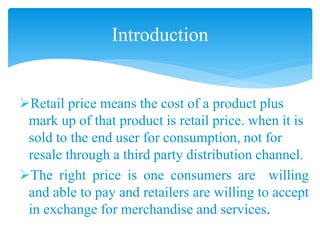
Retail price means the cost of a product plus
mark up of that product is retail price. when it is
sold to the end user for consumption, not for
resale through a third party distribution channel.
The right price is one consumers are willing
and able to pay and retailers are willing to accept
in exchange for merchandise and services.
Introduction
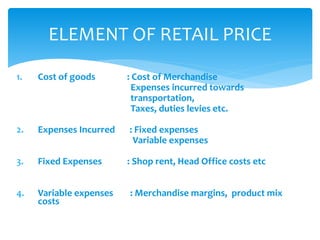
1. Cost of goods : Cost of Merchandise
Expenses incurred towards
transportation,
Taxes, duties levies etc.
2. Expenses Incurred : Fixed expenses
Variable expenses
3. Fixed Expenses : Shop rent, Head Office costs etc
4. Variable expenses : Merchandise margins, product mix
costs
ELEMENT OF RETAIL PRICE
Mark Up percentage can be expressed as :
Mark Up percent (based on Retail Price) = Mark Up in
Rupees / Retail Price
Mark Up percent (based on Cost) = Mark Up in Rupees /
Cost
THE FOLLOWING FORMULA WOULD
APPLY
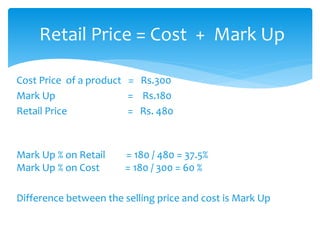
Cost Price of a product = Rs.300
Mark Up = Rs.180
Retail Price = Rs. 480
Mark Up % on Retail = 180 / 480 = 37.5%
Mark Up % on Cost = 180 / 300 = 60 %
Difference between the selling price and cost is Mark Up
Retail Price = Cost + Mark Up
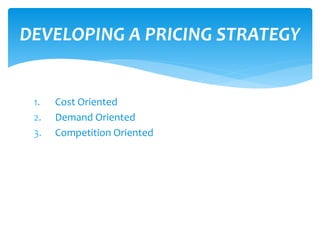
1. Cost Oriented
2. Demand Oriented
3. Competition Oriented
DEVELOPING A PRICING STRATEGY
 Focuses on quantities the customers would buy at
various prices
 It depends on perceived value attached to the
product by customers
 Sometimes a high priced product is perceived to be of
high quality
 Sometimes a low priced product is perceived to be of
high quality
Demand Oriented
 Competitors play a key role in determining price
 Retailer fixes price on par with the competitors
 Retailer fixes price above the competitor’s price
 Retailer fixes price below the competitor’s price
Competition Oriented
 Skimming price
 Market Penetration
 Leader Pricing
 Price Bundling
 Multi-Unit Pricing
 Discount Pricing
 Everyday Low Pricing
 Odd Pricing
APPROACHES TO PRICING STRATEGY
 It is a pricing strategy where in firms Strategy to charge
a high price initially and attract customers
 Gradually reduce it if necessary
Market Penetration
 It is a pricing strategy in which the retailer seeks to
achieve large revenues by setting low prices and selling
high unit volume
 Opposite of Market Skimming
 Low prices stimulate purchases
 Low prices discourages competitors from entering the
market
Skimming price
 Retailer sells few items at deep discounts
 This increases traffic and sales
 Heavily advertised to attract customers into the store.
 Items best suited for this type of pricing are those that are
bought frequently
Price Bundling
 Retailer bundles a few products and offers them at
a particular price
 Price bundling helps increase sale of related items
Leader Pricing
 Retailer offers discounts to customers who buy in large
quantities or who buy a product in bundle
 This involves value pricing for more than one of the same
item
 Example: Offer price of one T-shirt for Rs.250 and two T-
shirts for Rs.350
Everyday Low Pricing
 It is known as EDLP
 Strategy adopted by retailers who continually price their
products lower than the other retailers in the area
 Example: Food Bazaar, shopping mall
Multi-Unit Pricing
 Strategy is to set retail prices in such a manner that the
price ends in odd numbers
 Example: Rs.99.99, Rs.199.99 or Rs.299.99
Odd Pricing
Retail pricing strategy  by sumit

Retail pricing strategy by sumit

  • 1.
    RETAIL PRICING PRESENTED BY:- SUMIT BEHURA REGD . NO:-150402100038
  • 2.
    Retail price meansthe cost of a product plus mark up of that product is retail price. when it is sold to the end user for consumption, not for resale through a third party distribution channel. The right price is one consumers are willing and able to pay and retailers are willing to accept in exchange for merchandise and services. Introduction
  • 3.
    1. Cost ofgoods : Cost of Merchandise Expenses incurred towards transportation, Taxes, duties levies etc. 2. Expenses Incurred : Fixed expenses Variable expenses 3. Fixed Expenses : Shop rent, Head Office costs etc 4. Variable expenses : Merchandise margins, product mix costs ELEMENT OF RETAIL PRICE
  • 4.
    Mark Up percentagecan be expressed as : Mark Up percent (based on Retail Price) = Mark Up in Rupees / Retail Price Mark Up percent (based on Cost) = Mark Up in Rupees / Cost THE FOLLOWING FORMULA WOULD APPLY
  • 5.
    Cost Price ofa product = Rs.300 Mark Up = Rs.180 Retail Price = Rs. 480 Mark Up % on Retail = 180 / 480 = 37.5% Mark Up % on Cost = 180 / 300 = 60 % Difference between the selling price and cost is Mark Up Retail Price = Cost + Mark Up
  • 6.
    1. Cost Oriented 2.Demand Oriented 3. Competition Oriented DEVELOPING A PRICING STRATEGY
  • 7.
     Focuses onquantities the customers would buy at various prices  It depends on perceived value attached to the product by customers  Sometimes a high priced product is perceived to be of high quality  Sometimes a low priced product is perceived to be of high quality Demand Oriented
  • 8.
     Competitors playa key role in determining price  Retailer fixes price on par with the competitors  Retailer fixes price above the competitor’s price  Retailer fixes price below the competitor’s price Competition Oriented
  • 9.
     Skimming price Market Penetration  Leader Pricing  Price Bundling  Multi-Unit Pricing  Discount Pricing  Everyday Low Pricing  Odd Pricing APPROACHES TO PRICING STRATEGY
  • 10.
     It isa pricing strategy where in firms Strategy to charge a high price initially and attract customers  Gradually reduce it if necessary Market Penetration  It is a pricing strategy in which the retailer seeks to achieve large revenues by setting low prices and selling high unit volume  Opposite of Market Skimming  Low prices stimulate purchases  Low prices discourages competitors from entering the market Skimming price
  • 11.
     Retailer sellsfew items at deep discounts  This increases traffic and sales  Heavily advertised to attract customers into the store.  Items best suited for this type of pricing are those that are bought frequently Price Bundling  Retailer bundles a few products and offers them at a particular price  Price bundling helps increase sale of related items Leader Pricing
  • 12.
     Retailer offersdiscounts to customers who buy in large quantities or who buy a product in bundle  This involves value pricing for more than one of the same item  Example: Offer price of one T-shirt for Rs.250 and two T- shirts for Rs.350 Everyday Low Pricing  It is known as EDLP  Strategy adopted by retailers who continually price their products lower than the other retailers in the area  Example: Food Bazaar, shopping mall Multi-Unit Pricing
  • 13.
     Strategy isto set retail prices in such a manner that the price ends in odd numbers  Example: Rs.99.99, Rs.199.99 or Rs.299.99 Odd Pricing