DECODER
INTEGRATED CIRCUITS 
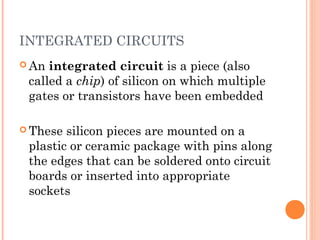
An integrated circuit is a piece (also 
called a chip) of silicon on which multiple 
gates or transistors have been embedded 
These silicon pieces are mounted on a 
plastic or ceramic package with pins along 
the edges that can be soldered onto circuit 
boards or inserted into appropriate 
sockets
INTEGRATED CIRCUITS 
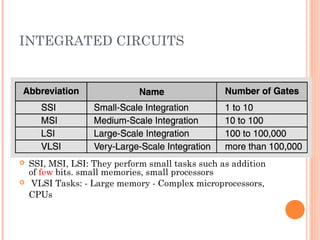
 SSI, MSI, LSI: They perform small tasks such as addition 
of few bits. small memories, small processors 
 VLSI Tasks: - Large memory - Complex microprocessors, 
CPUs
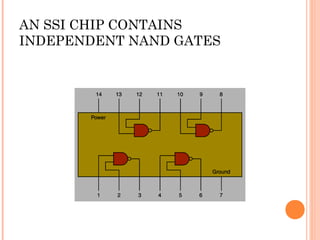
AN SSI CHIP CONTAINS 
INDEPENDENT NAND GATES
EXAMPLES OF COMBINATIONAL 
CIRCUITS 
 a) Decoders 
 b) Encoders 
 c) Multiplexers 
 d) Demultiplexers
DECODER 
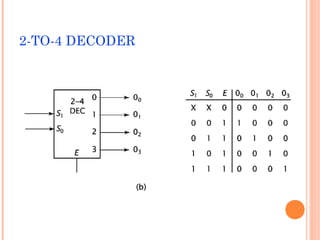
 Accepts a value and decodes it 
 Output corresponds to value of n inputs 
 Consists of: 
 Inputs (n) 
 Outputs (2n , numbered from 0 ® 2n - 1) 
 Selectors / Enable (active high or active low)
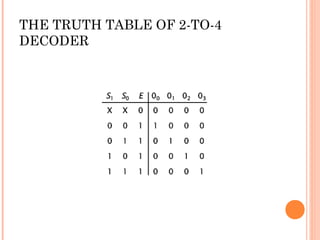
THE TRUTH TABLE OF 2-TO-4 
DECODER
2-TO-4 DECODER
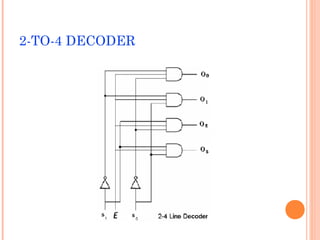
2-TO-4 DECODER
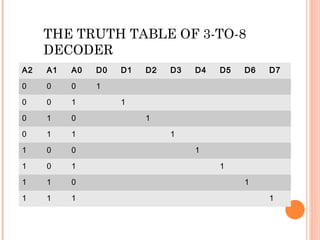
THE TRUTH TABLE OF 3-TO-8 
DECODER 
A2 A1 A0 D0 D1 D2 D3 D4 D5 D6 D7 
0 0 0 1 
0 0 1 1 
0 1 0 1 
0 1 1 1 
1 0 0 1 
1 0 1 1 
1 1 0 1 
1 1 1 1
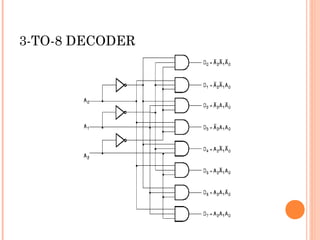
3-TO-8 DECODER
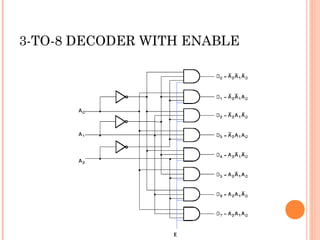
3-TO-8 DECODER WITH ENABLE
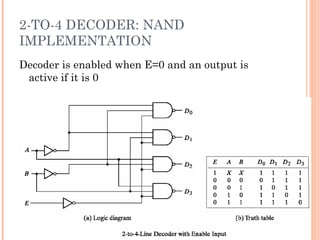
2-TO-4 DECODER: NAND 
IMPLEMENTATION 
Decoder is enabled when E=0 and an output is 
active if it is 0
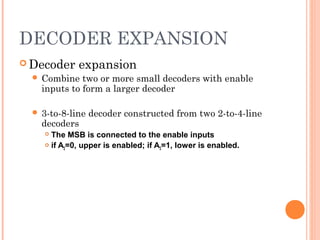
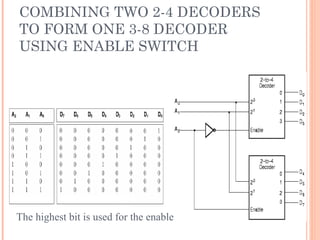
DECODER EXPANSION 
Decoder expansion 
 Combine two or more small decoders with enable 
inputs to form a larger decoder 
 3-to-8-line decoder constructed from two 2-to-4-line 
decoders 
 The MSB is connected to the enable inputs 
 if A2=0, upper is enabled; if A2=1, lower is enabled.
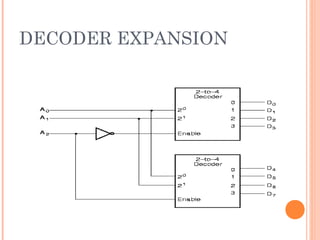
DECODER EXPANSION
COMBINING TWO 2-4 DECODERS 
TO FORM ONE 3-8 DECODER 
USING ENABLE SWITCH 
The highest bit is used for the enables
ENCODER
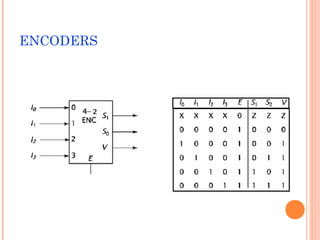
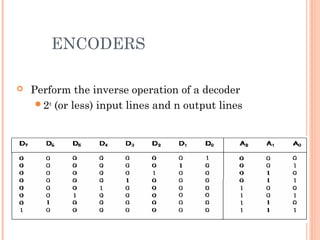
ENCODERS 
 Perform the inverse operation of a decoder 
2n (or less) input lines and n output 
lines
ENCODERS
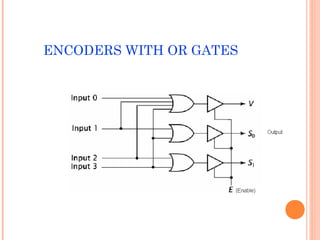
ENCODERS WITH OR GATES
ENCODERS 
 Perform the inverse operation of a decoder 
2n (or less) input lines and n output lines
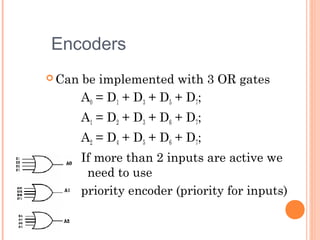
Encoders 
Can be implemented with 3 OR gates 
A0 = D1 + D3 + D5 + D7; 
A1 = D2 + D3 + D6 + D7; 
A2 = D4 + D5 + D6 + D7; 
If more than 2 inputs are active we 
need to use 
priority encoder (priority for inputs)
MULTIPLEXER (MUX) 
A multiplexer can use addressing bits to 
select one of several input bits to be the 
output. 
 A selector chooses a single data input and passes it to 
the MUX output 
 It has one output selected at a time.
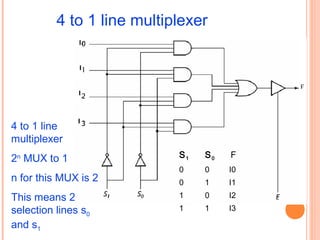
4 to 1 line multiplexer 
S1 S0 F 
0 0 I0 
0 1 I1 
1 0 I2 
1 1 I3 
4 to 1 line 
multiplexer 
2n MUX to 1 
n for this MUX is 2 
This means 2 
selection lines s0 
and s1
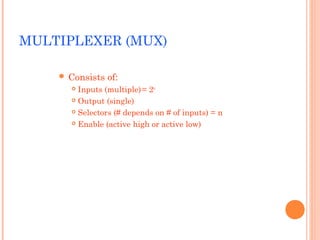
MULTIPLEXER (MUX) 
 Consists of: 
 Inputs (multiple)= 2n 
 Output (single) 
 Selectors (# depends on # of inputs) = n 
 Enable (active high or active low)
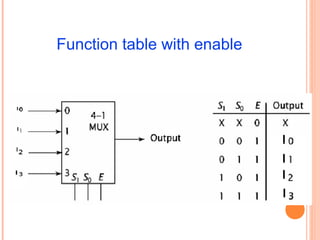
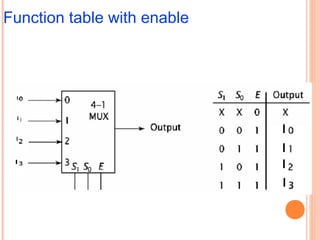
Function table with enable
MULTIPLEXERS VERSUS 
DECODERS 
• A Multiplexer uses n binary select bits to choose 
from a maximum of 2n unique input lines. 
•Multiplexers and decoders both can decode 
minterms. 
•Decoders have n number of output lines while 
multiplexers have only one output line. 
•The decoded minterms are used to select data from 
one of up to 2n unique data input lines. 
•The output of the multiplexer is the data input 
whose index is specified by the n bit code.
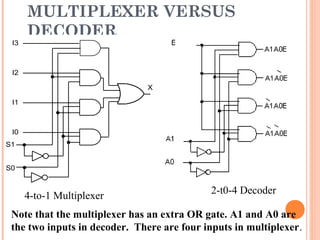
MULTIPLEXER VERSUS 
DECODER 
I3 
I2 
I1 
I0 
S1 
S0 
X 
4-to-1 Multiplexer 2-t0-4 Decoder 
Note that the multiplexer has an extra OR gate. A1 and A0 are 
the two inputs in decoder. There are four inputs in multiplexer.
Function table with enable
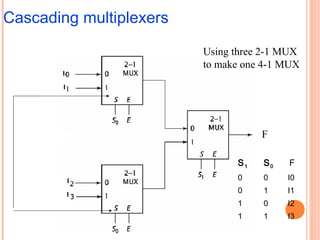
Cascading multiplexers 
Using three 2-1 MUX 
to make one 4-1 MUX 
F 
S1 S0 F 
0 0 I0 
0 1 I1 
1 0 I2 
1 1 I3
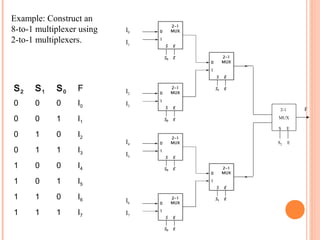
2-1 F 
MU X 
S E 
S2 E 
S2 S1 S0 F 
0 0 0 I0 
0 0 1 I1 
0 1 0 I2 
0 1 1 I3 
1 0 0 I4 
1 0 1 I5 
1 1 0 I6 
1 1 1 I7 
I0 
I1 
I2 
I3 
I4 
I5 
I6 
I7 
Example: Construct an 
8-to-1 multiplexer using 
2-to-1 multiplexers.
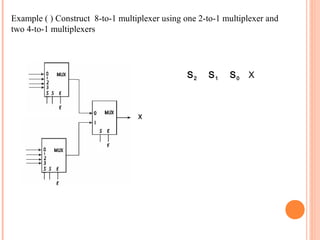
Example ( ) Construct 8-to-1 multiplexer using one 2-to-1 multiplexer and 
two 4-to-1 multiplexers 
S2 S1 S0 X
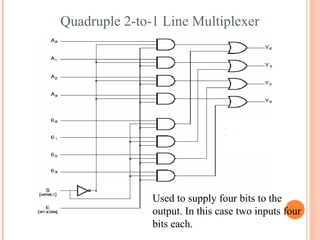
Quadruple 2-to-1 Line Multiplexer 
Used to supply four bits to the 
output. In this case two inputs four 
bits each.
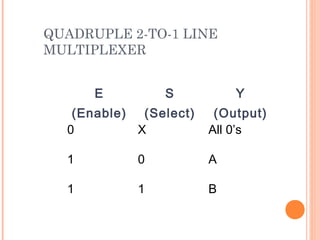
QUADRUPLE 2-TO-1 LINE 
MULTIPLEXER 
E 
(Enable) 
S 
(Select) 
Y 
(Output) 
0 X All 0’s 
1 0 A 
1 1 B

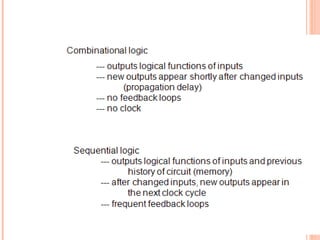
Combinational circuit

  • 2.
  • 3.
    INTEGRATED CIRCUITS Anintegrated circuit is a piece (also called a chip) of silicon on which multiple gates or transistors have been embedded These silicon pieces are mounted on a plastic or ceramic package with pins along the edges that can be soldered onto circuit boards or inserted into appropriate sockets
  • 4.
    INTEGRATED CIRCUITS SSI, MSI, LSI: They perform small tasks such as addition of few bits. small memories, small processors  VLSI Tasks: - Large memory - Complex microprocessors, CPUs
  • 5.
    AN SSI CHIPCONTAINS INDEPENDENT NAND GATES
  • 6.
    EXAMPLES OF COMBINATIONAL CIRCUITS  a) Decoders  b) Encoders  c) Multiplexers  d) Demultiplexers
  • 7.
    DECODER  Acceptsa value and decodes it  Output corresponds to value of n inputs  Consists of:  Inputs (n)  Outputs (2n , numbered from 0 ® 2n - 1)  Selectors / Enable (active high or active low)
  • 8.
    THE TRUTH TABLEOF 2-TO-4 DECODER
  • 9.
  • 10.
  • 11.
    THE TRUTH TABLEOF 3-TO-8 DECODER A2 A1 A0 D0 D1 D2 D3 D4 D5 D6 D7 0 0 0 1 0 0 1 1 0 1 0 1 0 1 1 1 1 0 0 1 1 0 1 1 1 1 0 1 1 1 1 1
  • 12.
  • 13.
  • 14.
    2-TO-4 DECODER: NAND IMPLEMENTATION Decoder is enabled when E=0 and an output is active if it is 0
  • 15.
    DECODER EXPANSION Decoderexpansion  Combine two or more small decoders with enable inputs to form a larger decoder  3-to-8-line decoder constructed from two 2-to-4-line decoders  The MSB is connected to the enable inputs  if A2=0, upper is enabled; if A2=1, lower is enabled.
  • 16.
  • 17.
    COMBINING TWO 2-4DECODERS TO FORM ONE 3-8 DECODER USING ENABLE SWITCH The highest bit is used for the enables
  • 18.
  • 19.
    ENCODERS  Performthe inverse operation of a decoder 2n (or less) input lines and n output lines
  • 20.
  • 21.
  • 22.
    ENCODERS  Performthe inverse operation of a decoder 2n (or less) input lines and n output lines
  • 23.
    Encoders Can beimplemented with 3 OR gates A0 = D1 + D3 + D5 + D7; A1 = D2 + D3 + D6 + D7; A2 = D4 + D5 + D6 + D7; If more than 2 inputs are active we need to use priority encoder (priority for inputs)
  • 24.
    MULTIPLEXER (MUX) Amultiplexer can use addressing bits to select one of several input bits to be the output.  A selector chooses a single data input and passes it to the MUX output  It has one output selected at a time.
  • 25.
    4 to 1line multiplexer S1 S0 F 0 0 I0 0 1 I1 1 0 I2 1 1 I3 4 to 1 line multiplexer 2n MUX to 1 n for this MUX is 2 This means 2 selection lines s0 and s1
  • 26.
    MULTIPLEXER (MUX) Consists of:  Inputs (multiple)= 2n  Output (single)  Selectors (# depends on # of inputs) = n  Enable (active high or active low)
  • 27.
  • 28.
    MULTIPLEXERS VERSUS DECODERS • A Multiplexer uses n binary select bits to choose from a maximum of 2n unique input lines. •Multiplexers and decoders both can decode minterms. •Decoders have n number of output lines while multiplexers have only one output line. •The decoded minterms are used to select data from one of up to 2n unique data input lines. •The output of the multiplexer is the data input whose index is specified by the n bit code.
  • 29.
    MULTIPLEXER VERSUS DECODER I3 I2 I1 I0 S1 S0 X 4-to-1 Multiplexer 2-t0-4 Decoder Note that the multiplexer has an extra OR gate. A1 and A0 are the two inputs in decoder. There are four inputs in multiplexer.
  • 30.
  • 31.
    Cascading multiplexers Usingthree 2-1 MUX to make one 4-1 MUX F S1 S0 F 0 0 I0 0 1 I1 1 0 I2 1 1 I3
  • 32.
    2-1 F MUX S E S2 E S2 S1 S0 F 0 0 0 I0 0 0 1 I1 0 1 0 I2 0 1 1 I3 1 0 0 I4 1 0 1 I5 1 1 0 I6 1 1 1 I7 I0 I1 I2 I3 I4 I5 I6 I7 Example: Construct an 8-to-1 multiplexer using 2-to-1 multiplexers.
  • 33.
    Example ( )Construct 8-to-1 multiplexer using one 2-to-1 multiplexer and two 4-to-1 multiplexers S2 S1 S0 X
  • 34.
    Quadruple 2-to-1 LineMultiplexer Used to supply four bits to the output. In this case two inputs four bits each.
  • 35.
    QUADRUPLE 2-TO-1 LINE MULTIPLEXER E (Enable) S (Select) Y (Output) 0 X All 0’s 1 0 A 1 1 B