DIGITAL LOGIC CIRCUITS
~ INTRODUCTION TO COMBINATIONAL AND
SEQUENTIAL CIRCUITS.
~DESIGN PROCEDURE OF COMBINATIONAL
CIRCUITS
~ANALYSIS PROCEDURE OF COMBINATIONAL
CIRCUITS
PRESENTED BY:
QURATULAIN
BS(CS)-1
QUAID-E-AZAM UNIVERSITY
ISLAMABAD ,PAKISTAN.
TYPES OF DIGITAL LOGIC
CIRCUITS
 COMBINATIONAL CIRCUITS
 SEQUENTIAL CIRCUITS
COMBINATIONAL CIRCUITS
 Combinational Circuits are made of logic
gates.
 Doesn’t contain memory element , that’s
why they cant store any information.
 Value of present output is determined by
present input.
 Examples of combinational circuits are
half adders, full adders, sub tractors etc.
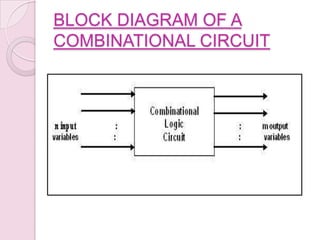
BLOCK DIAGRAM OF A
COMBINATIONAL CIRCUIT
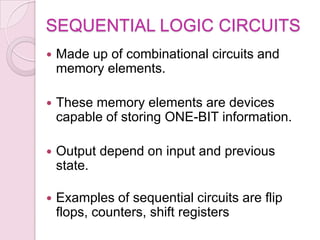
SEQUENTIAL LOGIC CIRCUITS
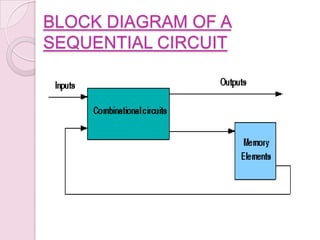
 Made up of combinational circuits and
memory elements.
 These memory elements are devices
capable of storing ONE-BIT information.
 Output depend on input and previous
state.
 Examples of sequential circuits are flip
flops, counters, shift registers
BLOCK DIAGRAM OF A
SEQUENTIAL CIRCUIT
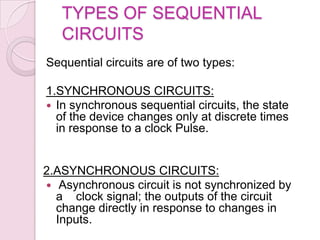
TYPES OF SEQUENTIAL
CIRCUITS
Sequential circuits are of two types:
1.SYNCHRONOUS CIRCUITS:
 In synchronous sequential circuits, the state
of the device changes only at discrete times
in response to a clock Pulse.
2.ASYNCHRONOUS CIRCUITS:
 Asynchronous circuit is not synchronized by
a clock signal; the outputs of the circuit
change directly in response to changes in
Inputs.
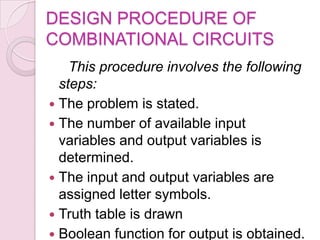
DESIGN PROCEDURE OF
COMBINATIONAL CIRCUITS
This procedure involves the following
steps:
 The problem is stated.
 The number of available input
variables and output variables is
determined.
 The input and output variables are
assigned letter symbols.
 Truth table is drawn
 Boolean function for output is obtained.
ANALYSIS PROCEDURE OF
COMBINATIONAL CIRCUIT
 TO DETERMINE THE OUTPUT FUNCTIONS
AS ALGEBRAIC EXPRESSIONS.
 It is the reverse process of design procedure.
 Logic diagram of the circuit is given.
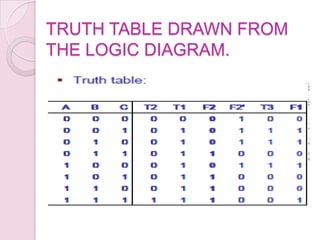
 Obtain the truth table from the diagram.
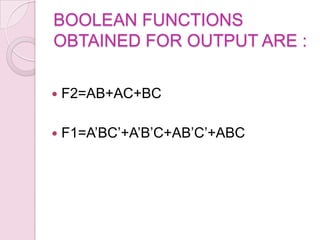
 Obtain Boolean function from the Truth Table
for output.
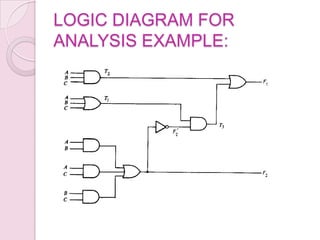
LOGIC DIAGRAM FOR
ANALYSIS EXAMPLE:
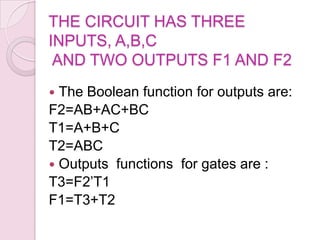
THE CIRCUIT HAS THREE
INPUTS, A,B,C
AND TWO OUTPUTS F1 AND F2
 The Boolean function for outputs are:
F2=AB+AC+BC
T1=A+B+C
T2=ABC
 Outputs functions for gates are :
T3=F2’T1
F1=T3+T2
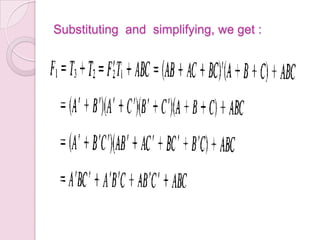
Substituting and simplifying, we get :
TRUTH TABLE DRAWN FROM
THE LOGIC DIAGRAM.
BOOLEAN FUNCTIONS
OBTAINED FOR OUTPUT ARE :
 F2=AB+AC+BC
 F1=A’BC’+A’B’C+AB’C’+ABC
SEQUENTIAL AND COMBINATIONAL CIRCUITS,DIGITAL LOGIC DESIGN

SEQUENTIAL AND COMBINATIONAL CIRCUITS,DIGITAL LOGIC DESIGN

  • 2.
    DIGITAL LOGIC CIRCUITS ~INTRODUCTION TO COMBINATIONAL AND SEQUENTIAL CIRCUITS. ~DESIGN PROCEDURE OF COMBINATIONAL CIRCUITS ~ANALYSIS PROCEDURE OF COMBINATIONAL CIRCUITS PRESENTED BY: QURATULAIN BS(CS)-1 QUAID-E-AZAM UNIVERSITY ISLAMABAD ,PAKISTAN.
  • 3.
    TYPES OF DIGITALLOGIC CIRCUITS  COMBINATIONAL CIRCUITS  SEQUENTIAL CIRCUITS
  • 4.
    COMBINATIONAL CIRCUITS  CombinationalCircuits are made of logic gates.  Doesn’t contain memory element , that’s why they cant store any information.  Value of present output is determined by present input.  Examples of combinational circuits are half adders, full adders, sub tractors etc.
  • 5.
    BLOCK DIAGRAM OFA COMBINATIONAL CIRCUIT
  • 6.
    SEQUENTIAL LOGIC CIRCUITS Made up of combinational circuits and memory elements.  These memory elements are devices capable of storing ONE-BIT information.  Output depend on input and previous state.  Examples of sequential circuits are flip flops, counters, shift registers
  • 7.
    BLOCK DIAGRAM OFA SEQUENTIAL CIRCUIT
  • 8.
    TYPES OF SEQUENTIAL CIRCUITS Sequentialcircuits are of two types: 1.SYNCHRONOUS CIRCUITS:  In synchronous sequential circuits, the state of the device changes only at discrete times in response to a clock Pulse. 2.ASYNCHRONOUS CIRCUITS:  Asynchronous circuit is not synchronized by a clock signal; the outputs of the circuit change directly in response to changes in Inputs.
  • 9.
    DESIGN PROCEDURE OF COMBINATIONALCIRCUITS This procedure involves the following steps:  The problem is stated.  The number of available input variables and output variables is determined.  The input and output variables are assigned letter symbols.  Truth table is drawn  Boolean function for output is obtained.
  • 10.
    ANALYSIS PROCEDURE OF COMBINATIONALCIRCUIT  TO DETERMINE THE OUTPUT FUNCTIONS AS ALGEBRAIC EXPRESSIONS.  It is the reverse process of design procedure.  Logic diagram of the circuit is given.  Obtain the truth table from the diagram.  Obtain Boolean function from the Truth Table for output.
  • 11.
  • 12.
    THE CIRCUIT HASTHREE INPUTS, A,B,C AND TWO OUTPUTS F1 AND F2  The Boolean function for outputs are: F2=AB+AC+BC T1=A+B+C T2=ABC  Outputs functions for gates are : T3=F2’T1 F1=T3+T2
  • 13.
  • 14.
    TRUTH TABLE DRAWNFROM THE LOGIC DIAGRAM.
  • 15.
    BOOLEAN FUNCTIONS OBTAINED FOROUTPUT ARE :  F2=AB+AC+BC  F1=A’BC’+A’B’C+AB’C’+ABC