Multiplexing
By: Muhammad Hanif
Agenda
 Multiplexing
 MUX and DEMUX
 Frequency Division Multiplexing
 Wavelength Division Multiplexing
 Time Division Multiplexing
Multiplexing
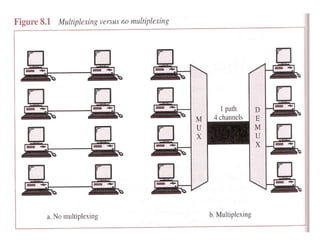
 Multiplexing is the set of techniques that allows
the simultaneous transmission of multiple
signals across a single data link.
 Using one data link for multiple signals to
transmit.
 A Multiplexer (MUX) is a device that
combines several signals into a single signal.
 A Demultiplexer (DEMUX) is a device that
performs the inverse operation.
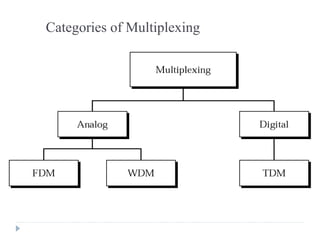
Categories of Multiplexing
Frequency-division Multiplexing
(FDM)
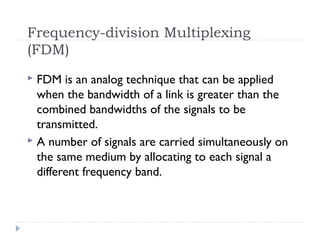
 FDM is an analog technique that can be applied
when the bandwidth of a link is greater than the
combined bandwidths of the signals to be
transmitted.
 A number of signals are carried simultaneously on
the same medium by allocating to each signal a
different frequency band.
Frequency-division Multiplexing
(FDM)
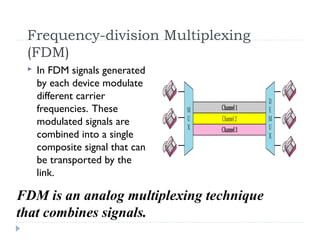
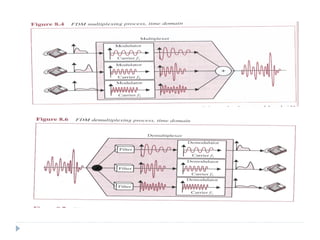
 In FDM signals generated
by each device modulate
different carrier
frequencies. These
modulated signals are
combined into a single
composite signal that can
be transported by the
link.
FDM is an analog multiplexing technique
that combines signals.
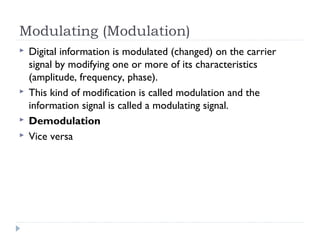
Modulating (Modulation)
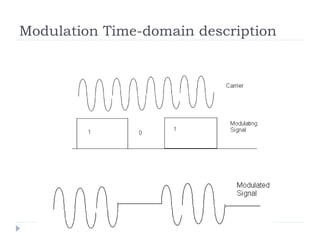
 Digital information is modulated (changed) on the carrier
signal by modifying one or more of its characteristics
(amplitude, frequency, phase).
 This kind of modification is called modulation and the
information signal is called a modulating signal.
 Demodulation
 Vice versa
Modulation Time-domain description
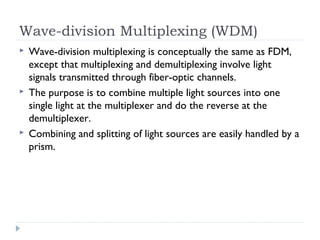
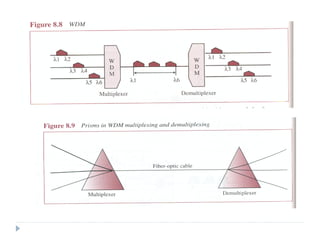
Wave-division Multiplexing (WDM)
 Wave-division multiplexing is conceptually the same as FDM,
except that multiplexing and demultiplexing involve light
signals transmitted through fiber-optic channels.
 The purpose is to combine multiple light sources into one
single light at the multiplexer and do the reverse at the
demultiplexer.
 Combining and splitting of light sources are easily handled by a
prism.
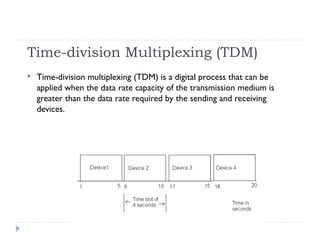
Time-division Multiplexing (TDM)
 Time-division multiplexing (TDM) is a digital process that can be
applied when the data rate capacity of the transmission medium is
greater than the data rate required by the sending and receiving
devices.
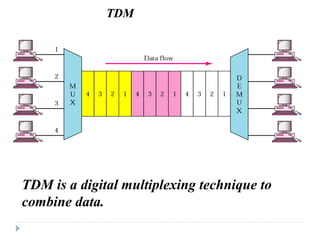
TDM
TDM is a digital multiplexing technique to
combine data.
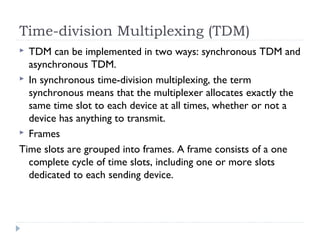
Time-division Multiplexing (TDM)
 TDM can be implemented in two ways: synchronous TDM and
asynchronous TDM.
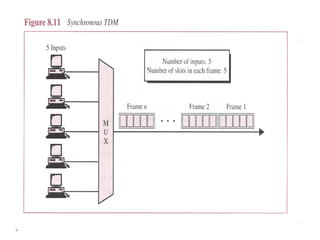
 In synchronous time-division multiplexing, the term
synchronous means that the multiplexer allocates exactly the
same time slot to each device at all times, whether or not a
device has anything to transmit.
 Frames
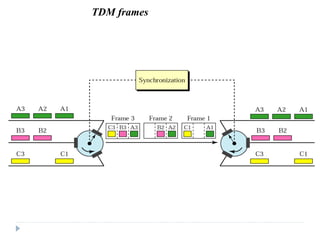
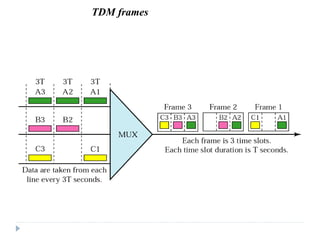
Time slots are grouped into frames. A frame consists of a one
complete cycle of time slots, including one or more slots
dedicated to each sending device.
TDM frames
TDM frames
Asynchronous TDM
 Synchronous TDM does not guarantee that the full
capacity of a link is used. Because the time slots are
preassigned and fixed, whenever a connected device is not
transmitting, the corresponding slot is empty.
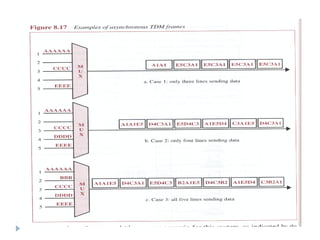
 Asynchronous time-division multiplexing, or statistical
time-division multiplexing, is designed to avoid this type of
waste.
 Like synchronous TDM, asynchronous TDM allows a
number of lower-speed input lines to be multiplexed to a
single higher-speed line.
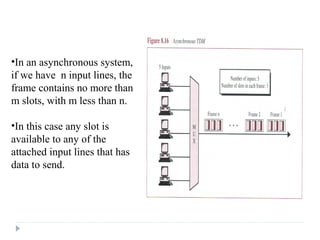
•In an asynchronous system,
if we have n input lines, the
frame contains no more than
m slots, with m less than n.
•In this case any slot is
available to any of the
attached input lines that has
data to send.
Summary
 Multiplexing
 MUX and DEMUX
 Frequency Division Multiplexing
 Wavelength Division Multiplexing
 Time Division Multiplexing

Multiplexing changes(2)

  • 1.
  • 2.
    Agenda  Multiplexing  MUXand DEMUX  Frequency Division Multiplexing  Wavelength Division Multiplexing  Time Division Multiplexing
  • 3.
    Multiplexing  Multiplexing isthe set of techniques that allows the simultaneous transmission of multiple signals across a single data link.  Using one data link for multiple signals to transmit.  A Multiplexer (MUX) is a device that combines several signals into a single signal.  A Demultiplexer (DEMUX) is a device that performs the inverse operation.
  • 5.
  • 6.
    Frequency-division Multiplexing (FDM)  FDMis an analog technique that can be applied when the bandwidth of a link is greater than the combined bandwidths of the signals to be transmitted.  A number of signals are carried simultaneously on the same medium by allocating to each signal a different frequency band.
  • 7.
    Frequency-division Multiplexing (FDM)  InFDM signals generated by each device modulate different carrier frequencies. These modulated signals are combined into a single composite signal that can be transported by the link. FDM is an analog multiplexing technique that combines signals.
  • 8.
    Modulating (Modulation)  Digitalinformation is modulated (changed) on the carrier signal by modifying one or more of its characteristics (amplitude, frequency, phase).  This kind of modification is called modulation and the information signal is called a modulating signal.  Demodulation  Vice versa
  • 9.
  • 11.
    Wave-division Multiplexing (WDM) Wave-division multiplexing is conceptually the same as FDM, except that multiplexing and demultiplexing involve light signals transmitted through fiber-optic channels.  The purpose is to combine multiple light sources into one single light at the multiplexer and do the reverse at the demultiplexer.  Combining and splitting of light sources are easily handled by a prism.
  • 13.
    Time-division Multiplexing (TDM) Time-division multiplexing (TDM) is a digital process that can be applied when the data rate capacity of the transmission medium is greater than the data rate required by the sending and receiving devices.
  • 14.
    TDM TDM is adigital multiplexing technique to combine data.
  • 15.
    Time-division Multiplexing (TDM) TDM can be implemented in two ways: synchronous TDM and asynchronous TDM.  In synchronous time-division multiplexing, the term synchronous means that the multiplexer allocates exactly the same time slot to each device at all times, whether or not a device has anything to transmit.  Frames Time slots are grouped into frames. A frame consists of a one complete cycle of time slots, including one or more slots dedicated to each sending device.
  • 17.
  • 18.
  • 19.
    Asynchronous TDM  SynchronousTDM does not guarantee that the full capacity of a link is used. Because the time slots are preassigned and fixed, whenever a connected device is not transmitting, the corresponding slot is empty.  Asynchronous time-division multiplexing, or statistical time-division multiplexing, is designed to avoid this type of waste.  Like synchronous TDM, asynchronous TDM allows a number of lower-speed input lines to be multiplexed to a single higher-speed line.
  • 20.
    •In an asynchronoussystem, if we have n input lines, the frame contains no more than m slots, with m less than n. •In this case any slot is available to any of the attached input lines that has data to send.
  • 22.
    Summary  Multiplexing  MUXand DEMUX  Frequency Division Multiplexing  Wavelength Division Multiplexing  Time Division Multiplexing