SEQUENTIAL CIRCUITS
INTRODUCTION
Today's Topic
Sequential Logic Circuits
• Introduction
Introduction to topic
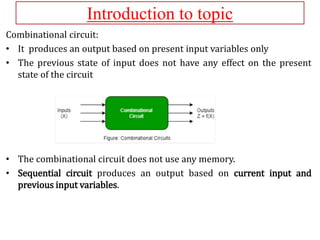
Combinational circuit:
• It produces an output based on present input variables only
• The previous state of input does not have any effect on the present
state of the circuit
• The combinational circuit does not use any memory.
• Sequential circuit produces an output based on current input and
previous input variables.
Sequential circuit
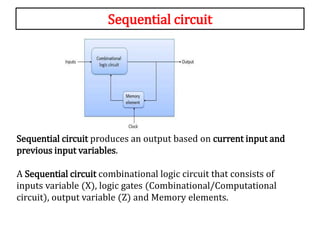
Sequential circuit produces an output based on current input and
previous input variables.
A Sequential circuit combinational logic circuit that consists of
inputs variable (X), logic gates (Combinational/Computational
circuit), output variable (Z) and Memory elements.
• The word “Sequential” means that things happen in a
“sequence”, one after another.
• The clock signal actually determines about the things will
happen next.
• Simple sequential logic circuits can be constructed from
standard Bistable circuits such as:
Flip lops, Latches and Counters
Types of Sequential Circuits
There are two types of sequential circuit :
 Asynchronous sequential circuit
 Synchronous sequential circuit
Asynchronous sequential circuit Synchronous sequential circuit
1. Do not use a clock signal 1. Uses a clock signal
2. Faster than synchronous sequential 2. They wait for the next clock pulse
circuits because there is no clock pulse to arrive, to perform the next
and change their state immediately operation, so these circuits are
when there is a change in the i/p signal bit slower compared to async.
In Next Class
• Flip Flops
• Latches
• Counters
• A

SEQUENTIAL CIRCUITS INTRODUCTION

  • 1.
  • 2.
    Today's Topic Sequential LogicCircuits • Introduction
  • 3.
    Introduction to topic Combinationalcircuit: • It produces an output based on present input variables only • The previous state of input does not have any effect on the present state of the circuit • The combinational circuit does not use any memory. • Sequential circuit produces an output based on current input and previous input variables.
  • 4.
    Sequential circuit Sequential circuitproduces an output based on current input and previous input variables. A Sequential circuit combinational logic circuit that consists of inputs variable (X), logic gates (Combinational/Computational circuit), output variable (Z) and Memory elements.
  • 5.
    • The word“Sequential” means that things happen in a “sequence”, one after another. • The clock signal actually determines about the things will happen next. • Simple sequential logic circuits can be constructed from standard Bistable circuits such as: Flip lops, Latches and Counters
  • 6.
    Types of SequentialCircuits There are two types of sequential circuit :  Asynchronous sequential circuit  Synchronous sequential circuit Asynchronous sequential circuit Synchronous sequential circuit 1. Do not use a clock signal 1. Uses a clock signal 2. Faster than synchronous sequential 2. They wait for the next clock pulse circuits because there is no clock pulse to arrive, to perform the next and change their state immediately operation, so these circuits are when there is a change in the i/p signal bit slower compared to async.
  • 7.
    In Next Class •Flip Flops • Latches • Counters
  • 8.