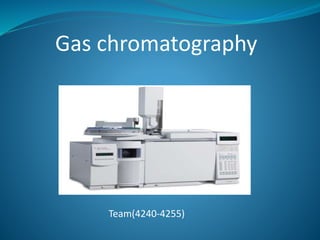
Gas chromatography
Team(4240-4255)
content
 introduction
 Principle
 Applications
 Advantages disadvantages
 Practical method
 Instrumentation
What is gas chromatography?
 Gas chromatography (GC) is a common type of
chromatography used in analytical chemistry for
separating and analyzing compounds that can be
vaporized without decomposition.
Principle
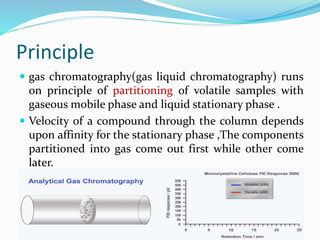
 gas chromatography(gas liquid chromatography) runs
on principle of partitioning of volatile samples with
gaseous mobile phase and liquid stationary phase .
 Velocity of a compound through the column depends
upon affinity for the stationary phase ,The components
partitioned into gas come out first while other come
later.
GC is in principle similar to HPLC, TLC, but
has several notable differences.
 the process of separating the compounds in a mixture carried
out between a liquid stationary phase and a gas mobile
phase(partitioning), whereas in column chromatography the
stationary phase is a solid and the mobile phase is a
liquid(adsorption).
 the column through which the gas phase passes is located in
an oven where the temperature of the gas can be controlled,
whereas column chromatography has no such temperature
control.
Applications
 criteria of compounds to be analysed by GC
1-volatility 2-thermostability
Ex 1- Aromatics (benzene, toluene,)
2- Hydrocarbons
3-Flavors and Fragrances
4- Permanent gases (H2, N2, O2, Ar, CO2,, CH4)
5- Pesticides, Herbicides
Advantages of gas chromatography.
 High resolution power compared to other methods.
 High sensitivity.
 High accuracy and precision.
 analysis of sample very quickly(minutes even seconds)
 Small sample needed (µl-μg)
Disadvantages of gas chromatography
 Limited to volatile sample.
 Not suitable for thermally labile samples.
 Samples be soluble and don’t react with the column.
 During injection of the gaseous sample proper
attention is required.
How dose GC works.
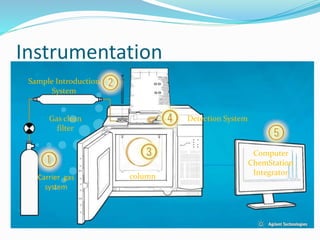
Instrumentation
Carrier gas
system
Gas clean
filter
Sample Introduction
System
column
Detection System
Computer
ChemStation
Integrator
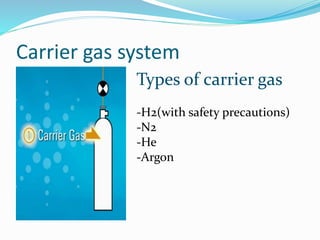
Carrier gas system
Types of carrier gas
-H2(with safety precautions)
-N2
-He
-Argon
Criteria of carrier gas
 Should meet purity of 99.9995%
 free from oxygen so we use oxygen trap why???
as significant damages can be done to the column if it is
heated above 70℃with even trace amounts of O2 in the
column
sample introduction system
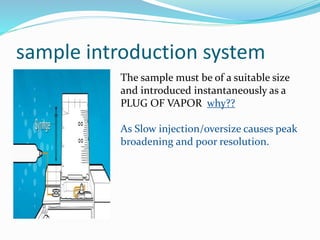
The sample must be of a suitable size
and introduced instantaneously as a
PLUG OF VAPOR why??
As Slow injection/oversize causes peak
broadening and poor resolution.
sample introduction system
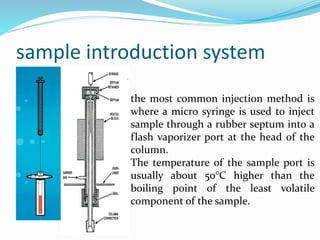
the most common injection method is
where a micro syringe is used to inject
sample through a rubber septum into a
flash vaporizer port at the head of the
column.
The temperature of the sample port is
usually about 50°C higher than the
boiling point of the least volatile
component of the sample.
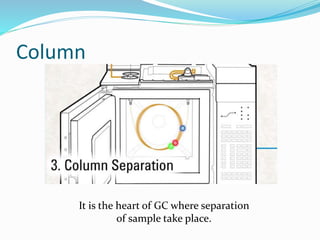
Column
It is the heart of GC where separation
of sample take place.
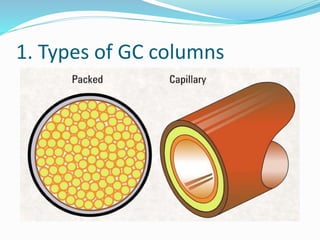
1. Types of GC columns
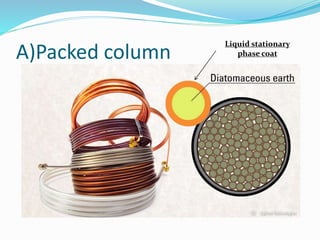
A)Packed column
Liquid stationary
phase coat
• Packed columns contain a finely divided, inert,
solid support material (commonly based on
diatomaceous earth) coated with liquid stationary
phase.
• Most packed columns are 1.5 - 10m in length and
have an internal diameter of 2 - 4mm
• The efficiency of a gas chromatographic column
increases rapidly with decreasing particle diameter
of the packing
Disadvantages
 Less application: fixed gas analysis
 Lower column efficiency than that of capillary
columns (smaller in length)
Advantages
 Larger sample capacity
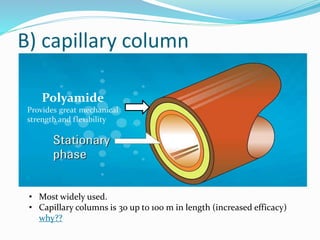
B) capillary column
Polyamide
Provides great mechanical
strength and flexibility
• Most widely used.
• Capillary columns is 30 up to 100 m in length (increased efficacy)
why??
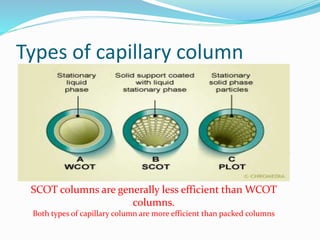
Types of capillary column
1- wall-coated open tubular (WCOT)
 consist of a capillary tube whose walls are coated with
liquid stationary phase.
2- support-coated open tubular (SCOT)
 the inner wall of the capillary is lined with a thin layer of
support material such as diatomaceous earth, onto which
the stationary phase has been adsorbed
SCOT columns are generally less efficient than WCOT
columns.
Both types of capillary column are more efficient than packed columns
Advantages
High column efficiency (large number of theoretical
plates due to long column length, up to 100 m)
Disadvantages
Small sample capacity.
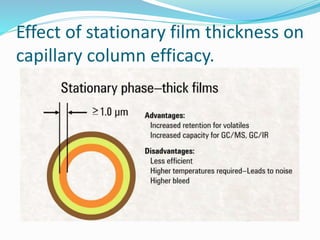
Effect of stationary film thickness on
capillary column efficacy.
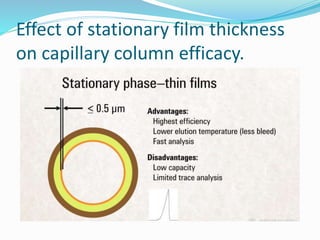
Effect of stationary film thickness
on capillary column efficacy.
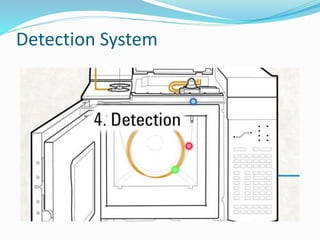
Detection System
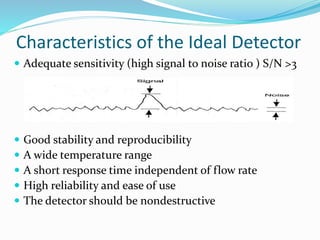
Characteristics of the Ideal Detector
 Adequate sensitivity (high signal to noise ratio ) S/N >3
 Good stability and reproducibility
 A wide temperature range
 A short response time independent of flow rate
 High reliability and ease of use
 The detector should be nondestructive
Typical GC Detectors
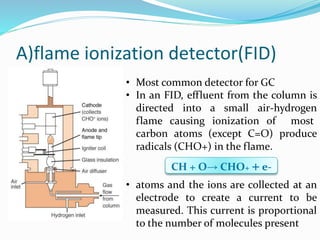
A)flame ionization detector(FID)
• Most common detector for GC
• In an FID, effluent from the column is
directed into a small air-hydrogen
flame causing ionization of most
carbon atoms (except C=O) produce
radicals (CHO+) in the flame.
• atoms and the ions are collected at an
electrode to create a current to be
measured. This current is proportional
to the number of molecules present
CH + O→ CHO+ + e-
Advantages
 universal detector for organics.
 does not respond to common inorganic compounds.
 mobile phase impurities not detected.
 carrier gases not detected.
 limit of detection of FID is 1000x better than TCD.
Disadvantage
 destructive detector.
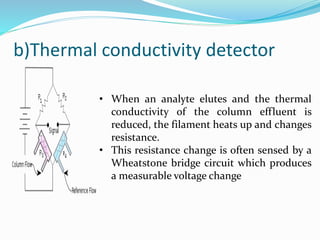
b)Thermal conductivity detector
• When an analyte elutes and the thermal
conductivity of the column effluent is
reduced, the filament heats up and changes
resistance.
• This resistance change is often sensed by a
Wheatstone bridge circuit which produces
a measurable voltage change
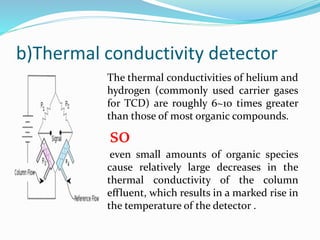
b)Thermal conductivity detector
The thermal conductivities of helium and
hydrogen (commonly used carrier gases
for TCD) are roughly 6~10 times greater

than those of most organic compounds.
so
even small amounts of organic species
cause relatively large decreases in the
thermal conductivity of the column
effluent, which results in a marked rise in
the temperature of the detector .
Advantages
 Simplicity
 nondestructive
Disadvantages
 Low sensitivity
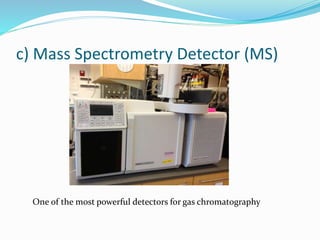
c) Mass Spectrometry Detector (MS)
One of the most powerful detectors for gas chromatography
gas chromatography

gas chromatography

  • 1.
  • 2.
    content  introduction  Principle Applications  Advantages disadvantages  Practical method  Instrumentation
  • 3.
    What is gaschromatography?  Gas chromatography (GC) is a common type of chromatography used in analytical chemistry for separating and analyzing compounds that can be vaporized without decomposition.
  • 4.
    Principle  gas chromatography(gasliquid chromatography) runs on principle of partitioning of volatile samples with gaseous mobile phase and liquid stationary phase .  Velocity of a compound through the column depends upon affinity for the stationary phase ,The components partitioned into gas come out first while other come later.
  • 5.
    GC is inprinciple similar to HPLC, TLC, but has several notable differences.  the process of separating the compounds in a mixture carried out between a liquid stationary phase and a gas mobile phase(partitioning), whereas in column chromatography the stationary phase is a solid and the mobile phase is a liquid(adsorption).  the column through which the gas phase passes is located in an oven where the temperature of the gas can be controlled, whereas column chromatography has no such temperature control.
  • 6.
    Applications  criteria ofcompounds to be analysed by GC 1-volatility 2-thermostability Ex 1- Aromatics (benzene, toluene,) 2- Hydrocarbons 3-Flavors and Fragrances 4- Permanent gases (H2, N2, O2, Ar, CO2,, CH4) 5- Pesticides, Herbicides
  • 7.
    Advantages of gaschromatography.  High resolution power compared to other methods.  High sensitivity.  High accuracy and precision.  analysis of sample very quickly(minutes even seconds)  Small sample needed (µl-μg)
  • 8.
    Disadvantages of gaschromatography  Limited to volatile sample.  Not suitable for thermally labile samples.  Samples be soluble and don’t react with the column.  During injection of the gaseous sample proper attention is required.
  • 9.
  • 10.
    Instrumentation Carrier gas system Gas clean filter SampleIntroduction System column Detection System Computer ChemStation Integrator
  • 11.
    Carrier gas system Typesof carrier gas -H2(with safety precautions) -N2 -He -Argon
  • 12.
    Criteria of carriergas  Should meet purity of 99.9995%  free from oxygen so we use oxygen trap why??? as significant damages can be done to the column if it is heated above 70℃with even trace amounts of O2 in the column
  • 13.
    sample introduction system Thesample must be of a suitable size and introduced instantaneously as a PLUG OF VAPOR why?? As Slow injection/oversize causes peak broadening and poor resolution.
  • 14.
    sample introduction system themost common injection method is where a micro syringe is used to inject sample through a rubber septum into a flash vaporizer port at the head of the column. The temperature of the sample port is usually about 50°C higher than the boiling point of the least volatile component of the sample.
  • 15.
    Column It is theheart of GC where separation of sample take place.
  • 16.
    1. Types ofGC columns
  • 17.
  • 18.
    • Packed columnscontain a finely divided, inert, solid support material (commonly based on diatomaceous earth) coated with liquid stationary phase. • Most packed columns are 1.5 - 10m in length and have an internal diameter of 2 - 4mm • The efficiency of a gas chromatographic column increases rapidly with decreasing particle diameter of the packing
  • 19.
    Disadvantages  Less application:fixed gas analysis  Lower column efficiency than that of capillary columns (smaller in length) Advantages  Larger sample capacity
  • 20.
    B) capillary column Polyamide Providesgreat mechanical strength and flexibility • Most widely used. • Capillary columns is 30 up to 100 m in length (increased efficacy) why??
  • 21.
    Types of capillarycolumn 1- wall-coated open tubular (WCOT)  consist of a capillary tube whose walls are coated with liquid stationary phase. 2- support-coated open tubular (SCOT)  the inner wall of the capillary is lined with a thin layer of support material such as diatomaceous earth, onto which the stationary phase has been adsorbed SCOT columns are generally less efficient than WCOT columns. Both types of capillary column are more efficient than packed columns
  • 22.
    Advantages High column efficiency(large number of theoretical plates due to long column length, up to 100 m) Disadvantages Small sample capacity.
  • 23.
    Effect of stationaryfilm thickness on capillary column efficacy.
  • 24.
    Effect of stationaryfilm thickness on capillary column efficacy.
  • 25.
  • 26.
    Characteristics of theIdeal Detector  Adequate sensitivity (high signal to noise ratio ) S/N >3  Good stability and reproducibility  A wide temperature range  A short response time independent of flow rate  High reliability and ease of use  The detector should be nondestructive
  • 27.
  • 28.
    A)flame ionization detector(FID) •Most common detector for GC • In an FID, effluent from the column is directed into a small air-hydrogen flame causing ionization of most carbon atoms (except C=O) produce radicals (CHO+) in the flame. • atoms and the ions are collected at an electrode to create a current to be measured. This current is proportional to the number of molecules present CH + O→ CHO+ + e-
  • 29.
    Advantages  universal detectorfor organics.  does not respond to common inorganic compounds.  mobile phase impurities not detected.  carrier gases not detected.  limit of detection of FID is 1000x better than TCD. Disadvantage  destructive detector.
  • 30.
    b)Thermal conductivity detector •When an analyte elutes and the thermal conductivity of the column effluent is reduced, the filament heats up and changes resistance. • This resistance change is often sensed by a Wheatstone bridge circuit which produces a measurable voltage change
  • 31.
    b)Thermal conductivity detector Thethermal conductivities of helium and hydrogen (commonly used carrier gases for TCD) are roughly 6~10 times greater than those of most organic compounds. so even small amounts of organic species cause relatively large decreases in the thermal conductivity of the column effluent, which results in a marked rise in the temperature of the detector .
  • 32.
  • 33.
    c) Mass SpectrometryDetector (MS) One of the most powerful detectors for gas chromatography