CMOS Logic
Sudhanshu Janwadkar, Teaching Assistant, SVNIT, Surat
Lecture Notes 16-17th February 2017
Introduction
 Metal-Oxide-Semiconductor (MOS) structure is created by superimposing
several layers of conducting and insulating materials to form a sandwich-
like structure.
 These structures are manufactured using a series of chemical processing
steps involving oxidation of the silicon, selective introduction of dopants,
and deposition and etching of metal wires and contacts.
 CMOS technology provides two types of transistors: an n-type transistor
(nMOS) and a p-type transistor (pMOS).
 Transistor operation is controlled by electric fields so the devices are also
called Metal Oxide Semiconductor Field Effect Transistors (MOSFETs)
Introduction
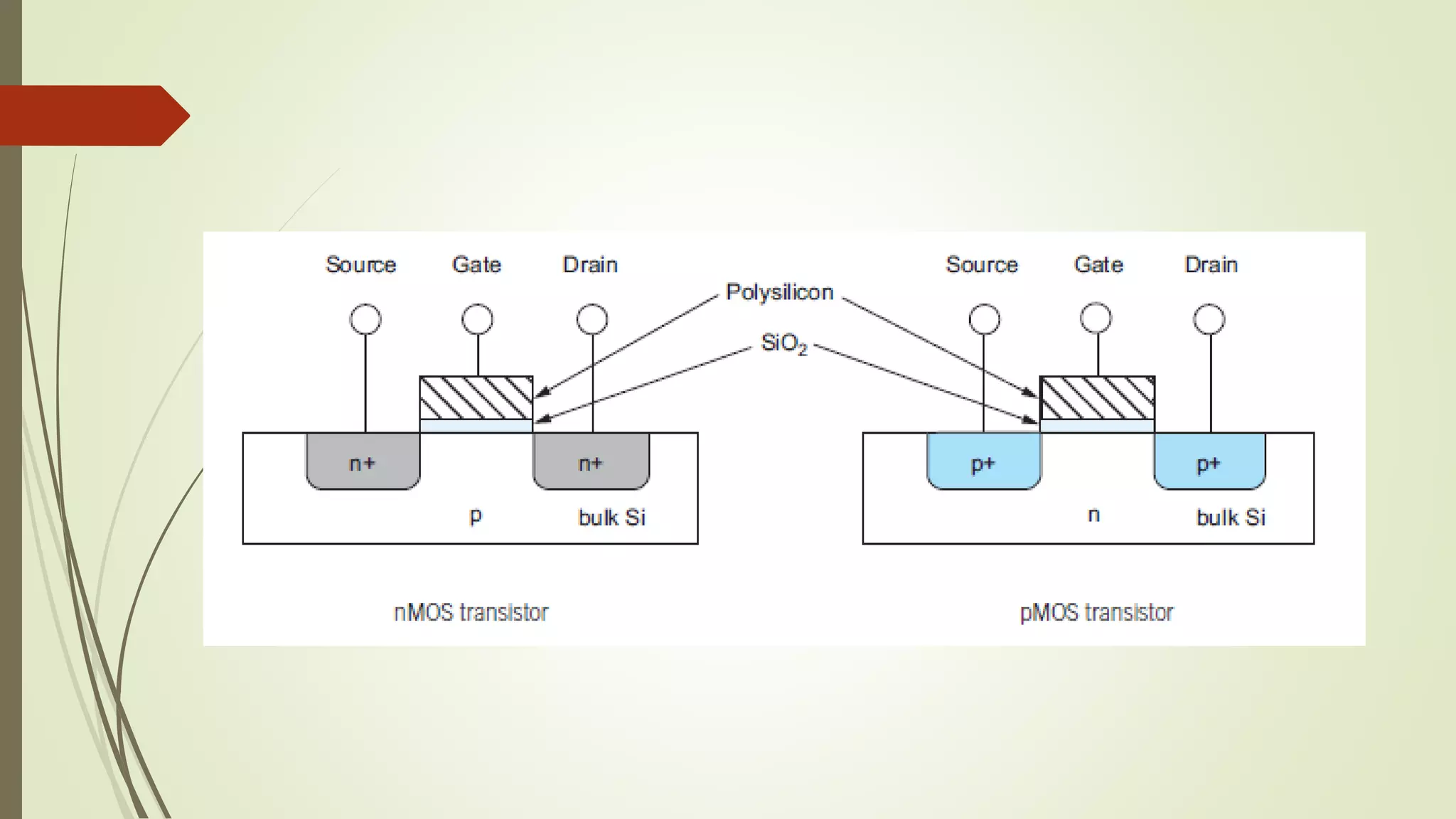
 Each transistor consists of a stack of the conducting gate, an insulating
layer of silicon dioxide (SiO2), and the silicon wafer, also called the
substrate, or body, or bulk.
 An nMOS transistor is built with a p-type body and has regions of n-type
semiconductor adjacent to the gate called the source and drain
 A pMOS consists of p-type source and drain regions with an n-type body.
 In a CMOS technology, with both flavors of transistors, the substrate is
either n-type or p-type.
 The other flavor of transistor must be built in a special well in which dopant
atoms have been added to form the body of the opposite type.
MOS Principle
 The gate is a control input: It affects the flow of electrical current between the
source and drain.
N-channel MOSFET
 Consider an nMOS transistor.
 The body is generally grounded so the p–n junctions of the source and
drain to body are reverse-biased.
 If the gate is also grounded, no current flows through the reverse-biased
junctions. Hence, we say the transistor is OFF.
 If the gate voltage is raised, it creates an electric field that starts to attract
free electrons to the underside of the Si–SiO2 interface.
 If the voltage is raised enough, the electrons outnumber the holes and a
thin region under the gate called the channel is inverted to act as an n-
type semiconductor.
 Hence, a conducting path of electron carriers is formed from source to
drain and current can flow. We say the transistor is ON.
P-channel MOSFET
 For a pMOS transistor, The body is held at a positive voltage.
 When the gate is also at a positive voltage, the source and drain junctions are
reverse-biased and no current flows, so the transistor is OFF.
 When the gate voltage is lowered, positive charges are attracted to the underside
of the Si–SiO2 interface.
 A sufficiently low gate voltage inverts the channel and a conducting path of
positive carriers is formed from source to drain, so the transistor is ON.
MOSFET as Switch
 The gate of an MOS transistor controls the flow of current between the source and
drain
 Simplifying this to the extreme allows the MOS transistors to be viewed as simple
ON/OFF switches.
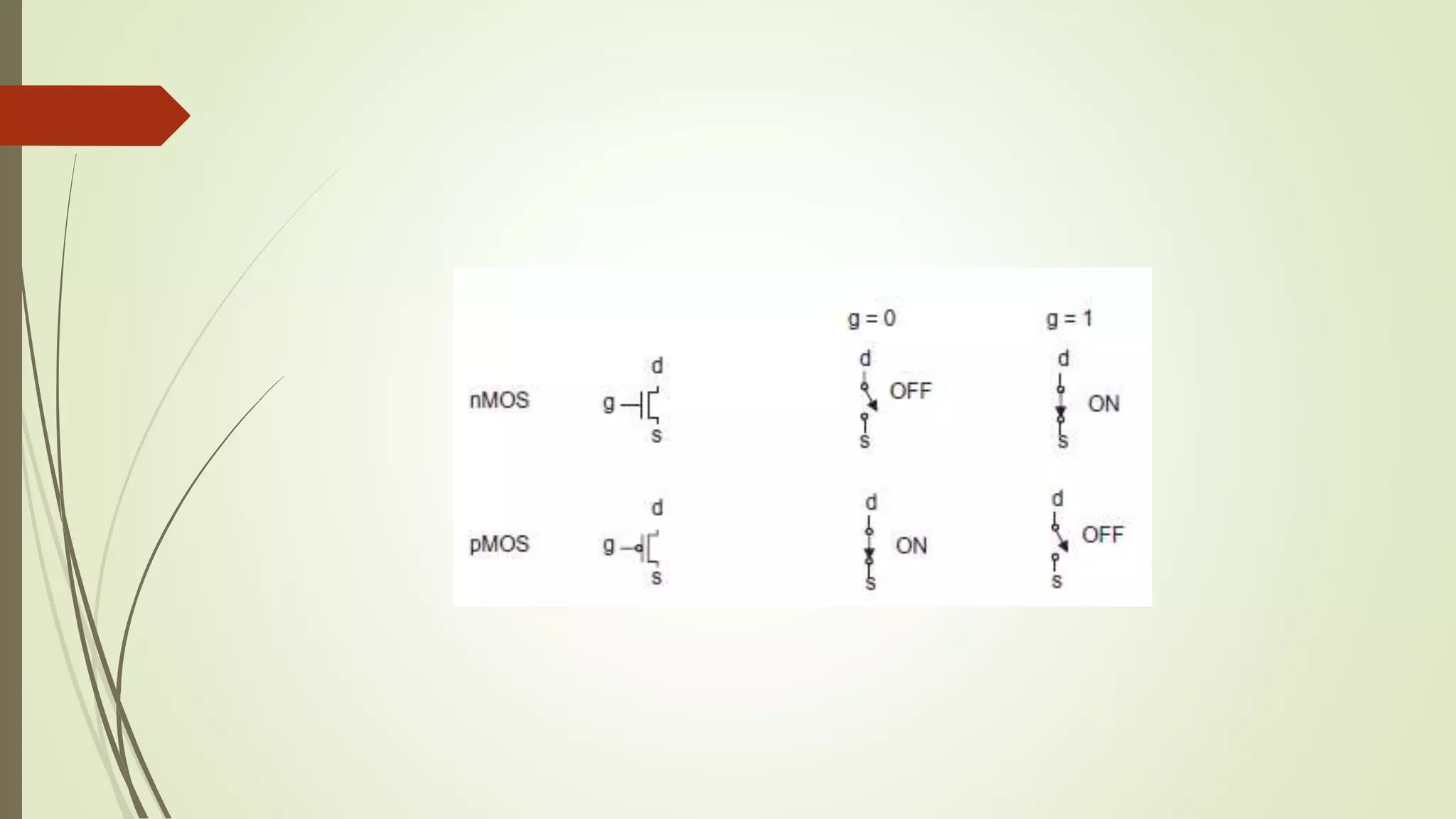
 When the gate of an nMOS transistor is 1, the transistor is ON and there is a
conducting path from source to drain.
 When the gate is low, the nMOS transistor is OFF and almost zero current flows
from source to drain.
 A pMOS transistor is just the opposite, being ON when the gate is low and OFF
when the gate is high.
CMOS Inverter
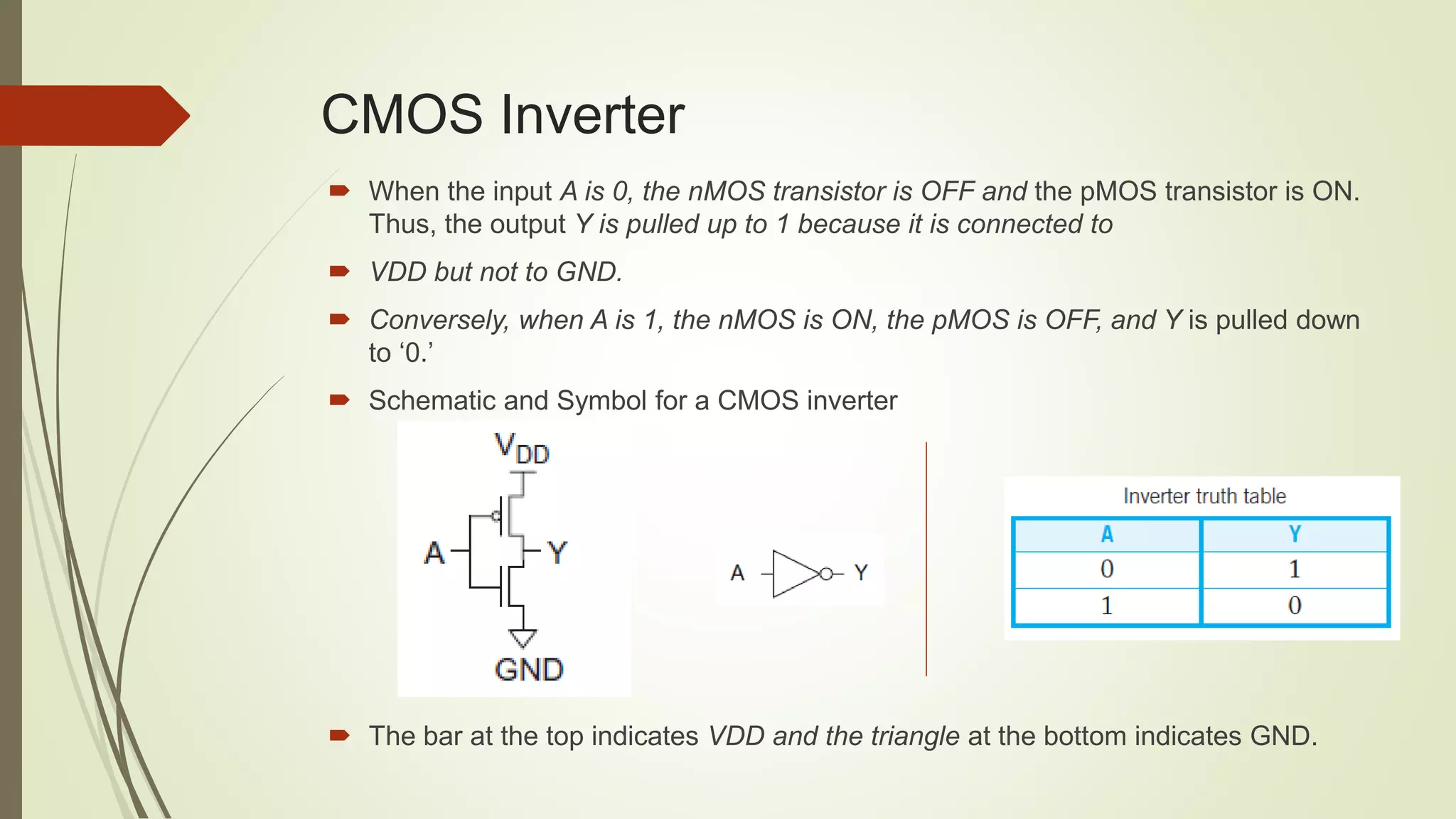
 When the input A is 0, the nMOS transistor is OFF and the pMOS transistor is ON.
Thus, the output Y is pulled up to 1 because it is connected to
 VDD but not to GND.
 Conversely, when A is 1, the nMOS is ON, the pMOS is OFF, and Y is pulled down
to ‘0.’
 Schematic and Symbol for a CMOS inverter
 The bar at the top indicates VDD and the triangle at the bottom indicates GND.
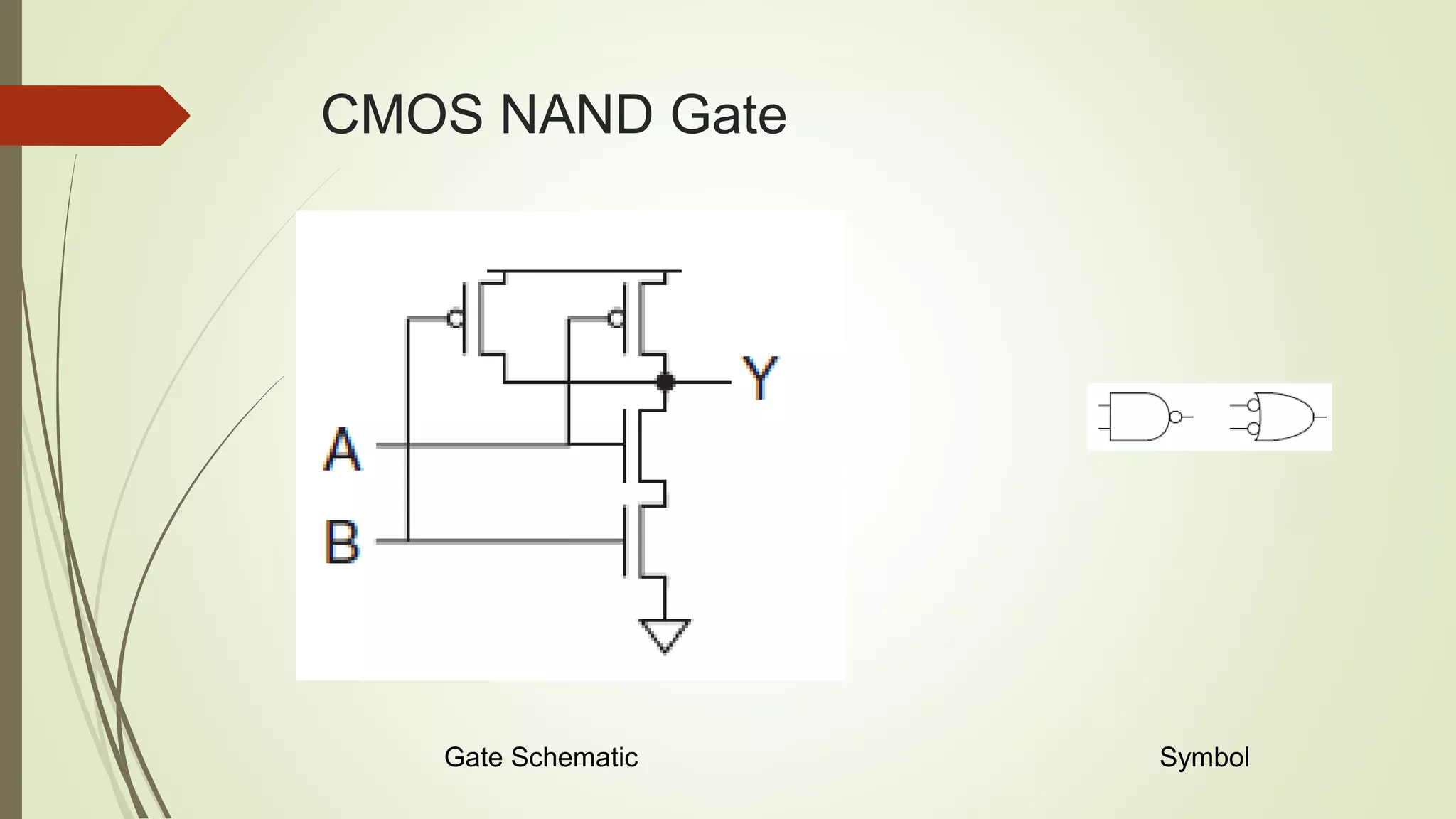
CMOS NAND Gate
Gate Schematic Symbol
CMOS NAND Gate
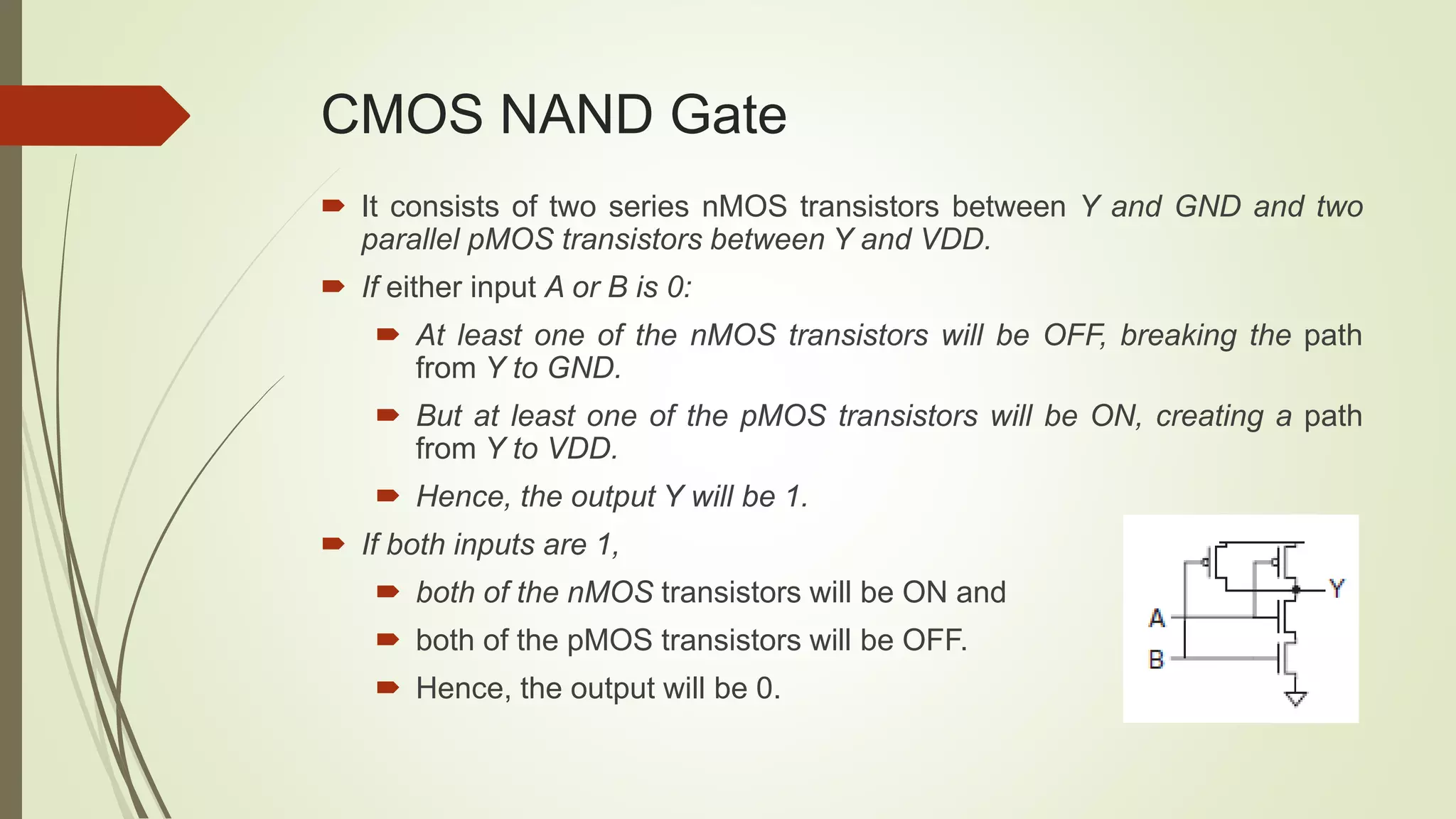
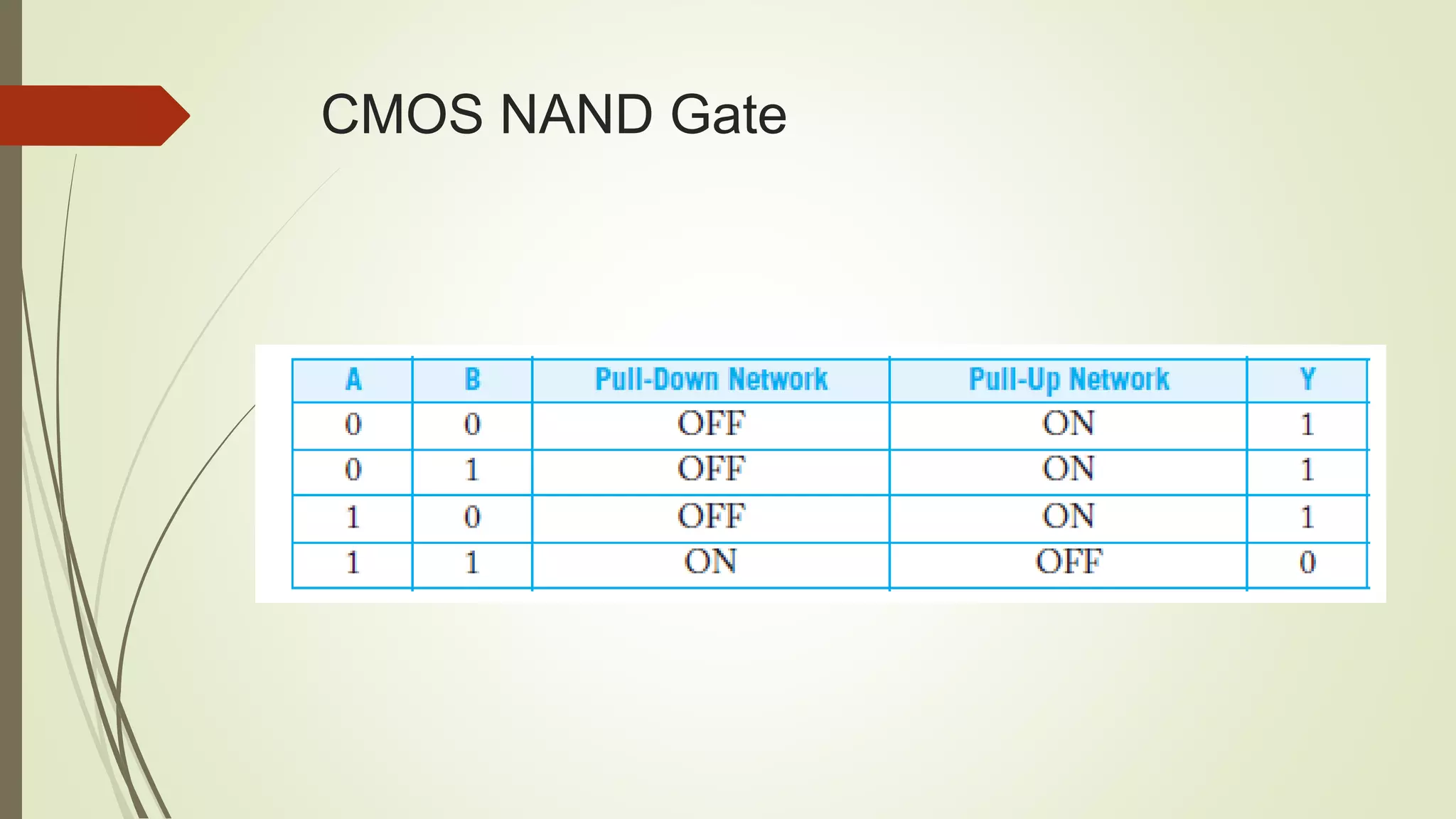
 It consists of two series nMOS transistors between Y and GND and two
parallel pMOS transistors between Y and VDD.
 If either input A or B is 0:
 At least one of the nMOS transistors will be OFF, breaking the path
from Y to GND.
 But at least one of the pMOS transistors will be ON, creating a path
from Y to VDD.
 Hence, the output Y will be 1.
 If both inputs are 1,
 both of the nMOS transistors will be ON and
 both of the pMOS transistors will be OFF.
 Hence, the output will be 0.
CMOS NAND Gate
CMOS Logic Structure
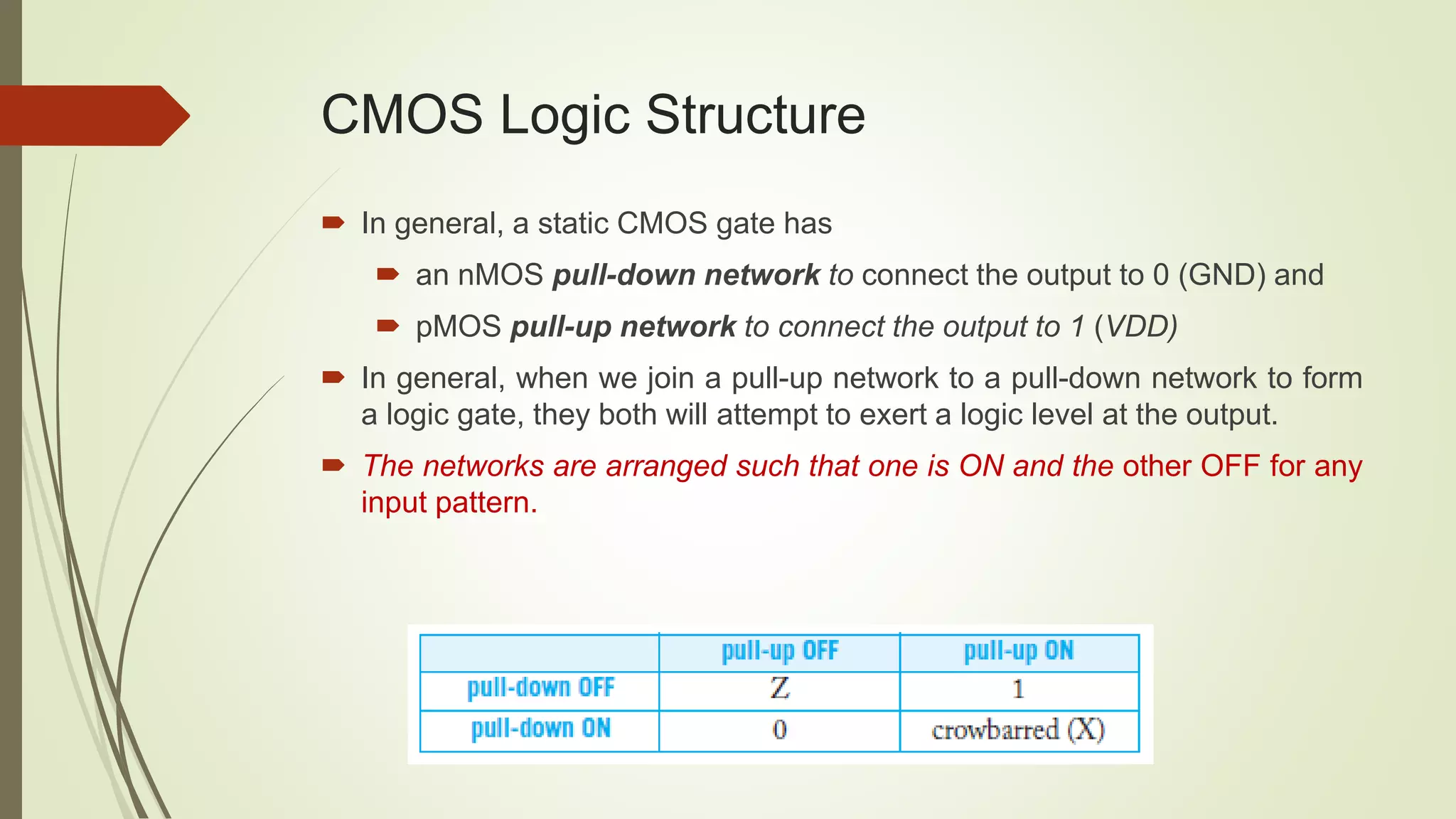
 In general, a static CMOS gate has
 an nMOS pull-down network to connect the output to 0 (GND) and
 pMOS pull-up network to connect the output to 1 (VDD)
 In general, when we join a pull-up network to a pull-down network to form
a logic gate, they both will attempt to exert a logic level at the output.
 The networks are arranged such that one is ON and the other OFF for any
input pattern.
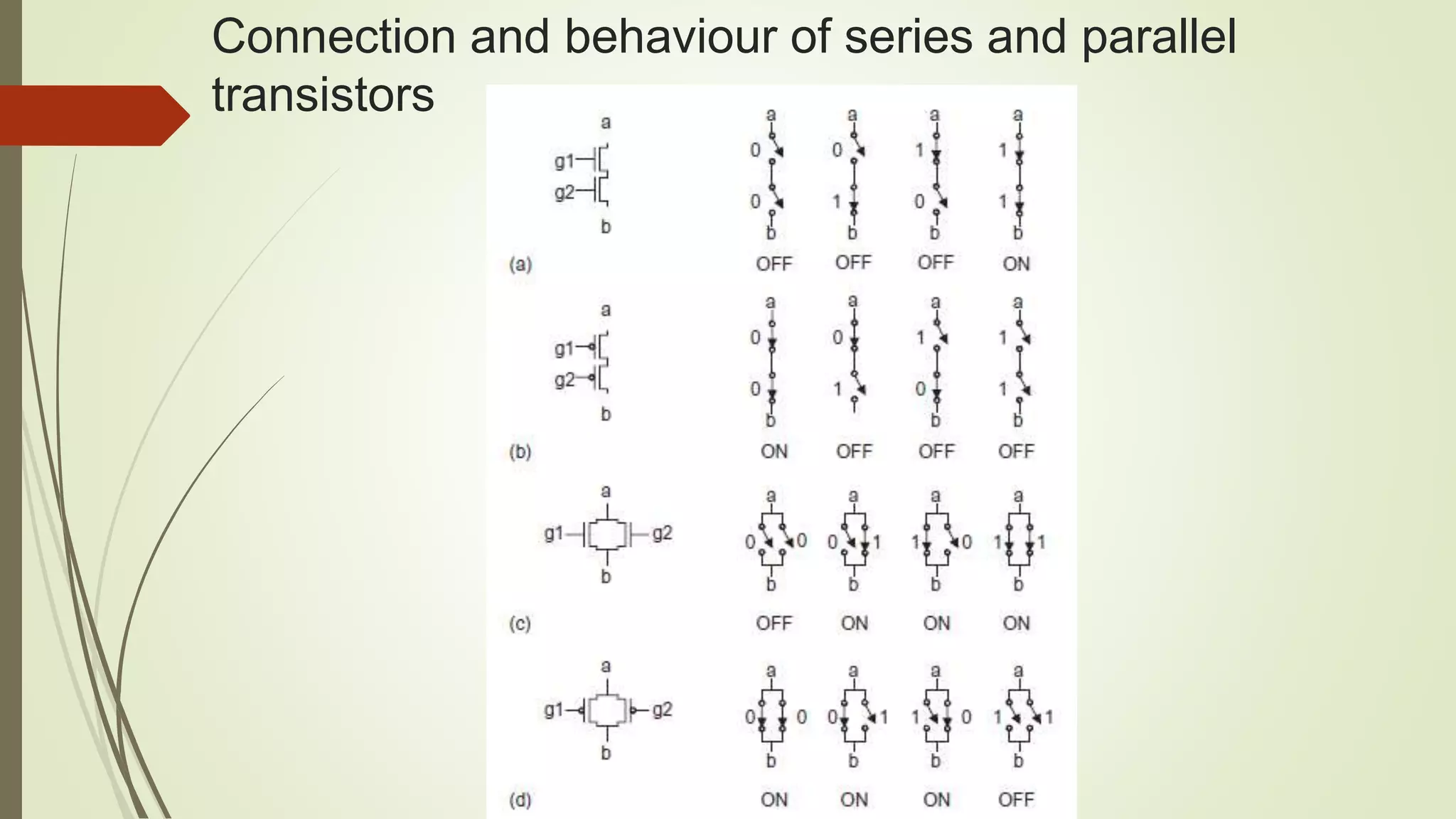
Connection and behaviour of series and parallel
transistors
CMOS NOR Gate
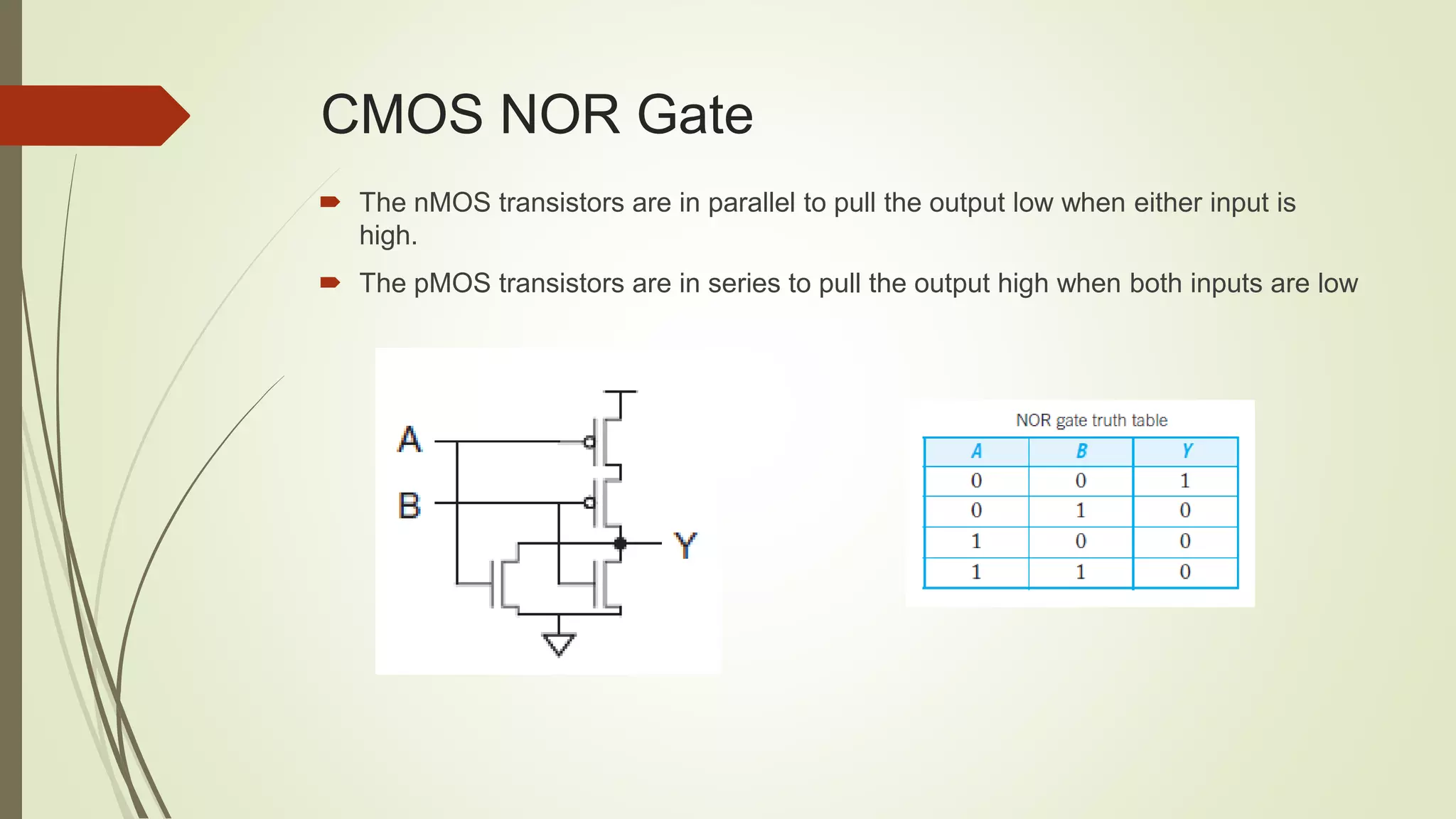
 The nMOS transistors are in parallel to pull the output low when either input is
high.
 The pMOS transistors are in series to pull the output high when both inputs are low
3 input NOR Gate??
3 input NOR Gate
3 input NAND Gate??
3 input NAND Gate
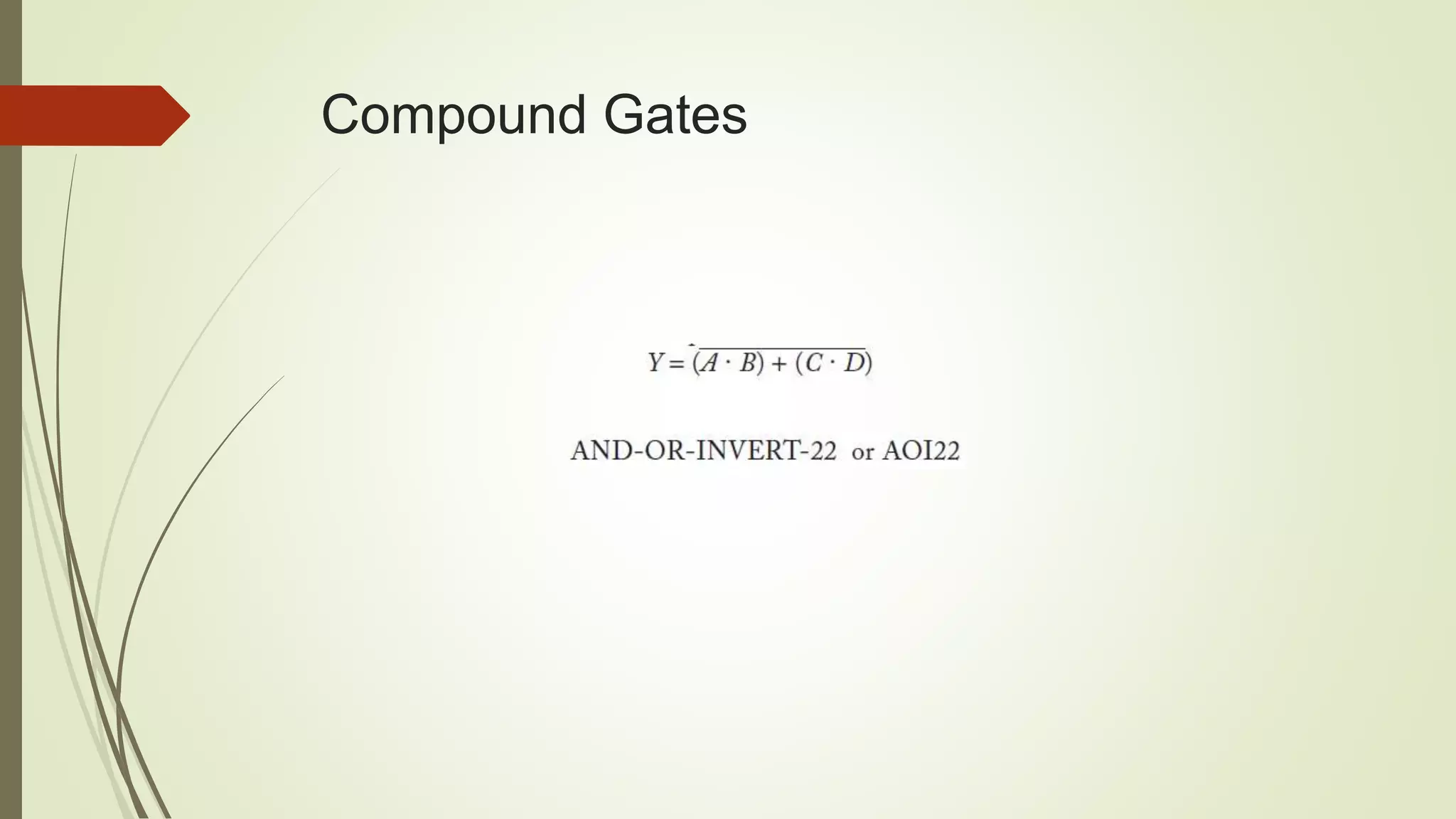
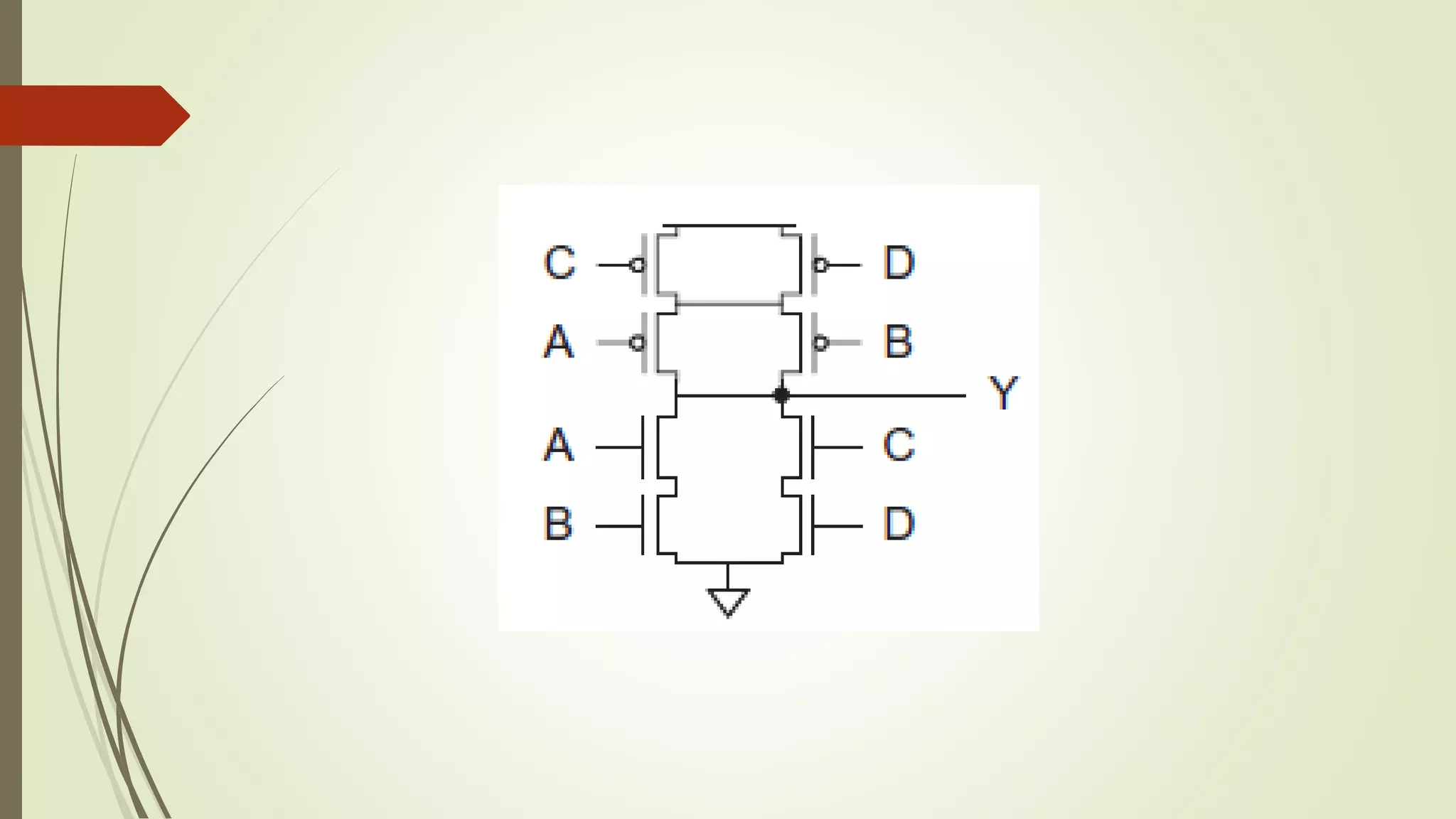
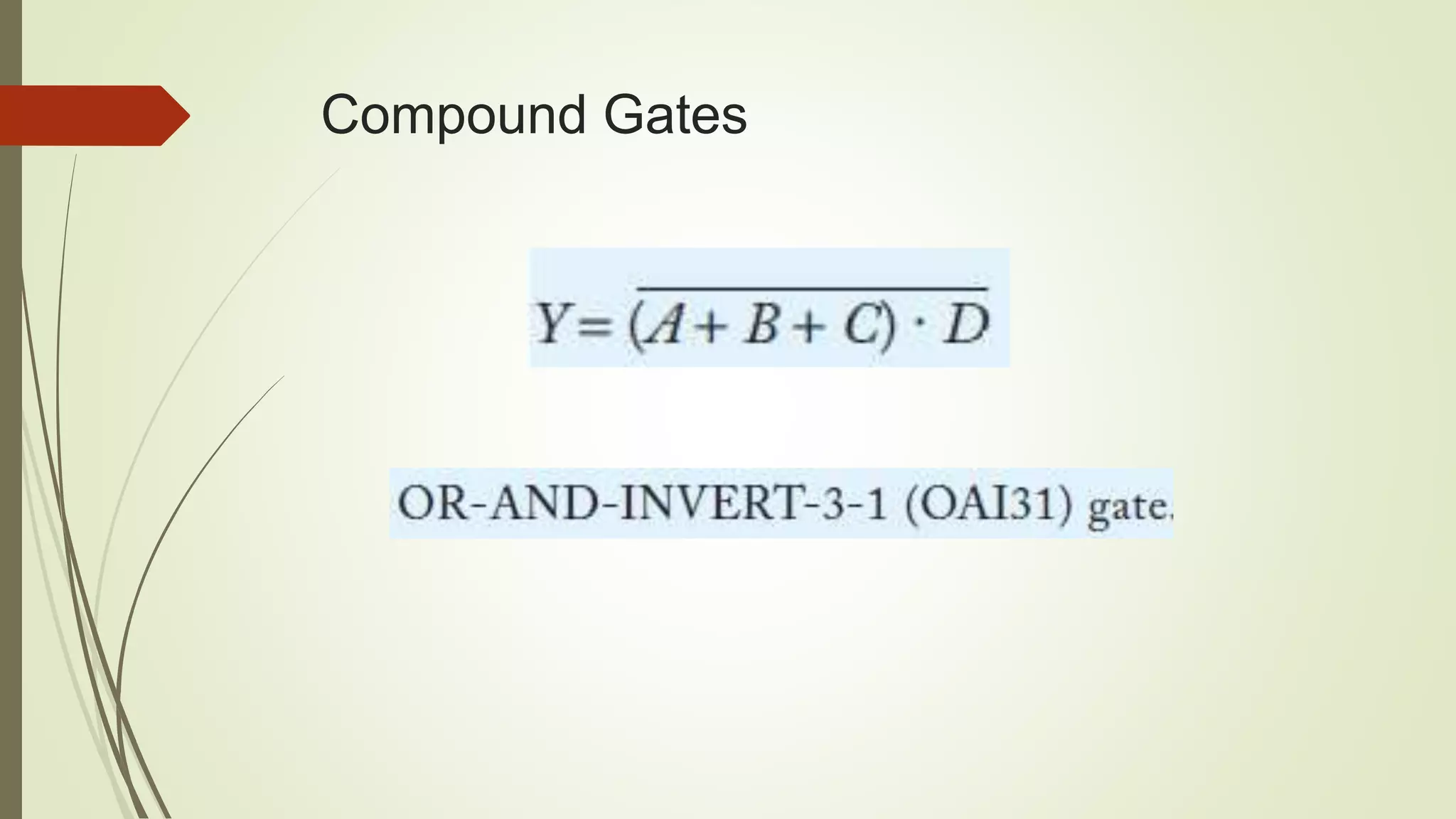
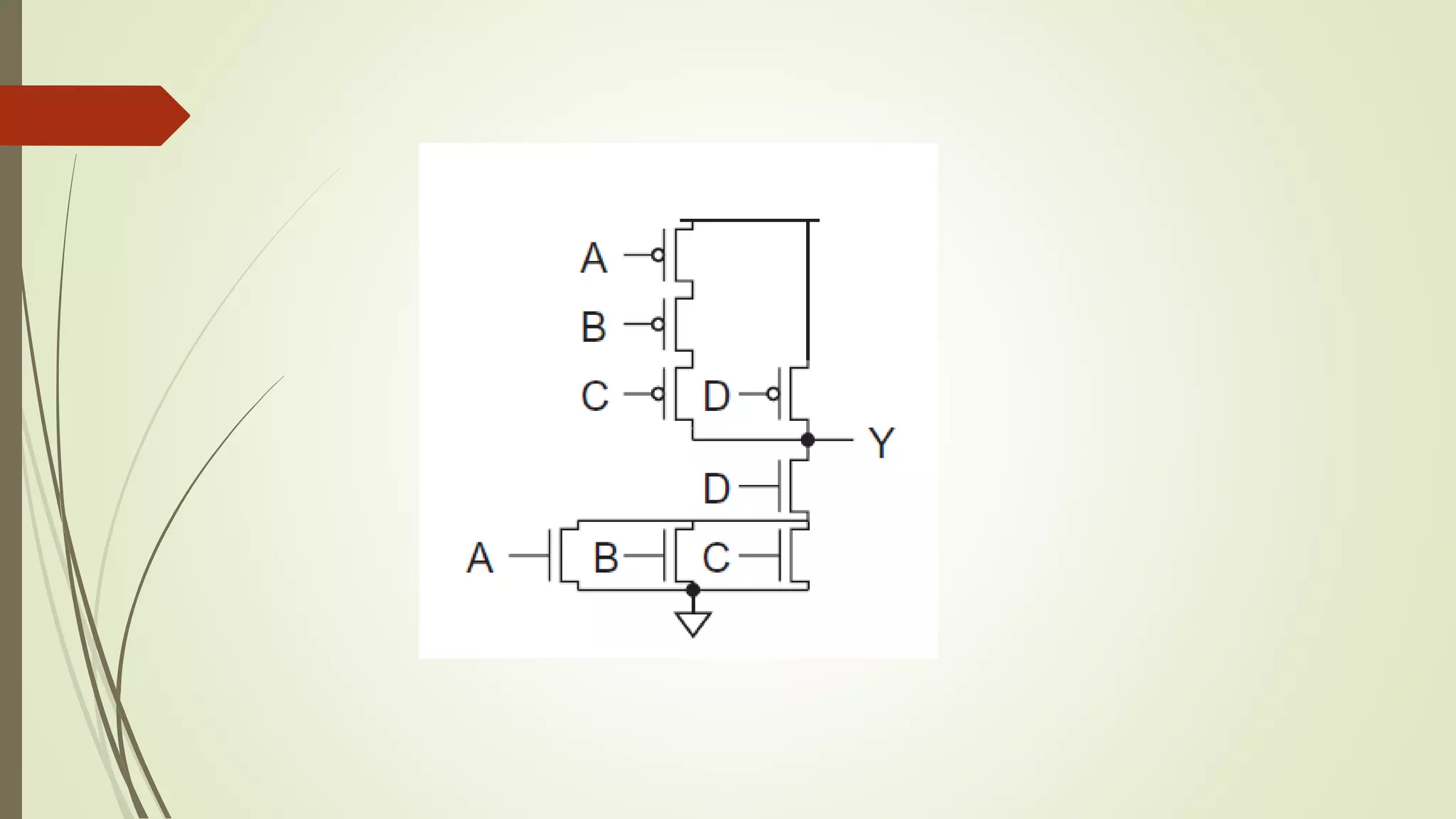
Compound Gates
Compound Gates
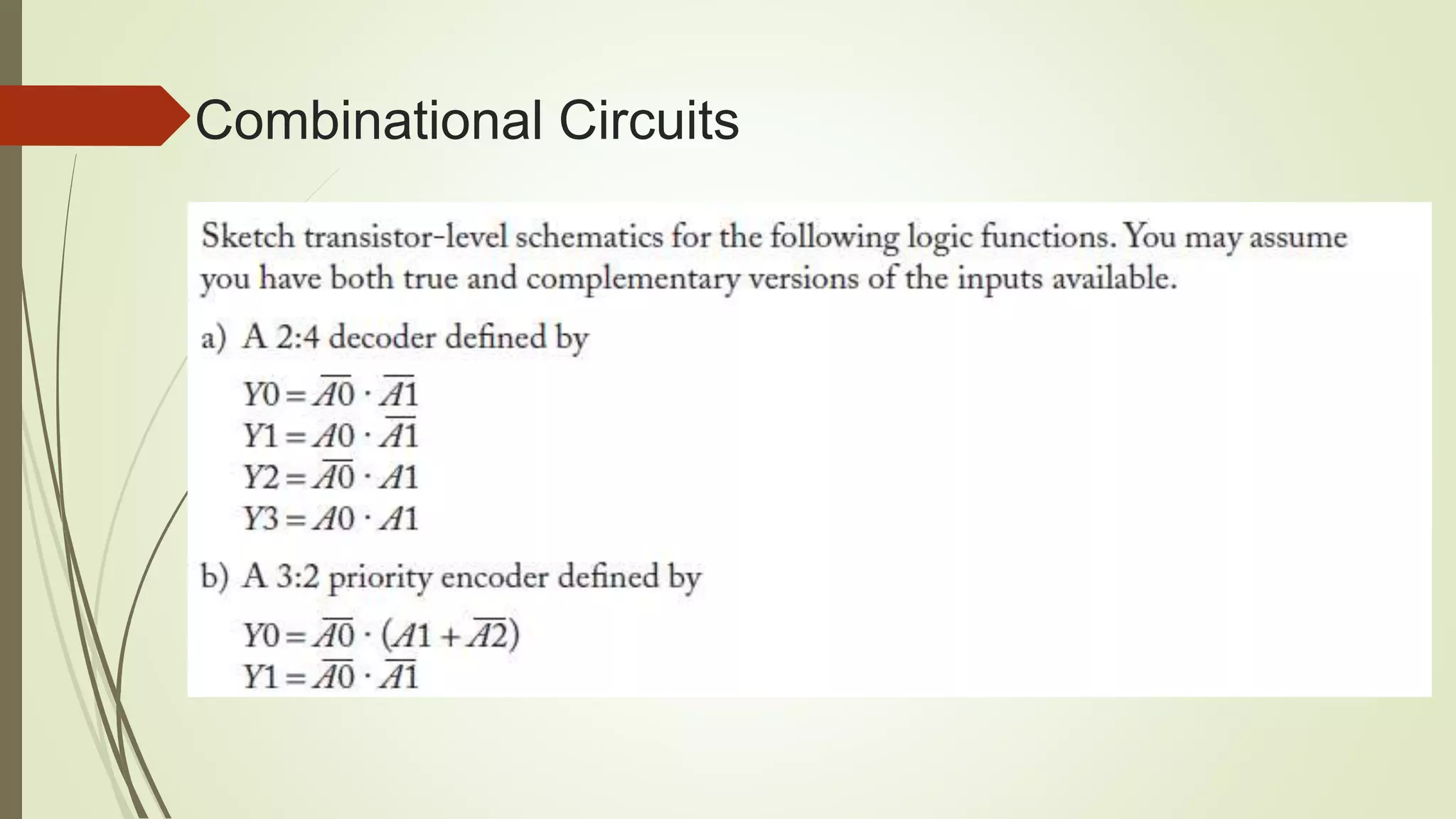
Combinational Circuits
Pass Transistors and Transmission Gates
 The strength of a signal is measured by how closely it approximates an
ideal voltage source.
 The power supplies, or rails, (VDD and GND) are the source of the
strongest 1s and 0s.
 An nMOS transistor is an almost perfect switch when passing a 0 and thus
we say it passes a strong 0. However, the nMOS transistor is imperfect at
passing a 1. We say it passes a degraded or weak 1.
 An pMOS transistor is an almost perfect switch when passing a 1 and
thus we say it passes a strong 1. However, the nMOS transistor is
imperfect at passing a 1. We say it passes a degraded or weak 0
Pass Transistors and Transmission Gates
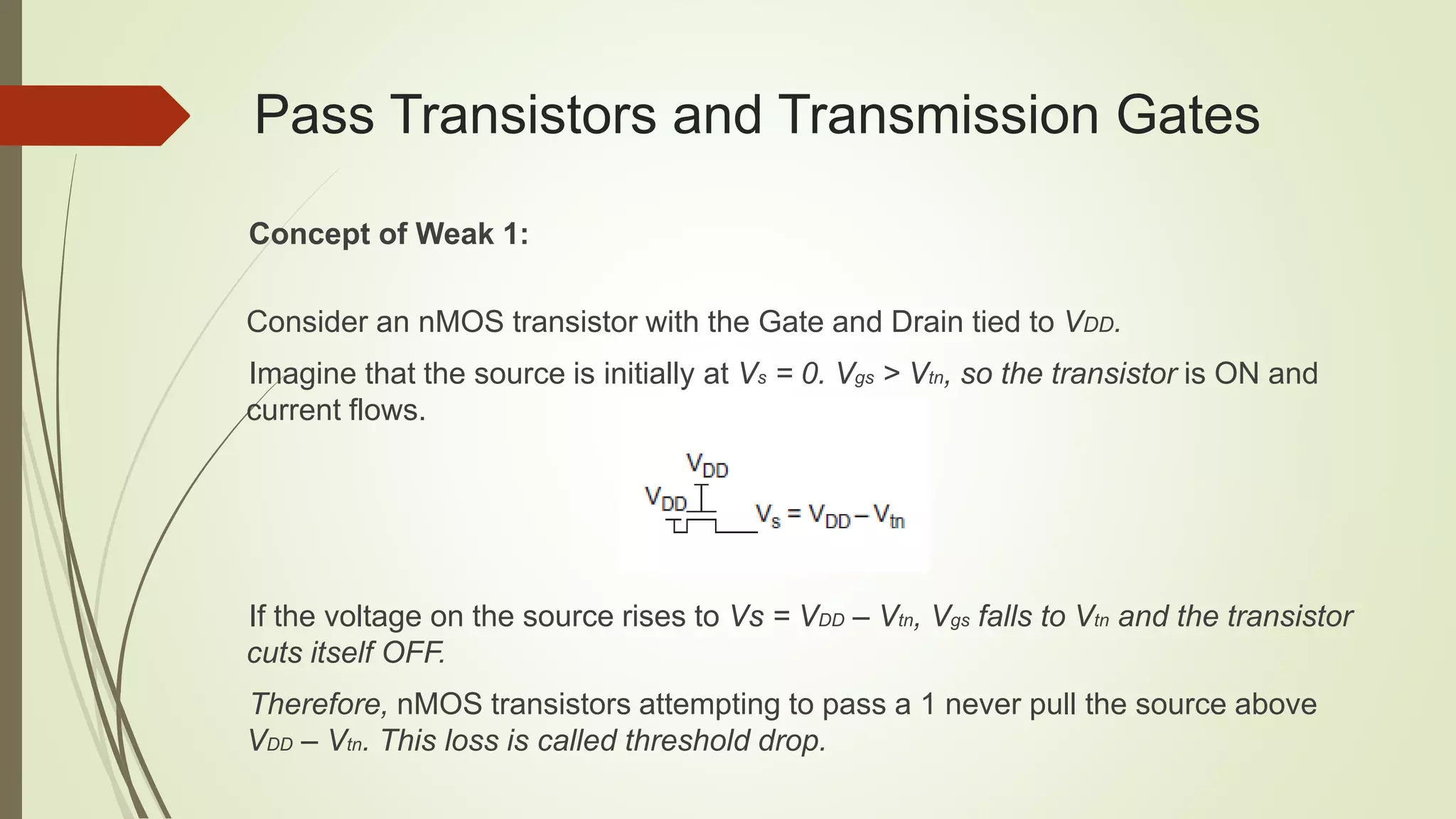
Concept of Weak 1:
Consider an nMOS transistor with the Gate and Drain tied to VDD.
Imagine that the source is initially at Vs = 0. Vgs > Vtn, so the transistor is ON and
current flows.
If the voltage on the source rises to Vs = VDD – Vtn, Vgs falls to Vtn and the transistor
cuts itself OFF.
Therefore, nMOS transistors attempting to pass a 1 never pull the source above
VDD – Vtn. This loss is called threshold drop.
Pass Transistors and Transmission Gates
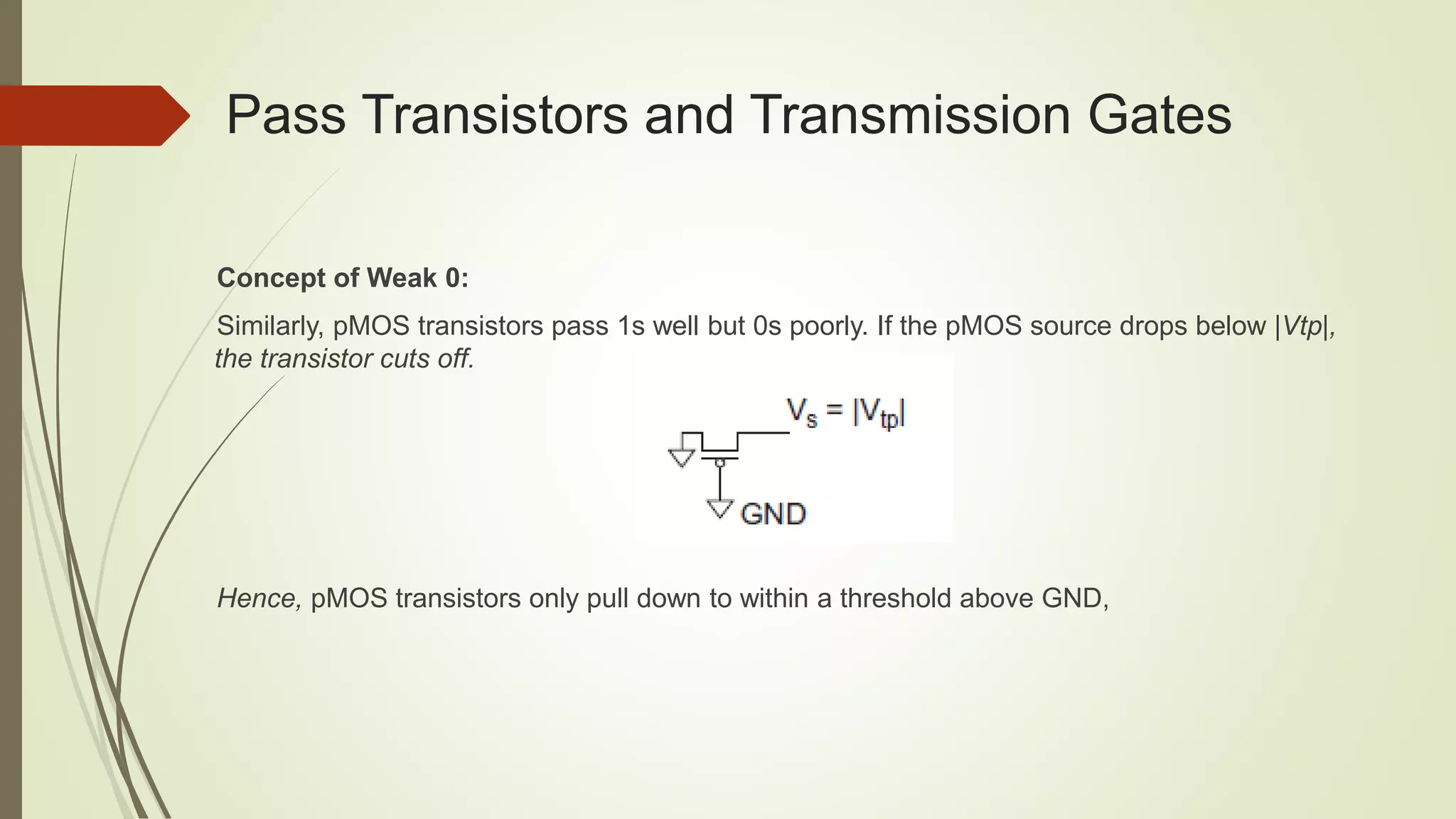
Concept of Weak 0:
Similarly, pMOS transistors pass 1s well but 0s poorly. If the pMOS source drops below |Vtp|,
the transistor cuts off.
Hence, pMOS transistors only pull down to within a threshold above GND,
 When an nMOS or pMOS is used alone as an imperfect switch, we call it a
pass transistor.
Pass Transistors and Transmission Gates
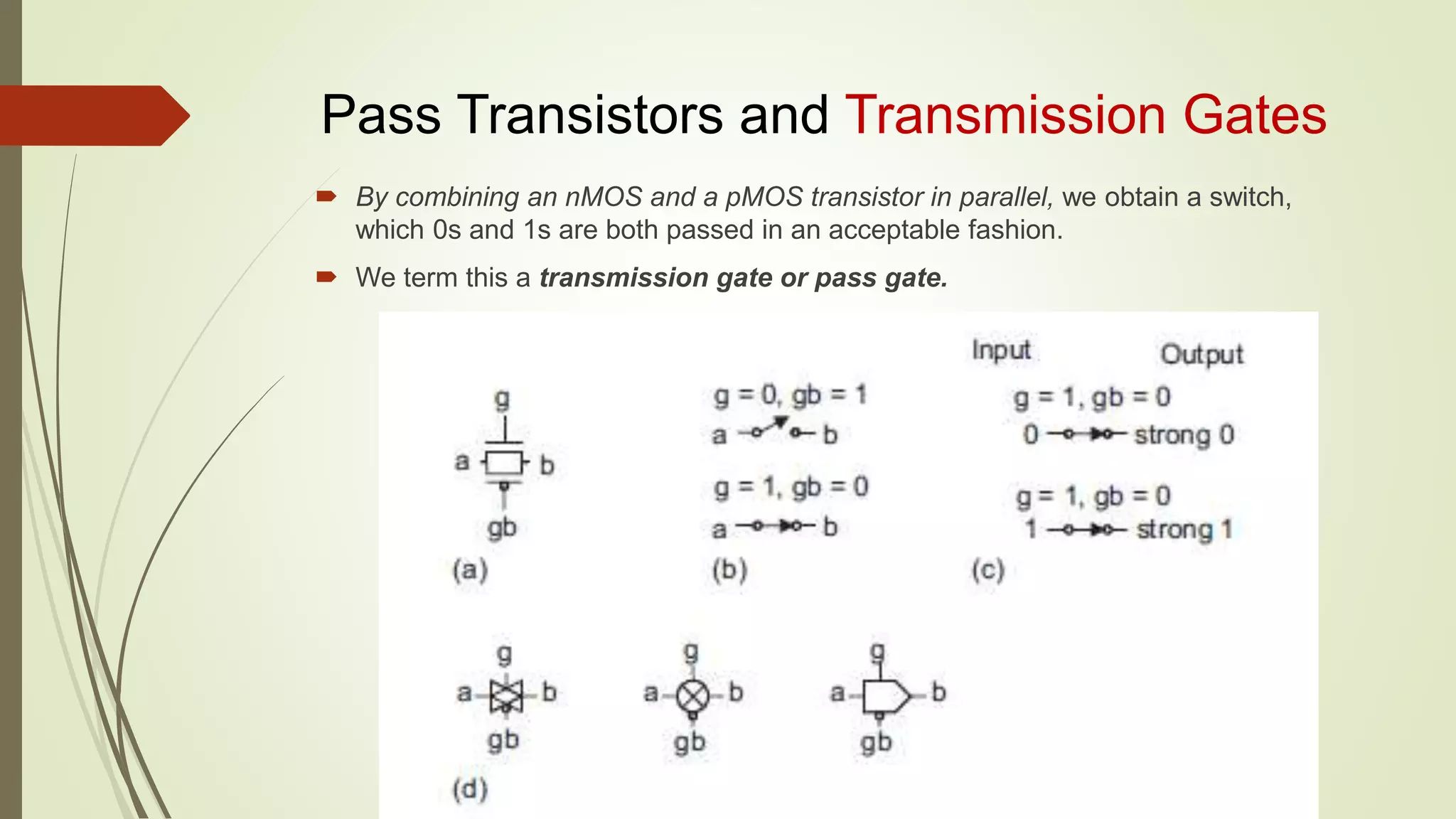
 By combining an nMOS and a pMOS transistor in parallel, we obtain a switch,
which 0s and 1s are both passed in an acceptable fashion.
 We term this a transmission gate or pass gate.
CMOS Logic

CMOS Logic

  • 1.
    CMOS Logic Sudhanshu Janwadkar,Teaching Assistant, SVNIT, Surat Lecture Notes 16-17th February 2017
  • 2.
    Introduction  Metal-Oxide-Semiconductor (MOS)structure is created by superimposing several layers of conducting and insulating materials to form a sandwich- like structure.  These structures are manufactured using a series of chemical processing steps involving oxidation of the silicon, selective introduction of dopants, and deposition and etching of metal wires and contacts.  CMOS technology provides two types of transistors: an n-type transistor (nMOS) and a p-type transistor (pMOS).  Transistor operation is controlled by electric fields so the devices are also called Metal Oxide Semiconductor Field Effect Transistors (MOSFETs)
  • 4.
    Introduction  Each transistorconsists of a stack of the conducting gate, an insulating layer of silicon dioxide (SiO2), and the silicon wafer, also called the substrate, or body, or bulk.  An nMOS transistor is built with a p-type body and has regions of n-type semiconductor adjacent to the gate called the source and drain  A pMOS consists of p-type source and drain regions with an n-type body.  In a CMOS technology, with both flavors of transistors, the substrate is either n-type or p-type.  The other flavor of transistor must be built in a special well in which dopant atoms have been added to form the body of the opposite type.
  • 5.
    MOS Principle  Thegate is a control input: It affects the flow of electrical current between the source and drain.
  • 6.
    N-channel MOSFET  Consideran nMOS transistor.  The body is generally grounded so the p–n junctions of the source and drain to body are reverse-biased.  If the gate is also grounded, no current flows through the reverse-biased junctions. Hence, we say the transistor is OFF.  If the gate voltage is raised, it creates an electric field that starts to attract free electrons to the underside of the Si–SiO2 interface.  If the voltage is raised enough, the electrons outnumber the holes and a thin region under the gate called the channel is inverted to act as an n- type semiconductor.  Hence, a conducting path of electron carriers is formed from source to drain and current can flow. We say the transistor is ON.
  • 7.
    P-channel MOSFET  Fora pMOS transistor, The body is held at a positive voltage.  When the gate is also at a positive voltage, the source and drain junctions are reverse-biased and no current flows, so the transistor is OFF.  When the gate voltage is lowered, positive charges are attracted to the underside of the Si–SiO2 interface.  A sufficiently low gate voltage inverts the channel and a conducting path of positive carriers is formed from source to drain, so the transistor is ON.
  • 8.
    MOSFET as Switch The gate of an MOS transistor controls the flow of current between the source and drain  Simplifying this to the extreme allows the MOS transistors to be viewed as simple ON/OFF switches.  When the gate of an nMOS transistor is 1, the transistor is ON and there is a conducting path from source to drain.  When the gate is low, the nMOS transistor is OFF and almost zero current flows from source to drain.  A pMOS transistor is just the opposite, being ON when the gate is low and OFF when the gate is high.
  • 10.
    CMOS Inverter  Whenthe input A is 0, the nMOS transistor is OFF and the pMOS transistor is ON. Thus, the output Y is pulled up to 1 because it is connected to  VDD but not to GND.  Conversely, when A is 1, the nMOS is ON, the pMOS is OFF, and Y is pulled down to ‘0.’  Schematic and Symbol for a CMOS inverter  The bar at the top indicates VDD and the triangle at the bottom indicates GND.
  • 11.
    CMOS NAND Gate GateSchematic Symbol
  • 12.
    CMOS NAND Gate It consists of two series nMOS transistors between Y and GND and two parallel pMOS transistors between Y and VDD.  If either input A or B is 0:  At least one of the nMOS transistors will be OFF, breaking the path from Y to GND.  But at least one of the pMOS transistors will be ON, creating a path from Y to VDD.  Hence, the output Y will be 1.  If both inputs are 1,  both of the nMOS transistors will be ON and  both of the pMOS transistors will be OFF.  Hence, the output will be 0.
  • 13.
  • 14.
  • 15.
    CMOS Logic Structure In general, a static CMOS gate has  an nMOS pull-down network to connect the output to 0 (GND) and  pMOS pull-up network to connect the output to 1 (VDD)  In general, when we join a pull-up network to a pull-down network to form a logic gate, they both will attempt to exert a logic level at the output.  The networks are arranged such that one is ON and the other OFF for any input pattern.
  • 16.
    Connection and behaviourof series and parallel transistors
  • 17.
    CMOS NOR Gate The nMOS transistors are in parallel to pull the output low when either input is high.  The pMOS transistors are in series to pull the output high when both inputs are low
  • 18.
  • 19.
  • 20.
  • 21.
  • 22.
  • 25.
  • 27.
  • 28.
    Pass Transistors andTransmission Gates  The strength of a signal is measured by how closely it approximates an ideal voltage source.  The power supplies, or rails, (VDD and GND) are the source of the strongest 1s and 0s.  An nMOS transistor is an almost perfect switch when passing a 0 and thus we say it passes a strong 0. However, the nMOS transistor is imperfect at passing a 1. We say it passes a degraded or weak 1.  An pMOS transistor is an almost perfect switch when passing a 1 and thus we say it passes a strong 1. However, the nMOS transistor is imperfect at passing a 1. We say it passes a degraded or weak 0
  • 29.
    Pass Transistors andTransmission Gates Concept of Weak 1: Consider an nMOS transistor with the Gate and Drain tied to VDD. Imagine that the source is initially at Vs = 0. Vgs > Vtn, so the transistor is ON and current flows. If the voltage on the source rises to Vs = VDD – Vtn, Vgs falls to Vtn and the transistor cuts itself OFF. Therefore, nMOS transistors attempting to pass a 1 never pull the source above VDD – Vtn. This loss is called threshold drop.
  • 30.
    Pass Transistors andTransmission Gates Concept of Weak 0: Similarly, pMOS transistors pass 1s well but 0s poorly. If the pMOS source drops below |Vtp|, the transistor cuts off. Hence, pMOS transistors only pull down to within a threshold above GND,
  • 31.
     When annMOS or pMOS is used alone as an imperfect switch, we call it a pass transistor. Pass Transistors and Transmission Gates
  • 32.
    Pass Transistors andTransmission Gates  By combining an nMOS and a pMOS transistor in parallel, we obtain a switch, which 0s and 1s are both passed in an acceptable fashion.  We term this a transmission gate or pass gate.