Field EffectField Effect
TransistorsTransistors
1.Construction of MOS
2.NMOS and PMOS
3.Types of MOS
4.MOSFET Basic Operation
5.Characteristics
The MOS Transistor
Polysilicon Aluminum
JFET – Junction Field Effect Transistor
MOSFET - Metal Oxide Semiconductor Field Effect Transistor
n-channel MOSFET (nMOS) & p-channel MOSFET (pMOS)
The MOS Transistor
n+n+
p-substrate
Field-Oxide
(SiO2)
p+ stopper
Polysilicon
Gate Oxide
DrainSource
Gate
Bulk Contact
CROSS-SECTION of NMOS Transistor
Switch Model of NMOS Transistor
Gate
Source
(of carriers)
Drain
(of
carriers)
| VGS |
| VGS | < | VT | | VGS | > | VT |
Open (off) (Gate = ‘0’) Closed (on) (Gate = ‘1’)
Ron
Switch Model of PMOS Transistor
Gate
Source
(of carriers)
Drain
(of carriers)
| VGS |
| VGS | > | VDD – | VT | | | VGS | < | VDD – |VT| |
Open (off) (Gate = ‘1’) Closed (on) (Gate = ‘0’)
Ron
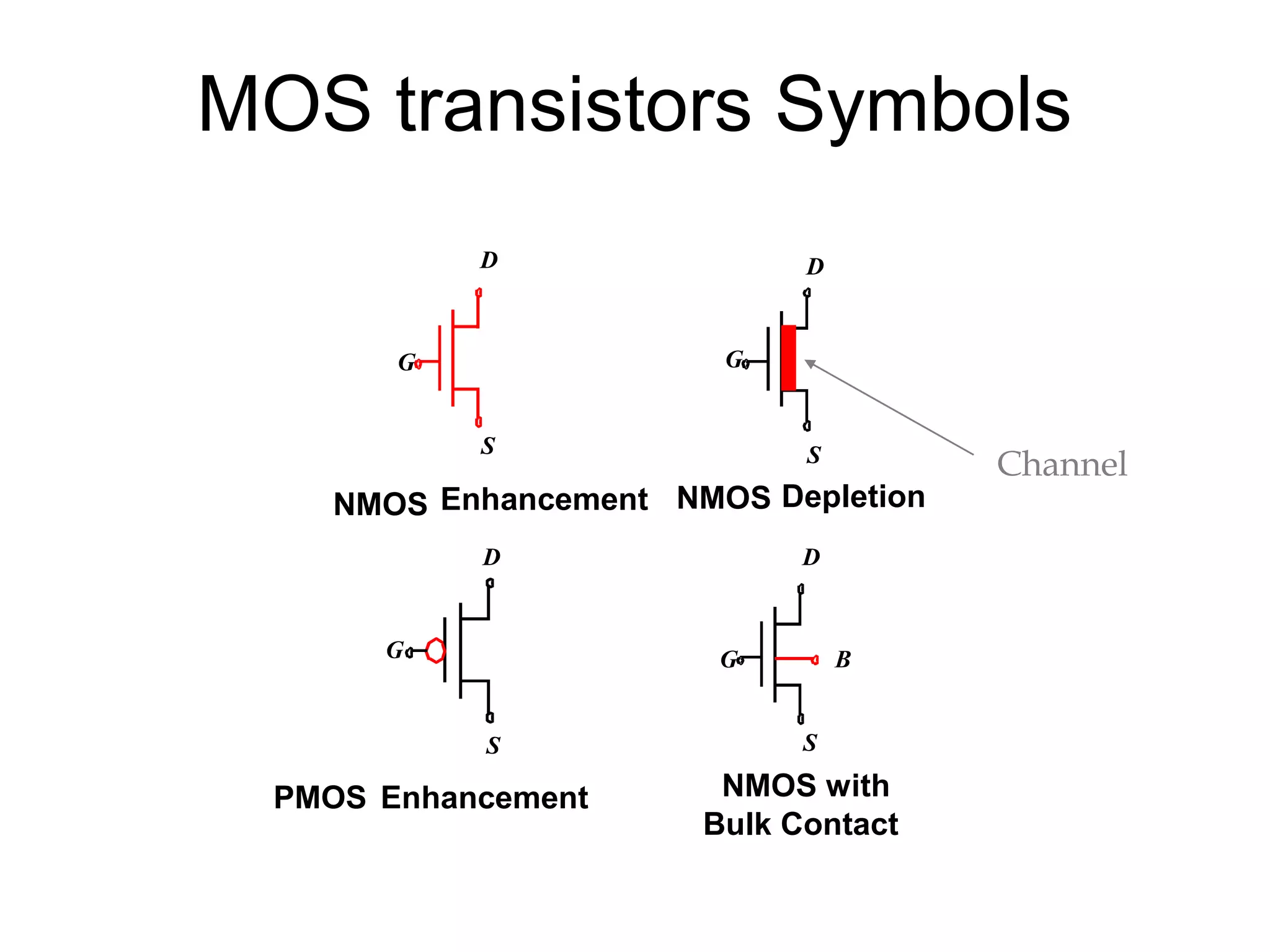
MOS transistors Symbols
D
S
G
D
S
G
G
S
D D
S
G
NMOS Enhancement NMOS
PMOS
Depletion
Enhancement
B
NMOS with
Bulk Contact
Channel
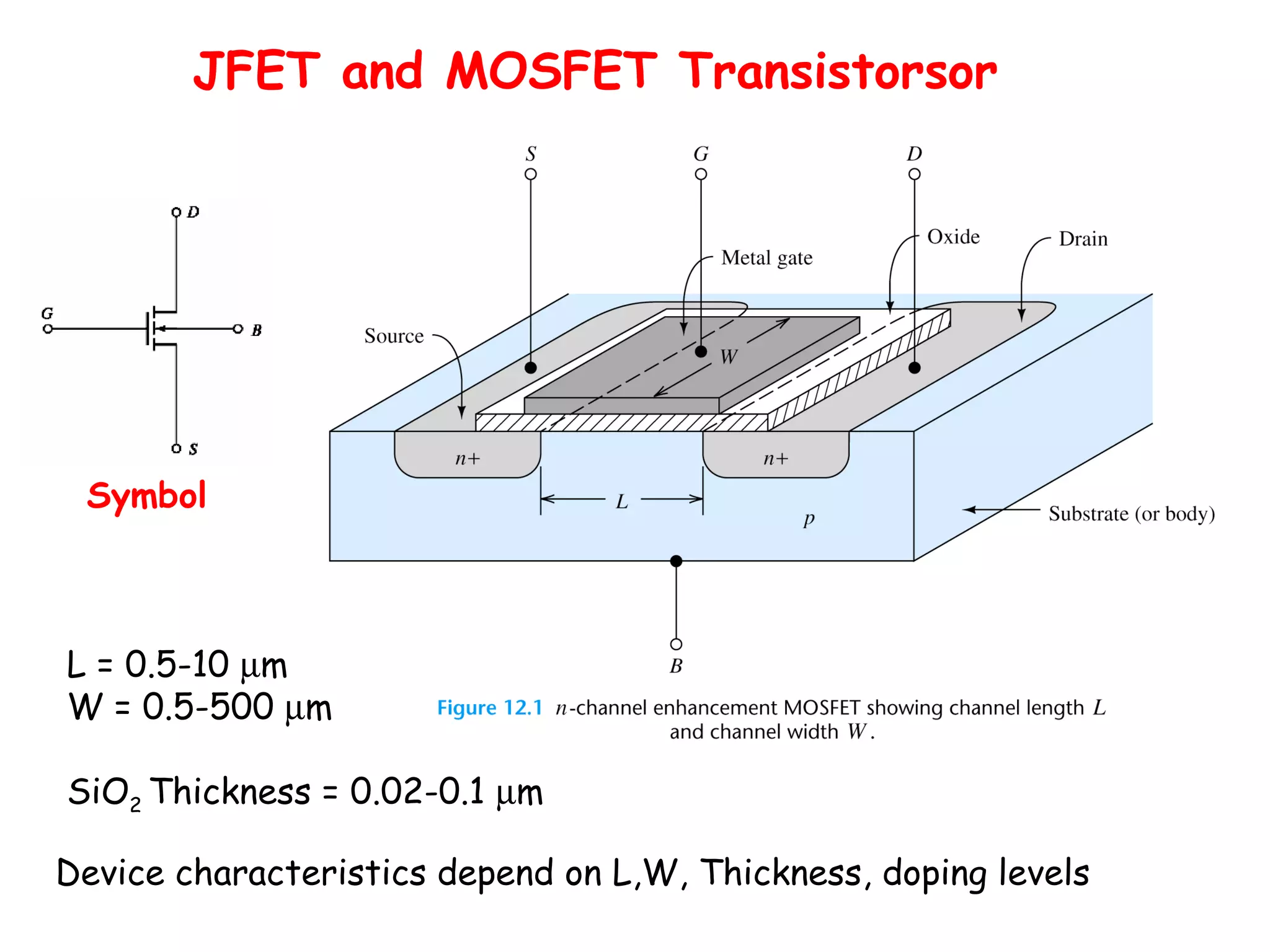
JFET and MOSFET Transistorsor
L = 0.5-10 µm
W = 0.5-500 µm
SiO2 Thickness = 0.02-0.1 µm
Device characteristics depend on L,W, Thickness, doping levels
Symbol
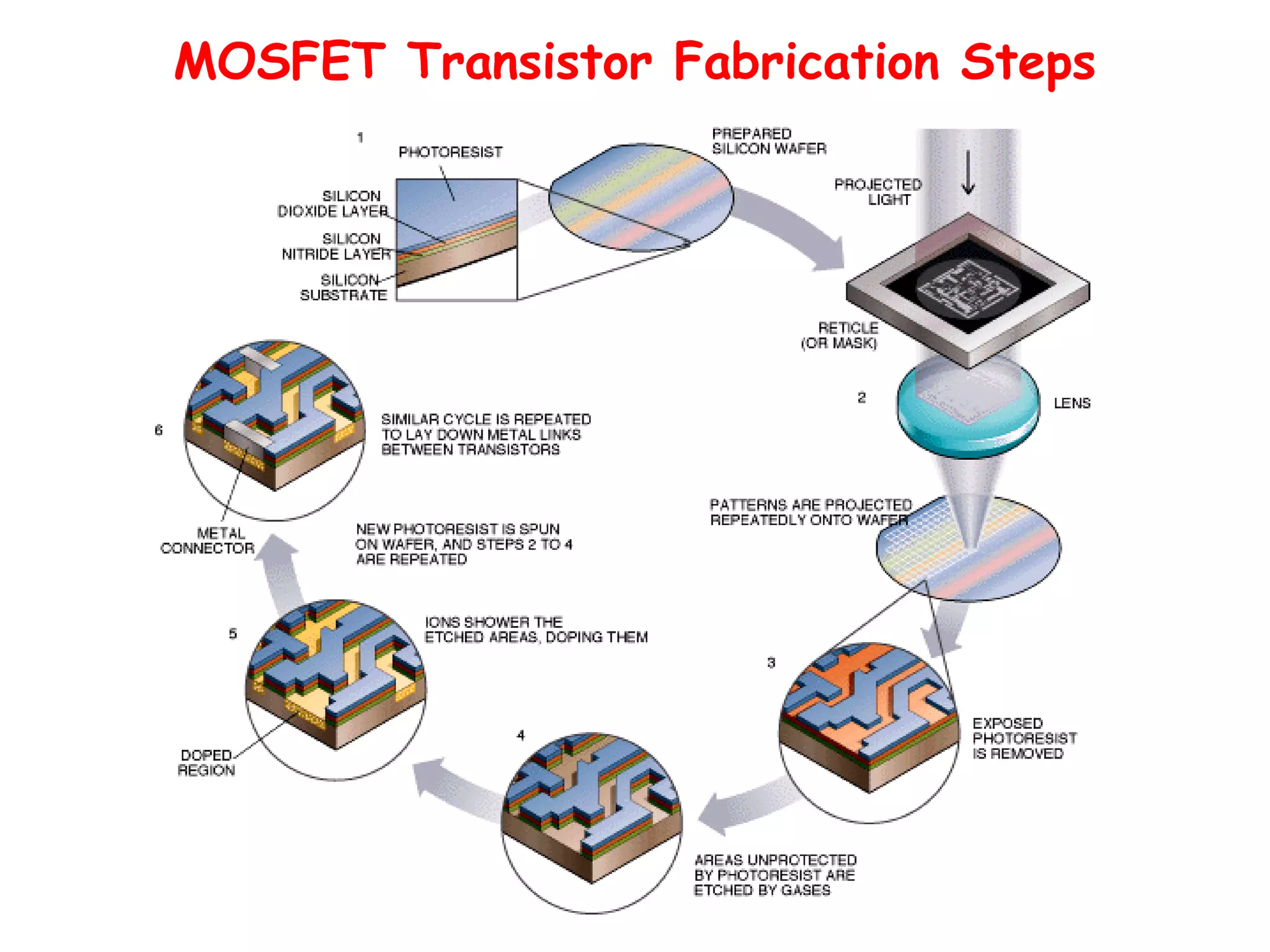
MOSFET Transistor Fabrication Steps
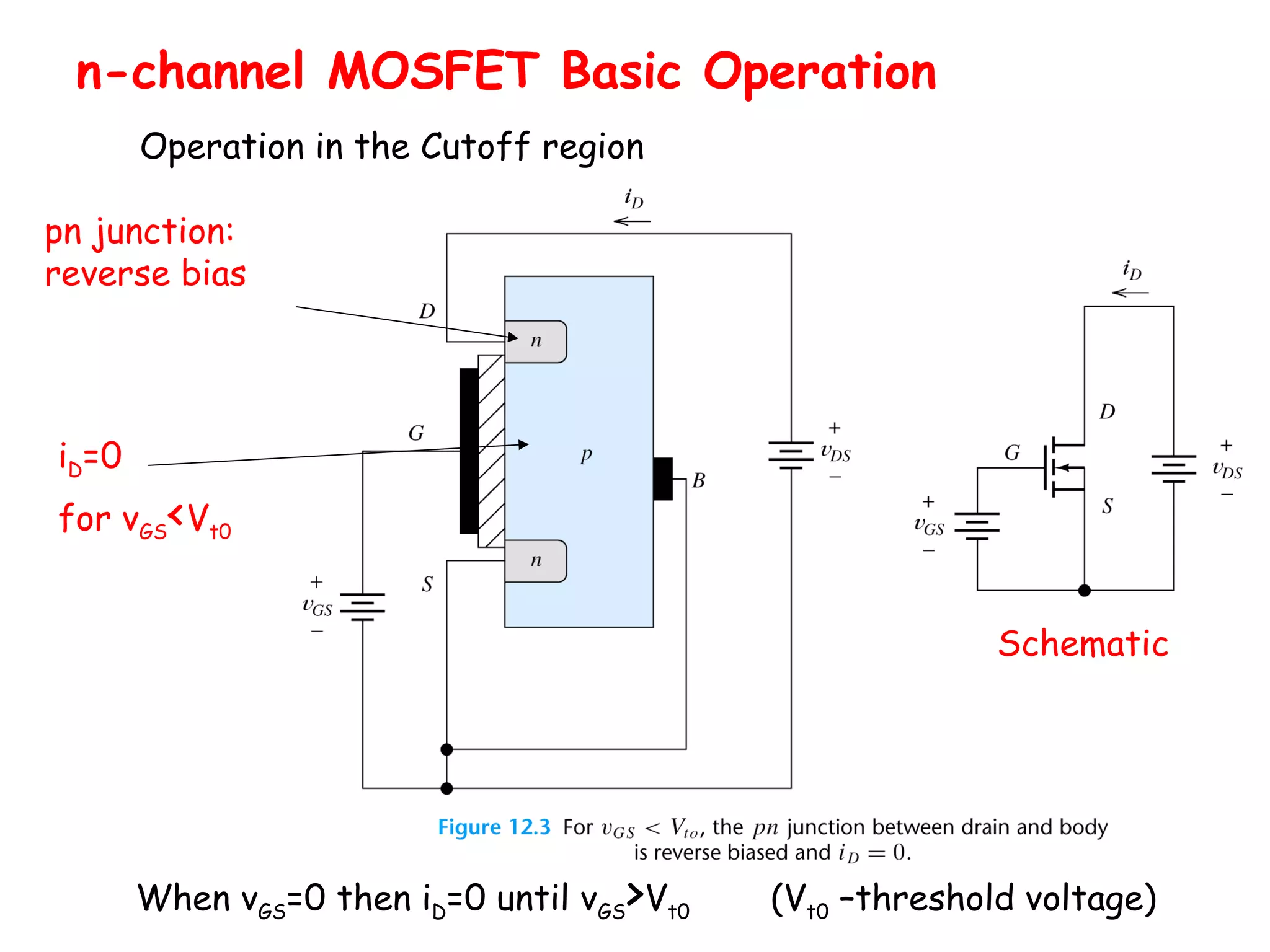
n-channel MOSFET Basic Operation
Operation in the Cutoff region
Schematic
pn junction:
reverse bias
iD=0
for vGS<Vt0
When vGS=0 then iD=0 until vGS>Vt0 (Vt0 –threshold voltage)
n-channel MOSFET Basic Operation
Operation in the Triode Region
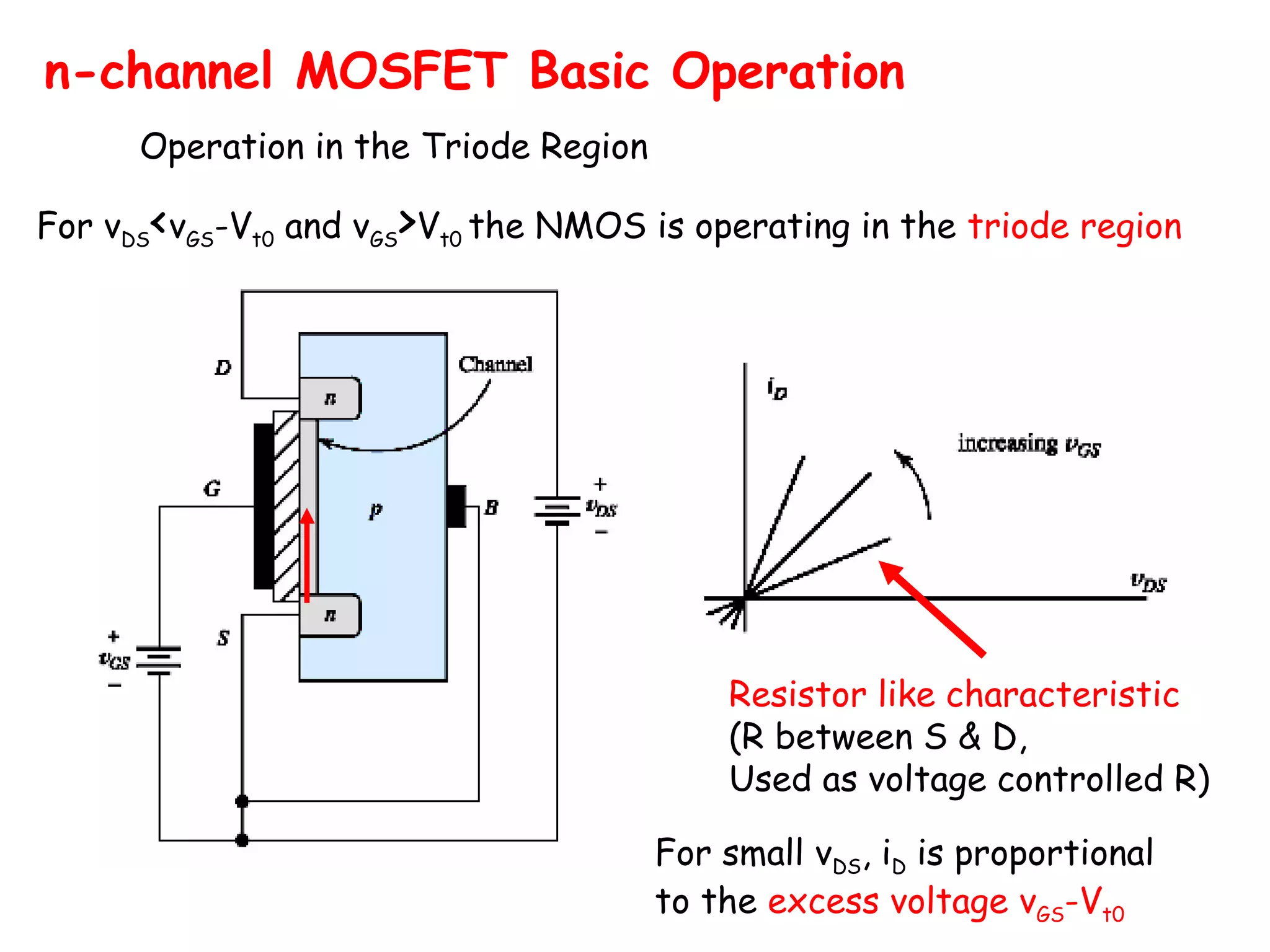
For vDS<vGS-Vt0 and vGS>Vt0 the NMOS is operating in the triode region
Resistor like characteristic
(R between S & D,
Used as voltage controlled R)
For small vDS, iD is proportional
to the excess voltage vGS-Vt0
n-channel MOSFET Basic Operation
Operation in the Triode Region
( )[ ]2
02 DSDStGSD vvVvKi −−=
2
KP
L
W
K 





=
Device parameter KP for
NMOSFET is 50 µA/V2
n-channel MOSFET Basic Operation
Operation in the Saturation Region (vDS is increased)
Tapering
of the
channel
- increments
of iD are
smaller
when
vDS is
larger When vGD=Vt0 then the channel
thickness is 0 and
( )2
0tGSD VvKi −=
n-channel MOSFET Basic Operation
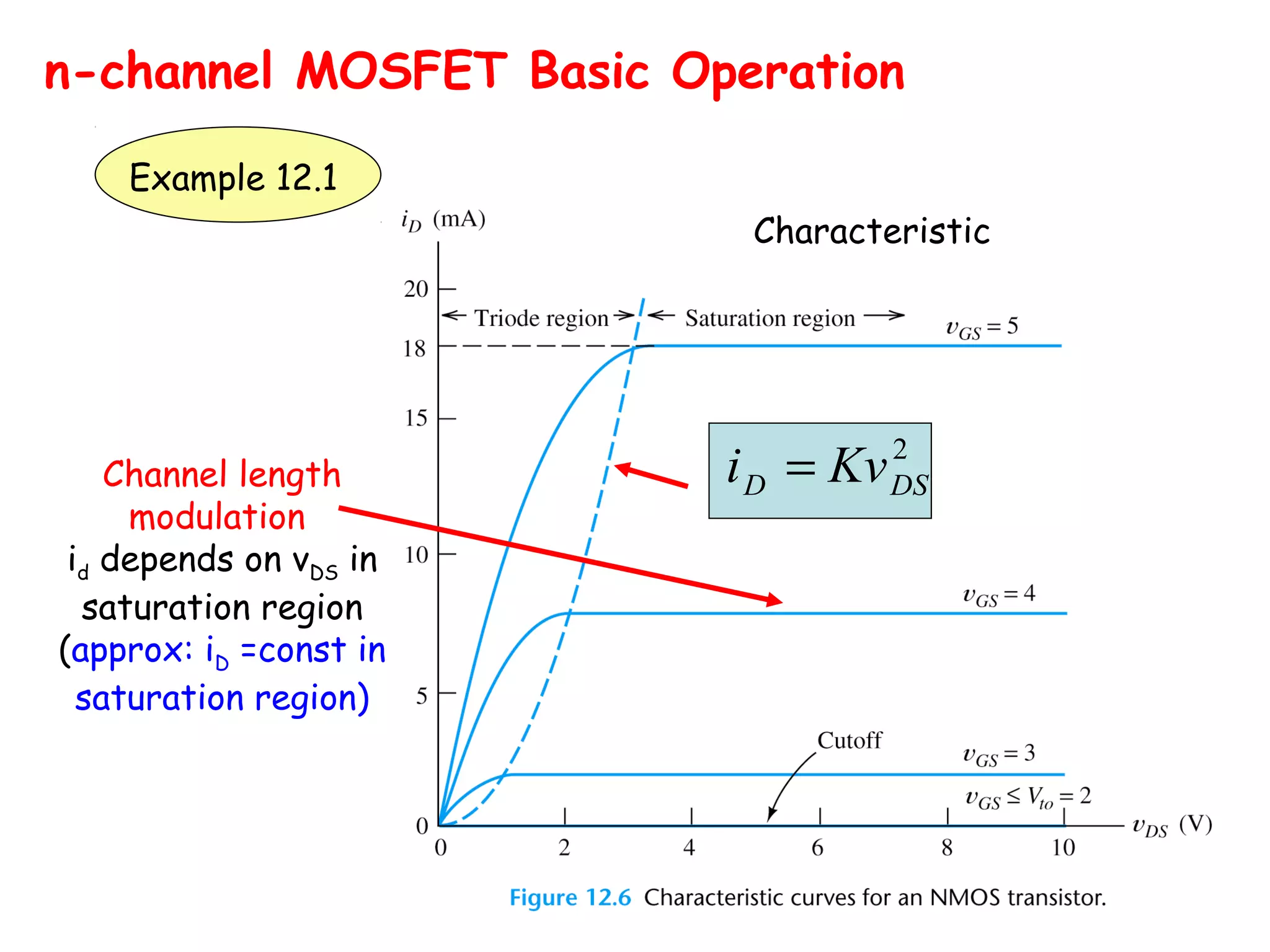
Characteristic
2
DSD Kvi =
Example 12.1
Channel length
modulation
id depends on vDS in
saturation region
(approx: iD =const in
saturation region)
p-channel MOSFET Basic Operation
It is constructed by interchanging the n and p regions of n-
channel MOSFET.
Symbol
Characteristic
How does p-channel
MOSFET operate?
-voltage polarities
-iD current
-schematic

Transistor

  • 1.
  • 2.
    1.Construction of MOS 2.NMOSand PMOS 3.Types of MOS 4.MOSFET Basic Operation 5.Characteristics
  • 3.
    The MOS Transistor PolysiliconAluminum JFET – Junction Field Effect Transistor MOSFET - Metal Oxide Semiconductor Field Effect Transistor n-channel MOSFET (nMOS) & p-channel MOSFET (pMOS)
  • 4.
    The MOS Transistor n+n+ p-substrate Field-Oxide (SiO2) p+stopper Polysilicon Gate Oxide DrainSource Gate Bulk Contact CROSS-SECTION of NMOS Transistor
  • 5.
    Switch Model ofNMOS Transistor Gate Source (of carriers) Drain (of carriers) | VGS | | VGS | < | VT | | VGS | > | VT | Open (off) (Gate = ‘0’) Closed (on) (Gate = ‘1’) Ron
  • 6.
    Switch Model ofPMOS Transistor Gate Source (of carriers) Drain (of carriers) | VGS | | VGS | > | VDD – | VT | | | VGS | < | VDD – |VT| | Open (off) (Gate = ‘1’) Closed (on) (Gate = ‘0’) Ron
  • 7.
    MOS transistors Symbols D S G D S G G S DD S G NMOS Enhancement NMOS PMOS Depletion Enhancement B NMOS with Bulk Contact Channel
  • 8.
    JFET and MOSFETTransistorsor L = 0.5-10 µm W = 0.5-500 µm SiO2 Thickness = 0.02-0.1 µm Device characteristics depend on L,W, Thickness, doping levels Symbol
  • 9.
  • 10.
    n-channel MOSFET BasicOperation Operation in the Cutoff region Schematic pn junction: reverse bias iD=0 for vGS<Vt0 When vGS=0 then iD=0 until vGS>Vt0 (Vt0 –threshold voltage)
  • 11.
    n-channel MOSFET BasicOperation Operation in the Triode Region For vDS<vGS-Vt0 and vGS>Vt0 the NMOS is operating in the triode region Resistor like characteristic (R between S & D, Used as voltage controlled R) For small vDS, iD is proportional to the excess voltage vGS-Vt0
  • 12.
    n-channel MOSFET BasicOperation Operation in the Triode Region ( )[ ]2 02 DSDStGSD vvVvKi −−= 2 KP L W K       = Device parameter KP for NMOSFET is 50 µA/V2
  • 13.
    n-channel MOSFET BasicOperation Operation in the Saturation Region (vDS is increased) Tapering of the channel - increments of iD are smaller when vDS is larger When vGD=Vt0 then the channel thickness is 0 and ( )2 0tGSD VvKi −=
  • 14.
    n-channel MOSFET BasicOperation Characteristic 2 DSD Kvi = Example 12.1 Channel length modulation id depends on vDS in saturation region (approx: iD =const in saturation region)
  • 15.
    p-channel MOSFET BasicOperation It is constructed by interchanging the n and p regions of n- channel MOSFET. Symbol Characteristic How does p-channel MOSFET operate? -voltage polarities -iD current -schematic

Editor's Notes

  • #5 The MOS transistor, or MOSFET is a very simple device to manufacture. It also lends itself to high scale integration. Several thousand devices can be manufactured on a single chip without the devices interacting with one another. Heavily doped n-type source and drain regions are implanted (diffused) into a lightly doped p-type substrate (body). A thin layer of SiO2 (gate oxide) is grown over the region between the source and drain and is covered by a polysilicon gate. Neighboring devices are shielded with a thick layer of SiO2 (field oxide) and a reverse-biased np-diode formed by adding a an extra P+ region (channel-stop implant or field implant) When a voltage larger than the threshold voltage, VT is applied to the gate, a conducting channel is formed between drain and source. Current can then flow from drain to source through the channel if there exists a potential difference between them. Current is carried by electrons in an NMOS transistor. This is unlike a diode where both electrons and holes carry the current though different types of material.
  • #6 Fourth terminal, body (bulk on previous slide)- substrate, not shown. Assumed connected to the appropriate supply rail, GND for NMOS, VDD for PMOS Electrons flow from source to drain – so current is referenced drain to source (IDS) Performs very well as a switch, little parasitic effects Today: STATIC (steady-state view) and later DYNAMIC (transient view) VGS &amp;lt; 0.43 V for off VGS &amp;gt; 0.43 V for on
  • #7 holds flow source to drain – so current is referenced source to drain (ISD) VGS &amp;gt; 2.5 - .4 = 2.1 V for off and Vgs &amp;lt; 2.1 V for on
  • #8 MOS transistors can be either enhancement (no channel at VGS = 0) or depletion (finite channel at VGS = 0) types. Notice the thick line on the symbol that represents the channel. All MOSFET transistors actually have 4 pins (including the base [substrate] pin). Since the substrates are connected to the supply lines in digital circuits, they are typically not drawn.