Dr Soniya Kasliwal
Bangalore University
Dr Soniya Kasliwal
Bangalore University
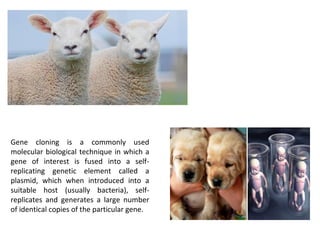
Gene cloning is a commonly used
molecular biological technique in which a
gene of interest is fused into a self-
replicating genetic element called a
plasmid, which when introduced into a
suitable host (usually bacteria), self-
replicates and generates a large number
of identical copies of the particular gene.
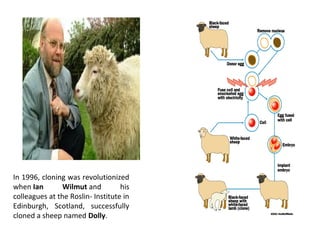
In 1996, cloning was revolutionized
when Ian Wilmut and his
colleagues at the Roslin- Institute in
Edinburgh, Scotland, successfully
cloned a sheep named Dolly.
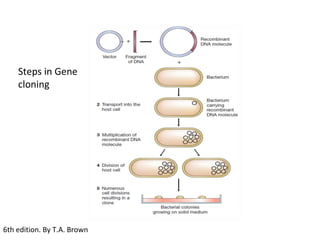
Steps in Gene
cloning
6th edition. By T.A. Brown
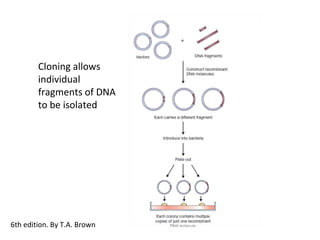
Cloning allows
individual
fragments of DNA
to be isolated
6th edition. By T.A. Brown
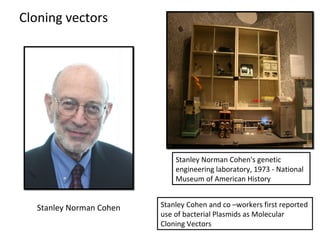
Cloning vectors
Stanley Norman Cohen
Stanley Norman Cohen's genetic
engineering laboratory, 1973 - National
Museum of American History
Stanley Cohen and co –workers first reported
use of bacterial Plasmids as Molecular
Cloning Vectors
Properties
Structure of a vector
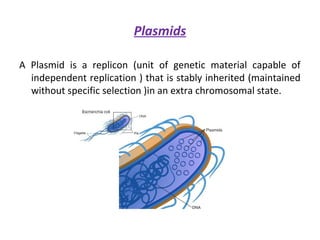
Plasmids
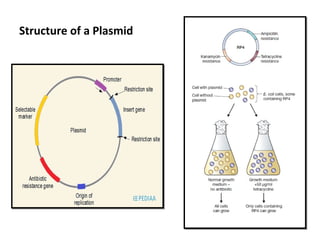
A Plasmid is a replicon (unit of genetic material capable of
independent replication ) that is stably inherited (maintained
without specific selection )in an extra chromosomal state.
Structure of a Plasmid
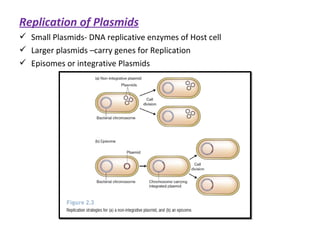
Replication of Plasmids
 Small Plasmids- DNA replicative enzymes of Host cell
 Larger plasmids –carry genes for Replication
 Episomes or integrative Plasmids
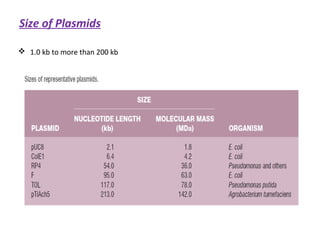
Size of Plasmids
 1.0 kb to more than 200 kb
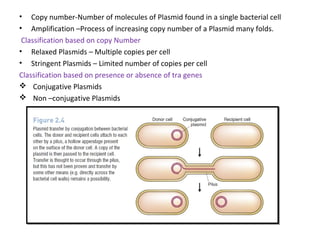
• Copy number-Number of molecules of Plasmid found in a single bacterial cell
• Amplification –Process of increasing copy number of a Plasmid many folds.
Classification based on copy Number
• Relaxed Plasmids – Multiple copies per cell
• Stringent Plasmids – Limited number of copies per cell
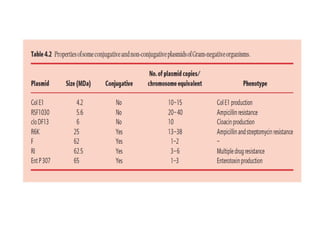
Classification based on presence or absence of tra genes
 Conjugative Plasmids
 Non –conjugative Plasmids
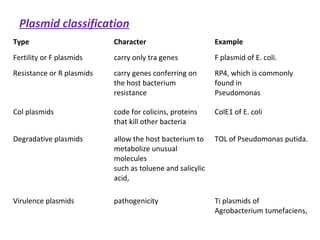
Plasmid classification
Type Character Example
Fertility or F plasmids carry only tra genes F plasmid of E. coli.
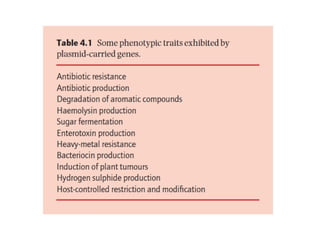
Resistance or R plasmids carry genes conferring on
the host bacterium
resistance
RP4, which is commonly
found in
Pseudomonas
Col plasmids code for colicins, proteins
that kill other bacteria
ColE1 of E. coli
Degradative plasmids allow the host bacterium to
metabolize unusual
molecules
such as toluene and salicylic
acid,
TOL of Pseudomonas putida.
Virulence plasmids pathogenicity Ti plasmids of
Agrobacterium tumefaciens,
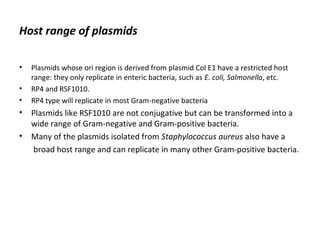
Host range of plasmids
• Plasmids whose ori region is derived from plasmid Col E1 have a restricted host
range: they only replicate in enteric bacteria, such as E. coli, Salmonella, etc.
• RP4 and RSF1010.
• RP4 type will replicate in most Gram-negative bacteria
• Plasmids like RSF1010 are not conjugative but can be transformed into a
wide range of Gram-negative and Gram-positive bacteria.
• Many of the plasmids isolated from Staphylococcus aureus also have a
broad host range and can replicate in many other Gram-positive bacteria.
Isolation of plasmid DNA
• Growth of bacteria and plasmid amplification
• Breaking the bacterial cells to release their contents
• Treatment of bacterial cell extracts to remove all components
except the DNA
• Separation of Plasmid DNA from the chromosomal DNA
Criteria to design a vector
• Vector should be small
• Should be well characterized with respect to gene number,
location and should contain single cleavage site for a large
number of cleavage sites located in one or other genetic
marker.
• Ability to confer readily selectable markers (phenotypic trait)
on the host cells.
• Should be easily propagated .
• Have large number of copies
• Should have additional genetic marker that can be inactivated
by insertion of foreign DNA .
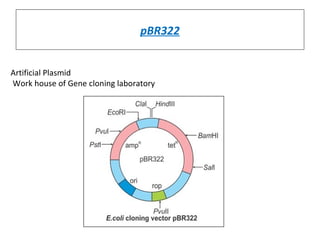
pBR322
Artificial Plasmid
Work house of Gene cloning laboratory
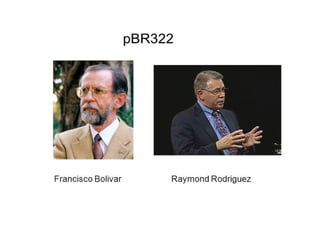
pBR322 is a plasmid and was one of the first widely used E. coli cloning vectors.
Created in 1977 in the laboratory of Herbert Boyer at the University of California,
San Francisco, it was named after the postdoctoral researchers who constructed it.
The p stands for "plasmid," and BR for "Bolivar" and "Rodriguez.“
pBR322 has also served as a model system
for the study of prokaryotic transcription and replication.
Basics
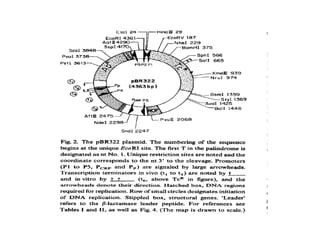
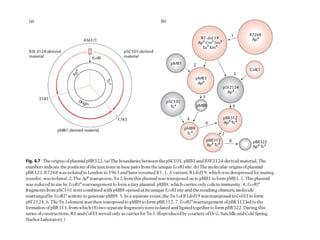
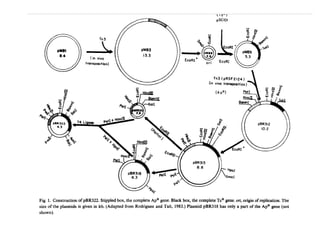
Its size is 4361bp (Watson 1988)
 Contain two antibiotic resistance genes: –
a) Ampicillin resistance gene (ApR) b) Tetracycline resistance gene (TcR)
 These genes were taken from plasmid RSF2124 and pSC101 respectively.
 Origin of replication from plasmid pMB1(ColE1 like plasmid)
• Its total genome has been sequenced in 1979.
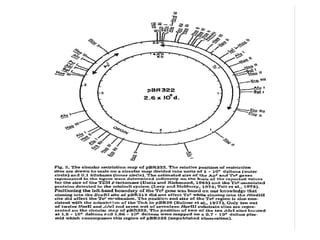
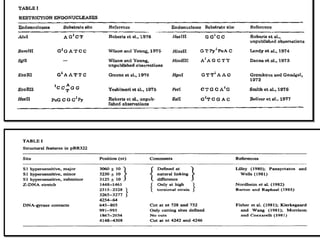
• It contain unique restriction sites for >40 different restriction endonucleases.
• Out of these, 11 are present within tetracycline resistant gene(TcR ) two for ClaI and
HindIII within the promoter of that gene.
• Ampicillin resistant ApR gene contain unique cleavage sites for 6 restriction enzymes
• If any of these 19 R.E. is used for inserting the desired DNA fragment then it will result
in insertional inactivation of that particular gene(either Ap or Tc)
• Use of any RE out of 19 different RE will result in insertional inactivation of that
particular antibiotic resistant gene and it will no longer remain functional.
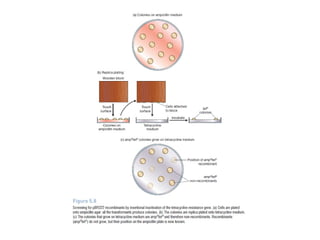
• For eg. If it is inserted in TcR gene then the cells containing it will be resistant to
ampicillin but sensitive to tetracycline.
Importance :-
Model system for study of prokaryotic transcription and translation.
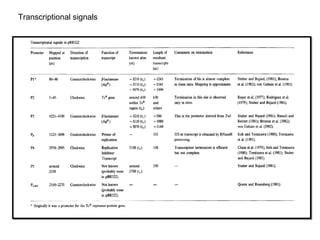
Transcriptional signals
Replication
The ori present in pBR322 shows strong homology to several other ori found in
natural isolates. This type of replicon has been termed ColEl-like, for historical
reasons, Five plasmids belong to this category; pMB1 (ancestor to pBR series),
ColEl, CloDF13, RSF1030 and p15A.
ColE 1 -type replicons are amplificable. Replication of the plasmid DNA may continue
in the absence of protein synthesis, so protein synthesis inhibitors such as Cm and
Sp are widely used to obtain large amounts of DNA per cell.
Mobilization
Plasmid pBR322 can be mobilized by a number of conjugative plasmids under certain
conditions. In the presence of ColK, pBR322 can be mobilized by R64drdll. For
mobilization to occur, a diffusible product from ColK and bom (basis of
mobilization),a cis-acting element, are needed in addition to the conjugative
machinery
The nt sequences that comprise bom sites inpBR322 and ColEl are highly conserved
and their potential secondary structures are similar to those of CloDF13 (Snijders
et al., 1983). The region is indicated around the position of the nick (nt position
2254) in the sequence.
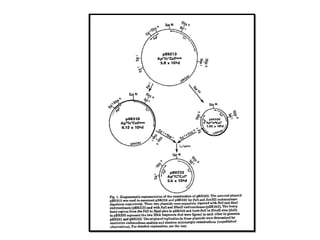
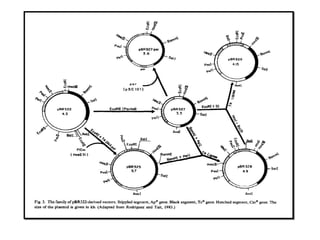
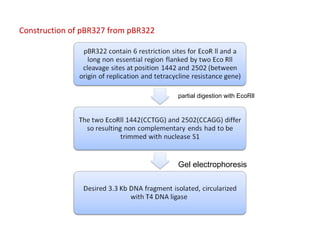
Construction of pBR327 from pBR322
partial digestion with EcoRll
Gel electrophoresis
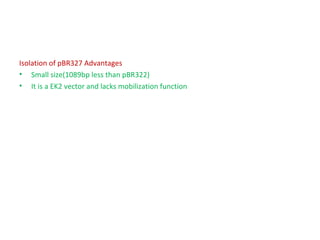
Isolation of pBR327 Advantages
• Small size(1089bp less than pBR322)
• It is a EK2 vector and lacks mobilization function
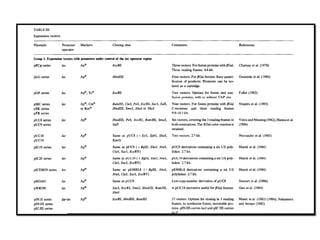
Expression vectors
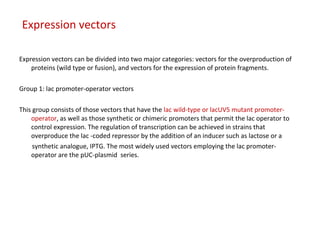
Expression vectors can be divided into two major categories: vectors for the overproduction of
proteins (wild type or fusion), and vectors for the expression of protein fragments.
Group 1: lac promoter-operator vectors
This group consists of those vectors that have the lac wild-type or lacUV5 mutant promoter-
operator, as well as those synthetic or chimeric promoters that permit the lac operator to
control expression. The regulation of transcription can be achieved in strains that
overproduce the lac -coded repressor by the addition of an inducer such as lactose or a
synthetic analogue, IPTG. The most widely used vectors employing the lac promoter-
operator are the pUC-plasmid series.
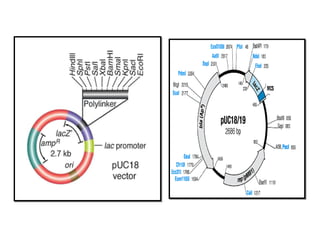
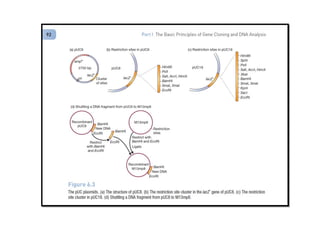
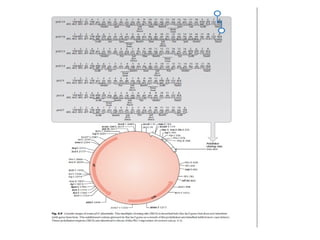
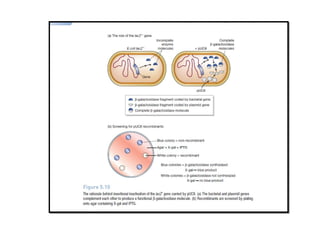
Plasmids pUC
pUC8 is descended from pBR322, although only the replication origin and the ampR
gene remain. The nucleotide sequence of the ampR gene has been changed so
that it no longer contains the unique restriction sites: all these cloning sites are
now clustered into a short segment of the lacZ gene carried by pUC8.′
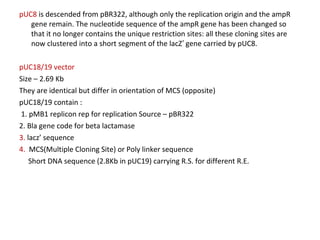
pUC18/19 vector
Size – 2.69 Kb
They are identical but differ in orientation of MCS (opposite)
pUC18/19 contain :
1. pMB1 replicon rep for replication Source – pBR322
2. Bla gene code for beta lactamase
3. lacz’ sequence
4. MCS(Multiple Cloning Site) or Poly linker sequence
Short DNA sequence (2.8Kb in pUC19) carrying R.S. for different R.E.
Cloning vectors
Cloning vectors
Cloning vectors
Cloning vectors
Cloning vectors

Cloning vectors

  • 1.
    Dr Soniya Kasliwal BangaloreUniversity Dr Soniya Kasliwal Bangalore University
  • 3.
    Gene cloning isa commonly used molecular biological technique in which a gene of interest is fused into a self- replicating genetic element called a plasmid, which when introduced into a suitable host (usually bacteria), self- replicates and generates a large number of identical copies of the particular gene.
  • 4.
    In 1996, cloningwas revolutionized when Ian Wilmut and his colleagues at the Roslin- Institute in Edinburgh, Scotland, successfully cloned a sheep named Dolly.
  • 5.
    Steps in Gene cloning 6thedition. By T.A. Brown
  • 6.
    Cloning allows individual fragments ofDNA to be isolated 6th edition. By T.A. Brown
  • 7.
    Cloning vectors Stanley NormanCohen Stanley Norman Cohen's genetic engineering laboratory, 1973 - National Museum of American History Stanley Cohen and co –workers first reported use of bacterial Plasmids as Molecular Cloning Vectors
  • 8.
  • 9.
  • 10.
    Plasmids A Plasmid isa replicon (unit of genetic material capable of independent replication ) that is stably inherited (maintained without specific selection )in an extra chromosomal state.
  • 11.
  • 13.
    Replication of Plasmids Small Plasmids- DNA replicative enzymes of Host cell  Larger plasmids –carry genes for Replication  Episomes or integrative Plasmids
  • 14.
    Size of Plasmids 1.0 kb to more than 200 kb
  • 15.
    • Copy number-Numberof molecules of Plasmid found in a single bacterial cell • Amplification –Process of increasing copy number of a Plasmid many folds. Classification based on copy Number • Relaxed Plasmids – Multiple copies per cell • Stringent Plasmids – Limited number of copies per cell Classification based on presence or absence of tra genes  Conjugative Plasmids  Non –conjugative Plasmids
  • 16.
    Plasmid classification Type CharacterExample Fertility or F plasmids carry only tra genes F plasmid of E. coli. Resistance or R plasmids carry genes conferring on the host bacterium resistance RP4, which is commonly found in Pseudomonas Col plasmids code for colicins, proteins that kill other bacteria ColE1 of E. coli Degradative plasmids allow the host bacterium to metabolize unusual molecules such as toluene and salicylic acid, TOL of Pseudomonas putida. Virulence plasmids pathogenicity Ti plasmids of Agrobacterium tumefaciens,
  • 18.
    Host range ofplasmids • Plasmids whose ori region is derived from plasmid Col E1 have a restricted host range: they only replicate in enteric bacteria, such as E. coli, Salmonella, etc. • RP4 and RSF1010. • RP4 type will replicate in most Gram-negative bacteria • Plasmids like RSF1010 are not conjugative but can be transformed into a wide range of Gram-negative and Gram-positive bacteria. • Many of the plasmids isolated from Staphylococcus aureus also have a broad host range and can replicate in many other Gram-positive bacteria.
  • 19.
    Isolation of plasmidDNA • Growth of bacteria and plasmid amplification • Breaking the bacterial cells to release their contents • Treatment of bacterial cell extracts to remove all components except the DNA • Separation of Plasmid DNA from the chromosomal DNA
  • 20.
    Criteria to designa vector • Vector should be small • Should be well characterized with respect to gene number, location and should contain single cleavage site for a large number of cleavage sites located in one or other genetic marker. • Ability to confer readily selectable markers (phenotypic trait) on the host cells. • Should be easily propagated . • Have large number of copies • Should have additional genetic marker that can be inactivated by insertion of foreign DNA .
  • 21.
    pBR322 Artificial Plasmid Work houseof Gene cloning laboratory
  • 24.
    pBR322 is aplasmid and was one of the first widely used E. coli cloning vectors. Created in 1977 in the laboratory of Herbert Boyer at the University of California, San Francisco, it was named after the postdoctoral researchers who constructed it. The p stands for "plasmid," and BR for "Bolivar" and "Rodriguez.“ pBR322 has also served as a model system for the study of prokaryotic transcription and replication. Basics Its size is 4361bp (Watson 1988)  Contain two antibiotic resistance genes: – a) Ampicillin resistance gene (ApR) b) Tetracycline resistance gene (TcR)  These genes were taken from plasmid RSF2124 and pSC101 respectively.  Origin of replication from plasmid pMB1(ColE1 like plasmid)
  • 27.
    • Its totalgenome has been sequenced in 1979. • It contain unique restriction sites for >40 different restriction endonucleases. • Out of these, 11 are present within tetracycline resistant gene(TcR ) two for ClaI and HindIII within the promoter of that gene. • Ampicillin resistant ApR gene contain unique cleavage sites for 6 restriction enzymes • If any of these 19 R.E. is used for inserting the desired DNA fragment then it will result in insertional inactivation of that particular gene(either Ap or Tc) • Use of any RE out of 19 different RE will result in insertional inactivation of that particular antibiotic resistant gene and it will no longer remain functional. • For eg. If it is inserted in TcR gene then the cells containing it will be resistant to ampicillin but sensitive to tetracycline. Importance :- Model system for study of prokaryotic transcription and translation.
  • 29.
  • 30.
    Replication The ori presentin pBR322 shows strong homology to several other ori found in natural isolates. This type of replicon has been termed ColEl-like, for historical reasons, Five plasmids belong to this category; pMB1 (ancestor to pBR series), ColEl, CloDF13, RSF1030 and p15A. ColE 1 -type replicons are amplificable. Replication of the plasmid DNA may continue in the absence of protein synthesis, so protein synthesis inhibitors such as Cm and Sp are widely used to obtain large amounts of DNA per cell.
  • 31.
    Mobilization Plasmid pBR322 canbe mobilized by a number of conjugative plasmids under certain conditions. In the presence of ColK, pBR322 can be mobilized by R64drdll. For mobilization to occur, a diffusible product from ColK and bom (basis of mobilization),a cis-acting element, are needed in addition to the conjugative machinery The nt sequences that comprise bom sites inpBR322 and ColEl are highly conserved and their potential secondary structures are similar to those of CloDF13 (Snijders et al., 1983). The region is indicated around the position of the nick (nt position 2254) in the sequence.
  • 36.
    Construction of pBR327from pBR322 partial digestion with EcoRll Gel electrophoresis
  • 37.
    Isolation of pBR327Advantages • Small size(1089bp less than pBR322) • It is a EK2 vector and lacks mobilization function
  • 39.
    Expression vectors Expression vectorscan be divided into two major categories: vectors for the overproduction of proteins (wild type or fusion), and vectors for the expression of protein fragments. Group 1: lac promoter-operator vectors This group consists of those vectors that have the lac wild-type or lacUV5 mutant promoter- operator, as well as those synthetic or chimeric promoters that permit the lac operator to control expression. The regulation of transcription can be achieved in strains that overproduce the lac -coded repressor by the addition of an inducer such as lactose or a synthetic analogue, IPTG. The most widely used vectors employing the lac promoter- operator are the pUC-plasmid series.
  • 41.
  • 43.
    pUC8 is descendedfrom pBR322, although only the replication origin and the ampR gene remain. The nucleotide sequence of the ampR gene has been changed so that it no longer contains the unique restriction sites: all these cloning sites are now clustered into a short segment of the lacZ gene carried by pUC8.′ pUC18/19 vector Size – 2.69 Kb They are identical but differ in orientation of MCS (opposite) pUC18/19 contain : 1. pMB1 replicon rep for replication Source – pBR322 2. Bla gene code for beta lactamase 3. lacz’ sequence 4. MCS(Multiple Cloning Site) or Poly linker sequence Short DNA sequence (2.8Kb in pUC19) carrying R.S. for different R.E.