•Hot Start PCR
•Q-PCR
•RT-PCR
•Nested PCR
Kary Mullis
Polymerase Chain Reaction
 PCR is technology in molecular biology
used to amplify a single or a few copies of
DNA across several orders generating
thousands and millions copies of a
particular sequence.
 PCR takes a specific sequence of DNA of
small amounts and amplifies it to be used
for further testing.
 It relies on thermal cycling consisting of
cycles of repeated heating & cooling of the
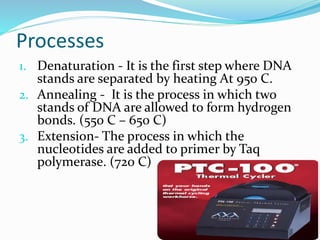
Processes
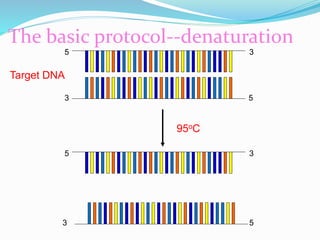
1. Denaturation - It is the first step where DNA
stands are separated by heating At 950 C.
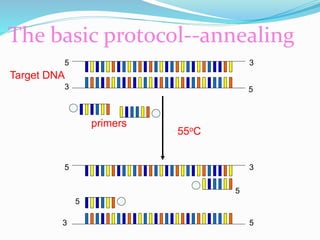
2. Annealing - It is the process in which two
stands of DNA are allowed to form hydrogen
bonds. (550 C – 650 C)
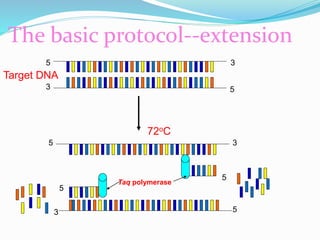
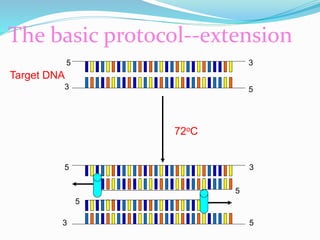
3. Extension- The process in which the
nucleotides are added to primer by Taq
polymerase. (720 C)
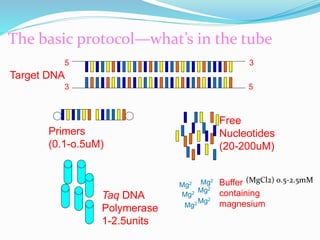
The basic protocol—what’s in the tube
Target DNA
5’ 3’
3’ 5’
Primers
(0.1-o.5uM)
A B
Free
Nucleotides
(20-200uM)
Taq DNA
Polymerase
1-2.5units
Mg2+
Mg2+
Mg2+
Mg2+
Mg2+
Mg2+
Buffer
containing
magnesium
(MgCl2) 0.5-2.5mM
The basic protocol--denaturation
Target DNA
95oC
5’ 3
3’ 5
5’ 3’
3’ 5
The basic protocol--annealing
~55oC
5 3’
3’ 5’
5’ 3
3’ 5’
5’
5’
Target DNA
A
B
primers
A
B
The basic protocol--extension
72oC
5’ 3
3’ 5’
5
’
3’ 5
5’
5’
Target DNA
Taq polymerase
3’
The basic protocol--extension
72oC
’5
3’ 5
5’ 3
3 5’
5’
5’
Target DNA
3’
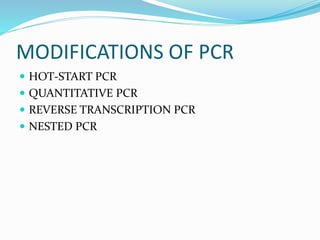
MODIFICATIONS OF PCR
 HOT-START PCR
 QUANTITATIVE PCR
 REVERSE TRANSCRIPTION PCR
 NESTED PCR
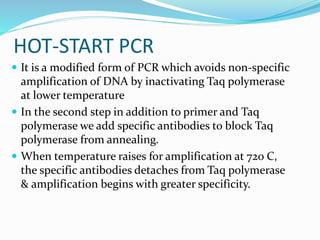
HOT-START PCR
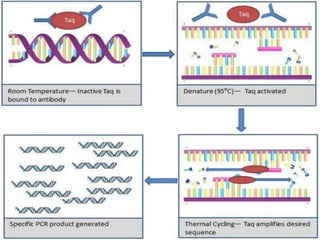
 It is a modified form of PCR which avoids non-specific
amplification of DNA by inactivating Taq polymerase
at lower temperature
 In the second step in addition to primer and Taq
polymerase we add specific antibodies to block Taq
polymerase from annealing.
 When temperature raises for amplification at 72o C,
the specific antibodies detaches from Taq polymerase
& amplification begins with greater specificity.
HOT-START PCR
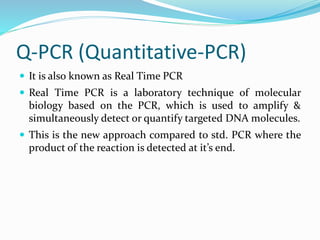
Q-PCR (Quantitative-PCR)
 It is also known as Real Time PCR
 Real Time PCR is a laboratory technique of molecular
biology based on the PCR, which is used to amplify &
simultaneously detect or quantify targeted DNA molecules.
 This is the new approach compared to std. PCR where the
product of the reaction is detected at it’s end.
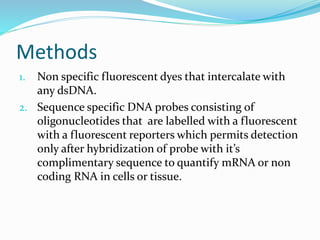
Methods
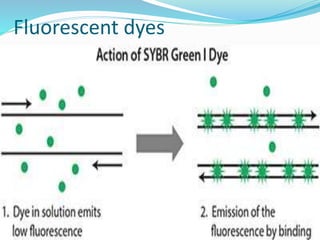
1. Non specific fluorescent dyes that intercalate with
any dsDNA.
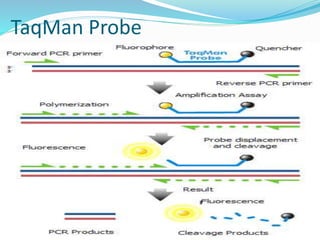
2. Sequence specific DNA probes consisting of
oligonucleotides that are labelled with a fluorescent
with a fluorescent reporters which permits detection
only after hybridization of probe with it’s
complimentary sequence to quantify mRNA or non
coding RNA in cells or tissue.
TaqMan Probe
Fluorescent dyes
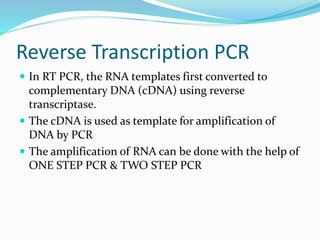
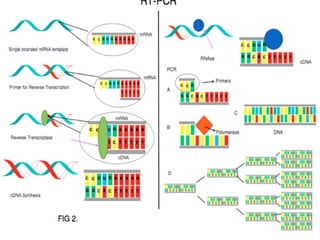
Reverse Transcription PCR
 In RT PCR, the RNA templates first converted to
complementary DNA (cDNA) using reverse
transcriptase.
 The cDNA is used as template for amplification of
DNA by PCR
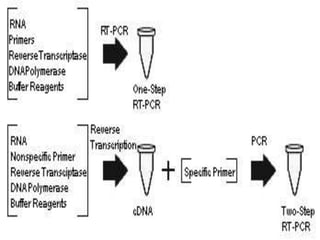
 The amplification of RNA can be done with the help of
ONE STEP PCR & TWO STEP PCR
NESTED PCR
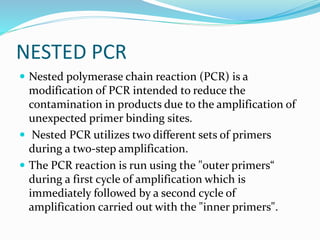
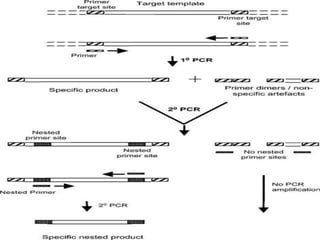
 Nested polymerase chain reaction (PCR) is a
modification of PCR intended to reduce the
contamination in products due to the amplification of
unexpected primer binding sites.
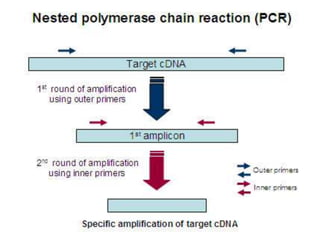
 Nested PCR utilizes two different sets of primers
during a two-step amplification.
 The PCR reaction is run using the "outer primers“
during a first cycle of amplification which is
immediately followed by a second cycle of
amplification carried out with the "inner primers".
NESTED PCR
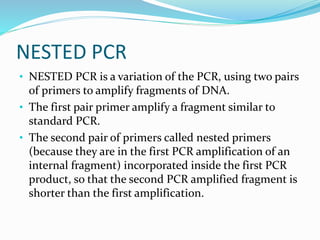
• NESTED PCR is a variation of the PCR, using two pairs
of primers to amplify fragments of DNA.
• The first pair primer amplify a fragment similar to
standard PCR.
• The second pair of primers called nested primers
(because they are in the first PCR amplification of an
internal fragment) incorporated inside the first PCR
product, so that the second PCR amplified fragment is
shorter than the first amplification.
Polymerase chain reaction and it’s modifications

Polymerase chain reaction and it’s modifications

  • 1.
  • 2.
    Polymerase Chain Reaction PCR is technology in molecular biology used to amplify a single or a few copies of DNA across several orders generating thousands and millions copies of a particular sequence.  PCR takes a specific sequence of DNA of small amounts and amplifies it to be used for further testing.  It relies on thermal cycling consisting of cycles of repeated heating & cooling of the
  • 3.
    Processes 1. Denaturation -It is the first step where DNA stands are separated by heating At 950 C. 2. Annealing - It is the process in which two stands of DNA are allowed to form hydrogen bonds. (550 C – 650 C) 3. Extension- The process in which the nucleotides are added to primer by Taq polymerase. (720 C)
  • 4.
    The basic protocol—what’sin the tube Target DNA 5’ 3’ 3’ 5’ Primers (0.1-o.5uM) A B Free Nucleotides (20-200uM) Taq DNA Polymerase 1-2.5units Mg2+ Mg2+ Mg2+ Mg2+ Mg2+ Mg2+ Buffer containing magnesium (MgCl2) 0.5-2.5mM
  • 5.
    The basic protocol--denaturation TargetDNA 95oC 5’ 3 3’ 5 5’ 3’ 3’ 5
  • 6.
    The basic protocol--annealing ~55oC 53’ 3’ 5’ 5’ 3 3’ 5’ 5’ 5’ Target DNA A B primers A B
  • 7.
    The basic protocol--extension 72oC 5’3 3’ 5’ 5 ’ 3’ 5 5’ 5’ Target DNA Taq polymerase 3’
  • 8.
    The basic protocol--extension 72oC ’5 3’5 5’ 3 3 5’ 5’ 5’ Target DNA 3’
  • 9.
    MODIFICATIONS OF PCR HOT-START PCR  QUANTITATIVE PCR  REVERSE TRANSCRIPTION PCR  NESTED PCR
  • 10.
    HOT-START PCR  Itis a modified form of PCR which avoids non-specific amplification of DNA by inactivating Taq polymerase at lower temperature  In the second step in addition to primer and Taq polymerase we add specific antibodies to block Taq polymerase from annealing.  When temperature raises for amplification at 72o C, the specific antibodies detaches from Taq polymerase & amplification begins with greater specificity.
  • 11.
  • 12.
    Q-PCR (Quantitative-PCR)  Itis also known as Real Time PCR  Real Time PCR is a laboratory technique of molecular biology based on the PCR, which is used to amplify & simultaneously detect or quantify targeted DNA molecules.  This is the new approach compared to std. PCR where the product of the reaction is detected at it’s end.
  • 13.
    Methods 1. Non specificfluorescent dyes that intercalate with any dsDNA. 2. Sequence specific DNA probes consisting of oligonucleotides that are labelled with a fluorescent with a fluorescent reporters which permits detection only after hybridization of probe with it’s complimentary sequence to quantify mRNA or non coding RNA in cells or tissue.
  • 14.
  • 15.
  • 16.
    Reverse Transcription PCR In RT PCR, the RNA templates first converted to complementary DNA (cDNA) using reverse transcriptase.  The cDNA is used as template for amplification of DNA by PCR  The amplification of RNA can be done with the help of ONE STEP PCR & TWO STEP PCR
  • 19.
    NESTED PCR  Nestedpolymerase chain reaction (PCR) is a modification of PCR intended to reduce the contamination in products due to the amplification of unexpected primer binding sites.  Nested PCR utilizes two different sets of primers during a two-step amplification.  The PCR reaction is run using the "outer primers“ during a first cycle of amplification which is immediately followed by a second cycle of amplification carried out with the "inner primers".
  • 20.
    NESTED PCR • NESTEDPCR is a variation of the PCR, using two pairs of primers to amplify fragments of DNA. • The first pair primer amplify a fragment similar to standard PCR. • The second pair of primers called nested primers (because they are in the first PCR amplification of an internal fragment) incorporated inside the first PCR product, so that the second PCR amplified fragment is shorter than the first amplification.