DNA Manipulating Enzymes
BY UMAIR RASOOL AZMI
DNA manipulation
For recombination, cutting and joining manipulations
carried out by enzymes called restriction endonucleases (for cutting) and ligases (for joining).
DNA manipulative enzymes can be grouped into four broad classes
Nucleases are enzymes that cut, shorten, or degrade nucleic acid molecules.
Ligases join nucleic acid molecules together.
Polymerases make copies of molecules.
Modifying enzymes remove or add chemical groups.
Ligases
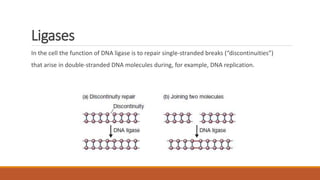
In the cell the function of DNA ligase is to repair single-stranded breaks (“discontinuities”)
that arise in double-stranded DNA molecules during, for example, DNA replication.
Polymerases
DNA polymerases are enzymes that synthesize a new strand of DNA complementary to an
existing DNA or RNA template
Most polymerases can function only if the template possesses a double-stranded region that
acts as a primer for initiation of polymerization.
Three types of DNA polymerase are used routinely in genetic engineering.
i. DNA polymerase I
ii. Klenow fragment
Iii. Reverse transcriptase
DNA Polymerase I
usually prepared from E. coli.
This enzyme attaches to a short single-stranded region (or nick) in a mainly double-stranded DNA
molecule, and then synthesizes a completely new strand, degrading the existing strand as it proceeds
Taq DNA polymerase
An example of an enzyme with a dual activity
◦ DNA polymerization
◦ DNA degradation.
The polymerase and nuclease activities are controlled by different parts of the enzyme molecule.
◦ The nuclease activity is contained in the first 323 amino acids of the polypeptide, so removal of this segment
leaves a modified enzyme that retains the polymerase function but is unable to degrade DNA, called Klenow
fragment
◦ Can’t continue the synthesis once the nick is filled
Reverse transcriptase
Involved in the replication of several kinds of virus.
Reverse transcriptase is unique in that it uses as a template not DNA but RNA.
The ability of this enzyme to synthesize a DNA strand complementary to an RNA template is
central to the technique called complementary DNA (cDNA) cloning
Modifying Enzymes
Modify the DNA molecules by addition or removal of specific chemical groups. The most
important are as follows:
Alkaline phosphatase (from E. coli, calf intestinal tissue, or arctic shrimp), which removes the
phosphate group present at the 5′ terminus of a DNA molecule
Polynucleotide kinase (from E. coli infected with T4 phage), which has the reverse effect to
alkaline phosphatase, adding phosphate groups onto free 5′ termini
Terminal deoxynucleotidyl transferase (from calf thymus tissue), which adds one or more
deoxyribonucleotides onto the 3′ terminus of a DNA molecule
Alkaline phosphatase, which removes 5  -phosphate
groups.
Polynucleotide kinase, which attaches 5  -phosphate groups
Terminal deoxynucleotidyl transferase, which attaches
deoxyribonucleotides to the 3 termini of polynucleotides
in either (i) single-stranded or (ii) double-stranded
molecules.
Nucleases
Nucleases degrade DNA molecules by breaking the phosphodiester bonds that link one
nucleotide to the next in a DNA strand
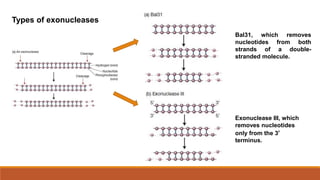
Exonucleases remove nucleotides one at a time from the end of a DNA molecule.
Endonucleases are able to break internal phosphodiester bonds within a DNA molecule
Types of exonucleases
Bal31, which removes
nucleotides from both
strands of a double-
stranded molecule.
Exonuclease III, which
removes nucleotides
only from the 3
terminus.
S1 nuclease, which cleaves
only single-stranded DNA,
including single-stranded
nicks in mainly double-
stranded molecules.
DNase I, which cleaves both
single- and double-stranded
DNA.
A restriction endonuclease,
which cleaves double-
stranded DNA, but only at a
limited number of sites.
Types of endonucleases
Restriction Endonucleases or Enzymes
A protein that recognizes a particular sequence of DNA and cuts the DNA at that
site (the restriction site)
• Molecular scissors that cut double stranded DNA molecules at specific points.
• Found naturally in a wide variety of prokaryotes.
• An important tool for manipulating DNA.
Restriction Endonucleases
In gene cloning, DNA molecules must be cut in a very precise and
reproducible fashion.
This is illustrated by the way in which the vector is cut during
construction of a recombinant DNA molecule
Each vector molecule must be cleaved at a single position, to open
up the circle so that new DNA can be inserted
A molecule that is cut more than once will be broken into two or
more separate fragments and will be of no use as a cloning vector.
Mechanism of Action
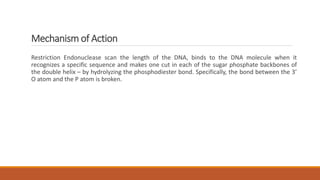
Restriction Endonuclease scan the length of the DNA, binds to the DNA molecule when it
recognizes a specific sequence and makes one cut in each of the sugar phosphate backbones of
the double helix – by hydrolyzing the phosphodiester bond. Specifically, the bond between the 3’
O atom and the P atom is broken.
Biological Role and types
Most bacteria use Restriction Enzymes as a defense against bacteriophages.
Restriction enzymes prevent the replication of the phage by cleaving its DNA at specific sites.
The host DNA is protected by Methylases which add methyl groups to adenine or cytosine
bases within the recognition site thereby modifying the site and protecting the DNA.
Three different classes of restriction endonucleases
◦ Type I
◦ Type II
◦ Type III
Type II restriction endonucleases
Have a specific recognition sequence at which a DNA molecule is cut. A particular enzyme
cleaves DNA at the recognition sequence and nowhere else.
Many restriction endonucleases recognize hexanucleotide target sites, but others cut at four,
five, eight, or even longer nucleotide sequences
*The sequence shown is that of one strand, given in the 5 to 3 direction. “N” indicates any nucleotide.
Note that almost all recognition sequences are palindromes: when both strands are considered they read the same
in each direction, for example:
5–GAATTC–3
| | | | | |
3–CTTAAG–5
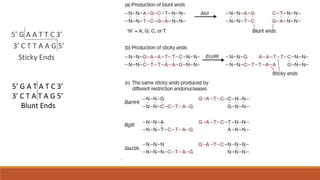
Blunt ends and sticky ends
Many restriction endonucleases make a simple double-stranded cut in the middle of the
recognition sequence resulting in a blunt end or flush end e.g. PvuII and AluI
Cleavage by other enzymes is staggered, usually by two or four nucleotides, so that the resulting
DNA fragments have short single-stranded overhangs at each end
These are called sticky or cohesive ends, as base pairing between them can stick the DNA
molecule back together again
BamHI (recognition sequence GGATCC) and BglII (AGATCT) are examples—both produce GATC
sticky ends
5’ G A A T T C 3’
3’ C T T A A G 5’
Sticky Ends
5’ G A T A T C 3’
3’ C T A T A G 5’
Blunt Ends
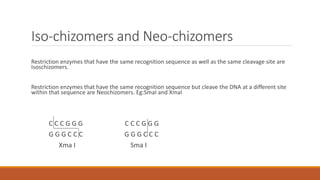
Iso-chizomers and Neo-chizomers
Restriction enzymes that have the same recognition sequence as well as the same cleavage site are
Isoschizomers.
Restriction enzymes that have the same recognition sequence but cleave the DNA at a different site
within that sequence are Neochizomers. Eg:SmaI and XmaI
C C C G G G C C C G G G
G G G C C C G G G C C C
Xma I Sma I
How to name Restriction Endonucleases ?
Named for bacterial genus, species, strain, and type
For example: EcoR1
Genus: Escherichia
Species: coli
Strain: R
Order discovered: 1
Uses of Restriction Enzymes
Restriction Enzymes can be used to generate a restriction
map. This can provide useful information in characterizing
a DNA molecule.
Uses….
Restriction Fragment Length Polymorphism is a tool to study variations among
individuals & among species
Uses….
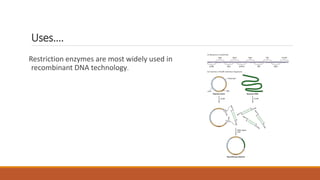
Restriction enzymes are most widely used in
recombinant DNA technology.

DNA manipulation

  • 1.
    DNA Manipulating Enzymes BYUMAIR RASOOL AZMI
  • 2.
    DNA manipulation For recombination,cutting and joining manipulations carried out by enzymes called restriction endonucleases (for cutting) and ligases (for joining). DNA manipulative enzymes can be grouped into four broad classes Nucleases are enzymes that cut, shorten, or degrade nucleic acid molecules. Ligases join nucleic acid molecules together. Polymerases make copies of molecules. Modifying enzymes remove or add chemical groups.
  • 3.
    Ligases In the cellthe function of DNA ligase is to repair single-stranded breaks (“discontinuities”) that arise in double-stranded DNA molecules during, for example, DNA replication.
  • 4.
    Polymerases DNA polymerases areenzymes that synthesize a new strand of DNA complementary to an existing DNA or RNA template Most polymerases can function only if the template possesses a double-stranded region that acts as a primer for initiation of polymerization. Three types of DNA polymerase are used routinely in genetic engineering. i. DNA polymerase I ii. Klenow fragment Iii. Reverse transcriptase
  • 5.
    DNA Polymerase I usuallyprepared from E. coli. This enzyme attaches to a short single-stranded region (or nick) in a mainly double-stranded DNA molecule, and then synthesizes a completely new strand, degrading the existing strand as it proceeds Taq DNA polymerase An example of an enzyme with a dual activity ◦ DNA polymerization ◦ DNA degradation. The polymerase and nuclease activities are controlled by different parts of the enzyme molecule. ◦ The nuclease activity is contained in the first 323 amino acids of the polypeptide, so removal of this segment leaves a modified enzyme that retains the polymerase function but is unable to degrade DNA, called Klenow fragment ◦ Can’t continue the synthesis once the nick is filled
  • 6.
    Reverse transcriptase Involved inthe replication of several kinds of virus. Reverse transcriptase is unique in that it uses as a template not DNA but RNA. The ability of this enzyme to synthesize a DNA strand complementary to an RNA template is central to the technique called complementary DNA (cDNA) cloning
  • 8.
    Modifying Enzymes Modify theDNA molecules by addition or removal of specific chemical groups. The most important are as follows: Alkaline phosphatase (from E. coli, calf intestinal tissue, or arctic shrimp), which removes the phosphate group present at the 5′ terminus of a DNA molecule Polynucleotide kinase (from E. coli infected with T4 phage), which has the reverse effect to alkaline phosphatase, adding phosphate groups onto free 5′ termini Terminal deoxynucleotidyl transferase (from calf thymus tissue), which adds one or more deoxyribonucleotides onto the 3′ terminus of a DNA molecule
  • 9.
    Alkaline phosphatase, whichremoves 5  -phosphate groups. Polynucleotide kinase, which attaches 5  -phosphate groups Terminal deoxynucleotidyl transferase, which attaches deoxyribonucleotides to the 3 termini of polynucleotides in either (i) single-stranded or (ii) double-stranded molecules.
  • 10.
    Nucleases Nucleases degrade DNAmolecules by breaking the phosphodiester bonds that link one nucleotide to the next in a DNA strand Exonucleases remove nucleotides one at a time from the end of a DNA molecule. Endonucleases are able to break internal phosphodiester bonds within a DNA molecule
  • 11.
    Types of exonucleases Bal31,which removes nucleotides from both strands of a double- stranded molecule. Exonuclease III, which removes nucleotides only from the 3 terminus.
  • 12.
    S1 nuclease, whichcleaves only single-stranded DNA, including single-stranded nicks in mainly double- stranded molecules. DNase I, which cleaves both single- and double-stranded DNA. A restriction endonuclease, which cleaves double- stranded DNA, but only at a limited number of sites. Types of endonucleases
  • 13.
    Restriction Endonucleases orEnzymes A protein that recognizes a particular sequence of DNA and cuts the DNA at that site (the restriction site) • Molecular scissors that cut double stranded DNA molecules at specific points. • Found naturally in a wide variety of prokaryotes. • An important tool for manipulating DNA.
  • 14.
    Restriction Endonucleases In genecloning, DNA molecules must be cut in a very precise and reproducible fashion. This is illustrated by the way in which the vector is cut during construction of a recombinant DNA molecule Each vector molecule must be cleaved at a single position, to open up the circle so that new DNA can be inserted A molecule that is cut more than once will be broken into two or more separate fragments and will be of no use as a cloning vector.
  • 15.
    Mechanism of Action RestrictionEndonuclease scan the length of the DNA, binds to the DNA molecule when it recognizes a specific sequence and makes one cut in each of the sugar phosphate backbones of the double helix – by hydrolyzing the phosphodiester bond. Specifically, the bond between the 3’ O atom and the P atom is broken.
  • 17.
    Biological Role andtypes Most bacteria use Restriction Enzymes as a defense against bacteriophages. Restriction enzymes prevent the replication of the phage by cleaving its DNA at specific sites. The host DNA is protected by Methylases which add methyl groups to adenine or cytosine bases within the recognition site thereby modifying the site and protecting the DNA. Three different classes of restriction endonucleases ◦ Type I ◦ Type II ◦ Type III
  • 18.
    Type II restrictionendonucleases Have a specific recognition sequence at which a DNA molecule is cut. A particular enzyme cleaves DNA at the recognition sequence and nowhere else. Many restriction endonucleases recognize hexanucleotide target sites, but others cut at four, five, eight, or even longer nucleotide sequences
  • 19.
    *The sequence shownis that of one strand, given in the 5 to 3 direction. “N” indicates any nucleotide. Note that almost all recognition sequences are palindromes: when both strands are considered they read the same in each direction, for example: 5–GAATTC–3 | | | | | | 3–CTTAAG–5
  • 20.
    Blunt ends andsticky ends Many restriction endonucleases make a simple double-stranded cut in the middle of the recognition sequence resulting in a blunt end or flush end e.g. PvuII and AluI Cleavage by other enzymes is staggered, usually by two or four nucleotides, so that the resulting DNA fragments have short single-stranded overhangs at each end These are called sticky or cohesive ends, as base pairing between them can stick the DNA molecule back together again BamHI (recognition sequence GGATCC) and BglII (AGATCT) are examples—both produce GATC sticky ends
  • 21.
    5’ G AA T T C 3’ 3’ C T T A A G 5’ Sticky Ends 5’ G A T A T C 3’ 3’ C T A T A G 5’ Blunt Ends
  • 23.
    Iso-chizomers and Neo-chizomers Restrictionenzymes that have the same recognition sequence as well as the same cleavage site are Isoschizomers. Restriction enzymes that have the same recognition sequence but cleave the DNA at a different site within that sequence are Neochizomers. Eg:SmaI and XmaI C C C G G G C C C G G G G G G C C C G G G C C C Xma I Sma I
  • 24.
    How to nameRestriction Endonucleases ? Named for bacterial genus, species, strain, and type For example: EcoR1 Genus: Escherichia Species: coli Strain: R Order discovered: 1
  • 25.
    Uses of RestrictionEnzymes Restriction Enzymes can be used to generate a restriction map. This can provide useful information in characterizing a DNA molecule.
  • 26.
    Uses…. Restriction Fragment LengthPolymorphism is a tool to study variations among individuals & among species
  • 27.
    Uses…. Restriction enzymes aremost widely used in recombinant DNA technology.

Editor's Notes

  • #18 Restriction occurs because the bacterium produces an enzyme that degrades the phage DNA before it has time to replicate and direct synthesis of new phage particles (Figure 4.8a). The bacterium’s own DNA, the destruction of which would of course be lethal, is protected from attack because it carries additional methyl groups that block the degradative enzyme action