Introduction to Chemical
Reactions
What is a Chemical Reaction?
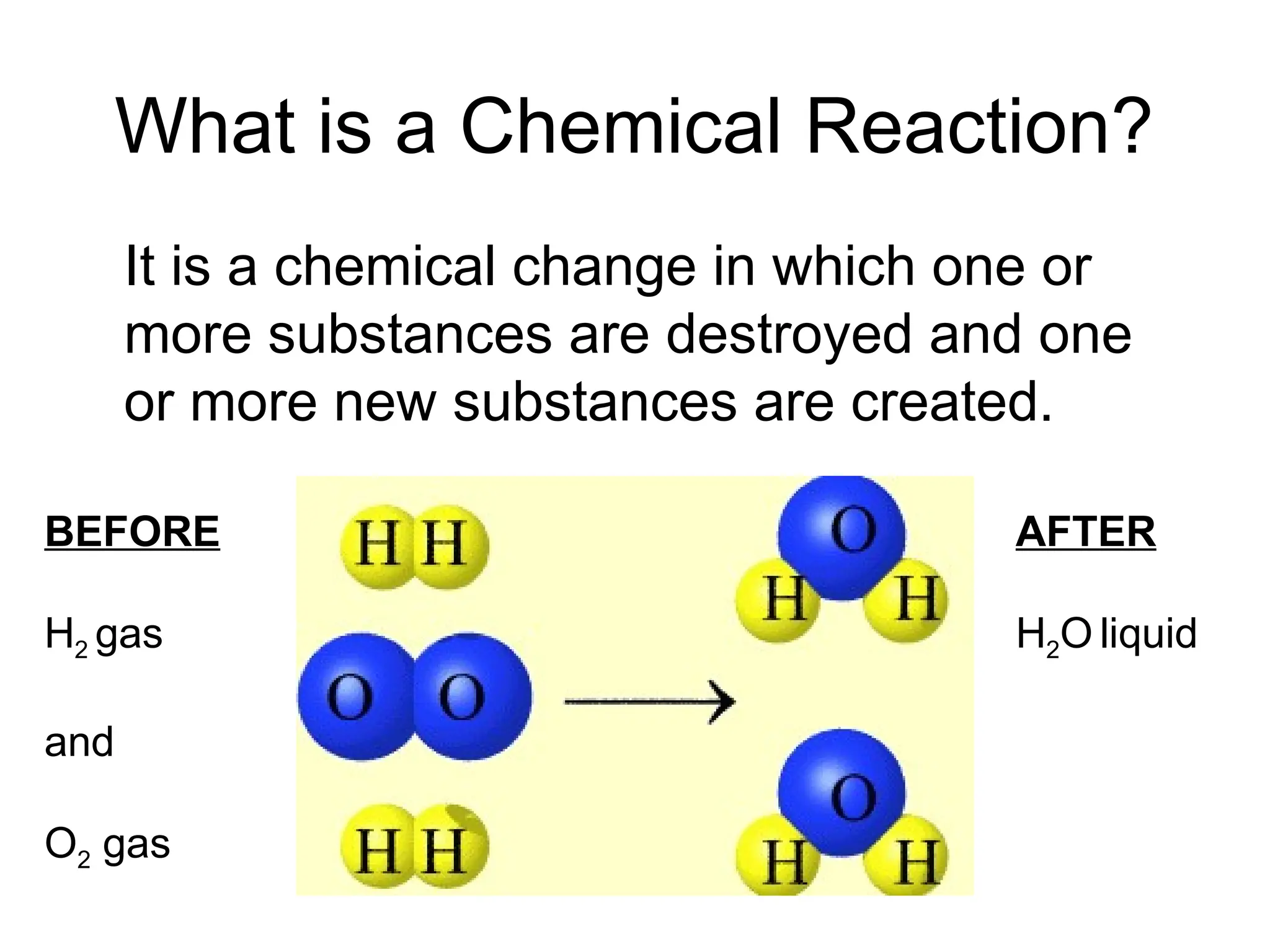
It is a chemical change in which one or
more substances are destroyed and one
or more new substances are created.
BEFORE
H2 gas
and
O2 gas
AFTER
H2O liquid
Parts of a Chemical Reaction
Reactants  Products
Reactants: Substances that are destroyed by the
chemical change (bonds break
break).
Products: Substances created by the chemical
change (new bonds form
form).
The arrow () is read as “yields”.
Other symbols in chemical
reactions
• (s) = solid
• (l) = liquid
• (g) = gas
• (aq) = aqueous solution (the substance is
dissolved in H2O)
• “+” separates two or more reactants or
products
• “” yield sign separates reactants from
products
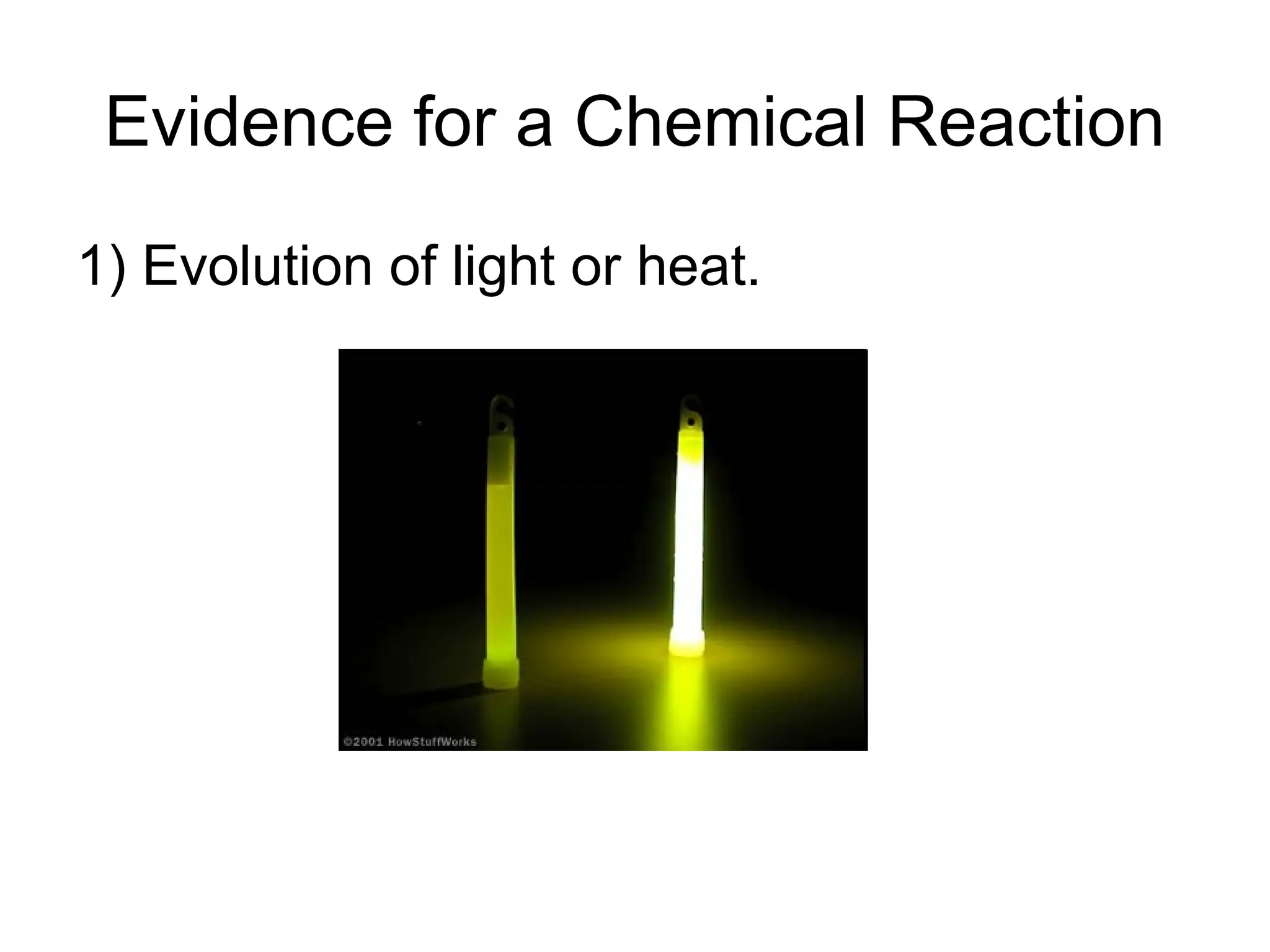
Evidence for a Chemical Reaction
1) Evolution of light or heat.
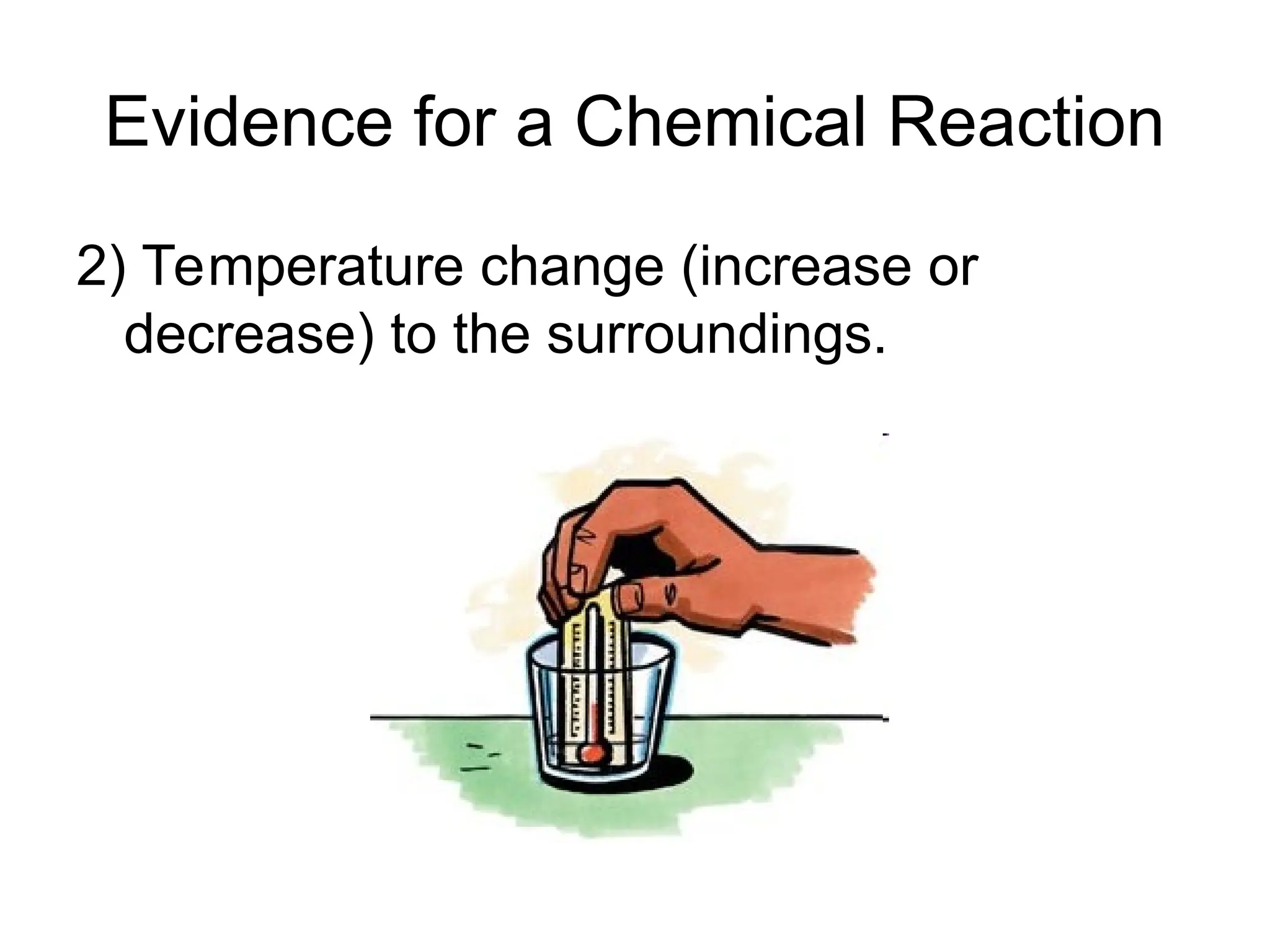
Evidence for a Chemical Reaction
2) Temperature change (increase or
decrease) to the surroundings.
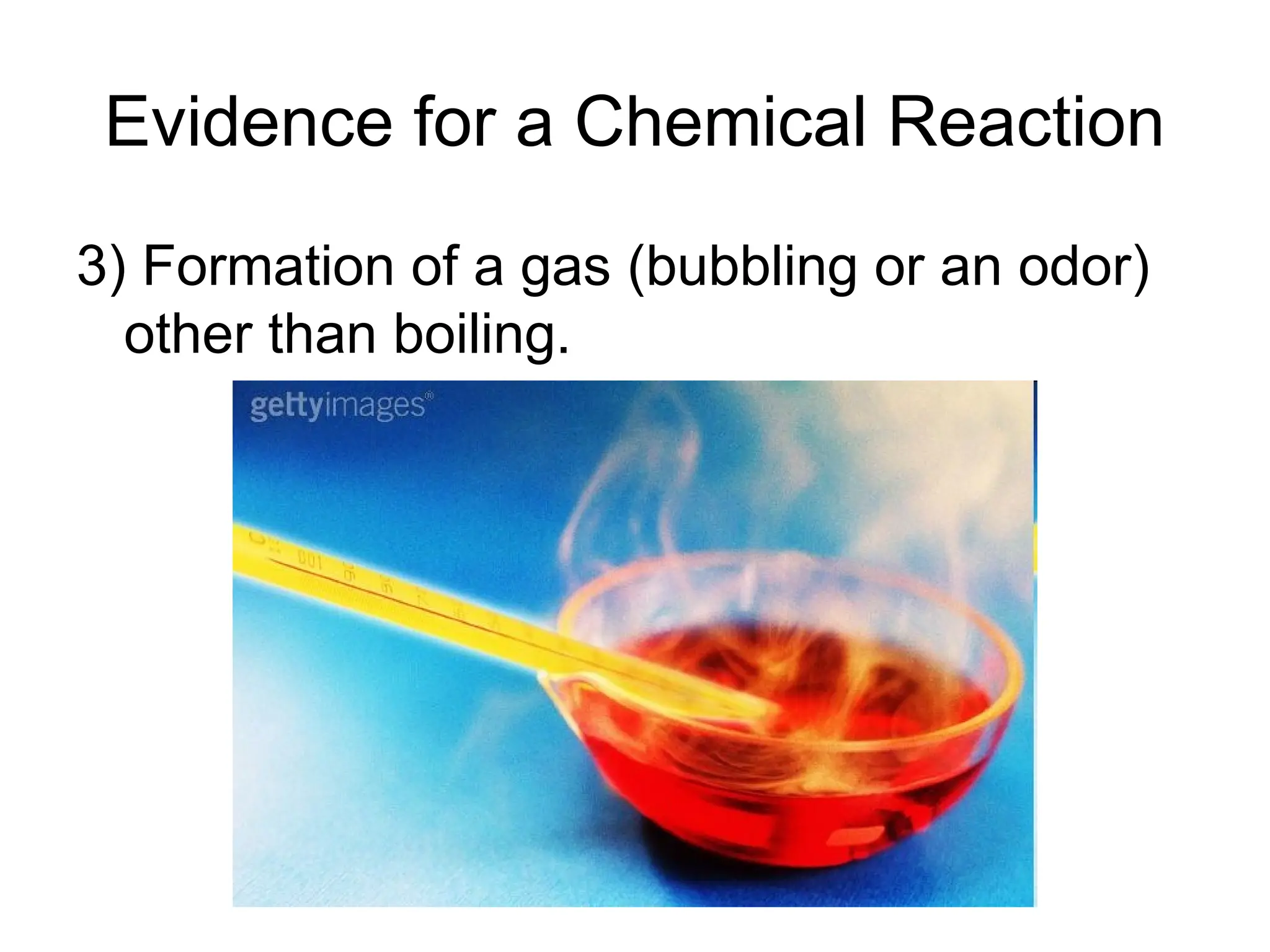
Evidence for a Chemical Reaction
3) Formation of a gas (bubbling or an odor)
other than boiling.
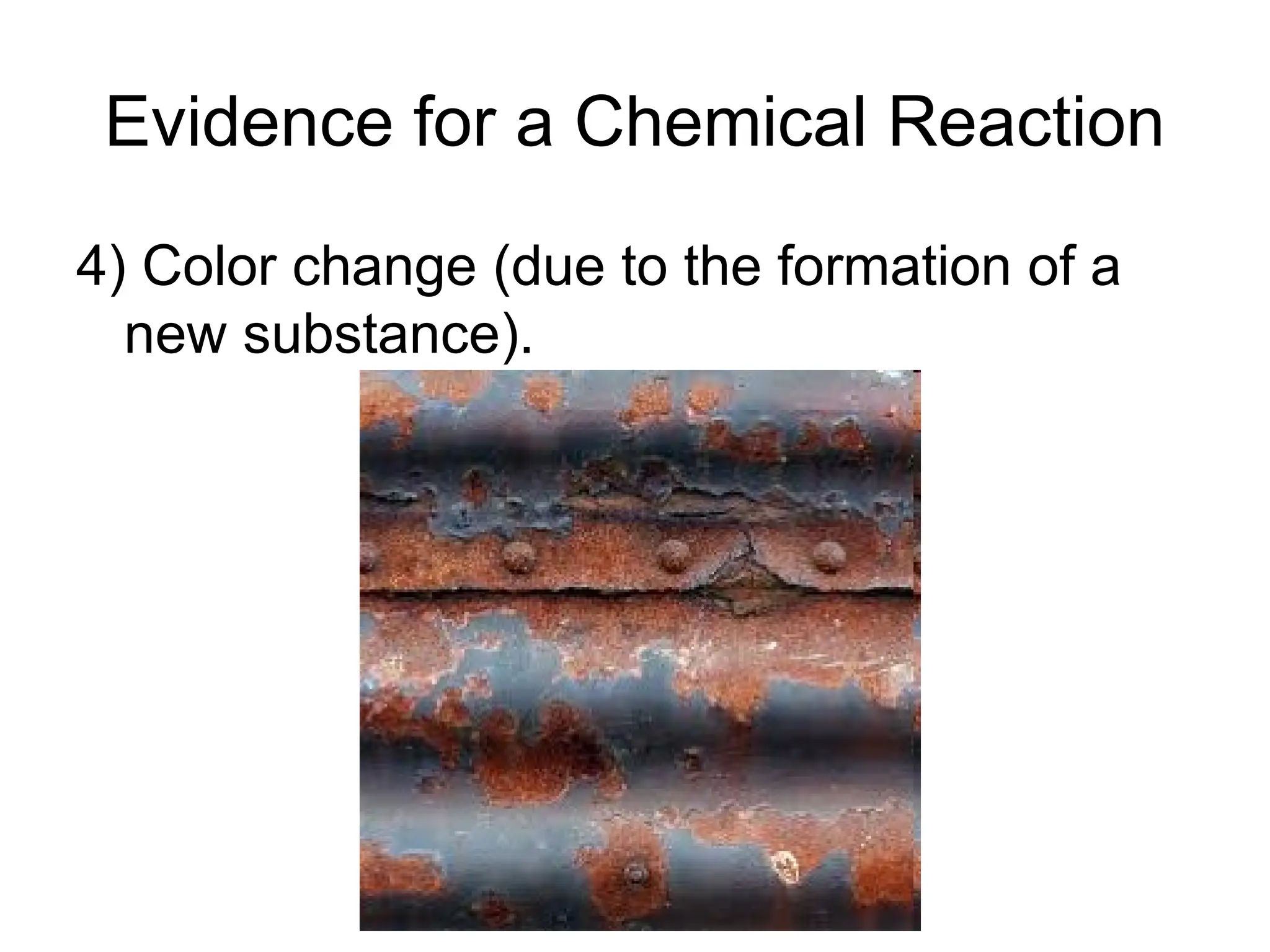
Evidence for a Chemical Reaction
4) Color change (due to the formation of a
new substance).
Evidence for a Chemical Reaction
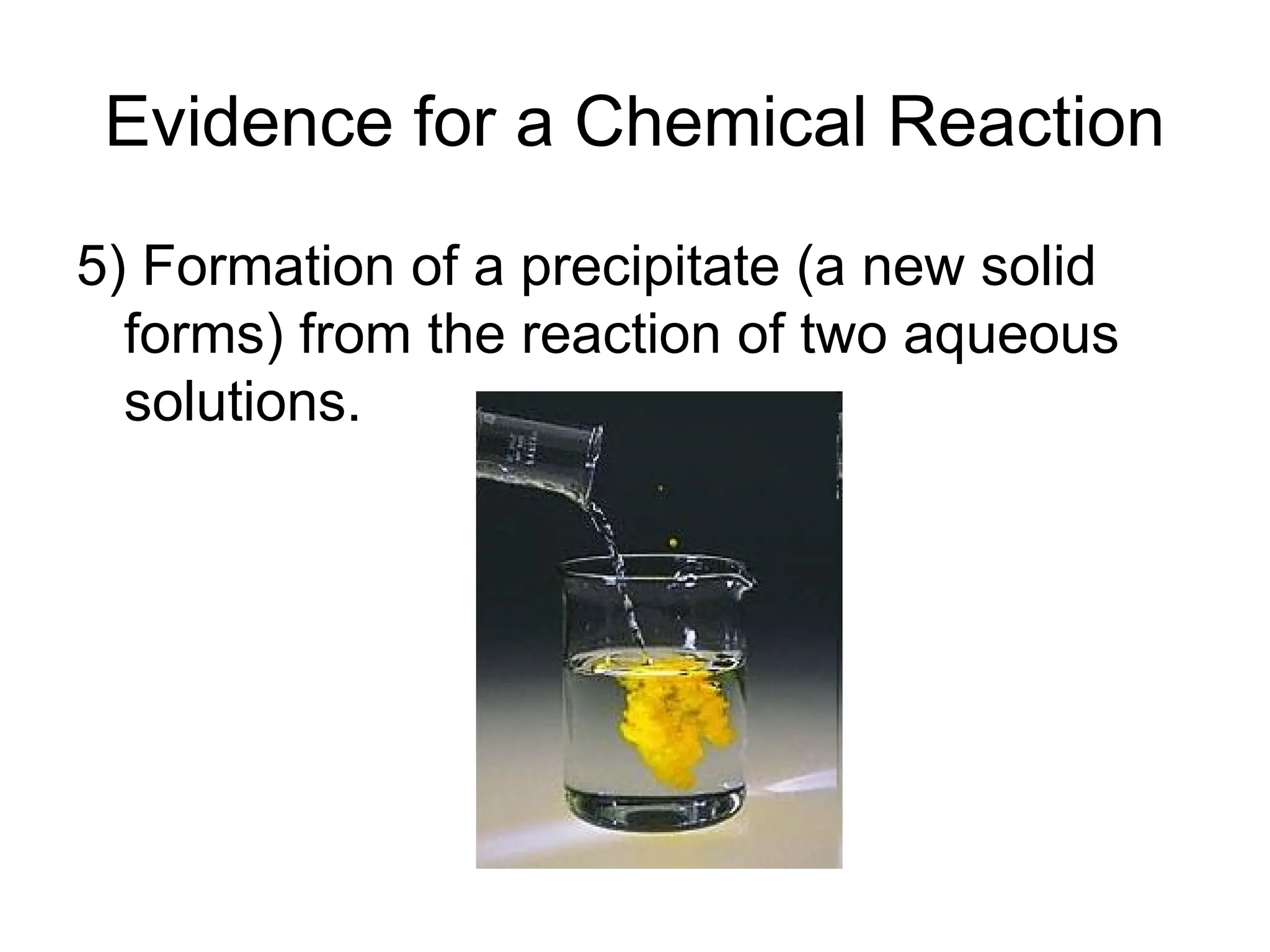
5) Formation of a precipitate (a new solid
forms) from the reaction of two aqueous
solutions.
Word Equations
• Statements that indicate the reactants and
products in a chemical reaction.
• Ex. Iron (s) + chlorine (g)  iron (III) chloride (s)
• This is read as:
“Solid iron and chlorine gas react (combine) to produce
solid iron (III) chloride”
Translating Word Equations to
Skeleton Equations
• A skeleton equation uses chemical formulas
rather than words to identify the reactants and
products of a chemical reaction.
• The word equation
Iron (s) + chlorine (g)  iron (III) chloride (s)
• The skeleton equation
Fe(s) + Cl2(g)  FeCl3 (s)
A skeleton equation is not yet “balanced” by coefficients!
One more example…
• 6 Na (s) + Fe2O3 (s)  3 Na2O (s) + 2 Fe (s)
– The numbers preceding the chemical formulae are
coefficients. They are used to balance the reaction.
– The numbers within the chemical formulae are
subscripts.
– You can read the above balanced reaction as:
• “6 atoms of solid sodium plus 1 formula unit of solid
iron (III) oxide yields 3 formula units of solid sodium
oxide and 2 atoms of solid iron” or…
• “6 moles of solid sodium plus 1 mole of solid iron (III)
oxide yields 3 moles of solid sodium oxide plus 2
moles of solid iron”
• Chemical reactions can never be read in terms of
grams, only in terms of particles or groups of particles
(moles).
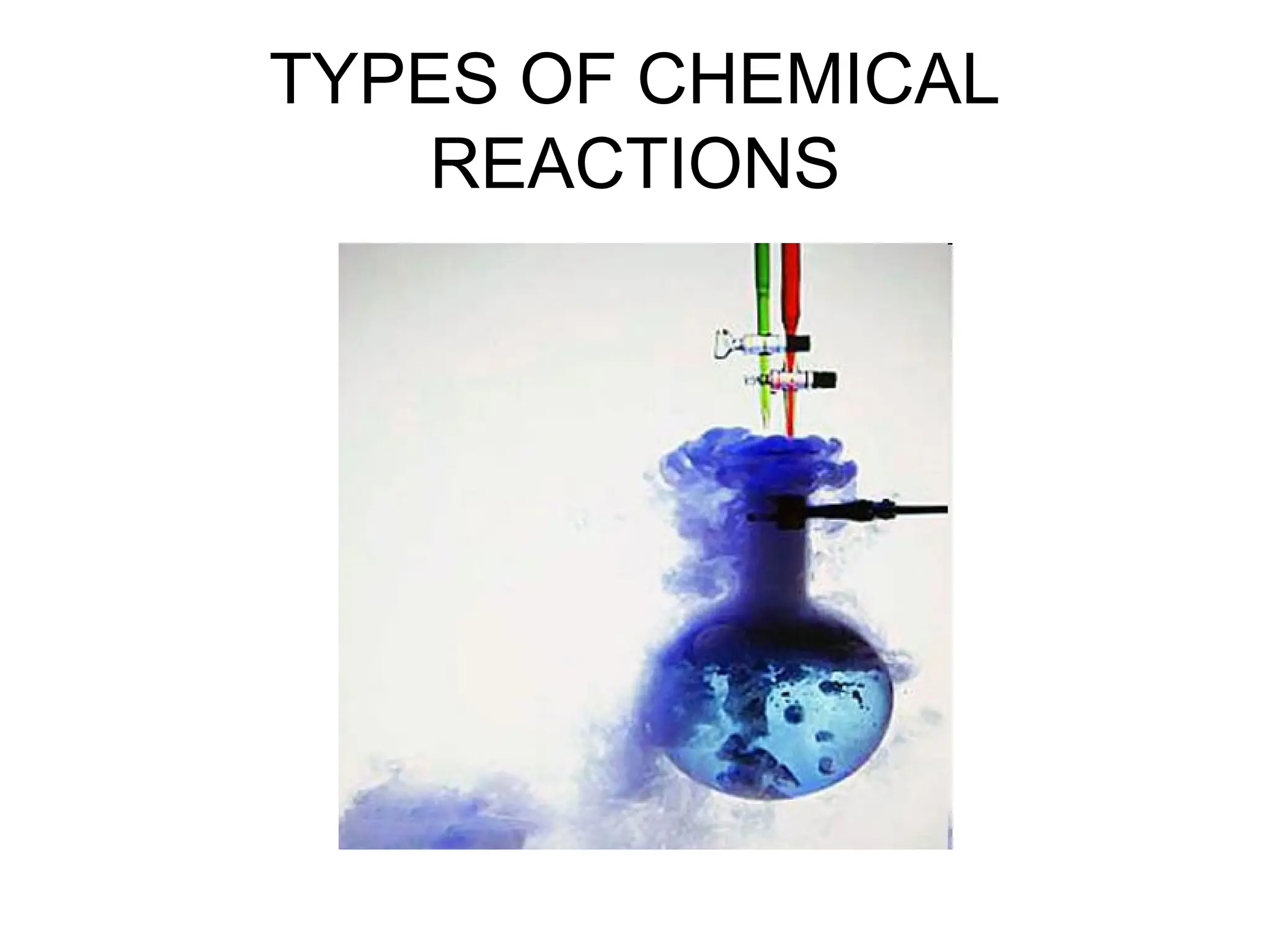
TYPES OF CHEMICAL
REACTIONS
There are 5 basic types….
• Single Replacement (Displacement)
(Redox)
• Double Replacement (Displacement)
(Metathesis)
• Synthesis (Combination)
• Decomposition
• Combustion
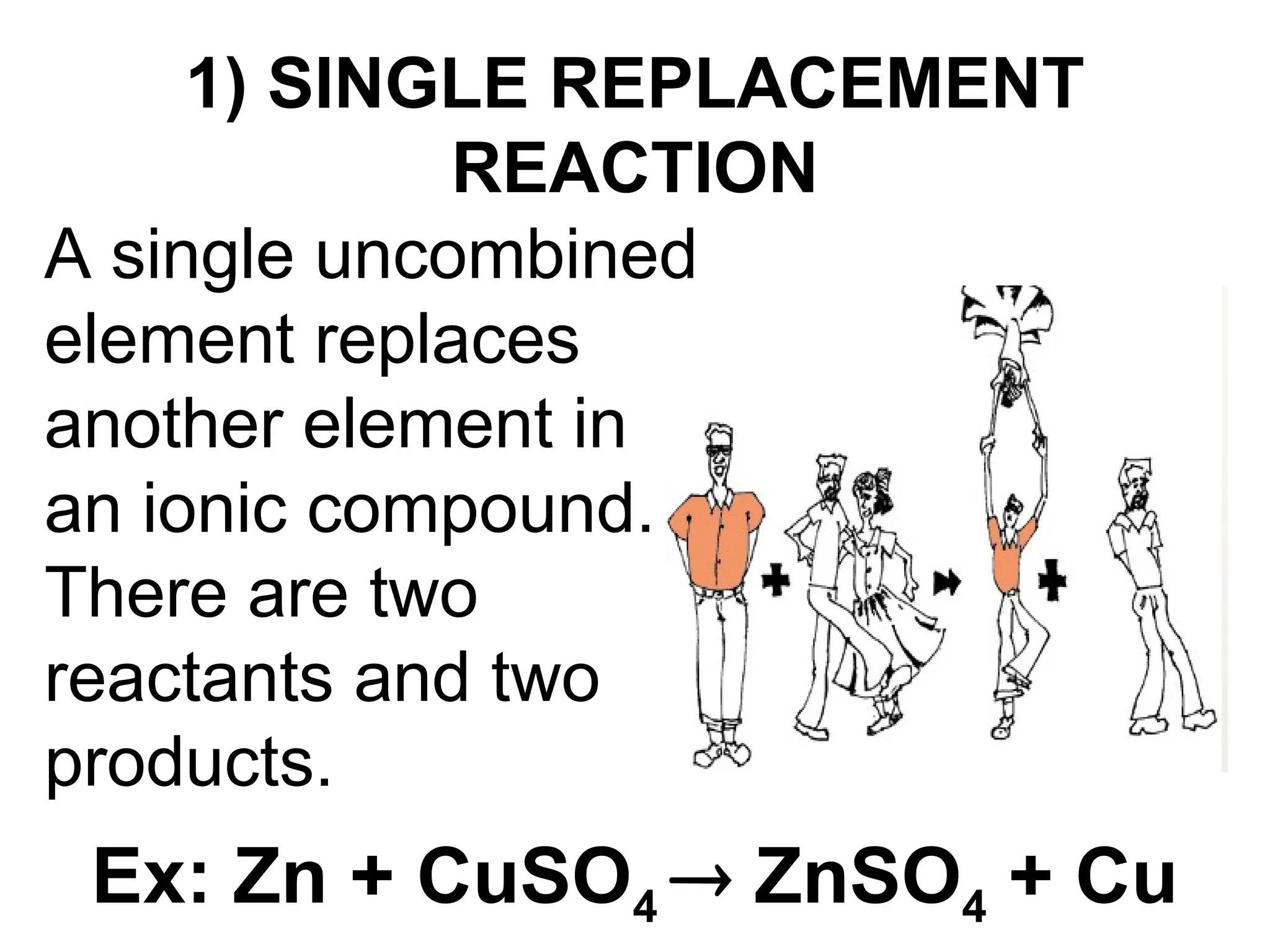
A single uncombined
element replaces
another element in
an ionic compound.
There are two
reactants and two
products.
1) SINGLE REPLACEMENT
REACTION
Ex: Zn + CuSO4  ZnSO4 + Cu
Single Replacement Reactions
Single replacement reactions have the
general form, A + BC  AC + B.
Question: Do all single replacement
reactions actually occur?
Answer: Not necessarily…
Single Replacement Reactions
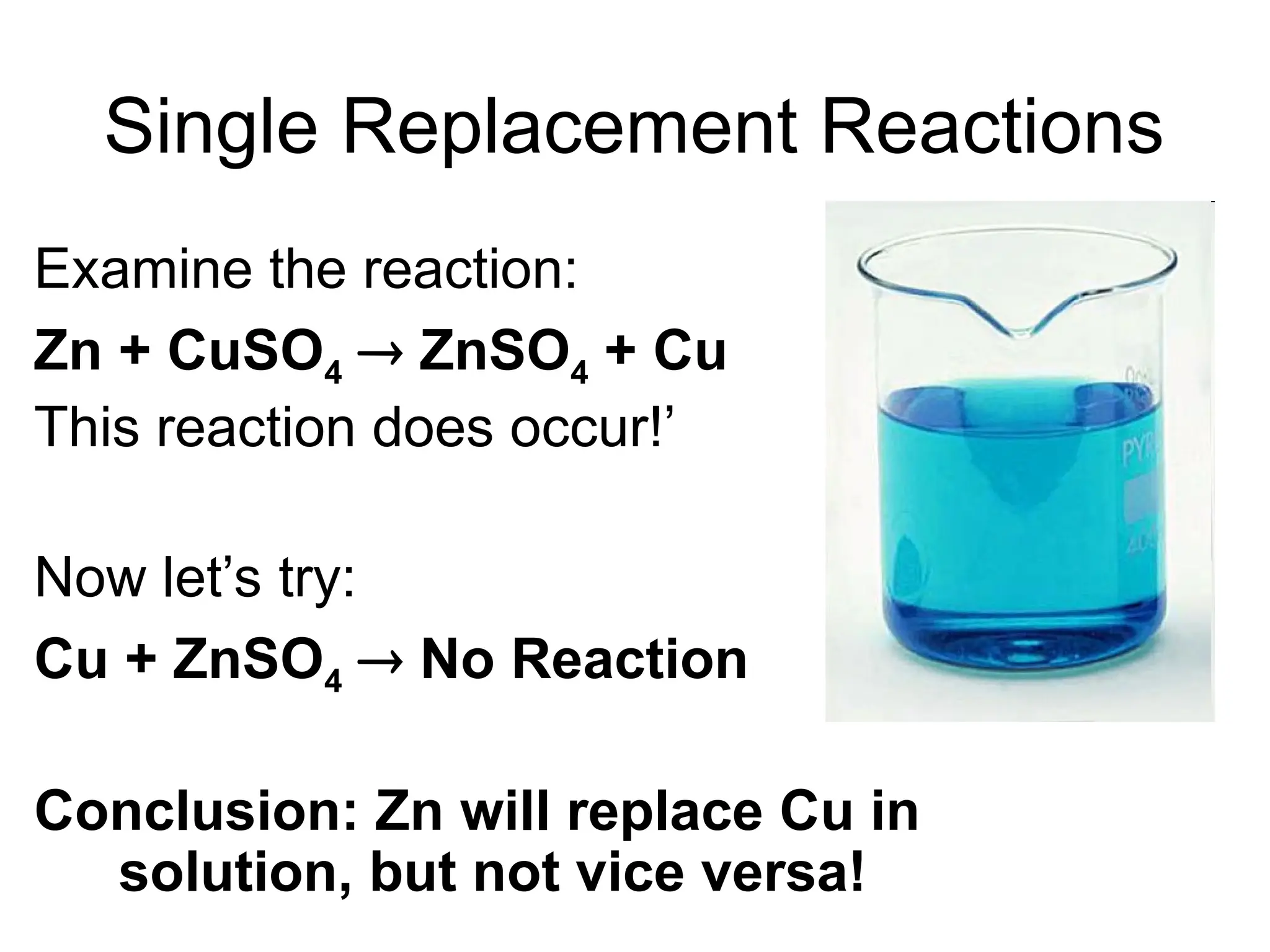
Examine the reaction:
Zn + CuSO4  ZnSO4 + Cu
This reaction does occur!’
Now let’s try:
Cu + ZnSO4  No Reaction
Conclusion: Zn will replace Cu in
solution, but not vice versa!
Single Replacement Reactions
How do we know which reactions will occur
and which ones will not?
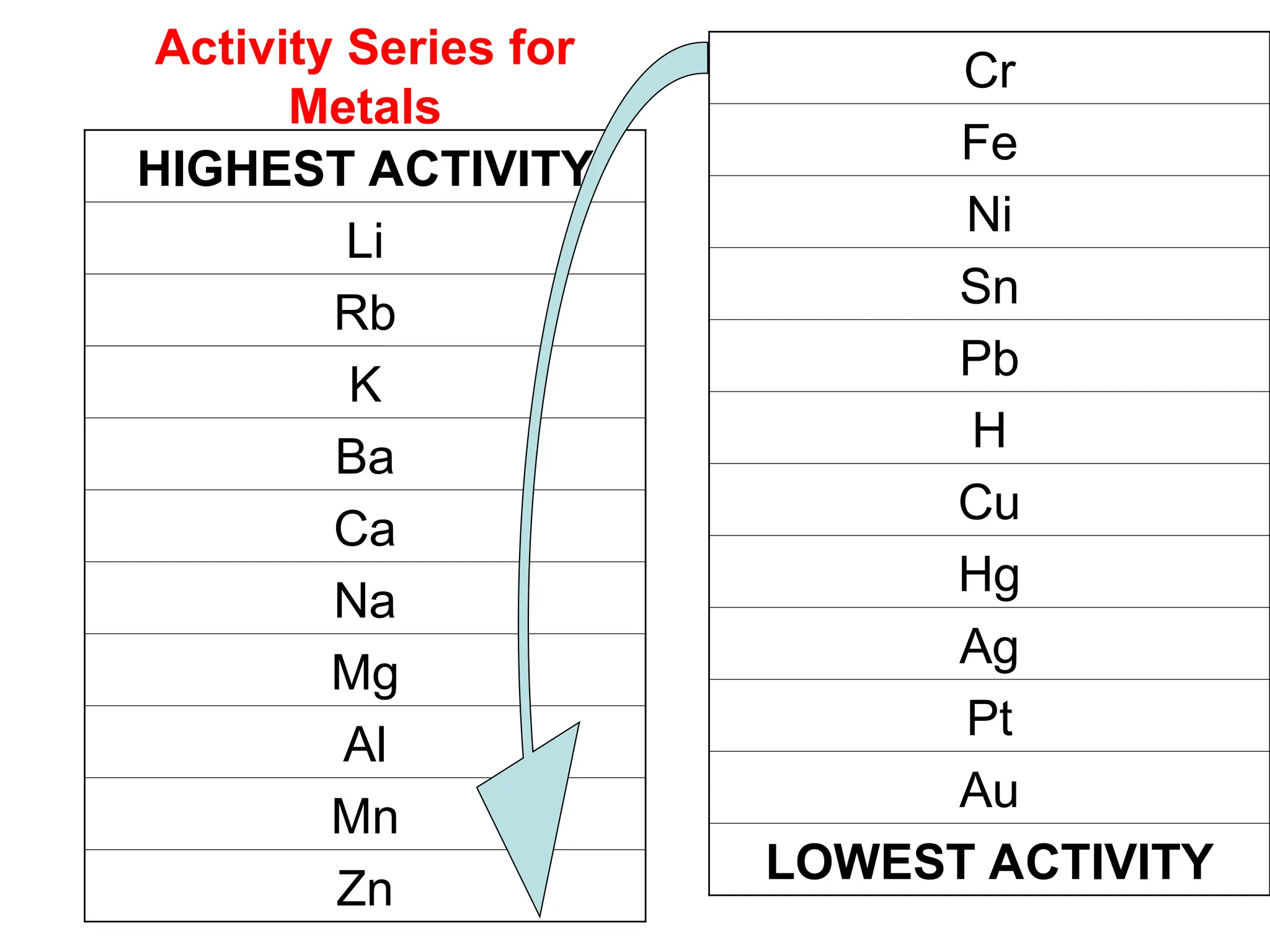
We look at the “activity series”.
Elements with higher activities replace
elements with lower activities during a
single-replacement reaction, but not vice-
versa.
HIGHEST ACTIVITY
Li
Rb
K
Ba
Ca
Na
Mg
Al
Mn
Zn
Cr
Fe
Ni
Sn
Pb
H
Cu
Hg
Ag
Pt
Au
LOWEST ACTIVITY
Activity Series for
Metals
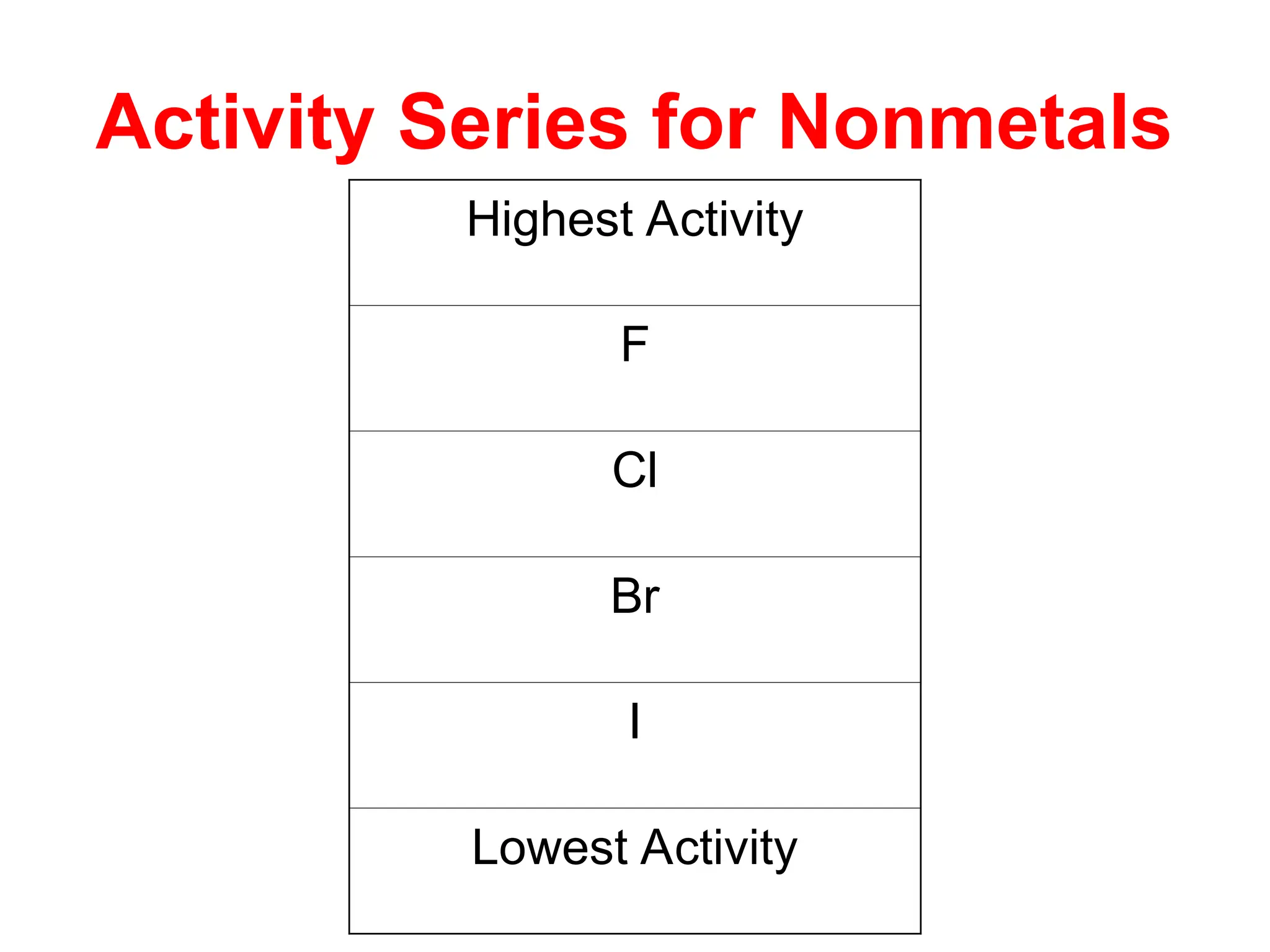
Activity Series for Nonmetals
Highest Activity
F
Cl
Br
I
Lowest Activity
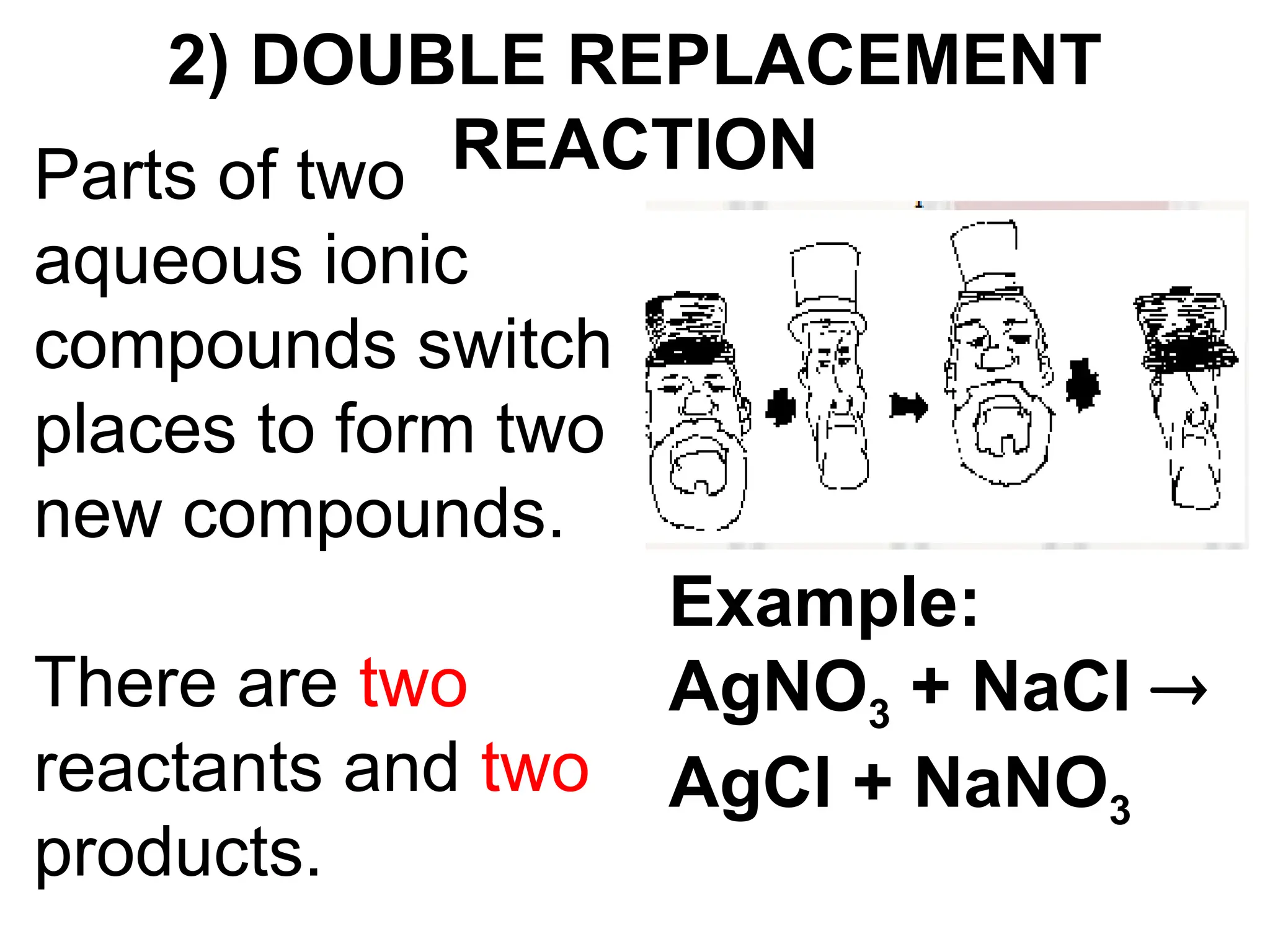
Parts of two
aqueous ionic
compounds switch
places to form two
new compounds.
There are two
reactants and two
products.
2) DOUBLE REPLACEMENT
REACTION
Example:
AgNO3 + NaCl 
AgCl + NaNO3
Double Replacement Reactions
The general form of a double replacement reaction is:
AB + CD  AD + CB
Just like single replacement reactions, not all double
replacement reactions actually occur.
We can experimentally attempt a D.R. reaction. The
reaction occurs if:
1) A solid precipitate is produced, or
2) A gas is produced, or
3) Water is produced.
If none of the above are produced and both products are
(aq), then there is no reaction (NR)!
Examples of Double Replacement
Reactions:
Pb(NO3)2 (aq) + 2NaI (aq)  PbI2 (s) + 2NaNO3 (aq)
(precipitate forming)
HCl (aq) + NaOH (aq)  NaCl (aq) + H2O (l)
(water-forming, acid-base, neutralization)
CaCO3 (s) + 2HCl (aq)  CaCl2 (aq) + H2CO3
(gas-forming)
H(OH)
H2O (l) + CO2 (g)
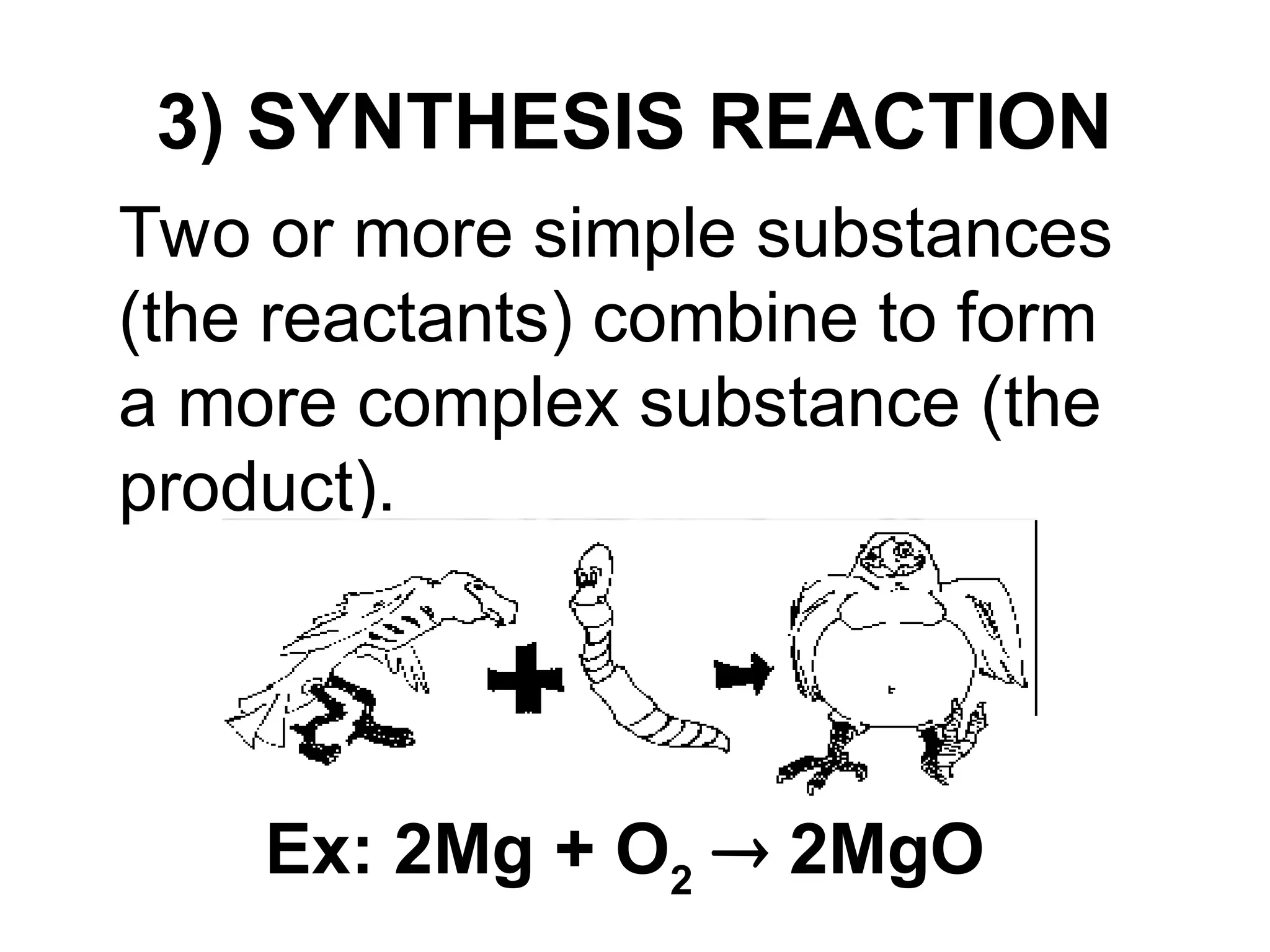
Two or more simple substances
(the reactants) combine to form
a more complex substance (the
product).
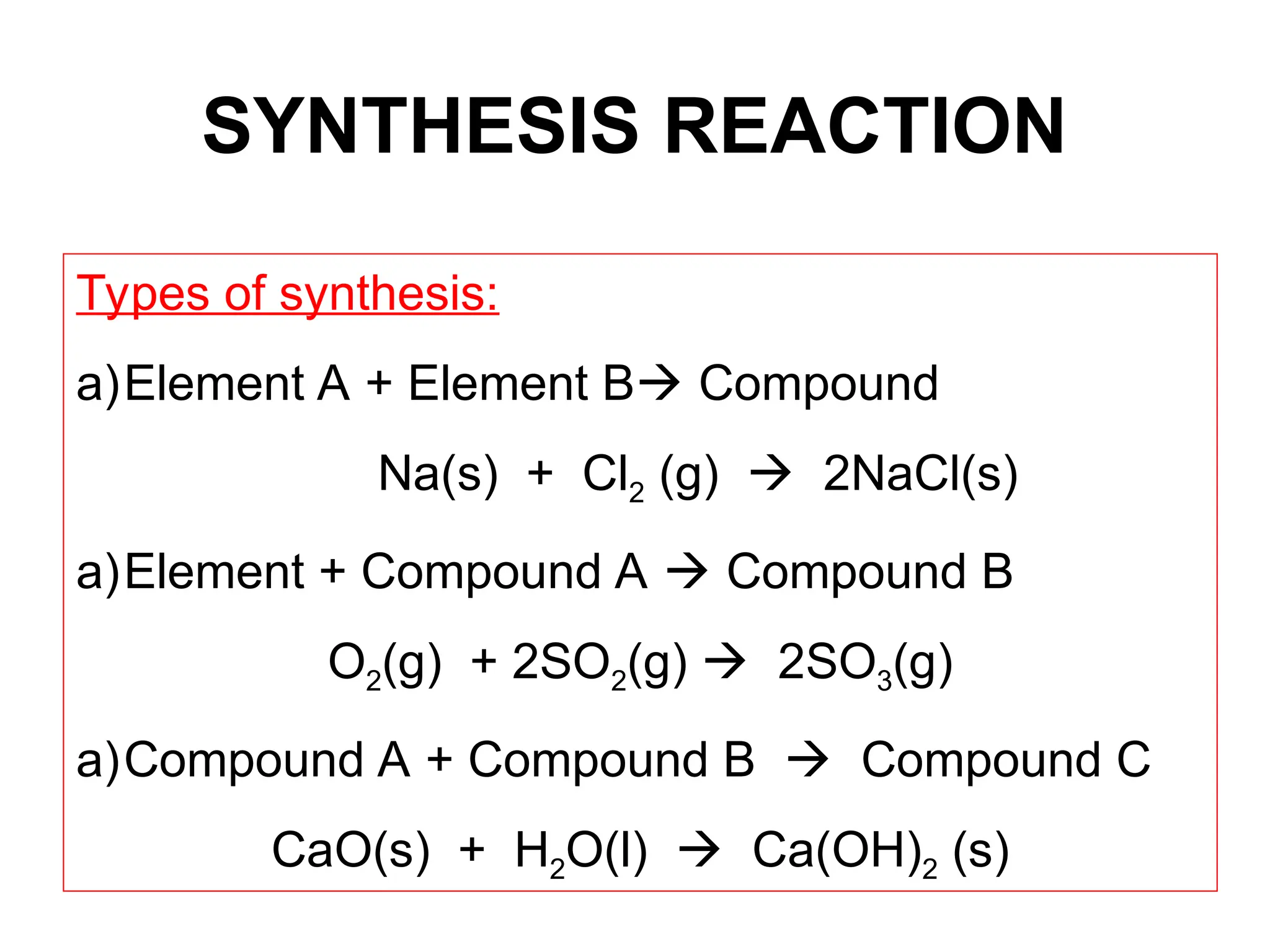
3) SYNTHESIS REACTION
Ex: 2Mg + O2
 2MgO
SYNTHESIS REACTION
Types of synthesis:
a)Element A + Element B Compound
Na(s) + Cl2 (g)  2NaCl(s)
a)Element + Compound A  Compound B
O2(g) + 2SO2(g)  2SO3(g)
a)Compound A + Compound B  Compound C
CaO(s) + H2O(l)  Ca(OH)2 (s)
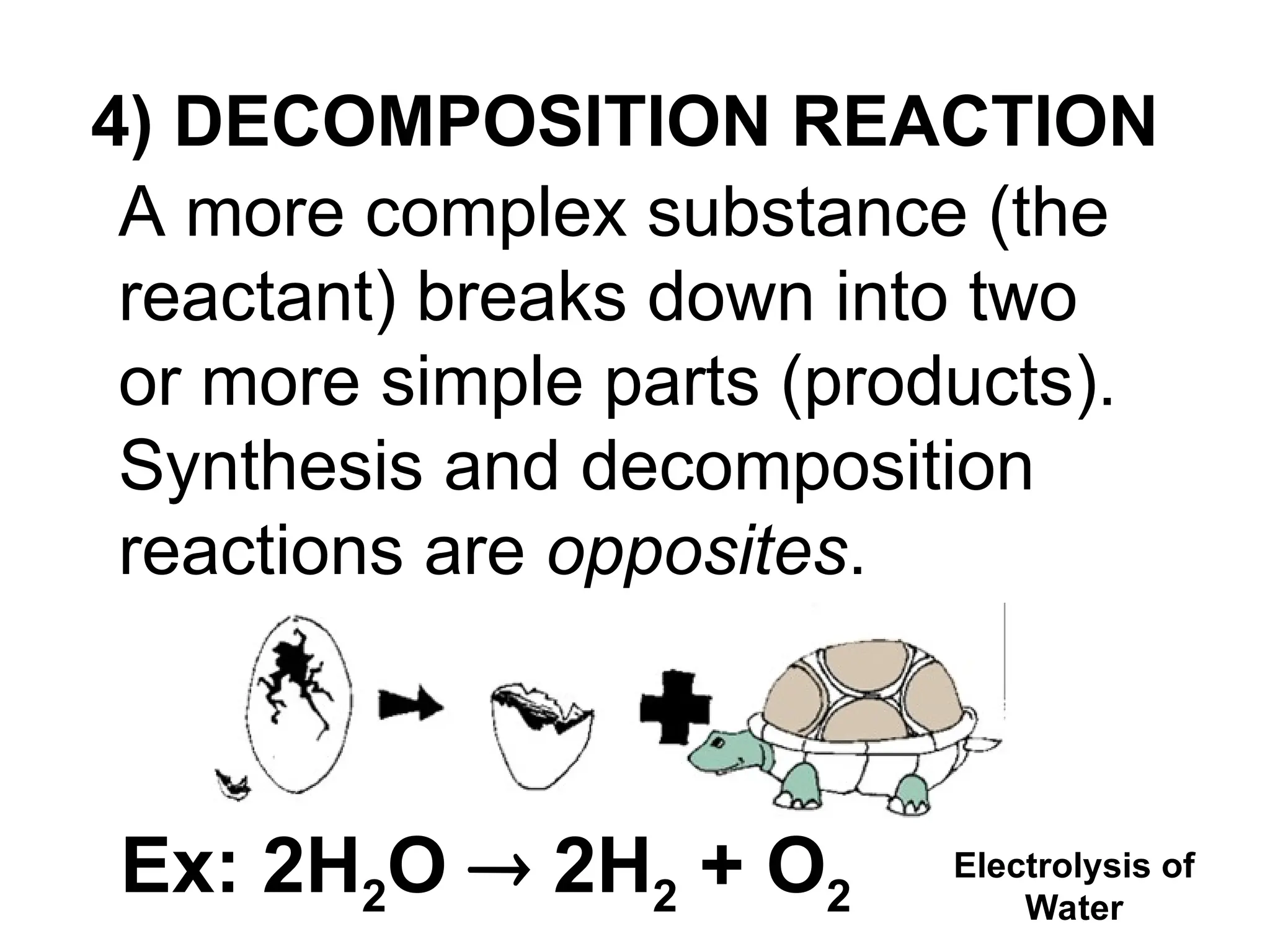
A more complex substance (the
reactant) breaks down into two
or more simple parts (products).
Synthesis and decomposition
reactions are opposites.
4) DECOMPOSITION REACTION
Ex: 2H2O  2H2 + O2
Electrolysis of
Water
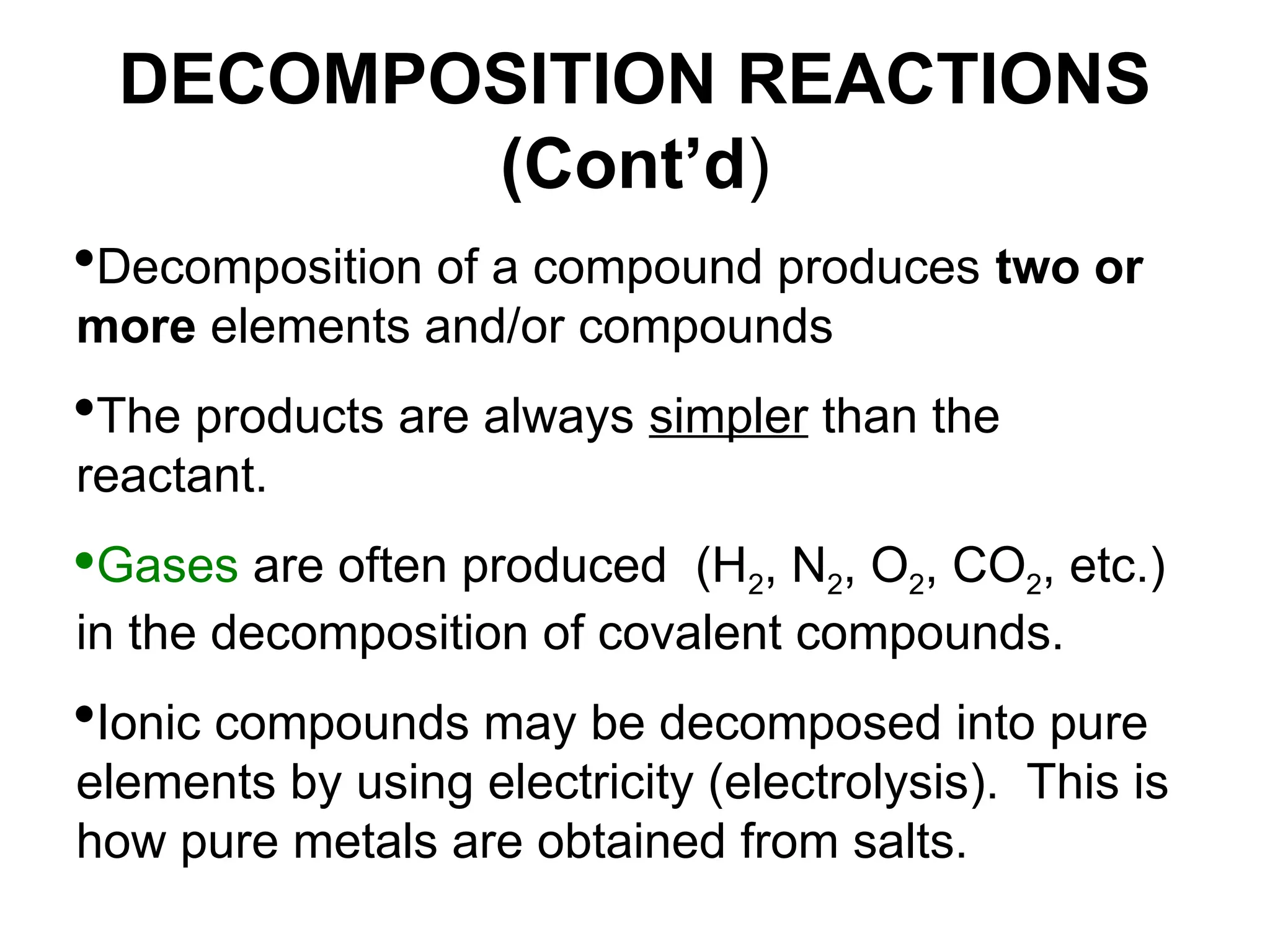
DECOMPOSITION REACTIONS
(Cont’d)
Decomposition of a compound produces two or
more elements and/or compounds
The products are always simpler than the
reactant.
Gases are often produced (H2, N2, O2, CO2, etc.)
in the decomposition of covalent compounds.
Ionic compounds may be decomposed into pure
elements by using electricity (electrolysis). This is
how pure metals are obtained from salts.
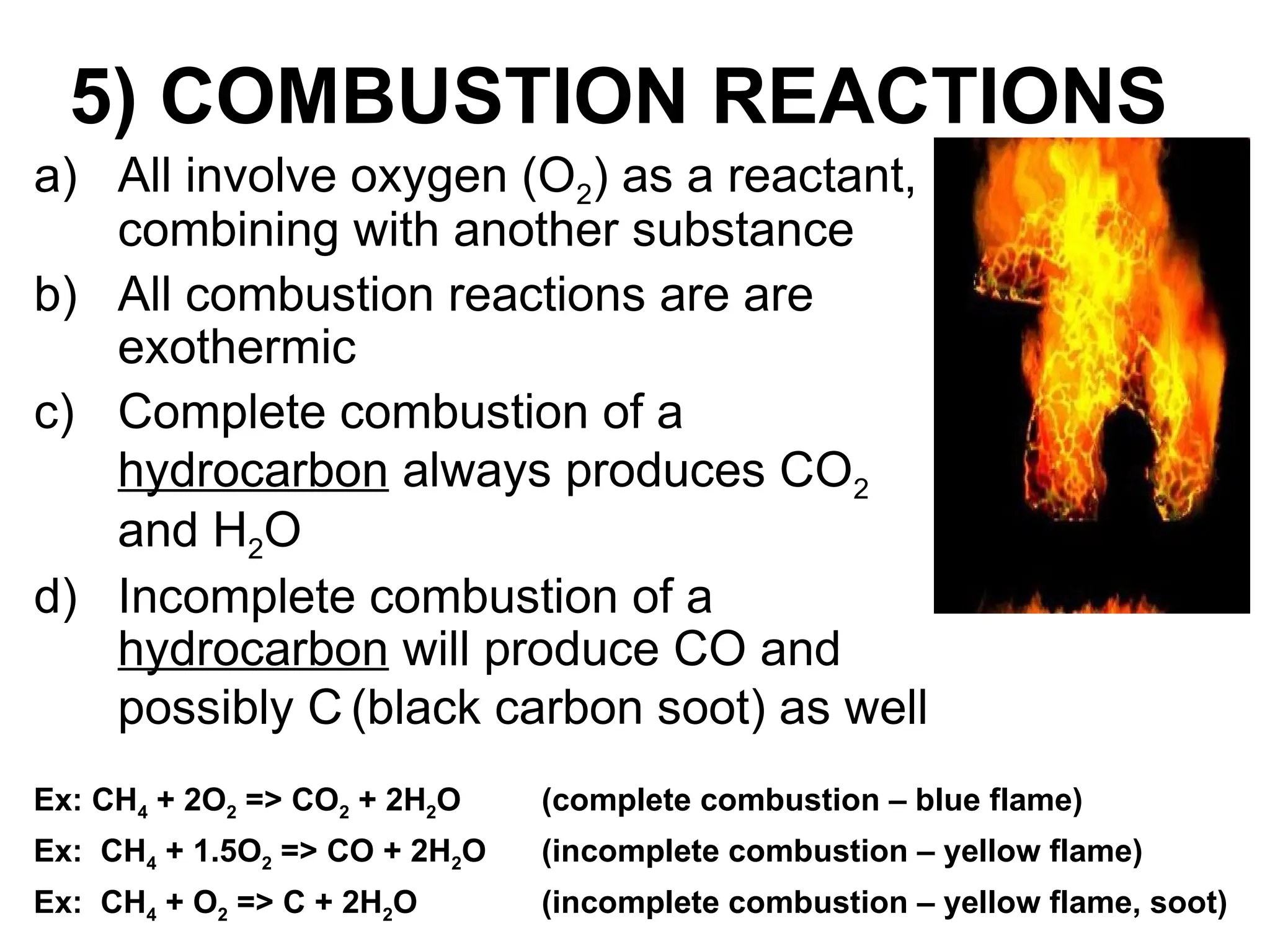
5) COMBUSTION REACTIONS
a) All involve oxygen (O2) as a reactant,
combining with another substance
b) All combustion reactions are are
exothermic
c) Complete combustion of a
hydrocarbon always produces CO2
and H2O
d) Incomplete combustion of a
hydrocarbon will produce CO and
possibly C (black carbon soot) as well
Ex: CH4 + 2O2 => CO2 + 2H2O (complete combustion – blue flame)
Ex: CH4 + 1.5O2 => CO + 2H2O (incomplete combustion – yellow flame)
Ex: CH4 + O2 => C + 2H2O (incomplete combustion – yellow flame, soot)
Combustion (cont’d)
• Any synthesis reaction which involves O2 as a
reactant is also considered to be a combustion
reaction!
Ex. 2Mg + O2  2MgO
(metal oxide)
This is called the combustion of magnesium or
the synthesis of magnesium oxide. The
combustion of a metal always produces a metal
oxide (in this case, magnesium oxide). Make
sure the metal product is criss-crossed
correctly!
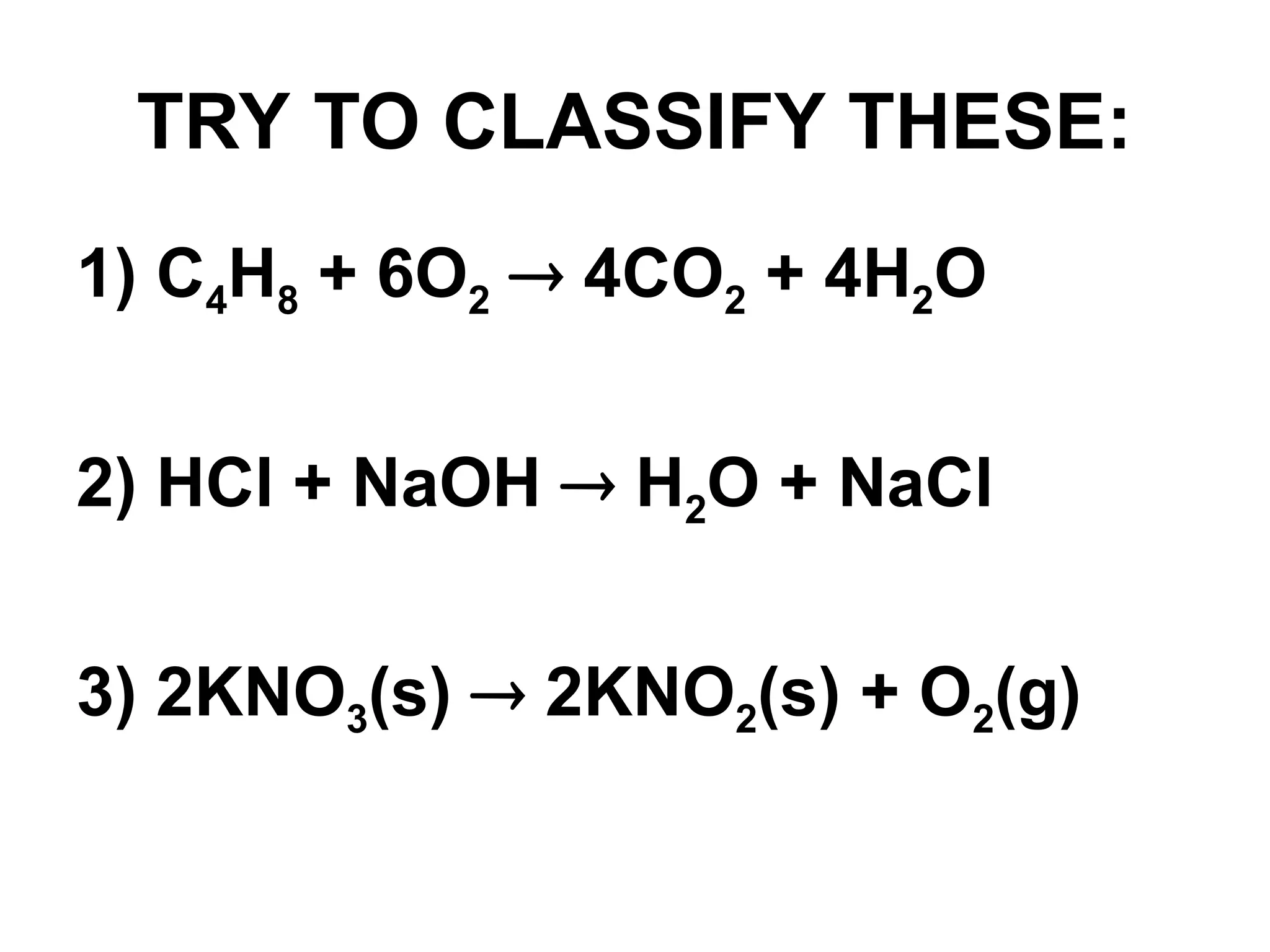
TRY TO CLASSIFY THESE:
1) C4H8 + 6O2  4CO2 + 4H2O
2) HCl + NaOH  H2O + NaCl
3) 2KNO3(s)  2KNO2(s) + O2(g)
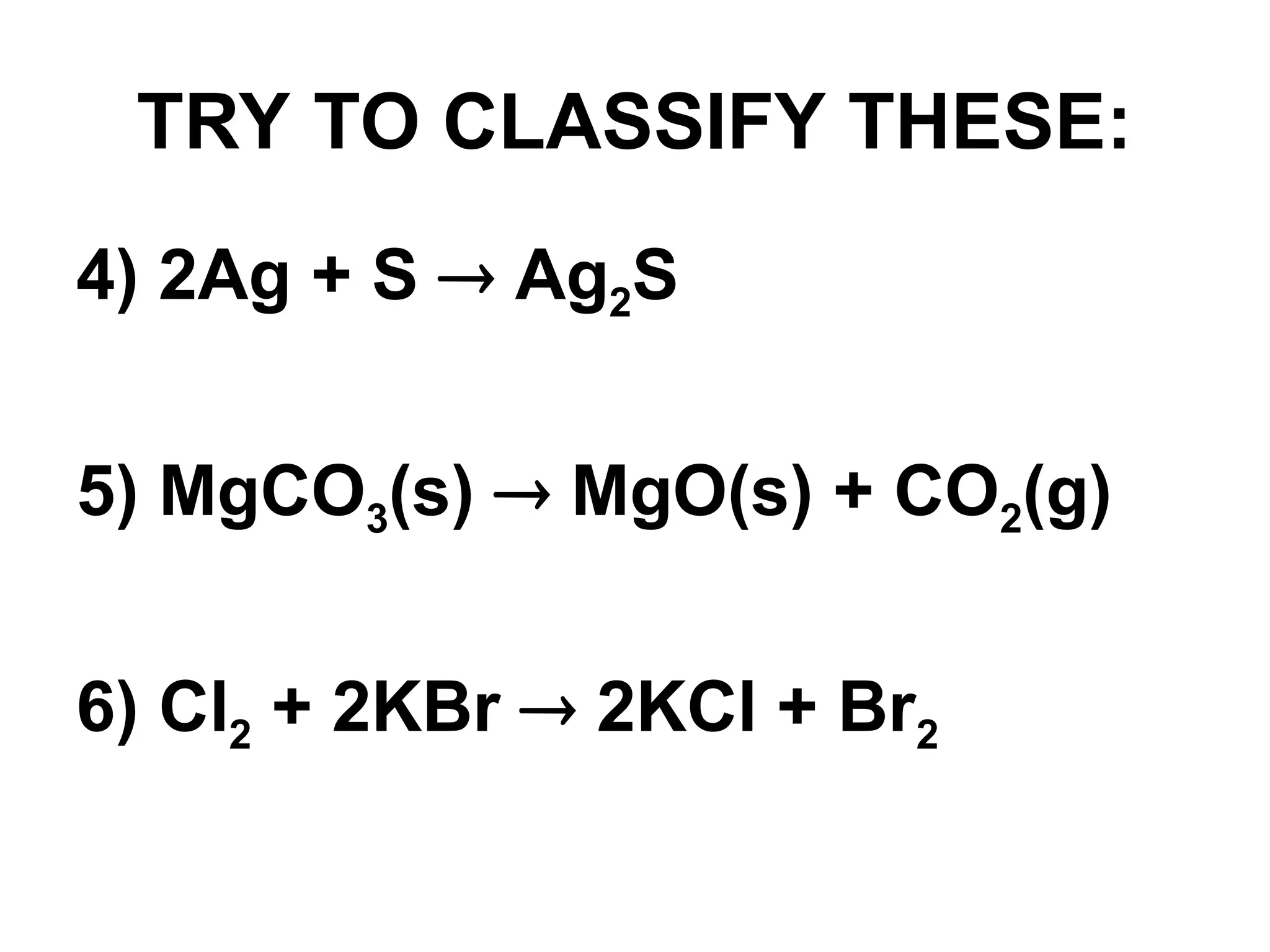
TRY TO CLASSIFY THESE:
4) 2Ag + S  Ag2S
5) MgCO3(s)  MgO(s) + CO2(g)
6) Cl2 + 2KBr  2KCl + Br2
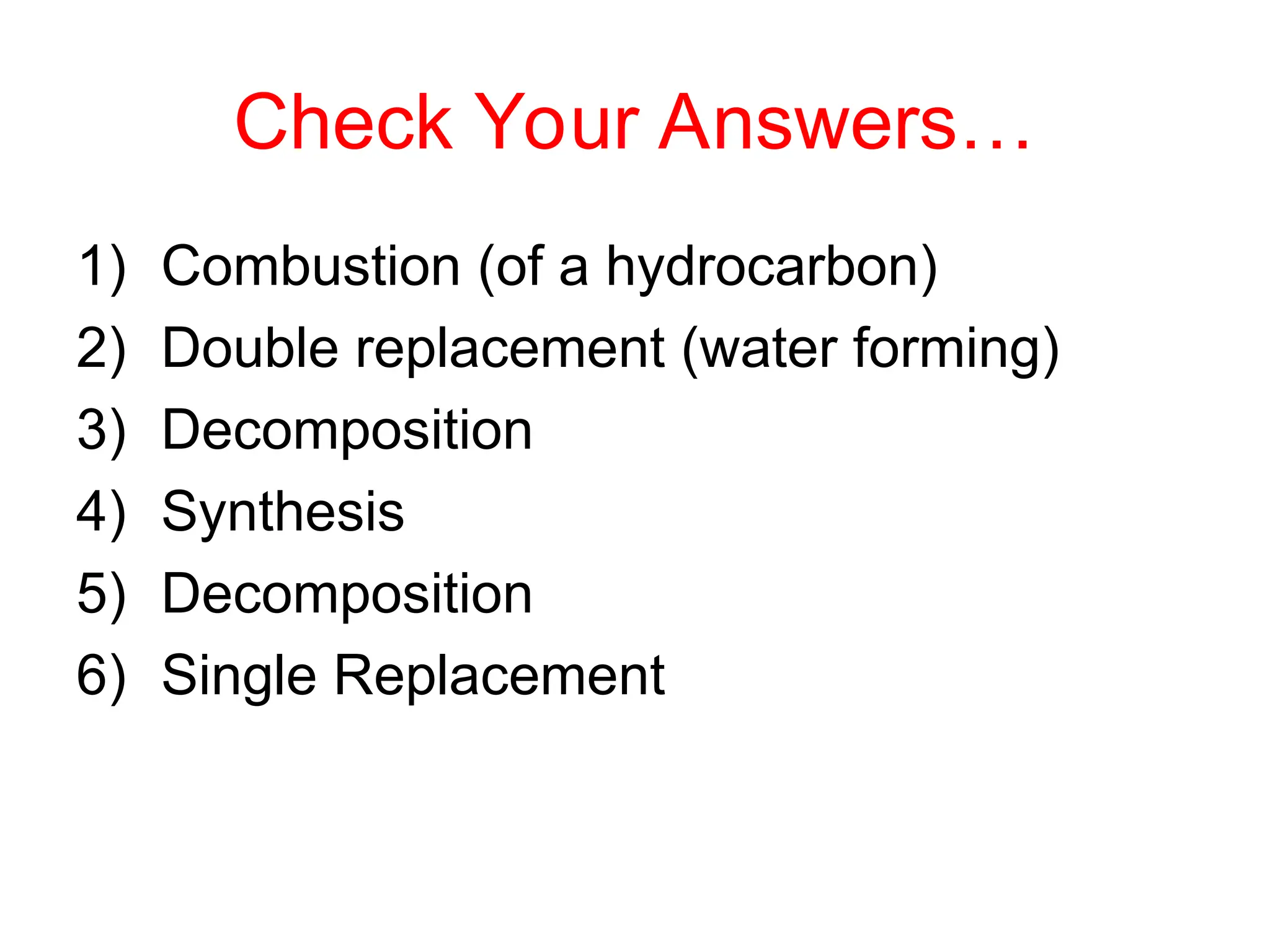
Check Your Answers…
1) Combustion (of a hydrocarbon)
2) Double replacement (water forming)
3) Decomposition
4) Synthesis
5) Decomposition
6) Single Replacement
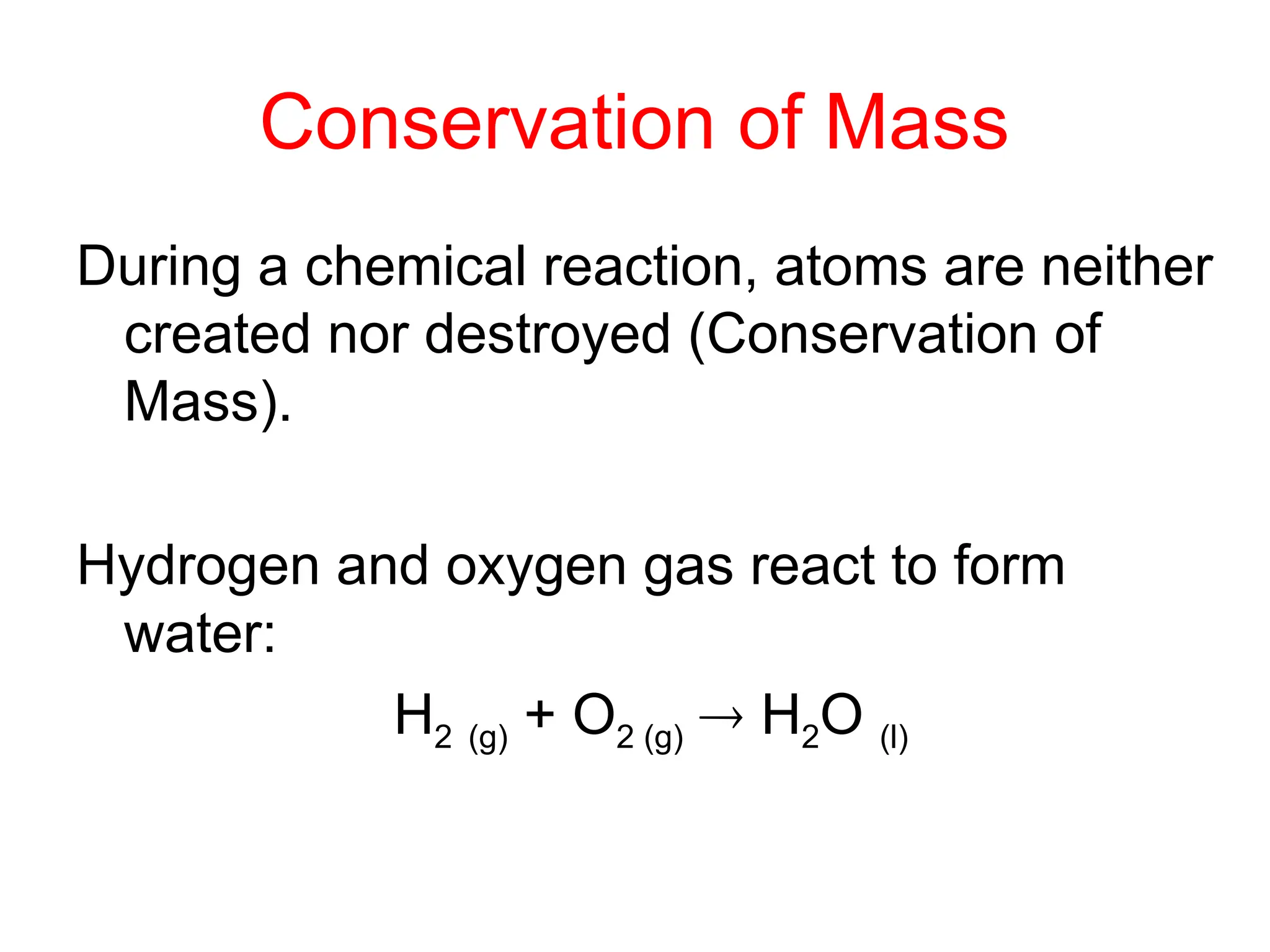
Conservation of Mass
During a chemical reaction, atoms are neither
created nor destroyed (Conservation of
Mass).
Hydrogen and oxygen gas react to form
water:
H2 (g) + O2 (g)  H2O (l)
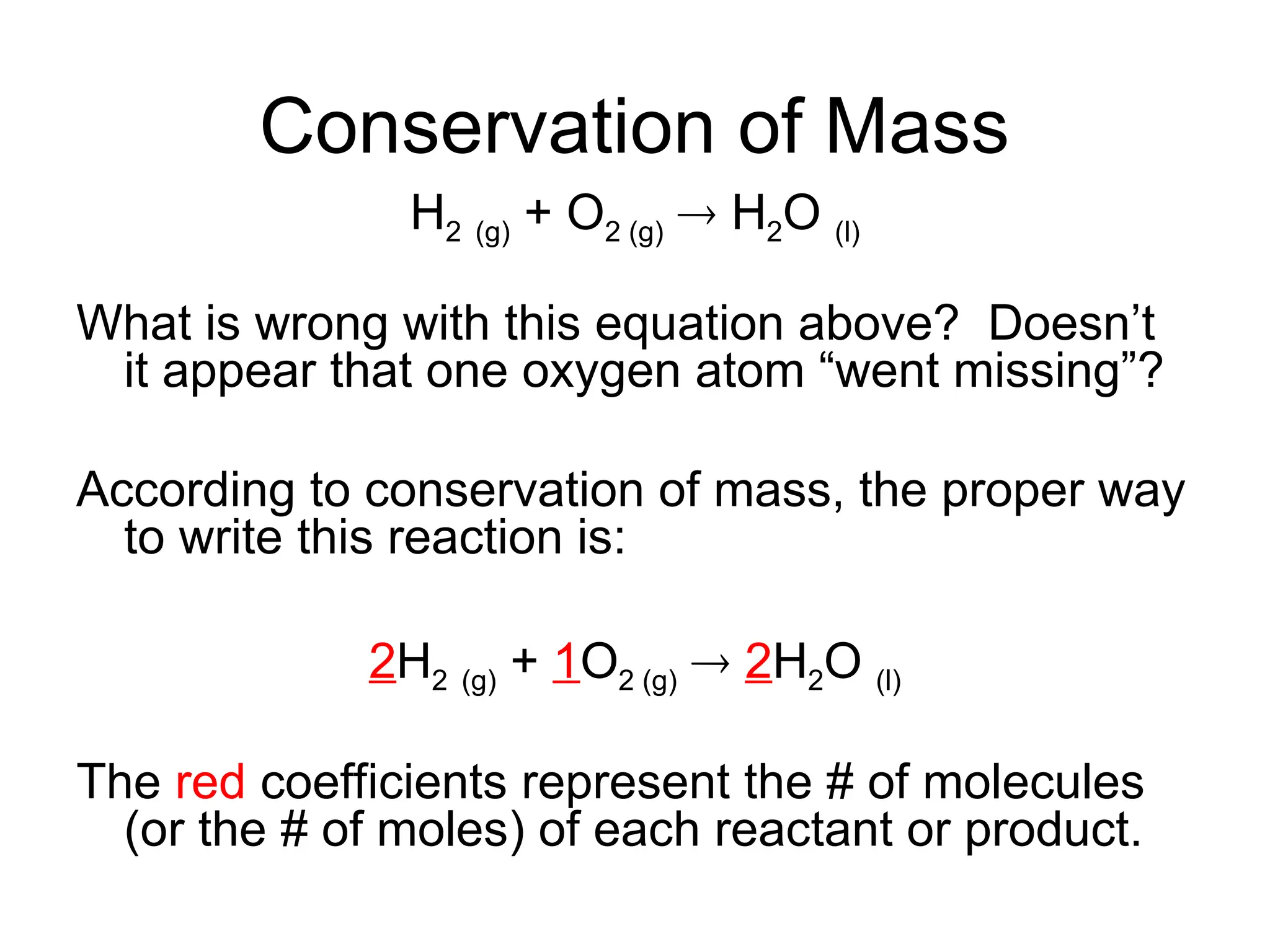
Conservation of Mass
H2 (g) + O2 (g)  H2O (l)
What is wrong with this equation above? Doesn’t
it appear that one oxygen atom “went missing”?
According to conservation of mass, the proper way
to write this reaction is:
2H2 (g) + 1O2 (g)  2H2O (l)
The red coefficients represent the # of molecules
(or the # of moles) of each reactant or product.
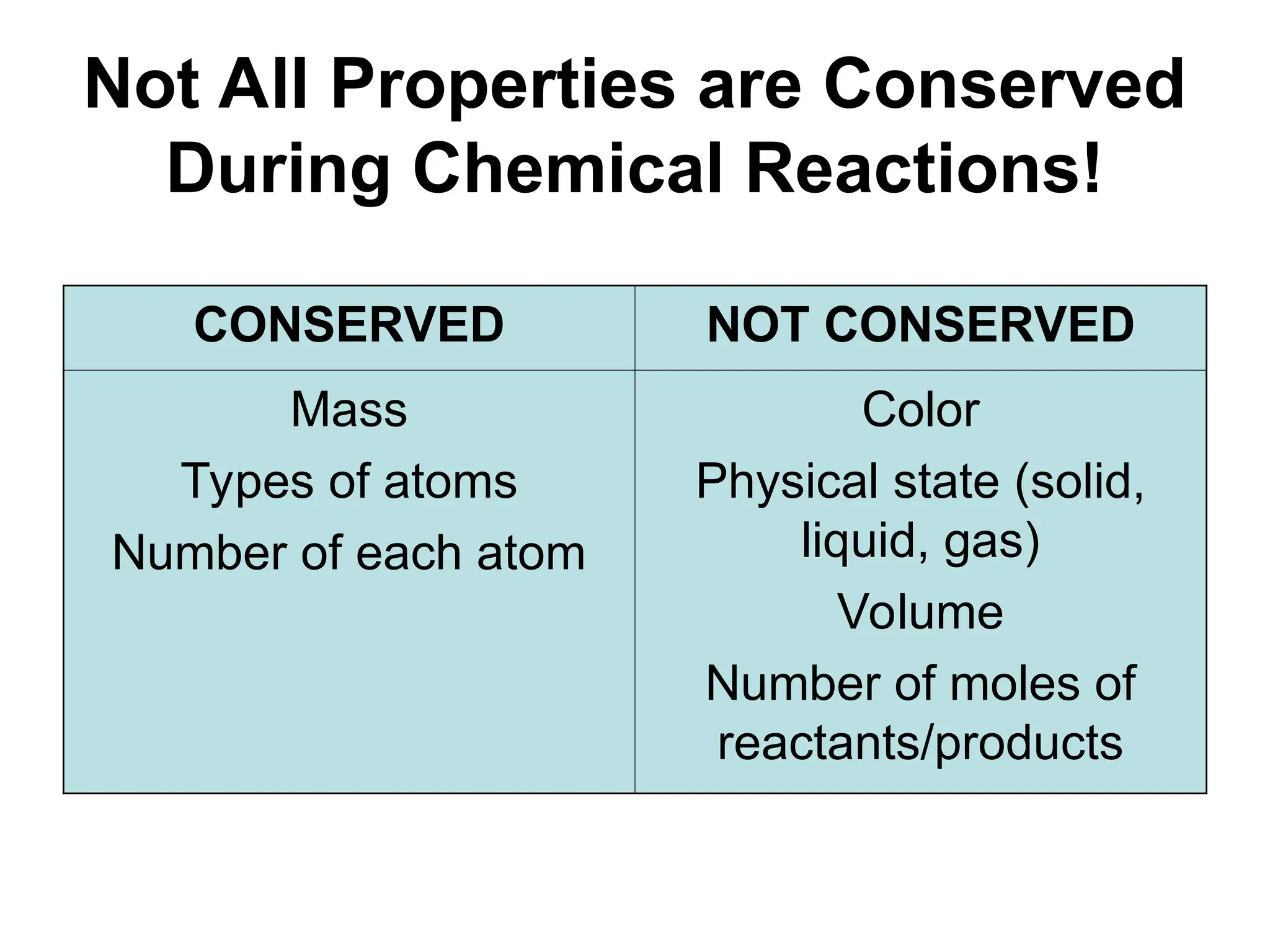
Not All Properties are Conserved
During Chemical Reactions!
CONSERVED NOT CONSERVED
Mass
Types of atoms
Number of each atom
Color
Physical state (solid,
liquid, gas)
Volume
Number of moles of
reactants/products
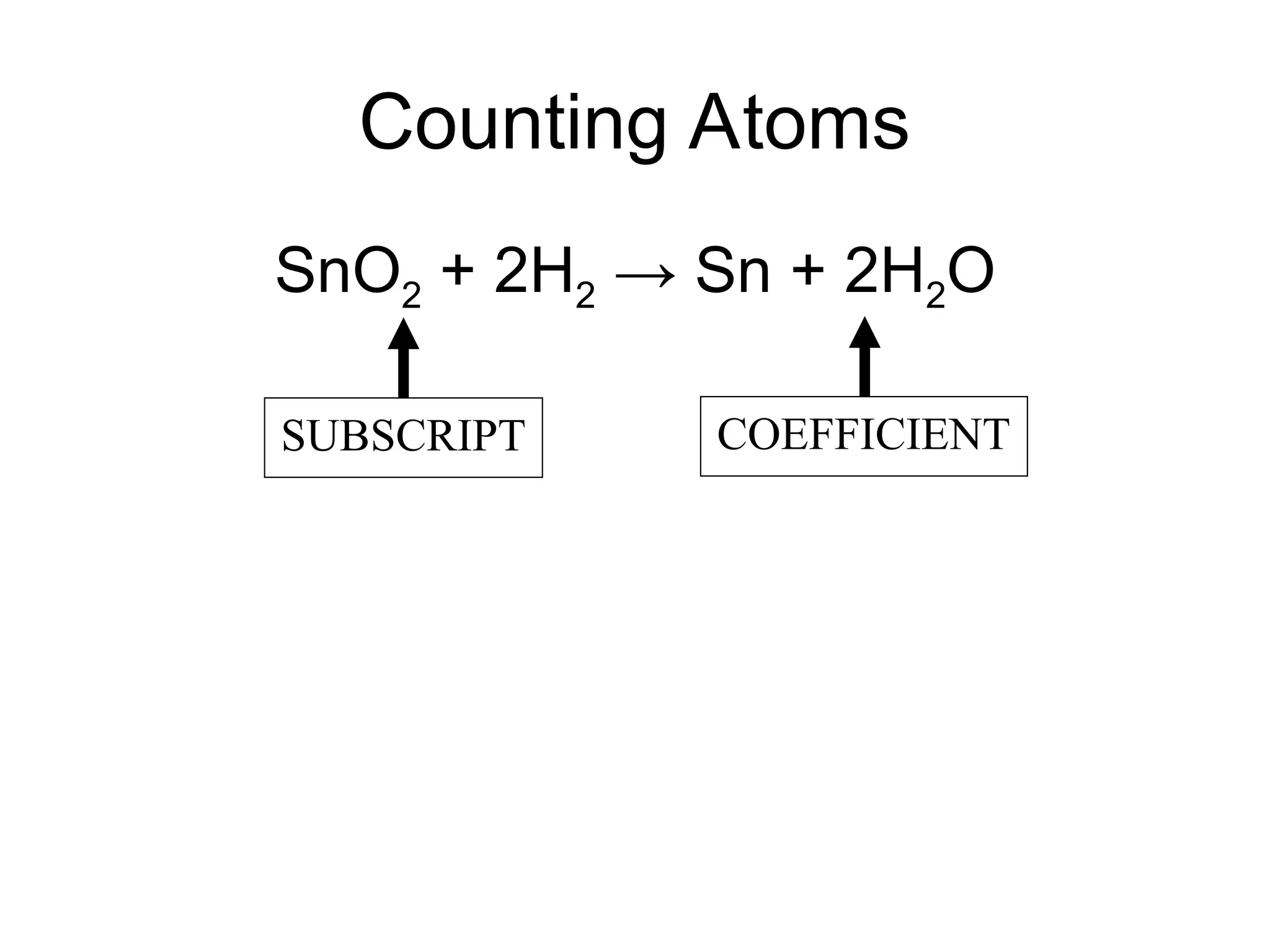
Counting Atoms
SnO2 + 2H2 → Sn + 2H2O
SUBSCRIPT COEFFICIENT
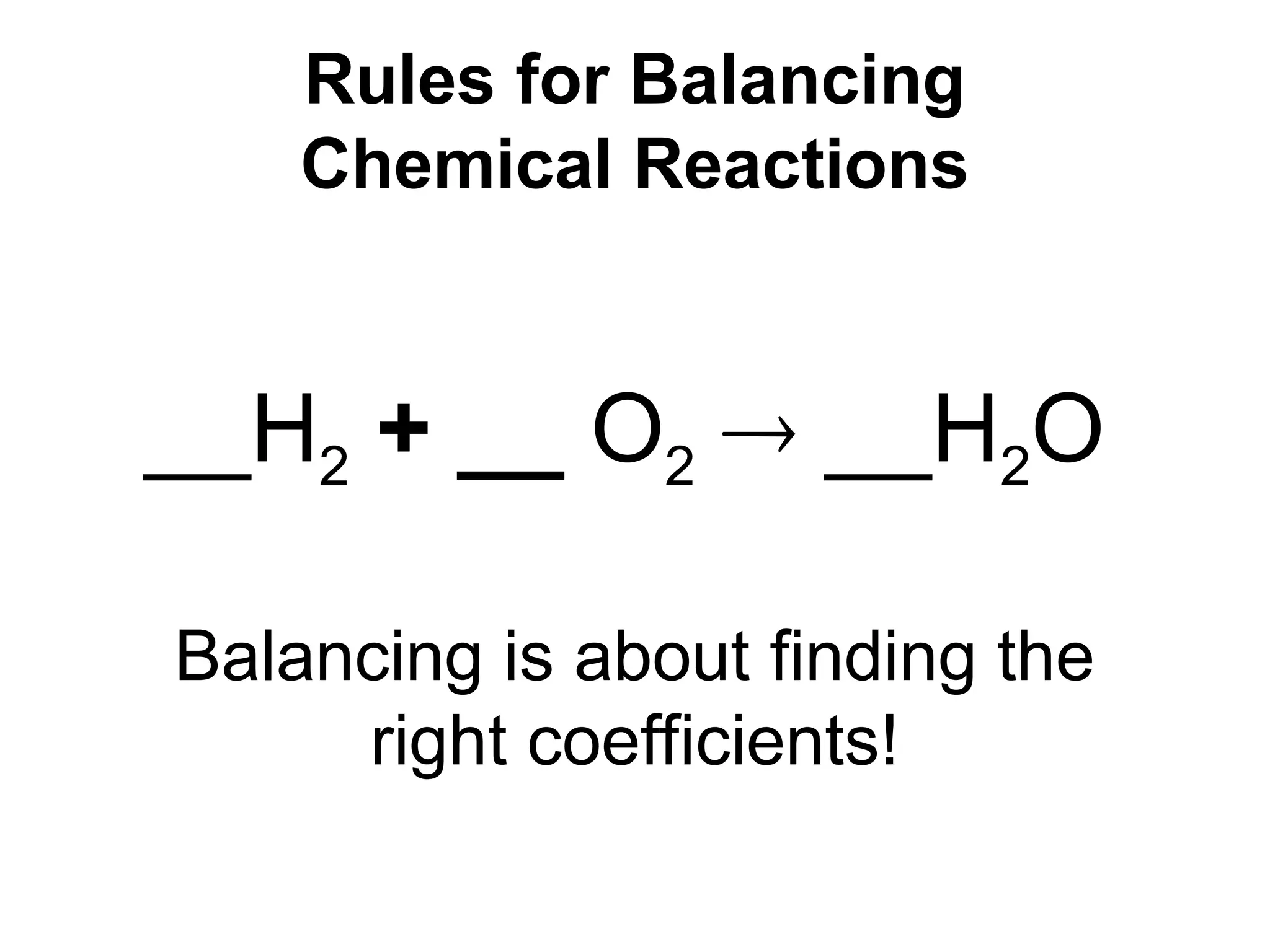
Rules for Balancing
Chemical Reactions
__H2 + __ O2  __H2O
Balancing is about finding the
right coefficients!
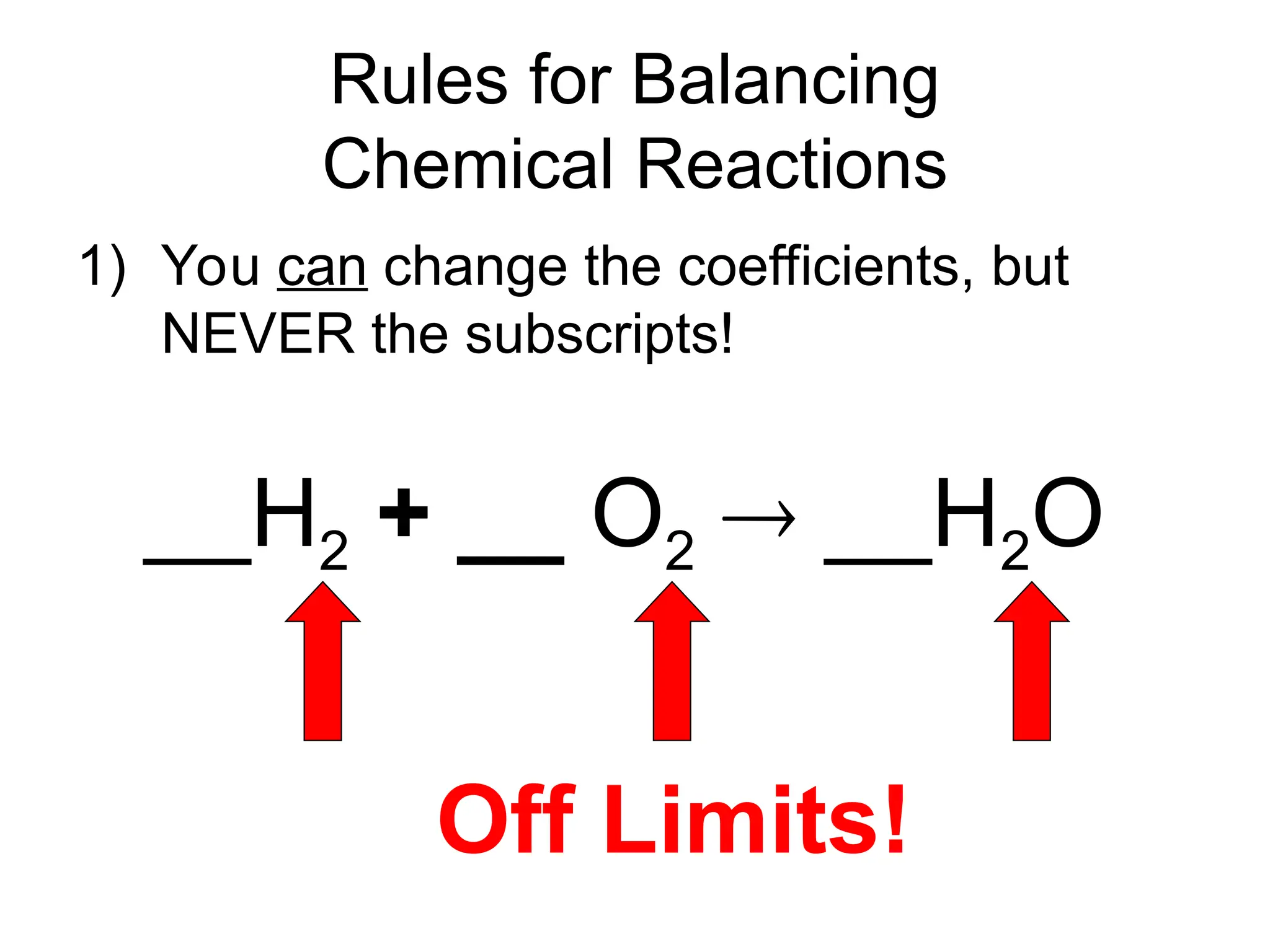
Rules for Balancing
Chemical Reactions
1) You can change the coefficients, but
NEVER the subscripts!
__H2 + __ O2  __H2O
Off Limits!
Rules for Balancing
Chemical Reactions
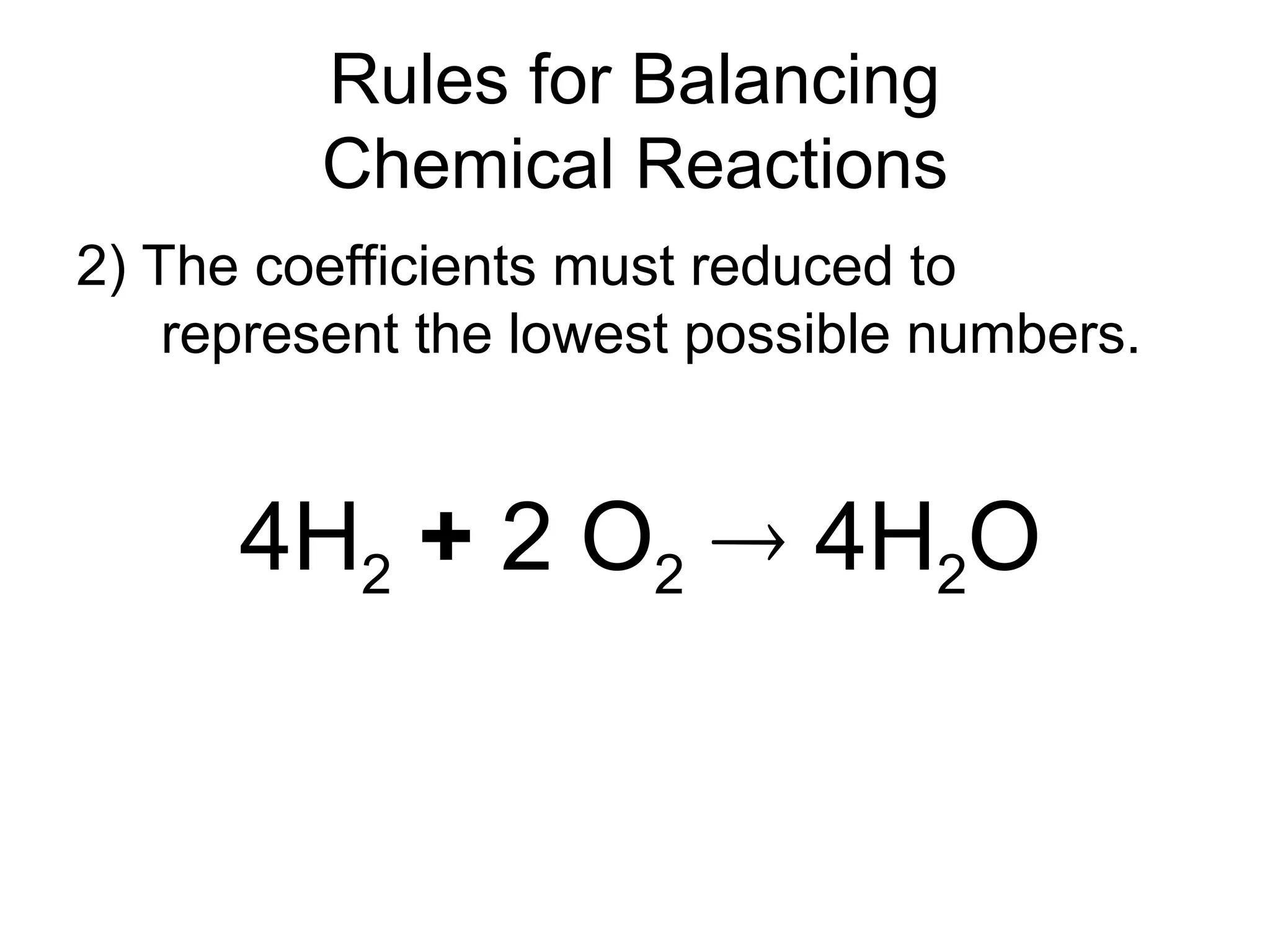
2) The coefficients must reduced to
represent the lowest possible numbers.
4H2 + 2 O2  4H2O
Rules for Balancing
Chemical Reactions
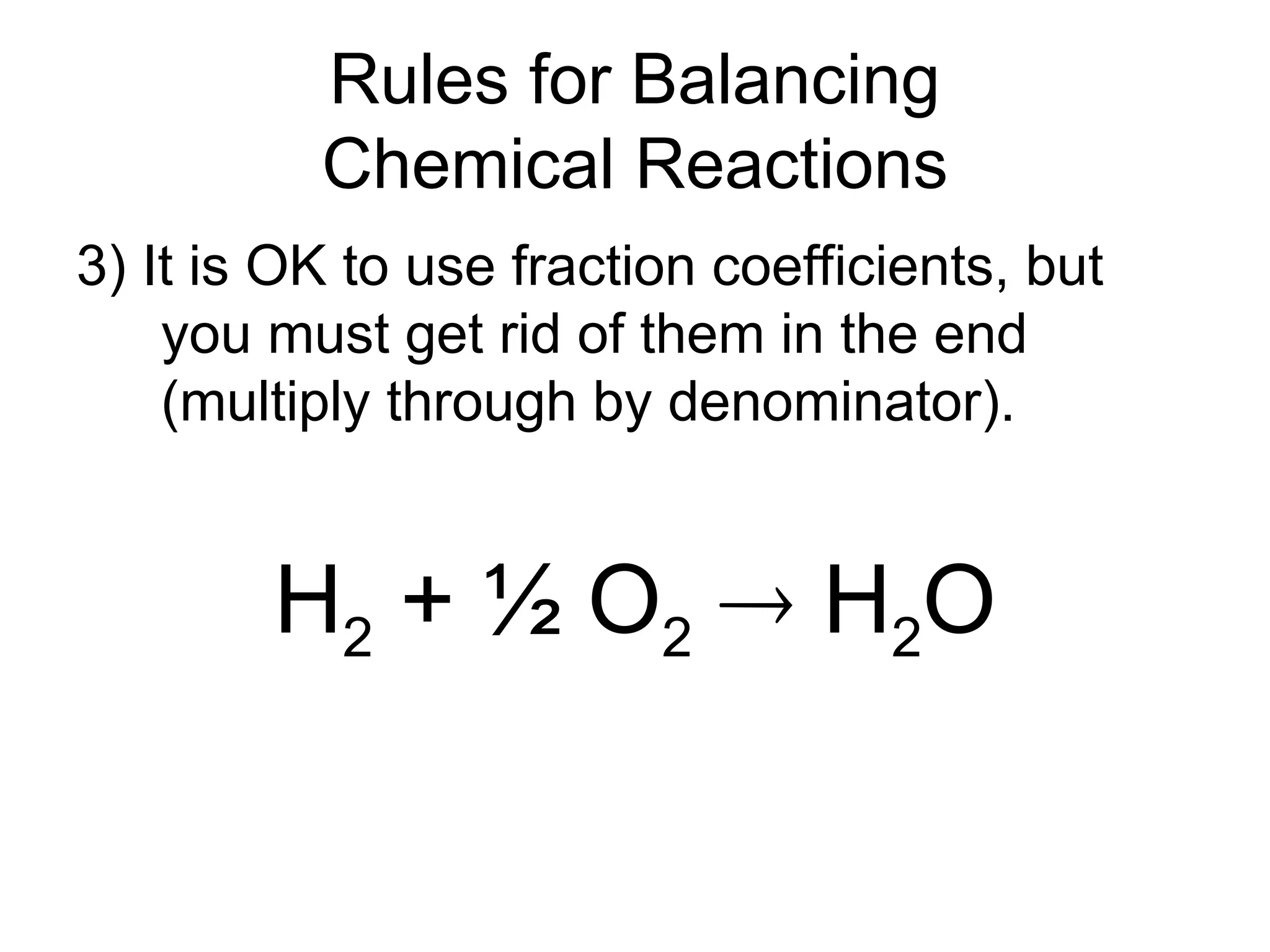
3) It is OK to use fraction coefficients, but
you must get rid of them in the end
(multiply through by denominator).
H2 + ½ O2  H2O
Rules for Balancing
Chemical Reactions
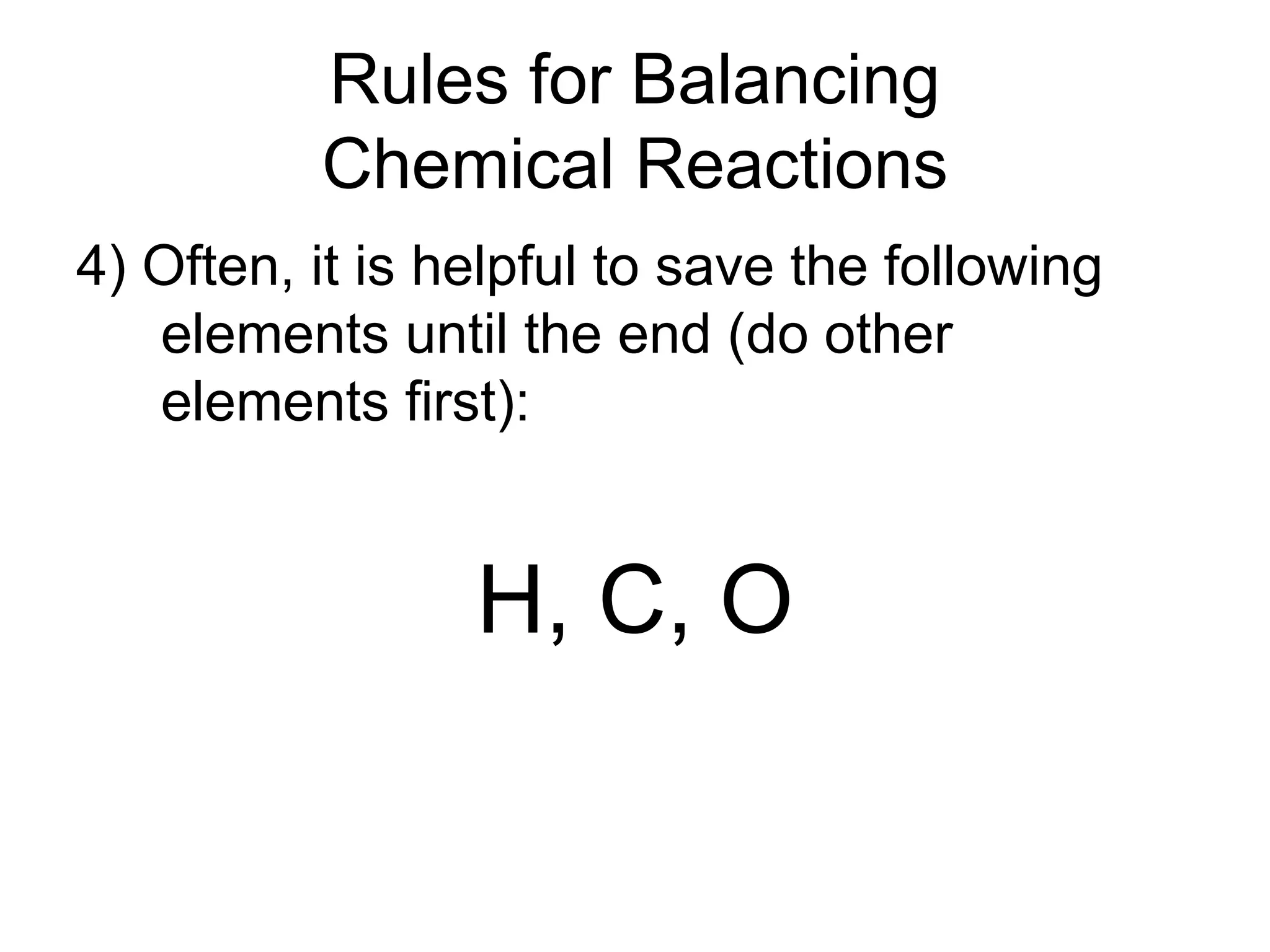
4) Often, it is helpful to save the following
elements until the end (do other
elements first):
H, C, O
Rules for Balancing
Chemical Reactions
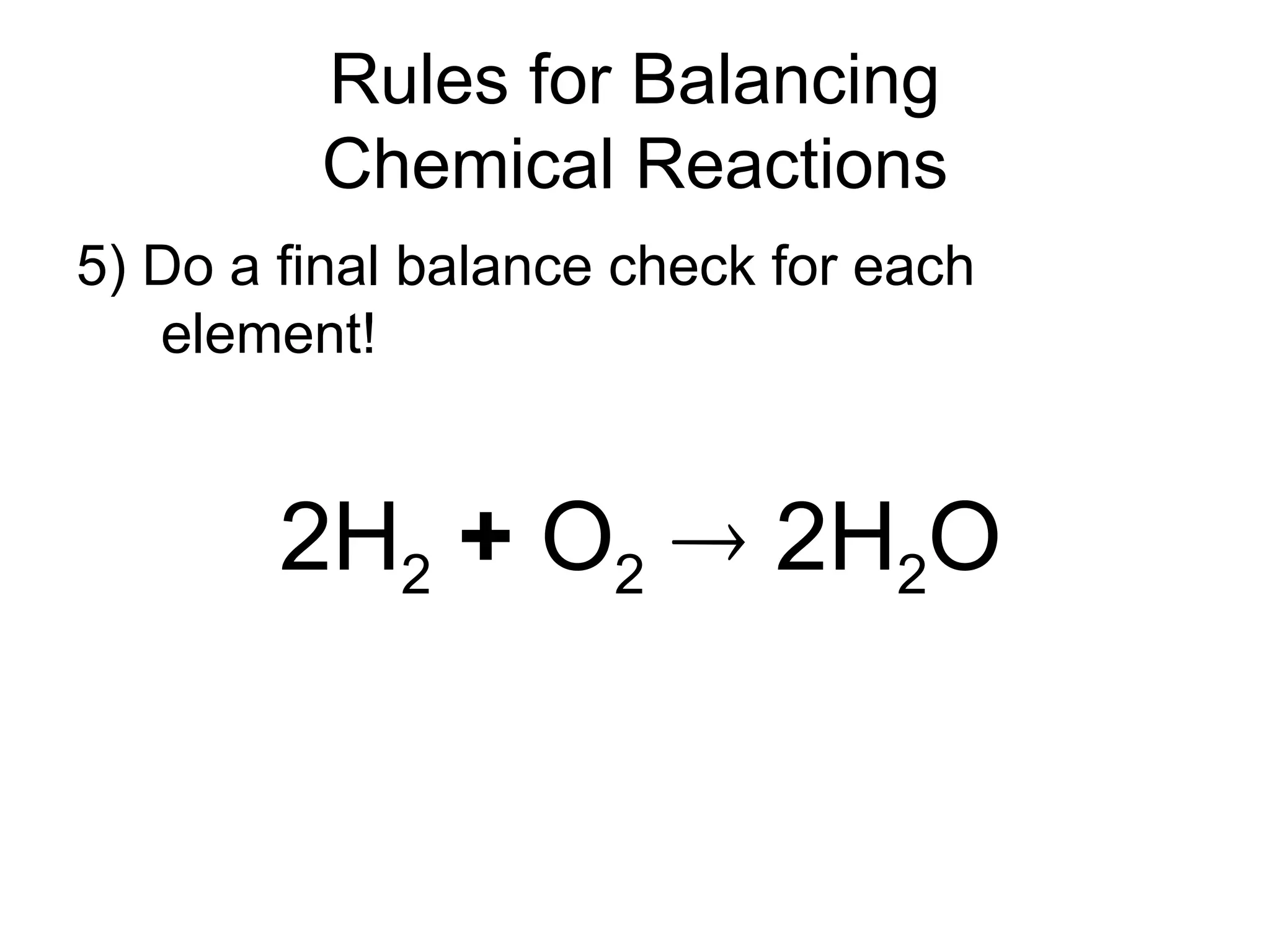
5) Do a final balance check for each
element!
2H2 + O2  2H2O
Practice
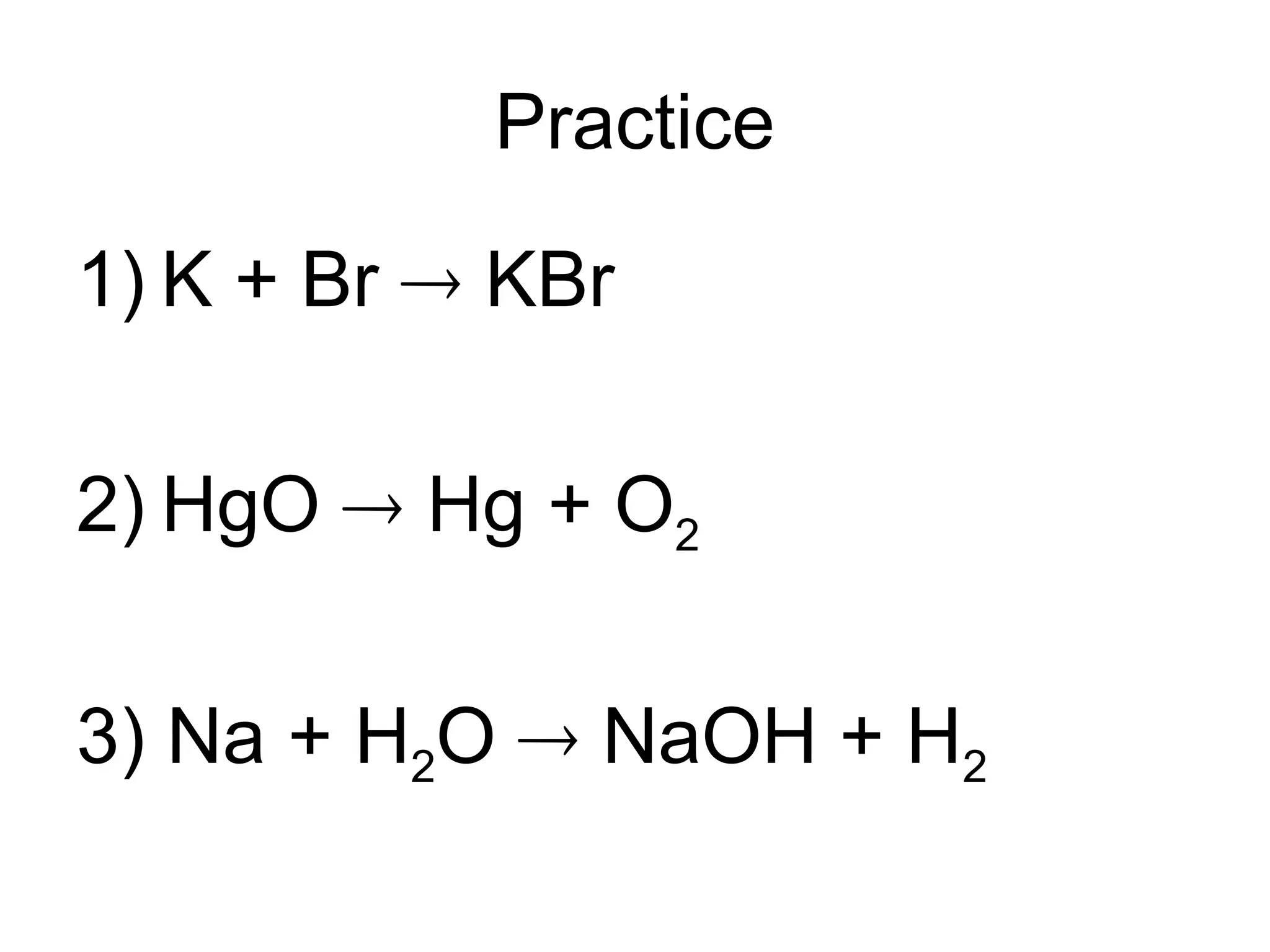
1) K + Br  KBr
2) HgO  Hg + O2
3) Na + H2O  NaOH + H2
Practice
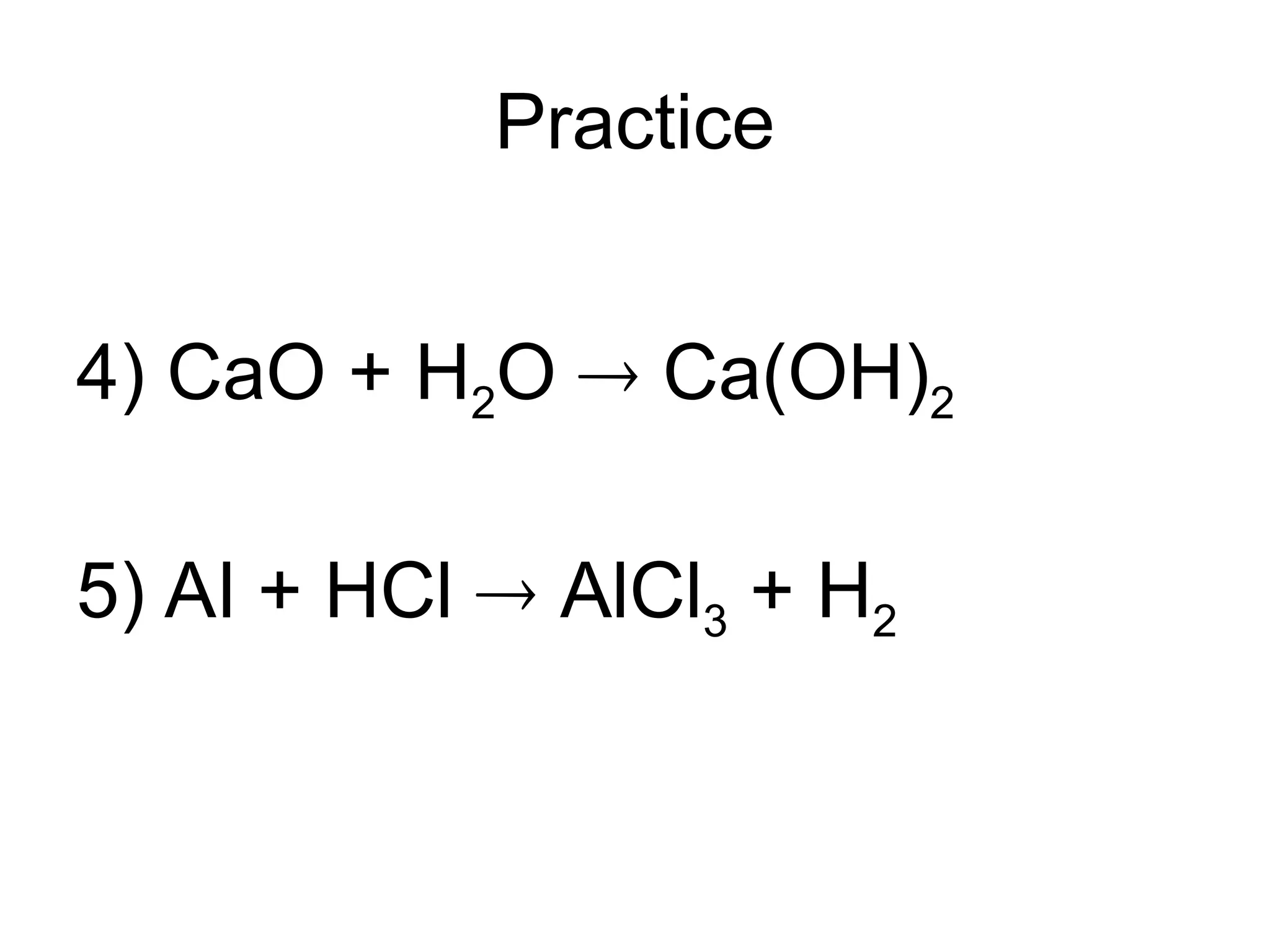
4) CaO + H2O  Ca(OH)2
5) Al + HCl  AlCl3 + H2

An Introduction to Chemical Reactions.ppt

  • 1.
  • 2.
    What is aChemical Reaction? It is a chemical change in which one or more substances are destroyed and one or more new substances are created. BEFORE H2 gas and O2 gas AFTER H2O liquid
  • 3.
    Parts of aChemical Reaction Reactants  Products Reactants: Substances that are destroyed by the chemical change (bonds break break). Products: Substances created by the chemical change (new bonds form form). The arrow () is read as “yields”.
  • 4.
    Other symbols inchemical reactions • (s) = solid • (l) = liquid • (g) = gas • (aq) = aqueous solution (the substance is dissolved in H2O) • “+” separates two or more reactants or products • “” yield sign separates reactants from products
  • 5.
    Evidence for aChemical Reaction 1) Evolution of light or heat.
  • 6.
    Evidence for aChemical Reaction 2) Temperature change (increase or decrease) to the surroundings.
  • 7.
    Evidence for aChemical Reaction 3) Formation of a gas (bubbling or an odor) other than boiling.
  • 8.
    Evidence for aChemical Reaction 4) Color change (due to the formation of a new substance).
  • 9.
    Evidence for aChemical Reaction 5) Formation of a precipitate (a new solid forms) from the reaction of two aqueous solutions.
  • 10.
    Word Equations • Statementsthat indicate the reactants and products in a chemical reaction. • Ex. Iron (s) + chlorine (g)  iron (III) chloride (s) • This is read as: “Solid iron and chlorine gas react (combine) to produce solid iron (III) chloride”
  • 11.
    Translating Word Equationsto Skeleton Equations • A skeleton equation uses chemical formulas rather than words to identify the reactants and products of a chemical reaction. • The word equation Iron (s) + chlorine (g)  iron (III) chloride (s) • The skeleton equation Fe(s) + Cl2(g)  FeCl3 (s) A skeleton equation is not yet “balanced” by coefficients!
  • 12.
    One more example… •6 Na (s) + Fe2O3 (s)  3 Na2O (s) + 2 Fe (s) – The numbers preceding the chemical formulae are coefficients. They are used to balance the reaction. – The numbers within the chemical formulae are subscripts. – You can read the above balanced reaction as: • “6 atoms of solid sodium plus 1 formula unit of solid iron (III) oxide yields 3 formula units of solid sodium oxide and 2 atoms of solid iron” or… • “6 moles of solid sodium plus 1 mole of solid iron (III) oxide yields 3 moles of solid sodium oxide plus 2 moles of solid iron” • Chemical reactions can never be read in terms of grams, only in terms of particles or groups of particles (moles).
  • 13.
  • 14.
    There are 5basic types…. • Single Replacement (Displacement) (Redox) • Double Replacement (Displacement) (Metathesis) • Synthesis (Combination) • Decomposition • Combustion
  • 15.
    A single uncombined elementreplaces another element in an ionic compound. There are two reactants and two products. 1) SINGLE REPLACEMENT REACTION Ex: Zn + CuSO4  ZnSO4 + Cu
  • 16.
    Single Replacement Reactions Singlereplacement reactions have the general form, A + BC  AC + B. Question: Do all single replacement reactions actually occur? Answer: Not necessarily…
  • 17.
    Single Replacement Reactions Examinethe reaction: Zn + CuSO4  ZnSO4 + Cu This reaction does occur!’ Now let’s try: Cu + ZnSO4  No Reaction Conclusion: Zn will replace Cu in solution, but not vice versa!
  • 18.
    Single Replacement Reactions Howdo we know which reactions will occur and which ones will not? We look at the “activity series”. Elements with higher activities replace elements with lower activities during a single-replacement reaction, but not vice- versa.
  • 19.
  • 20.
    Activity Series forNonmetals Highest Activity F Cl Br I Lowest Activity
  • 21.
    Parts of two aqueousionic compounds switch places to form two new compounds. There are two reactants and two products. 2) DOUBLE REPLACEMENT REACTION Example: AgNO3 + NaCl  AgCl + NaNO3
  • 22.
    Double Replacement Reactions Thegeneral form of a double replacement reaction is: AB + CD  AD + CB Just like single replacement reactions, not all double replacement reactions actually occur. We can experimentally attempt a D.R. reaction. The reaction occurs if: 1) A solid precipitate is produced, or 2) A gas is produced, or 3) Water is produced. If none of the above are produced and both products are (aq), then there is no reaction (NR)!
  • 23.
    Examples of DoubleReplacement Reactions: Pb(NO3)2 (aq) + 2NaI (aq)  PbI2 (s) + 2NaNO3 (aq) (precipitate forming) HCl (aq) + NaOH (aq)  NaCl (aq) + H2O (l) (water-forming, acid-base, neutralization) CaCO3 (s) + 2HCl (aq)  CaCl2 (aq) + H2CO3 (gas-forming) H(OH) H2O (l) + CO2 (g)
  • 24.
    Two or moresimple substances (the reactants) combine to form a more complex substance (the product). 3) SYNTHESIS REACTION Ex: 2Mg + O2  2MgO
  • 25.
    SYNTHESIS REACTION Types ofsynthesis: a)Element A + Element B Compound Na(s) + Cl2 (g)  2NaCl(s) a)Element + Compound A  Compound B O2(g) + 2SO2(g)  2SO3(g) a)Compound A + Compound B  Compound C CaO(s) + H2O(l)  Ca(OH)2 (s)
  • 26.
    A more complexsubstance (the reactant) breaks down into two or more simple parts (products). Synthesis and decomposition reactions are opposites. 4) DECOMPOSITION REACTION Ex: 2H2O  2H2 + O2 Electrolysis of Water
  • 27.
    DECOMPOSITION REACTIONS (Cont’d) Decomposition ofa compound produces two or more elements and/or compounds The products are always simpler than the reactant. Gases are often produced (H2, N2, O2, CO2, etc.) in the decomposition of covalent compounds. Ionic compounds may be decomposed into pure elements by using electricity (electrolysis). This is how pure metals are obtained from salts.
  • 28.
    5) COMBUSTION REACTIONS a)All involve oxygen (O2) as a reactant, combining with another substance b) All combustion reactions are are exothermic c) Complete combustion of a hydrocarbon always produces CO2 and H2O d) Incomplete combustion of a hydrocarbon will produce CO and possibly C (black carbon soot) as well Ex: CH4 + 2O2 => CO2 + 2H2O (complete combustion – blue flame) Ex: CH4 + 1.5O2 => CO + 2H2O (incomplete combustion – yellow flame) Ex: CH4 + O2 => C + 2H2O (incomplete combustion – yellow flame, soot)
  • 29.
    Combustion (cont’d) • Anysynthesis reaction which involves O2 as a reactant is also considered to be a combustion reaction! Ex. 2Mg + O2  2MgO (metal oxide) This is called the combustion of magnesium or the synthesis of magnesium oxide. The combustion of a metal always produces a metal oxide (in this case, magnesium oxide). Make sure the metal product is criss-crossed correctly!
  • 30.
    TRY TO CLASSIFYTHESE: 1) C4H8 + 6O2  4CO2 + 4H2O 2) HCl + NaOH  H2O + NaCl 3) 2KNO3(s)  2KNO2(s) + O2(g)
  • 31.
    TRY TO CLASSIFYTHESE: 4) 2Ag + S  Ag2S 5) MgCO3(s)  MgO(s) + CO2(g) 6) Cl2 + 2KBr  2KCl + Br2
  • 32.
    Check Your Answers… 1)Combustion (of a hydrocarbon) 2) Double replacement (water forming) 3) Decomposition 4) Synthesis 5) Decomposition 6) Single Replacement
  • 33.
    Conservation of Mass Duringa chemical reaction, atoms are neither created nor destroyed (Conservation of Mass). Hydrogen and oxygen gas react to form water: H2 (g) + O2 (g)  H2O (l)
  • 34.
    Conservation of Mass H2(g) + O2 (g)  H2O (l) What is wrong with this equation above? Doesn’t it appear that one oxygen atom “went missing”? According to conservation of mass, the proper way to write this reaction is: 2H2 (g) + 1O2 (g)  2H2O (l) The red coefficients represent the # of molecules (or the # of moles) of each reactant or product.
  • 35.
    Not All Propertiesare Conserved During Chemical Reactions! CONSERVED NOT CONSERVED Mass Types of atoms Number of each atom Color Physical state (solid, liquid, gas) Volume Number of moles of reactants/products
  • 36.
    Counting Atoms SnO2 +2H2 → Sn + 2H2O SUBSCRIPT COEFFICIENT
  • 37.
    Rules for Balancing ChemicalReactions __H2 + __ O2  __H2O Balancing is about finding the right coefficients!
  • 38.
    Rules for Balancing ChemicalReactions 1) You can change the coefficients, but NEVER the subscripts! __H2 + __ O2  __H2O Off Limits!
  • 39.
    Rules for Balancing ChemicalReactions 2) The coefficients must reduced to represent the lowest possible numbers. 4H2 + 2 O2  4H2O
  • 40.
    Rules for Balancing ChemicalReactions 3) It is OK to use fraction coefficients, but you must get rid of them in the end (multiply through by denominator). H2 + ½ O2  H2O
  • 41.
    Rules for Balancing ChemicalReactions 4) Often, it is helpful to save the following elements until the end (do other elements first): H, C, O
  • 42.
    Rules for Balancing ChemicalReactions 5) Do a final balance check for each element! 2H2 + O2  2H2O
  • 43.
    Practice 1) K +Br  KBr 2) HgO  Hg + O2 3) Na + H2O  NaOH + H2
  • 44.
    Practice 4) CaO +H2O  Ca(OH)2 5) Al + HCl  AlCl3 + H2