Chemical Reactions
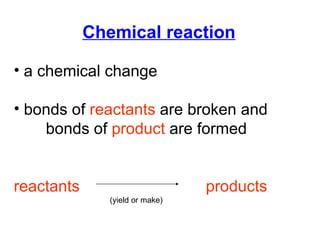
Chemical reaction   a chemical change bonds of  reactants  are broken and  bonds of  product  are formed reactants   products (yield or make)
when some chemicals come into contact with each other, they break apart, join, or rearrange to form new chemicals ( always  to become more stable)
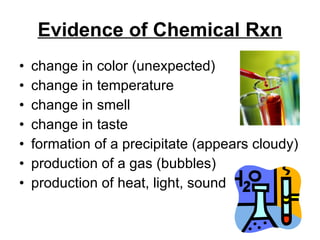
Evidence of Chemical Rxn change in color (unexpected) change in temperature  change in smell  change in taste  formation of a precipitate (appears cloudy) production of a gas (bubbles) production of heat, light, sound
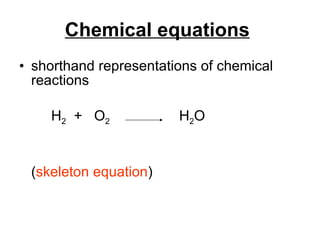
Chemical equations   shorthand representations of chemical reactions H 2   +  O 2   H 2 O ( skeleton equation )
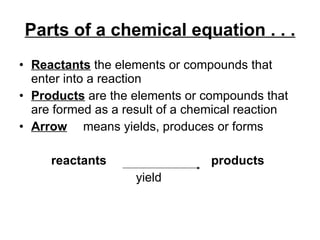
Parts of a chemical equation . . . Reactants  the elements or compounds that enter into a reaction Products  are the elements or compounds that are formed as a result of a chemical reaction Arrow   means yields, produces or forms reactants  products   yield
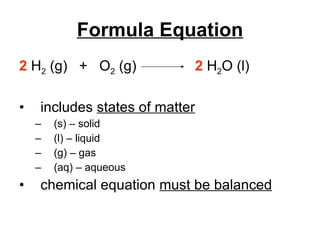
Formula Equation 2   H 2  (g)  +  O 2  (g)    2  H 2 O (l) includes  states of matter   (s) – solid (l) – liquid (g) – gas (aq) – aqueous chemical equation  must be balanced
Word equation   hydrogen gas and oxygen gas form liquid water 2   H 2  (g)  +  O 2  (g)    2  H 2 O (l)
Types of Chemical Reactions Synthesis Decomposition Double Replacement Single Replacement Combustion
1.  Synthesis A  +  B  AB two or more substances react to form a single product example : 2   H 2  (g)  +  O 2  (g)    2  H 2 O (l)
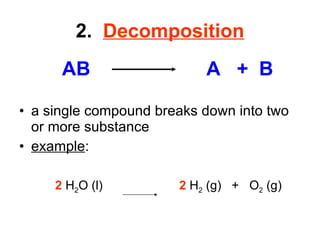
2.  Decomposition   AB    A  +  B a single compound breaks down into two or more substance example :   2  H 2 O (l)     2   H 2  (g)  +  O 2  (g)
3.  Single Replacement A  +  BC   AC  +  B the atoms of one element replace the atoms of another element in a compound example : Zn (s)  +  Cu(NO 3 ) 2  (aq) Zn(NO 3 ) 2  (aq)  +  Cu (s)
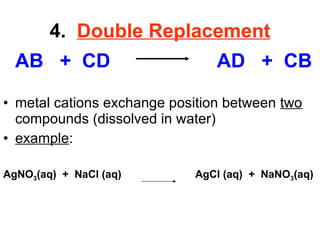
4.  Double Replacement AB  +  CD   AD  +  CB metal cations exchange position between  two  compounds (dissolved in water) example : AgNO 3 (aq)  +  NaCl (aq)  AgCl (aq)  +  NaNO 3 (aq)
5.  Combustion reactant(s)  +  O 2   product(s) oxygen combines with a substance and releases energy (heat & light) example : CH 4  (g)  +  2  O 2  (g)  CO 2  (g)  +  2  H 2 O (l)
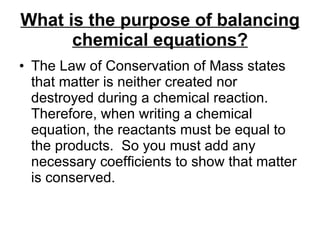
What is the purpose of balancing chemical equations? The Law of Conservation of Mass states that matter is neither created nor destroyed during a chemical reaction.  Therefore, when writing a chemical equation, the reactants must be equal to the products.  So you must add any necessary coefficients to show that matter is conserved.
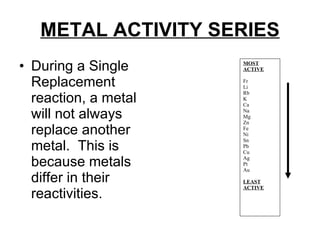
METAL ACTIVITY SERIES During a Single Replacement reaction, a metal will not always replace another metal.  This is because metals differ in their reactivities. MOST ACTIVE Fr Li Rb K Ca Na Mg Zn Fe Ni Sn Pb Cu Ag Pt Au LEAST ACTIVE
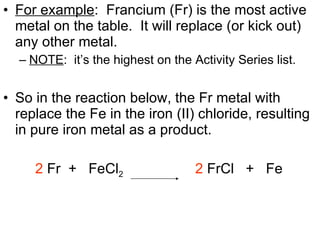
For example :  Francium (Fr) is the most active metal on the table.  It will replace (or kick out) any other metal.  NOTE :  it’s the highest on the Activity Series list. So in the reaction below, the Fr metal with replace the Fe in the iron (II) chloride, resulting in pure iron metal as a product.  2  Fr  +  FeCl 2  2  FrCl  +  Fe
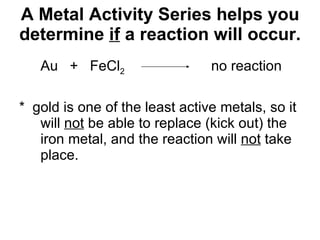
A Metal Activity Series helps you determine  if  a reaction will occur. Au  +  FeCl 2   no reaction  *  gold is one of the least active metals, so it will  not  be able to replace (kick out) the iron metal, and the reaction will  not  take place.
2  Al  +  3  FeCl 2 2  AlCl 3   +  3  Fe *  Al is more reactive than iron, so it  will  replace (kick out) the iron metal, and the reaction will take place.
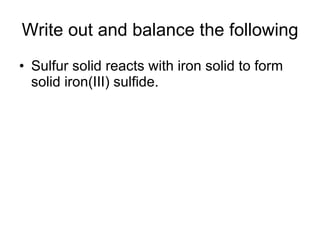
Write out and balance the following Sulfur solid reacts with iron solid to form solid iron(III) sulfide.
Magnesium metal reacts with hydrochloric acid to form magnesium chloride solution and hydrogen gas.
Oxygen gas reacts with solid copper metal to form copper(II) oxide solid.
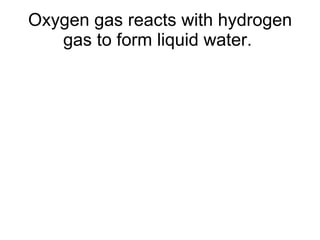
Oxygen gas reacts with hydrogen gas to form liquid water.
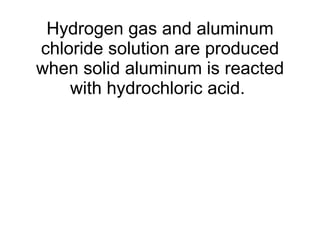
Hydrogen gas and aluminum chloride solution are produced when solid aluminum is reacted with hydrochloric acid.
Answer Key 3S (s) + 2Fe(s)------>  Fe 2 S 3 (s) Mg(s) + 2HCl(aq)------> MgCl 2 (aq) + H 2 (g) O 2 (g) + 2Cu(s)------> 2CuO(s) 2H 2 (g) + O 2 (g)------> 2H 2 O(l) 2Al(s) + 6HCl(aq)------> 3H 2 (g) + 2AlCl 3 (aq)
Try the following Write out the formula and balance. Dinitrogen pentoxide gas in the presence of a platinum catalyst and high enough temperature forms nitrogen gas and oxygen gas. Sulfur solid reacts with iron solid to form solid iron(III) sulfide. Hydrogen gas and iron(III) oxide powder react to form liquid water and solid iron powder. Magnesium metal reacts with hydrochloric acid to form magnesium chloride solution and hydrogen gas. Magnesium sulfide solid and hydrochloric acid react to form hydrogen sulfide gas and magnesium chloride solution.
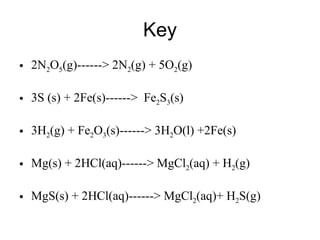
Key 2N 2 O 5 (g)------> 2N 2 (g) + 5O 2 (g) 3S (s) + 2Fe(s)------>  Fe 2 S 3 (s) 3H 2 (g) + Fe 2 O 3 (s)------> 3H 2 O(l) +2Fe(s)  Mg(s) + 2HCl(aq)------> MgCl 2 (aq) + H 2 (g) MgS(s) + 2HCl(aq)------> MgCl 2 (aq)+ H 2 S(g)
Finding Formula Mass H 3 PO 4   AlCl 3   K 2 C 4 H 4 O 6   N 2 O 5   K 3 SO 4 Nd 2 O 3

Chemical reactions

  • 1.
  • 2.
    Chemical reaction a chemical change bonds of reactants are broken and bonds of product are formed reactants products (yield or make)
  • 3.
    when some chemicalscome into contact with each other, they break apart, join, or rearrange to form new chemicals ( always to become more stable)
  • 4.
    Evidence of ChemicalRxn change in color (unexpected) change in temperature change in smell change in taste formation of a precipitate (appears cloudy) production of a gas (bubbles) production of heat, light, sound
  • 5.
    Chemical equations shorthand representations of chemical reactions H 2 + O 2 H 2 O ( skeleton equation )
  • 6.
    Parts of achemical equation . . . Reactants the elements or compounds that enter into a reaction Products are the elements or compounds that are formed as a result of a chemical reaction Arrow means yields, produces or forms reactants products yield
  • 7.
    Formula Equation 2 H 2 (g) + O 2 (g) 2 H 2 O (l) includes states of matter (s) – solid (l) – liquid (g) – gas (aq) – aqueous chemical equation must be balanced
  • 8.
    Word equation hydrogen gas and oxygen gas form liquid water 2 H 2 (g) + O 2 (g) 2 H 2 O (l)
  • 9.
    Types of ChemicalReactions Synthesis Decomposition Double Replacement Single Replacement Combustion
  • 10.
    1. SynthesisA + B AB two or more substances react to form a single product example : 2 H 2 (g) + O 2 (g) 2 H 2 O (l)
  • 11.
    2. Decomposition AB A + B a single compound breaks down into two or more substance example : 2 H 2 O (l) 2 H 2 (g) + O 2 (g)
  • 12.
    3. SingleReplacement A + BC AC + B the atoms of one element replace the atoms of another element in a compound example : Zn (s) + Cu(NO 3 ) 2 (aq) Zn(NO 3 ) 2 (aq) + Cu (s)
  • 13.
    4. DoubleReplacement AB + CD AD + CB metal cations exchange position between two compounds (dissolved in water) example : AgNO 3 (aq) + NaCl (aq) AgCl (aq) + NaNO 3 (aq)
  • 14.
    5. Combustionreactant(s) + O 2 product(s) oxygen combines with a substance and releases energy (heat & light) example : CH 4 (g) + 2 O 2 (g) CO 2 (g) + 2 H 2 O (l)
  • 15.
    What is thepurpose of balancing chemical equations? The Law of Conservation of Mass states that matter is neither created nor destroyed during a chemical reaction. Therefore, when writing a chemical equation, the reactants must be equal to the products. So you must add any necessary coefficients to show that matter is conserved.
  • 16.
    METAL ACTIVITY SERIESDuring a Single Replacement reaction, a metal will not always replace another metal. This is because metals differ in their reactivities. MOST ACTIVE Fr Li Rb K Ca Na Mg Zn Fe Ni Sn Pb Cu Ag Pt Au LEAST ACTIVE
  • 17.
    For example : Francium (Fr) is the most active metal on the table. It will replace (or kick out) any other metal. NOTE : it’s the highest on the Activity Series list. So in the reaction below, the Fr metal with replace the Fe in the iron (II) chloride, resulting in pure iron metal as a product. 2 Fr + FeCl 2 2 FrCl + Fe
  • 18.
    A Metal ActivitySeries helps you determine if a reaction will occur. Au + FeCl 2 no reaction * gold is one of the least active metals, so it will not be able to replace (kick out) the iron metal, and the reaction will not take place.
  • 19.
    2 Al + 3 FeCl 2 2 AlCl 3 + 3 Fe * Al is more reactive than iron, so it will replace (kick out) the iron metal, and the reaction will take place.
  • 20.
    Write out andbalance the following Sulfur solid reacts with iron solid to form solid iron(III) sulfide.
  • 21.
    Magnesium metal reactswith hydrochloric acid to form magnesium chloride solution and hydrogen gas.
  • 22.
    Oxygen gas reactswith solid copper metal to form copper(II) oxide solid.
  • 23.
    Oxygen gas reactswith hydrogen gas to form liquid water.
  • 24.
    Hydrogen gas andaluminum chloride solution are produced when solid aluminum is reacted with hydrochloric acid.
  • 25.
    Answer Key 3S(s) + 2Fe(s)------> Fe 2 S 3 (s) Mg(s) + 2HCl(aq)------> MgCl 2 (aq) + H 2 (g) O 2 (g) + 2Cu(s)------> 2CuO(s) 2H 2 (g) + O 2 (g)------> 2H 2 O(l) 2Al(s) + 6HCl(aq)------> 3H 2 (g) + 2AlCl 3 (aq)
  • 26.
    Try the followingWrite out the formula and balance. Dinitrogen pentoxide gas in the presence of a platinum catalyst and high enough temperature forms nitrogen gas and oxygen gas. Sulfur solid reacts with iron solid to form solid iron(III) sulfide. Hydrogen gas and iron(III) oxide powder react to form liquid water and solid iron powder. Magnesium metal reacts with hydrochloric acid to form magnesium chloride solution and hydrogen gas. Magnesium sulfide solid and hydrochloric acid react to form hydrogen sulfide gas and magnesium chloride solution.
  • 27.
    Key 2N 2O 5 (g)------> 2N 2 (g) + 5O 2 (g) 3S (s) + 2Fe(s)------> Fe 2 S 3 (s) 3H 2 (g) + Fe 2 O 3 (s)------> 3H 2 O(l) +2Fe(s) Mg(s) + 2HCl(aq)------> MgCl 2 (aq) + H 2 (g) MgS(s) + 2HCl(aq)------> MgCl 2 (aq)+ H 2 S(g)
  • 28.
    Finding Formula MassH 3 PO 4 AlCl 3 K 2 C 4 H 4 O 6 N 2 O 5 K 3 SO 4 Nd 2 O 3