SREENANDU
Jr. Faculty for CHEMISTRY
TMCC
• Historical development
• Relationship- position and electronic configuration
• Periodic table - 118 elements (2017)
• Difficult to study and remember all elements individually
• Classification was necessary
• Using atomic weight attempts started to classify elements
• Triads
• Law of octaves
• Lothar Mayer’s Atomic volume curve
• Mendeleev’s Periodic table
• Mosley's modern periodic table
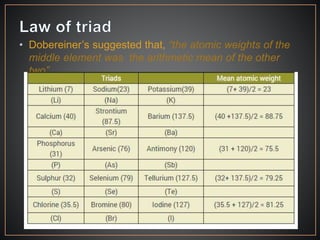
• Dobereiner’s suggested that, “the atomic weights of the
middle element was the arithmetic mean of the other
two”.
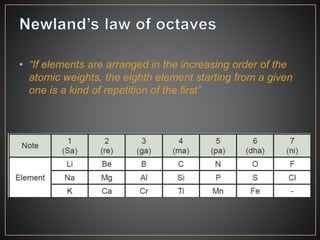
• “If elements are arranged in the increasing order of the
atomic weights, the eighth element starting from a given
one is a kind of repetition of the first”
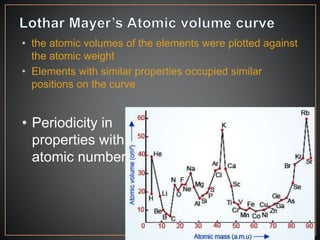
• the atomic volumes of the elements were plotted against
the atomic weight
• Elements with similar properties occupied similar
positions on the curve
• Periodicity in
properties with
atomic number
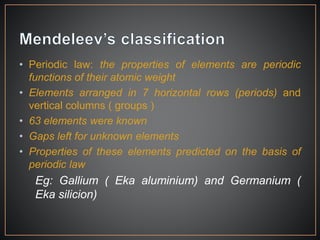
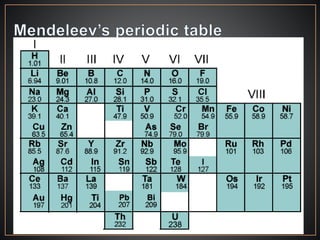
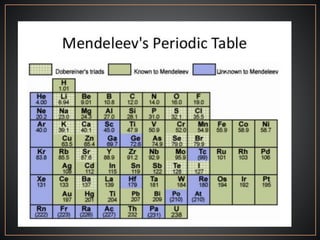
• Periodic law: the properties of elements are periodic
functions of their atomic weight
• Elements arranged in 7 horizontal rows (periods) and
vertical columns ( groups )
• 63 elements were known
• Gaps left for unknown elements
• Properties of these elements predicted on the basis of
periodic law
Eg: Gallium ( Eka aluminium) and Germanium (
Eka silicion)
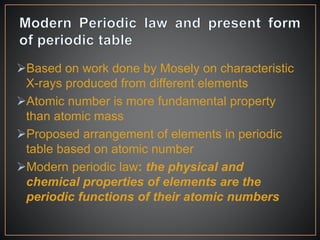
Based on work done by Mosely on characteristic
X-rays produced from different elements
Atomic number is more fundamental property
than atomic mass
Proposed arrangement of elements in periodic
table based on atomic number
Modern periodic law: the physical and
chemical properties of elements are the
periodic functions of their atomic numbers
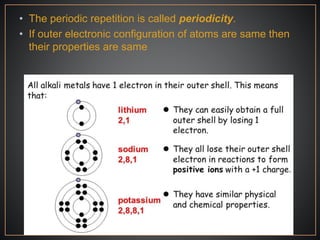
• The periodic repetition is called periodicity.
• If outer electronic configuration of atoms are same then
their properties are same
• Electronic configuration: distribution of electrons into
orbitals of an atom
• Location of element in the periodic table indicates its
quantum numbers.
• it helps to predict the chemical, electrical and magnetic
behavior of substance
• The electrons are distributed over different energy level.
These energy levels are called the shell or orbits.
• overall energy of all electrons of an atom remains
minimum for stability of atom
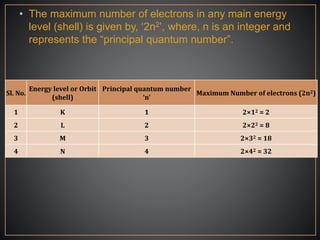
• The maximum number of electrons in any main energy
level (shell) is given by, ‘2n2’, where, n is an integer and
represents the “principal quantum number”.
Sl. No.
Energy level or Orbit
(shell)
Principal quantum number
‘n’
Maximum Number of electrons (2n2)
1 K 1 2×12 = 2
2 L 2 2×22 = 8
3 M 3 2×32 = 18
4 N 4 2×42 = 32
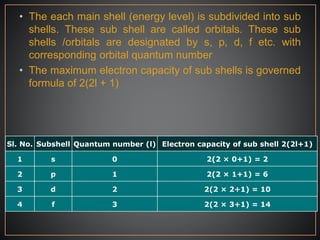
• The each main shell (energy level) is subdivided into sub
shells. These sub shell are called orbitals. These sub
shells /orbitals are designated by s, p, d, f etc. with
corresponding orbital quantum number
• The maximum electron capacity of sub shells is governed
formula of 2(2l + 1)
Sl. No. Subshell Quantum number (l) Electron capacity of sub shell 2(2l+1)
1 s 0 2(2 × 0+1) = 2
2 p 1 2(2 × 1+1) = 6
3 d 2 2(2 × 2+1) = 10
4 f 3 2(2 × 3+1) = 14
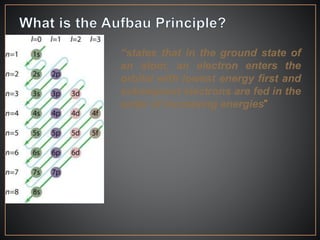
“states that in the ground state of
an atom, an electron enters the
orbital with lowest energy first and
subsequent electrons are fed in the
order of increasing energies”
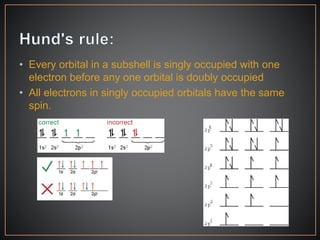
• Every orbital in a subshell is singly occupied with one
electron before any one orbital is doubly occupied
• All electrons in singly occupied orbitals have the same
spin.
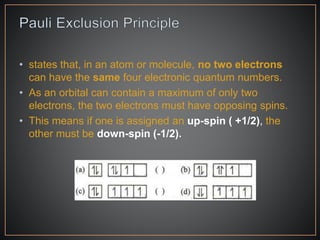
• states that, in an atom or molecule, no two electrons
can have the same four electronic quantum numbers.
• As an orbital can contain a maximum of only two
electrons, the two electrons must have opposing spins.
• This means if one is assigned an up-spin ( +1/2), the
other must be down-spin (-1/2).
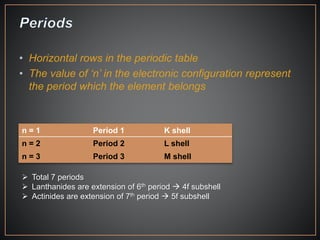
• Horizontal rows in the periodic table
• The value of ‘n’ in the electronic configuration represent
the period which the element belongs
n = 1 Period 1 K shell
n = 2 Period 2 L shell
n = 3 Period 3 M shell
 Total 7 periods
 Lanthanides are extension of 6th period  4f subshell
 Actinides are extension of 7th period  5f subshell
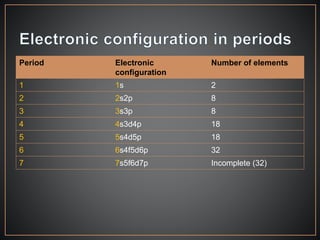
Period Electronic
configuration
Number of elements
1 1s 2
2 2s2p 8
3 3s3p 8
4 4s3d4p 18
5 5s4d5p 18
6 6s4f5d6p 32
7 7s5f6d7p Incomplete (32)
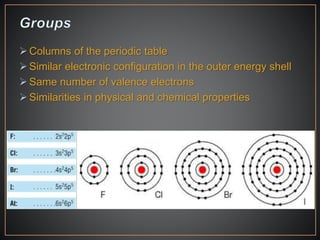
Columns of the periodic table
Similar electronic configuration in the outer energy shell
Same number of valence electrons
Similarities in physical and chemical properties
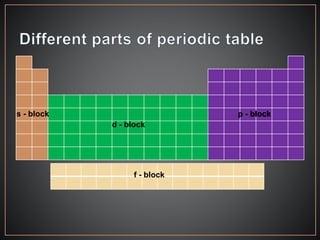
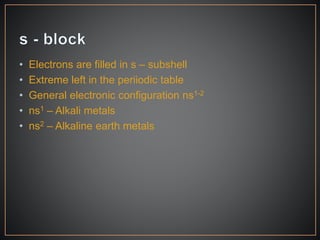
s - block
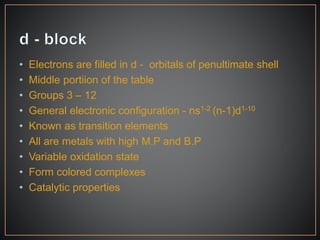
d - block
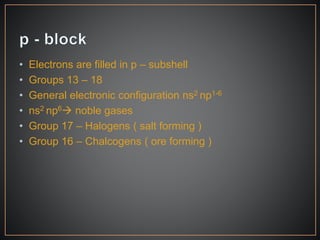
p - block
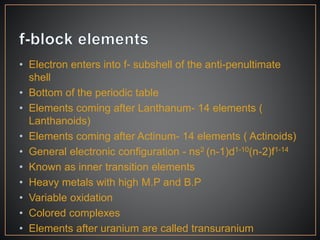
f - block
• Electrons are filled in s – subshell
• Extreme left in the periiodic table
• General electronic configuration ns1-2
• ns1 – Alkali metals
• ns2 – Alkaline earth metals
• Electrons are filled in p – subshell
• Groups 13 – 18
• General electronic configuration ns2 np1-6
• ns2 np6 noble gases
• Group 17 – Halogens ( salt forming )
• Group 16 – Chalcogens ( ore forming )
• Electrons are filled in d - orbitals of penultimate shell
• Middle portiion of the table
• Groups 3 – 12
• General electronic configuration - ns1-2 (n-1)d1-10
• Known as transition elements
• All are metals with high M.P and B.P
• Variable oxidation state
• Form colored complexes
• Catalytic properties
• Electron enters into f- subshell of the anti-penultimate
shell
• Bottom of the periodic table
• Elements coming after Lanthanum- 14 elements (
Lanthanoids)
• Elements coming after Actinum- 14 elements ( Actinoids)
• General electronic configuration - ns2 (n-1)d1-10(n-2)f1-14
• Known as inner transition elements
• Heavy metals with high M.P and B.P
• Variable oxidation
• Colored complexes
• Elements after uranium are called transuranium

Classification of elements

  • 1.
  • 2.
    • Historical development •Relationship- position and electronic configuration
  • 3.
    • Periodic table- 118 elements (2017) • Difficult to study and remember all elements individually • Classification was necessary • Using atomic weight attempts started to classify elements
  • 4.
    • Triads • Lawof octaves • Lothar Mayer’s Atomic volume curve • Mendeleev’s Periodic table • Mosley's modern periodic table
  • 5.
    • Dobereiner’s suggestedthat, “the atomic weights of the middle element was the arithmetic mean of the other two”.
  • 6.
    • “If elementsare arranged in the increasing order of the atomic weights, the eighth element starting from a given one is a kind of repetition of the first”
  • 7.
    • the atomicvolumes of the elements were plotted against the atomic weight • Elements with similar properties occupied similar positions on the curve • Periodicity in properties with atomic number
  • 8.
    • Periodic law:the properties of elements are periodic functions of their atomic weight • Elements arranged in 7 horizontal rows (periods) and vertical columns ( groups ) • 63 elements were known • Gaps left for unknown elements • Properties of these elements predicted on the basis of periodic law Eg: Gallium ( Eka aluminium) and Germanium ( Eka silicion)
  • 11.
    Based on workdone by Mosely on characteristic X-rays produced from different elements Atomic number is more fundamental property than atomic mass Proposed arrangement of elements in periodic table based on atomic number Modern periodic law: the physical and chemical properties of elements are the periodic functions of their atomic numbers
  • 12.
    • The periodicrepetition is called periodicity. • If outer electronic configuration of atoms are same then their properties are same
  • 14.
    • Electronic configuration:distribution of electrons into orbitals of an atom • Location of element in the periodic table indicates its quantum numbers. • it helps to predict the chemical, electrical and magnetic behavior of substance • The electrons are distributed over different energy level. These energy levels are called the shell or orbits. • overall energy of all electrons of an atom remains minimum for stability of atom
  • 15.
    • The maximumnumber of electrons in any main energy level (shell) is given by, ‘2n2’, where, n is an integer and represents the “principal quantum number”. Sl. No. Energy level or Orbit (shell) Principal quantum number ‘n’ Maximum Number of electrons (2n2) 1 K 1 2×12 = 2 2 L 2 2×22 = 8 3 M 3 2×32 = 18 4 N 4 2×42 = 32
  • 16.
    • The eachmain shell (energy level) is subdivided into sub shells. These sub shell are called orbitals. These sub shells /orbitals are designated by s, p, d, f etc. with corresponding orbital quantum number • The maximum electron capacity of sub shells is governed formula of 2(2l + 1) Sl. No. Subshell Quantum number (l) Electron capacity of sub shell 2(2l+1) 1 s 0 2(2 × 0+1) = 2 2 p 1 2(2 × 1+1) = 6 3 d 2 2(2 × 2+1) = 10 4 f 3 2(2 × 3+1) = 14
  • 17.
    “states that inthe ground state of an atom, an electron enters the orbital with lowest energy first and subsequent electrons are fed in the order of increasing energies”
  • 18.
    • Every orbitalin a subshell is singly occupied with one electron before any one orbital is doubly occupied • All electrons in singly occupied orbitals have the same spin.
  • 19.
    • states that,in an atom or molecule, no two electrons can have the same four electronic quantum numbers. • As an orbital can contain a maximum of only two electrons, the two electrons must have opposing spins. • This means if one is assigned an up-spin ( +1/2), the other must be down-spin (-1/2).
  • 20.
    • Horizontal rowsin the periodic table • The value of ‘n’ in the electronic configuration represent the period which the element belongs n = 1 Period 1 K shell n = 2 Period 2 L shell n = 3 Period 3 M shell  Total 7 periods  Lanthanides are extension of 6th period  4f subshell  Actinides are extension of 7th period  5f subshell
  • 21.
    Period Electronic configuration Number ofelements 1 1s 2 2 2s2p 8 3 3s3p 8 4 4s3d4p 18 5 5s4d5p 18 6 6s4f5d6p 32 7 7s5f6d7p Incomplete (32)
  • 22.
    Columns of theperiodic table Similar electronic configuration in the outer energy shell Same number of valence electrons Similarities in physical and chemical properties
  • 23.
    s - block d- block p - block f - block
  • 24.
    • Electrons arefilled in s – subshell • Extreme left in the periiodic table • General electronic configuration ns1-2 • ns1 – Alkali metals • ns2 – Alkaline earth metals
  • 25.
    • Electrons arefilled in p – subshell • Groups 13 – 18 • General electronic configuration ns2 np1-6 • ns2 np6 noble gases • Group 17 – Halogens ( salt forming ) • Group 16 – Chalcogens ( ore forming )
  • 26.
    • Electrons arefilled in d - orbitals of penultimate shell • Middle portiion of the table • Groups 3 – 12 • General electronic configuration - ns1-2 (n-1)d1-10 • Known as transition elements • All are metals with high M.P and B.P • Variable oxidation state • Form colored complexes • Catalytic properties
  • 27.
    • Electron entersinto f- subshell of the anti-penultimate shell • Bottom of the periodic table • Elements coming after Lanthanum- 14 elements ( Lanthanoids) • Elements coming after Actinum- 14 elements ( Actinoids) • General electronic configuration - ns2 (n-1)d1-10(n-2)f1-14 • Known as inner transition elements • Heavy metals with high M.P and B.P • Variable oxidation • Colored complexes • Elements after uranium are called transuranium