Quality Education For All
For more information please visit below website
https://v-learning.in/live-course/923/chemistry-periodic-classification-of-elements-kseeb-cbse-vistas-learning
1-SHOT REVISION
Periodic Classification Of Elements
Probable Type Of Question For Exams
The Modern Periodic Table
✓ The Modern Periodic Table was introduced by Henry
Moseley
✓ During his time 92 elements were already discovered.
• Elements should be arranged based on their Atomic Number
but not Atomic Mass
• Therefore all the 92 elements were arranged in increasing
order of their atomic number.
• There were
• 18 groups (Vertical column)
• 7 periods ( Horizontal row)
• The elements present in one single group will all have same
physical and chemical properties
• Elements present in the same group will have same number of
valence electrons.
• Periodicity – Elements shows similar physical and chemical
properties after certain gap is called as Periodicity .
Modern Periodic Law states that, "Properties of the elements are
the periodic function of their atomic number”
Position of Elements in Modern Periodic Table
Periodic Table has 18 vertical Columns called as GROUPS and 7 horizontal Rows called as
PERIODS
Importance of Group Number
• Elements present in the same group will have same number of valence
electrons
Importance of Period Number
Period number tells about the shell number present in last number of
electrons
The position of element in the periodic table tells about the Chemical
Reactivity
Valence Electrons determine the kind and number of bonds formed by
an element.
Trends in periodic table
The three important trends which we are learning in our Modern
Periodic Table are
➢Valency
➢Atomic Size
➢Metallic and Non-Metallic Properties
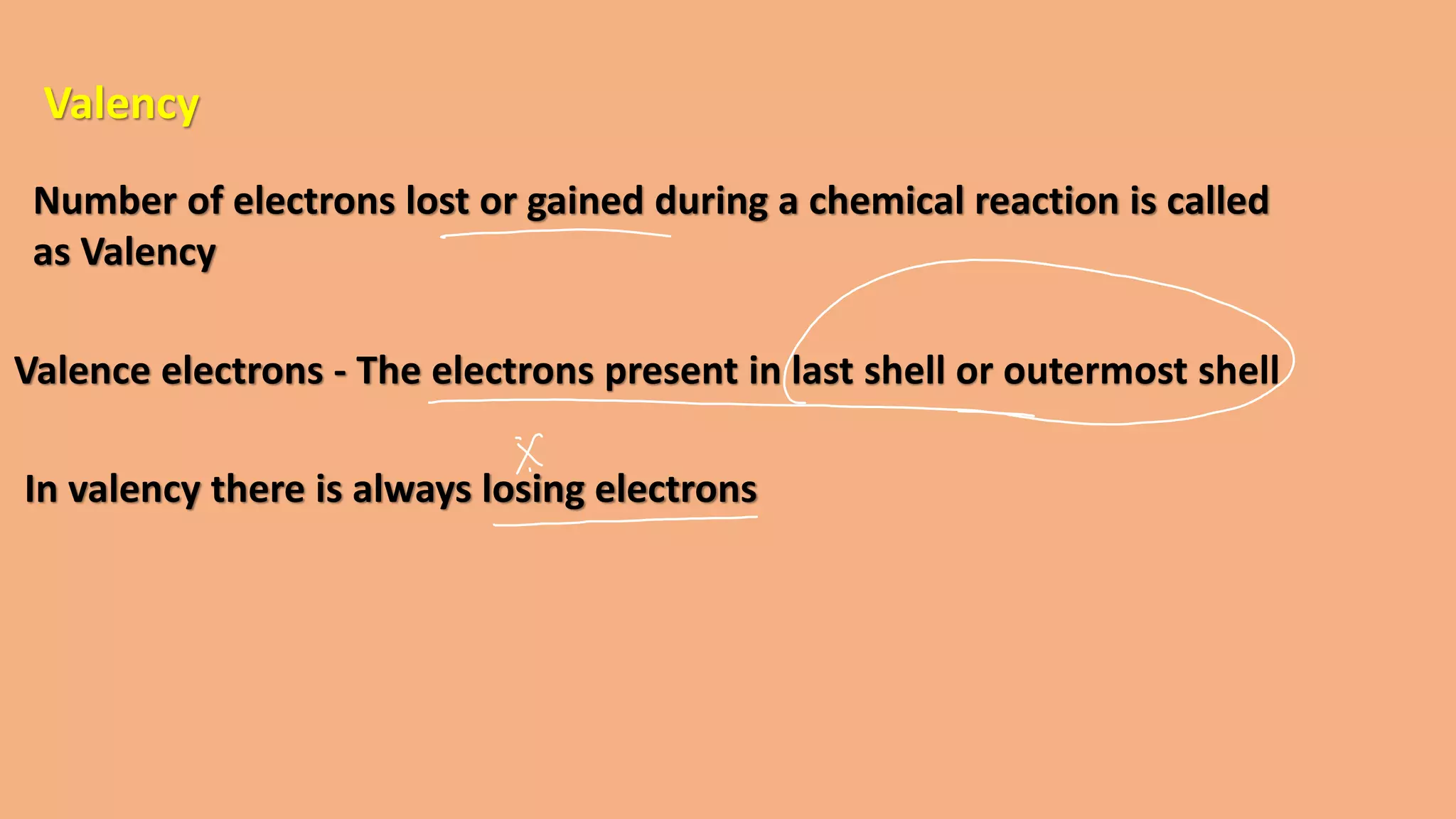
Valency
Number of electrons lost or gained during a chemical reaction is called
as Valency
Valence electrons - The electrons present in last shell or outermost shell
In valency there is always losing electrons
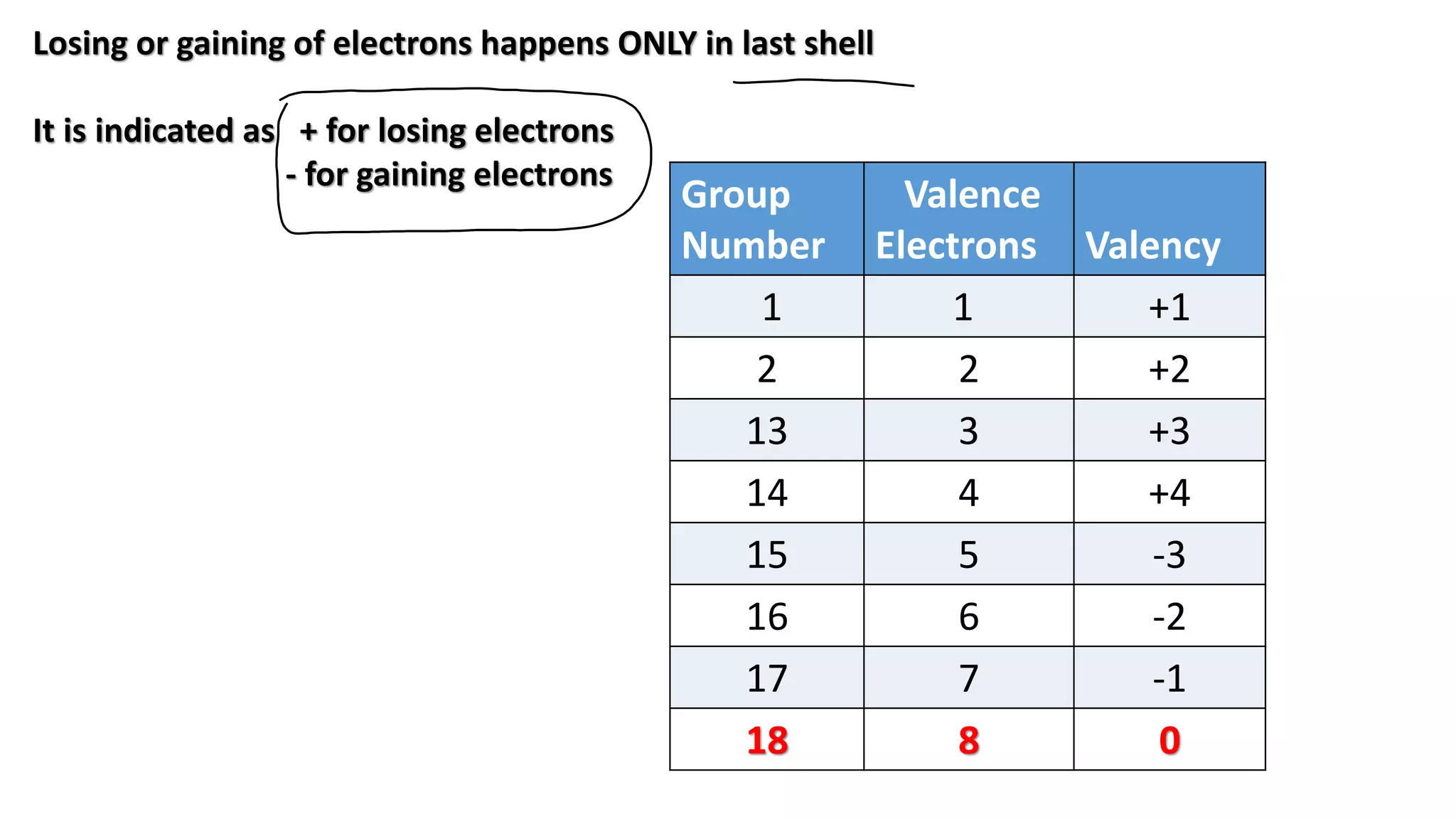
Losing or gaining of electrons happens ONLY in last shell
It is indicated as + for losing electrons
- for gaining electrons
Group
Number
Valence
Electrons Valency
1 1 +1
2 2 +2
13 3 +3
14 4 +4
15 5 -3
16 6 -2
17 7 -1
18 8 0
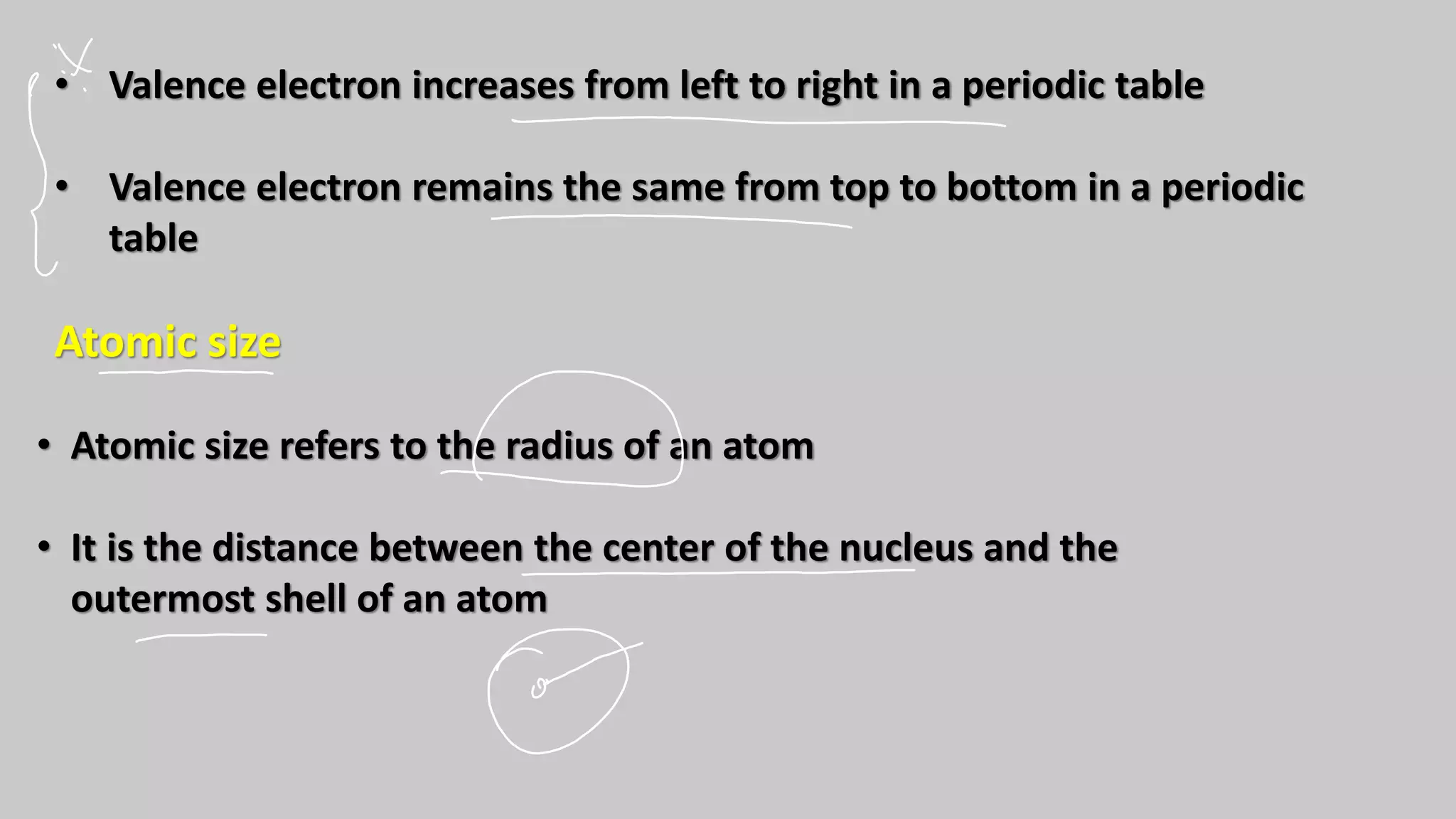
• Valence electron increases from left to right in a periodic table
• Valence electron remains the same from top to bottom in a periodic
table
Atomic size
• Atomic size refers to the radius of an atom
• It is the distance between the center of the nucleus and the
outermost shell of an atom
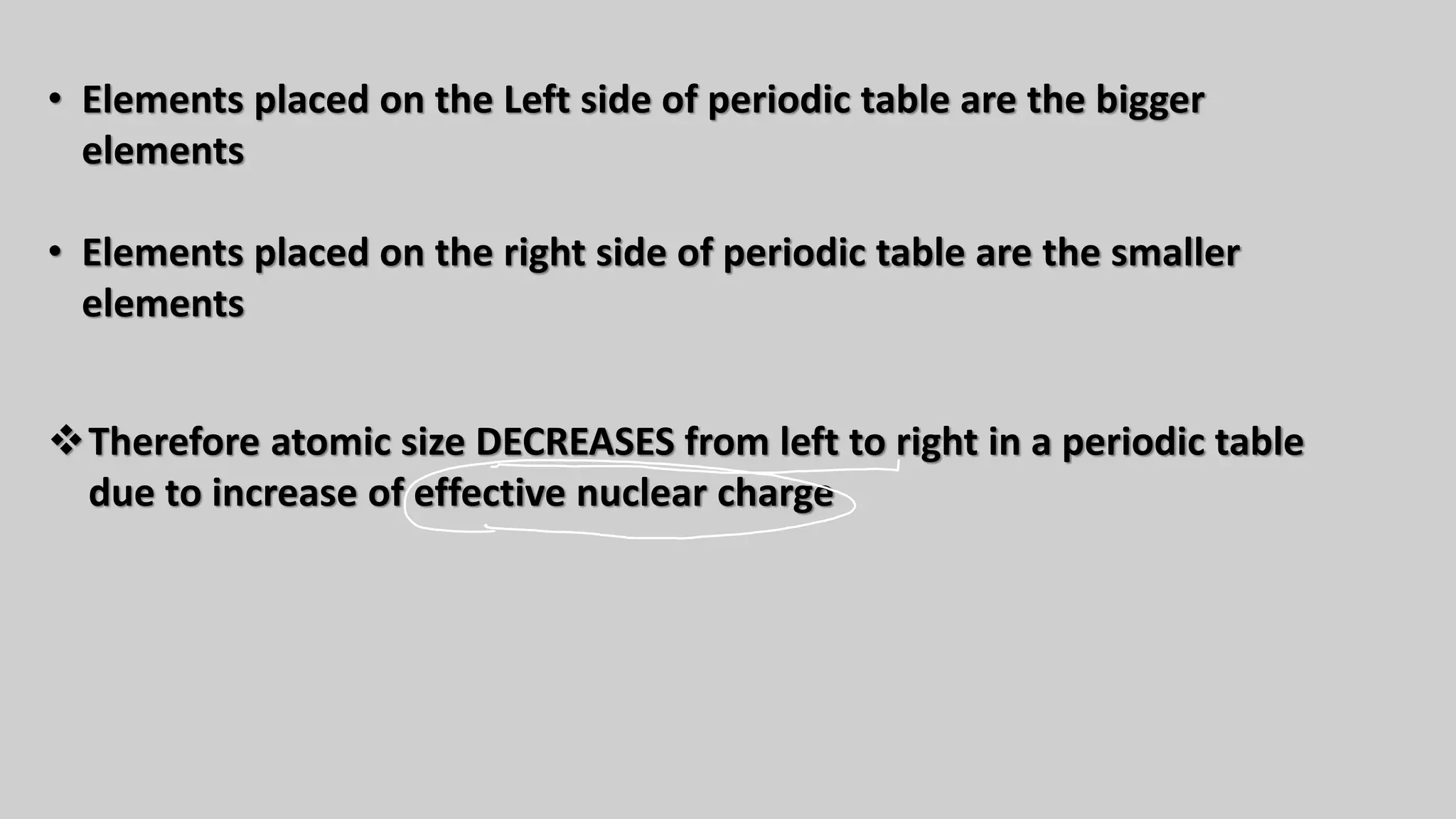
• Elements placed on the Left side of periodic table are the bigger
elements
• Elements placed on the right side of periodic table are the smaller
elements
❖Therefore atomic size DECREASES from left to right in a periodic table
due to increase of effective nuclear charge
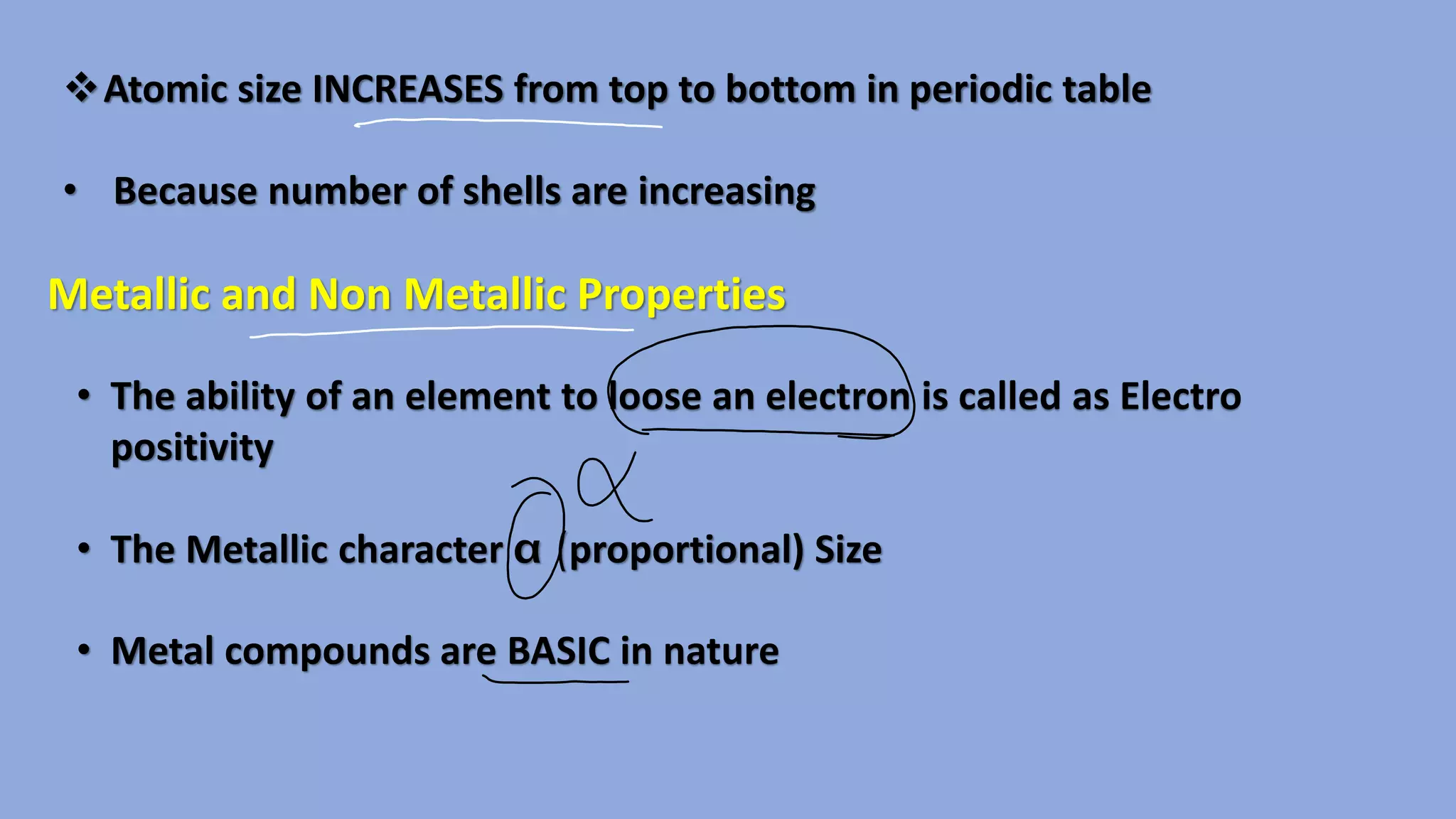
❖Atomic size INCREASES from top to bottom in periodic table
• Because number of shells are increasing
Metallic and Non Metallic Properties
• The ability of an element to loose an electron is called as Electro
positivity
• The Metallic character (proportional) Size
• Metal compounds are BASIC in nature
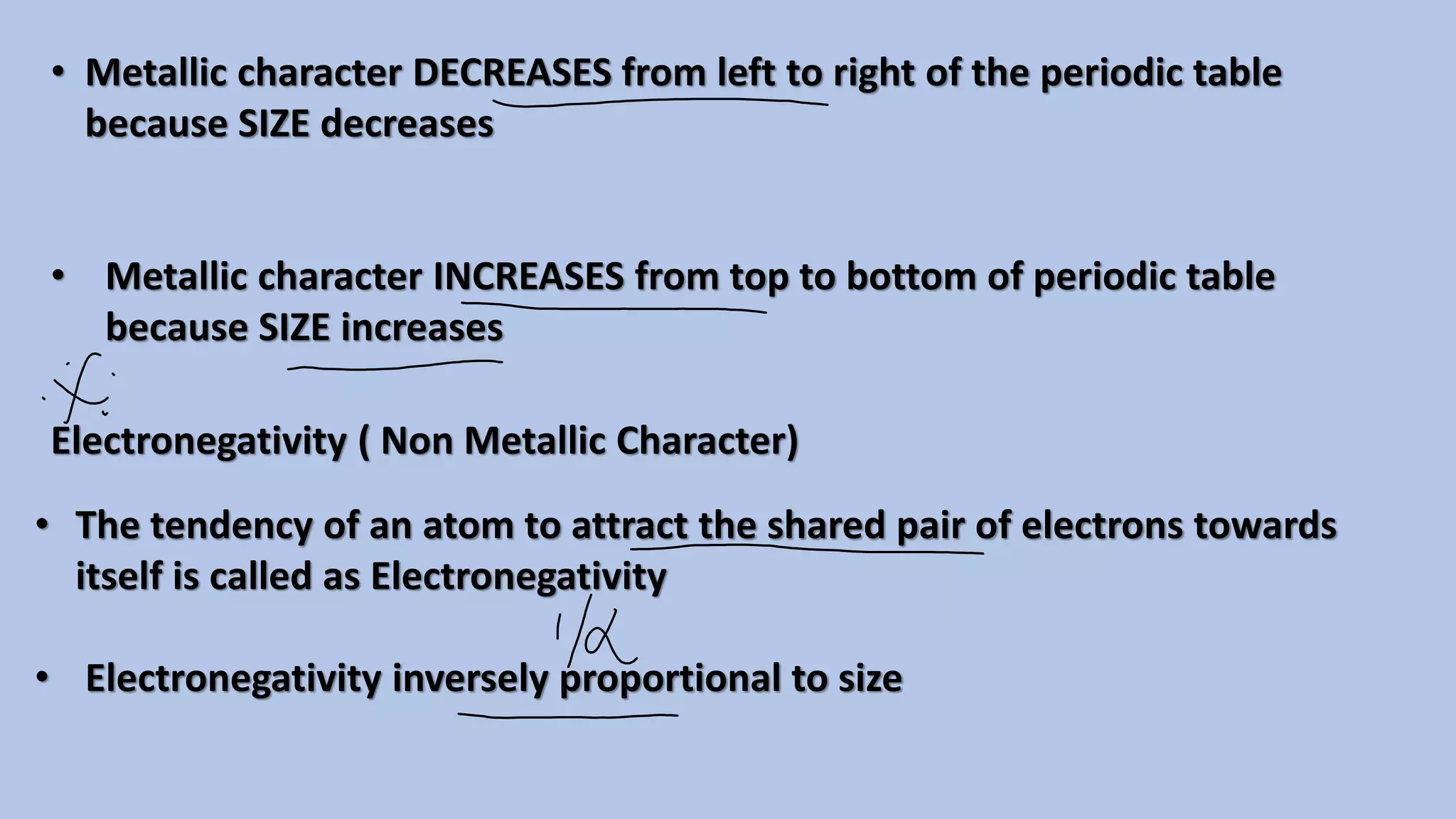
• Metallic character DECREASES from left to right of the periodic table
because SIZE decreases
• Metallic character INCREASES from top to bottom of periodic table
because SIZE increases
Electronegativity ( Non Metallic Character)
• The tendency of an atom to attract the shared pair of electrons towards
itself is called as Electronegativity
• Electronegativity inversely proportional to size
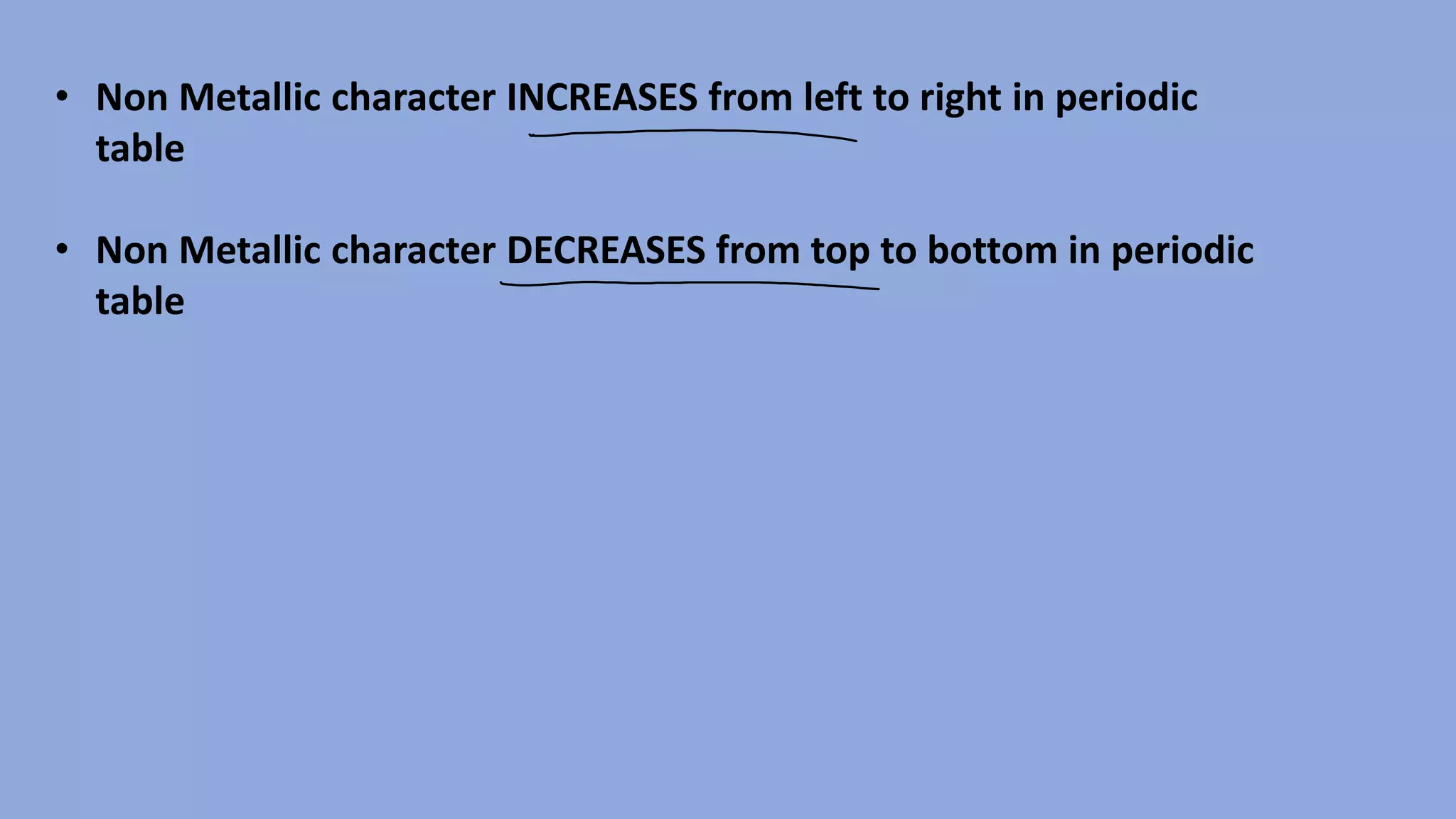
• Non Metallic character INCREASES from left to right in periodic
table
• Non Metallic character DECREASES from top to bottom in periodic
table
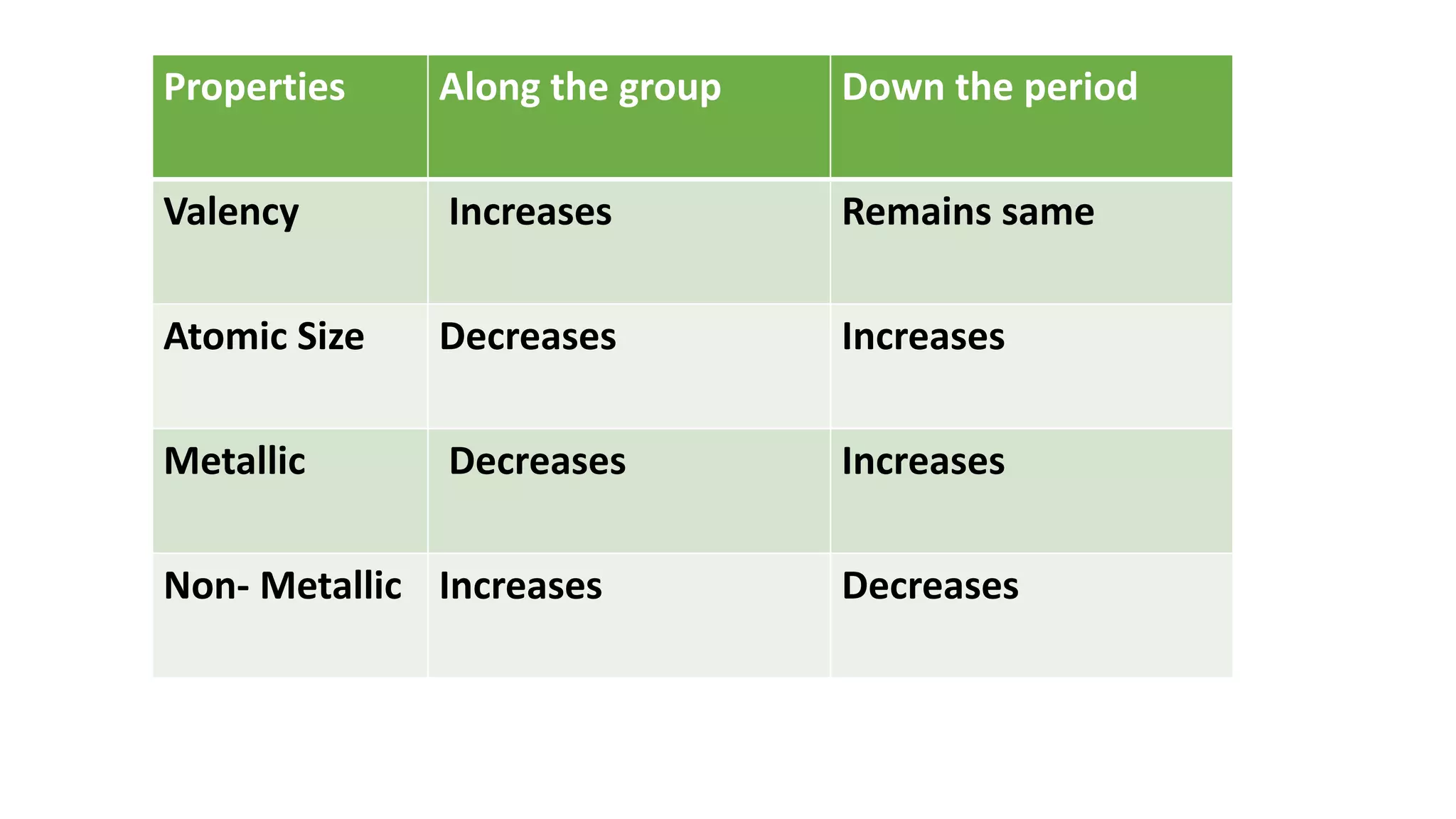
Properties Along the group Down the period
Valency Increases Remains same
Atomic Size Decreases Increases
Metallic Decreases Increases
Non- Metallic Increases Decreases
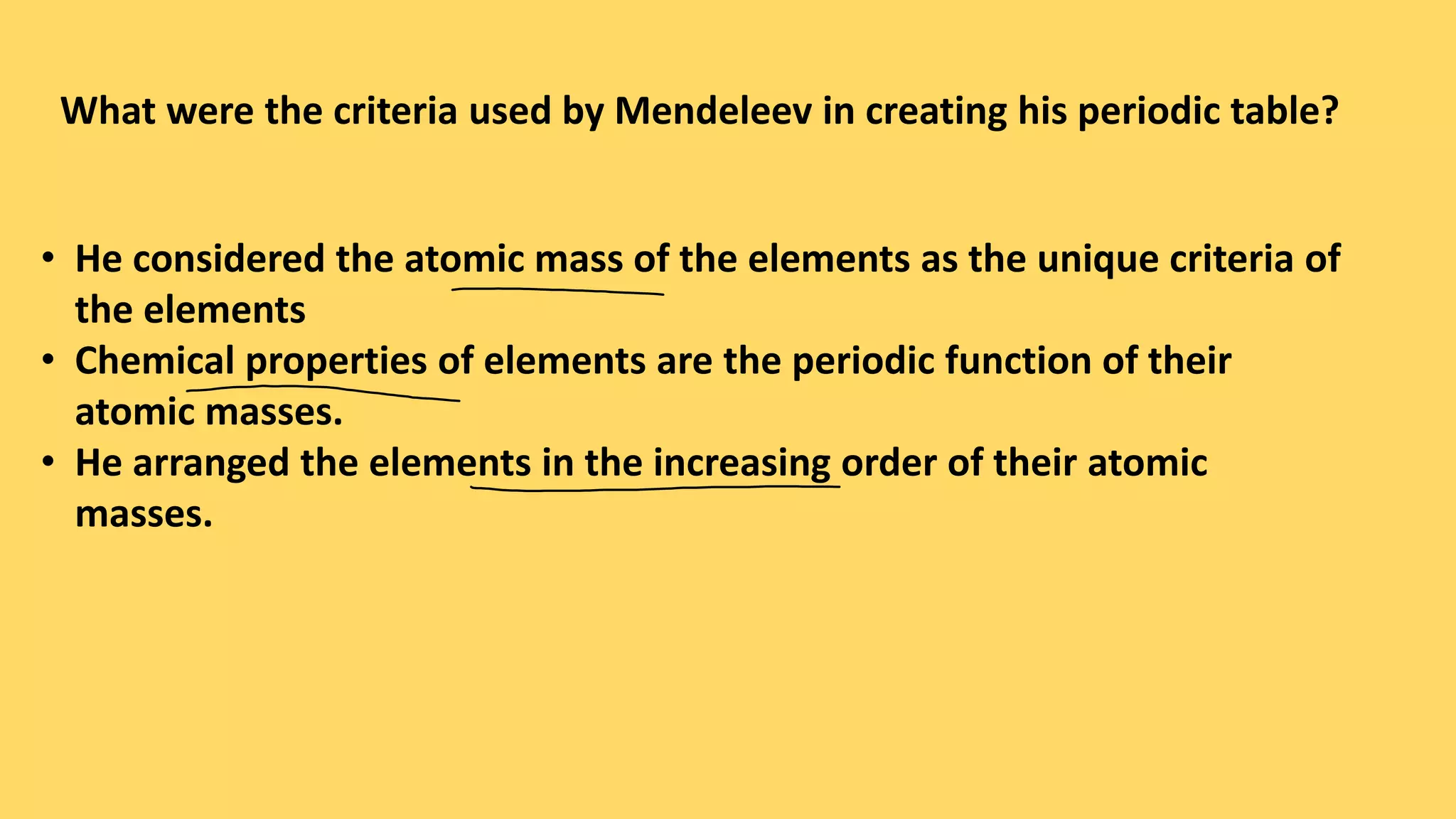
Probable Type Of Questions For Exams
What were the criteria used by Mendeleev in creating his periodic table?
• He considered the atomic mass of the elements as the unique criteria of
the elements
• Chemical properties of elements are the periodic function of their
atomic masses.
• He arranged the elements in the increasing order of their atomic
masses.
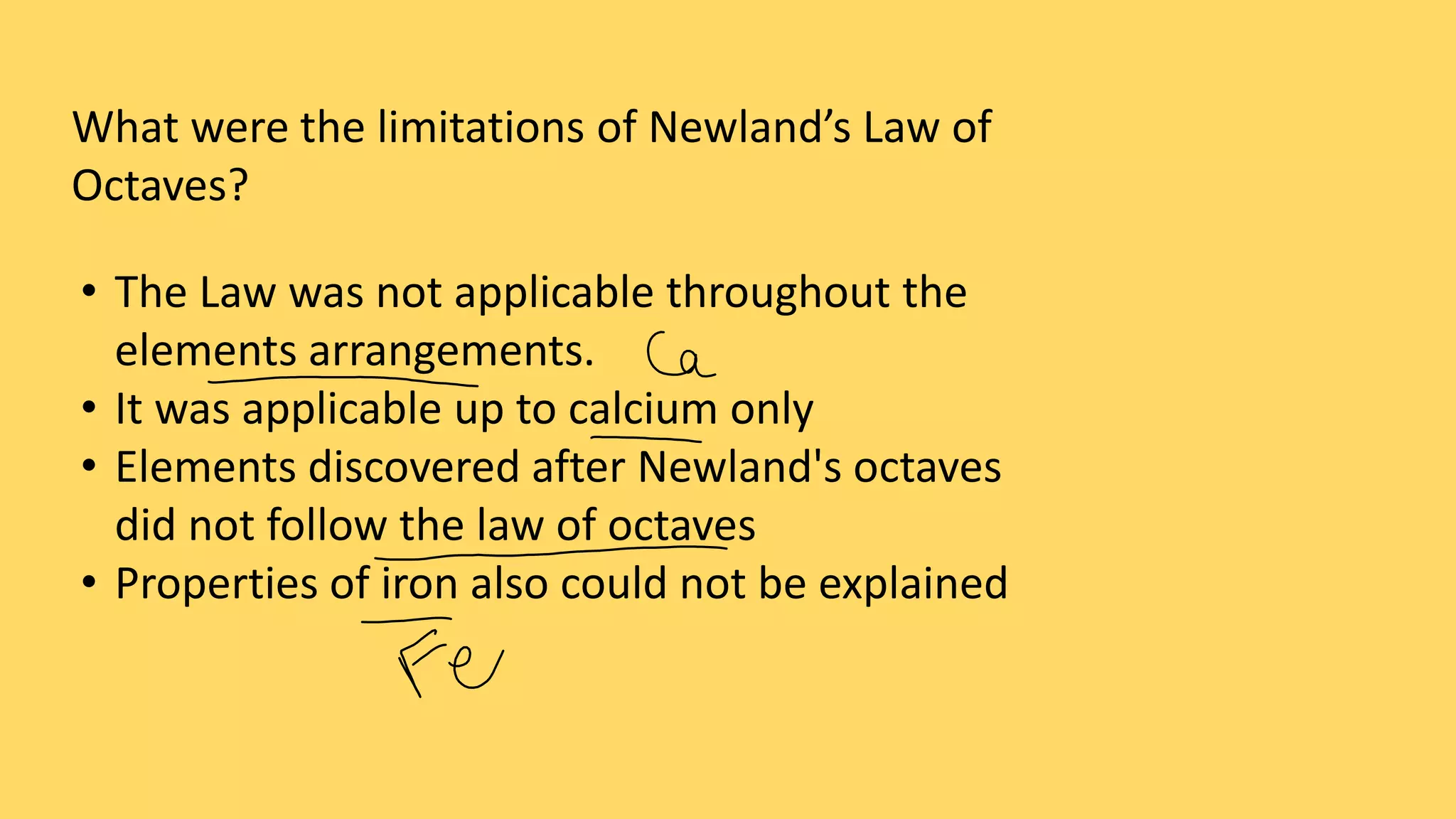
What were the limitations of Newland’s Law of
Octaves?
• The Law was not applicable throughout the
elements arrangements.
• It was applicable up to calcium only
• Elements discovered after Newland's octaves
did not follow the law of octaves
• Properties of iron also could not be explained
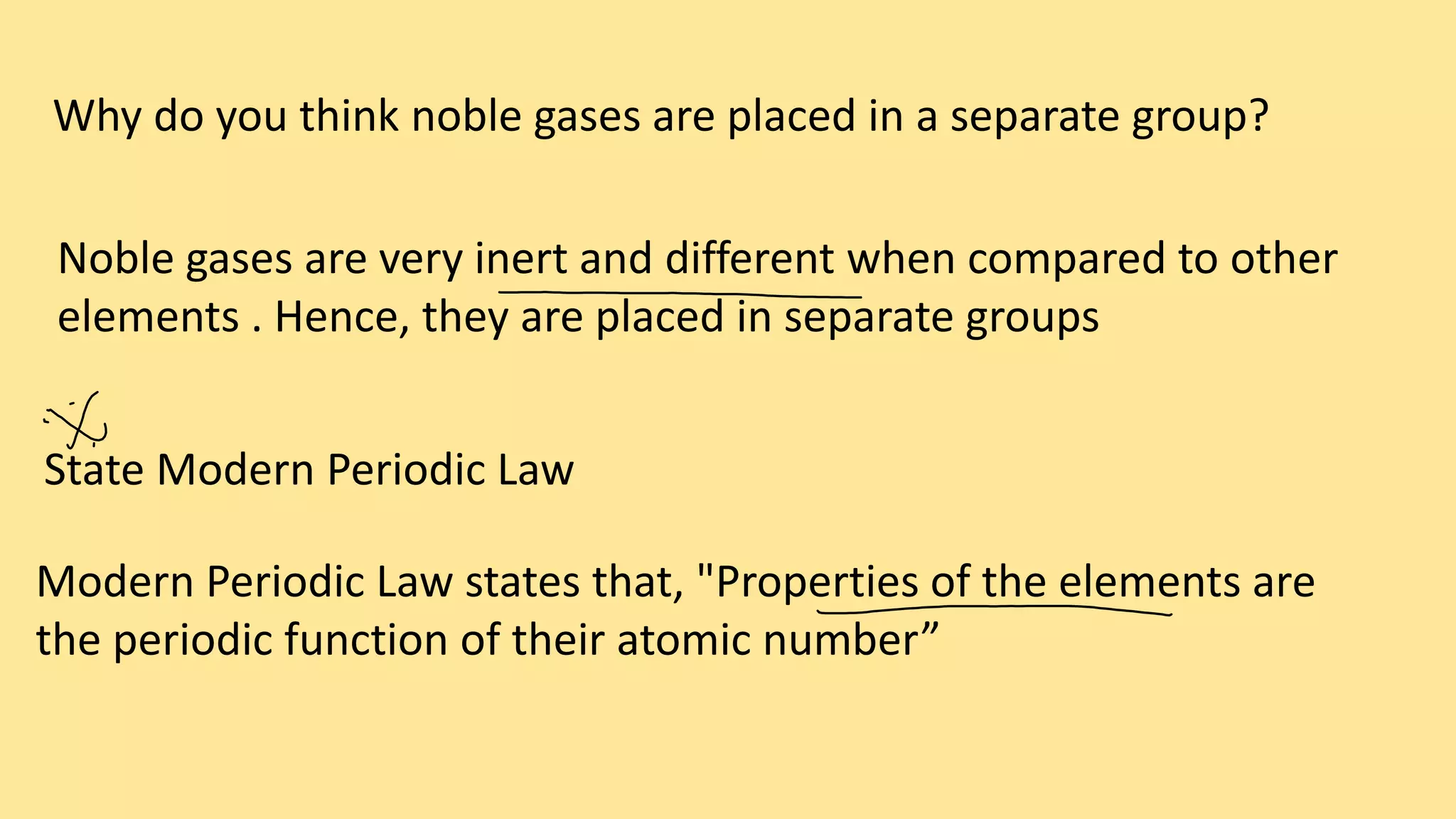
Why do you think noble gases are placed in a separate group?
Noble gases are very inert and different when compared to other
elements . Hence, they are placed in separate groups
State Modern Periodic Law
Modern Periodic Law states that, "Properties of the elements are
the periodic function of their atomic number”
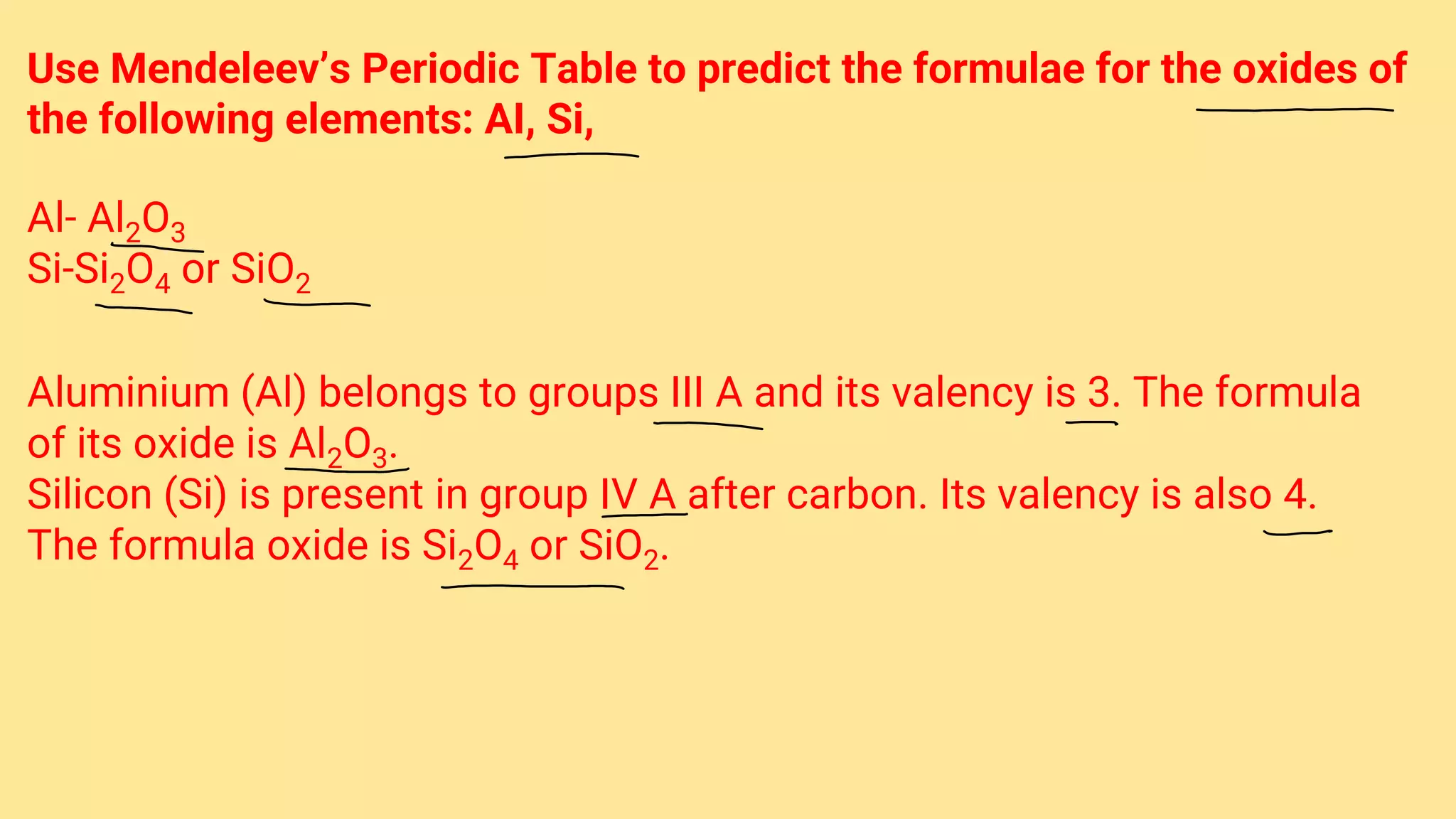
Use Mendeleev’s Periodic Table to predict the formulae for the oxides of
the following elements: AI, Si,
Al- Al2O3
Si-Si2O4 or SiO2
Aluminium (Al) belongs to groups III A and its valency is 3. The formula
of its oxide is Al2O3.
Silicon (Si) is present in group IV A after carbon. Its valency is also 4.
The formula oxide is Si2O4 or SiO2.
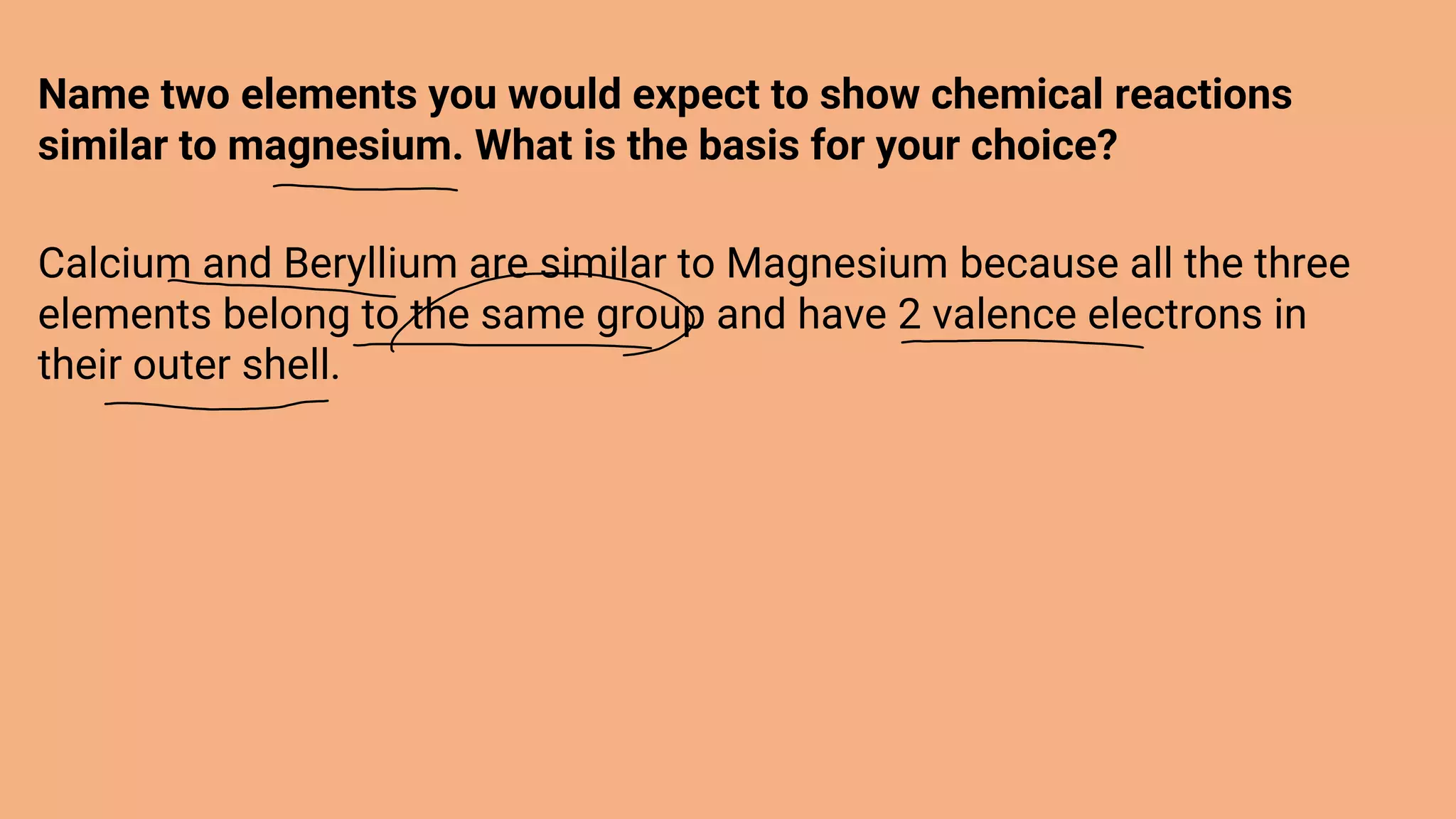
Name two elements you would expect to show chemical reactions
similar to magnesium. What is the basis for your choice?
Calcium and Beryllium are similar to Magnesium because all the three
elements belong to the same group and have 2 valence electrons in
their outer shell.
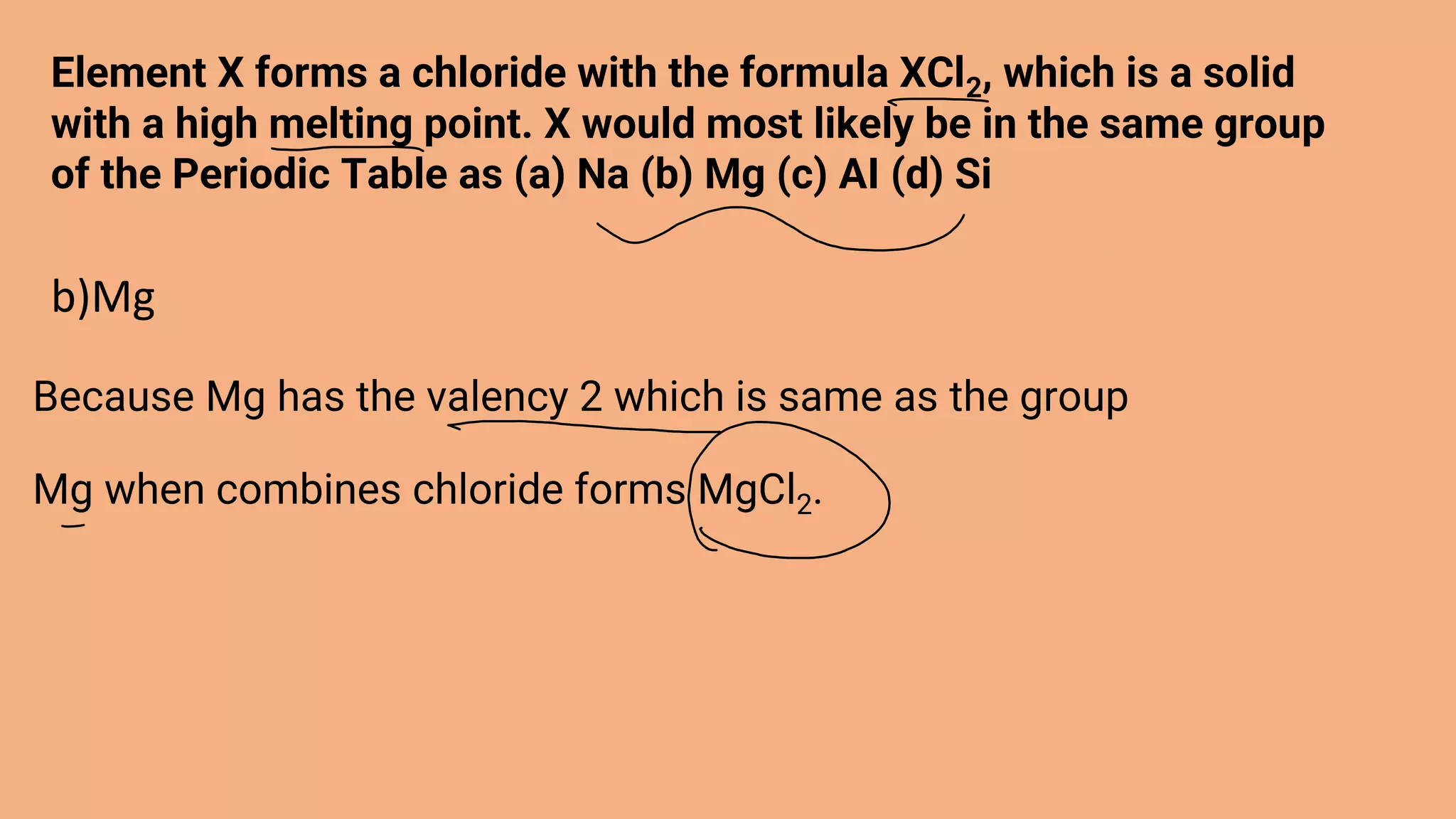
Element X forms a chloride with the formula XCl2, which is a solid
with a high melting point. X would most likely be in the same group
of the Periodic Table as (a) Na (b) Mg (c) AI (d) Si
b)Mg
Because Mg has the valency 2 which is same as the group
Mg when combines chloride forms MgCl2.
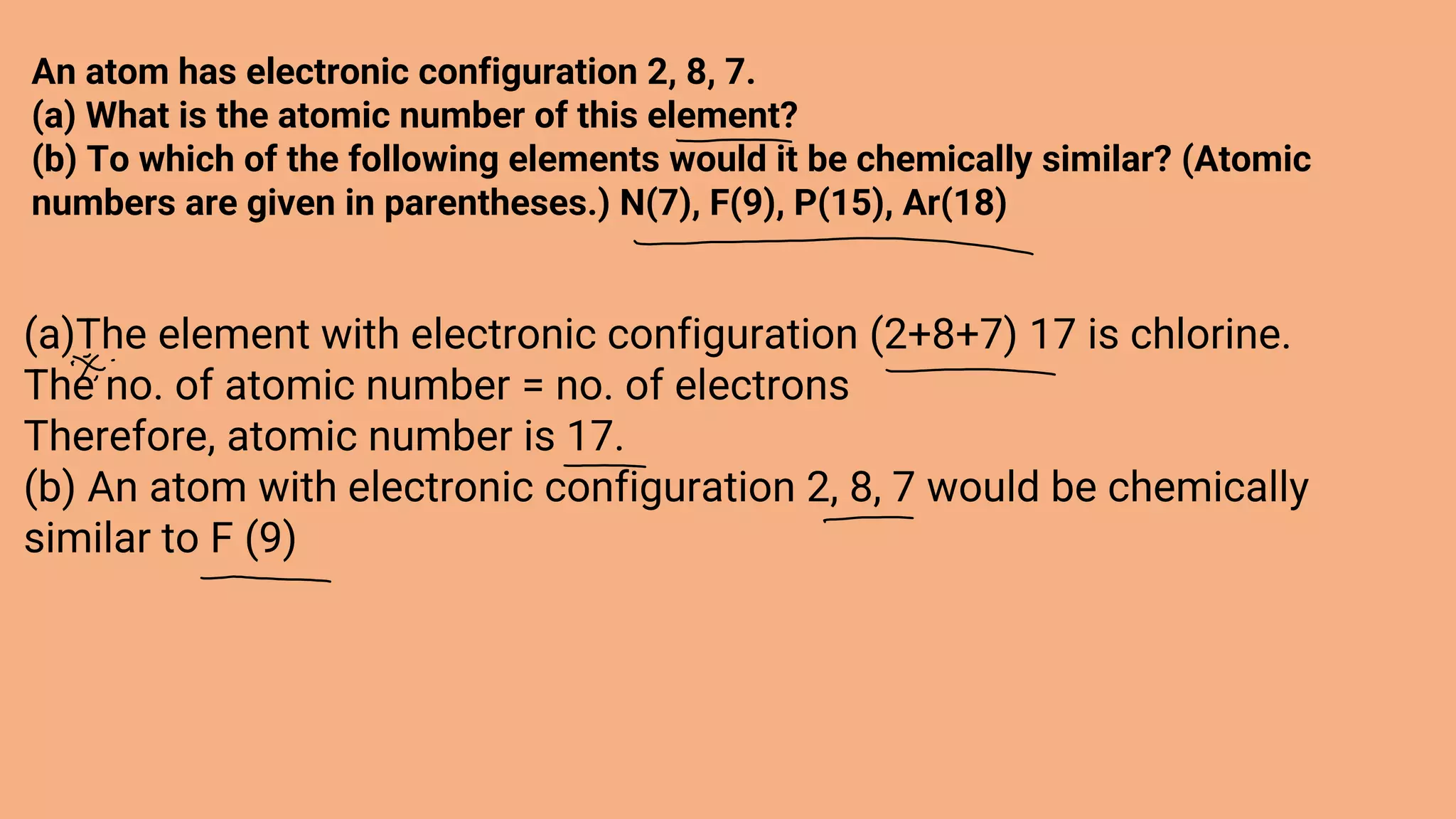
An atom has electronic configuration 2, 8, 7.
(a) What is the atomic number of this element?
(b) To which of the following elements would it be chemically similar? (Atomic
numbers are given in parentheses.) N(7), F(9), P(15), Ar(18)
(a)The element with electronic configuration (2+8+7) 17 is chlorine.
The no. of atomic number = no. of electrons
Therefore, atomic number is 17.
(b) An atom with electronic configuration 2, 8, 7 would be chemically
similar to F (9)
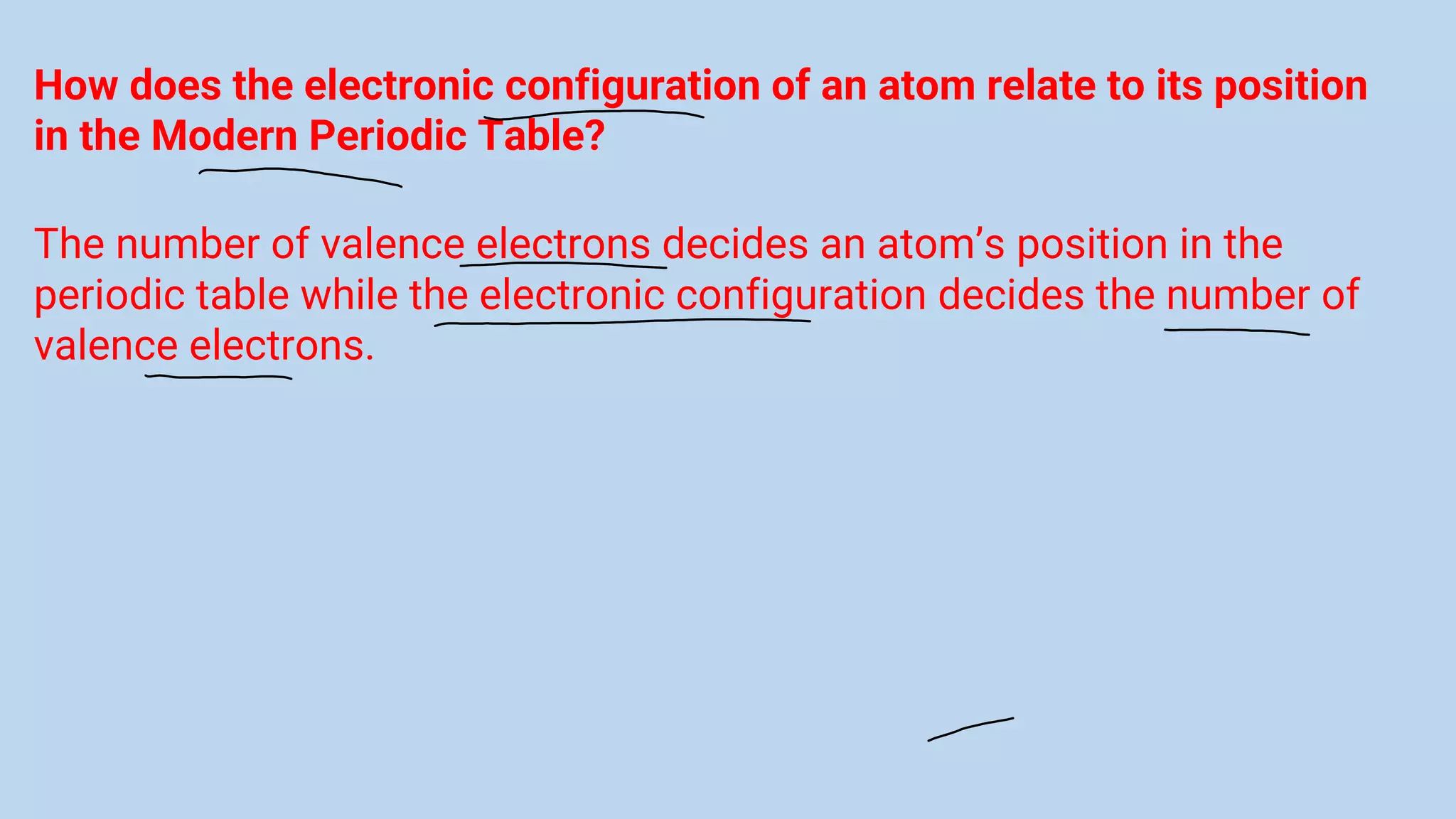
How does the electronic configuration of an atom relate to its position
in the Modern Periodic Table?
The number of valence electrons decides an atom’s position in the
periodic table while the electronic configuration decides the number of
valence electrons.
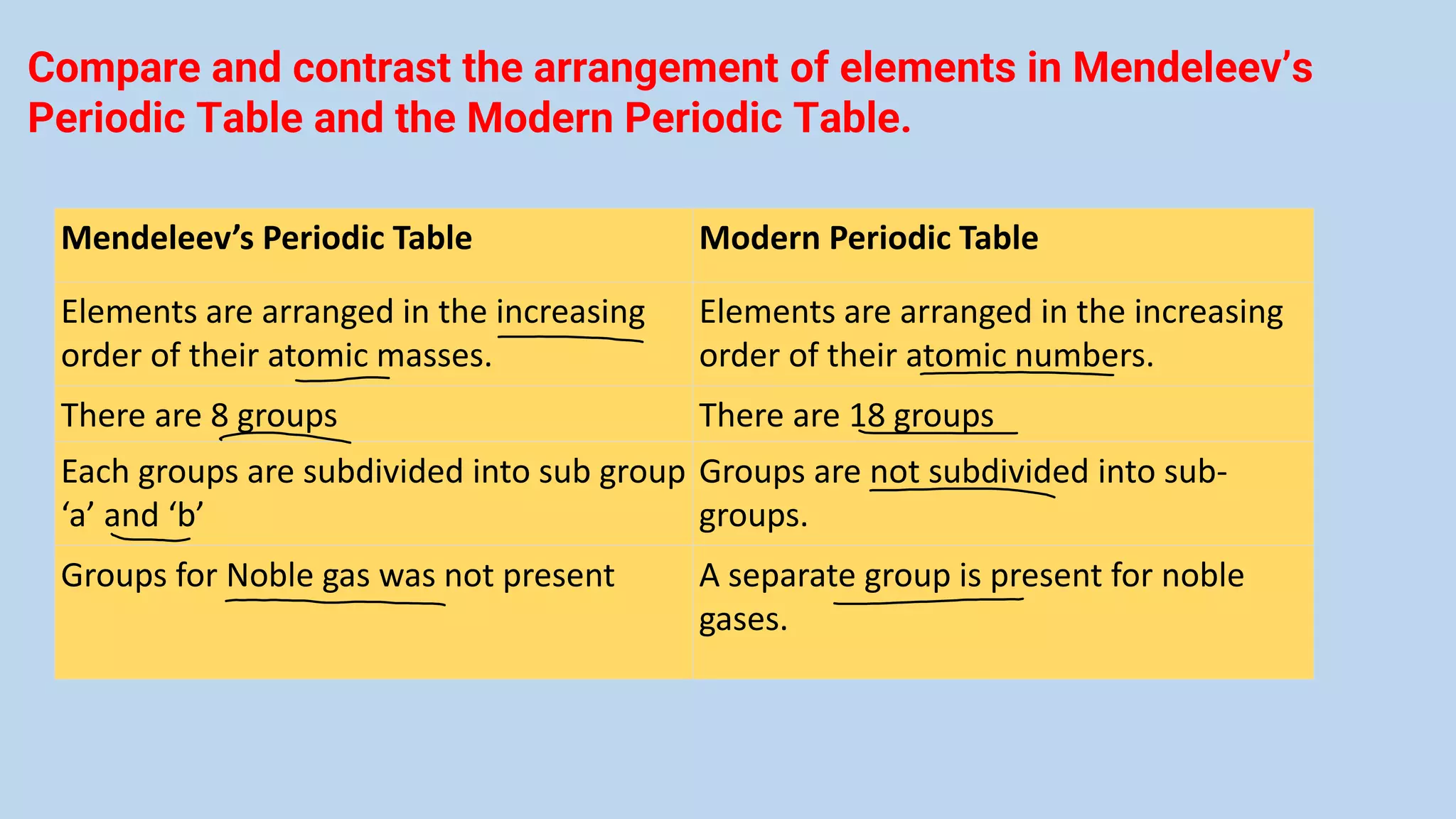
Compare and contrast the arrangement of elements in Mendeleev’s
Periodic Table and the Modern Periodic Table.
Mendeleev’s Periodic Table Modern Periodic Table
Elements are arranged in the increasing
order of their atomic masses.
Elements are arranged in the increasing
order of their atomic numbers.
There are 8 groups There are 18 groups
Each groups are subdivided into sub group
‘a’ and ‘b’
Groups are not subdivided into sub-
groups.
Groups for Noble gas was not present A separate group is present for noble
gases.
subject-chemistry,medium-english,chapter-periodic classification of elements,topic-1-shot revision (1)

subject-chemistry,medium-english,chapter-periodic classification of elements,topic-1-shot revision (1)

  • 1.
    Quality Education ForAll For more information please visit below website https://v-learning.in/live-course/923/chemistry-periodic-classification-of-elements-kseeb-cbse-vistas-learning
  • 2.
    1-SHOT REVISION Periodic ClassificationOf Elements Probable Type Of Question For Exams
  • 3.
    The Modern PeriodicTable ✓ The Modern Periodic Table was introduced by Henry Moseley ✓ During his time 92 elements were already discovered.
  • 4.
    • Elements shouldbe arranged based on their Atomic Number but not Atomic Mass • Therefore all the 92 elements were arranged in increasing order of their atomic number. • There were • 18 groups (Vertical column) • 7 periods ( Horizontal row)
  • 5.
    • The elementspresent in one single group will all have same physical and chemical properties • Elements present in the same group will have same number of valence electrons. • Periodicity – Elements shows similar physical and chemical properties after certain gap is called as Periodicity .
  • 6.
    Modern Periodic Lawstates that, "Properties of the elements are the periodic function of their atomic number”
  • 7.
    Position of Elementsin Modern Periodic Table Periodic Table has 18 vertical Columns called as GROUPS and 7 horizontal Rows called as PERIODS Importance of Group Number • Elements present in the same group will have same number of valence electrons Importance of Period Number Period number tells about the shell number present in last number of electrons
  • 8.
    The position ofelement in the periodic table tells about the Chemical Reactivity Valence Electrons determine the kind and number of bonds formed by an element.
  • 9.
    Trends in periodictable The three important trends which we are learning in our Modern Periodic Table are ➢Valency ➢Atomic Size ➢Metallic and Non-Metallic Properties
  • 10.
    Valency Number of electronslost or gained during a chemical reaction is called as Valency Valence electrons - The electrons present in last shell or outermost shell In valency there is always losing electrons
  • 11.
    Losing or gainingof electrons happens ONLY in last shell It is indicated as + for losing electrons - for gaining electrons Group Number Valence Electrons Valency 1 1 +1 2 2 +2 13 3 +3 14 4 +4 15 5 -3 16 6 -2 17 7 -1 18 8 0
  • 12.
    • Valence electronincreases from left to right in a periodic table • Valence electron remains the same from top to bottom in a periodic table Atomic size • Atomic size refers to the radius of an atom • It is the distance between the center of the nucleus and the outermost shell of an atom
  • 13.
    • Elements placedon the Left side of periodic table are the bigger elements • Elements placed on the right side of periodic table are the smaller elements ❖Therefore atomic size DECREASES from left to right in a periodic table due to increase of effective nuclear charge
  • 14.
    ❖Atomic size INCREASESfrom top to bottom in periodic table • Because number of shells are increasing Metallic and Non Metallic Properties • The ability of an element to loose an electron is called as Electro positivity • The Metallic character (proportional) Size • Metal compounds are BASIC in nature
  • 15.
    • Metallic characterDECREASES from left to right of the periodic table because SIZE decreases • Metallic character INCREASES from top to bottom of periodic table because SIZE increases Electronegativity ( Non Metallic Character) • The tendency of an atom to attract the shared pair of electrons towards itself is called as Electronegativity • Electronegativity inversely proportional to size
  • 16.
    • Non Metalliccharacter INCREASES from left to right in periodic table • Non Metallic character DECREASES from top to bottom in periodic table
  • 17.
    Properties Along thegroup Down the period Valency Increases Remains same Atomic Size Decreases Increases Metallic Decreases Increases Non- Metallic Increases Decreases
  • 18.
    Probable Type OfQuestions For Exams
  • 19.
    What were thecriteria used by Mendeleev in creating his periodic table? • He considered the atomic mass of the elements as the unique criteria of the elements • Chemical properties of elements are the periodic function of their atomic masses. • He arranged the elements in the increasing order of their atomic masses.
  • 20.
    What were thelimitations of Newland’s Law of Octaves? • The Law was not applicable throughout the elements arrangements. • It was applicable up to calcium only • Elements discovered after Newland's octaves did not follow the law of octaves • Properties of iron also could not be explained
  • 21.
    Why do youthink noble gases are placed in a separate group? Noble gases are very inert and different when compared to other elements . Hence, they are placed in separate groups State Modern Periodic Law Modern Periodic Law states that, "Properties of the elements are the periodic function of their atomic number”
  • 22.
    Use Mendeleev’s PeriodicTable to predict the formulae for the oxides of the following elements: AI, Si, Al- Al2O3 Si-Si2O4 or SiO2 Aluminium (Al) belongs to groups III A and its valency is 3. The formula of its oxide is Al2O3. Silicon (Si) is present in group IV A after carbon. Its valency is also 4. The formula oxide is Si2O4 or SiO2.
  • 23.
    Name two elementsyou would expect to show chemical reactions similar to magnesium. What is the basis for your choice? Calcium and Beryllium are similar to Magnesium because all the three elements belong to the same group and have 2 valence electrons in their outer shell.
  • 24.
    Element X formsa chloride with the formula XCl2, which is a solid with a high melting point. X would most likely be in the same group of the Periodic Table as (a) Na (b) Mg (c) AI (d) Si b)Mg Because Mg has the valency 2 which is same as the group Mg when combines chloride forms MgCl2.
  • 25.
    An atom haselectronic configuration 2, 8, 7. (a) What is the atomic number of this element? (b) To which of the following elements would it be chemically similar? (Atomic numbers are given in parentheses.) N(7), F(9), P(15), Ar(18) (a)The element with electronic configuration (2+8+7) 17 is chlorine. The no. of atomic number = no. of electrons Therefore, atomic number is 17. (b) An atom with electronic configuration 2, 8, 7 would be chemically similar to F (9)
  • 26.
    How does theelectronic configuration of an atom relate to its position in the Modern Periodic Table? The number of valence electrons decides an atom’s position in the periodic table while the electronic configuration decides the number of valence electrons.
  • 27.
    Compare and contrastthe arrangement of elements in Mendeleev’s Periodic Table and the Modern Periodic Table. Mendeleev’s Periodic Table Modern Periodic Table Elements are arranged in the increasing order of their atomic masses. Elements are arranged in the increasing order of their atomic numbers. There are 8 groups There are 18 groups Each groups are subdivided into sub group ‘a’ and ‘b’ Groups are not subdivided into sub- groups. Groups for Noble gas was not present A separate group is present for noble gases.