4th Quarter
THE MODERN PERIODIC TABLE
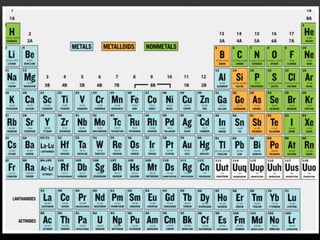
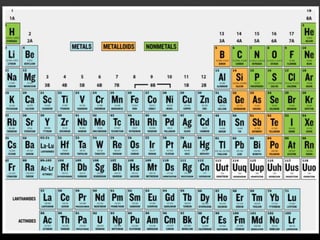
After a series of revisions, the early
periodic table has evolved into what it is now.
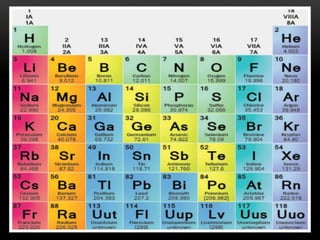
In the modern periodic table, the elements are
arranged horizontally in order of increasing
atomic numbers. Each element is identified by
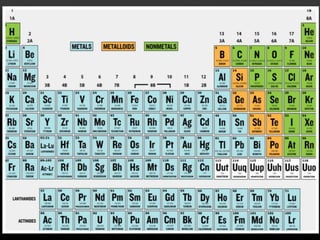
its symbols placed at the middle of the square;
the atomic number and the atomic mass are
also included.
THE GROUPS
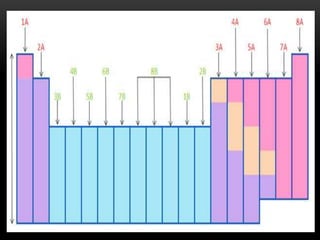
• also known as families
• 18 vertical columns in the periodic table
• elements have similar chemical properties due
to their similarities in the number of electrons in
their outer shells
• composed of two categories:
a. Group A (Representative Elements)
b. Group B (Transition Metals)
GROUP A (REPRESENTATIVE
ELEMENTS)
• Group IA – Alkali Metals (except Hydrogen)
• Group IIA – Alkaline Earth Metals
• Group IIIA – Aluminum Group/Boron Family
• Group IVA – Carbon Family
• Group VA – Nitrogen Family
• Group VIA – Oxygen Family/Chalcogens
• Group VIIA – Halogens
• Group VIIIA – Noble/Inert Gases
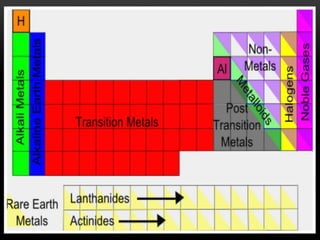
GROUP B (TRANSITION ELEMENTS)
• found in between Group IIA and Group IIIA and
referred to as the d-block
• inner transition elements (lanthanides and
actinides) are found at the bottom of the table
and referred to as the f-block
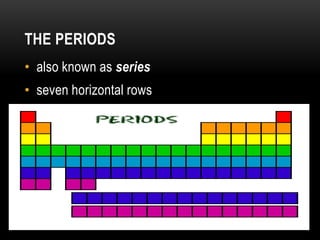
THE PERIODS
• also known as series
• seven horizontal rows
• Period 1 – 2 elements; electrons occupy only 1
main energy level, s-sublevel
• Periods 2 and 3 – 8 elements; eight electrons in
the s- and p-sublevels
• Periods 4 and 5 – 18 elements each; eighteen
electrons in the s-, p- and d-sublevels
• Periods 6 – 32 elements; 32 electrons in the s-, p-,
d- and f-sublevels.
- 14 elements from 58 – 71 were removed and
placed at the bottom to form the Lanthanide series.
• Period 7 – 14 elements; placed at the bottom
part of the table to form the Actinide series;
incomplete period
• Inner Transition Elements – last two periods
• Lanthanide Series = Rare Earth Elements
• Actinide Series = Heavy Rare Earth Elements
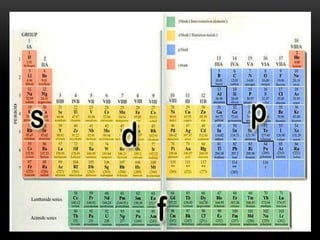
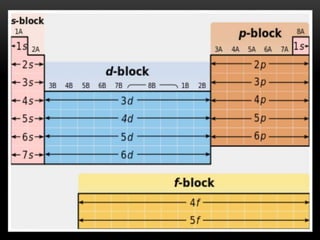
FOUR MAIN REGIONS IN THE PERIODIC TABLE
• Elements belonging to the same group have similar
last sublevel configuration (lsc). Thus using the
electron configuration of the elements, the periodic
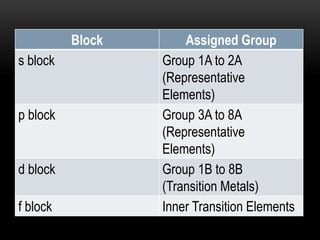
table can be divided into 4 regions or blocks such
as s-, p-, d- and f-blocks.
Block Assigned Group
s block Group 1A to 2A
(Representative
Elements)
p block Group 3A to 8A
(Representative
Elements)
d block Group 1B to 8B
(Transition Metals)
f block Inner Transition Elements
POINTS TO BE CONSIDER IN DETERMINING THE
ELECTRON CONFIGURATION AND/OR POSITION OF
ELEMENTS IN THE PERIODIC TABLE.
1. The Number of electrons in the outermost
energy level or the valence electrons
resembles to the group number.
2. The highest main energy level occupied by
the electrons of the atom corresponds to the
period where the element is located in the
periodic table.
CONFIGURATION OF VALENCE ELECTRONS
OF REPRESENTATIVE ELEMENTS
• s- and p-sublevels
• n represents the number of the highest main
energy level
• n is same as the period number in the periodic
table
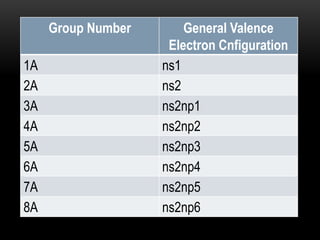
Group Number General Valence
Electron Cnfiguration
1A ns1
2A ns2
3A ns2np1
4A ns2np2
5A ns2np3
6A ns2np4
7A ns2np5
8A ns2np6
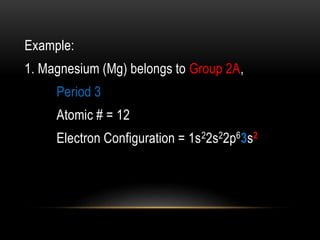
Example:
1. Magnesium (Mg) belongs to Group 2A,
Period 3
Atomic # = 12
Electron Configuration = 1s22s22p63s2
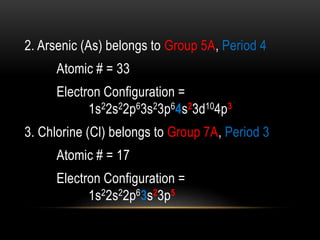
2. Arsenic (As) belongs to Group 5A, Period 4
Atomic # = 33
Electron Configuration =
1s22s22p63s23p64s23d104p3
3. Chlorine (Cl) belongs to Group 7A, Period 3
Atomic # = 17
Electron Configuration =
1s22s22p63s23p5
LET’S TRY!
• Sodium
• Calcium
• Oxygen
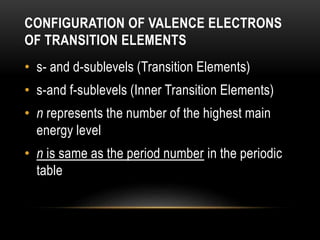
CONFIGURATION OF VALENCE ELECTRONS
OF TRANSITION ELEMENTS
• s- and d-sublevels (Transition Elements)
• s-and f-sublevels (Inner Transition Elements)
• n represents the number of the highest main
energy level
• n is same as the period number in the periodic
table
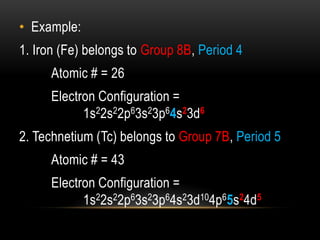
• Example:
1. Iron (Fe) belongs to Group 8B, Period 4
Atomic # = 26
Electron Configuration =
1s22s22p63s23p64s23d6
2. Technetium (Tc) belongs to Group 7B, Period 5
Atomic # = 43
Electron Configuration =
1s22s22p63s23p64s23d104p65s24d5
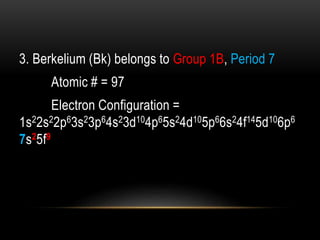
3. Berkelium (Bk) belongs to Group 1B, Period 7
Atomic # = 97
Electron Configuration =
1s22s22p63s23p64s23d104p65s24d105p66s24f145d106p6
7s25f9
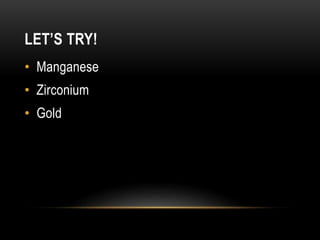
LET’S TRY!
• Manganese
• Zirconium
• Gold
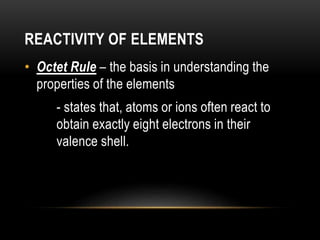
REACTIVITY OF ELEMENTS
• Octet Rule – the basis in understanding the
properties of the elements
- states that, atoms or ions often react to
obtain exactly eight electrons in their
valence shell.
ALKALI METALS
• Group 1A of the periodic table
• All are very reactive in the their elemental form.
• They are very soft, lustrous metals.
• They form compounds with the halogens similar
to table salt, a compound formed by sodium and
chlorine.
HALOGENS
• Group 7A
• very reactive
• form compounds with alkali metals
• Sodium chloride is a very stable compound
because both the sodium ion and chloride ion
has eight valence electrons or a complete octet.
NOBLE GASES
• Group 8A
• have complete octet, very stable
• unreactive gases
• physical and chemical properties can be
predicted from their position in the periodic table.
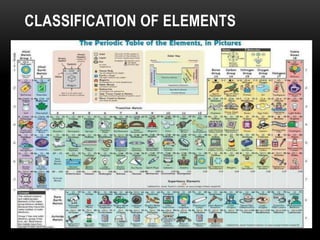
CLASSIFICATION OF ELEMENTS
METALS
• usually found on the left side and at the center of
the periodic table.
• three-fourths of the discovered elements
• have high thermal and electrical conductivity
• have mobile particles that can carry thermal or
heat energy and electrical charges from one
point of the material to another
• also have the ability to lose electrons
METALS
• In a group, from top to bottom of the periodic
table, metallic character increases.
• bottom elements of the periodic table, the most
metallic; top elements, least metallic
• Across the period from left to right, metallic
character decreases.
• right elements, least metallic; left elements, most
metallic
METALS
• bottom to left corner of the periodic table are the
most reactive metals
• more metallic, more reactive
• Group 1A and 2A – very reactive metals
• Transition Metals – less reactive among the
metals
• Coinage metals – unreactive transition metals
at room temperature (gold, silver, platinum); they
do not react with most of the substances they
come into contact with.
NONMETALS
• lie on the right side of the zigzag line
• 22 known nonmetals, 11 are gases
• do not conduct heat and electricity well
• have little luster and seldom reflect light
• usually brittle
• tend to gain electrons
METALLOIDS
• found along the zigzag line between the metals
and non metals
• can behave as either as a metal or a nonmetal
SYNTHESIS:
• Describe the arrangement of elements in the
Modern Periodic Table.
• What is the basis of the groupings of the
elements?
• What are the points to be considered in
determining the electron configuration and/or
position of elements in the periodic table.
ASSIGNMENT:
• Study, study, study!
• Quiz #2 on Thursday, January 28.
Topics:
- Modern Periodic Table
- Properties and uses of common elements

The modern periodic table

  • 1.
    4th Quarter THE MODERNPERIODIC TABLE
  • 3.
    After a seriesof revisions, the early periodic table has evolved into what it is now. In the modern periodic table, the elements are arranged horizontally in order of increasing atomic numbers. Each element is identified by its symbols placed at the middle of the square; the atomic number and the atomic mass are also included.
  • 4.
    THE GROUPS • alsoknown as families • 18 vertical columns in the periodic table • elements have similar chemical properties due to their similarities in the number of electrons in their outer shells • composed of two categories: a. Group A (Representative Elements) b. Group B (Transition Metals)
  • 6.
    GROUP A (REPRESENTATIVE ELEMENTS) •Group IA – Alkali Metals (except Hydrogen) • Group IIA – Alkaline Earth Metals • Group IIIA – Aluminum Group/Boron Family • Group IVA – Carbon Family • Group VA – Nitrogen Family • Group VIA – Oxygen Family/Chalcogens • Group VIIA – Halogens • Group VIIIA – Noble/Inert Gases
  • 8.
    GROUP B (TRANSITIONELEMENTS) • found in between Group IIA and Group IIIA and referred to as the d-block • inner transition elements (lanthanides and actinides) are found at the bottom of the table and referred to as the f-block
  • 11.
    THE PERIODS • alsoknown as series • seven horizontal rows
  • 12.
    • Period 1– 2 elements; electrons occupy only 1 main energy level, s-sublevel • Periods 2 and 3 – 8 elements; eight electrons in the s- and p-sublevels • Periods 4 and 5 – 18 elements each; eighteen electrons in the s-, p- and d-sublevels • Periods 6 – 32 elements; 32 electrons in the s-, p-, d- and f-sublevels. - 14 elements from 58 – 71 were removed and placed at the bottom to form the Lanthanide series.
  • 13.
    • Period 7– 14 elements; placed at the bottom part of the table to form the Actinide series; incomplete period • Inner Transition Elements – last two periods • Lanthanide Series = Rare Earth Elements • Actinide Series = Heavy Rare Earth Elements
  • 14.
    FOUR MAIN REGIONSIN THE PERIODIC TABLE • Elements belonging to the same group have similar last sublevel configuration (lsc). Thus using the electron configuration of the elements, the periodic table can be divided into 4 regions or blocks such as s-, p-, d- and f-blocks.
  • 16.
    Block Assigned Group sblock Group 1A to 2A (Representative Elements) p block Group 3A to 8A (Representative Elements) d block Group 1B to 8B (Transition Metals) f block Inner Transition Elements
  • 17.
    POINTS TO BECONSIDER IN DETERMINING THE ELECTRON CONFIGURATION AND/OR POSITION OF ELEMENTS IN THE PERIODIC TABLE. 1. The Number of electrons in the outermost energy level or the valence electrons resembles to the group number. 2. The highest main energy level occupied by the electrons of the atom corresponds to the period where the element is located in the periodic table.
  • 18.
    CONFIGURATION OF VALENCEELECTRONS OF REPRESENTATIVE ELEMENTS • s- and p-sublevels • n represents the number of the highest main energy level • n is same as the period number in the periodic table
  • 19.
    Group Number GeneralValence Electron Cnfiguration 1A ns1 2A ns2 3A ns2np1 4A ns2np2 5A ns2np3 6A ns2np4 7A ns2np5 8A ns2np6
  • 20.
    Example: 1. Magnesium (Mg)belongs to Group 2A, Period 3 Atomic # = 12 Electron Configuration = 1s22s22p63s2
  • 21.
    2. Arsenic (As)belongs to Group 5A, Period 4 Atomic # = 33 Electron Configuration = 1s22s22p63s23p64s23d104p3 3. Chlorine (Cl) belongs to Group 7A, Period 3 Atomic # = 17 Electron Configuration = 1s22s22p63s23p5
  • 22.
    LET’S TRY! • Sodium •Calcium • Oxygen
  • 23.
    CONFIGURATION OF VALENCEELECTRONS OF TRANSITION ELEMENTS • s- and d-sublevels (Transition Elements) • s-and f-sublevels (Inner Transition Elements) • n represents the number of the highest main energy level • n is same as the period number in the periodic table
  • 24.
    • Example: 1. Iron(Fe) belongs to Group 8B, Period 4 Atomic # = 26 Electron Configuration = 1s22s22p63s23p64s23d6 2. Technetium (Tc) belongs to Group 7B, Period 5 Atomic # = 43 Electron Configuration = 1s22s22p63s23p64s23d104p65s24d5
  • 25.
    3. Berkelium (Bk)belongs to Group 1B, Period 7 Atomic # = 97 Electron Configuration = 1s22s22p63s23p64s23d104p65s24d105p66s24f145d106p6 7s25f9
  • 26.
  • 27.
    REACTIVITY OF ELEMENTS •Octet Rule – the basis in understanding the properties of the elements - states that, atoms or ions often react to obtain exactly eight electrons in their valence shell.
  • 28.
    ALKALI METALS • Group1A of the periodic table • All are very reactive in the their elemental form. • They are very soft, lustrous metals. • They form compounds with the halogens similar to table salt, a compound formed by sodium and chlorine.
  • 29.
    HALOGENS • Group 7A •very reactive • form compounds with alkali metals • Sodium chloride is a very stable compound because both the sodium ion and chloride ion has eight valence electrons or a complete octet.
  • 30.
    NOBLE GASES • Group8A • have complete octet, very stable • unreactive gases • physical and chemical properties can be predicted from their position in the periodic table.
  • 31.
  • 32.
    METALS • usually foundon the left side and at the center of the periodic table. • three-fourths of the discovered elements • have high thermal and electrical conductivity • have mobile particles that can carry thermal or heat energy and electrical charges from one point of the material to another • also have the ability to lose electrons
  • 33.
    METALS • In agroup, from top to bottom of the periodic table, metallic character increases. • bottom elements of the periodic table, the most metallic; top elements, least metallic • Across the period from left to right, metallic character decreases. • right elements, least metallic; left elements, most metallic
  • 34.
    METALS • bottom toleft corner of the periodic table are the most reactive metals • more metallic, more reactive • Group 1A and 2A – very reactive metals
  • 35.
    • Transition Metals– less reactive among the metals • Coinage metals – unreactive transition metals at room temperature (gold, silver, platinum); they do not react with most of the substances they come into contact with.
  • 37.
    NONMETALS • lie onthe right side of the zigzag line • 22 known nonmetals, 11 are gases • do not conduct heat and electricity well • have little luster and seldom reflect light • usually brittle • tend to gain electrons
  • 39.
    METALLOIDS • found alongthe zigzag line between the metals and non metals • can behave as either as a metal or a nonmetal
  • 41.
    SYNTHESIS: • Describe thearrangement of elements in the Modern Periodic Table. • What is the basis of the groupings of the elements? • What are the points to be considered in determining the electron configuration and/or position of elements in the periodic table.
  • 43.
    ASSIGNMENT: • Study, study,study! • Quiz #2 on Thursday, January 28. Topics: - Modern Periodic Table - Properties and uses of common elements