History of the Periodic Table
• Fast facts
• 91 naturally occurring elements
• Oxygen is most abundant element
• Tie together properties that make metals,
metals and non-metals, nonmetals
• Early 1800’s scientists started to note
relationships between certain elements and
their atomic masses
• Classification of elements began using these
similarities
• Dobereiner @40 known elements
• First scientist to observe an important trend
• Noticed certain groups of three elements
had similar physical and chemical
properties but different masses
• Called them TRIADS
• Ex. Li,Na,K Cl,Br,I Cu,Ag,Au Be,Mg,Ca
• Newland
• mid 1800’s
• 45 @ known elements
• Noted connection of properties and mass were a
repeating pattern in order of increasing mass
• Every 8th element had similar
properties(Dobereiner’s Triads)
• Didn’t know about Noble gases
• Called it Law of Octaves
• Problems occurred as more elements were
discovered and did not fit pattern
• Mendeleev 1860’s @ 60+ known elements
• Father of Periodic Table (P.T.)
• Developed table that showed relationship between
properties of elements and atomic masses
• Remember: the only thing known about atoms is?
• Dalton’s Theories
• No e- or p+
• Carefully planned and in great detail
• Avoided earlier mistakes of forcing elements to fit
into 8 pattern like Newland
• Proposed properties were a function of increasing
atomic mass
• Believed similar properties occurred after periods
that could vary in length by specific patterns
• Left blank spaces on table were an element did not
fit ( did not force elements in) properties
• Predicted that spaces were undiscovered elements
• Predicted masses and properties of unknowns
• Elements discovered were very close to
predictions
• Elements properties repeated in an orderly way
• Not all elements fit pattern
• Ex. Te-I and Co-Ni
• Mendeleev switched elements around even
though masses were not in pattern
• Believed properties were more important
factor to consider
• Predicted a new theory or discovery would
explain this
• 1st Periodic Law: properties of the elements
are a periodic function of their increasing
atomic masses
• Mosley explained exceptions with
discovery of Atomic Number
• Modern Periodic Law: properties of the
elements are a periodic function of their
increasing atomic number
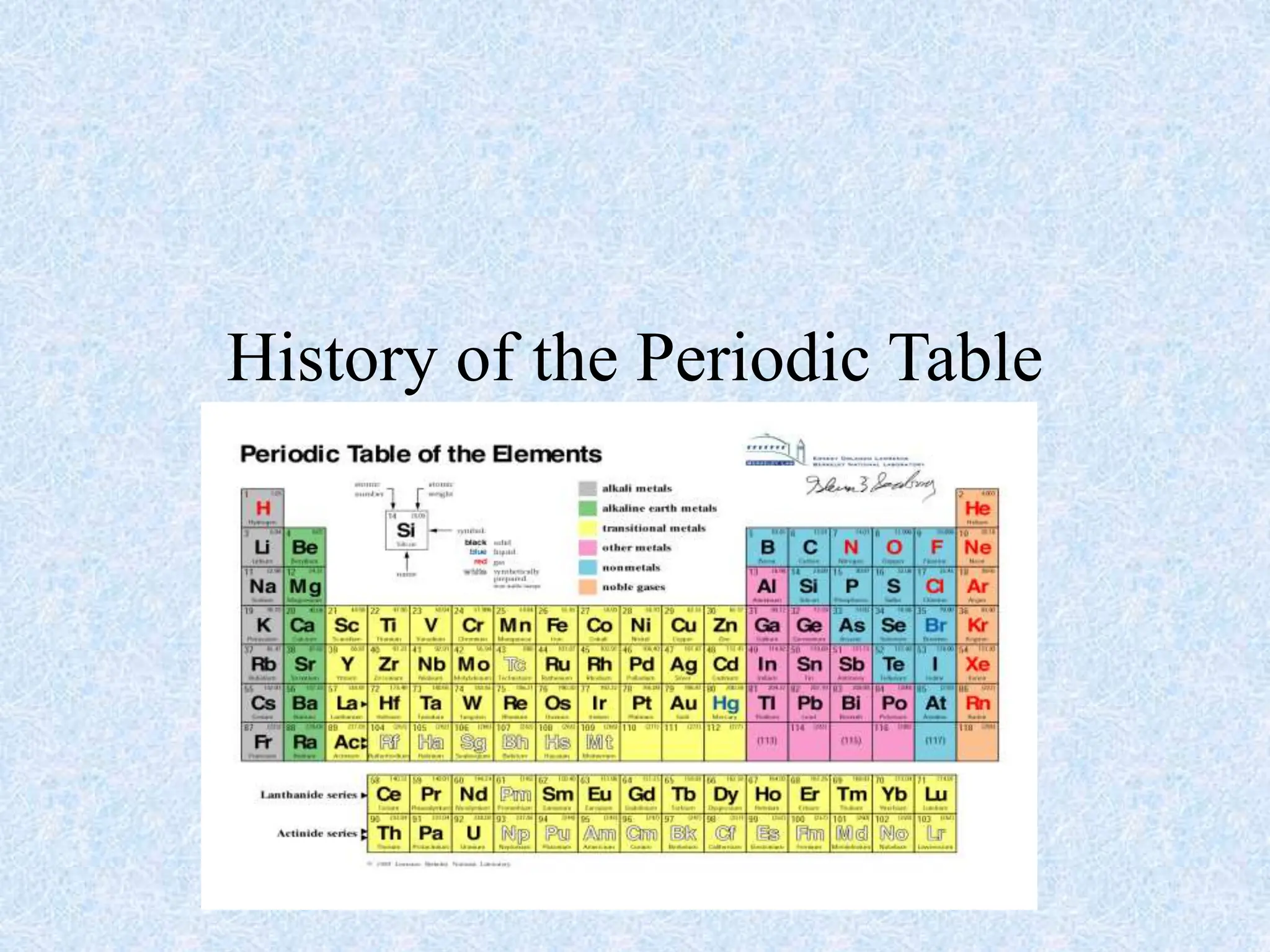
• Using a P.T.
• Elements arranged in horizontal rows in
order of increasing atomic number
• 5 things found on every P.T.
• 1. Symbol of element
• 2. Atomic number of element
• 3. Atomic mass of element
• 4. 7 periods
• 5. 18 groups and 2 series
• Period
• Horizontal row, 7 total
• Begins on left side, 1st element always has a
single e- in valence shell
• Each Period ends on right with a Noble Gas,
an element with 8e- in the valence shell
• Period shows the HIGHEST energy level
currently being filled
• Vertical columns are called GROUPS,1- 18
• Also referred to as Families
• Share similar chemical and physical
properties
• Number of valence e- in a Group are all the
same
• Same ending ECN
• Only difference is the number of energy
levels
• Family names
• Group 1 Alkali metals
• Group2 Alkaline earth metals
• Group 17 Halogens
• Group 18 Noble gases
• Look at Periods
• 1
• 2
• 3
• 4
• 5
• 6
• 7
• Transitional elements
• d-block
• Have incomplete d sublevels
• e- are filling in d sublevel
• All transitional elements as a group share
similar chem & phys properties
• Look at Groups
• Group 1
• Group 2
• Groups 3-11
• Group12
• Group 13
• Group 14
• Group 15
• Group16
• Group 17
• Group 18
• 2 Series
• Lanthanoid
• Actinoid
• P.T. is actually a repetitive pattern of ECN's
• Still does go by increasing atomic number
• Why?
• An atoms chemical properties are based on
its ending ECN
• Can use the table to read an elements ECN
• Group 1 all end in s1
• Group 2 all end in s2
• Called the s-block
• Transition elements all end in a d (1-10)
• Called d-block
• Groups 13-18 all end in p (1-6)
• Called p-block
• Lathanoids and Actinoids all end in f (1-14)
• Some ECN’s are not what expect however
• Due to the added stability by the
rearrangement of the e- in the outer
sublevels
• Some ECN’s are modified
• Due to stability factors
• Ex. Cr 1s2 2s2 2p6 3s2 3p6 4s2 3d4
• Changes to 1s2 2s2 2p6 3s2 3p6 4s1 3d5
• Half-filled or completely filled sublevels are
more stable than incompletely filled
sublevels
• Due to e- spin and distribution
• Only occurs in incomplete d and f filling
sublevels
• Octet Rule
• When there are 8e- in the outer energy level
of an atom s2p6, the atom is rendered
unreactive
• Atoms react with each other because the
resulting system is more stable after the
reaction than before
• ECN is one of the most important factors
leading to atom stability
• Atoms want to achieve s2p6 (Noble Gas
configuration)
• Other important feature of P.T.
• Staircase
• Separates metals on left, from non-metals
on right
• Elements on staircase are referred to as
metalloids
Metals
• Shiny (luster)
• Hard
• Conduct electricity and heat well
• Malleable
• Ductile
• Generally have three or fewer e- in their valance
levels
• Tend to lose e- in the bonding process
Non-metals
• Brittle
• No luster
• Do not conduct heat and electricity
• Generally have 5 or more e- in their valence
shell
• Tend to gain or share e- in the bonding
process
Metalloids
• Share some of but not all of the
characteristics of both metals and non-
metals

History_of_the_Periodic_Table of Elements.ppt

  • 1.
    History of thePeriodic Table
  • 2.
    • Fast facts •91 naturally occurring elements • Oxygen is most abundant element • Tie together properties that make metals, metals and non-metals, nonmetals • Early 1800’s scientists started to note relationships between certain elements and their atomic masses • Classification of elements began using these similarities
  • 3.
    • Dobereiner @40known elements • First scientist to observe an important trend • Noticed certain groups of three elements had similar physical and chemical properties but different masses • Called them TRIADS • Ex. Li,Na,K Cl,Br,I Cu,Ag,Au Be,Mg,Ca
  • 4.
    • Newland • mid1800’s • 45 @ known elements • Noted connection of properties and mass were a repeating pattern in order of increasing mass • Every 8th element had similar properties(Dobereiner’s Triads) • Didn’t know about Noble gases • Called it Law of Octaves • Problems occurred as more elements were discovered and did not fit pattern
  • 5.
    • Mendeleev 1860’s@ 60+ known elements • Father of Periodic Table (P.T.) • Developed table that showed relationship between properties of elements and atomic masses • Remember: the only thing known about atoms is? • Dalton’s Theories • No e- or p+ • Carefully planned and in great detail • Avoided earlier mistakes of forcing elements to fit into 8 pattern like Newland
  • 6.
    • Proposed propertieswere a function of increasing atomic mass • Believed similar properties occurred after periods that could vary in length by specific patterns • Left blank spaces on table were an element did not fit ( did not force elements in) properties • Predicted that spaces were undiscovered elements • Predicted masses and properties of unknowns • Elements discovered were very close to predictions • Elements properties repeated in an orderly way
  • 7.
    • Not allelements fit pattern • Ex. Te-I and Co-Ni • Mendeleev switched elements around even though masses were not in pattern • Believed properties were more important factor to consider • Predicted a new theory or discovery would explain this • 1st Periodic Law: properties of the elements are a periodic function of their increasing atomic masses
  • 8.
    • Mosley explainedexceptions with discovery of Atomic Number • Modern Periodic Law: properties of the elements are a periodic function of their increasing atomic number
  • 9.
    • Using aP.T. • Elements arranged in horizontal rows in order of increasing atomic number • 5 things found on every P.T. • 1. Symbol of element • 2. Atomic number of element • 3. Atomic mass of element • 4. 7 periods • 5. 18 groups and 2 series
  • 10.
    • Period • Horizontalrow, 7 total • Begins on left side, 1st element always has a single e- in valence shell • Each Period ends on right with a Noble Gas, an element with 8e- in the valence shell • Period shows the HIGHEST energy level currently being filled
  • 11.
    • Vertical columnsare called GROUPS,1- 18 • Also referred to as Families • Share similar chemical and physical properties • Number of valence e- in a Group are all the same • Same ending ECN • Only difference is the number of energy levels
  • 12.
    • Family names •Group 1 Alkali metals • Group2 Alkaline earth metals • Group 17 Halogens • Group 18 Noble gases
  • 13.
    • Look atPeriods • 1 • 2 • 3 • 4 • 5 • 6 • 7
  • 14.
    • Transitional elements •d-block • Have incomplete d sublevels • e- are filling in d sublevel • All transitional elements as a group share similar chem & phys properties
  • 15.
    • Look atGroups • Group 1 • Group 2 • Groups 3-11 • Group12 • Group 13 • Group 14 • Group 15 • Group16 • Group 17 • Group 18
  • 16.
    • 2 Series •Lanthanoid • Actinoid
  • 17.
    • P.T. isactually a repetitive pattern of ECN's • Still does go by increasing atomic number • Why?
  • 18.
    • An atomschemical properties are based on its ending ECN • Can use the table to read an elements ECN • Group 1 all end in s1 • Group 2 all end in s2 • Called the s-block • Transition elements all end in a d (1-10) • Called d-block
  • 19.
    • Groups 13-18all end in p (1-6) • Called p-block • Lathanoids and Actinoids all end in f (1-14) • Some ECN’s are not what expect however • Due to the added stability by the rearrangement of the e- in the outer sublevels
  • 20.
    • Some ECN’sare modified • Due to stability factors • Ex. Cr 1s2 2s2 2p6 3s2 3p6 4s2 3d4 • Changes to 1s2 2s2 2p6 3s2 3p6 4s1 3d5 • Half-filled or completely filled sublevels are more stable than incompletely filled sublevels • Due to e- spin and distribution • Only occurs in incomplete d and f filling sublevels
  • 21.
    • Octet Rule •When there are 8e- in the outer energy level of an atom s2p6, the atom is rendered unreactive • Atoms react with each other because the resulting system is more stable after the reaction than before • ECN is one of the most important factors leading to atom stability • Atoms want to achieve s2p6 (Noble Gas configuration)
  • 22.
    • Other importantfeature of P.T. • Staircase • Separates metals on left, from non-metals on right • Elements on staircase are referred to as metalloids
  • 23.
    Metals • Shiny (luster) •Hard • Conduct electricity and heat well • Malleable • Ductile • Generally have three or fewer e- in their valance levels • Tend to lose e- in the bonding process
  • 24.
    Non-metals • Brittle • Noluster • Do not conduct heat and electricity • Generally have 5 or more e- in their valence shell • Tend to gain or share e- in the bonding process
  • 25.
    Metalloids • Share someof but not all of the characteristics of both metals and non- metals