SHEET
METAL
PROCESSES
Introduction
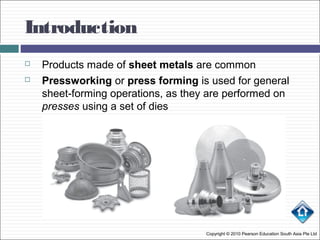
 Products made of sheet metals are common
 Pressworking or press forming is used for general
sheet-forming operations, as they are performed on
presses using a set of dies
Copyright © 2010 Pearson Education South Asia Pte Ltd
Introduction
 A sheet-metal part produced in presses is called a
stamping
 Low-carbon steel has low cost and good strength and
formability characteristics
 Manufacturing processes involving sheet metal are
performed at room temperature
Copyright © 2010 Pearson Education South Asia Pte Ltd
Three Major Categories of
Sheet Metal Processes
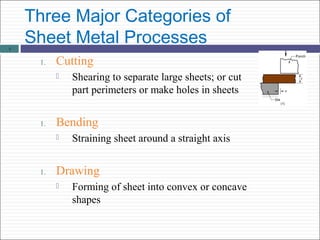
1. Cutting
 Shearing to separate large sheets; or cut
part perimeters or make holes in sheets
1. Bending
 Straining sheet around a straight axis
1. Drawing
 Forming of sheet into convex or concave
shapes
4
Shearing
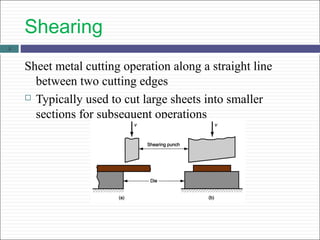
Sheet metal cutting operation along a straight line
between two cutting edges
 Typically used to cut large sheets into smaller
sections for subsequent operations
5
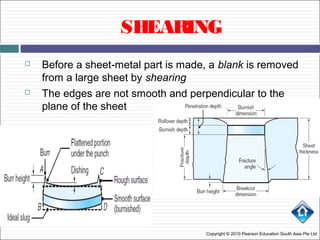
SHEARING
 Before a sheet-metal part is made, a blank is removed
from a large sheet by shearing
 The edges are not smooth and perpendicular to the
plane of the sheet
Copyright © 2010 Pearson Education South Asia Pte Ltd
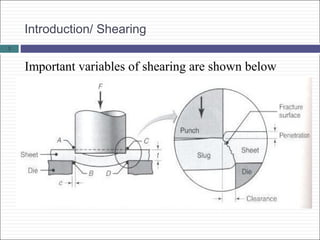
Introduction/ Shearing
7
Important variables of shearing are shown below
Manufacturing processes by S. Kalpakjian and S. Schmid
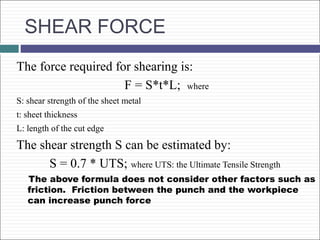
SHEAR FORCE
The force required for shearing is:
F = S*t*L; where
S: shear strength of the sheet metal
t: sheet thickness
L: length of the cut edge
The shear strength S can be estimated by:
S = 0.7 * UTS; where UTS: the Ultimate Tensile Strength
The above formula does not consider other factors such as
friction. Friction between the punch and the workpiece
can increase punch force
Shearing
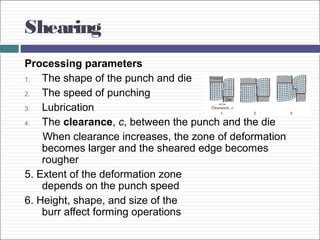
Processing parameters
1. The shape of the punch and die
2. The speed of punching
3. Lubrication
4. The clearance, c, between the punch and the die
When clearance increases, the zone of deformation
becomes larger and the sheared edge becomes
rougher
5. Extent of the deformation zone
depends on the punch speed
6. Height, shape, and size of the
burr affect forming operations
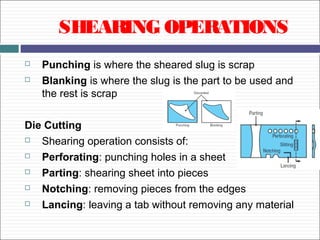
SHEARING OPERATIONS
 Punching is where the sheared slug is scrap
 Blanking is where the slug is the part to be used and
the rest is scrap
Die Cutting
 Shearing operation consists of:
 Perforating: punching holes in a sheet
 Parting: shearing sheet into pieces
 Notching: removing pieces from the edges
 Lancing: leaving a tab without removing any material
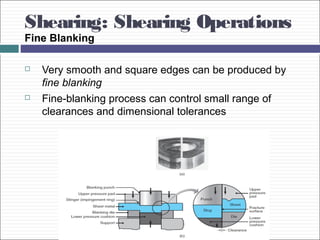
Shearing: Shearing Operations
Fine Blanking
 Very smooth and square edges can be produced by
fine blanking
 Fine-blanking process can control small range of
clearances and dimensional tolerances
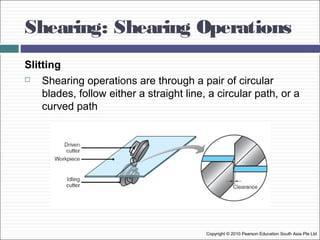
Shearing: Shearing Operations
Slitting
 Shearing operations are through a pair of circular
blades, follow either a straight line, a circular path, or a
curved path
Copyright © 2010 Pearson Education South Asia Pte Ltd
Shearing:
Characteristics and Type of Shearing Dies
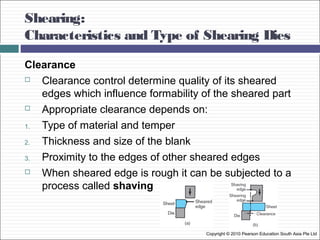
Clearance
 Clearance control determine quality of its sheared
edges which influence formability of the sheared part
 Appropriate clearance depends on:
1. Type of material and temper
2. Thickness and size of the blank
3. Proximity to the edges of other sheared edges
 When sheared edge is rough it can be subjected to a
process called shaving
Copyright © 2010 Pearson Education South Asia Pte Ltd
Shearing:
Characteristics and Type of Shearing Dies
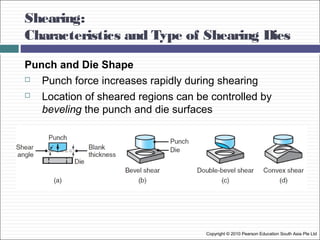
Punch and Die Shape
 Punch force increases rapidly during shearing
 Location of sheared regions can be controlled by
beveling the punch and die surfaces
Copyright © 2010 Pearson Education South Asia Pte Ltd
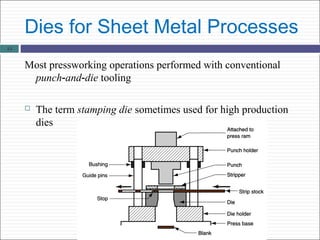
Dies for Sheet Metal Processes
Most pressworking operations performed with conventional
punch and die‑ ‑ tooling
 The term stamping die sometimes used for high production
dies
15
Shearing:
Characteristics and Type of Shearing Dies
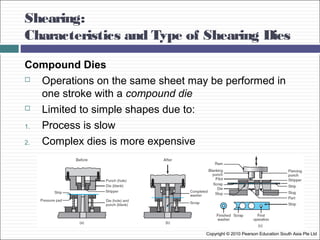
Compound Dies
 Operations on the same sheet may be performed in
one stroke with a compound die
 Limited to simple shapes due to:
1. Process is slow
2. Complex dies is more expensive
Copyright © 2010 Pearson Education South Asia Pte Ltd
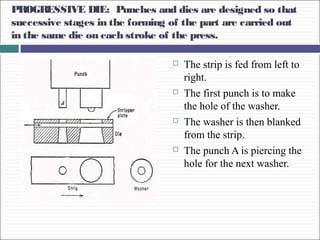
PROGRESSIVE DIE: Punches and dies are designed so that
successive stages in the forming of the part are carried out
in the same die on each stroke of the press.
 The strip is fed from left to
right.
 The first punch is to make
the hole of the washer.
 The washer is then blanked
from the strip.
 The punch A is piercing the
hole for the next washer.
Shearing:
Characteristics and Type of Shearing Dies
Transfer Dies
 Sheet metal undergoes different operations arranged
along a straight line or a circular path
Tool and Die Materials
 Tool and die materials for shearing are tool steels and
carbides
 Lubrication is needed for reducing tool and die wear,
and improving edge quality
Copyright © 2010 Pearson Education South Asia Pte Ltd
Sheet-metal Characteristics and Formability
Copyright © 2010 Pearson Education South Asia Pte Ltd
Elongation
 A specimen subjected to tension undergoes uniform
elongation
 When the load exceeds the UTS, the specimen begins
to neck
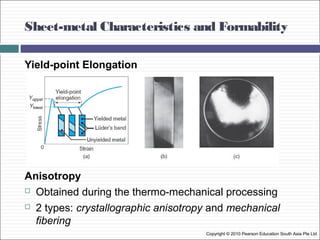
Yield-point Elongation
 Yield-point elongation: having both upper and lower yield
points
 Lüder’s bands has elongated depressions on the
surface of the sheet
Sheet-metal Characteristics and Formability
Copyright © 2010 Pearson Education South Asia Pte Ltd
Yield-point Elongation
Anisotropy
 Obtained during the thermo-mechanical processing
 2 types: crystallographic anisotropy and mechanical
fibering
Sheet-metal Characteristics and Formability
Copyright © 2010 Pearson Education South Asia Pte Ltd
Grain Size
 Affects mechanical properties and surface appearance
 Smaller the grain size, stronger is the metal
Dent Resistance of Sheet Metals
 Dents caused by dynamic forces from moving objects
that hit the sheet metal
 Dynamic yield stress, instead of static yield stress,
should be the significant strength parameter
Formability Tests forSheet Metals
Copyright © 2010 Pearson Education South Asia Pte Ltd
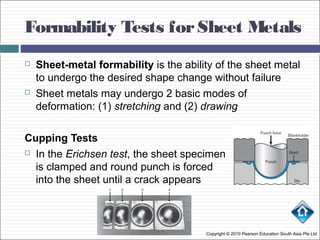
 Sheet-metal formability is the ability of the sheet metal
to undergo the desired shape change without failure
 Sheet metals may undergo 2 basic modes of
deformation: (1) stretching and (2) drawing
Cupping Tests
 In the Erichsen test, the sheet specimen
is clamped and round punch is forced
into the sheet until a crack appears
Formability Tests forSheet Metals
Copyright © 2010 Pearson Education South Asia Pte Ltd
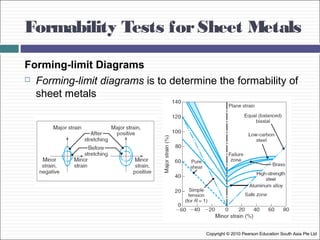
Forming-limit Diagrams
 Forming-limit diagrams is to determine the formability of
sheet metals
Formability Tests forSheet Metals
Copyright © 2010 Pearson Education South Asia Pte Ltd
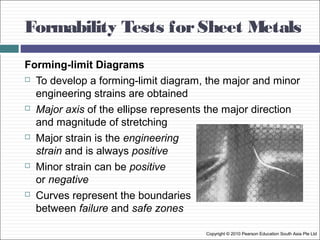
Forming-limit Diagrams
 To develop a forming-limit diagram, the major and minor
engineering strains are obtained
 Major axis of the ellipse represents the major direction
and magnitude of stretching
 Major strain is the engineering
strain and is always positive
 Minor strain can be positive
or negative
 Curves represent the boundaries
between failure and safe zones
BENDING SHEET ANDPLATE
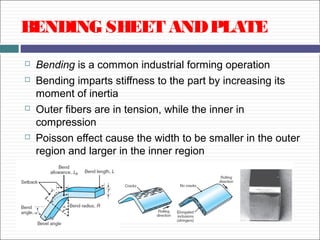
 Bending is a common industrial forming operation
 Bending imparts stiffness to the part by increasing its
moment of inertia
 Outer fibers are in tension, while the inner in
compression
 Poisson effect cause the width to be smaller in the outer
region and larger in the inner region
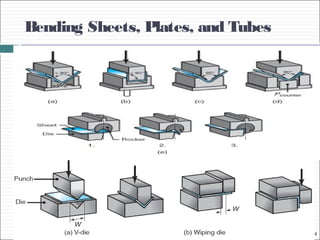
Bending Sheets, Plates, and Tubes
Copyright © 2010 Pearson Education South Asia Pte Ltd
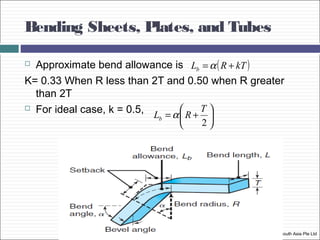
 Approximate bend allowance is
K= 0.33 When R less than 2T and 0.50 when R greater
than 2T
 For ideal case, k = 0.5,
( )kTRLb += α






+=
2
T
RLb α
Bending Sheets, Plates, and Tubes
Copyright © 2010 Pearson Education South Asia Pte Ltd
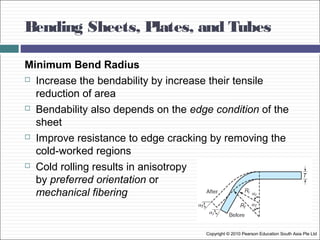
Minimum Bend Radius
 Increase the bendability by increase their tensile
reduction of area
 Bendability also depends on the edge condition of the
sheet
 Improve resistance to edge cracking by removing the
cold-worked regions
 Cold rolling results in anisotropy
by preferred orientation or
mechanical fibering
28
Introduction/ Types of Bending
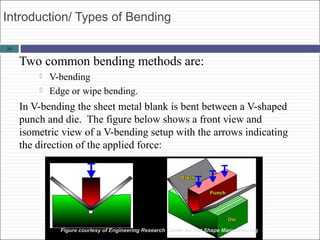
Two common bending methods are:
 V-bending
 Edge or wipe bending.
In V-bending the sheet metal blank is bent between a V-shaped
punch and die. The figure below shows a front view and
isometric view of a V-bending setup with the arrows indicating
the direction of the applied force:
Figure courtesy of Engineering Research Center for Net Shape Manufacturing
29
Introduction/ Types of Bending
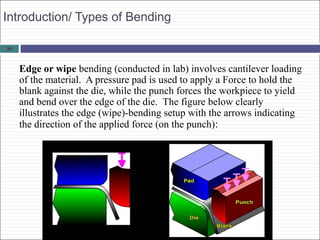
Edge or wipe bending (conducted in lab) involves cantilever loading
of the material. A pressure pad is used to apply a Force to hold the
blank against the die, while the punch forces the workpiece to yield
and bend over the edge of the die. The figure below clearly
illustrates the edge (wipe)-bending setup with the arrows indicating
the direction of the applied force (on the punch):
Bending Sheets, Plates, and Tubes
Copyright © 2010 Pearson Education South Asia Pte Ltd
31
SPRINGBACKIN BENDING
When the bending stress is removed at the end of the deformation
process, elastic energy remains in the bent part causing it to partially
recover to its original shape. In bending, this elastic recovery is called
springback.
It increases with decreasing the modulus of elasticity, E, and
increasing the yield strength, Y, of a material.
Springback is defined as the increase in included angle of the bent part
relative to the included angle of the forming tool after the tool is
removed.
Springback Effects:
 The bend angle will decrease (the included angle will increase)
 The bend radius will increase
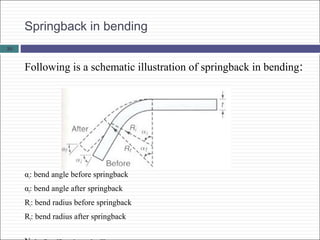
Springback in bending
Following is a schematic illustration of springback in bending:
αi: bend angle before springback
αf: bend angle after springback
Ri: bend radius before springback
Rf: bend radius after springback
32
Springback in bending
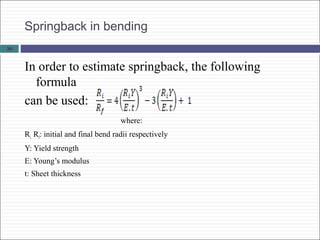
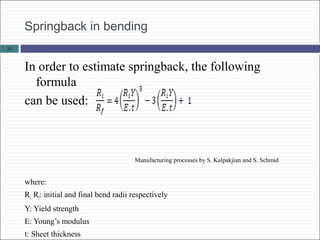
In order to estimate springback, the following
formula
can be used:
Manufacturing processes by S. Kalpakjian and S. Schmid
where:
Ri, Rf: initial and final bend radii respectively
Y: Yield strength
E: Young’s modulus
t: Sheet thickness
33
Compensation for Springback
 Springback is compensated for by
overbending the part
 One method is stretch bending where the
part is subjected to tension while being
bent
Bending Sheets, Plates, and Tubes
Bending Force
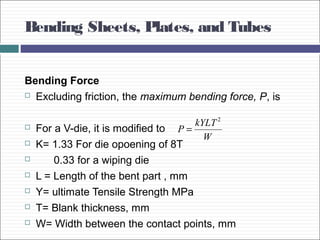
 Excluding friction, the maximum bending force, P, is
 For a V-die, it is modified to
 K= 1.33 For die opoening of 8T
 0.33 for a wiping die
 L = Length of the bent part , mm
 Y= ultimate Tensile Strength MPa
 T= Blank thickness, mm
 W= Width between the contact points, mm
W
kYLT
P
2
=
Springback in bending
In order to estimate springback, the following
formula
can be used:
where:
Ri, Rf: initial and final bend radii respectively
Y: Yield strength
E: Young’s modulus
t: Sheet thickness
36
37
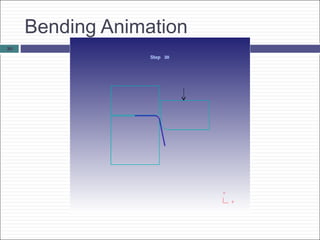
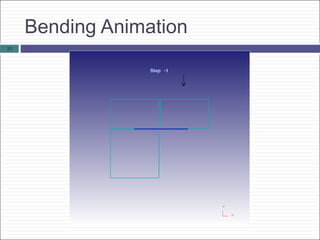
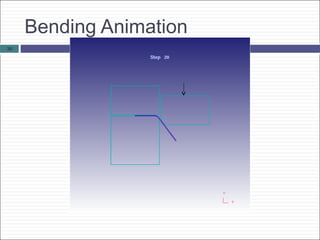
Bending Animation
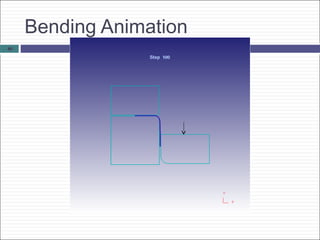
Bending Animation
38
Bending Animation
39
Bending Animation
40
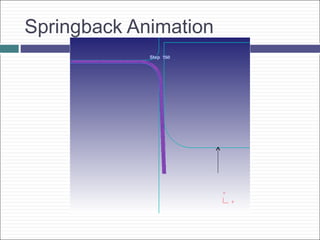
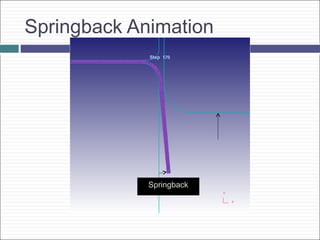
Springback Animation
Springback
Bending Sheets, Plates, and Tubes
Copyright © 2010 Pearson Education South Asia Pte Ltd
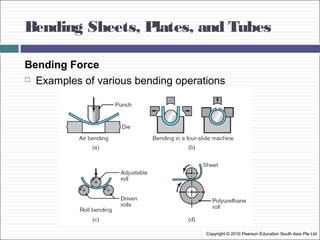
Bending Force
 Examples of various bending operations
Miscellaneous Bending and Related
Operations
Copyright © 2010 Pearson Education South Asia Pte Ltd
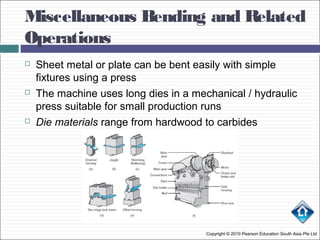
 Sheet metal or plate can be bent easily with simple
fixtures using a press
 The machine uses long dies in a mechanical / hydraulic
press suitable for small production runs
 Die materials range from hardwood to carbides
Miscellaneous Bending and Related
Operations
Copyright © 2010 Pearson Education South Asia Pte Ltd
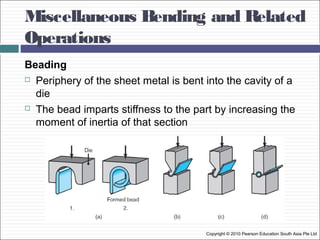
Beading
 Periphery of the sheet metal is bent into the cavity of a
die
 The bead imparts stiffness to the part by increasing the
moment of inertia of that section
Miscellaneous Bending and Related
Operations
Copyright © 2010 Pearson Education South Asia Pte Ltd
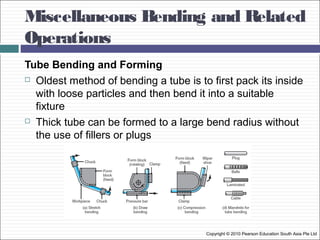
Tube Bending and Forming
 Oldest method of bending a tube is to first pack its inside
with loose particles and then bend it into a suitable
fixture
 Thick tube can be formed to a large bend radius without
the use of fillers or plugs
Miscellaneous Bending and Related
Operations
Copyright © 2010 Pearson Education South Asia Pte Ltd
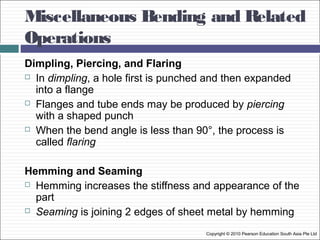
Dimpling, Piercing, and Flaring
 In dimpling, a hole first is punched and then expanded
into a flange
 Flanges and tube ends may be produced by piercing
with a shaped punch
 When the bend angle is less than 90°, the process is
called flaring
Hemming and Seaming
 Hemming increases the stiffness and appearance of the
part
 Seaming is joining 2 edges of sheet metal by hemming
Miscellaneous Bending and Related
Operations
Copyright © 2010 Pearson Education South Asia Pte Ltd
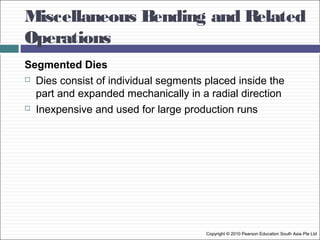
Segmented Dies
 Dies consist of individual segments placed inside the
part and expanded mechanically in a radial direction
 Inexpensive and used for large production runs
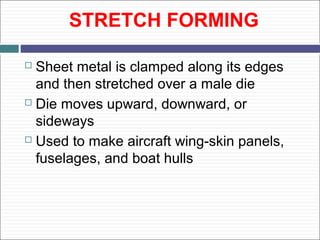
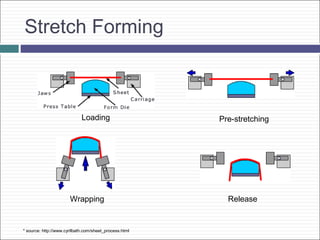
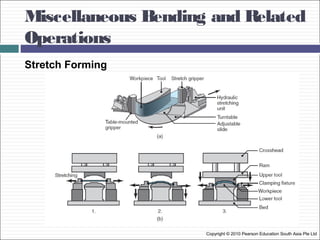
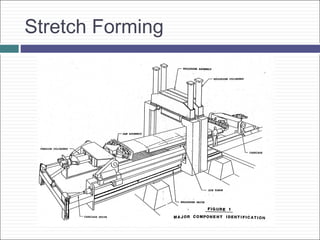
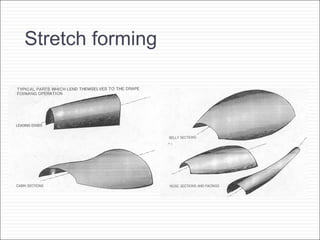
STRETCH FORMING
 Sheet metal is clamped along its edges
and then stretched over a male die
 Die moves upward, downward, or
sideways
 Used to make aircraft wing-skin panels,
fuselages, and boat hulls
Stretch Forming
Loading Pre-stretching
Wrapping Release
* source: http://www.cyrilbath.com/sheet_process.html
Miscellaneous Bending and Related
Operations
Copyright © 2010 Pearson Education South Asia Pte Ltd
Stretch Forming
Stretch Forming
Stretch forming
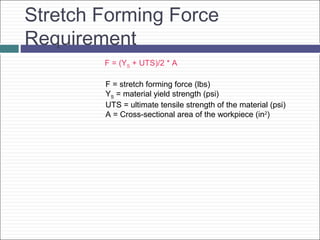
Stretch Forming Force
Requirement
F = (YS + UTS)/2 * A
F = stretch forming force (lbs)
YS = material yield strength (psi)
UTS = ultimate tensile strength of the material (psi)
A = Cross-sectional area of the workpiece (in2
)
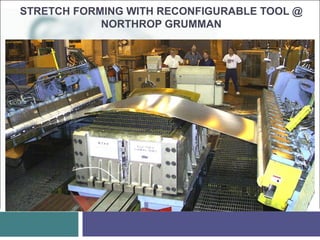
STRETCH FORMING WITH RECONFIGURABLE TOOL @
NORTHROP GRUMMAN
Deep Drawing
Copyright © 2010 Pearson Education South Asia Pte Ltd
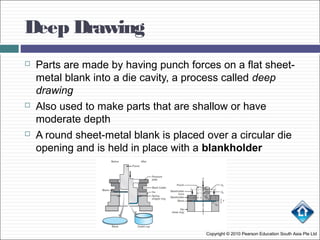
 Parts are made by having punch forces on a flat sheet-
metal blank into a die cavity, a process called deep
drawing
 Also used to make parts that are shallow or have
moderate depth
 A round sheet-metal blank is placed over a circular die
opening and is held in place with a blankholder
Deep Drawing
Copyright © 2010 Pearson Education South Asia Pte Ltd
Deep Drawing:
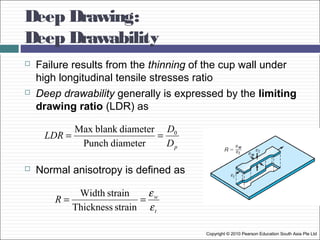
Deep Drawability
Copyright © 2010 Pearson Education South Asia Pte Ltd
 Failure results from the thinning of the cup wall under
high longitudinal tensile stresses ratio
 Deep drawability generally is expressed by the limiting
drawing ratio (LDR) as
 Normal anisotropy is defined as
pD
D
LDR 0
diameterPunch
diameterblankMax
==
t
w
R
ε
ε
==
strainThickness
strainWidth
Deep Drawing:
Deep-drawing Practice
Copyright © 2010 Pearson Education South Asia Pte Ltd
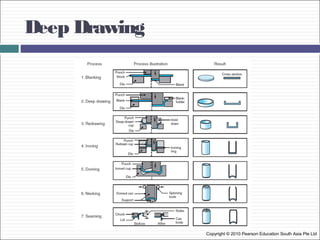
Ironing
 If the clearance between the punch and the die is large,
the drawn cup will have thicker walls
 Thickness of the cup wall can be controlled by ironing,
where drawn cup is pushed through one or more ironing
rings
Redrawing
 Containers that are difficult to draw undergo redrawing
 Cup becomes longer as it is redrawn to smaller
diameters since volume of the metal is constant
Deep Drawing:
Deep-drawing Practice
Copyright © 2010 Pearson Education South Asia Pte Ltd
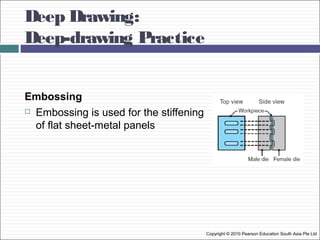
Embossing
 Embossing is used for the stiffening
of flat sheet-metal panels
RubberForming and Hydroforming
Copyright © 2010 Pearson Education South Asia Pte Ltd
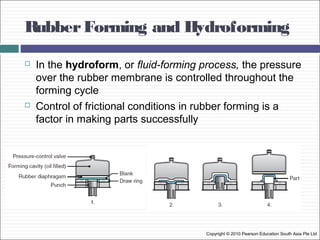
 In the hydroform, or fluid-forming process, the pressure
over the rubber membrane is controlled throughout the
forming cycle
 Control of frictional conditions in rubber forming is a
factor in making parts successfully
RubberForming and Hydroforming
Copyright © 2010 Pearson Education South Asia Pte Ltd
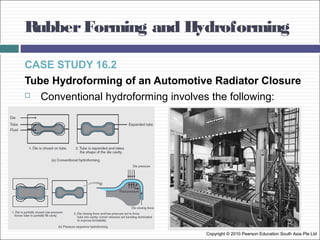
CASE STUDY 16.2
Tube Hydroforming of an Automotive Radiator Closure
 Conventional hydroforming involves the following:
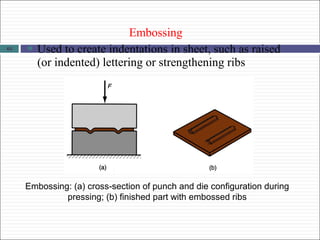
Embossing
 Used to create indentations in sheet, such as raised
(or indented) lettering or strengthening ribs
Embossing: (a) cross section of punch and die configuration during‑
pressing; (b) finished part with embossed ribs
63
Spinning
Copyright © 2010 Pearson Education South Asia Pte Ltd
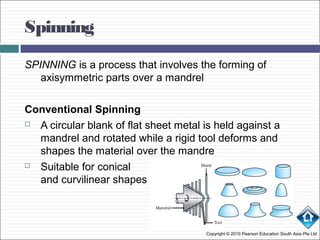
SPINNING is a process that involves the forming of
axisymmetric parts over a mandrel
Conventional Spinning
 A circular blank of flat sheet metal is held against a
mandrel and rotated while a rigid tool deforms and
shapes the material over the mandre
 Suitable for conical
and curvilinear shapes
Spinning
Copyright © 2010 Pearson Education South Asia Pte Ltd
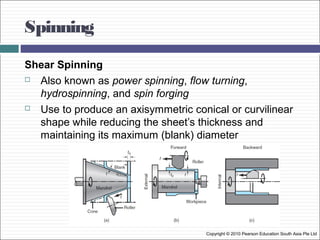
Shear Spinning
 Also known as power spinning, flow turning,
hydrospinning, and spin forging
 Use to produce an axisymmetric conical or curvilinear
shape while reducing the sheet’s thickness and
maintaining its maximum (blank) diameter
Spinning
Copyright © 2010 Pearson Education South Asia Pte Ltd
Tube Spinning
 The thickness of hollow, cylindrical blanks is reduced
by spinning them on a solid, round mandrel using
rollers
 Can be carried out externally or internally
 Various external and internal profiles can be produced
from cylindrical blanks with constant wall thickness
Specialized Forming Processes
Copyright © 2010 Pearson Education South Asia Pte Ltd
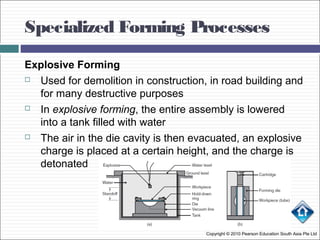
Explosive Forming
 Used for demolition in construction, in road building and
for many destructive purposes
 In explosive forming, the entire assembly is lowered
into a tank filled with water
 The air in the die cavity is then evacuated, an explosive
charge is placed at a certain height, and the charge is
detonated
Specialized Forming Processes
Copyright © 2010 Pearson Education South Asia Pte Ltd
Explosive Forming
 The mechanical properties of parts similar to those
made by conventional forming methods
 The dies may be made of aluminum alloys, steel,
ductile iron or zinc alloys
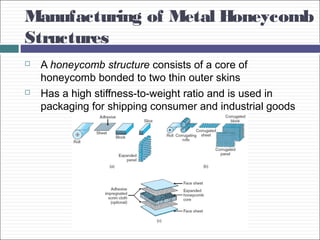
Manufacturing of Metal Honeycomb
Structures
 A honeycomb structure consists of a core of
honeycomb bonded to two thin outer skins
 Has a high stiffness-to-weight ratio and is used in
packaging for shipping consumer and industrial goods
Manufacturing of Metal Honeycomb
Structures
Copyright © 2010 Pearson Education South Asia Pte Ltd
 A honeycomb structure has light weight and high
resistance to bending forces, used for aircraft and
aerospace components
 2 methods of manufacturing honeycomb materials:
1. Expansion process
2. Corrugation process
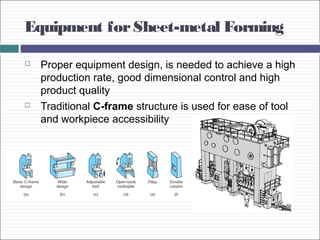
Equipment forSheet-metal Forming
 Proper equipment design, is needed to achieve a high
production rate, good dimensional control and high
product quality
 Traditional C-frame structure is used for ease of tool
and workpiece accessibility
Equipment forSheet-metal Forming
 Press selection for sheet-metal forming operations
depends on:
1. Type of forming operation
2. Size and shape of workpieces
3. Number of slides
4. Maximum force required
5. Type of mechanical, hydraulic, and computer controls
6. Features for changing dies
7. Safety features
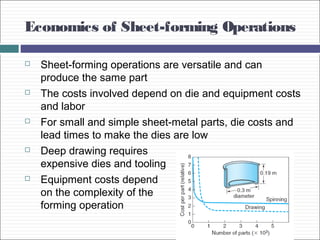
Economics of Sheet-forming Operations
 Sheet-forming operations are versatile and can
produce the same part
 The costs involved depend on die and equipment costs
and labor
 For small and simple sheet-metal parts, die costs and
lead times to make the dies are low
 Deep drawing requires
expensive dies and tooling
 Equipment costs depend
on the complexity of the
forming operation
THANKS

Class sheet metal processes

  • 1.
  • 2.
    Introduction  Products madeof sheet metals are common  Pressworking or press forming is used for general sheet-forming operations, as they are performed on presses using a set of dies Copyright © 2010 Pearson Education South Asia Pte Ltd
  • 3.
    Introduction  A sheet-metalpart produced in presses is called a stamping  Low-carbon steel has low cost and good strength and formability characteristics  Manufacturing processes involving sheet metal are performed at room temperature Copyright © 2010 Pearson Education South Asia Pte Ltd
  • 4.
    Three Major Categoriesof Sheet Metal Processes 1. Cutting  Shearing to separate large sheets; or cut part perimeters or make holes in sheets 1. Bending  Straining sheet around a straight axis 1. Drawing  Forming of sheet into convex or concave shapes 4
  • 5.
    Shearing Sheet metal cuttingoperation along a straight line between two cutting edges  Typically used to cut large sheets into smaller sections for subsequent operations 5
  • 6.
    SHEARING  Before asheet-metal part is made, a blank is removed from a large sheet by shearing  The edges are not smooth and perpendicular to the plane of the sheet Copyright © 2010 Pearson Education South Asia Pte Ltd
  • 7.
    Introduction/ Shearing 7 Important variablesof shearing are shown below Manufacturing processes by S. Kalpakjian and S. Schmid
  • 8.
    SHEAR FORCE The forcerequired for shearing is: F = S*t*L; where S: shear strength of the sheet metal t: sheet thickness L: length of the cut edge The shear strength S can be estimated by: S = 0.7 * UTS; where UTS: the Ultimate Tensile Strength The above formula does not consider other factors such as friction. Friction between the punch and the workpiece can increase punch force
  • 9.
    Shearing Processing parameters 1. Theshape of the punch and die 2. The speed of punching 3. Lubrication 4. The clearance, c, between the punch and the die When clearance increases, the zone of deformation becomes larger and the sheared edge becomes rougher 5. Extent of the deformation zone depends on the punch speed 6. Height, shape, and size of the burr affect forming operations
  • 10.
    SHEARING OPERATIONS  Punchingis where the sheared slug is scrap  Blanking is where the slug is the part to be used and the rest is scrap Die Cutting  Shearing operation consists of:  Perforating: punching holes in a sheet  Parting: shearing sheet into pieces  Notching: removing pieces from the edges  Lancing: leaving a tab without removing any material
  • 11.
    Shearing: Shearing Operations FineBlanking  Very smooth and square edges can be produced by fine blanking  Fine-blanking process can control small range of clearances and dimensional tolerances
  • 12.
    Shearing: Shearing Operations Slitting Shearing operations are through a pair of circular blades, follow either a straight line, a circular path, or a curved path Copyright © 2010 Pearson Education South Asia Pte Ltd
  • 13.
    Shearing: Characteristics and Typeof Shearing Dies Clearance  Clearance control determine quality of its sheared edges which influence formability of the sheared part  Appropriate clearance depends on: 1. Type of material and temper 2. Thickness and size of the blank 3. Proximity to the edges of other sheared edges  When sheared edge is rough it can be subjected to a process called shaving Copyright © 2010 Pearson Education South Asia Pte Ltd
  • 14.
    Shearing: Characteristics and Typeof Shearing Dies Punch and Die Shape  Punch force increases rapidly during shearing  Location of sheared regions can be controlled by beveling the punch and die surfaces Copyright © 2010 Pearson Education South Asia Pte Ltd
  • 15.
    Dies for SheetMetal Processes Most pressworking operations performed with conventional punch and die‑ ‑ tooling  The term stamping die sometimes used for high production dies 15
  • 16.
    Shearing: Characteristics and Typeof Shearing Dies Compound Dies  Operations on the same sheet may be performed in one stroke with a compound die  Limited to simple shapes due to: 1. Process is slow 2. Complex dies is more expensive Copyright © 2010 Pearson Education South Asia Pte Ltd
  • 17.
    PROGRESSIVE DIE: Punchesand dies are designed so that successive stages in the forming of the part are carried out in the same die on each stroke of the press.  The strip is fed from left to right.  The first punch is to make the hole of the washer.  The washer is then blanked from the strip.  The punch A is piercing the hole for the next washer.
  • 18.
    Shearing: Characteristics and Typeof Shearing Dies Transfer Dies  Sheet metal undergoes different operations arranged along a straight line or a circular path Tool and Die Materials  Tool and die materials for shearing are tool steels and carbides  Lubrication is needed for reducing tool and die wear, and improving edge quality Copyright © 2010 Pearson Education South Asia Pte Ltd
  • 19.
    Sheet-metal Characteristics andFormability Copyright © 2010 Pearson Education South Asia Pte Ltd Elongation  A specimen subjected to tension undergoes uniform elongation  When the load exceeds the UTS, the specimen begins to neck Yield-point Elongation  Yield-point elongation: having both upper and lower yield points  Lüder’s bands has elongated depressions on the surface of the sheet
  • 20.
    Sheet-metal Characteristics andFormability Copyright © 2010 Pearson Education South Asia Pte Ltd Yield-point Elongation Anisotropy  Obtained during the thermo-mechanical processing  2 types: crystallographic anisotropy and mechanical fibering
  • 21.
    Sheet-metal Characteristics andFormability Copyright © 2010 Pearson Education South Asia Pte Ltd Grain Size  Affects mechanical properties and surface appearance  Smaller the grain size, stronger is the metal Dent Resistance of Sheet Metals  Dents caused by dynamic forces from moving objects that hit the sheet metal  Dynamic yield stress, instead of static yield stress, should be the significant strength parameter
  • 22.
    Formability Tests forSheetMetals Copyright © 2010 Pearson Education South Asia Pte Ltd  Sheet-metal formability is the ability of the sheet metal to undergo the desired shape change without failure  Sheet metals may undergo 2 basic modes of deformation: (1) stretching and (2) drawing Cupping Tests  In the Erichsen test, the sheet specimen is clamped and round punch is forced into the sheet until a crack appears
  • 23.
    Formability Tests forSheetMetals Copyright © 2010 Pearson Education South Asia Pte Ltd Forming-limit Diagrams  Forming-limit diagrams is to determine the formability of sheet metals
  • 24.
    Formability Tests forSheetMetals Copyright © 2010 Pearson Education South Asia Pte Ltd Forming-limit Diagrams  To develop a forming-limit diagram, the major and minor engineering strains are obtained  Major axis of the ellipse represents the major direction and magnitude of stretching  Major strain is the engineering strain and is always positive  Minor strain can be positive or negative  Curves represent the boundaries between failure and safe zones
  • 25.
    BENDING SHEET ANDPLATE Bending is a common industrial forming operation  Bending imparts stiffness to the part by increasing its moment of inertia  Outer fibers are in tension, while the inner in compression  Poisson effect cause the width to be smaller in the outer region and larger in the inner region
  • 26.
    Bending Sheets, Plates,and Tubes Copyright © 2010 Pearson Education South Asia Pte Ltd  Approximate bend allowance is K= 0.33 When R less than 2T and 0.50 when R greater than 2T  For ideal case, k = 0.5, ( )kTRLb += α       += 2 T RLb α
  • 27.
    Bending Sheets, Plates,and Tubes Copyright © 2010 Pearson Education South Asia Pte Ltd Minimum Bend Radius  Increase the bendability by increase their tensile reduction of area  Bendability also depends on the edge condition of the sheet  Improve resistance to edge cracking by removing the cold-worked regions  Cold rolling results in anisotropy by preferred orientation or mechanical fibering
  • 28.
    28 Introduction/ Types ofBending Two common bending methods are:  V-bending  Edge or wipe bending. In V-bending the sheet metal blank is bent between a V-shaped punch and die. The figure below shows a front view and isometric view of a V-bending setup with the arrows indicating the direction of the applied force: Figure courtesy of Engineering Research Center for Net Shape Manufacturing
  • 29.
    29 Introduction/ Types ofBending Edge or wipe bending (conducted in lab) involves cantilever loading of the material. A pressure pad is used to apply a Force to hold the blank against the die, while the punch forces the workpiece to yield and bend over the edge of the die. The figure below clearly illustrates the edge (wipe)-bending setup with the arrows indicating the direction of the applied force (on the punch):
  • 30.
    Bending Sheets, Plates,and Tubes Copyright © 2010 Pearson Education South Asia Pte Ltd
  • 31.
    31 SPRINGBACKIN BENDING When thebending stress is removed at the end of the deformation process, elastic energy remains in the bent part causing it to partially recover to its original shape. In bending, this elastic recovery is called springback. It increases with decreasing the modulus of elasticity, E, and increasing the yield strength, Y, of a material. Springback is defined as the increase in included angle of the bent part relative to the included angle of the forming tool after the tool is removed. Springback Effects:  The bend angle will decrease (the included angle will increase)  The bend radius will increase
  • 32.
    Springback in bending Followingis a schematic illustration of springback in bending: αi: bend angle before springback αf: bend angle after springback Ri: bend radius before springback Rf: bend radius after springback 32
  • 33.
    Springback in bending Inorder to estimate springback, the following formula can be used: Manufacturing processes by S. Kalpakjian and S. Schmid where: Ri, Rf: initial and final bend radii respectively Y: Yield strength E: Young’s modulus t: Sheet thickness 33
  • 34.
    Compensation for Springback Springback is compensated for by overbending the part  One method is stretch bending where the part is subjected to tension while being bent
  • 35.
    Bending Sheets, Plates,and Tubes Bending Force  Excluding friction, the maximum bending force, P, is  For a V-die, it is modified to  K= 1.33 For die opoening of 8T  0.33 for a wiping die  L = Length of the bent part , mm  Y= ultimate Tensile Strength MPa  T= Blank thickness, mm  W= Width between the contact points, mm W kYLT P 2 =
  • 36.
    Springback in bending Inorder to estimate springback, the following formula can be used: where: Ri, Rf: initial and final bend radii respectively Y: Yield strength E: Young’s modulus t: Sheet thickness 36
  • 37.
  • 38.
  • 39.
  • 40.
  • 41.
  • 42.
  • 43.
    Bending Sheets, Plates,and Tubes Copyright © 2010 Pearson Education South Asia Pte Ltd Bending Force  Examples of various bending operations
  • 44.
    Miscellaneous Bending andRelated Operations Copyright © 2010 Pearson Education South Asia Pte Ltd  Sheet metal or plate can be bent easily with simple fixtures using a press  The machine uses long dies in a mechanical / hydraulic press suitable for small production runs  Die materials range from hardwood to carbides
  • 45.
    Miscellaneous Bending andRelated Operations Copyright © 2010 Pearson Education South Asia Pte Ltd Beading  Periphery of the sheet metal is bent into the cavity of a die  The bead imparts stiffness to the part by increasing the moment of inertia of that section
  • 46.
    Miscellaneous Bending andRelated Operations Copyright © 2010 Pearson Education South Asia Pte Ltd Tube Bending and Forming  Oldest method of bending a tube is to first pack its inside with loose particles and then bend it into a suitable fixture  Thick tube can be formed to a large bend radius without the use of fillers or plugs
  • 47.
    Miscellaneous Bending andRelated Operations Copyright © 2010 Pearson Education South Asia Pte Ltd Dimpling, Piercing, and Flaring  In dimpling, a hole first is punched and then expanded into a flange  Flanges and tube ends may be produced by piercing with a shaped punch  When the bend angle is less than 90°, the process is called flaring Hemming and Seaming  Hemming increases the stiffness and appearance of the part  Seaming is joining 2 edges of sheet metal by hemming
  • 48.
    Miscellaneous Bending andRelated Operations Copyright © 2010 Pearson Education South Asia Pte Ltd Segmented Dies  Dies consist of individual segments placed inside the part and expanded mechanically in a radial direction  Inexpensive and used for large production runs
  • 49.
    STRETCH FORMING  Sheetmetal is clamped along its edges and then stretched over a male die  Die moves upward, downward, or sideways  Used to make aircraft wing-skin panels, fuselages, and boat hulls
  • 50.
    Stretch Forming Loading Pre-stretching WrappingRelease * source: http://www.cyrilbath.com/sheet_process.html
  • 51.
    Miscellaneous Bending andRelated Operations Copyright © 2010 Pearson Education South Asia Pte Ltd Stretch Forming
  • 52.
  • 53.
  • 54.
    Stretch Forming Force Requirement F= (YS + UTS)/2 * A F = stretch forming force (lbs) YS = material yield strength (psi) UTS = ultimate tensile strength of the material (psi) A = Cross-sectional area of the workpiece (in2 )
  • 55.
    STRETCH FORMING WITHRECONFIGURABLE TOOL @ NORTHROP GRUMMAN
  • 56.
    Deep Drawing Copyright ©2010 Pearson Education South Asia Pte Ltd  Parts are made by having punch forces on a flat sheet- metal blank into a die cavity, a process called deep drawing  Also used to make parts that are shallow or have moderate depth  A round sheet-metal blank is placed over a circular die opening and is held in place with a blankholder
  • 57.
    Deep Drawing Copyright ©2010 Pearson Education South Asia Pte Ltd
  • 58.
    Deep Drawing: Deep Drawability Copyright© 2010 Pearson Education South Asia Pte Ltd  Failure results from the thinning of the cup wall under high longitudinal tensile stresses ratio  Deep drawability generally is expressed by the limiting drawing ratio (LDR) as  Normal anisotropy is defined as pD D LDR 0 diameterPunch diameterblankMax == t w R ε ε == strainThickness strainWidth
  • 59.
    Deep Drawing: Deep-drawing Practice Copyright© 2010 Pearson Education South Asia Pte Ltd Ironing  If the clearance between the punch and the die is large, the drawn cup will have thicker walls  Thickness of the cup wall can be controlled by ironing, where drawn cup is pushed through one or more ironing rings Redrawing  Containers that are difficult to draw undergo redrawing  Cup becomes longer as it is redrawn to smaller diameters since volume of the metal is constant
  • 60.
    Deep Drawing: Deep-drawing Practice Copyright© 2010 Pearson Education South Asia Pte Ltd Embossing  Embossing is used for the stiffening of flat sheet-metal panels
  • 61.
    RubberForming and Hydroforming Copyright© 2010 Pearson Education South Asia Pte Ltd  In the hydroform, or fluid-forming process, the pressure over the rubber membrane is controlled throughout the forming cycle  Control of frictional conditions in rubber forming is a factor in making parts successfully
  • 62.
    RubberForming and Hydroforming Copyright© 2010 Pearson Education South Asia Pte Ltd CASE STUDY 16.2 Tube Hydroforming of an Automotive Radiator Closure  Conventional hydroforming involves the following:
  • 63.
    Embossing  Used tocreate indentations in sheet, such as raised (or indented) lettering or strengthening ribs Embossing: (a) cross section of punch and die configuration during‑ pressing; (b) finished part with embossed ribs 63
  • 64.
    Spinning Copyright © 2010Pearson Education South Asia Pte Ltd SPINNING is a process that involves the forming of axisymmetric parts over a mandrel Conventional Spinning  A circular blank of flat sheet metal is held against a mandrel and rotated while a rigid tool deforms and shapes the material over the mandre  Suitable for conical and curvilinear shapes
  • 65.
    Spinning Copyright © 2010Pearson Education South Asia Pte Ltd Shear Spinning  Also known as power spinning, flow turning, hydrospinning, and spin forging  Use to produce an axisymmetric conical or curvilinear shape while reducing the sheet’s thickness and maintaining its maximum (blank) diameter
  • 66.
    Spinning Copyright © 2010Pearson Education South Asia Pte Ltd Tube Spinning  The thickness of hollow, cylindrical blanks is reduced by spinning them on a solid, round mandrel using rollers  Can be carried out externally or internally  Various external and internal profiles can be produced from cylindrical blanks with constant wall thickness
  • 67.
    Specialized Forming Processes Copyright© 2010 Pearson Education South Asia Pte Ltd Explosive Forming  Used for demolition in construction, in road building and for many destructive purposes  In explosive forming, the entire assembly is lowered into a tank filled with water  The air in the die cavity is then evacuated, an explosive charge is placed at a certain height, and the charge is detonated
  • 68.
    Specialized Forming Processes Copyright© 2010 Pearson Education South Asia Pte Ltd Explosive Forming  The mechanical properties of parts similar to those made by conventional forming methods  The dies may be made of aluminum alloys, steel, ductile iron or zinc alloys
  • 69.
    Manufacturing of MetalHoneycomb Structures  A honeycomb structure consists of a core of honeycomb bonded to two thin outer skins  Has a high stiffness-to-weight ratio and is used in packaging for shipping consumer and industrial goods
  • 70.
    Manufacturing of MetalHoneycomb Structures Copyright © 2010 Pearson Education South Asia Pte Ltd  A honeycomb structure has light weight and high resistance to bending forces, used for aircraft and aerospace components  2 methods of manufacturing honeycomb materials: 1. Expansion process 2. Corrugation process
  • 71.
    Equipment forSheet-metal Forming Proper equipment design, is needed to achieve a high production rate, good dimensional control and high product quality  Traditional C-frame structure is used for ease of tool and workpiece accessibility
  • 72.
    Equipment forSheet-metal Forming Press selection for sheet-metal forming operations depends on: 1. Type of forming operation 2. Size and shape of workpieces 3. Number of slides 4. Maximum force required 5. Type of mechanical, hydraulic, and computer controls 6. Features for changing dies 7. Safety features
  • 73.
    Economics of Sheet-formingOperations  Sheet-forming operations are versatile and can produce the same part  The costs involved depend on die and equipment costs and labor  For small and simple sheet-metal parts, die costs and lead times to make the dies are low  Deep drawing requires expensive dies and tooling  Equipment costs depend on the complexity of the forming operation
  • 74.