Types of Extrusion Dies
Design Basis for Extrusion Dies
Designing of extrusion dies basically depends on
two melt properties.
• Melts exhibit shear thinning behavior.
• Melts exhibit viscoelastic behavior, which
influences the ‘‘die swell’’ on exiting the die.
Classification
Dies needed to make several unique products
are classified as
1) Sheet dies.
2) Flat-film and blown-film dies.
3) Pipe and tubing dies.
4) Profile extrusion dies.
5) Co-extrusion dies.
Typical extruded die shapes.
Sheet Extrusion dies
• The most common extrusion die for sheet
products is the coat hanger-type manifold die.
(Schematic)
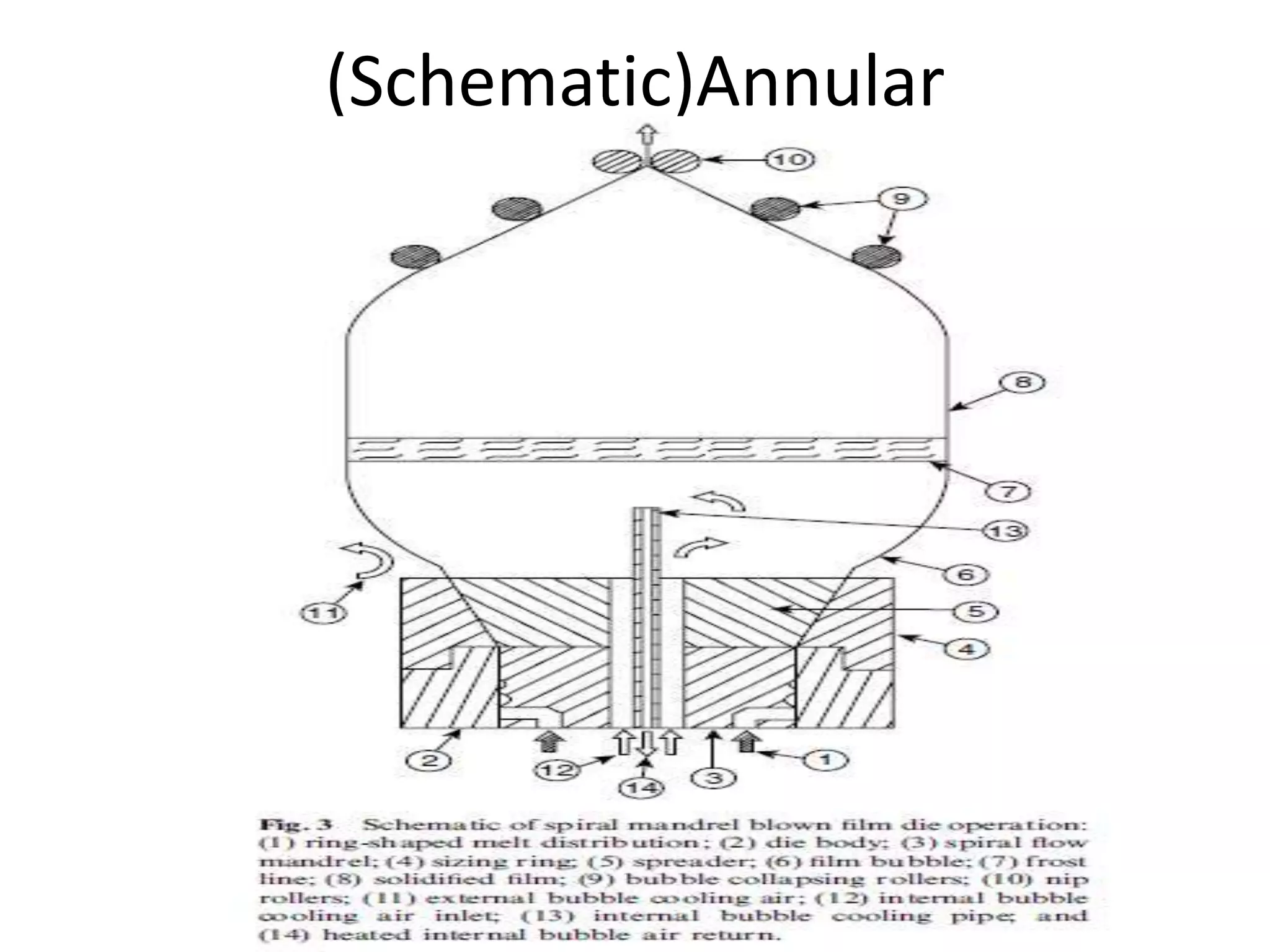
FLAT FILM AND BLOWN FILM DIES
• To make film less than 0.01 in.
• Include flat, slit-shaped dies called T-dies and
annular dies
• Limited to coating applications.
(Schematic) T-Shaped
(Schematic)Annular
PIPE AND TUBING DIES
• Both pipe and tubing are made in dies with an
annular die exit.
• A pipe product is defined as being greater
than 1 in. in outer diameter and a tube less
than 1 in. Dies
• Two styles:
1) In-line dies (also called spider dies) shown in
schematic 1.
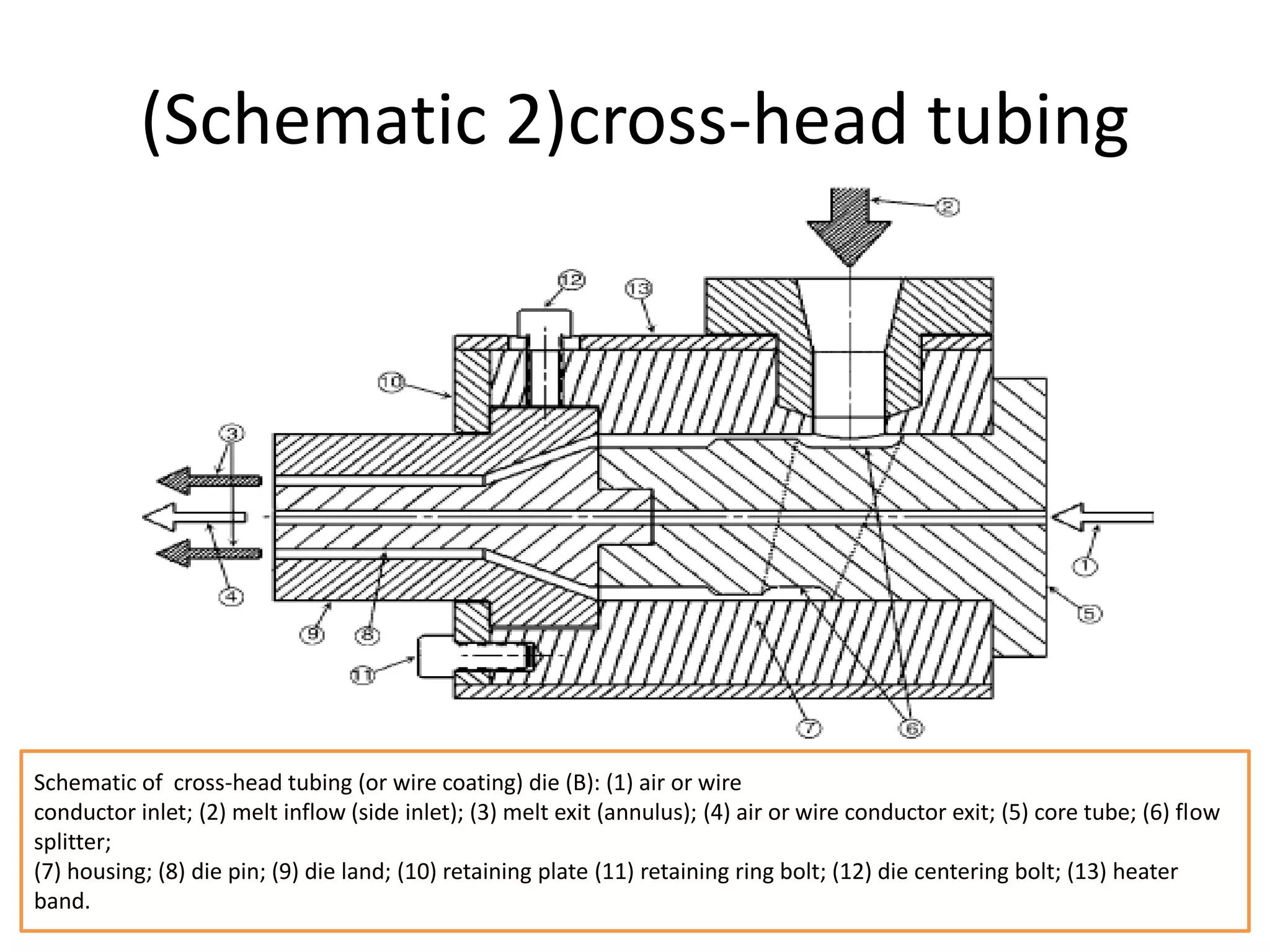
2) Cross-head dies shown in schematic 2.
(Schematic 1)Inline tubing die
Schematic of in-line tubing die (A): (1) housing; (2) mandrel (torpedo); (3) die pin (interchangeable); (4) die land
(interchangeable);
(5) retaining plate; (6) die centering bolt; (7) air hole; (8) mandrel support (spider leg); (9) die flange (mount to extruder
with split clamp); (10) heater band
Improvement in Spider Dies
• Inline dies inexpensive to manufacture but
cause the defect of weld lines.
• Weld lines occur because the melt split and
rejoin as it passes over spider legs.
• Cross-head die can overcome this problem by
eliminating the spiders. The melt enters the
side of the die and turns 90 as it flows through
a coat hanger-type passage.
(Schematic 2)cross-head tubing
Schematic of cross-head tubing (or wire coating) die (B): (1) air or wire
conductor inlet; (2) melt inflow (side inlet); (3) melt exit (annulus); (4) air or wire conductor exit; (5) core tube; (6) flow
splitter;
(7) housing; (8) die pin; (9) die land; (10) retaining plate (11) retaining ring bolt; (12) die centering bolt; (13) heater
band.
PROFILE EXTRUSION DIES
• Profile extrudates are significantly affected by
nonuniform die swell unlike sheet and tube
products.
• In the case of profiles with corners and other
irregularities, like a square profile, the die exit
needed to achieve a square profile is not
square owing to the influence of die swell.
Schematic
Stack
Plate Die
Benefits
• Better-quality products due to more uniform
cooling and shrinkage: straighter products.
• Less material use by removing thick,
unnecessary regions: savings of material costs.
• Faster cooling rates due to less hot plastic to
cool: higher production rates.
U-Profile stack die: exploded view
(1) extruder mounting plate; (2) die adapter plate; (3) transition plate; (4) preland plate; (5)
die land plate; (6) die bolt hole; (7) alignment dowel pin hole; (8) thermocouple well;
COEXTRUSION DIES
• Creation of multilayered materials.
• Making more economical material by
sandwiching a less costly core material
between two more expensive materials.
• Creating a composite material with improved
properties.
Schematic
(1) sheet die with flow restriction; (2) adapter plate; (3) feed block assembly; (4) core
material layer inlet; (5) upper material layer inlet; (6) lower material layer inlet;
Reference
M. M. Kostic and L. G. Reifschneider, “Design of
Extrusion Dies,” pp. 633–649, 2006.

Types of extrusion dies

  • 1.
  • 2.
    Design Basis forExtrusion Dies Designing of extrusion dies basically depends on two melt properties. • Melts exhibit shear thinning behavior. • Melts exhibit viscoelastic behavior, which influences the ‘‘die swell’’ on exiting the die.
  • 3.
    Classification Dies needed tomake several unique products are classified as 1) Sheet dies. 2) Flat-film and blown-film dies. 3) Pipe and tubing dies. 4) Profile extrusion dies. 5) Co-extrusion dies.
  • 4.
  • 5.
    Sheet Extrusion dies •The most common extrusion die for sheet products is the coat hanger-type manifold die.
  • 6.
  • 7.
    FLAT FILM ANDBLOWN FILM DIES • To make film less than 0.01 in. • Include flat, slit-shaped dies called T-dies and annular dies • Limited to coating applications.
  • 8.
  • 9.
  • 10.
    PIPE AND TUBINGDIES • Both pipe and tubing are made in dies with an annular die exit. • A pipe product is defined as being greater than 1 in. in outer diameter and a tube less than 1 in. Dies • Two styles: 1) In-line dies (also called spider dies) shown in schematic 1. 2) Cross-head dies shown in schematic 2.
  • 11.
    (Schematic 1)Inline tubingdie Schematic of in-line tubing die (A): (1) housing; (2) mandrel (torpedo); (3) die pin (interchangeable); (4) die land (interchangeable); (5) retaining plate; (6) die centering bolt; (7) air hole; (8) mandrel support (spider leg); (9) die flange (mount to extruder with split clamp); (10) heater band
  • 12.
    Improvement in SpiderDies • Inline dies inexpensive to manufacture but cause the defect of weld lines. • Weld lines occur because the melt split and rejoin as it passes over spider legs. • Cross-head die can overcome this problem by eliminating the spiders. The melt enters the side of the die and turns 90 as it flows through a coat hanger-type passage.
  • 13.
    (Schematic 2)cross-head tubing Schematicof cross-head tubing (or wire coating) die (B): (1) air or wire conductor inlet; (2) melt inflow (side inlet); (3) melt exit (annulus); (4) air or wire conductor exit; (5) core tube; (6) flow splitter; (7) housing; (8) die pin; (9) die land; (10) retaining plate (11) retaining ring bolt; (12) die centering bolt; (13) heater band.
  • 14.
    PROFILE EXTRUSION DIES •Profile extrudates are significantly affected by nonuniform die swell unlike sheet and tube products. • In the case of profiles with corners and other irregularities, like a square profile, the die exit needed to achieve a square profile is not square owing to the influence of die swell.
  • 15.
  • 16.
    Stack Plate Die Benefits • Better-qualityproducts due to more uniform cooling and shrinkage: straighter products. • Less material use by removing thick, unnecessary regions: savings of material costs. • Faster cooling rates due to less hot plastic to cool: higher production rates.
  • 17.
    U-Profile stack die:exploded view (1) extruder mounting plate; (2) die adapter plate; (3) transition plate; (4) preland plate; (5) die land plate; (6) die bolt hole; (7) alignment dowel pin hole; (8) thermocouple well;
  • 18.
    COEXTRUSION DIES • Creationof multilayered materials. • Making more economical material by sandwiching a less costly core material between two more expensive materials. • Creating a composite material with improved properties.
  • 19.
    Schematic (1) sheet diewith flow restriction; (2) adapter plate; (3) feed block assembly; (4) core material layer inlet; (5) upper material layer inlet; (6) lower material layer inlet;
  • 20.
    Reference M. M. Kosticand L. G. Reifschneider, “Design of Extrusion Dies,” pp. 633–649, 2006.