Chapter 1 
The Structure of Metals 
Manufacturing, Engineering & Technology, Fifth Edition, by Serope Kalpakjian and Steven R. Schmid. 
ISBN 0-13-148965-8. © 2006 Pearson Education, Inc., Upper Saddle River, NJ. All rights reserved.
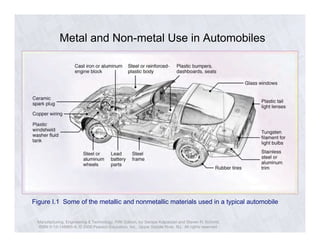
Metal and Non-metal Use in Automobiles 
Figure I.1 Some of the metallic and nonmetallic materials used in a typical automobile 
Manufacturing, Engineering & Technology, Fifth Edition, by Serope Kalpakjian and Steven R. Schmid. 
ISBN 0-13-148965-8. © 2006 Pearson Education, Inc., Upper Saddle River, NJ. All rights reserved.
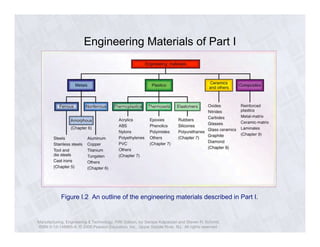
Engineering Materials of Part I 
Figure I.2 An outline of the engineering materials described in Part I. 
Manufacturing, Engineering & Technology, Fifth Edition, by Serope Kalpakjian and Steven R. Schmid. 
ISBN 0-13-148965-8. © 2006 Pearson Education, Inc., Upper Saddle River, NJ. All rights reserved.
Behavior and Manufacturing Properties of Part I 
Figure I.3 An outline of the behavior and the manufacturing properties of 
materials described in Part I. 
Manufacturing, Engineering & Technology, Fifth Edition, by Serope Kalpakjian and Steven R. Schmid. 
ISBN 0-13-148965-8. © 2006 Pearson Education, Inc., Upper Saddle River, NJ. All rights reserved.
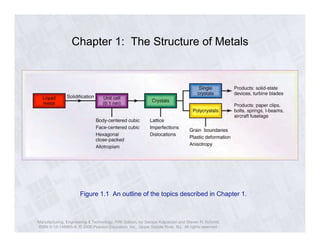
Chapter 1: The Structure of Metals 
Figure 1.1 An outline of the topics described in Chapter 1. 
Manufacturing, Engineering & Technology, Fifth Edition, by Serope Kalpakjian and Steven R. Schmid. 
ISBN 0-13-148965-8. © 2006 Pearson Education, Inc., Upper Saddle River, NJ. All rights reserved.
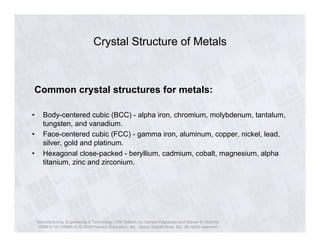
Crystal Structure of Metals 
Common crystal structures for metals: 
• Body-centered cubic (BCC) - alpha iron, chromium, molybdenum, tantalum, 
tungsten, and vanadium. 
• Face-centered cubic (FCC) - gamma iron, aluminum, copper, nickel, lead, 
silver, gold and platinum. 
• Hexagonal close-packed - beryllium, cadmium, cobalt, magnesium, alpha 
titanium, zinc and zirconium. 
Manufacturing, Engineering & Technology, Fifth Edition, by Serope Kalpakjian and Steven R. Schmid. 
ISBN 0-13-148965-8. © 2006 Pearson Education, Inc., Upper Saddle River, NJ. All rights reserved.
Body-centered Cubic Crystal Structure 
Figure 1.2 The body-centered cubic (bcc) crystal structure: (a) hard-ball model; 
(b) unit cell; and (c) single crystal with many unit cells 
Manufacturing, Engineering & Technology, Fifth Edition, by Serope Kalpakjian and Steven R. Schmid. 
ISBN 0-13-148965-8. © 2006 Pearson Education, Inc., Upper Saddle River, NJ. All rights reserved.
Face-centered Cubic Crystal Structure 
Figure 1.3 The face-centered cubic (fcc) crystal structure: (a) hard-ball 
model; (b) unit cell; and (c) single crystal with many unit cells 
Manufacturing, Engineering & Technology, Fifth Edition, by Serope Kalpakjian and Steven R. Schmid. 
ISBN 0-13-148965-8. © 2006 Pearson Education, Inc., Upper Saddle River, NJ. All rights reserved.
Hexagonal Close-packed Crystal Structure 
Figure 1.4 The hexagonal close-packed (hcp) crystal structure: 
(a) unit cell; and (b) single crystal with many unit cells. 
Manufacturing, Engineering & Technology, Fifth Edition, by Serope Kalpakjian and Steven R. Schmid. 
ISBN 0-13-148965-8. © 2006 Pearson Education, Inc., Upper Saddle River, NJ. All rights reserved.
Permanent Deformation 
Figure 1.5 Permanent deformation (also called plastic deformation) of a 
single crystal subjected to a shear stress: (a) structure before 
deformation; and (b) permanent deformation by slip. The b/a ratio 
influences the magnitude of the shear stress required to cause slip. 
Manufacturing, Engineering & Technology, Fifth Edition, by Serope Kalpakjian and Steven R. Schmid. 
ISBN 0-13-148965-8. © 2006 Pearson Education, Inc., Upper Saddle River, NJ. All rights reserved.
Permanent Deformation and Twinning in Crystal 
Figure 1.6 (a) Permanent 
deformation of a single crystal under 
a tensile load. Note that the slip 
planes tend to align themselves in 
the direction of the pulling force. 
This behavior can be simulated 
using a deck of cards with a rubber 
band around them. (b) Twinning in 
a single crystal in tension. 
Manufacturing, Engineering & Technology, Fifth Edition, by Serope Kalpakjian and Steven R. Schmid. 
ISBN 0-13-148965-8. © 2006 Pearson Education, Inc., Upper Saddle River, NJ. All rights reserved.
Slip Lines and Slip Bands in Crystal 
Figure 1.7 Schematic illustration of 
slip lines and slip bands in a single 
crystal (grain) subjected to a shear 
stress. A slip band consists of a 
number of slip planes. The crystal at 
the center of the upper illustration is 
an individual grain surrounded by 
several other grains 
Manufacturing, Engineering & Technology, Fifth Edition, by Serope Kalpakjian and Steven R. Schmid. 
ISBN 0-13-148965-8. © 2006 Pearson Education, Inc., Upper Saddle River, NJ. All rights reserved.
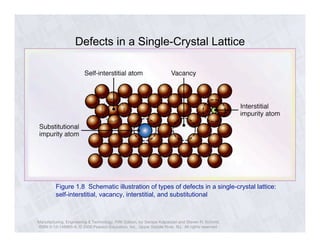
Defects in a Single-Crystal Lattice 
Figure 1.8 Schematic illustration of types of defects in a single-crystal lattice: 
self-interstitial, vacancy, interstitial, and substitutional 
Manufacturing, Engineering & Technology, Fifth Edition, by Serope Kalpakjian and Steven R. Schmid. 
ISBN 0-13-148965-8. © 2006 Pearson Education, Inc., Upper Saddle River, NJ. All rights reserved.
Dislocations in Crystals 
Figure 1.9 Types of dislocations in a single crystal: 
(a) edge dislocation; and (b) screw dislocation 
Manufacturing, Engineering & Technology, Fifth Edition, by Serope Kalpakjian and Steven R. Schmid. 
ISBN 0-13-148965-8. © 2006 Pearson Education, Inc., Upper Saddle River, NJ. All rights reserved.
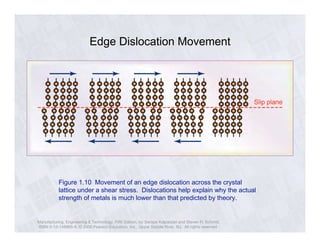
Edge Dislocation Movement 
Figure 1.10 Movement of an edge dislocation across the crystal 
lattice under a shear stress. Dislocations help explain why the actual 
strength of metals is much lower than that predicted by theory. 
Manufacturing, Engineering & Technology, Fifth Edition, by Serope Kalpakjian and Steven R. Schmid. 
ISBN 0-13-148965-8. © 2006 Pearson Education, Inc., Upper Saddle River, NJ. All rights reserved.
Solidification of Molten Metal 
Figure 1.11 Schematic illustration of the stages during solidification of molten 
metal; each small square represents a unit cell. (a) Nucleation of crystals at 
random sites in the molten metal; note that the crystallographic orientation of 
each site is different. (b) and (c) Growth of crystals as solidification continues. 
(d) Solidified metal, showing individual grains and grain boundaries; note the 
different angles at which neighboring grains meet each other. 
Manufacturing, Engineering & Technology, Fifth Edition, by Serope Kalpakjian and Steven R. Schmid. 
ISBN 0-13-148965-8. © 2006 Pearson Education, Inc., Upper Saddle River, NJ. All rights reserved.
Grain Sizes 
ASTM Grain Size: 
N = 2n-1 
where 
N = Grains per square 
inch at 100x 
magnification 
n = ASTM grain size 
number 
Manufacturing, Engineering & Technology, Fifth Edition, by Serope Kalpakjian and Steven R. Schmid. 
ISBN 0-13-148965-8. © 2006 Pearson Education, Inc., Upper Saddle River, NJ. All rights reserved.
Plastic Deformation of Idealized Grains 
Figure 1.12 Plastic deformation of idealized (equiaxed) grains in a specimen 
subjected to compression (such as occurs in the forging or rolling of metals): (a) 
before deformation; and (b) after deformation. Note the alignment of grain 
boundaries along a horizontal direction; this effect is known as preferred orientation. 
Manufacturing, Engineering & Technology, Fifth Edition, by Serope Kalpakjian and Steven R. Schmid. 
ISBN 0-13-148965-8. © 2006 Pearson Education, Inc., Upper Saddle River, NJ. All rights reserved.
Cracks in Sheet Metal 
Figure 1.13 (a) Schematic illustration of a crack in sheet metal that has 
been subjected to bulging (caused by, for example, pushing a steel ball 
against the sheet). Note the orientation of the crack with respect to the 
rolling direction of the sheet; this sheet is anisotropic. (b) Aluminum sheet 
with a crack (vertical dark line at the center) developed in a bulge test; the 
rolling direction of the sheet was vertical. Source: Courtesy of J.S. Kallend, 
Illinois Institute of Technology 
Manufacturing, Engineering & Technology, Fifth Edition, by Serope Kalpakjian and Steven R. Schmid. 
ISBN 0-13-148965-8. © 2006 Pearson Education, Inc., Upper Saddle River, NJ. All rights reserved.
Recovery, Recrystallization, and Grain Growth Effects 
Figure 1.14 Schematic illustration 
of the effects of recovery, 
recrystallization, and grain growth 
on mechanical properties and on 
the shape and size of grains. Note 
the formation of small new grains 
during recrystallization. 
Manufacturing, Engineering & Technology, Fifth Edition, by Serope Kalpakjian and Steven R. Schmid. 
ISBN 0-13-148965-8. © 2006 Pearson Education, Inc., Upper Saddle River, NJ. All rights reserved.
Temperature Ranges for Cold, Warm 
and Hot Working 
Manufacturing, Engineering & Technology, Fifth Edition, by Serope Kalpakjian and Steven R. Schmid. 
ISBN 0-13-148965-8. © 2006 Pearson Education, Inc., Upper Saddle River, NJ. All rights reserved.

Met ch1

  • 1.
    Chapter 1 TheStructure of Metals Manufacturing, Engineering & Technology, Fifth Edition, by Serope Kalpakjian and Steven R. Schmid. ISBN 0-13-148965-8. © 2006 Pearson Education, Inc., Upper Saddle River, NJ. All rights reserved.
  • 2.
    Metal and Non-metalUse in Automobiles Figure I.1 Some of the metallic and nonmetallic materials used in a typical automobile Manufacturing, Engineering & Technology, Fifth Edition, by Serope Kalpakjian and Steven R. Schmid. ISBN 0-13-148965-8. © 2006 Pearson Education, Inc., Upper Saddle River, NJ. All rights reserved.
  • 3.
    Engineering Materials ofPart I Figure I.2 An outline of the engineering materials described in Part I. Manufacturing, Engineering & Technology, Fifth Edition, by Serope Kalpakjian and Steven R. Schmid. ISBN 0-13-148965-8. © 2006 Pearson Education, Inc., Upper Saddle River, NJ. All rights reserved.
  • 4.
    Behavior and ManufacturingProperties of Part I Figure I.3 An outline of the behavior and the manufacturing properties of materials described in Part I. Manufacturing, Engineering & Technology, Fifth Edition, by Serope Kalpakjian and Steven R. Schmid. ISBN 0-13-148965-8. © 2006 Pearson Education, Inc., Upper Saddle River, NJ. All rights reserved.
  • 5.
    Chapter 1: TheStructure of Metals Figure 1.1 An outline of the topics described in Chapter 1. Manufacturing, Engineering & Technology, Fifth Edition, by Serope Kalpakjian and Steven R. Schmid. ISBN 0-13-148965-8. © 2006 Pearson Education, Inc., Upper Saddle River, NJ. All rights reserved.
  • 6.
    Crystal Structure ofMetals Common crystal structures for metals: • Body-centered cubic (BCC) - alpha iron, chromium, molybdenum, tantalum, tungsten, and vanadium. • Face-centered cubic (FCC) - gamma iron, aluminum, copper, nickel, lead, silver, gold and platinum. • Hexagonal close-packed - beryllium, cadmium, cobalt, magnesium, alpha titanium, zinc and zirconium. Manufacturing, Engineering & Technology, Fifth Edition, by Serope Kalpakjian and Steven R. Schmid. ISBN 0-13-148965-8. © 2006 Pearson Education, Inc., Upper Saddle River, NJ. All rights reserved.
  • 7.
    Body-centered Cubic CrystalStructure Figure 1.2 The body-centered cubic (bcc) crystal structure: (a) hard-ball model; (b) unit cell; and (c) single crystal with many unit cells Manufacturing, Engineering & Technology, Fifth Edition, by Serope Kalpakjian and Steven R. Schmid. ISBN 0-13-148965-8. © 2006 Pearson Education, Inc., Upper Saddle River, NJ. All rights reserved.
  • 8.
    Face-centered Cubic CrystalStructure Figure 1.3 The face-centered cubic (fcc) crystal structure: (a) hard-ball model; (b) unit cell; and (c) single crystal with many unit cells Manufacturing, Engineering & Technology, Fifth Edition, by Serope Kalpakjian and Steven R. Schmid. ISBN 0-13-148965-8. © 2006 Pearson Education, Inc., Upper Saddle River, NJ. All rights reserved.
  • 9.
    Hexagonal Close-packed CrystalStructure Figure 1.4 The hexagonal close-packed (hcp) crystal structure: (a) unit cell; and (b) single crystal with many unit cells. Manufacturing, Engineering & Technology, Fifth Edition, by Serope Kalpakjian and Steven R. Schmid. ISBN 0-13-148965-8. © 2006 Pearson Education, Inc., Upper Saddle River, NJ. All rights reserved.
  • 10.
    Permanent Deformation Figure1.5 Permanent deformation (also called plastic deformation) of a single crystal subjected to a shear stress: (a) structure before deformation; and (b) permanent deformation by slip. The b/a ratio influences the magnitude of the shear stress required to cause slip. Manufacturing, Engineering & Technology, Fifth Edition, by Serope Kalpakjian and Steven R. Schmid. ISBN 0-13-148965-8. © 2006 Pearson Education, Inc., Upper Saddle River, NJ. All rights reserved.
  • 11.
    Permanent Deformation andTwinning in Crystal Figure 1.6 (a) Permanent deformation of a single crystal under a tensile load. Note that the slip planes tend to align themselves in the direction of the pulling force. This behavior can be simulated using a deck of cards with a rubber band around them. (b) Twinning in a single crystal in tension. Manufacturing, Engineering & Technology, Fifth Edition, by Serope Kalpakjian and Steven R. Schmid. ISBN 0-13-148965-8. © 2006 Pearson Education, Inc., Upper Saddle River, NJ. All rights reserved.
  • 12.
    Slip Lines andSlip Bands in Crystal Figure 1.7 Schematic illustration of slip lines and slip bands in a single crystal (grain) subjected to a shear stress. A slip band consists of a number of slip planes. The crystal at the center of the upper illustration is an individual grain surrounded by several other grains Manufacturing, Engineering & Technology, Fifth Edition, by Serope Kalpakjian and Steven R. Schmid. ISBN 0-13-148965-8. © 2006 Pearson Education, Inc., Upper Saddle River, NJ. All rights reserved.
  • 13.
    Defects in aSingle-Crystal Lattice Figure 1.8 Schematic illustration of types of defects in a single-crystal lattice: self-interstitial, vacancy, interstitial, and substitutional Manufacturing, Engineering & Technology, Fifth Edition, by Serope Kalpakjian and Steven R. Schmid. ISBN 0-13-148965-8. © 2006 Pearson Education, Inc., Upper Saddle River, NJ. All rights reserved.
  • 14.
    Dislocations in Crystals Figure 1.9 Types of dislocations in a single crystal: (a) edge dislocation; and (b) screw dislocation Manufacturing, Engineering & Technology, Fifth Edition, by Serope Kalpakjian and Steven R. Schmid. ISBN 0-13-148965-8. © 2006 Pearson Education, Inc., Upper Saddle River, NJ. All rights reserved.
  • 15.
    Edge Dislocation Movement Figure 1.10 Movement of an edge dislocation across the crystal lattice under a shear stress. Dislocations help explain why the actual strength of metals is much lower than that predicted by theory. Manufacturing, Engineering & Technology, Fifth Edition, by Serope Kalpakjian and Steven R. Schmid. ISBN 0-13-148965-8. © 2006 Pearson Education, Inc., Upper Saddle River, NJ. All rights reserved.
  • 16.
    Solidification of MoltenMetal Figure 1.11 Schematic illustration of the stages during solidification of molten metal; each small square represents a unit cell. (a) Nucleation of crystals at random sites in the molten metal; note that the crystallographic orientation of each site is different. (b) and (c) Growth of crystals as solidification continues. (d) Solidified metal, showing individual grains and grain boundaries; note the different angles at which neighboring grains meet each other. Manufacturing, Engineering & Technology, Fifth Edition, by Serope Kalpakjian and Steven R. Schmid. ISBN 0-13-148965-8. © 2006 Pearson Education, Inc., Upper Saddle River, NJ. All rights reserved.
  • 17.
    Grain Sizes ASTMGrain Size: N = 2n-1 where N = Grains per square inch at 100x magnification n = ASTM grain size number Manufacturing, Engineering & Technology, Fifth Edition, by Serope Kalpakjian and Steven R. Schmid. ISBN 0-13-148965-8. © 2006 Pearson Education, Inc., Upper Saddle River, NJ. All rights reserved.
  • 18.
    Plastic Deformation ofIdealized Grains Figure 1.12 Plastic deformation of idealized (equiaxed) grains in a specimen subjected to compression (such as occurs in the forging or rolling of metals): (a) before deformation; and (b) after deformation. Note the alignment of grain boundaries along a horizontal direction; this effect is known as preferred orientation. Manufacturing, Engineering & Technology, Fifth Edition, by Serope Kalpakjian and Steven R. Schmid. ISBN 0-13-148965-8. © 2006 Pearson Education, Inc., Upper Saddle River, NJ. All rights reserved.
  • 19.
    Cracks in SheetMetal Figure 1.13 (a) Schematic illustration of a crack in sheet metal that has been subjected to bulging (caused by, for example, pushing a steel ball against the sheet). Note the orientation of the crack with respect to the rolling direction of the sheet; this sheet is anisotropic. (b) Aluminum sheet with a crack (vertical dark line at the center) developed in a bulge test; the rolling direction of the sheet was vertical. Source: Courtesy of J.S. Kallend, Illinois Institute of Technology Manufacturing, Engineering & Technology, Fifth Edition, by Serope Kalpakjian and Steven R. Schmid. ISBN 0-13-148965-8. © 2006 Pearson Education, Inc., Upper Saddle River, NJ. All rights reserved.
  • 20.
    Recovery, Recrystallization, andGrain Growth Effects Figure 1.14 Schematic illustration of the effects of recovery, recrystallization, and grain growth on mechanical properties and on the shape and size of grains. Note the formation of small new grains during recrystallization. Manufacturing, Engineering & Technology, Fifth Edition, by Serope Kalpakjian and Steven R. Schmid. ISBN 0-13-148965-8. © 2006 Pearson Education, Inc., Upper Saddle River, NJ. All rights reserved.
  • 21.
    Temperature Ranges forCold, Warm and Hot Working Manufacturing, Engineering & Technology, Fifth Edition, by Serope Kalpakjian and Steven R. Schmid. ISBN 0-13-148965-8. © 2006 Pearson Education, Inc., Upper Saddle River, NJ. All rights reserved.