Metal
FORMING
AND SHAPING
PROCESSES
©2010 John Wiley & Sons, Inc. M P Groover,
Fundamentals of Modern Manufacturing 4/e
Metal Forming
Large group of manufacturing processes in
which plastic deformation is used to change
the shape of metal workpieces

The tool, usually called a die, applies
stresses that exceed the yield strength of the
metal

The metal takes a shape determined by the
geometry of the die
©2010 John Wiley & Sons, Inc. M P Groover,
Fundamentals of Modern Manufacturing 4/e
Stresses in Metal Forming

Stresses to plastically deform the metal are
usually compressive

Examples: rolling, forging, extrusion

However, some forming processes

Stretch the metal (tensile stresses)

Others bend the metal (tensile and compressive)

Still others apply shear stresses
©2010 John Wiley & Sons, Inc. M P Groover,
Fundamentals of Modern Manufacturing 4/e
Essential Material Properties

Desirable material properties:

Low yield strength

High ductility

These properties are affected by
temperature:

Ductility increases and yield strength decreases
when work temperature is raised

Other factors:

Strain rate and friction
©2010 John Wiley & Sons, Inc. M P Groover,
Fundamentals of Modern Manufacturing 4/e
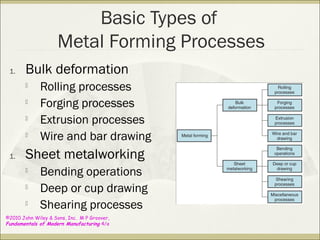
Basic Types of
Metal Forming Processes
1. Bulk deformation

Rolling processes

Forging processes

Extrusion processes

Wire and bar drawing
1. Sheet metalworking

Bending operations

Deep or cup drawing

Shearing processes
©2010 John Wiley & Sons, Inc. M P Groover,
Fundamentals of Modern Manufacturing 4/e
Bulk Deformation Processes

Characterized by significant deformations
and massive shape changes

"Bulk" refers to workparts with relatively low
surface area to volume ratios‑ ‑

Starting work shapes are usually simple
geometries

Examples:

Cylindrical billets

Rectangular bars
©2010 John Wiley & Sons, Inc. M P Groover,
Fundamentals of Modern Manufacturing 4/e
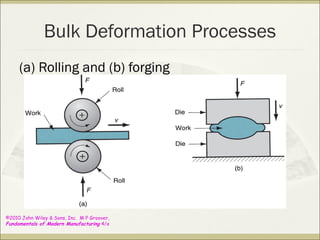
Bulk Deformation Processes
(a) Rolling and (b) forging
©2010 John Wiley & Sons, Inc. M P Groover,
Fundamentals of Modern Manufacturing 4/e
Considerations in
Choosing a Lubricant

Type of forming process (rolling, forging,
sheet metal drawing, etc.)

Hot working or cold working

Work material

Chemical reactivity with tool and work
metals

Ease of application

Cost
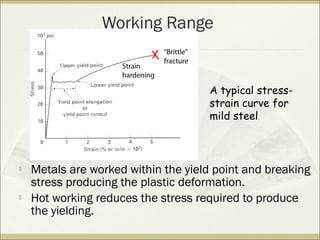
 Metals are worked within the yield point and breaking
stress producing the plastic deformation.
 Hot working reduces the stress required to produce
the yielding.
Working Range
A typical stress-
strain curve for
mild steel
CLASSIFICATION ON
TEMPERATURE BASIS
HOT WORKING
COLD WORKING
Forming of metals at a temperature above the re-
crystallization temperature. Shape is obtained
by virtue of their ability to flow plastically in
the solid-state without accompanying
deterioration of properties.
Advantages and Limitations

Porosity in metal is largely eliminated.

Impurities in the form of inclusions are
broken up and distributed thought the metal.

Coarse grains are refined; Physical
properties improved.
HOT WORKING
HOT WORKING
Energy required to change shape is less
Good Machinability and weldability
No residual stresses developed
 Ready to use products
Rapid oxidation and scaling of the
surface lead to poor surface finish and
loss of metal
 Loss of carbon from steel surface-
decarburization
Weakening of surface lead to fatigue
cracks
Close Tolerance cannot be obtained
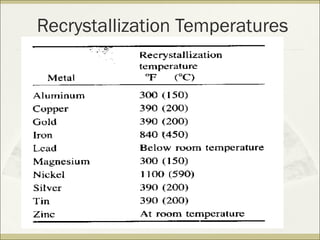
Recrystallization Temperatures
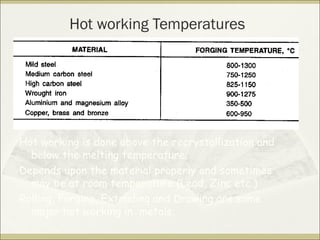
Hot working Temperatures
Hot working is done above the recrystallization and
below the melting temperature.
Depends upon the material properly and sometimes
may be at room temperature (Lead, Zinc etc.)
Rolling, Forging, Extruding and Drawing are some
major hot working in metals.
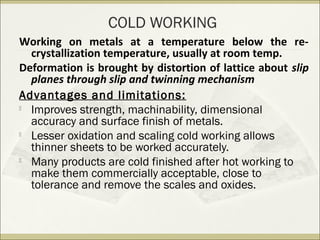
Working on metals at a temperature below the re-
crystallization temperature, usually at room temp.
Deformation is brought by distortion of lattice about slip
planes through slip and twinning mechanism
Advantages and limitations:

Improves strength, machinability, dimensional
accuracy and surface finish of metals.

Lesser oxidation and scaling cold working allows
thinner sheets to be worked accurately.

Many products are cold finished after hot working to
make them commercially acceptable, close to
tolerance and remove the scales and oxides.
COLD WORKING

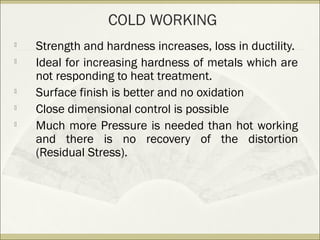
Strength and hardness increases, loss in ductility.

Ideal for increasing hardness of metals which are
not responding to heat treatment.

Surface finish is better and no oxidation

Close dimensional control is possible

Much more Pressure is needed than hot working
and there is no recovery of the distortion
(Residual Stress).
COLD WORKING
COLD WORKING

Distortion and fragmentation of grain structure is
created.

Only applicable to ductile material

Stresses are setup in metals that remains unless
removed by subsequent heat treatment

It results in loss of uniformity of metal
composition and effect metal properties

Impact strength and elongation are reduced

Bending, Drawing, Spinning, Forming, Embossing,
cold extrusion ,cold rolling and seaming are
major cold working operations
ROLLİNG
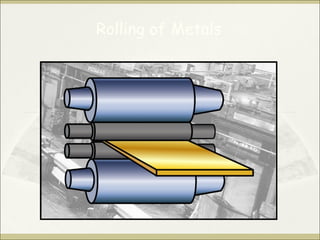
Rolling of Metals
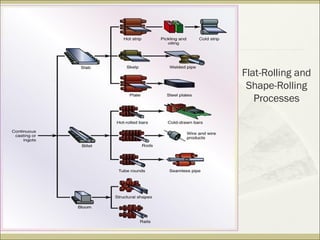
Flat-Rolling and
Shape-Rolling
Processes
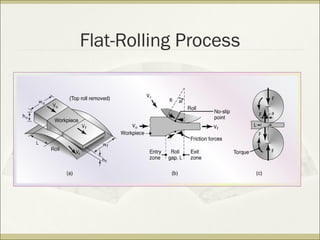
Flat-Rolling Process
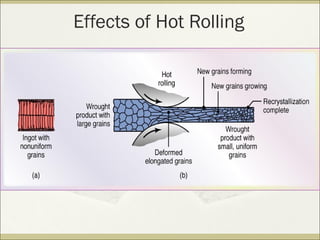
Effects of Hot Rolling

It is the process of reducing the thickess or
changing the cross-section of a long workpiece by
compressive forces applied through a set of rolls

90 % of Metals used are rolled sheets

The metal moves through the rolling mill by a
friction process. The metal is pushed or drawn
through the rolling mill
ROLLING PROCESS
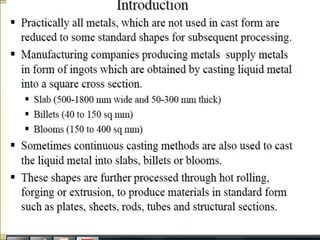
Rolling Process : Introduction

Rolling is the most extensively used metal
forming process and its share is roughly
90%

The material to be rolled is drawn by
means of friction into the two revolving
roll gap

The compressive forces applied by the
rolls reduce the thickness of the material
or changes its cross sectional area

Rolling Process : Introduction

The geometry of the product depend on the
contour of the roll gap

Roll materials are cast iron, cast steel and
forged steel because of high strength and wear
resistance requirements

Hot rolls are generally rough so that they can
bite the work, and cold rolls are ground and
polished for good finish
Rolling Process : Introduction

In rolling the crystals get elongated in the rolling direction. In
cold rolling crystal more or less retain the elongated shape
but in hot rolling they start reforming after coming out from
the deformation zone

The peripheral velocity of rolls at entry exceeds that of the
strip, which is dragged in if the interface friction is high
enough.

In the deformation zone the thickness of the strip gets
reduced and it elongates. This increases the linear speed of
the at the exit.

Thus there exist a neutral point where roll speed and strip
speeds are equal. At this point the direction of the friction
reverses.
Rolling Process : Introduction

When the angle of contact α exceeds the
friction angle λ the rolls cannot draw fresh
strip

Roll torque, power etc. increase with
increase in roll work contact length or roll
radius
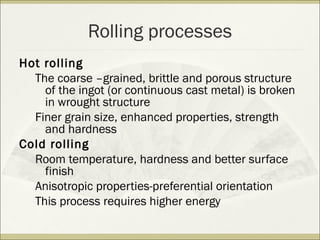
Hot rolling
The coarse –grained, brittle and porous structure
of the ingot (or continuous cast metal) is broken
in wrought structure
Finer grain size, enhanced properties, strength
and hardness
Cold rolling
Room temperature, hardness and better surface
finish
Anisotropic properties-preferential orientation
This process requires higher energy
Rolling processes
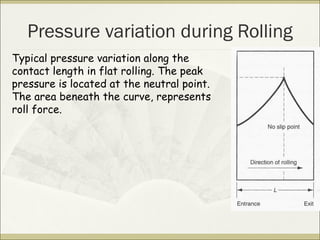
Pressure variation during Rolling
Typical pressure variation along the
contact length in flat rolling. The peak
pressure is located at the neutral point.
The area beneath the curve, represents
roll force.
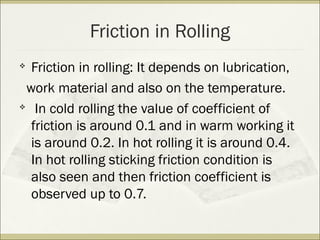
Friction in Rolling

Friction in rolling: It depends on lubrication,
work material and also on the temperature.

In cold rolling the value of coefficient of
friction is around 0.1 and in warm working it
is around 0.2. In hot rolling it is around 0.4.
In hot rolling sticking friction condition is
also seen and then friction coefficient is
observed up to 0.7.
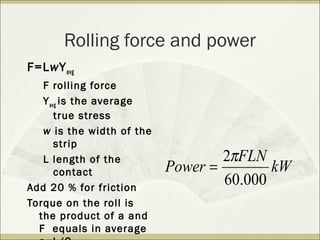
Rolling force and power
F=LwYavg
F rolling force
Yavg is the average
true stress
w is the width of the
strip
L length of the
contact
Add 20 % for friction
Torque on the roll is
the product of a and
F equals in average
kW
FLN
Power
000.60
2π
=

W width of the strip

Diameter of the contact roll

Metal structure

Temperature of the metal

Rolling speed

µ friction coefficient

Reduction in thickness

Thickness incoming sheet

Pull or push at the beginning or at the end
Parameters that affect
Rolling Force
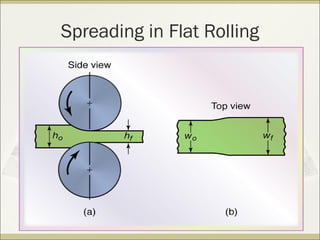
Spreading in Flat Rolling
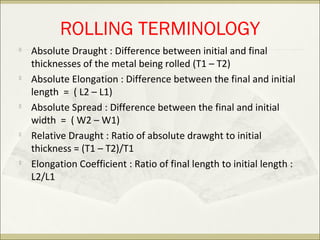
ROLLING TERMINOLOGY

Absolute Draught : Difference between initial and final
thicknesses of the metal being rolled (T1 – T2)

Absolute Elongation : Difference between the final and initial
length = ( L2 – L1)

Absolute Spread : Difference between the final and initial
width = ( W2 – W1)

Relative Draught : Ratio of absolute drawght to initial
thickness = (T1 – T2)/T1

Elongation Coefficient : Ratio of final length to initial length :
L2/L1
ROLLING TERMINOLOGY
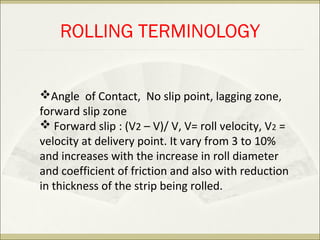
Angle of Contact, No slip point, lagging zone,
forward slip zone
 Forward slip : (V2 – V)/ V, V= roll velocity, V2 =
velocity at delivery point. It vary from 3 to 10%
and increases with the increase in roll diameter
and coefficient of friction and also with reduction
in thickness of the strip being rolled.
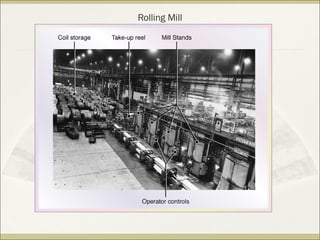
Rolling Mill
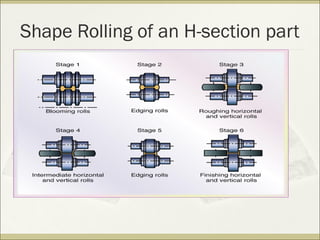
Shape Rolling of an H-section part
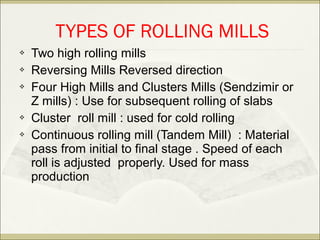
 Two high rolling mills
 Reversing Mills Reversed direction
 Four High Mills and Clusters Mills (Sendzimir or
Z mills) : Use for subsequent rolling of slabs
 Cluster roll mill : used for cold rolling
 Continuous rolling mill (Tandem Mill) : Material
pass from initial to final stage . Speed of each
roll is adjusted properly. Used for mass
production
TYPES OF ROLLING MILLS
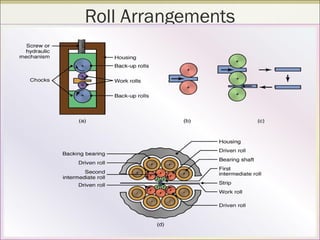
Roll Arrangements
To control the friction process lubricants have
to be used
Low friction has to be used to avoid damage of
the equipment
But friction is necessary
Lubrication during rolling
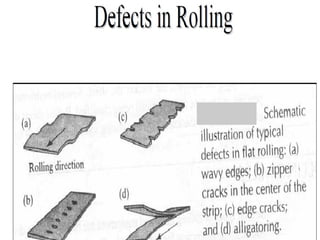
Defects

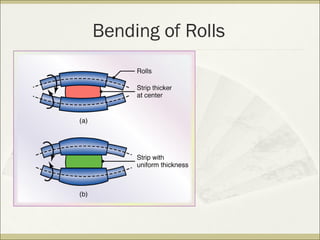
Wavy Edges : Due to roll bending, edge
elongate more than the centre

Spread : Due to high width to thickness
ratio, width of material remain constant.
With smaller ratio, width increases
considerable in the roll gap.

Crocodile crack : Due to weakness at the
center, sheet bifurcate into two parts.
Bending of Rolls
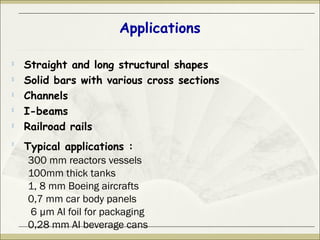
Applications

Straight and long structural shapes

Solid bars with various cross sections

Channels

I-beams

Railroad rails

Typical applications :
300 mm reactors vessels
100mm thick tanks
1, 8 mm Boeing aircrafts
0,7 mm car body panels
6 µm Al foil for packaging
0,28 mm Al beverage cans

Forming and rolling class 25 mar ppt

  • 1.
  • 2.
    ©2010 John Wiley& Sons, Inc. M P Groover, Fundamentals of Modern Manufacturing 4/e Metal Forming Large group of manufacturing processes in which plastic deformation is used to change the shape of metal workpieces  The tool, usually called a die, applies stresses that exceed the yield strength of the metal  The metal takes a shape determined by the geometry of the die
  • 3.
    ©2010 John Wiley& Sons, Inc. M P Groover, Fundamentals of Modern Manufacturing 4/e Stresses in Metal Forming  Stresses to plastically deform the metal are usually compressive  Examples: rolling, forging, extrusion  However, some forming processes  Stretch the metal (tensile stresses)  Others bend the metal (tensile and compressive)  Still others apply shear stresses
  • 4.
    ©2010 John Wiley& Sons, Inc. M P Groover, Fundamentals of Modern Manufacturing 4/e Essential Material Properties  Desirable material properties:  Low yield strength  High ductility  These properties are affected by temperature:  Ductility increases and yield strength decreases when work temperature is raised  Other factors:  Strain rate and friction
  • 5.
    ©2010 John Wiley& Sons, Inc. M P Groover, Fundamentals of Modern Manufacturing 4/e Basic Types of Metal Forming Processes 1. Bulk deformation  Rolling processes  Forging processes  Extrusion processes  Wire and bar drawing 1. Sheet metalworking  Bending operations  Deep or cup drawing  Shearing processes
  • 6.
    ©2010 John Wiley& Sons, Inc. M P Groover, Fundamentals of Modern Manufacturing 4/e Bulk Deformation Processes  Characterized by significant deformations and massive shape changes  "Bulk" refers to workparts with relatively low surface area to volume ratios‑ ‑  Starting work shapes are usually simple geometries  Examples:  Cylindrical billets  Rectangular bars
  • 7.
    ©2010 John Wiley& Sons, Inc. M P Groover, Fundamentals of Modern Manufacturing 4/e Bulk Deformation Processes (a) Rolling and (b) forging
  • 8.
    ©2010 John Wiley& Sons, Inc. M P Groover, Fundamentals of Modern Manufacturing 4/e Considerations in Choosing a Lubricant  Type of forming process (rolling, forging, sheet metal drawing, etc.)  Hot working or cold working  Work material  Chemical reactivity with tool and work metals  Ease of application  Cost
  • 9.
     Metals areworked within the yield point and breaking stress producing the plastic deformation.  Hot working reduces the stress required to produce the yielding. Working Range A typical stress- strain curve for mild steel
  • 10.
  • 11.
    Forming of metalsat a temperature above the re- crystallization temperature. Shape is obtained by virtue of their ability to flow plastically in the solid-state without accompanying deterioration of properties. Advantages and Limitations  Porosity in metal is largely eliminated.  Impurities in the form of inclusions are broken up and distributed thought the metal.  Coarse grains are refined; Physical properties improved. HOT WORKING
  • 12.
    HOT WORKING Energy requiredto change shape is less Good Machinability and weldability No residual stresses developed  Ready to use products Rapid oxidation and scaling of the surface lead to poor surface finish and loss of metal  Loss of carbon from steel surface- decarburization Weakening of surface lead to fatigue cracks Close Tolerance cannot be obtained
  • 13.
  • 14.
    Hot working Temperatures Hotworking is done above the recrystallization and below the melting temperature. Depends upon the material properly and sometimes may be at room temperature (Lead, Zinc etc.) Rolling, Forging, Extruding and Drawing are some major hot working in metals.
  • 15.
    Working on metalsat a temperature below the re- crystallization temperature, usually at room temp. Deformation is brought by distortion of lattice about slip planes through slip and twinning mechanism Advantages and limitations:  Improves strength, machinability, dimensional accuracy and surface finish of metals.  Lesser oxidation and scaling cold working allows thinner sheets to be worked accurately.  Many products are cold finished after hot working to make them commercially acceptable, close to tolerance and remove the scales and oxides. COLD WORKING
  • 16.
     Strength and hardnessincreases, loss in ductility.  Ideal for increasing hardness of metals which are not responding to heat treatment.  Surface finish is better and no oxidation  Close dimensional control is possible  Much more Pressure is needed than hot working and there is no recovery of the distortion (Residual Stress). COLD WORKING
  • 17.
    COLD WORKING  Distortion andfragmentation of grain structure is created.  Only applicable to ductile material  Stresses are setup in metals that remains unless removed by subsequent heat treatment  It results in loss of uniformity of metal composition and effect metal properties  Impact strength and elongation are reduced  Bending, Drawing, Spinning, Forming, Embossing, cold extrusion ,cold rolling and seaming are major cold working operations
  • 18.
  • 19.
  • 20.
  • 21.
  • 22.
  • 24.
     It is theprocess of reducing the thickess or changing the cross-section of a long workpiece by compressive forces applied through a set of rolls  90 % of Metals used are rolled sheets  The metal moves through the rolling mill by a friction process. The metal is pushed or drawn through the rolling mill ROLLING PROCESS
  • 25.
    Rolling Process :Introduction  Rolling is the most extensively used metal forming process and its share is roughly 90%  The material to be rolled is drawn by means of friction into the two revolving roll gap  The compressive forces applied by the rolls reduce the thickness of the material or changes its cross sectional area 
  • 26.
    Rolling Process :Introduction  The geometry of the product depend on the contour of the roll gap  Roll materials are cast iron, cast steel and forged steel because of high strength and wear resistance requirements  Hot rolls are generally rough so that they can bite the work, and cold rolls are ground and polished for good finish
  • 27.
    Rolling Process :Introduction  In rolling the crystals get elongated in the rolling direction. In cold rolling crystal more or less retain the elongated shape but in hot rolling they start reforming after coming out from the deformation zone  The peripheral velocity of rolls at entry exceeds that of the strip, which is dragged in if the interface friction is high enough.  In the deformation zone the thickness of the strip gets reduced and it elongates. This increases the linear speed of the at the exit.  Thus there exist a neutral point where roll speed and strip speeds are equal. At this point the direction of the friction reverses.
  • 28.
    Rolling Process :Introduction  When the angle of contact α exceeds the friction angle λ the rolls cannot draw fresh strip  Roll torque, power etc. increase with increase in roll work contact length or roll radius
  • 29.
    Hot rolling The coarse–grained, brittle and porous structure of the ingot (or continuous cast metal) is broken in wrought structure Finer grain size, enhanced properties, strength and hardness Cold rolling Room temperature, hardness and better surface finish Anisotropic properties-preferential orientation This process requires higher energy Rolling processes
  • 31.
    Pressure variation duringRolling Typical pressure variation along the contact length in flat rolling. The peak pressure is located at the neutral point. The area beneath the curve, represents roll force.
  • 32.
    Friction in Rolling  Frictionin rolling: It depends on lubrication, work material and also on the temperature.  In cold rolling the value of coefficient of friction is around 0.1 and in warm working it is around 0.2. In hot rolling it is around 0.4. In hot rolling sticking friction condition is also seen and then friction coefficient is observed up to 0.7.
  • 33.
    Rolling force andpower F=LwYavg F rolling force Yavg is the average true stress w is the width of the strip L length of the contact Add 20 % for friction Torque on the roll is the product of a and F equals in average kW FLN Power 000.60 2π =
  • 34.
     W width ofthe strip  Diameter of the contact roll  Metal structure  Temperature of the metal  Rolling speed  µ friction coefficient  Reduction in thickness  Thickness incoming sheet  Pull or push at the beginning or at the end Parameters that affect Rolling Force
  • 35.
  • 36.
    ROLLING TERMINOLOGY  Absolute Draught: Difference between initial and final thicknesses of the metal being rolled (T1 – T2)  Absolute Elongation : Difference between the final and initial length = ( L2 – L1)  Absolute Spread : Difference between the final and initial width = ( W2 – W1)  Relative Draught : Ratio of absolute drawght to initial thickness = (T1 – T2)/T1  Elongation Coefficient : Ratio of final length to initial length : L2/L1
  • 37.
    ROLLING TERMINOLOGY Angle ofContact, No slip point, lagging zone, forward slip zone  Forward slip : (V2 – V)/ V, V= roll velocity, V2 = velocity at delivery point. It vary from 3 to 10% and increases with the increase in roll diameter and coefficient of friction and also with reduction in thickness of the strip being rolled.
  • 38.
  • 39.
    Shape Rolling ofan H-section part
  • 43.
     Two highrolling mills  Reversing Mills Reversed direction  Four High Mills and Clusters Mills (Sendzimir or Z mills) : Use for subsequent rolling of slabs  Cluster roll mill : used for cold rolling  Continuous rolling mill (Tandem Mill) : Material pass from initial to final stage . Speed of each roll is adjusted properly. Used for mass production TYPES OF ROLLING MILLS
  • 44.
  • 45.
    To control thefriction process lubricants have to be used Low friction has to be used to avoid damage of the equipment But friction is necessary Lubrication during rolling
  • 48.
    Defects  Wavy Edges :Due to roll bending, edge elongate more than the centre  Spread : Due to high width to thickness ratio, width of material remain constant. With smaller ratio, width increases considerable in the roll gap.  Crocodile crack : Due to weakness at the center, sheet bifurcate into two parts.
  • 49.
  • 50.
    Applications  Straight and longstructural shapes  Solid bars with various cross sections  Channels  I-beams  Railroad rails  Typical applications : 300 mm reactors vessels 100mm thick tanks 1, 8 mm Boeing aircrafts 0,7 mm car body panels 6 µm Al foil for packaging 0,28 mm Al beverage cans