Reproductive System in Insects.
AEN 201 Fundamentals Of Entomology.
Course Mentor: Dr Pretheep Kumar
Expounded by:
Chandini S
2013-009-005
II B.Sc.(Sericulture)
&The reproductive organs of insects are similar in
structure and function to those of vertebrates.
&Both types of gametes are haploid and unicellular,
but eggs are usually much larger in volume than
sperm.
&Most insect species reproduce sexually by internal
fertilization.
Functions of the Reproductive
System:
Male:
&Production of sperm.
&Storage of sperm.
&Delivery of sperms to the
female.
Female:
&Production of eggs, including yolk
and chorion formation.
&Reception and storage of sperm
(may be for long times).
&Coordination of events that lead to
fertilization and oviposition.
Male Reproductive System:
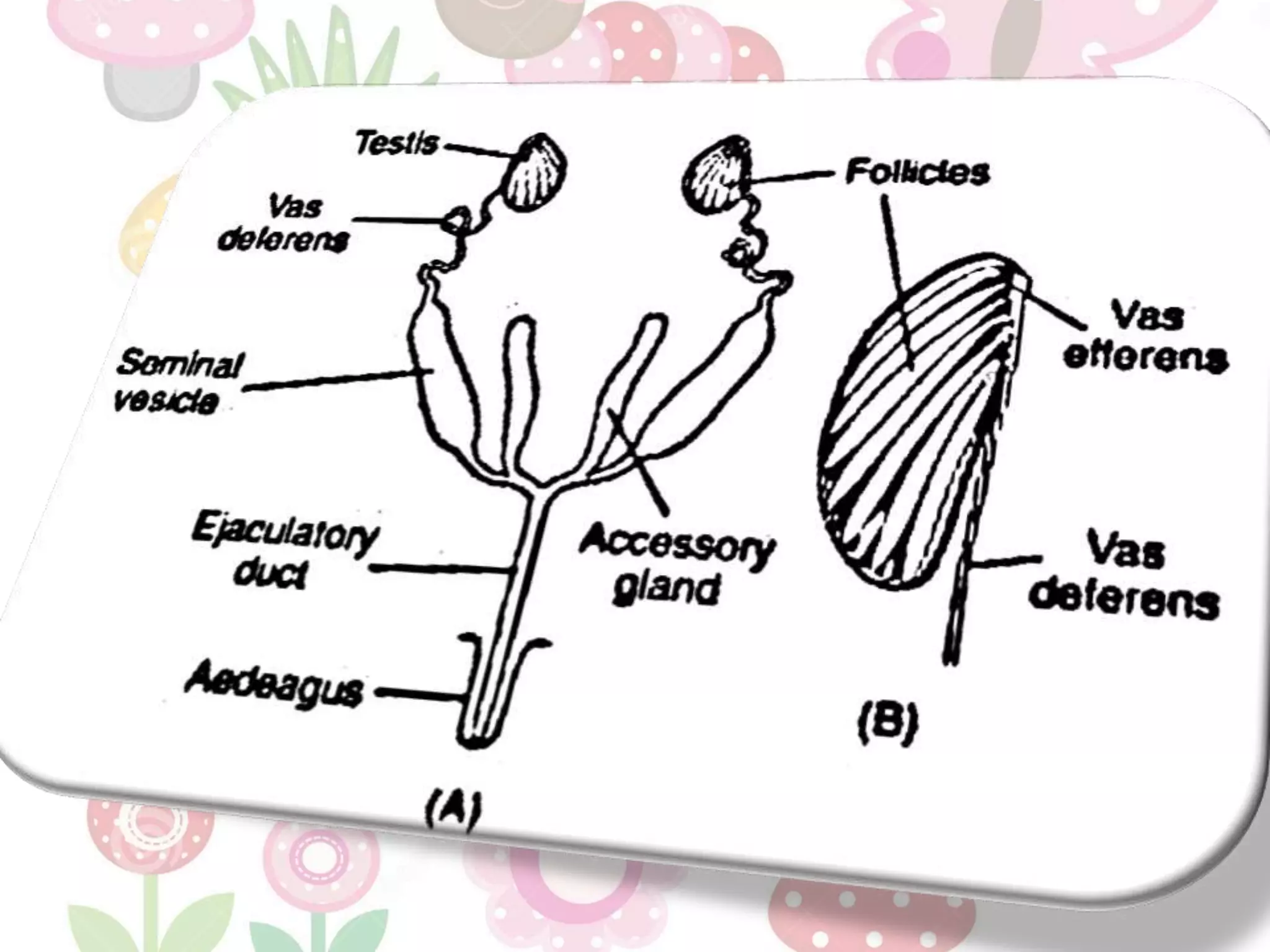
&Testes - Usually near the back of the abdomen.
&Each testes is subdivide into functional units - Follicles - sperm
is produced.
&At the distal end of each follicle-group of germ cells -
Spermatogonia.
&Spermatogonia - divide by mitosis - Increase in size to form
Spermatocytes.
&Spermatocytes - migrate toward the basal end of the follicle.
&Spermatocytes – undergo meiosis – yields 4 haploid spermatids.
&Spermatids – develop into mature spermatozoa.
&One or more pair of accessory glands – usually associated with
male’s reproductive system.
&2 major functions of accessory glands:
Manufacture of seminal fluid.
Production of spermatophores.
&Mature sperm pass out of the testes through short
ducts – Vasa efferentia.
&Collected in storage chambers – Seminal vesicles.
&Similar ducts – Vasa deferentia – from the seminal
vesicles – join together near the body mid line –
form a single Ejaculatory duct – leads out of the
body through copulatory organ – Aedeagus.
Female Reproductive System:
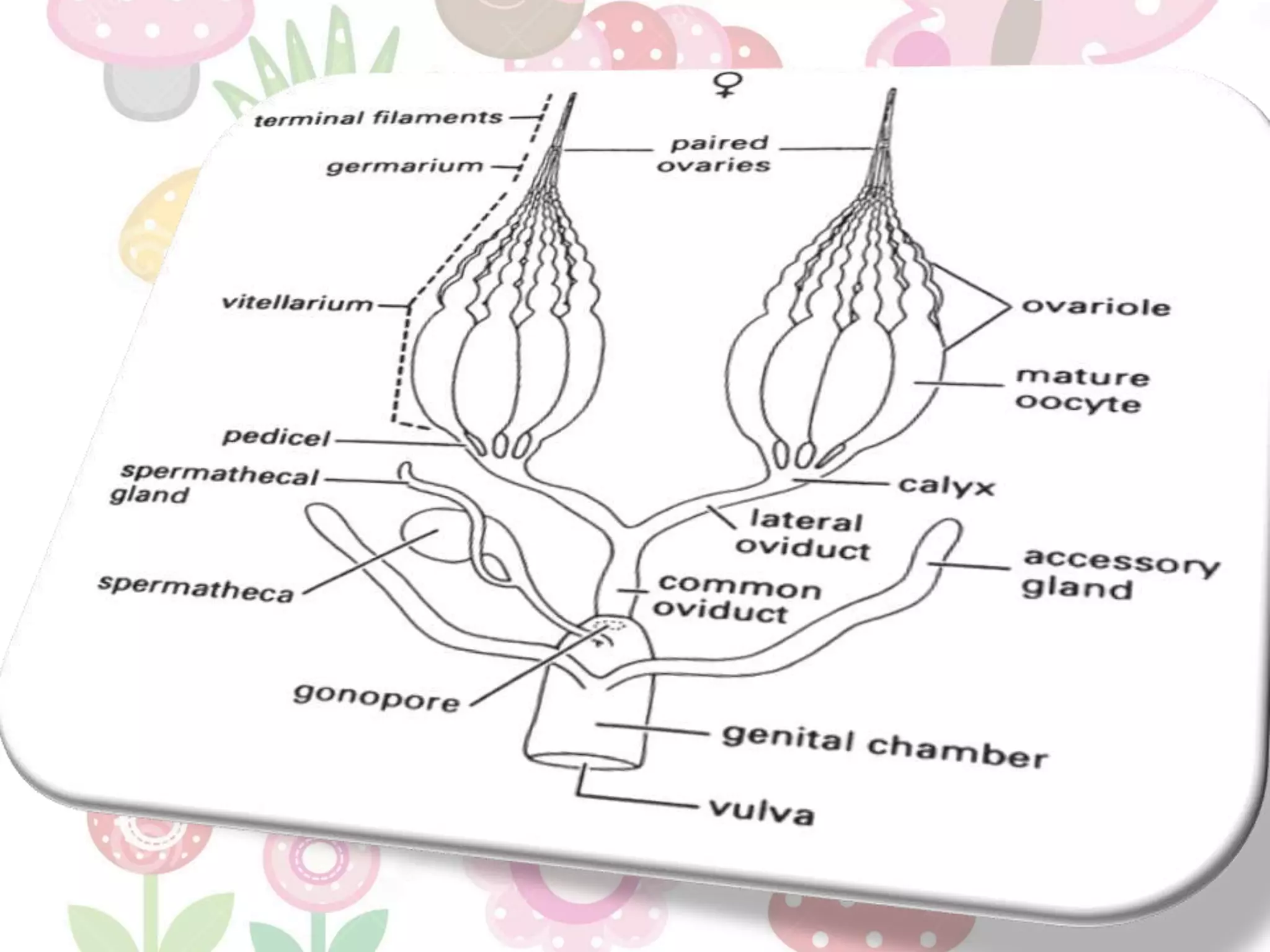
&A pair of ovaries.
&Each ovary - subdivided into functional units – Ovarioles –
Eggs are produced.
&Near the distal end of each ovariole – group of germ cells –
Oogonia – divide by Mitosis.
&Oogonia – increase in size to form Oocytes.
&Each oocyte – undergoes Meiosis – yields 4 cells – 1 egg and 3
polar bodies.
&Polar bodies may disintegrate or they may accompany the egg as nurse
cells.
&Developing eggs move down the ovariole – grow in size by absorbing
yolk.
&Mature eggs leave the ovaries through short Lateral Oviducts.
&Near the body midline – lateral oviducts join to form a common oviduct
– opens into a genital chamber – Bursa Copultrix.
&Female accessory glands – supply lubricants for the reproductive system
and screte a protein-rich egg shell – Chorion.
&Accessory glands – usually connected by small ducts to the common
oviduct – Bursa Copultrix.
Processes:
&Copulation – The male deposits its spermatophore in the bursa
copultrix.
&Peristaltic contractions force the spermatophore into the female’s
spermatheca.
&Spermathecal gland – Produces enzymes and nutrients.
&Ovulation – Each egg passes across the opening to the
spermatheca – stimulates release of a few sperm onto the egg’s
surface.
&Fertilization – Occurs as soon as one sperm’s
nucleus fuses with the egg cell’s nucleus.
&Oviposition – Egg laying – usually follows closely
after fertilization.
&After the completion of all the processes – the egg
is ready to begin embryonic development.
Oviparity:
&Egg laid shortly after
fertilization.
&No retention
&No nutrients to embryo
after fertilization.
&Eggs retained.
&Embryo fed by mother.
&Immature may
complete development
before deposition.
Viviparity:
Types of Reproduction:
& Paedogenesis – Reproduction by larval insects.
& Parthenogenesis – Developments without fertilization –
Unfertilized eggs produce – Males, Female, Or Both.
& Polyembryony .
Mating:
& Females of some species – essentially Monogamous – mate only
once.
& Most female insects – Polygamous - mate several to many times.
CITATION:
“The Reproductive System of Insects”
Dr Arwa Elaagip,
Department of Parasitology and Medical
Entomology,
University of Kartoum.
Thankieyeww

Reproductive System in Insects

  • 1.
    Reproductive System inInsects. AEN 201 Fundamentals Of Entomology. Course Mentor: Dr Pretheep Kumar Expounded by: Chandini S 2013-009-005 II B.Sc.(Sericulture)
  • 2.
    &The reproductive organsof insects are similar in structure and function to those of vertebrates. &Both types of gametes are haploid and unicellular, but eggs are usually much larger in volume than sperm. &Most insect species reproduce sexually by internal fertilization.
  • 3.
    Functions of theReproductive System: Male: &Production of sperm. &Storage of sperm. &Delivery of sperms to the female. Female: &Production of eggs, including yolk and chorion formation. &Reception and storage of sperm (may be for long times). &Coordination of events that lead to fertilization and oviposition.
  • 4.
    Male Reproductive System: &Testes- Usually near the back of the abdomen. &Each testes is subdivide into functional units - Follicles - sperm is produced. &At the distal end of each follicle-group of germ cells - Spermatogonia. &Spermatogonia - divide by mitosis - Increase in size to form Spermatocytes.
  • 5.
    &Spermatocytes - migratetoward the basal end of the follicle. &Spermatocytes – undergo meiosis – yields 4 haploid spermatids. &Spermatids – develop into mature spermatozoa. &One or more pair of accessory glands – usually associated with male’s reproductive system. &2 major functions of accessory glands: Manufacture of seminal fluid. Production of spermatophores.
  • 6.
    &Mature sperm passout of the testes through short ducts – Vasa efferentia. &Collected in storage chambers – Seminal vesicles. &Similar ducts – Vasa deferentia – from the seminal vesicles – join together near the body mid line – form a single Ejaculatory duct – leads out of the body through copulatory organ – Aedeagus.
  • 8.
    Female Reproductive System: &Apair of ovaries. &Each ovary - subdivided into functional units – Ovarioles – Eggs are produced. &Near the distal end of each ovariole – group of germ cells – Oogonia – divide by Mitosis. &Oogonia – increase in size to form Oocytes. &Each oocyte – undergoes Meiosis – yields 4 cells – 1 egg and 3 polar bodies.
  • 9.
    &Polar bodies maydisintegrate or they may accompany the egg as nurse cells. &Developing eggs move down the ovariole – grow in size by absorbing yolk. &Mature eggs leave the ovaries through short Lateral Oviducts. &Near the body midline – lateral oviducts join to form a common oviduct – opens into a genital chamber – Bursa Copultrix. &Female accessory glands – supply lubricants for the reproductive system and screte a protein-rich egg shell – Chorion. &Accessory glands – usually connected by small ducts to the common oviduct – Bursa Copultrix.
  • 11.
    Processes: &Copulation – Themale deposits its spermatophore in the bursa copultrix. &Peristaltic contractions force the spermatophore into the female’s spermatheca. &Spermathecal gland – Produces enzymes and nutrients. &Ovulation – Each egg passes across the opening to the spermatheca – stimulates release of a few sperm onto the egg’s surface.
  • 12.
    &Fertilization – Occursas soon as one sperm’s nucleus fuses with the egg cell’s nucleus. &Oviposition – Egg laying – usually follows closely after fertilization. &After the completion of all the processes – the egg is ready to begin embryonic development.
  • 13.
    Oviparity: &Egg laid shortlyafter fertilization. &No retention &No nutrients to embryo after fertilization. &Eggs retained. &Embryo fed by mother. &Immature may complete development before deposition. Viviparity:
  • 14.
    Types of Reproduction: &Paedogenesis – Reproduction by larval insects. & Parthenogenesis – Developments without fertilization – Unfertilized eggs produce – Males, Female, Or Both. & Polyembryony . Mating: & Females of some species – essentially Monogamous – mate only once. & Most female insects – Polygamous - mate several to many times.
  • 15.
    CITATION: “The Reproductive Systemof Insects” Dr Arwa Elaagip, Department of Parasitology and Medical Entomology, University of Kartoum.
  • 16.

Editor's Notes

  • #5 Seminal fluid- a liquid medium that sustains and nourishes mature sperm while they are in the males’s genital system. Speramtophores- pouch like structures(mostly ptn) that encase the sperm and protect them as they are delivered to the female’s body during copulation.
  • #12 Enzymes for digesting the protein coat of the spermatophore. Nurtrients for sustaining the sperm while they are in storage. A sperm may live in spermatheca for weeks, months or even years!