Circulatory system of insets
Submitted by: Submitted to:
Manish Kumar Pal Mr. Rajendra Regmi
ENT-03M-2017 Assisstant professor of AFU
Department of Entomology
AFU, Rampur
10th Ashoj,2075
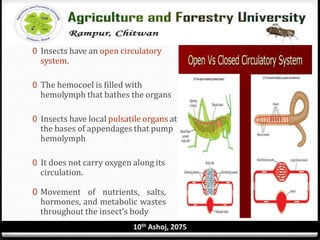
0 Insects have an open circulatory
system.
0 The hemocoel is filled with
hemolymph that bathes the organs
0 Insects have local pulsatile organs at
the bases of appendages that pump
hemolymph
0 It does not carry oxygen along its
circulation.
0 Movement of nutrients, salts,
hormones, and metabolic wastes
throughout the insect’s body
10th Ashoj, 2075
Insect Circulatory Organs
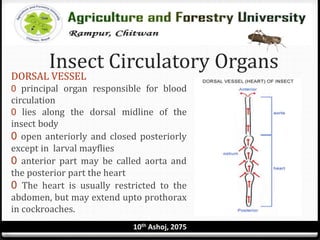
DORSAL VESSEL
0 principal organ responsible for blood
circulation
0 lies along the dorsal midline of the
insect body
0 open anteriorly and closed posteriorly
except in larval mayflies
0 anterior part may be called aorta and
the posterior part the heart
0 The heart is usually restricted to the
abdomen, but may extend upto prothorax
in cockroaches.
10th Ashoj, 2075
Insect Circulatory Organs
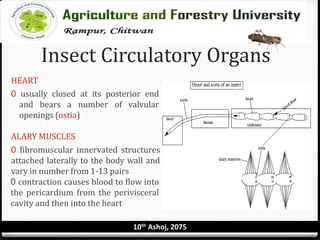
HEART
0 usually closed at its posterior end
and bears a number of valvular
openings (ostia)
ALARY MUSCLES
0 fibromuscular innervated structures
attached laterally to the body wall and
vary in number from 1-13 pairs
0 contraction causes blood to flow into
the pericardium from the perivisceral
cavity and then into the heart
10th Ashoj, 2075
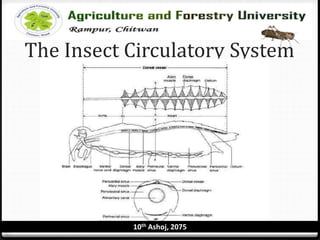
The Insect Circulatory System
10th Ashoj, 2075
Insect Circulatory Organs
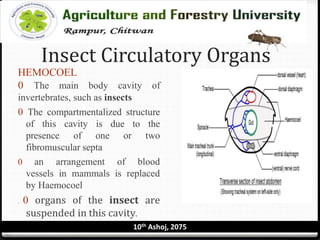
HEMOCOEL
0 The main body cavity of
invertebrates, such as insects
0 The compartmentalized structure
of this cavity is due to the
presence of one or two
fibromuscular septa
0 an arrangement of blood
vessels in mammals is replaced
by Haemocoel
. 0 organs of the insect are
suspended in this cavity.
10th Ashoj, 2075
Insect Circulatory Organs
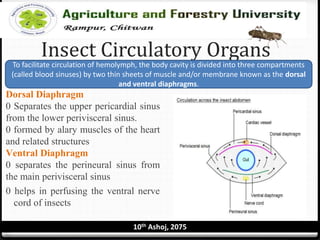
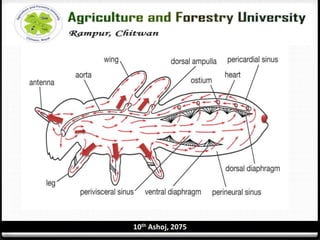
Dorsal Diaphragm
0 Separates the upper pericardial sinus
from the lower perivisceral sinus.
0 formed by alary muscles of the heart
and related structures
Ventral Diaphragm
0 separates the perineural sinus from
the main perivisceral sinus
0 helps in perfusing the ventral nerve
cord of insects
10th Ashoj, 2075
To facilitate circulation of hemolymph, the body cavity is divided into three compartments
(called blood sinuses) by two thin sheets of muscle and/or membrane known as the dorsal
and ventral diaphragms.
Insect Circulatory Organs
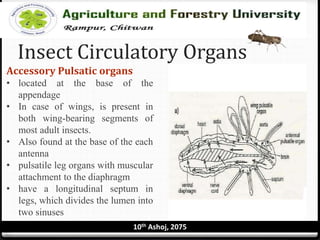
Accessory Pulsatic organs
• located at the base of the
appendage
• In case of wings, is present in
both wing-bearing segments of
most adult insects.
• Also found at the base of the each
antenna
• pulsatile leg organs with muscular
attachment to the diaphragm
• have a longitudinal septum in
legs, which divides the lumen into
two sinuses
10th Ashoj, 2075
Insect Circulatory Organs
HEMOLYMPH
0 Colorless liquid that bathes the insect tissues
0 Only about 10% are hemocytes and the rest of the
hemolymph content is watery plasma
0 analogous to the blood in vertebrates
0 circulates in the interior of the arthropod body remaining
in direct contact with the animal's tissues.
0 transfers nutrients from the insect gut to the organs, takes
away waste and also transmits hormones
10th Ashoj, 2075
Insect Circulatory Organs
HEMOLYMPH COMPOSITION:
0 90% Water
0 Inorganic ions
0 Nitrogenous wastes
0 Carbohydrates
0 Lipids
0 Proteins and enzymes
0 Pigments
0 Hormones
10th Ashoj, 2075
Insect Circulatory Organs
HEMOLYMPH FUNCTIONS:
0 Lubricant for tissues and internal organs
0 Hydraulic medium (caterpillars, wing expansion, etc.)
0 Transport medium for nutrients, wastes and hormones
0 Storage (amino acids, water, and glycerol)
0 Heat exchange
0 Immune response
10th Ashoj, 2075
Circulation
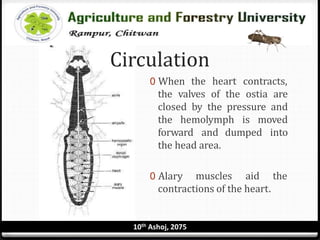
0 When the heart contracts,
the valves of the ostia are
closed by the pressure and
the hemolymph is moved
forward and dumped into
the head area.
0 Alary muscles aid the
contractions of the heart.
10th Ashoj, 2075
Circulation
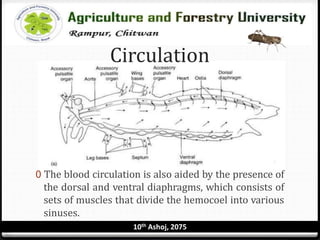
0 The blood circulation is also aided by the presence of
the dorsal and ventral diaphragms, which consists of
sets of muscles that divide the hemocoel into various
sinuses.
10th Ashoj, 2075
10th Ashoj, 2075
Overview
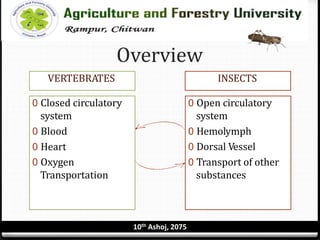
VERTEBRATES INSECTS
0 Closed circulatory
system
0 Blood
0 Heart
0 Oxygen
Transportation
0 Open circulatory
system
0 Hemolymph
0 Dorsal Vessel
0 Transport of other
substances
10th Ashoj, 2075
Circulatory system of insects

Circulatory system of insects

  • 1.
    Circulatory system ofinsets Submitted by: Submitted to: Manish Kumar Pal Mr. Rajendra Regmi ENT-03M-2017 Assisstant professor of AFU Department of Entomology AFU, Rampur 10th Ashoj,2075
  • 2.
    0 Insects havean open circulatory system. 0 The hemocoel is filled with hemolymph that bathes the organs 0 Insects have local pulsatile organs at the bases of appendages that pump hemolymph 0 It does not carry oxygen along its circulation. 0 Movement of nutrients, salts, hormones, and metabolic wastes throughout the insect’s body 10th Ashoj, 2075
  • 3.
    Insect Circulatory Organs DORSALVESSEL 0 principal organ responsible for blood circulation 0 lies along the dorsal midline of the insect body 0 open anteriorly and closed posteriorly except in larval mayflies 0 anterior part may be called aorta and the posterior part the heart 0 The heart is usually restricted to the abdomen, but may extend upto prothorax in cockroaches. 10th Ashoj, 2075
  • 4.
    Insect Circulatory Organs HEART 0usually closed at its posterior end and bears a number of valvular openings (ostia) ALARY MUSCLES 0 fibromuscular innervated structures attached laterally to the body wall and vary in number from 1-13 pairs 0 contraction causes blood to flow into the pericardium from the perivisceral cavity and then into the heart 10th Ashoj, 2075
  • 5.
    The Insect CirculatorySystem 10th Ashoj, 2075
  • 6.
    Insect Circulatory Organs HEMOCOEL 0The main body cavity of invertebrates, such as insects 0 The compartmentalized structure of this cavity is due to the presence of one or two fibromuscular septa 0 an arrangement of blood vessels in mammals is replaced by Haemocoel . 0 organs of the insect are suspended in this cavity. 10th Ashoj, 2075
  • 7.
    Insect Circulatory Organs DorsalDiaphragm 0 Separates the upper pericardial sinus from the lower perivisceral sinus. 0 formed by alary muscles of the heart and related structures Ventral Diaphragm 0 separates the perineural sinus from the main perivisceral sinus 0 helps in perfusing the ventral nerve cord of insects 10th Ashoj, 2075 To facilitate circulation of hemolymph, the body cavity is divided into three compartments (called blood sinuses) by two thin sheets of muscle and/or membrane known as the dorsal and ventral diaphragms.
  • 8.
    Insect Circulatory Organs AccessoryPulsatic organs • located at the base of the appendage • In case of wings, is present in both wing-bearing segments of most adult insects. • Also found at the base of the each antenna • pulsatile leg organs with muscular attachment to the diaphragm • have a longitudinal septum in legs, which divides the lumen into two sinuses 10th Ashoj, 2075
  • 9.
    Insect Circulatory Organs HEMOLYMPH 0Colorless liquid that bathes the insect tissues 0 Only about 10% are hemocytes and the rest of the hemolymph content is watery plasma 0 analogous to the blood in vertebrates 0 circulates in the interior of the arthropod body remaining in direct contact with the animal's tissues. 0 transfers nutrients from the insect gut to the organs, takes away waste and also transmits hormones 10th Ashoj, 2075
  • 10.
    Insect Circulatory Organs HEMOLYMPHCOMPOSITION: 0 90% Water 0 Inorganic ions 0 Nitrogenous wastes 0 Carbohydrates 0 Lipids 0 Proteins and enzymes 0 Pigments 0 Hormones 10th Ashoj, 2075
  • 11.
    Insect Circulatory Organs HEMOLYMPHFUNCTIONS: 0 Lubricant for tissues and internal organs 0 Hydraulic medium (caterpillars, wing expansion, etc.) 0 Transport medium for nutrients, wastes and hormones 0 Storage (amino acids, water, and glycerol) 0 Heat exchange 0 Immune response 10th Ashoj, 2075
  • 12.
    Circulation 0 When theheart contracts, the valves of the ostia are closed by the pressure and the hemolymph is moved forward and dumped into the head area. 0 Alary muscles aid the contractions of the heart. 10th Ashoj, 2075
  • 13.
    Circulation 0 The bloodcirculation is also aided by the presence of the dorsal and ventral diaphragms, which consists of sets of muscles that divide the hemocoel into various sinuses. 10th Ashoj, 2075
  • 14.
  • 15.
    Overview VERTEBRATES INSECTS 0 Closedcirculatory system 0 Blood 0 Heart 0 Oxygen Transportation 0 Open circulatory system 0 Hemolymph 0 Dorsal Vessel 0 Transport of other substances 10th Ashoj, 2075