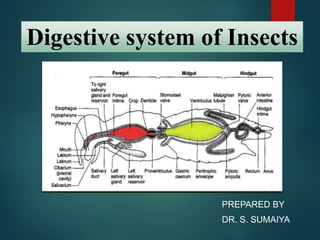
Digestive system of Insects
PREPARED BY
DR. S. SUMAIYA
Alimentary canal
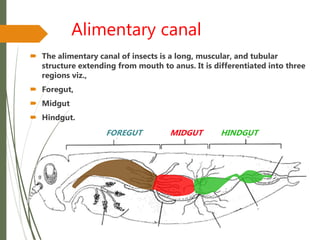
 The alimentary canal of insects is a long, muscular, and tubular
structure extending from mouth to anus. It is differentiated into three
regions viz.,
 Foregut,
 Midgut
 Hindgut.
FOREGUT MIDGUT HINDGUT
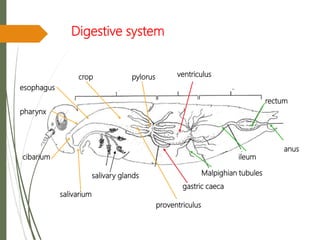
Digestive system
pharynx
esophagus
crop
Malpighian tubulessalivary glands
cibarium
salivarium
gastric caeca
proventriculus
pylorus
ileum
rectum
ventriculus
anus
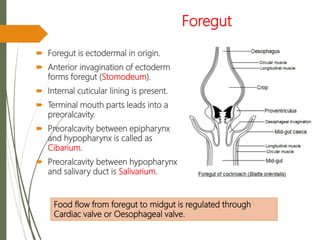
Foregut
 Foregut is ectodermal in origin.
 Anterior invagination of ectoderm
forms foregut (Stomodeum).
 Internal cuticular lining is present.
 Terminal mouth parts leads into a
preoralcavity.
 Preoralcavity between epipharynx
and hypopharynx is called as
Cibarium.
 Preoralcavity between hypopharynx
and salivary duct is Salivarium.
Food flow from foregut to midgut is regulated through
Cardiac valve or Oesophageal valve.
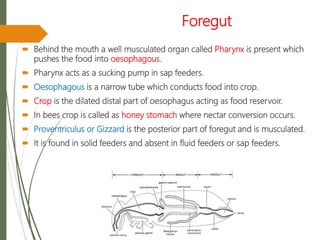
 Behind the mouth a well musculated organ called Pharynx is present which
pushes the food into oesophagous.
 Pharynx acts as a sucking pump in sap feeders.
 Oesophagous is a narrow tube which conducts food into crop.
 Crop is the dilated distal part of oesophagus acting as food reservoir.
 In bees crop is called as honey stomach where nectar conversion occurs.
 Proventriculus or Gizzard is the posterior part of foregut and is musculated.
 It is found in solid feeders and absent in fluid feeders or sap feeders.
Foregut
Midgut
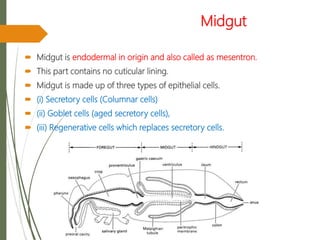
 Midgut is endodermal in origin and also called as mesentron.
 This part contains no cuticular lining.
 Midgut is made up of three types of epithelial cells.
 (i) Secretory cells (Columnar cells)
 (ii) Goblet cells (aged secretory cells),
 (iii) Regenerative cells which replaces secretory cells.
 (i) Peritrophic membrane
 It is the internal lining of midgut,
 secreted by anterior or entire layer of midgut epithelial cells.
 Present in solid feeders and absent in sap feeders.
 This layer is semi-permeable in nature to digestive juices and digestion
products.
 Its functions are
 (a) Lubricate and facilitate food movement
 (b) Envelops the food and protects the midgut epithelial cells against
harder food particles.
Midgut
Midgut
 (ii) Gastric caecae: (Enteric caecae or Hepatic caecae)
 Finger like outgrowths found in anterior or posterior ends of midgut.
 This structure increases the functional area of midgut and shelter
symbiotic bacteria in some insects.
Midgut
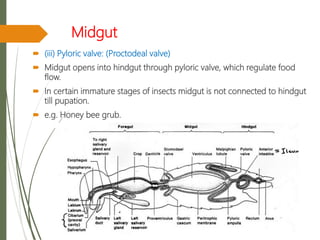
 (iii) Pyloric valve: (Proctodeal valve)
 Midgut opens into hindgut through pyloric valve, which regulate food
flow.
 In certain immature stages of insects midgut is not connected to hindgut
till pupation.
 e.g. Honey bee grub.
Midgut
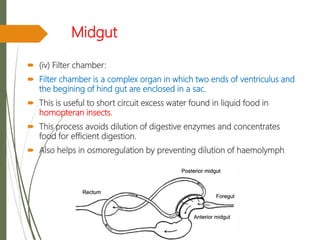
 (iv) Filter chamber:
 Filter chamber is a complex organ in which two ends of ventriculus and
the begining of hind gut are enclosed in a sac.
 This is useful to short circuit excess water found in liquid food in
homopteran insects.
 This process avoids dilution of digestive enzymes and concentrates
food for efficient digestion.
 Also helps in osmoregulation by preventing dilution of haemolymph
Hindgut
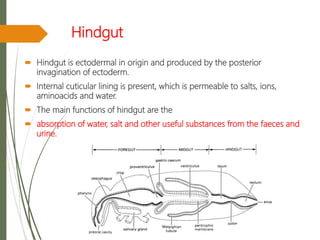
 Hindgut is ectodermal in origin and produced by the posterior
invagination of ectoderm.
 Internal cuticular lining is present, which is permeable to salts, ions,
aminoacids and water.
 The main functions of hindgut are the
 absorption of water, salt and other useful substances from the faeces and
urine.
Hindgut
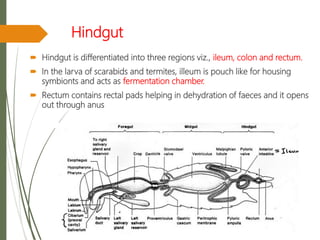
 Hindgut is differentiated into three regions viz., ileum, colon and rectum.
 In the larva of scarabids and termites, illeum is pouch like for housing
symbionts and acts as fermentation chamber.
 Rectum contains rectal pads helping in dehydration of faeces and it opens
out through anus

Insect digestive system

  • 1.
    Digestive system ofInsects PREPARED BY DR. S. SUMAIYA
  • 2.
    Alimentary canal  Thealimentary canal of insects is a long, muscular, and tubular structure extending from mouth to anus. It is differentiated into three regions viz.,  Foregut,  Midgut  Hindgut. FOREGUT MIDGUT HINDGUT
  • 3.
    Digestive system pharynx esophagus crop Malpighian tubulessalivaryglands cibarium salivarium gastric caeca proventriculus pylorus ileum rectum ventriculus anus
  • 4.
    Foregut  Foregut isectodermal in origin.  Anterior invagination of ectoderm forms foregut (Stomodeum).  Internal cuticular lining is present.  Terminal mouth parts leads into a preoralcavity.  Preoralcavity between epipharynx and hypopharynx is called as Cibarium.  Preoralcavity between hypopharynx and salivary duct is Salivarium. Food flow from foregut to midgut is regulated through Cardiac valve or Oesophageal valve.
  • 5.
     Behind themouth a well musculated organ called Pharynx is present which pushes the food into oesophagous.  Pharynx acts as a sucking pump in sap feeders.  Oesophagous is a narrow tube which conducts food into crop.  Crop is the dilated distal part of oesophagus acting as food reservoir.  In bees crop is called as honey stomach where nectar conversion occurs.  Proventriculus or Gizzard is the posterior part of foregut and is musculated.  It is found in solid feeders and absent in fluid feeders or sap feeders. Foregut
  • 6.
    Midgut  Midgut isendodermal in origin and also called as mesentron.  This part contains no cuticular lining.  Midgut is made up of three types of epithelial cells.  (i) Secretory cells (Columnar cells)  (ii) Goblet cells (aged secretory cells),  (iii) Regenerative cells which replaces secretory cells.
  • 7.
     (i) Peritrophicmembrane  It is the internal lining of midgut,  secreted by anterior or entire layer of midgut epithelial cells.  Present in solid feeders and absent in sap feeders.  This layer is semi-permeable in nature to digestive juices and digestion products.  Its functions are  (a) Lubricate and facilitate food movement  (b) Envelops the food and protects the midgut epithelial cells against harder food particles. Midgut
  • 8.
    Midgut  (ii) Gastriccaecae: (Enteric caecae or Hepatic caecae)  Finger like outgrowths found in anterior or posterior ends of midgut.  This structure increases the functional area of midgut and shelter symbiotic bacteria in some insects.
  • 9.
    Midgut  (iii) Pyloricvalve: (Proctodeal valve)  Midgut opens into hindgut through pyloric valve, which regulate food flow.  In certain immature stages of insects midgut is not connected to hindgut till pupation.  e.g. Honey bee grub.
  • 10.
    Midgut  (iv) Filterchamber:  Filter chamber is a complex organ in which two ends of ventriculus and the begining of hind gut are enclosed in a sac.  This is useful to short circuit excess water found in liquid food in homopteran insects.  This process avoids dilution of digestive enzymes and concentrates food for efficient digestion.  Also helps in osmoregulation by preventing dilution of haemolymph
  • 11.
    Hindgut  Hindgut isectodermal in origin and produced by the posterior invagination of ectoderm.  Internal cuticular lining is present, which is permeable to salts, ions, aminoacids and water.  The main functions of hindgut are the  absorption of water, salt and other useful substances from the faeces and urine.
  • 12.
    Hindgut  Hindgut isdifferentiated into three regions viz., ileum, colon and rectum.  In the larva of scarabids and termites, illeum is pouch like for housing symbionts and acts as fermentation chamber.  Rectum contains rectal pads helping in dehydration of faeces and it opens out through anus