INSECT CIRCULATORY SYSTEM
Circulatory system
There are two types of circulatory systems in the animal kingdom.
 In many animals , the blood travels through vessels like arteries, capillaries
and veins. This is known as closed type of circulatory system.
In insects the blood flows through the body cavity (i.e., heamocoel)
irrigating various tissues and organs. It is known as open type of circulatory
system.
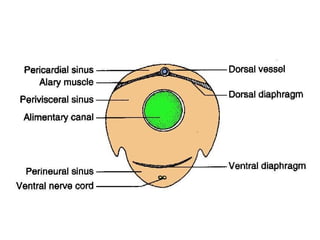
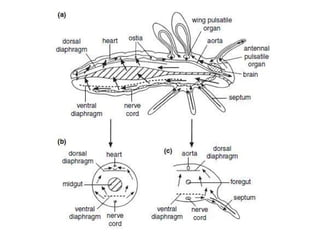
Haemocoel of the insects is divided into 3 sinuses (or) regions due to
the presence of two fibro muscular septa (or) diaphragms composed of
connective tissues
1)Dorsal or Pericardial Sinus: The area lying in between the tergum and
dorsal diaphragm . It contains heart.
2) Ventral or Perineural Sinus: The area lying in between the sternum
and ventral diaphragm. It contains nerve cord.
3)Visceral Sinus: The area in between dorsal and ventral diaphragms . It
harbour the visceral organs like alimentary canal and gonads.
Organs associated with blood circulation
Dorsal blood vessel
It is the main organ of circulation and consists of anterior aorta and
posterior heart.
The dorsal vessel is a simple tube closed at its posterior end and
bears a number of vulvular openings called as ostia ( prevents back flow
of haemolymph)
The number of ostia are
3 pairs –thorax
9 pairs -abdomen
Accessory pulsatile organs: Insects consists of sac like structures
called accessory pulsatile organs, which are present at the base of the
appendages such as wings, legs and antenna. They pulsate
independently and supply adequate blood to the appendages.
Composition of Haemolymph -contains a fluid portion called plasma and
cellular fractions called haemocytes.
1.Plasma: Plasma is an aqueous solution of inorganic ions, lipids, sugars
(mainly trehalose), amino acids, proteins, organic acids and other compounds.
 pH is usually acidic (6-7).
Density is 1.01 to 1.06.
Water content is 84-92 per cent.
Inorganic ions present are `Na' in predators and parasites, `Mg' and `K‘ in
phytophagous insects.
Blood lacks vitamin ‘K’
 Carbohydrate is in the form of trehalose sugar.
Major proteins are lipoproteins, glycoproteins and enzymes. Lipids in form
of fat particles or lipoproteins.
Glycerol is present which acts as a anti freezing compound.
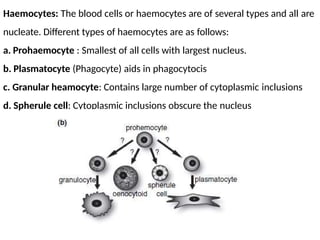
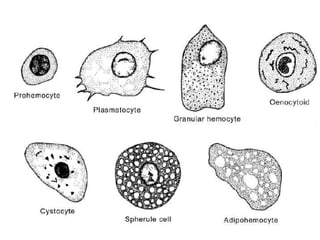
Haemocytes: The blood cells or haemocytes are of several types and all are
nucleate. Different types of haemocytes are as follows:
a. Prohaemocyte : Smallest of all cells with largest nucleus.
b. Plasmatocyte (Phagocyte) aids in phagocytocis
c. Granular heamocyte: Contains large number of cytoplasmic inclusions
d. Spherule cell: Cytoplasmic inclusions obscure the nucleus
e.Cystocyte(Coagulocyte): Role in blood coagulation and plasma
precipitation.
f. Oenocytoids: Large cells with ecentric nucleus
g. Adipo haemocytes: Round or avoid with distinct fat droplets
h.Podocyte: Large flattened cells with number of protoplasmic
projections.
i. Vermiform cells: Rare type, long thread like.
Process of blood circulation:
Heart mainly function as a pulsatile organ whose expansion and
contraction leads to blood circulation .
It takes place generally in an anti clock manner starting from
posterior end to the anterior end in a forward direction.
Circulation of blood takes place in two phases due to the action of the
alary muscles as well as the muscles of the walls of the heart.
The two phases are
1. Diastole: During which expansion of heart takes place.
2. Systole : Contraction of heart takes place.
1.Diastole: Expansion of heart ( diastole). It results in increase of volume
of heart and decrease in the area of pericardial sinus. This creates a pressure
on the blood in pericardial sinus forcing the blood to enter into the heart
through the incurrent ostia. These incurrent ostia allow only the entry of blood
from the sinus in to the heart and prevents its backflow from the heart to the
sinus.
2.Systole : Contraction of heart (systole). This creates pressure on the
blood within the heart leading to its forward movement in to the aorta. From
the aorta blood enters in to the head and flows back bathing the visceral
organs in the visceral sinus and neural cord in the perineural sinus.
In between diastole and systole there will be a short period of rest which is
known as diastasis.
Functions of haemolymph
1.Lubricant : Haemolymph keeps the internal cells moist and the
movement of internal organs is also made easy.
2. Hydraulic medium : Hydrostatic pressure developed due to
blood
pumping is useful in the following processes.
a) Ecdysis (moulting)
b) Wing expansion in adults
c) Ecolosion in diptera (adult emergence from the puparium
using ptilinum)
d) Eversion of penis in male insects
e) Eversion of osmeteria in papilionid larvae
f) Eversion of mask in naiad of dragonfly
3.Transport and storage : Digested nutrients, hormones and gases
(chironomid larva) were transported with the help of haemolymph. It
also removes the waste materials to the excretory organs. Water and
raw materials required for histogenesis is stored in haemolymph.
4.Protection: It helps in phagocytocis, encapsulation, detoxification,
coagulation, and wound healing. Non celluar component like lysozymes
also kill the invading bacteria.
5.Heat transfer: Haemolymph through its movement in the circulatory
system regulate the body heat (Thermoregulation).
6.Maintenance of osmotic pressure: Ions, amino acids and organic
acids present in the haemolymph helps in maintaining osmotic pressure
required for normal physiological functions.
Metabolic medium: Haemolymph serves as a medium for on going
metabolic reactions (trahalose is converted into glucose).

circulatorysystemininsects- .................................PPT.pptx

  • 1.
  • 2.
    Circulatory system There aretwo types of circulatory systems in the animal kingdom.  In many animals , the blood travels through vessels like arteries, capillaries and veins. This is known as closed type of circulatory system. In insects the blood flows through the body cavity (i.e., heamocoel) irrigating various tissues and organs. It is known as open type of circulatory system.
  • 3.
    Haemocoel of theinsects is divided into 3 sinuses (or) regions due to the presence of two fibro muscular septa (or) diaphragms composed of connective tissues 1)Dorsal or Pericardial Sinus: The area lying in between the tergum and dorsal diaphragm . It contains heart. 2) Ventral or Perineural Sinus: The area lying in between the sternum and ventral diaphragm. It contains nerve cord. 3)Visceral Sinus: The area in between dorsal and ventral diaphragms . It harbour the visceral organs like alimentary canal and gonads.
  • 6.
    Organs associated withblood circulation Dorsal blood vessel It is the main organ of circulation and consists of anterior aorta and posterior heart. The dorsal vessel is a simple tube closed at its posterior end and bears a number of vulvular openings called as ostia ( prevents back flow of haemolymph) The number of ostia are 3 pairs –thorax 9 pairs -abdomen
  • 8.
    Accessory pulsatile organs:Insects consists of sac like structures called accessory pulsatile organs, which are present at the base of the appendages such as wings, legs and antenna. They pulsate independently and supply adequate blood to the appendages.
  • 10.
    Composition of Haemolymph-contains a fluid portion called plasma and cellular fractions called haemocytes. 1.Plasma: Plasma is an aqueous solution of inorganic ions, lipids, sugars (mainly trehalose), amino acids, proteins, organic acids and other compounds.  pH is usually acidic (6-7). Density is 1.01 to 1.06. Water content is 84-92 per cent. Inorganic ions present are `Na' in predators and parasites, `Mg' and `K‘ in phytophagous insects. Blood lacks vitamin ‘K’  Carbohydrate is in the form of trehalose sugar. Major proteins are lipoproteins, glycoproteins and enzymes. Lipids in form of fat particles or lipoproteins. Glycerol is present which acts as a anti freezing compound.
  • 11.
    Haemocytes: The bloodcells or haemocytes are of several types and all are nucleate. Different types of haemocytes are as follows: a. Prohaemocyte : Smallest of all cells with largest nucleus. b. Plasmatocyte (Phagocyte) aids in phagocytocis c. Granular heamocyte: Contains large number of cytoplasmic inclusions d. Spherule cell: Cytoplasmic inclusions obscure the nucleus
  • 13.
    e.Cystocyte(Coagulocyte): Role inblood coagulation and plasma precipitation. f. Oenocytoids: Large cells with ecentric nucleus g. Adipo haemocytes: Round or avoid with distinct fat droplets h.Podocyte: Large flattened cells with number of protoplasmic projections. i. Vermiform cells: Rare type, long thread like.
  • 15.
    Process of bloodcirculation: Heart mainly function as a pulsatile organ whose expansion and contraction leads to blood circulation . It takes place generally in an anti clock manner starting from posterior end to the anterior end in a forward direction. Circulation of blood takes place in two phases due to the action of the alary muscles as well as the muscles of the walls of the heart. The two phases are 1. Diastole: During which expansion of heart takes place. 2. Systole : Contraction of heart takes place.
  • 16.
    1.Diastole: Expansion ofheart ( diastole). It results in increase of volume of heart and decrease in the area of pericardial sinus. This creates a pressure on the blood in pericardial sinus forcing the blood to enter into the heart through the incurrent ostia. These incurrent ostia allow only the entry of blood from the sinus in to the heart and prevents its backflow from the heart to the sinus. 2.Systole : Contraction of heart (systole). This creates pressure on the blood within the heart leading to its forward movement in to the aorta. From the aorta blood enters in to the head and flows back bathing the visceral organs in the visceral sinus and neural cord in the perineural sinus. In between diastole and systole there will be a short period of rest which is known as diastasis.
  • 17.
    Functions of haemolymph 1.Lubricant: Haemolymph keeps the internal cells moist and the movement of internal organs is also made easy. 2. Hydraulic medium : Hydrostatic pressure developed due to blood pumping is useful in the following processes. a) Ecdysis (moulting) b) Wing expansion in adults c) Ecolosion in diptera (adult emergence from the puparium using ptilinum) d) Eversion of penis in male insects e) Eversion of osmeteria in papilionid larvae f) Eversion of mask in naiad of dragonfly
  • 18.
    3.Transport and storage: Digested nutrients, hormones and gases (chironomid larva) were transported with the help of haemolymph. It also removes the waste materials to the excretory organs. Water and raw materials required for histogenesis is stored in haemolymph. 4.Protection: It helps in phagocytocis, encapsulation, detoxification, coagulation, and wound healing. Non celluar component like lysozymes also kill the invading bacteria. 5.Heat transfer: Haemolymph through its movement in the circulatory system regulate the body heat (Thermoregulation).
  • 19.
    6.Maintenance of osmoticpressure: Ions, amino acids and organic acids present in the haemolymph helps in maintaining osmotic pressure required for normal physiological functions. Metabolic medium: Haemolymph serves as a medium for on going metabolic reactions (trahalose is converted into glucose).