Internal Morphology
      Lecture 2
Circulatory Systems
• For larger or more active animals, some form
  of more efficient circulatory system is
  necessary for internal transport.


• Two types of circulatory system are found:
  Open Circulatory Systems
  Closed Circulatory Systems
Open Circulatory System
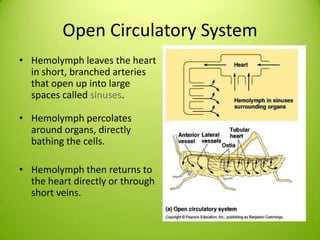
• Hemolymph leaves the heart
  in short, branched arteries
  that open up into large
  spaces called sinuses.

• Hemolymph percolates
  around organs, directly
  bathing the cells.

• Hemolymph then returns to
  the heart directly or through
  short veins.
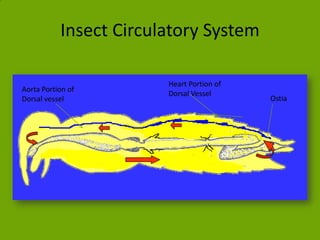
Insect Circulatory System

                        Heart Portion of
Aorta Portion of
                        Dorsal Vessel
Dorsal vessel                              Ostia
Insect circulatory system
• Only one vessel-------- dorsal vessel
• Posteriorly (Abdominal Region) it act as heart
  pumping blood forward to anterior parts
  (Head and Thorax)
• In head and thorax region dorsal vessel act as
  aorta which dump the blood into head region
• Blood return to the heart posteriorly via ostia
• Ostia is a small slits in the heart regions of
  dorsal vessel for hemolymph uptake
Open Circulatory System
• Advantage - Exchange of materials is direct
  between the hemolymph and tissues. There is
  no diffusion barrier.

• Disadvantage - Little fine control over
  distribution of the hemolymph to body
  regions. No mechanism for reducing flow to a
  specific part of an organ.
Composition of hemolymph
• Insect Blood Called Hemolymph
• Watery fluid, clear but sometime yellowish
  or greenish in colour
• Hemolymph= 90% plasma+10% hemocytes
• Lack hemoglobin unlike humans
• Oxygen is delivered by respiratory system
Why Circulatory system
• Responsible for movements of
  nutrients, salts, hormones and metabolic wastes
• Insects defense system
  – Seals off wounds through a clotting reaction
  – Encapsulates and destroy internal parasites
  – Produce distasteful compounds that protect them
    against predators
• Hydraulic properties of blood create pressure
  inside egg shell and help hatching, molting in
  instars, expansion of body and wings, physical
  movements, reproduction e.g. oviposition
Why circulation is important
• Help in thermoregulation;
    – it can help cool the body by conducting excess
      heat away from active flight muscles
    – It can help warm the body by collecting and
      circulating heat absorbed while relaxing in the sun
•
Internal morphology circulatory system

Internal morphology circulatory system

  • 1.
  • 2.
    Circulatory Systems • Forlarger or more active animals, some form of more efficient circulatory system is necessary for internal transport. • Two types of circulatory system are found: Open Circulatory Systems Closed Circulatory Systems
  • 3.
    Open Circulatory System •Hemolymph leaves the heart in short, branched arteries that open up into large spaces called sinuses. • Hemolymph percolates around organs, directly bathing the cells. • Hemolymph then returns to the heart directly or through short veins.
  • 4.
    Insect Circulatory System Heart Portion of Aorta Portion of Dorsal Vessel Dorsal vessel Ostia
  • 5.
    Insect circulatory system •Only one vessel-------- dorsal vessel • Posteriorly (Abdominal Region) it act as heart pumping blood forward to anterior parts (Head and Thorax) • In head and thorax region dorsal vessel act as aorta which dump the blood into head region • Blood return to the heart posteriorly via ostia • Ostia is a small slits in the heart regions of dorsal vessel for hemolymph uptake
  • 6.
    Open Circulatory System •Advantage - Exchange of materials is direct between the hemolymph and tissues. There is no diffusion barrier. • Disadvantage - Little fine control over distribution of the hemolymph to body regions. No mechanism for reducing flow to a specific part of an organ.
  • 7.
    Composition of hemolymph •Insect Blood Called Hemolymph • Watery fluid, clear but sometime yellowish or greenish in colour • Hemolymph= 90% plasma+10% hemocytes • Lack hemoglobin unlike humans • Oxygen is delivered by respiratory system
  • 8.
    Why Circulatory system •Responsible for movements of nutrients, salts, hormones and metabolic wastes • Insects defense system – Seals off wounds through a clotting reaction – Encapsulates and destroy internal parasites – Produce distasteful compounds that protect them against predators • Hydraulic properties of blood create pressure inside egg shell and help hatching, molting in instars, expansion of body and wings, physical movements, reproduction e.g. oviposition
  • 9.
    Why circulation isimportant • Help in thermoregulation; – it can help cool the body by conducting excess heat away from active flight muscles – It can help warm the body by collecting and circulating heat absorbed while relaxing in the sun •