PHYSIOLOGY OF EXCRETION IN
INSECTS
Submitted by:
Monika
CUHP18ZOO12
SUBMITTED TO:
Dr. Pratima Ashawat
EXCRETION
The removal of the nitrogenous waste products of metabolism from the body is
known as excretion.
The organs of excretion in insects are:
I. The Malpighian tubules
II. The rectum
The accessory organs of excretion are:
I. Nephrocytes
II. Oenocytes
III. Labial glands
IV. Urate cells
V. Chloride cells
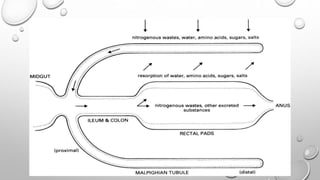
Generalized structure of insect gut showing excretory
organs
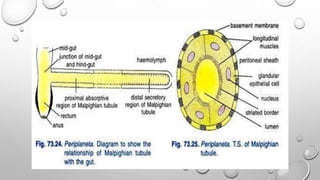
Malpighian tubules
These are the main excretory organs in insects.
These are fine, unbranched and thread-like processes.
These are the outgrowth of alimentary canal and present at the junction of
midgut and hindgut.
These are absent in spring tail and aphids, 2 in scale insects, 4 in bugs, 5 in
mosquitoes, 6 in moths and butterflies, 60 in cockroach and more than 200 in
locusts.
The walls of Malpighian tubule consists of 4-6 large epithelial cells arranged in
a circle which externally rests on the basement membrane.
It is divided into two parts:
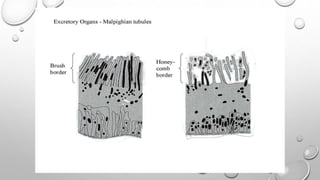
1. Distal secretary part having honey comb border.
2. Proximal absorptive part having brush border.
PHYSIOLOGY OF EXCRETION
I. MECHANISM OF EXCRETION
The terrestrial insects are uricotelic while the aquatic insects are often
ammonotelic.
In haemolymph,
uric acid+ sodium= sodium urate
uric acid+ potassium= potassium urate
These sodium and potassium urate are highly soluble in water and easily
absorbed by Malpighian tubules.
Physiology of excretion in insects in which Malpighian tubule is differentiated:
In some insects, like Rhodnius, the tubules are differentiated into two parts: distal part and
proximal part
The distal part secrete ions, uric acid, amino acids and water from haemolymph, which is
known as primary urine or simply urate.
The urate then flows toward the proximal part during which the uric acid precipitates.
In alkaline pH.
Carbonic anhydrase
splitting
Bicarbonates + uric acidurate
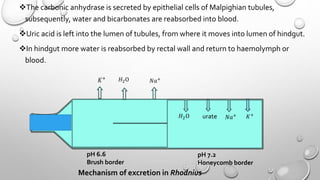
The carbonic anhydrase is secreted by epithelial cells of Malpighian tubules,
subsequently, water and bicarbonates are reabsorbed into blood.
Uric acid is left into the lumen of tubules, from where it moves into lumen of hindgut.
In hindgut more water is reabsorbed by rectal wall and return to haemolymph or
blood.
𝐻2O 𝑁𝑎+
𝐾+urate
pH 6.6
Brush border
pH 7.2
Honeycomb border
Mechanism of excretion in Rhodnius
Physiology of excretion in insects in which Malpighian tubule is
undifferentiated
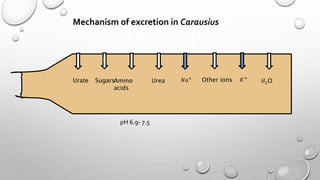
In insects like Carausius Malpighian tubule is not differentiated into distal and proximal
parts.
So the entire tubule functions as a distal part absorbing only salts while conversion into
uric acid occurs in the rectum.
There is continuous release of large quality of water from tubule into rectum drives uric
acid along it and is eliminated through faeces through anus.
𝐾+
Other ions
c
Urate SugarsAmino
acids
Urea 𝑁𝑎+
𝐻2O
pH 6.9- 7.5
Mechanism of excretion in Carausius
𝐾+
Other ions
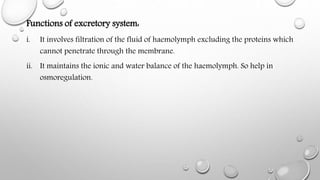
Functions of excretory system:
i. It involves filtration of the fluid of haemolymph excluding the proteins which
cannot penetrate through the membrane.
ii. It maintains the ionic and water balance of the haemolymph. So help in
osmoregulation.
2. URINE AND EXCRETORY END PRODUCTS
The physical and chemical properties of urine vary among insects according to
their food and environment.
In fluid feeders, urine appears as a crystal-clear fluid.
In aquatic insects, urine is copious and clear.
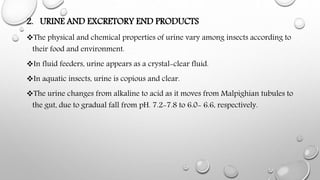
The urine changes from alkaline to acid as it moves from Malpighian tubules to
the gut, due to gradual fall from pH. 7.2-7.8 to 6.0- 6.6, respectively.
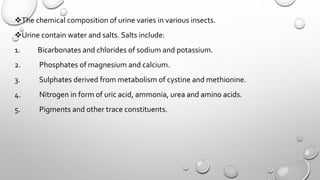
The chemical composition of urine varies in various insects.
Urine contain water and salts. Salts include:
1. Bicarbonates and chlorides of sodium and potassium.
2. Phosphates of magnesium and calcium.
3. Sulphates derived from metabolism of cystine and methionine.
4. Nitrogen in form of uric acid, ammonia, urea and amino acids.
5. Pigments and other trace constituents.
a. Nitrogenous end products
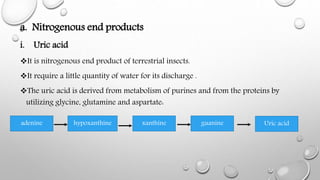
i. Uric acid
It is nitrogenous end product of terrestrial insects.
It require a little quantity of water for its discharge .
The uric acid is derived from metabolism of purines and from the proteins by
utilizing glycine, glutamine and aspartate:
adenine hypoxanthine xanthine guanine Uric acid
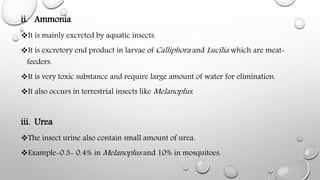
ii. Ammonia
It is mainly excreted by aquatic insects.
It is excretory end product in larvae of Calliphora and Lucilia which are meat-
feeders.
It is very toxic substance and require large amount of water for elimination.
It also occurs in terrestrial insects like Melanoplus.
iii. Urea
The insect urine also contain small amount of urea.
Example-0.3- 0.4% in Melanoplus and 10% in mosquitoes.
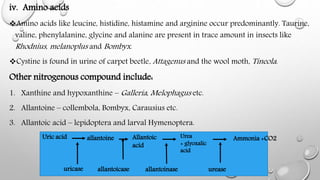
iv. Amino acids
Amino acids like leucine, histidine, histamine and arginine occur predominantly. Taurine,
valine, phenylalanine, glycine and alanine are present in trace amount in insects like
Rhodnius, melanoplus and Bombyx.
Cystine is found in urine of carpet beetle, Attagenus and the wool moth, Tineola.
Other nitrogenous compound include:
1. Xanthine and hypoxanthine – Galleria, Melophagus etc.
2. Allantoine – collembola, Bombyx, Carausius etc.
3. Allantoic acid – lepidoptera and larval Hymenoptera.
Uric acid allantoine Allantoic
acid
Urea
+ glyoxalic
acid
Ammonia +CO2
uricase allantoinaseallantoicase urease
b. Pigments
Pteridines are the common pigments present in insect urine.
Other are leucopterine and isoxanthopterins found in some insects.
c. Other trace constituents
Calcium carbonate and calcium oxalate is found in urine of plant feeding
and phasmids.
Other pigments like ommochrome, biliverdin, salicylic acid, orthophosphates etc.
are also found in many insects.
Physiology of excretion in insects