Organisation of Insect Body
Structure of Head, Thorax and
Abdomen
@Bhubanananda Adhikari
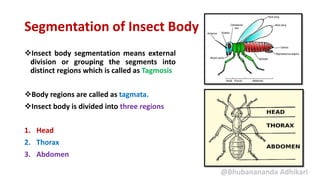
Insect body segmentation means external
division or grouping the segments into
distinct regions which is called as Tagmosis
Body regions are called as tagmata.
Insect body is divided into three regions
1. Head
2. Thorax
3. Abdomen
@Bhubanananda Adhikari
Segmentation of Insect Body
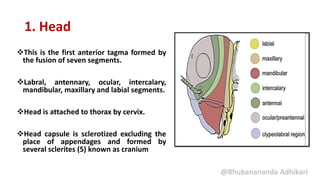
This is the first anterior tagma formed by
the fusion of seven segments.
Labral, antennary, ocular, intercalary,
mandibular, maxillary and labial segments.
Head is attached to thorax by cervix.
Head capsule is sclerotized excluding the
place of appendages and formed by
several sclerites (5) known as cranium
@Bhubanananda Adhikari
1. Head
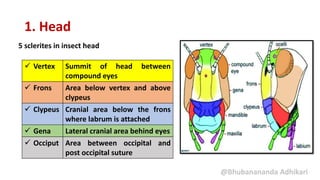
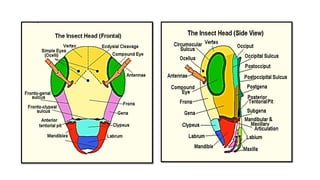
5 sclerites in insect head
@Bhubanananda Adhikari
1. Head
 Vertex Summit of head between
compound eyes
 Frons Area below vertex and above
clypeus
 Clypeus Cranial area below the frons
where labrum is attached
 Gena Lateral cranial area behind eyes
 Occiput Area between occipital and
post occipital suture
Sutures/ Sulcus of Head : Linear invaginations of exoskeleton between two sclerites
@Bhubanananda Adhikari
1. Head
 Epicranial suture (Ecdysal line)  Inverted Y shaped suture found mediallyon
the top of head [Median suture (coronal),
Lateral sutures (Frontal)]
 Epistomal suture
(Fronto clypeal)
 Epi: Above ; Stoma: mouth
 Between frons and clypeus
 Clypeo-labral suture  Between clypeus and labrum
 Frontogenal suture  It starts from the junction of the
clypofrontal and the subgenal sutures.
Sutures/ Sulcus of Head : Linear invaginations of exoskeleton between two sclerites
@Bhubanananda Adhikari
1. Head
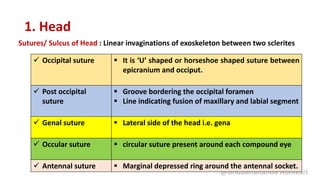
 Occipital suture  It is ‘U’ shaped or horseshoe shaped suture between
epicranium and occiput.
 Post occipital
suture
 Groove bordering the occipital foramen
 Line indicating fusion of maxillary and labial segment
 Genal suture  Lateral side of the head i.e. gena
 Occular suture  circular suture present around each compound eye
 Antennal suture  Marginal depressed ring around the antennal socket.
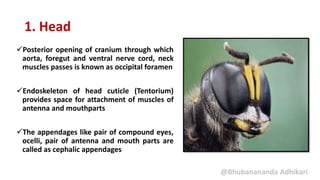
Posterior opening of cranium through which
aorta, foregut and ventral nerve cord, neck
muscles passes is known as occipital foramen
Endoskeleton of head cuticle (Tentorium)
provides space for attachment of muscles of
antenna and mouthparts
The appendages like pair of compound eyes,
ocelli, pair of antenna and mouth parts are
called as cephalic appendages
@Bhubanananda Adhikari
1. Head
Based on the inclination of long axis of head and
orientation of mouthparts there are three types of
insect head
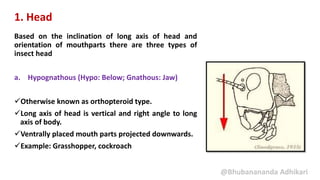
a. Hypognathous (Hypo: Below; Gnathous: Jaw)
Otherwise known as orthopteroid type.
Long axis of head is vertical and right angle to long
axis of body.
Ventrally placed mouth parts projected downwards.
Example: Grasshopper, cockroach
@Bhubanananda Adhikari
1. Head
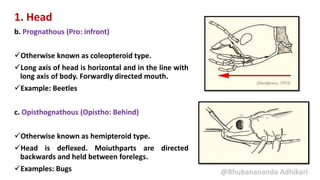
b. Prognathous (Pro: infront)
Otherwise known as coleopteroid type.
Long axis of head is horizontal and in the line with
long axis of body. Forwardly directed mouth.
Example: Beetles
c. Opisthognathous (Opistho: Behind)
Otherwise known as hemipteroid type.
Head is deflexed. Moiuthparts are directed
backwards and held between forelegs.
Examples: Bugs @Bhubanananda Adhikari
1. Head
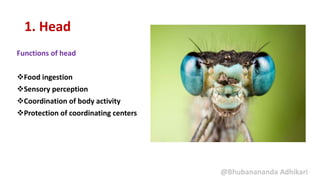
Functions of head
Food ingestion
Sensory perception
Coordination of body activity
Protection of coordinating centers
@Bhubanananda Adhikari
1. Head
Second and middle tagma which is three
segmented namely prothorax, mesothorax and
metathorax.
Main function of thorax is locomotion
Meso and meta thorax which bears wings are
called as pterothorax.
Thoracic segments are made up of three
sclerites.
a). Dorsal plate : Tergum/ Notum
b). Lateral plate : Pleuron
c). Ventral plate : sternum
@Bhubanananda Adhikari
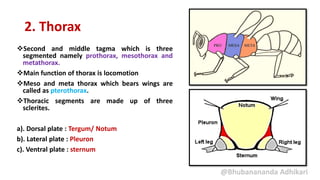
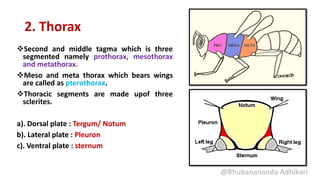
2. Thorax
Second and middle tagma which is three
segmented namely prothorax, mesothorax
and metathorax.
Meso and meta thorax which bears wings
are called as pterothorax.
Thoracic segments are made upof three
sclerites.
a). Dorsal plate : Tergum/ Notum
b). Lateral plate : Pleuron
c). Ventral plate : sternum
@Bhubanananda Adhikari
2. Thorax
Thoracic nota:
Dorsal body plate of each thoracic segments are called as
pronotum, mesonotum and metanotum
i. Pronotum :
Undifferentiated (Saddle shaped in grasshopper and
shield like in cockroach
i. Pterothoracic notum:
Three sutures (Antecostal, prescutal, scutoscutellar)
Five tergites( Acrotergite, prescutum, scutum, scutellum,
post scutellum)
@Bhubanananda Adhikari
2. Thorax
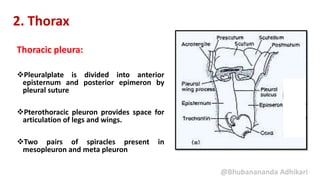
Thoracic pleura:
Pleuralplate is divided into anterior
episternum and posterior epimeron by
pleural suture
Pterothoracic pleuron provides space for
articulation of legs and wings.
Two pairs of spiracles present in
mesopleuron and meta pleuron
@Bhubanananda Adhikari
2. Thorax
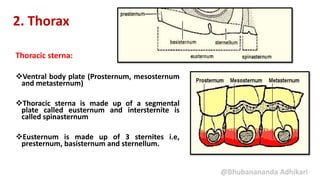
Thoracic sterna:
Ventral body plate (Prosternum, mesosternum
and metasternum)
Thoracic sterna is made up of a segmental
plate called eusternum and intersternite is
called spinasternum
Eusternum is made up of 3 sternites i.e,
presternum, basisternum and sternellum.
@Bhubanananda Adhikari
2. Thorax
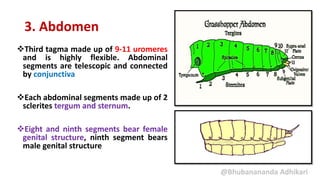
Third tagma made up of 9-11 uromeres
and is highly flexible. Abdominal
segments are telescopic and connected
by conjunctiva
Each abdominal segments made up of 2
sclerites tergum and sternum.
Eight and ninth segments bear female
genital structure, ninth segment bears
male genital structure
@Bhubanananda Adhikari
3. Abdomen
Thank You…

structural organisation of insect body

  • 1.
    Organisation of InsectBody Structure of Head, Thorax and Abdomen @Bhubanananda Adhikari
  • 2.
    Insect body segmentationmeans external division or grouping the segments into distinct regions which is called as Tagmosis Body regions are called as tagmata. Insect body is divided into three regions 1. Head 2. Thorax 3. Abdomen @Bhubanananda Adhikari Segmentation of Insect Body
  • 3.
    This is thefirst anterior tagma formed by the fusion of seven segments. Labral, antennary, ocular, intercalary, mandibular, maxillary and labial segments. Head is attached to thorax by cervix. Head capsule is sclerotized excluding the place of appendages and formed by several sclerites (5) known as cranium @Bhubanananda Adhikari 1. Head
  • 4.
    5 sclerites ininsect head @Bhubanananda Adhikari 1. Head  Vertex Summit of head between compound eyes  Frons Area below vertex and above clypeus  Clypeus Cranial area below the frons where labrum is attached  Gena Lateral cranial area behind eyes  Occiput Area between occipital and post occipital suture
  • 6.
    Sutures/ Sulcus ofHead : Linear invaginations of exoskeleton between two sclerites @Bhubanananda Adhikari 1. Head  Epicranial suture (Ecdysal line)  Inverted Y shaped suture found mediallyon the top of head [Median suture (coronal), Lateral sutures (Frontal)]  Epistomal suture (Fronto clypeal)  Epi: Above ; Stoma: mouth  Between frons and clypeus  Clypeo-labral suture  Between clypeus and labrum  Frontogenal suture  It starts from the junction of the clypofrontal and the subgenal sutures.
  • 7.
    Sutures/ Sulcus ofHead : Linear invaginations of exoskeleton between two sclerites @Bhubanananda Adhikari 1. Head  Occipital suture  It is ‘U’ shaped or horseshoe shaped suture between epicranium and occiput.  Post occipital suture  Groove bordering the occipital foramen  Line indicating fusion of maxillary and labial segment  Genal suture  Lateral side of the head i.e. gena  Occular suture  circular suture present around each compound eye  Antennal suture  Marginal depressed ring around the antennal socket.
  • 8.
    Posterior opening ofcranium through which aorta, foregut and ventral nerve cord, neck muscles passes is known as occipital foramen Endoskeleton of head cuticle (Tentorium) provides space for attachment of muscles of antenna and mouthparts The appendages like pair of compound eyes, ocelli, pair of antenna and mouth parts are called as cephalic appendages @Bhubanananda Adhikari 1. Head
  • 9.
    Based on theinclination of long axis of head and orientation of mouthparts there are three types of insect head a. Hypognathous (Hypo: Below; Gnathous: Jaw) Otherwise known as orthopteroid type. Long axis of head is vertical and right angle to long axis of body. Ventrally placed mouth parts projected downwards. Example: Grasshopper, cockroach @Bhubanananda Adhikari 1. Head
  • 10.
    b. Prognathous (Pro:infront) Otherwise known as coleopteroid type. Long axis of head is horizontal and in the line with long axis of body. Forwardly directed mouth. Example: Beetles c. Opisthognathous (Opistho: Behind) Otherwise known as hemipteroid type. Head is deflexed. Moiuthparts are directed backwards and held between forelegs. Examples: Bugs @Bhubanananda Adhikari 1. Head
  • 11.
    Functions of head Foodingestion Sensory perception Coordination of body activity Protection of coordinating centers @Bhubanananda Adhikari 1. Head
  • 12.
    Second and middletagma which is three segmented namely prothorax, mesothorax and metathorax. Main function of thorax is locomotion Meso and meta thorax which bears wings are called as pterothorax. Thoracic segments are made up of three sclerites. a). Dorsal plate : Tergum/ Notum b). Lateral plate : Pleuron c). Ventral plate : sternum @Bhubanananda Adhikari 2. Thorax
  • 13.
    Second and middletagma which is three segmented namely prothorax, mesothorax and metathorax. Meso and meta thorax which bears wings are called as pterothorax. Thoracic segments are made upof three sclerites. a). Dorsal plate : Tergum/ Notum b). Lateral plate : Pleuron c). Ventral plate : sternum @Bhubanananda Adhikari 2. Thorax
  • 14.
    Thoracic nota: Dorsal bodyplate of each thoracic segments are called as pronotum, mesonotum and metanotum i. Pronotum : Undifferentiated (Saddle shaped in grasshopper and shield like in cockroach i. Pterothoracic notum: Three sutures (Antecostal, prescutal, scutoscutellar) Five tergites( Acrotergite, prescutum, scutum, scutellum, post scutellum) @Bhubanananda Adhikari 2. Thorax
  • 15.
    Thoracic pleura: Pleuralplate isdivided into anterior episternum and posterior epimeron by pleural suture Pterothoracic pleuron provides space for articulation of legs and wings. Two pairs of spiracles present in mesopleuron and meta pleuron @Bhubanananda Adhikari 2. Thorax
  • 16.
    Thoracic sterna: Ventral bodyplate (Prosternum, mesosternum and metasternum) Thoracic sterna is made up of a segmental plate called eusternum and intersternite is called spinasternum Eusternum is made up of 3 sternites i.e, presternum, basisternum and sternellum. @Bhubanananda Adhikari 2. Thorax
  • 17.
    Third tagma madeup of 9-11 uromeres and is highly flexible. Abdominal segments are telescopic and connected by conjunctiva Each abdominal segments made up of 2 sclerites tergum and sternum. Eight and ninth segments bear female genital structure, ninth segment bears male genital structure @Bhubanananda Adhikari 3. Abdomen
  • 18.