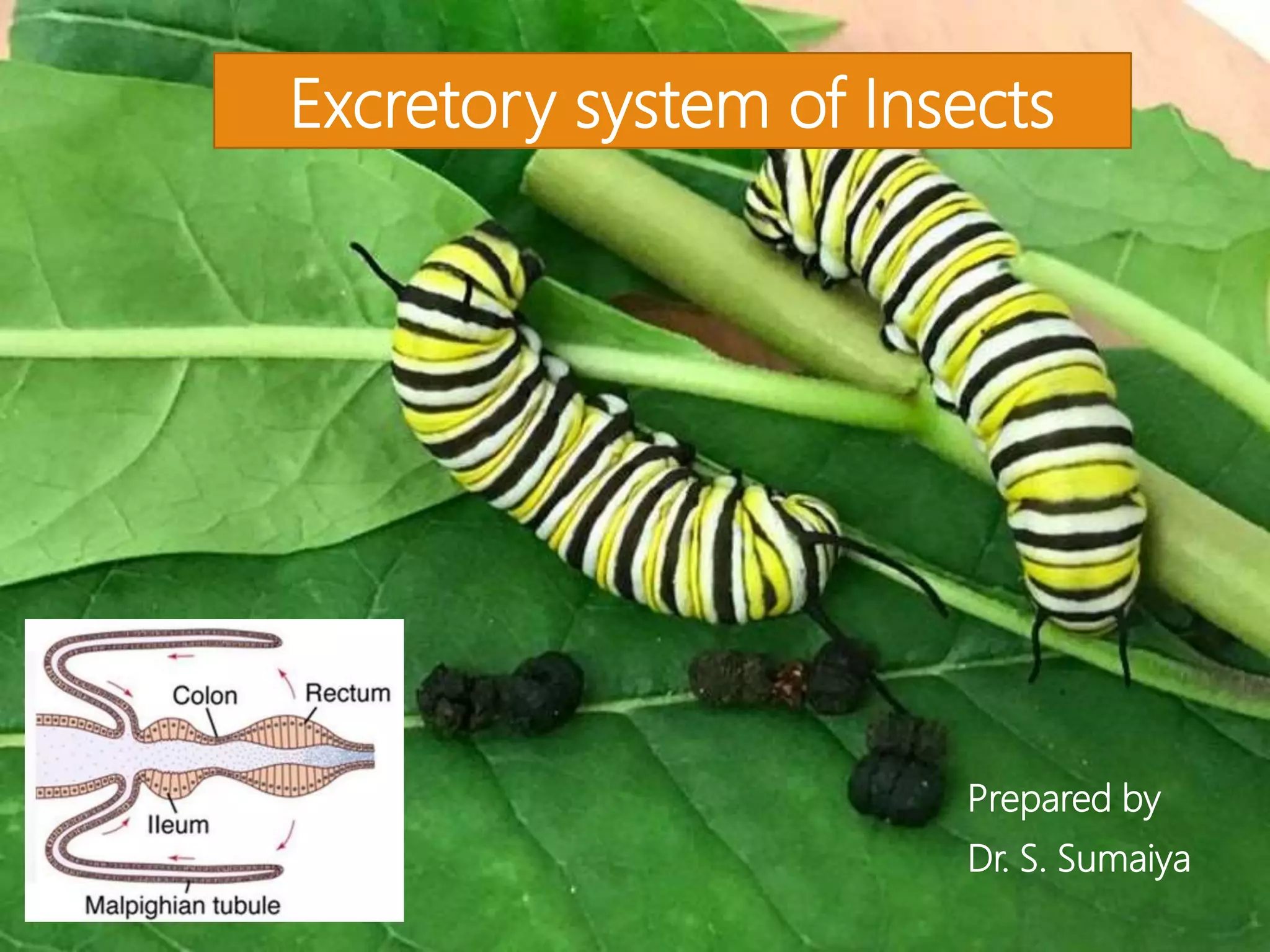
Excretory system of Insects
Prepared by
Dr. S. Sumaiya
Excretory system
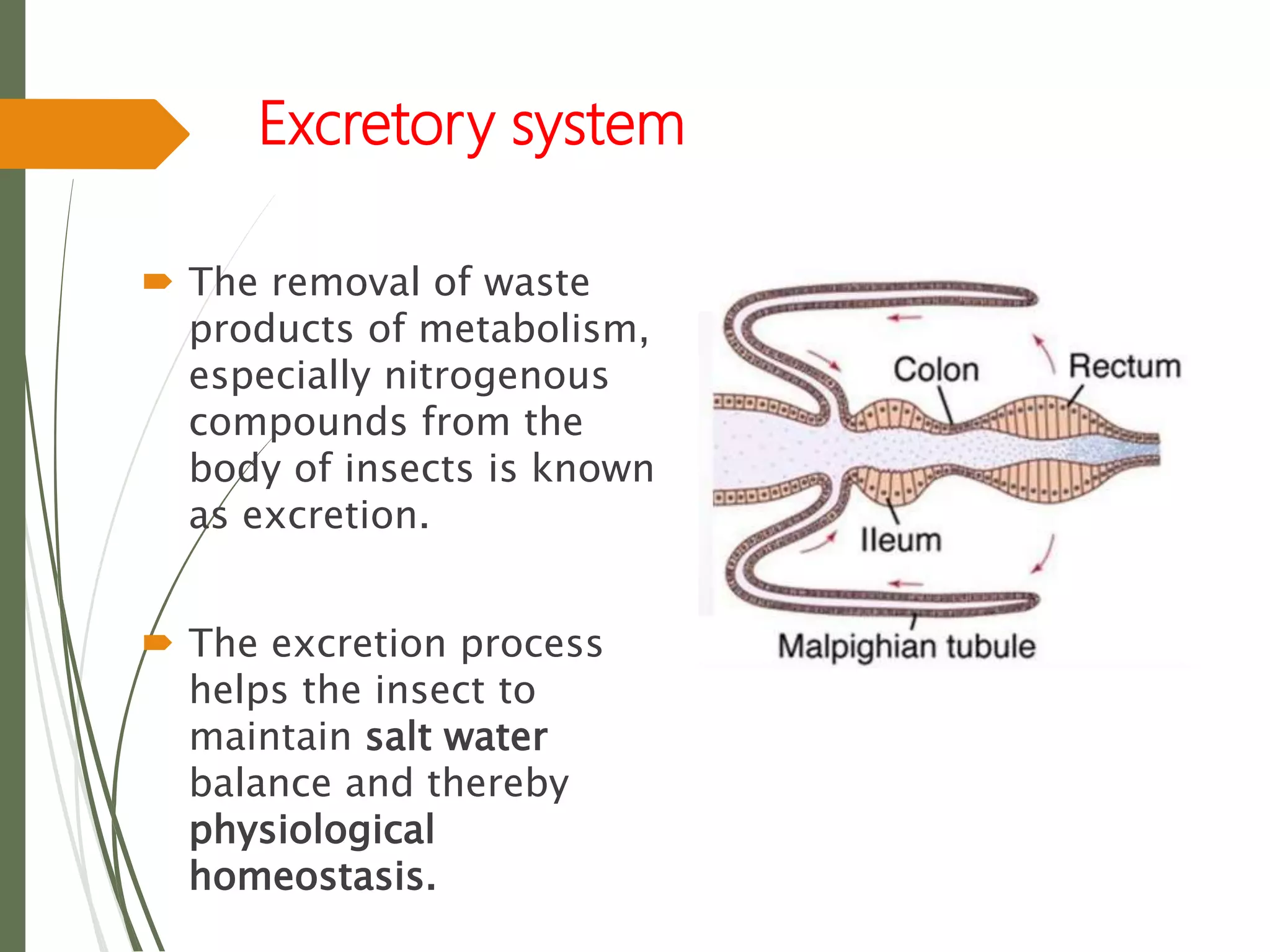
 The removal of waste
products of metabolism,
especially nitrogenous
compounds from the
body of insects is known
as excretion.
 The excretion process
helps the insect to
maintain salt water
balance and thereby
physiological
homeostasis.
Excretory organs
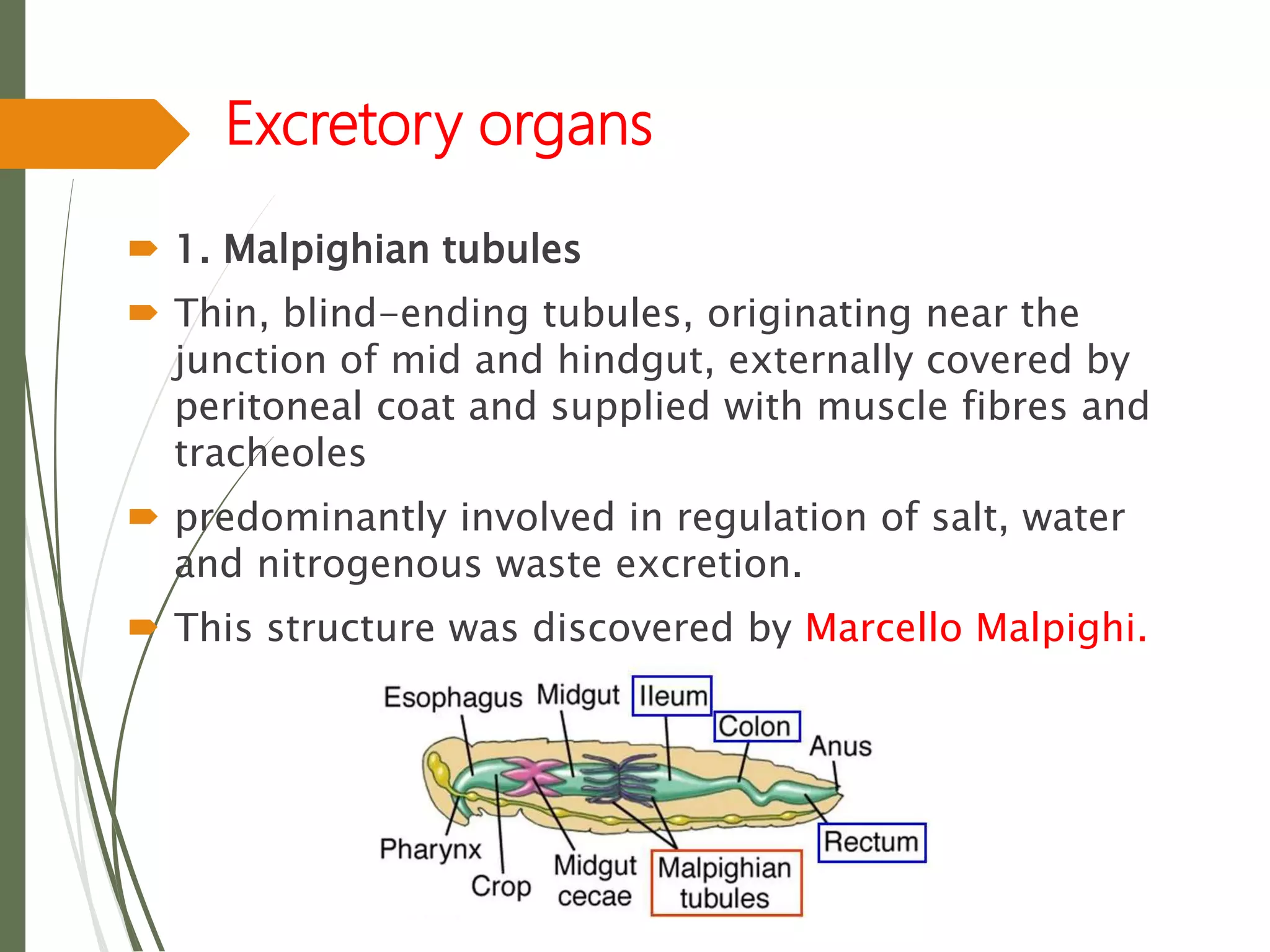
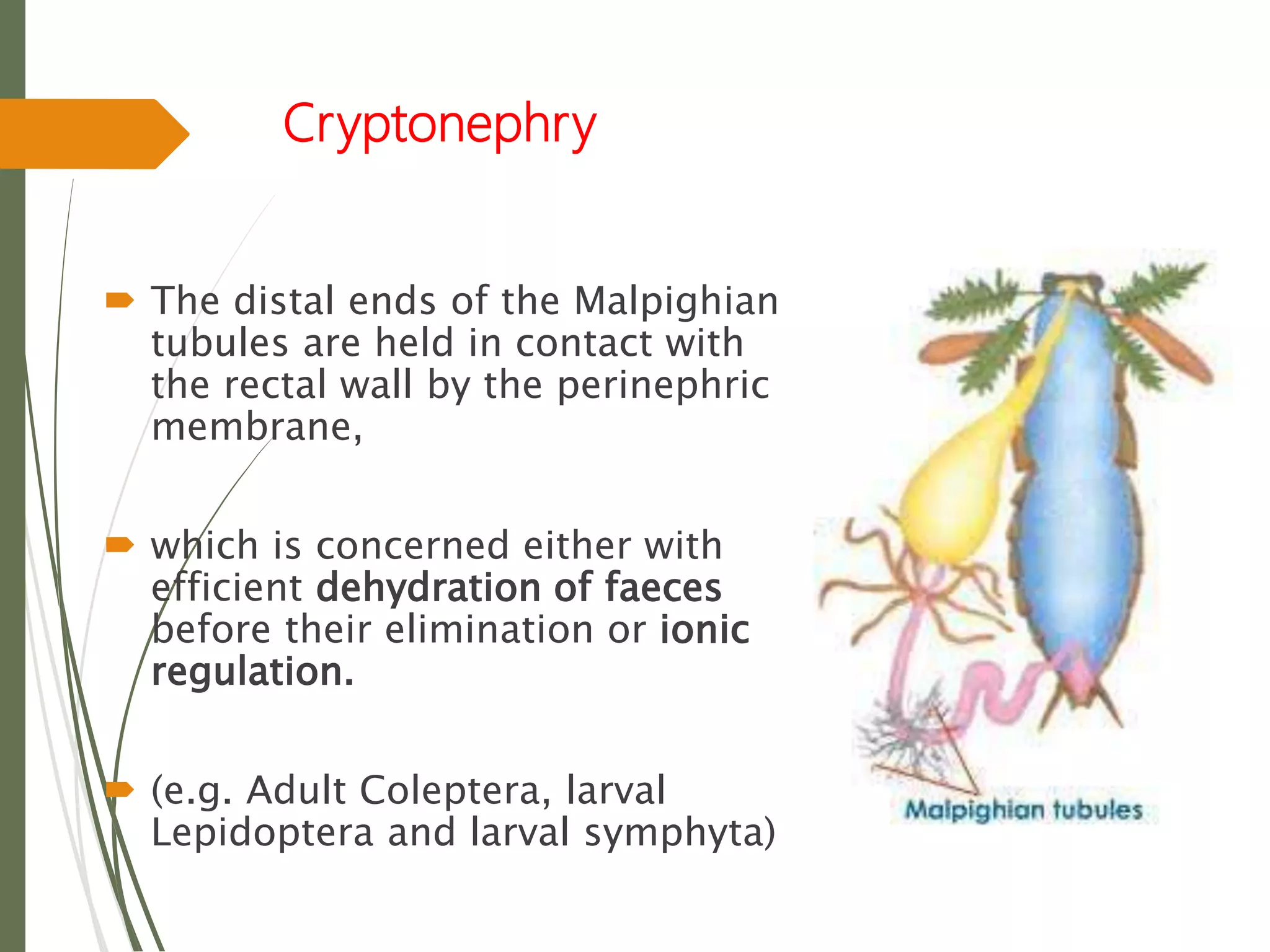
 1. Malpighian tubules
 Thin, blind-ending tubules, originating near the
junction of mid and hindgut, externally covered by
peritoneal coat and supplied with muscle fibres and
tracheoles
 predominantly involved in regulation of salt, water
and nitrogenous waste excretion.
 This structure was discovered by Marcello Malpighi.
Excretory organs
 2. Nephrocytes: Cells that sieve the haemolmph
for products that they metabolize (pericardial
cells).
 3. Fat bodies: A loose or compact aggregation of
cells, mostly trophocytes, suspended in the
haemocoel, responsible for storage and
excretion.
 4. Oenocytes: These are specialised cells of
haemocoel, epidermis or fat body with many
functions. One is excretion.
 5. Integument: The outer covering of the living
tissues of an insect.
 6.Tracheal system: The insect gas exchange
system, comprising tracheae and tracheoles.
Nitrogen excretion
 Terrestrial insects excrete waste products as uric acid or
certain of its salts called urates, which were water
insoluble and requires less amount of water for waste
product removal. This type of excretion is known as
uricotelism.
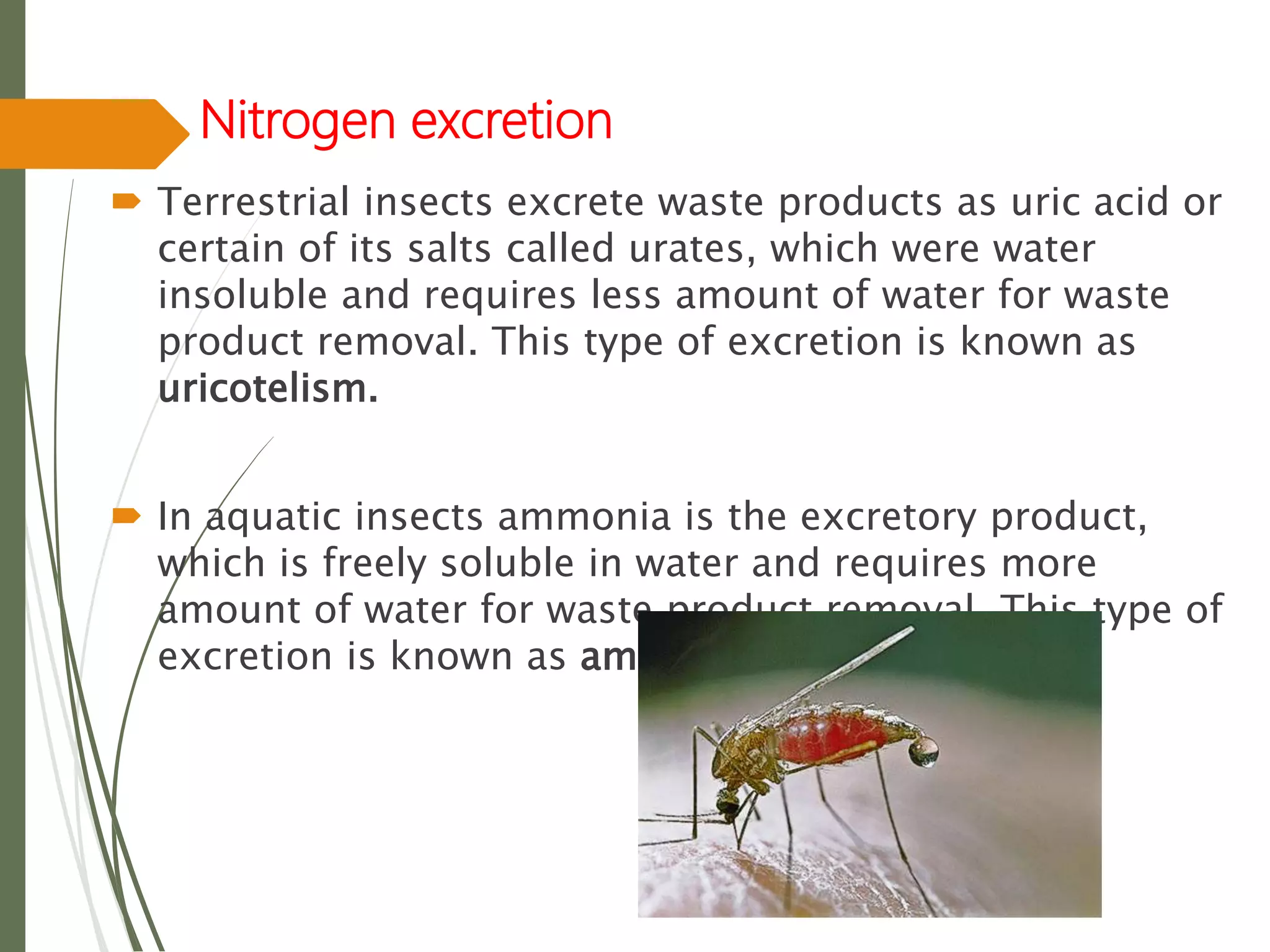
 In aquatic insects ammonia is the excretory product,
which is freely soluble in water and requires more
amount of water for waste product removal. This type of
excretion is known as ammonotelism.
Cryptonephry
 The distal ends of the Malpighian
tubules are held in contact with
the rectal wall by the perinephric
membrane,
 which is concerned either with
efficient dehydration of faeces
before their elimination or ionic
regulation.
 (e.g. Adult Coleptera, larval
Lepidoptera and larval symphyta)
Physiology
 The malpighian tubules produce a filtrate (the
primary urine) which is isosmotic but ionically
dissimilar to the haemolymph and selectively
reabsorbs water and certain solutes, but
eliminates others.
 The malpighian tubules produces an isosmotic
filtrate which is high in K+ and low in Na+with
Cl- as major anion.
 The active transport of ions especially K+ into
the tubule lumen generates an osmotic pressure
gradiant for the passive flow of water.
 Sugars and most amino acids are also passively
filtered from the haemolymph via junctions between
the tubule cells, where as amino acids and non-
metabolizables and toxic organic compounds are
actively transported into the tubule lumen.
 Sugars are reabsorbed from the lumen and returned
to the haemolymph.
 The continuous secretory activity of each Malpighian
tubule leads to a flow of primary urine from its
lumen towards and into the gut.
 In the rectum, the urine is modified by removal of
solutes and water to maintain fluid and ionic
homeostasis of the body
Physiology
Storage Excretion
 The excretory waste materials are
retained within the body in different
sites.
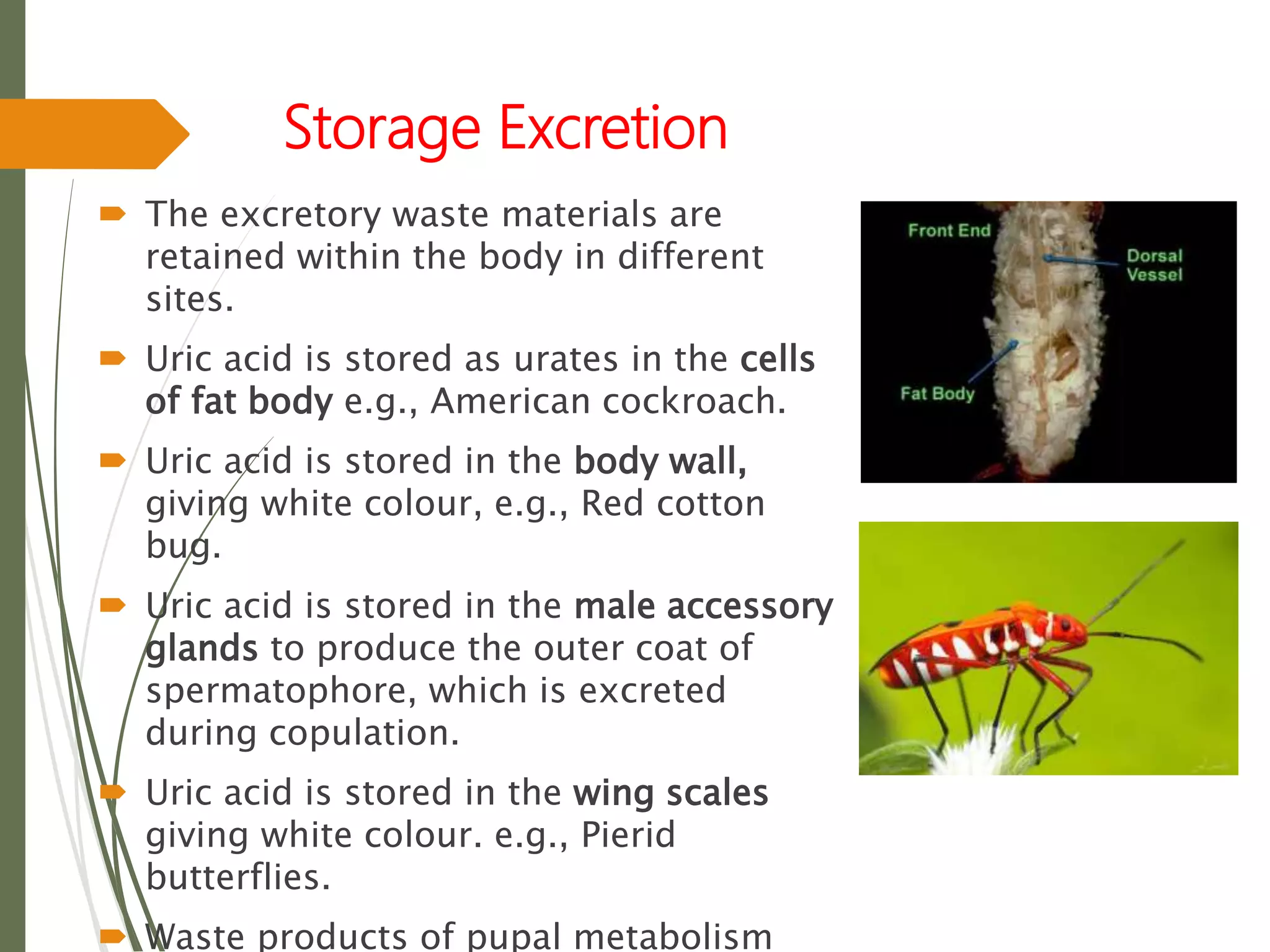
 Uric acid is stored as urates in the cells
of fat body e.g., American cockroach.
 Uric acid is stored in the body wall,
giving white colour, e.g., Red cotton
bug.
 Uric acid is stored in the male accessory
glands to produce the outer coat of
spermatophore, which is excreted
during copulation.
 Uric acid is stored in the wing scales
giving white colour. e.g., Pierid
butterflies.
 Waste products of pupal metabolism

Inscet excretory system

  • 1.
    Excretory system ofInsects Prepared by Dr. S. Sumaiya
  • 2.
    Excretory system  Theremoval of waste products of metabolism, especially nitrogenous compounds from the body of insects is known as excretion.  The excretion process helps the insect to maintain salt water balance and thereby physiological homeostasis.
  • 3.
    Excretory organs  1.Malpighian tubules  Thin, blind-ending tubules, originating near the junction of mid and hindgut, externally covered by peritoneal coat and supplied with muscle fibres and tracheoles  predominantly involved in regulation of salt, water and nitrogenous waste excretion.  This structure was discovered by Marcello Malpighi.
  • 4.
    Excretory organs  2.Nephrocytes: Cells that sieve the haemolmph for products that they metabolize (pericardial cells).  3. Fat bodies: A loose or compact aggregation of cells, mostly trophocytes, suspended in the haemocoel, responsible for storage and excretion.  4. Oenocytes: These are specialised cells of haemocoel, epidermis or fat body with many functions. One is excretion.  5. Integument: The outer covering of the living tissues of an insect.  6.Tracheal system: The insect gas exchange system, comprising tracheae and tracheoles.
  • 5.
    Nitrogen excretion  Terrestrialinsects excrete waste products as uric acid or certain of its salts called urates, which were water insoluble and requires less amount of water for waste product removal. This type of excretion is known as uricotelism.  In aquatic insects ammonia is the excretory product, which is freely soluble in water and requires more amount of water for waste product removal. This type of excretion is known as ammonotelism.
  • 6.
    Cryptonephry  The distalends of the Malpighian tubules are held in contact with the rectal wall by the perinephric membrane,  which is concerned either with efficient dehydration of faeces before their elimination or ionic regulation.  (e.g. Adult Coleptera, larval Lepidoptera and larval symphyta)
  • 7.
    Physiology  The malpighiantubules produce a filtrate (the primary urine) which is isosmotic but ionically dissimilar to the haemolymph and selectively reabsorbs water and certain solutes, but eliminates others.  The malpighian tubules produces an isosmotic filtrate which is high in K+ and low in Na+with Cl- as major anion.  The active transport of ions especially K+ into the tubule lumen generates an osmotic pressure gradiant for the passive flow of water.
  • 8.
     Sugars andmost amino acids are also passively filtered from the haemolymph via junctions between the tubule cells, where as amino acids and non- metabolizables and toxic organic compounds are actively transported into the tubule lumen.  Sugars are reabsorbed from the lumen and returned to the haemolymph.  The continuous secretory activity of each Malpighian tubule leads to a flow of primary urine from its lumen towards and into the gut.  In the rectum, the urine is modified by removal of solutes and water to maintain fluid and ionic homeostasis of the body Physiology
  • 9.
    Storage Excretion  Theexcretory waste materials are retained within the body in different sites.  Uric acid is stored as urates in the cells of fat body e.g., American cockroach.  Uric acid is stored in the body wall, giving white colour, e.g., Red cotton bug.  Uric acid is stored in the male accessory glands to produce the outer coat of spermatophore, which is excreted during copulation.  Uric acid is stored in the wing scales giving white colour. e.g., Pierid butterflies.  Waste products of pupal metabolism