R.K. PANSE
Assistant Professor (Entomology)
College of Agriculture, Balaghat
Murjhad Farm Waraseoni
Email: rkpanseento@gmail.com
Mobile No. : 9806145992
Lecture no. 17
Structure and functions of excretory
system in insects
Excretion
Removal of waste products of metabolism, especially
nitrogenous compounds from the body of insects is known
as excretion. The excretion process helps the insect to
maintain salt water balance and thereby physiological
homeostasis.
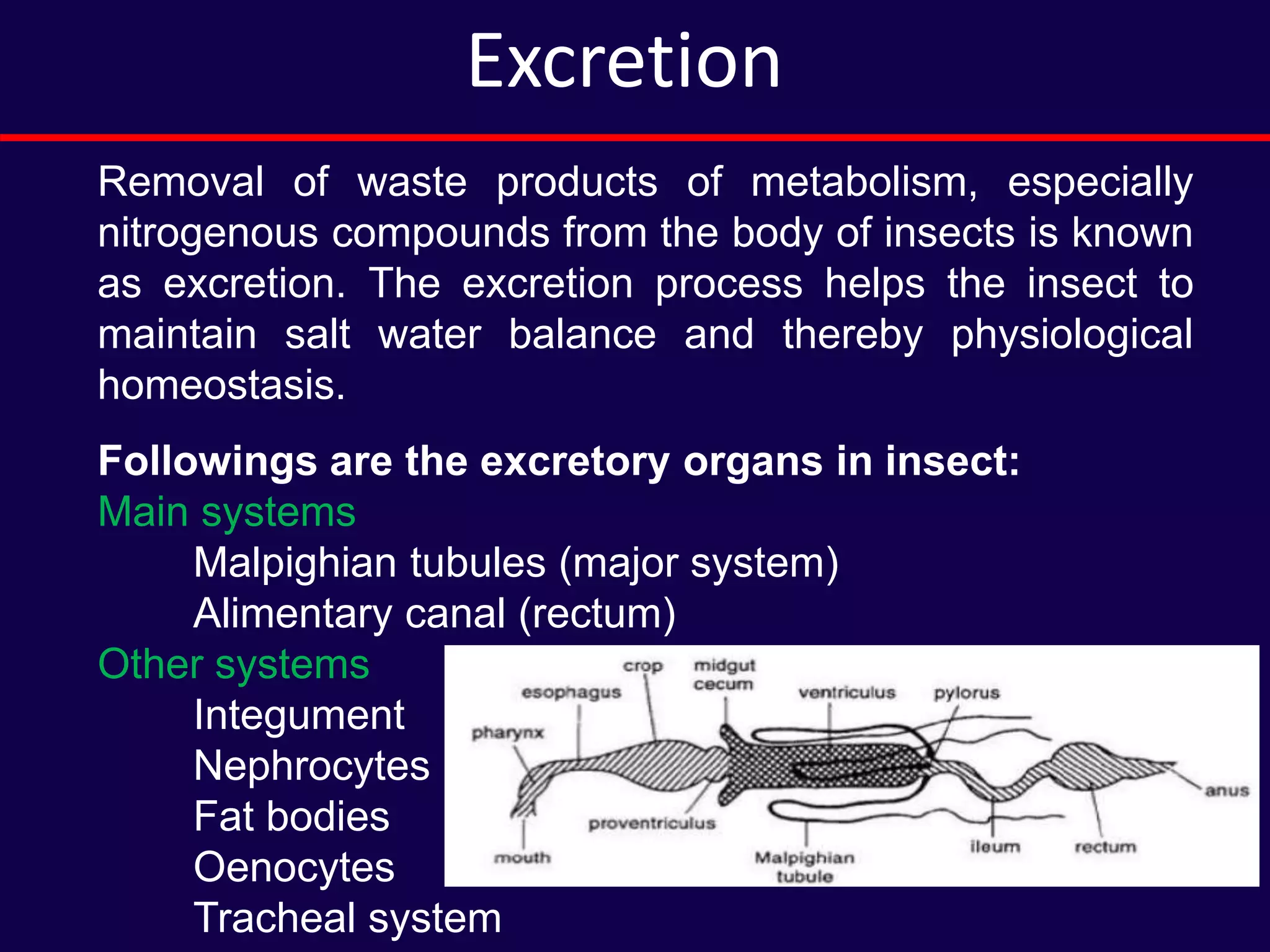
Followings are the excretory organs in insect:
Main systems
Malpighian tubules (major system)
Alimentary canal (rectum)
Other systems
Integument
Nephrocytes
Fat bodies
Oenocytes
Tracheal system
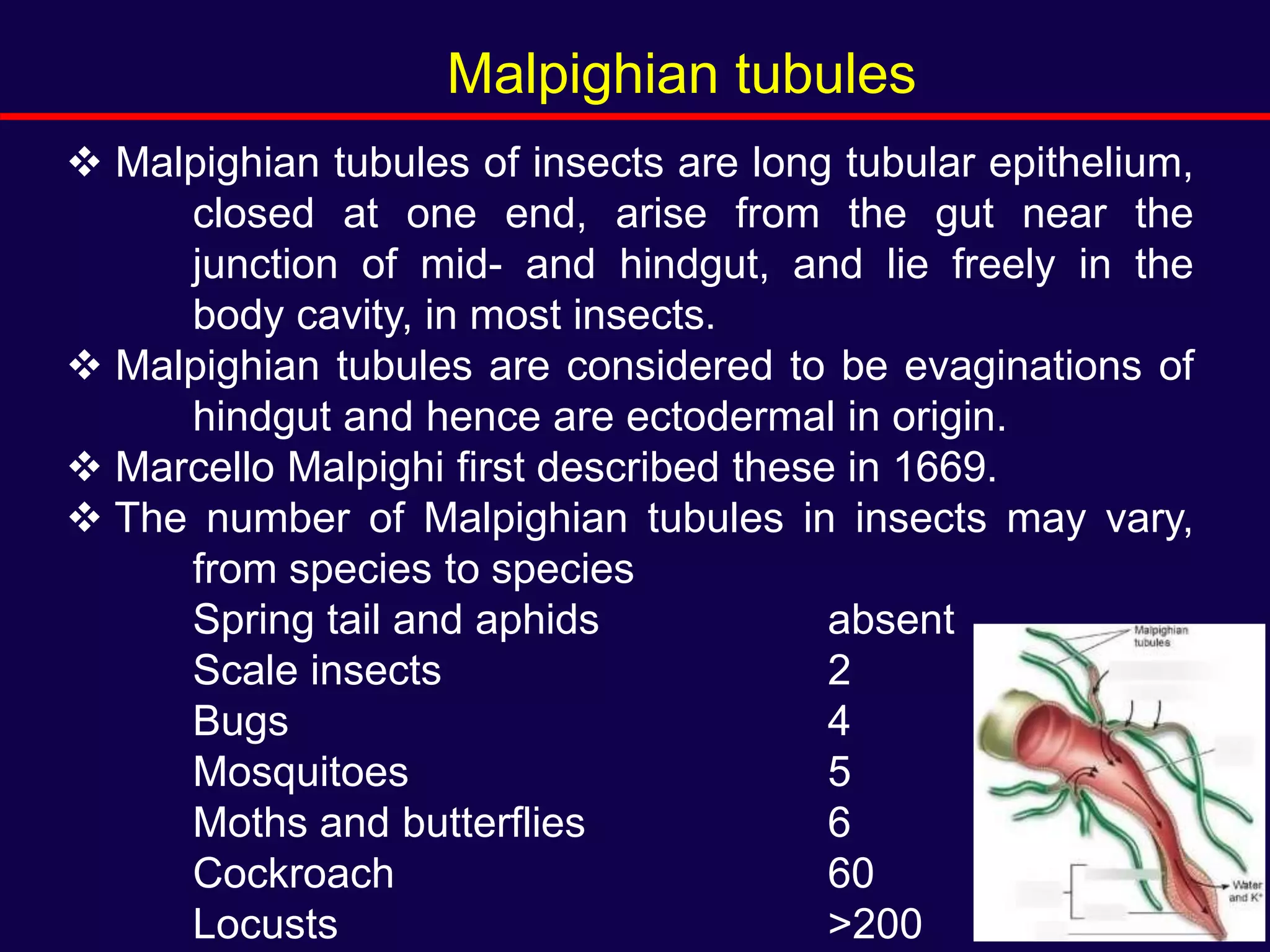
 Malpighian tubules of insects are long tubular epithelium,
closed at one end, arise from the gut near the
junction of mid- and hindgut, and lie freely in the
body cavity, in most insects.
 Malpighian tubules are considered to be evaginations of
hindgut and hence are ectodermal in origin.
 Marcello Malpighi first described these in 1669.
 The number of Malpighian tubules in insects may vary,
from species to species
Spring tail and aphids absent
Scale insects 2
Bugs 4
Mosquitoes 5
Moths and butterflies 6
Cockroach 60
Locusts >200
Malpighian tubules
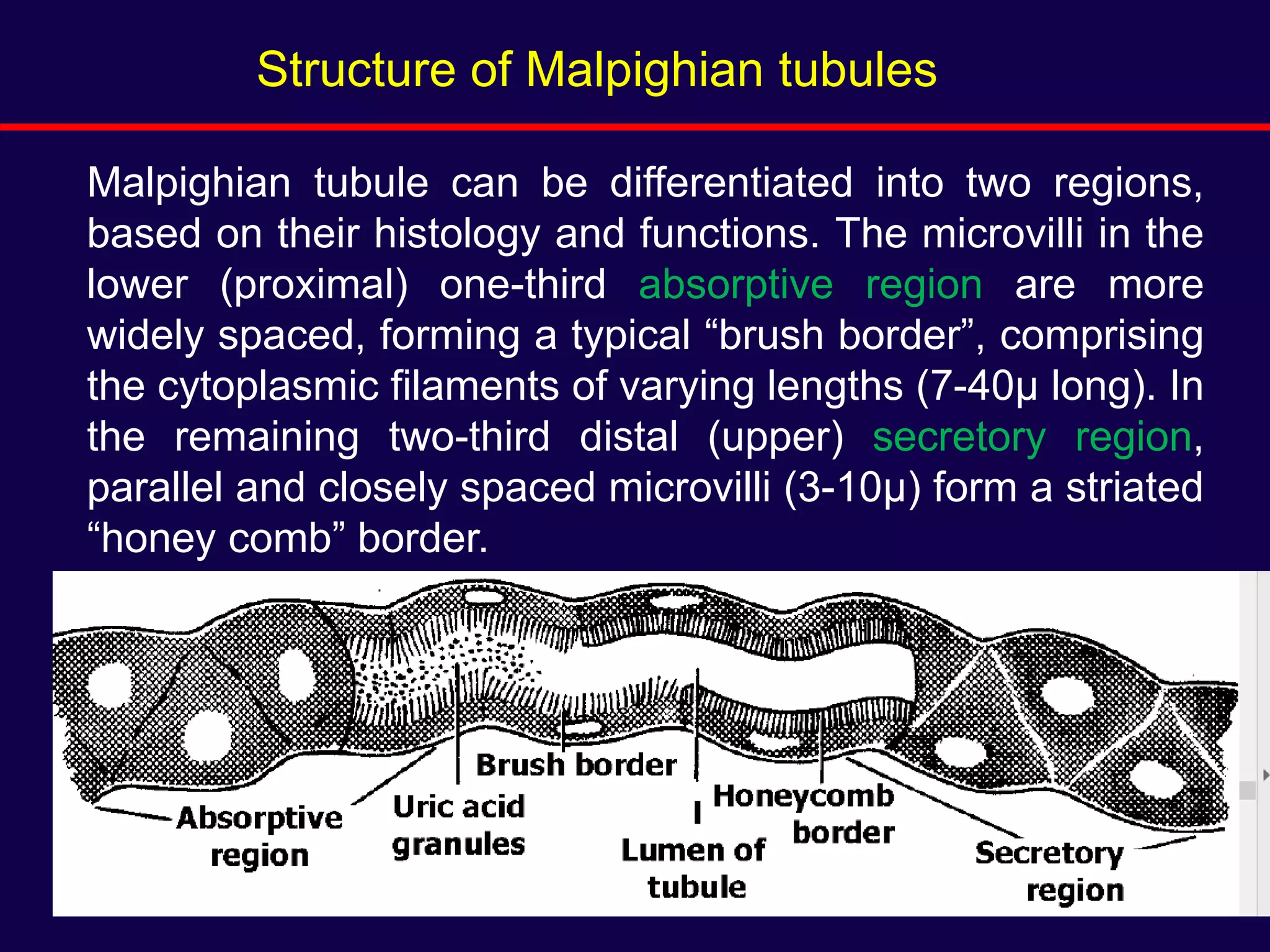
Malpighian tubule can be differentiated into two regions,
based on their histology and functions. The microvilli in the
lower (proximal) one-third absorptive region are more
widely spaced, forming a typical “brush border”, comprising
the cytoplasmic filaments of varying lengths (7-40μ long). In
the remaining two-third distal (upper) secretory region,
parallel and closely spaced microvilli (3-10μ) form a striated
“honey comb” border.
Structure of Malpighian tubules
Terrestrial insects excrete waste products as uric acid or certain
of its salts called urates, which were water insoluble and
requires less amount of water for waste product removal. In
aquatic insects ammonia is the excretory product, which is
freely soluble in water and requires more amount of water for
waste product removal.
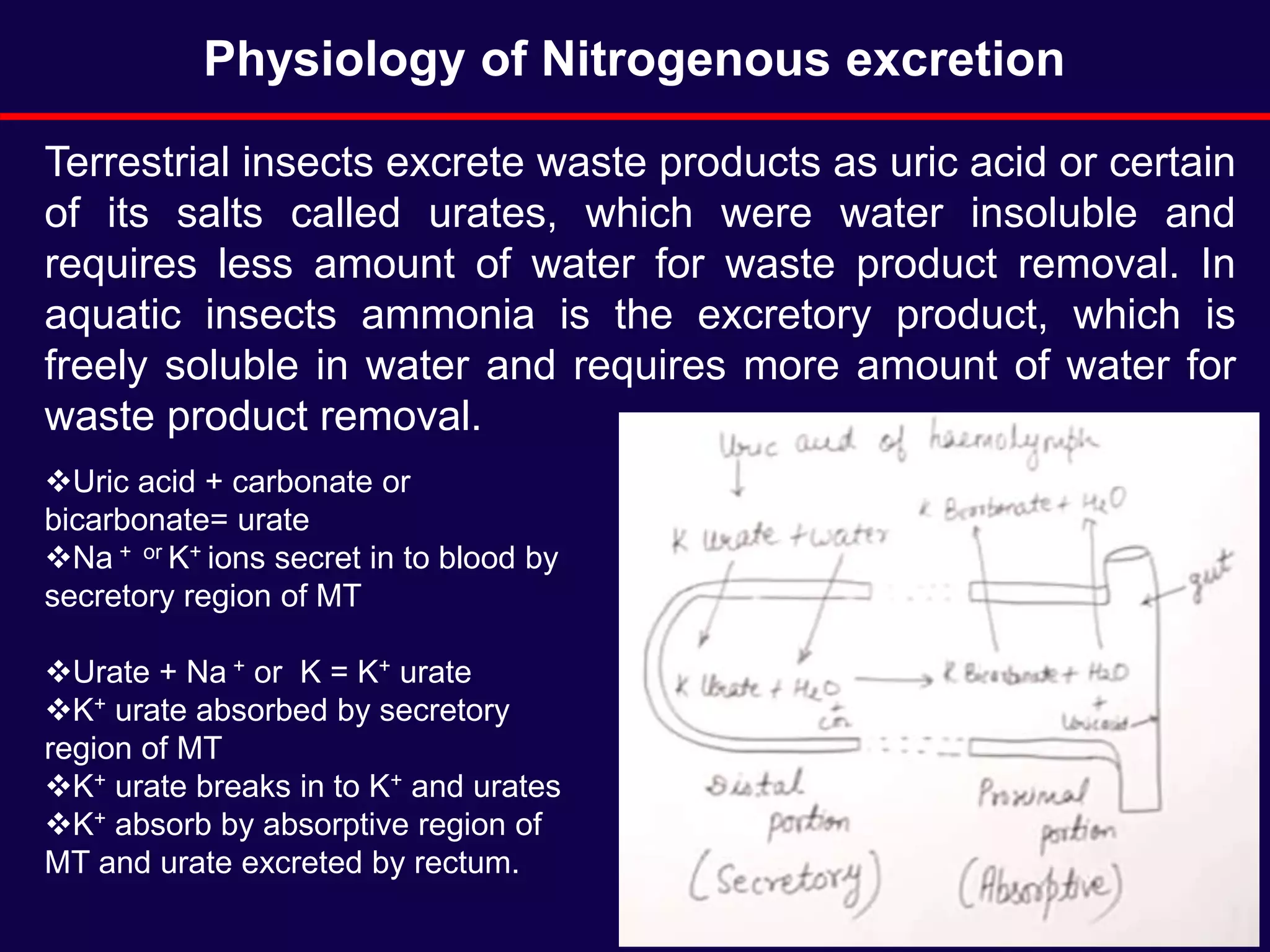
Physiology of Nitrogenous excretion
Uric acid + carbonate or
bicarbonate= urate
Na + or K+ ions secret in to blood by
secretory region of MT
Urate + Na + or K = K+ urate
K+ urate absorbed by secretory
region of MT
K+ urate breaks in to K+ and urates
K+ absorb by absorptive region of
MT and urate excreted by rectum.
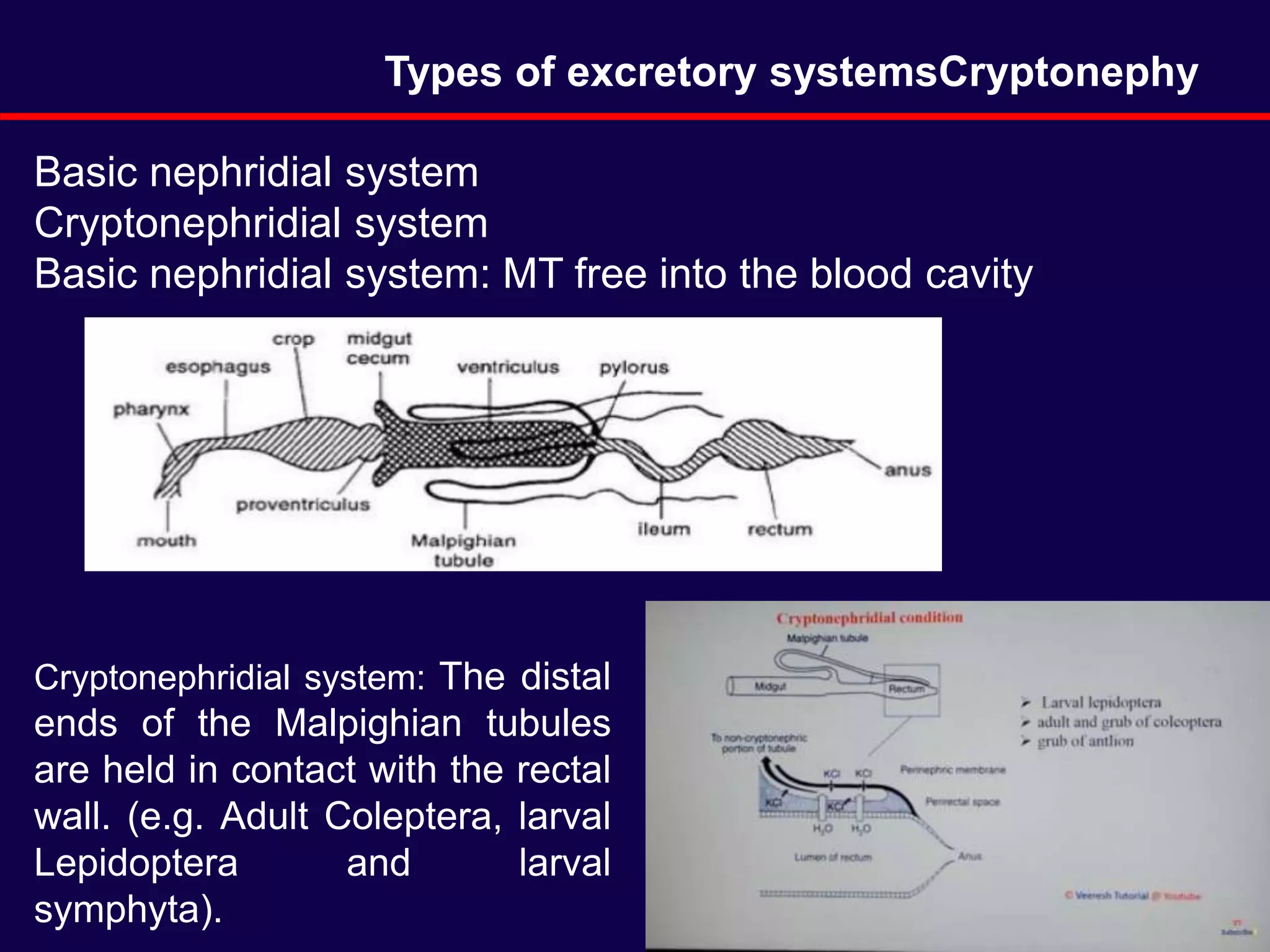
Basic nephridial system
Cryptonephridial system
Basic nephridial system: MT free into the blood cavity
Types of excretory systemsCryptonephy
Cryptonephridial system: The distal
ends of the Malpighian tubules
are held in contact with the rectal
wall. (e.g. Adult Coleptera, larval
Lepidoptera and larval
symphyta).
Functions of MT: Excretory in function, removal of
nitrogenous wastes. The other accessory functions are as:
1. Spittle secretion in spittle bug
2. Light production in Bolitophila
3. Silk production in larval neuroptera
Storage Excretion: The excretory waste materials are
retained within the body in different sites.
i. Uric acid is stored as urates in the cells of fat body e.g.,
American cockroach.
ii. Uric acid is stored in the body wall, giving white colour.
e.g. Red cotton bug.
iii. Uric acid is stored in the male accessory glands to
produce the outer coat of spermatophore.
iv. Uric acid is stored in the wing scales giving white colour.
e.g., Pierid butterflies.
v. Waste products of pupal metabolism (Meconium) is stored
and released during adult emergence.
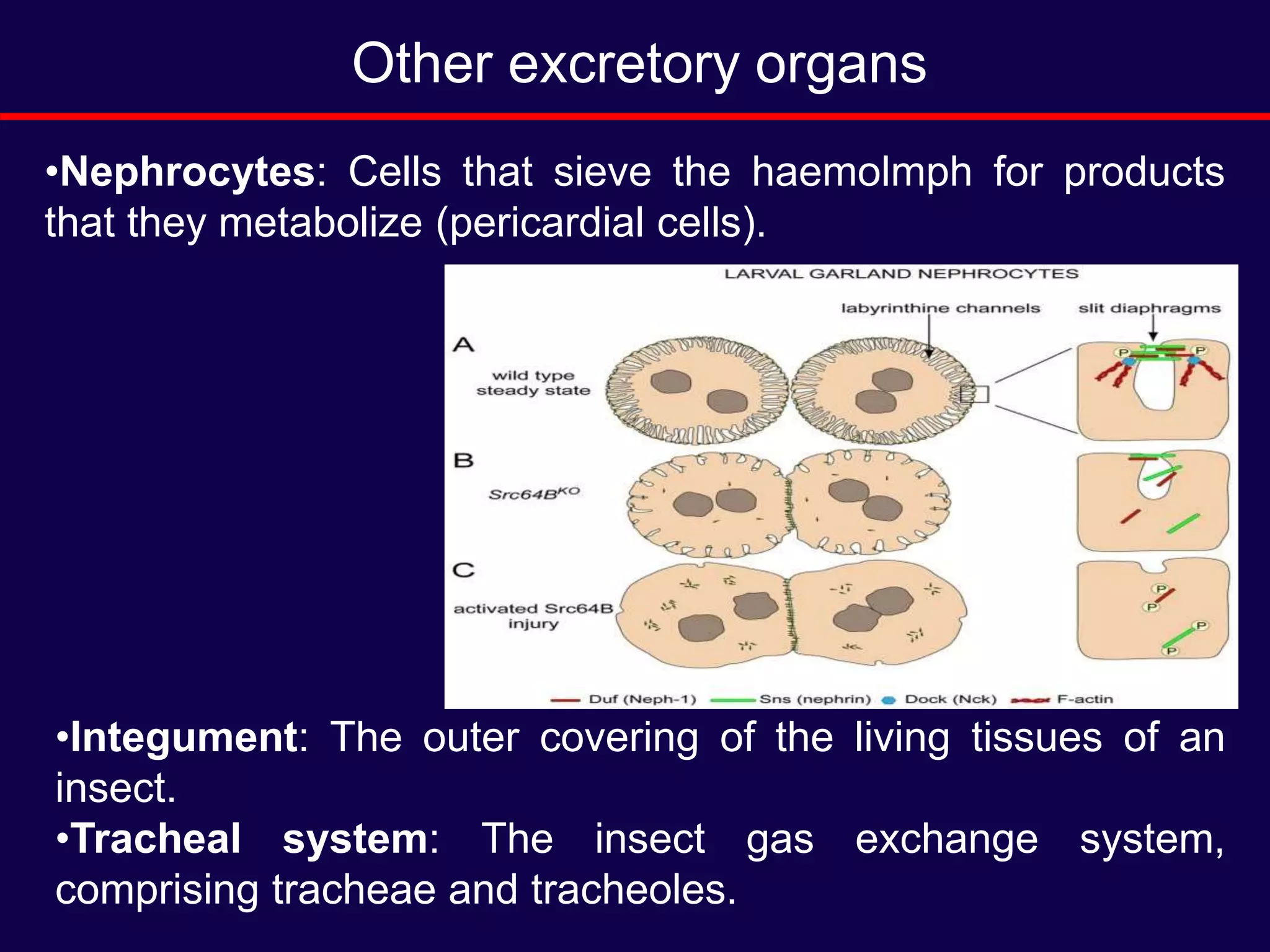
•Nephrocytes: Cells that sieve the haemolmph for products
that they metabolize (pericardial cells).
Other excretory organs
•Integument: The outer covering of the living tissues of an
insect.
•Tracheal system: The insect gas exchange system,
comprising tracheae and tracheoles.
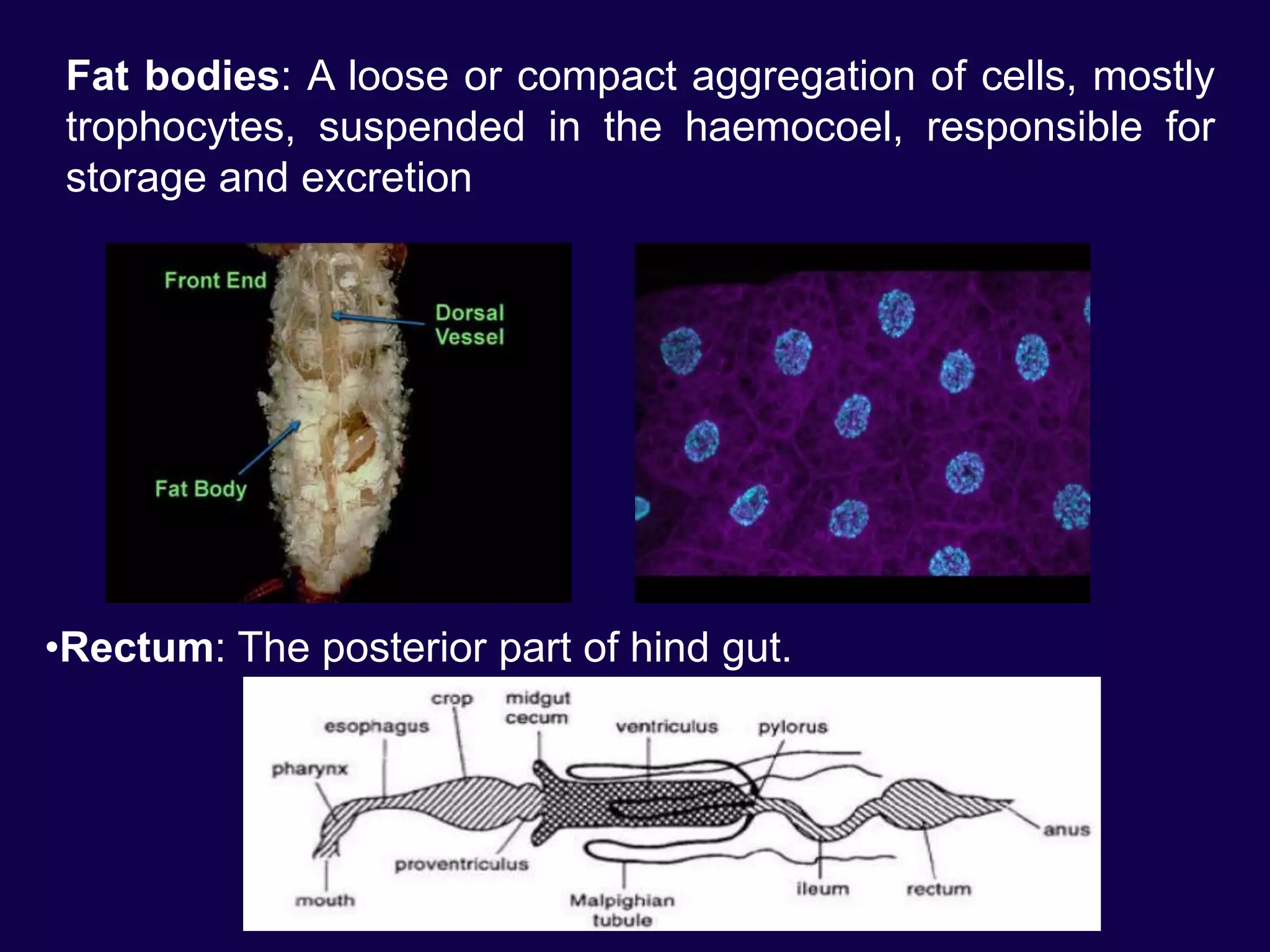
Fat bodies: A loose or compact aggregation of cells, mostly
trophocytes, suspended in the haemocoel, responsible for
storage and excretion
•Rectum: The posterior part of hind gut.
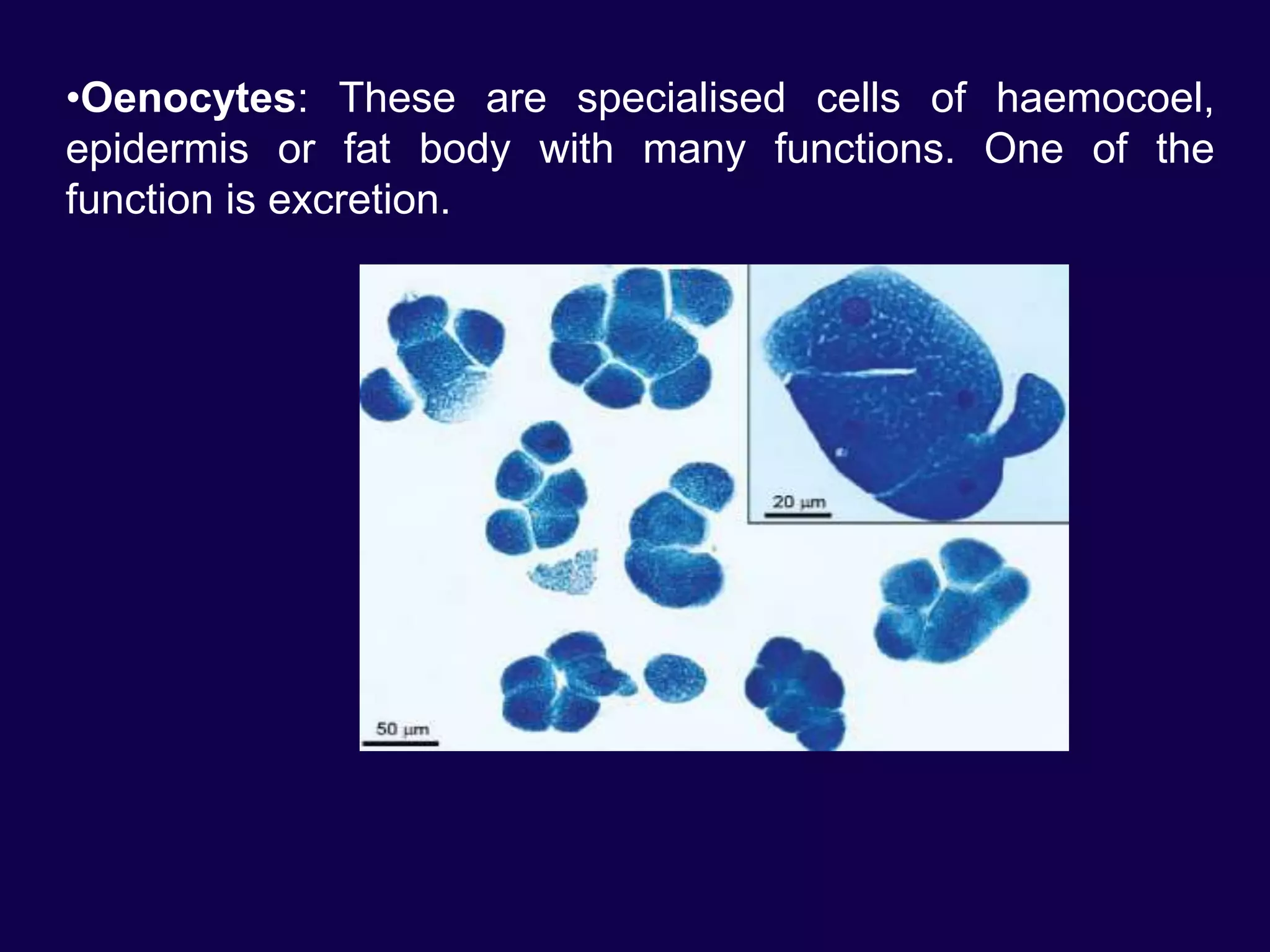
•Oenocytes: These are specialised cells of haemocoel,
epidermis or fat body with many functions. One of the
function is excretion.

Lec. 17 Structure and functions of excretory system in insects.ppt

  • 1.
    R.K. PANSE Assistant Professor(Entomology) College of Agriculture, Balaghat Murjhad Farm Waraseoni Email: rkpanseento@gmail.com Mobile No. : 9806145992 Lecture no. 17 Structure and functions of excretory system in insects
  • 2.
    Excretion Removal of wasteproducts of metabolism, especially nitrogenous compounds from the body of insects is known as excretion. The excretion process helps the insect to maintain salt water balance and thereby physiological homeostasis. Followings are the excretory organs in insect: Main systems Malpighian tubules (major system) Alimentary canal (rectum) Other systems Integument Nephrocytes Fat bodies Oenocytes Tracheal system
  • 3.
     Malpighian tubulesof insects are long tubular epithelium, closed at one end, arise from the gut near the junction of mid- and hindgut, and lie freely in the body cavity, in most insects.  Malpighian tubules are considered to be evaginations of hindgut and hence are ectodermal in origin.  Marcello Malpighi first described these in 1669.  The number of Malpighian tubules in insects may vary, from species to species Spring tail and aphids absent Scale insects 2 Bugs 4 Mosquitoes 5 Moths and butterflies 6 Cockroach 60 Locusts >200 Malpighian tubules
  • 4.
    Malpighian tubule canbe differentiated into two regions, based on their histology and functions. The microvilli in the lower (proximal) one-third absorptive region are more widely spaced, forming a typical “brush border”, comprising the cytoplasmic filaments of varying lengths (7-40μ long). In the remaining two-third distal (upper) secretory region, parallel and closely spaced microvilli (3-10μ) form a striated “honey comb” border. Structure of Malpighian tubules
  • 5.
    Terrestrial insects excretewaste products as uric acid or certain of its salts called urates, which were water insoluble and requires less amount of water for waste product removal. In aquatic insects ammonia is the excretory product, which is freely soluble in water and requires more amount of water for waste product removal. Physiology of Nitrogenous excretion Uric acid + carbonate or bicarbonate= urate Na + or K+ ions secret in to blood by secretory region of MT Urate + Na + or K = K+ urate K+ urate absorbed by secretory region of MT K+ urate breaks in to K+ and urates K+ absorb by absorptive region of MT and urate excreted by rectum.
  • 6.
    Basic nephridial system Cryptonephridialsystem Basic nephridial system: MT free into the blood cavity Types of excretory systemsCryptonephy Cryptonephridial system: The distal ends of the Malpighian tubules are held in contact with the rectal wall. (e.g. Adult Coleptera, larval Lepidoptera and larval symphyta).
  • 7.
    Functions of MT:Excretory in function, removal of nitrogenous wastes. The other accessory functions are as: 1. Spittle secretion in spittle bug 2. Light production in Bolitophila 3. Silk production in larval neuroptera Storage Excretion: The excretory waste materials are retained within the body in different sites. i. Uric acid is stored as urates in the cells of fat body e.g., American cockroach. ii. Uric acid is stored in the body wall, giving white colour. e.g. Red cotton bug. iii. Uric acid is stored in the male accessory glands to produce the outer coat of spermatophore. iv. Uric acid is stored in the wing scales giving white colour. e.g., Pierid butterflies. v. Waste products of pupal metabolism (Meconium) is stored and released during adult emergence.
  • 8.
    •Nephrocytes: Cells thatsieve the haemolmph for products that they metabolize (pericardial cells). Other excretory organs •Integument: The outer covering of the living tissues of an insect. •Tracheal system: The insect gas exchange system, comprising tracheae and tracheoles.
  • 9.
    Fat bodies: Aloose or compact aggregation of cells, mostly trophocytes, suspended in the haemocoel, responsible for storage and excretion •Rectum: The posterior part of hind gut.
  • 10.
    •Oenocytes: These arespecialised cells of haemocoel, epidermis or fat body with many functions. One of the function is excretion.