STRUCTURAL CHANGES IN CHROMOSOME: Changes in Chromosomes Structure
Structural chromosomal aberrations refer to changes in chromosome structure, such as deletions, duplications, translocations, and inversions. Deletions involve the loss of a chromosome segment, duplications the presence of a segment twice, translocations the transfer of a segment between non-homologous chromosomes, and inversions the reversal of a chromosome segment. These changes can impact fertility, viability, phenotype, and karyotype by altering gene dosage, order, and position. Structural aberrations play an important role in evolution by creating genetic variability and changing karyotypes.
2
Introduction
Any type ofchange in structure of a normal chromosome, is referred
to Structural Chromosomal aberration. These changes are also
known as chromosomal mutations or structural chromosomal
changes.
It may take place in both somatic as well as in germ cells.
It occurs during interphase or early prophase.
It occurs due to breakage and reunion of the chromosome
segments caused by radiations or chemicals.
Structural changes causes changes in phenotype, fertility, viability
and karyotype of an individual.
3.
3
Type of StructuralChanges
1. Deletion or Deficiency:- It refers to
loss of portion of segment from a
chromosome. It is also well known as
Deficiency. Deletion or deficiency has
been observed in Drosophila, tomato
and wheat etc.
Based on the locations of loss of
genes, deletion are divided into two
types.
i. Terminal Deletion
ii. Interstitial Deletion
4.
4
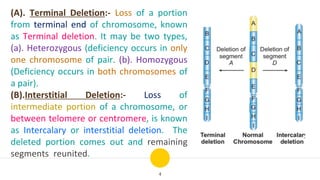
(A). Terminal Deletion:-Loss of a portion
from terminal end of chromosome, known
as Terminal deletion. It may be two types,
(a). Heterozygous (deficiency occurs in only
one chromosome of pair. (b). Homozygous
(Deficiency occurs in both chromosomes of
a pair).
(B).Interstitial Deletion:- Loss of
intermediate portion of a chromosome, or
between telomere or centromere, is known
as Intercalary or interstitial deletion. The
deleted portion comes out and remaining
segments reunited.
5.
5
Effects of Deletion:-
Deletioncauses reduction in pollen fertility.
Small deletion (Heterozygous) is viable while large deletion
(homozygous) is lethal for individual.
Crossing over is also suppressed in presence of deletion due to
loss of corresponding portion in homologous chrmosomes.
Deletion also affect phenotype due to deletion in short arm of
chromosome which causes cri du chat (cry like cat) syndrome in
Man.
Significance:- Deletion are important for creating variability by
chromosomal mutations and used as a cytological tool for gene
mapping.
6.
6
2. Duplication:- Itrefers to the
presence of a segment twice in
the same chrmosome. It is also
known as repeat and reported by
Bridges (1919) in Drosophila. It is
reported in Maize, wheat, rice,
Tradescantia and Nicotiana.
It is four type:-
i. Tandem
ii. Reverse Tandem
iii. Displaced
iv. Reverse Displaced
7.
7
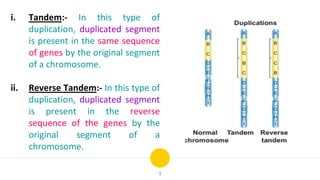
i. Tandem:- Inthis type of
duplication, duplicated segment
is present in the same sequence
of genes by the original segment
of a chromosome.
ii. Reverse Tandem:- In this type of
duplication, duplicated segment
is present in the reverse
sequence of the genes by the
original segment of a
chromosome.
8.
8
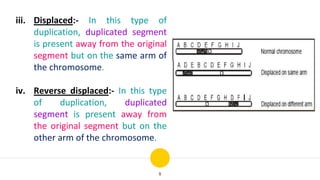
iii. Displaced:- Inthis type of
duplication, duplicated segment
is present away from the original
segment but on the same arm of
the chromosome.
iv. Reverse displaced:- In this type
of duplication, duplicated
segment is present away from
the original segment but on the
other arm of the chromosome.
9.
9
Effects of Duplication
Duplicationincreases the number of genes in the
chromosome.
It causes reduction in the pollen fertility.
Crossing over also suppressed due to duplication of the
corresponding segment of the chromosome.
Duplication is responsible for bar eye in Drosophila which
produces oval shaped eye.
Significance:- Duplication do not reduce viability and are less
harmful than deletions. Duplication leads to addition of some
genes, which may have an important role in evolution.
10.
10
3. Translocation:- Itrefers to the one
way or reciprocal transfer of the
segement between non-
homologous chromosomes. It is
reported in Datura, Maize,
Oenothera, Rye and wheat etc.
Translocation differs from the
crossing over because it involves
non-homologous chromosomes
while crossing over involves non-
sister chromatids of homologous
chromosomes.
11.
11
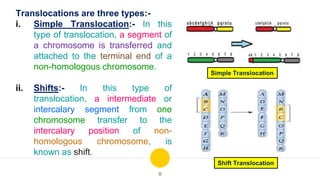
Translocations are threetypes:-
i. Simple Translocation:- In this
type of translocation, a segment of
a chromosome is transferred and
attached to the terminal end of a
non-homologous chromosome.
ii. Shifts:- In this type of
translocation, a intermediate or
intercalary segment from one
chromosome transfer to the
intercalary position of non-
homologous chromosome, is
known as shift.
Shift Translocation
Simple Translocation
12.
12
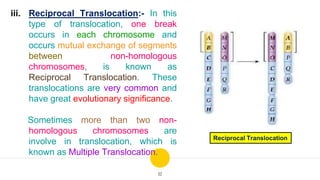
iii. Reciprocal Translocation:-In this
type of translocation, one break
occurs in each chromosome and
occurs mutual exchange of segments
between non-homologous
chromosomes, is known as
Reciprocal Translocation. These
translocations are very common and
have great evolutionary significance.
Sometimes more than two non-
homologous chromosomes are
involve in translocation, which is
known as Multiple Translocation.
Reciprocal Translocation
13.
13
Effects of Translocation:-
Translocationslead to duplication and deletion of genes. Because,
gametes with duplication or deficiency are inviable. So, it leads to
pollen and ovule sterility.
Crossing over is also suppressed in translocated chromosomes.
Translocation change the size of chromosome and position of
centromere also.
Translocation also affect phenotype e.g. Progeny of individual
heterozygote with a translocation involving chromosome number 21,
can arise as Downy Syndrome in Human.
Significance:- Translocations alter the chromosome size,
chromosome number and karyotype and thus plays an important role
in formation of species.
14.
14
4. Inversion:- Itrefers to the structural
change in a chromosome in which a
segment is oriented in a reverse
sequence. Inversion firstly
discovered by Sturtevant (1926) in
Drosophila. Now, it is reported in
Maize and Nicotiana etc.
Based on whether centromere is
involved or not involved in
inversions, It is classified into two
types:-
i. Paracentric Inversion
ii. Pericentric Inversion
15.
15
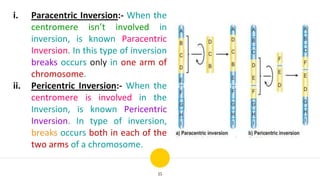
i. Paracentric Inversion:-When the
centromere isn’t involved in
inversion, is known Paracentric
Inversion. In this type of inversion
breaks occurs only in one arm of
chromosome.
ii. Pericentric Inversion:- When the
centromere is involved in the
Inversion, is known Pericentric
Inversion. In type of inversion,
breaks occurs both in each of the
two arms of a chromosome.
16.
16
Effects of Inversion
Thecrossing over in the inversion leads to formation of
chromosomes with duplications and deficiency, which causes
individual inviable and leads to 50% sterility.
Gene order is changed in the inverted segment of a
chromosome.
Pericentric inversions changes the karyotype by shifting the
position of centromere.
Significance:- Inversion also play an important role in the
evolution of new species by changing the karyotype of an
individual.
17.
Any suggestions orquestions?
You can find me at:-
◉ Twitter
◉ Email
Thanks!
17