Lecture 6. Variationin chromosome
structure – deletion, duplication,
inversion and translocation – genetic
and cytological implications
2.
Any change whichalters the normal
structure of a chromosome is known as
structural chromosome change.
Such changes are also called
Chromosomal mutations or
Chromosomal aberrations
3.
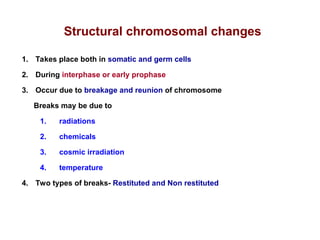
1. Takes placeboth in somatic and germ cells
2. During interphase or early prophase
3. Occur due to breakage and reunion of chromosome
Breaks may be due to
1. radiations
2. chemicals
3. cosmic irradiation
4. temperature
4. Two types of breaks- Restituted and Non restituted
Structural chromosomal changes
4.
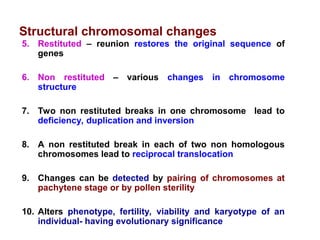
5. Restituted –reunion restores the original sequence of
genes
6. Non restituted – various changes in chromosome
structure
7. Two non restituted breaks in one chromosome lead to
deficiency, duplication and inversion
8. A non restituted break in each of two non homologous
chromosomes lead to reciprocal translocation
9. Changes can be detected by pairing of chromosomes at
pachytene stage or by pollen sterility
10. Alters phenotype, fertility, viability and karyotype of an
individual- having evolutionary significance
Structural chromosomal changes
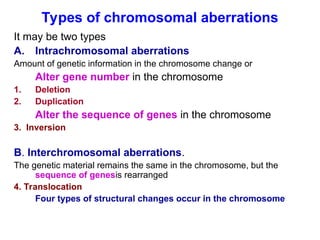
Types of chromosomalaberrations
It may be two types
A. Intrachromosomal aberrations
Amount of genetic information in the chromosome change or
Alter gene number in the chromosome
1. Deletion
2. Duplication
Alter the sequence of genes in the chromosome
3. Inversion
B. Interchromosomal aberrations.
The genetic material remains the same in the chromosome, but the
sequence of genesis rearranged
4. Translocation
Four types of structural changes occur in the chromosome
7.
A. Intrachromosomal Aberrations
Whenaberrations remain confined to a
single chromosome of a homologous
pair, they are called
intrachromosomal / homosomal
aberrations.
1. Deficiencies/ Deletion
2. Duplication
8.
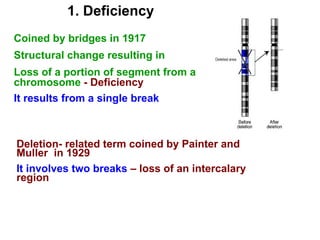
1. Deficiency
Coined bybridges in 1917
Structural change resulting in
Loss of a portion of segment from a
chromosome - Deficiency
It results from a single break
Deletion- related term coined by Painter and
Muller in 1929
It involves two breaks – loss of an intercalary
region
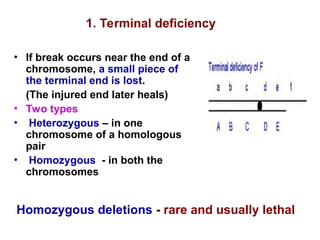
• If breakoccurs near the end of a
chromosome, a small piece of
the terminal end is lost.
(The injured end later heals)
• Two types
• Heterozygous – in one
chromosome of a homologous
pair
• Homozygous - in both the
chromosomes
Homozygous deletions - rare and usually lethal
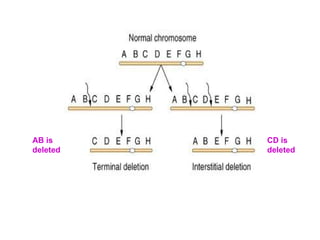
1. Terminal deficiency
13.
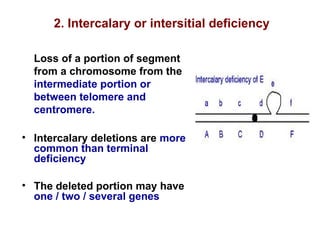
Loss of aportion of segment
from a chromosome from the
intermediate portion or
between telomere and
centromere.
• Intercalary deletions are more
common than terminal
deficiency
• The deleted portion may have
one / two / several genes
2. Intercalary or intersitial deficiency
14.
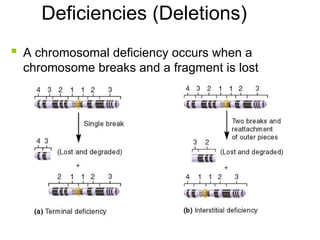
A chromosomaldeficiency occurs when a
chromosome breaks and a fragment is lost
Deficiencies (Deletions)
15.
Phenotypic consequencesof deficiency depends
on
Size of the deletion
Functions of the genes deleted
Phenotypic effect of deletions usually detrimental
Pollen sterility in Maize
Different syndromes in human
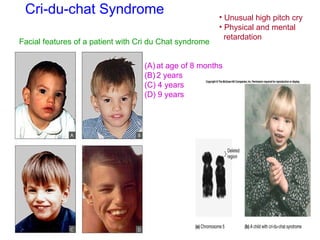
1. Cri-du-chat Syndrome: deletion in short arm of
Chromosome 5
2. Antimongolism: deletion in long arm of Chromosome 5-
occur mostly in females
Phenotypic effect of Deficiencies
16.
Cri-du-chat Syndrome
(A) atage of 8 months
(B) 2 years
(C) 4 years
(D) 9 years
Facial features of a patient with Cri du Chat syndrome
• Unusual high pitch cry
• Physical and mental
retardation
17.
Detection of Deletion
Detectedin two ways
1. Cytological method
Meiotic pairing and chromosome length
2. Genetic method
Deletion of dominant gene, results in the
expression of recessive gene – change in
the phenotype
18.
Genetic effects dueto Deletion/ Deficiency
1. Fertility : reduced pollen fertility
2. Viability: Organisms with homozygous deficiency
usually do not survive to an adult stage because a
complete set of genes is lacking.
3. Crossing over: is suppressed in the region of
deficiency
4. Phenotype: absence of a dominant gene due to deletion
results in the expression of recessive genes, resulting
in change in phenotype.
Eg: Cat Cry in human
5. Change in karyotype: Gene number and karyotype of an
individual gets changed
19.
1. Important rolein species formation and
releasing variability through chromosomal
mutation
2. Cytological tool for mapping genes (for
locating genes) in a CHS
3. Study of chromosome pairing and its
behaviour during cell division
Significance of Deletion
20.
2. Duplications (Additions)
•Occurrence of a segment twice in the same
chromosome
• It results in addition of one or more genes to a
chromosome
• Also called as Repeats
• Reported by Bridges (1919) in Drosophila
• Recent reports on several crops – Rice , Wheat, Maize,
Tobacco, Tradescantia, Barley
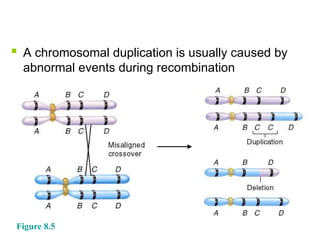
21.
A chromosomalduplication is usually caused by
abnormal events during recombination
Figure 8.5
22.
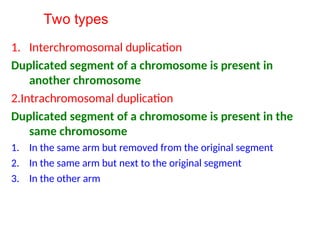
Two types
1. Interchromosomalduplication
Duplicated segment of a chromosome is present in
another chromosome
2.Intrachromosomal duplication
Duplicated segment of a chromosome is present in the
same chromosome
1. In the same arm but removed from the original segment
2. In the same arm but next to the original segment
3. In the other arm
23.
Duplications are of4 types
1. Tandem
2. Reverse tandem
3. Displaced
4. Reverse displaced
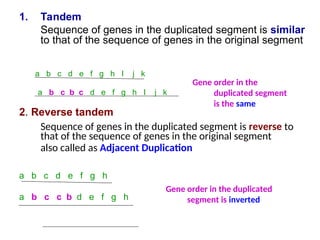
24.
1. Tandem
Sequence ofgenes in the duplicated segment is similar
to that of the sequence of genes in the original segment
2. Reverse tandem
Sequence of genes in the duplicated segment is reverse to
that of the sequence of genes in the original segment
also called as Adjacent Duplication
a b c d e f g h I j k
a b c b c d e f g h I j k
a b c d e f g h
a b c c b d e f g h
Gene order in the
duplicated segment
is the same
Gene order in the duplicated
segment is inverted
25.
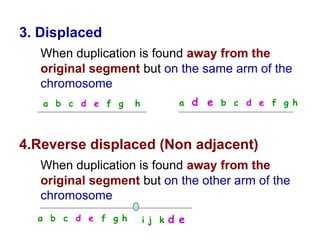
3. Displaced
When duplicationis found away from the
original segment but on the same arm of the
chromosome
4.Reverse displaced (Non adjacent)
When duplication is found away from the
original segment but on the other arm of the
chromosome
a b c d e f g h a d e b c d e f g h
a b c d e f g h i j k d e
26.
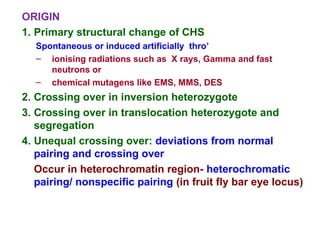
ORIGIN
1. Primary structuralchange of CHS
Spontaneous or induced artificially thro’
– ionising radiations such as X rays, Gamma and fast
neutrons or
– chemical mutagens like EMS, MMS, DES
2. Crossing over in inversion heterozygote
3. Crossing over in translocation heterozygote and
segregation
4. Unequal crossing over: deviations from normal
pairing and crossing over
Occur in heterochromatin region- heterochromatic
pairing/ nonspecific pairing (in fruit fly bar eye locus)
27.
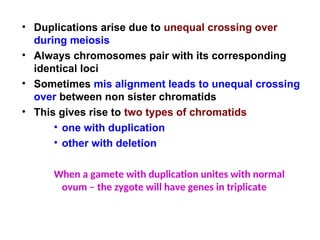
• Duplications arisedue to unequal crossing over
during meiosis
• Always chromosomes pair with its corresponding
identical loci
• Sometimes mis alignment leads to unequal crossing
over between non sister chromatids
• This gives rise to two types of chromatids
• one with duplication
• other with deletion
When a gamete with duplication unites with normal
ovum – the zygote will have genes in triplicate
28.
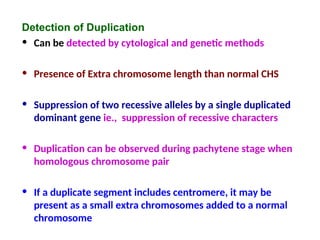
Detection of Duplication
•Can be detected by cytological and genetic methods
• Presence of Extra chromosome length than normal CHS
• Suppression of two recessive alleles by a single duplicated
dominant gene ie., suppression of recessive characters
• Duplication can be observed during pachytene stage when
homologous chromosome pair
• If a duplicate segment includes centromere, it may be
present as a small extra chromosomes added to a normal
chromosome
29.
Genetic effects ofDuplications
Duplications affect
1.Phenotype
2.Crossing over: suppressed in the duplicated region
3.Gene number: number of genes increase in the
duplicated region
4.Pollen fertility: reduction in pollen fertility
30.
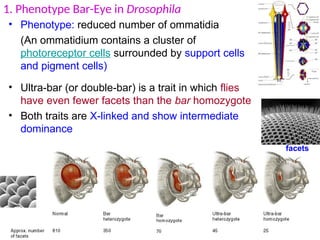
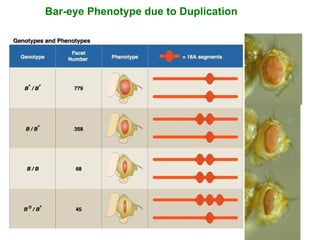
1. Phenotype Bar-Eyein Drosophila
• Phenotype: reduced number of ommatidia
(An ommatidium contains a cluster of
photoreceptor cells surrounded by support cells
and pigment cells)
• Ultra-bar (or double-bar) is a trait in which flies
have even fewer facets than the bar homozygote
• Both traits are X-linked and show intermediate
dominance
facets
2. Crossing overis suppressed in the duplicated region due to
lack of corresponding duplicated segment in the normal
chromosome
3. The gene number is increased in the chromosome having
duplication
4. Presence of duplication leads to reduction in pollen fertility in
plants
33.
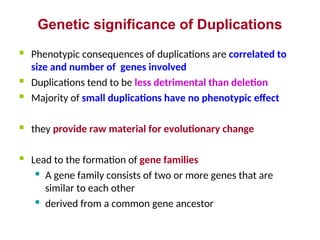
Genetic significance ofDuplications
Phenotypic consequences of duplications are correlated to
size and number of genes involved
Duplications tend to be less detrimental than deletion
Majority of small duplications have no phenotypic effect
they provide raw material for evolutionary change
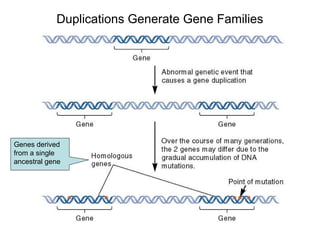
Lead to the formation of gene families
A gene family consists of two or more genes that are
similar to each other
derived from a common gene ancestor
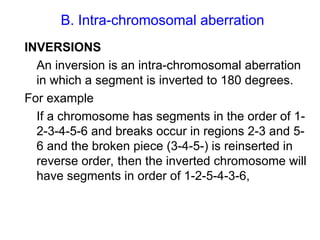
B. Intra-chromosomal aberration
INVERSIONS
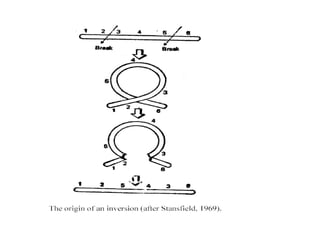
Aninversion is an intra-chromosomal aberration
in which a segment is inverted to 180 degrees.
For example
If a chromosome has segments in the order of 1-
2-3-4-5-6 and breaks occur in regions 2-3 and 5-
6 and the broken piece (3-4-5-) is reinserted in
reverse order, then the inverted chromosome will
have segments in order of 1-2-5-4-3-6,
37.
• In adiploid organism, out of two homologous
chromosomes, one chromosome undergoes the
inversion, then, it is called inversion
heterozygote.
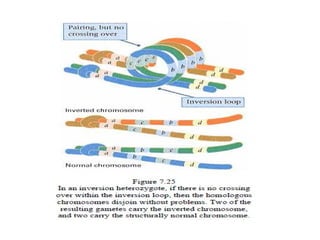
• During synapsis of such a homologous pair
having inversion heterozygote, the synapsis
configuration attempts to maximize the pairing
between homologous regions in the two
chromosomes.
• This is usually accomplished by a characteristic
inversion loop in one of the chromosome.
38.
Types of inversions
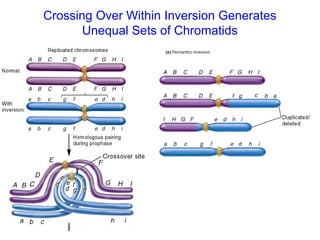
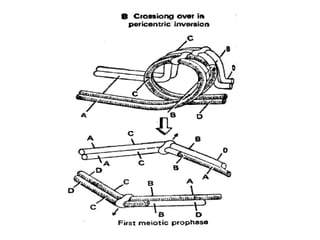
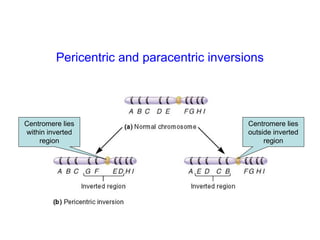
i)Pericentric inversions
• When the inverted segment of chromosome includes or
contains centromere, then such inversions are called
heterobranchial or pericentric inversions.
• If crossing over occurs within the loop of a pericentric
inversion, the resulted chromatids include half of the
chromatids with duplications and deficiencies forming
nonfunction.
• The other half of the chromatids form functional
gametes: ¼ gametes have normal chromosome order,
¼ gametes have the inverted arrangement.
ii) Paracentric inversions
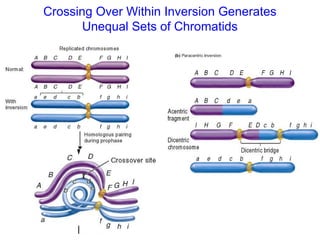
•When the inverted segment includes no centromere and the
• centromere remains located outside the segment, then such type of inversion is
called homobranchial or paracentric inversion.
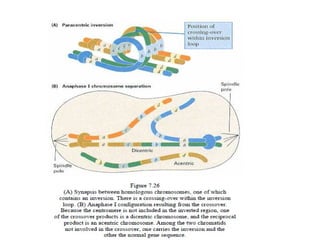
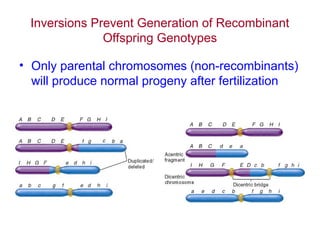
• Crossing over within the inverted segment of a paracentric inversion, produces
a dicentric chromosome contains two centromeres and forms a bridge from
one pole to the other during first meiotic anaphase.
• When anaphase chromosomes separate towards poles, this bridge breaks
somewhere along its length and the resulting fragments contain duplications
and/ or deficiencies.
• The acentric chromosome because lacks in centromere and fails to move to
either pole and so, it is not included in the meiotic products.
• Such, breakage-fusion bridge cycles of crossing over of paracentric inversions
are most common in maize.
• The meiotic products includes half non-functional, ¼ functional normal and ¼
functional inverted chromosomes.
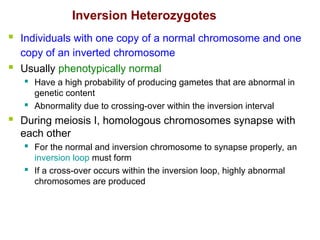
Individuals withone copy of a normal chromosome and one
copy of an inverted chromosome
Usually phenotypically normal
Have a high probability of producing gametes that are abnormal in
genetic content
Abnormality due to crossing-over within the inversion interval
During meiosis I, homologous chromosomes synapse with
each other
For the normal and inversion chromosome to synapse properly, an
inversion loop must form
If a cross-over occurs within the inversion loop, highly abnormal
chromosomes are produced
Inversion Heterozygotes
47.
Inversions Prevent Generationof Recombinant
Offspring Genotypes
• Only parental chromosomes (non-recombinants)
will produce normal progeny after fertilization
48.
Genetic significance ofinversions
i) Simple inversions do not have primary phenotypic effects other than on
chromosome shape. However, some DNA at a break point has been
damaged and this may result in an observable mutation, often
recessive (e.g., lethal mutation in Drosophila).
ii) Due to inversion a peculiar kind of position effect occurs. The position
effect is caused by the transfer of a gene from a euchromatic segment
to the vicinity of heterochromatic segment. Heterochromatinization
may then extend into a displaced, originally euchromatic region and
suppress the transcription of the gene in it.
iii) Normal linear pairing is not possible in inversion heterozygotes. The
difficulties encountered with pairing cause a reduction of exchange
(crossing over) in and around the inversion.
iv) They maintain heterozygosity from generations to generations.
49.
B. Interchromosomal aberrations
Whenbreaks occur in non-homologous chromosomes and
resulting fragments are interchanged by
both of the non-Homologous chromosomes,
the inter-chromosomal or heterosomal aberrations will occur.
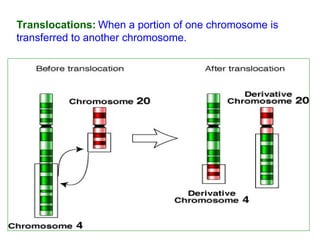
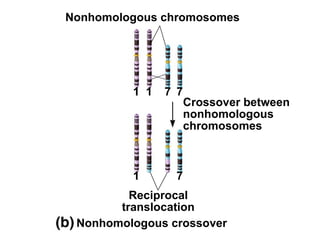
TRANSLOCATION
• Translocation involvesthe shifting of a part
of one chromosome to another non
homologous chromosome.
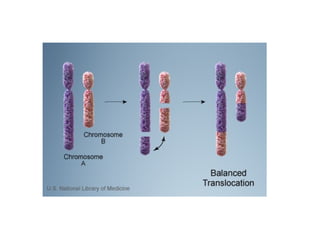
• If two non-homologous chromosomes
exchange parts, which need not be of the
same size, the result is a reciprocal
translocation.
52.
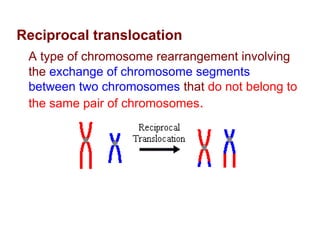
Reciprocal translocation
A typeof chromosome rearrangement involving
the exchange of chromosome segments
between two chromosomes that do not belong to
the same pair of chromosomes.
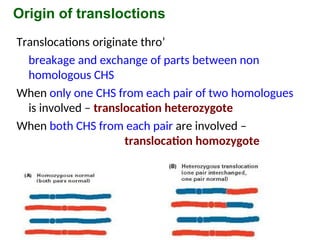
Origin of transloctions
Translocationsoriginate thro’
breakage and exchange of parts between non
homologous CHS
When only one CHS from each pair of two homologues
is involved – translocation heterozygote
When both CHS from each pair are involved –
translocation homozygote
56.
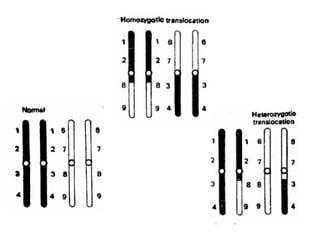
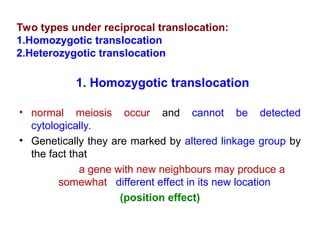
1. Homozygotic translocation
•normal meiosis occur and cannot be detected
cytologically.
• Genetically they are marked by altered linkage group by
the fact that
a gene with new neighbours may produce a
somewhat different effect in its new location
(position effect)
Two types under reciprocal translocation:
1.Homozygotic translocation
2.Heterozygotic translocation
57.
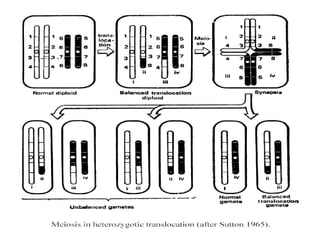
2. Heterozygotic translocation
•considerable degree of meiotic irregularity occur.
• During meiosis, an individual which is heterozygous for a
reciprocal translocation must form a cross-shaped
configuration
• In order to affect pairing of all homologous segments. this
cross-shaped configuration often opens out into a ring as
chiasmata terminalize.
• The meiotic products (gametes) are of three types
1. normal,
2. balanced
3. unbalanced gametes
60.
GENETIC EFFECTS
.
1.STERILITY: pollenand ovule sterility, reduced
yield – deletion / duplication of genes
2. CROSSING OVER: suppressed due to
competition in pairing
3. KARYOTYPE: size of the chromosome and
position of the centromere gets altered
4. PHENOTYPE: changes the phenotype- Downs
syndrome
61.
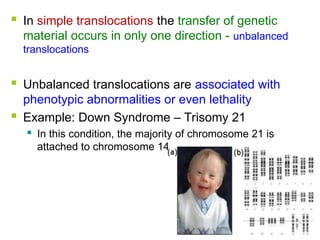
In simpletranslocations the transfer of genetic
material occurs in only one direction - unbalanced
translocations
Unbalanced translocations are associated with
phenotypic abnormalities or even lethality
Example: Down Syndrome – Trisomy 21
In this condition, the majority of chromosome 21 is
attached to chromosome 14
62.
This translocationoccurs as such
Breaks occur at the extreme ends of the short arms of
two non-homologous acrocentric chromosomes
The small acentric fragments are lost
The larger fragments fuse at their centromeic regions to
form a single chromosome
This type of translocation is the most common type
of chromosomal rearrangement in humans
63.
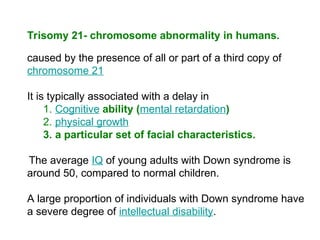
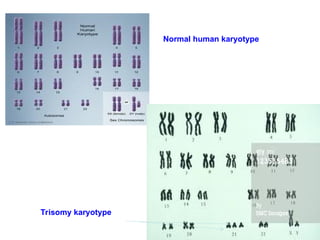
Trisomy 21- chromosomeabnormality in humans.
caused by the presence of all or part of a third copy of
chromosome 21
It is typically associated with a delay in
1. Cognitive ability (mental retardation)
2. physical growth
3. a particular set of facial characteristics.
The average IQ of young adults with Down syndrome is
around 50, compared to normal children.
A large proportion of individuals with Down syndrome have
a severe degree of intellectual disability.
Individuals carryingbalanced translocations have a
greater risk of producing gametes with unbalanced
combinations of chromosomes
This depends on the segregation pattern during meiosis I
During meiosis I, homologous chromosomes
synapse with each other
For the translocated chromosome to synapse properly, a
translocation cross must form
Balanced Translocations and Gamete
Production
67.
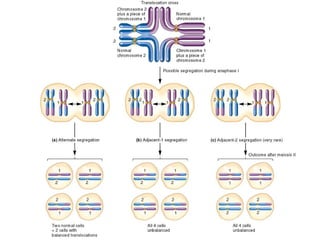
Meiotic segregationcan occur in one of three ways
1. Alternate segregation
Chromosomes on opposite sides of the translocation cross
segregate into the same cell
Leads to balanced gametes
Both contain a complete set of genes and are thus viable
2. Adjacent-1 segregation
Adjacent non-homologous chromosomes segregate into the
same cell
Leads to unbalanced gametes
Both have duplications and deletions and are thus inviable
3. Adjacent-2 segregation
Adjacent homologous chromosomes segregate into the same
cell
Leads to unbalanced gametes
Both have duplications and deletions and are thus inviable
68.
Genetic significance ofTranslocation
1. Alter the chromosome size, chromosome number and
karyotype, thus play an important role in the formation
of species
2. Tanslocation homozygotes lead to establishment of new
linkage relationship
3. They are useful in locating the position of genes,
centromere and other genetic markers in the
chromosome
4. They are useful tools in breeding programmes for
transfer of desirable characters from one species to
another
69.
Role of structuralchromosomal aberrations in plant
breeding
1. They are useful in the identification of chromosomes
2. Utilization of vigour as in case of duplication.
3. Useful in genome analysis.
4. Useful for the transfer of desirable characters
through translocation.
5. They have evolutionary significance.