PLOIDY AND ITS TYPES
SUBMITTED BY: MA.NITYA
K. RAJ BHARANI
SABAREESHA
SAM
SANTHOSH
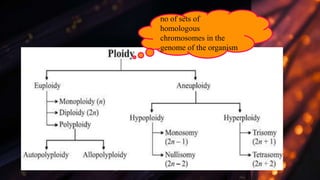
no of sets of
homologous
chromosomes in the
genome of the organism
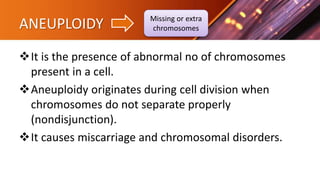
It is the presence of abnormal no of chromosomes
present in a cell.
Aneuploidy originates during cell division when
chromosomes do not separate properly
(nondisjunction).
It causes miscarriage and chromosomal disorders.
ANEUPLOIDY Missing or extra
chromosomes
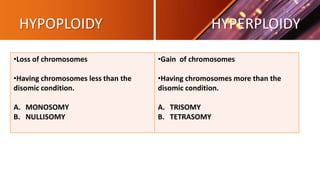
HYPOPLOIDY HYPERPLOIDY
•Loss of chromosomes
•Having chromosomes less than the
disomic condition.
A. MONOSOMY
B. NULLISOMY
•Gain of chromosomes
•Having chromosomes more than the
disomic condition.
A. TRISOMY
B. TETRASOMY
MONOSOMY
• Monosomy means that an organism is
missing one chromosome in a pair.
• The chromosome is completely or
partially lost.
2N – 1
Eg. Turners syndrome
TURNERS SYNDROME. Turner syndrome, a condition that
affects only females, results when one
of the X chromosomes (sex
chromosomes) is missing or partially
missing
 short height
 failure of the ovaries
to develop
heart defects
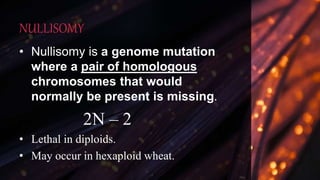
NULLISOMY
• Nullisomy is a genome mutation
where a pair of homologous
chromosomes that would
normally be present is missing.
2N – 2
• Lethal in diploids.
• May occur in hexaploid wheat.
TRISOMY
• Trisomy is the presence of three
chromosomes instead of the usual pair of
chromosomes ( 1 extra chromosome).
2N + 1
Eg. Down syndrome
Edward syndrome
Klinefleter syndrome
DOWN SYNDROME
Down syndrome is a genetic
disorder caused when abnormal cell
division results in an extra full or
partial copy of chromosome 21.
distinct facial appearance
intellectual disability
developmental delays
 thyroid
heart disease.
EDWARD SYNDROME
KLINEFLETER SYNDROME
• Klinefelter syndrome is a genetic
condition in which a boy is born with
an extra X chromosome.
XXY 47
 low testosterone
 reduced muscle mass, facial hair and body
hair.
 Breast growth
TETRASOMY
• Tetrasomy is a type of aneuploidy
where there is a gain of extra two
chromosomes of the same type.
2N + 2
Eg. Pallister killian syndrome
Cat eye syndrome.
PALLISTER KILLIAN SYNDROME
presence of at
least four copies of
the short arm of
chromosome 12
instead of the
normal two.
have low muscle
tone at birth
(hypotonia),
sparse scalp hair, a
high forehead, a
coarse face.
large ears with lobes
that are thick and
protrude outward.
can experience
problems with
feeding, breathing,
walking and standing
CAT EYE SYNDROME
usually appears as a cleft or
gap in the iris below the pupil,
and the elongated pupil
therefore resembles the
appearance of a cat's eye.
Unusually shaped ears.
Conductive hearing
loss.
Hypertelorism (widely
EUPLOIDY
 Euploidy is a chromosomal variation that involves the entire set of
chromosomes in a cell or an organism.
 i.e. loss or gain of the full set of chromosomes. It mostly occurs in plants.
i. MONOPLOIDY
ii. DIPLOIDY
iii. PLOYPLOIDY
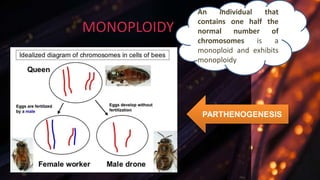
MONOPLOIDY
An individual that
contains one half the
normal number of
chromosomes is a
monoploid and exhibits
monoploidy
PARTHENOGENESIS
DIPLOID
• The state of being diploid, that is
having two sets of the
chromosomes (and therefore two
copies of genes).
• eg. Somatic cells
POLYPLOIDY
• Polyploidy is a condition in which the cells of an organism
have more than two paired sets of chromosomes.
• Polyploidy arises as the result of total nondisjunction
of chromosomes during mitosis or meiosis.
• Normally a hybrid is sterile because it does not have the
required homologous pairs of chromosomes for
successful gamete formation during meiosis.
• Through polyploidy, the plant duplicates
the chromosome . Thus, polyploidy confers fertility.
THANK YOU

ploidy

  • 1.
    PLOIDY AND ITSTYPES SUBMITTED BY: MA.NITYA K. RAJ BHARANI SABAREESHA SAM SANTHOSH
  • 2.
    no of setsof homologous chromosomes in the genome of the organism
  • 3.
    It is thepresence of abnormal no of chromosomes present in a cell. Aneuploidy originates during cell division when chromosomes do not separate properly (nondisjunction). It causes miscarriage and chromosomal disorders. ANEUPLOIDY Missing or extra chromosomes
  • 4.
    HYPOPLOIDY HYPERPLOIDY •Loss ofchromosomes •Having chromosomes less than the disomic condition. A. MONOSOMY B. NULLISOMY •Gain of chromosomes •Having chromosomes more than the disomic condition. A. TRISOMY B. TETRASOMY
  • 5.
    MONOSOMY • Monosomy meansthat an organism is missing one chromosome in a pair. • The chromosome is completely or partially lost. 2N – 1 Eg. Turners syndrome
  • 6.
    TURNERS SYNDROME. Turnersyndrome, a condition that affects only females, results when one of the X chromosomes (sex chromosomes) is missing or partially missing  short height  failure of the ovaries to develop heart defects
  • 7.
    NULLISOMY • Nullisomy isa genome mutation where a pair of homologous chromosomes that would normally be present is missing. 2N – 2 • Lethal in diploids. • May occur in hexaploid wheat.
  • 8.
    TRISOMY • Trisomy isthe presence of three chromosomes instead of the usual pair of chromosomes ( 1 extra chromosome). 2N + 1 Eg. Down syndrome Edward syndrome Klinefleter syndrome
  • 9.
    DOWN SYNDROME Down syndromeis a genetic disorder caused when abnormal cell division results in an extra full or partial copy of chromosome 21. distinct facial appearance intellectual disability developmental delays  thyroid heart disease.
  • 10.
  • 11.
    KLINEFLETER SYNDROME • Klinefeltersyndrome is a genetic condition in which a boy is born with an extra X chromosome. XXY 47  low testosterone  reduced muscle mass, facial hair and body hair.  Breast growth
  • 12.
    TETRASOMY • Tetrasomy isa type of aneuploidy where there is a gain of extra two chromosomes of the same type. 2N + 2 Eg. Pallister killian syndrome Cat eye syndrome.
  • 13.
    PALLISTER KILLIAN SYNDROME presenceof at least four copies of the short arm of chromosome 12 instead of the normal two. have low muscle tone at birth (hypotonia), sparse scalp hair, a high forehead, a coarse face. large ears with lobes that are thick and protrude outward. can experience problems with feeding, breathing, walking and standing
  • 14.
    CAT EYE SYNDROME usuallyappears as a cleft or gap in the iris below the pupil, and the elongated pupil therefore resembles the appearance of a cat's eye. Unusually shaped ears. Conductive hearing loss. Hypertelorism (widely
  • 15.
    EUPLOIDY  Euploidy isa chromosomal variation that involves the entire set of chromosomes in a cell or an organism.  i.e. loss or gain of the full set of chromosomes. It mostly occurs in plants. i. MONOPLOIDY ii. DIPLOIDY iii. PLOYPLOIDY
  • 16.
    MONOPLOIDY An individual that containsone half the normal number of chromosomes is a monoploid and exhibits monoploidy PARTHENOGENESIS
  • 17.
    DIPLOID • The stateof being diploid, that is having two sets of the chromosomes (and therefore two copies of genes). • eg. Somatic cells
  • 18.
    POLYPLOIDY • Polyploidy isa condition in which the cells of an organism have more than two paired sets of chromosomes. • Polyploidy arises as the result of total nondisjunction of chromosomes during mitosis or meiosis. • Normally a hybrid is sterile because it does not have the required homologous pairs of chromosomes for successful gamete formation during meiosis. • Through polyploidy, the plant duplicates the chromosome . Thus, polyploidy confers fertility.
  • 20.