NUMERICAL VARIATIONS
Terminology:
• Ploidy : no.of sets of chromosomes in a biological cell.
• Monoploidy polyploidy aneuploidy
• Euploidy : Euploidy is the state of a cell or organism
having an integral multiple of the monoploid number.
- a human cell has 46 chromosomes,
which is an integral multiple of the monoploid number, 23.
-Monoploidy common in plants barley (7), Corn (10)
rare in animals
Production of monoploids
X-rays Delayed Pollination Cold treatment colchicine
Distant hybridization Anther or pollen culture
Smaller features/ small cells/ organelles sterile unequal
meiotic chromosomal distribution
NUMERICAL ABNORMALITIES
• Monoploid - basic single set - Monoploid (N)
• Euploidy - genome containing chromosomes that are
multiple of basic single set -
ex: Monoploid (N) or Diploid (2N)
• Polyploidy -
Triploidy (3N) –Three sets
Tetraploidy (4N) – Four sets
• Numerical abnormality or changes
chromosomal changes which involve the addition or
loss of complete sets of chromosomes.
• Polyploidy : Presence of extra sets of
chromosomes in cells
• diploidy (2n)
• triploidy (3n)
• tetraploidy (4n)
• pentaploidy (5n)
• hexaploidy (6n)
• heptaploidy (7n)
• octaploidy (8n)
• Aneuploidy : Presence of extra or missing
chromosomes
• e.g. monosomy (second most common)
• e.g. trisomy (most common)
Kinds of Polyploids
1) Autopolyploids- polyploidy as a result of duplications
in the SAME species
2) Allopolyploids- polyploid formed by hybridization
BETWEEN TWO Species
A typical allopolyploid species is derived from
hybridization from two or more diploid species with
chromosome doubling following the hybridization
Gigantism Bigger plant parts /more vigor less fertility
Autopolyploidy
• All chromosomes come from same ancestral diploid species
• Homologous copies of each chromosome
• Meiotic pairing, can form bivalents, trivalents, quadrivalents,
• Univalents
• Natural Induced (colchicine) mitotic spindle
• Chrysanthimum
• Autotriploids (artificial) seedless watermelons, tomato, grapes
and banana
• Autotetraploids(artificial) corn, rye, grapes , apples and
marigolds
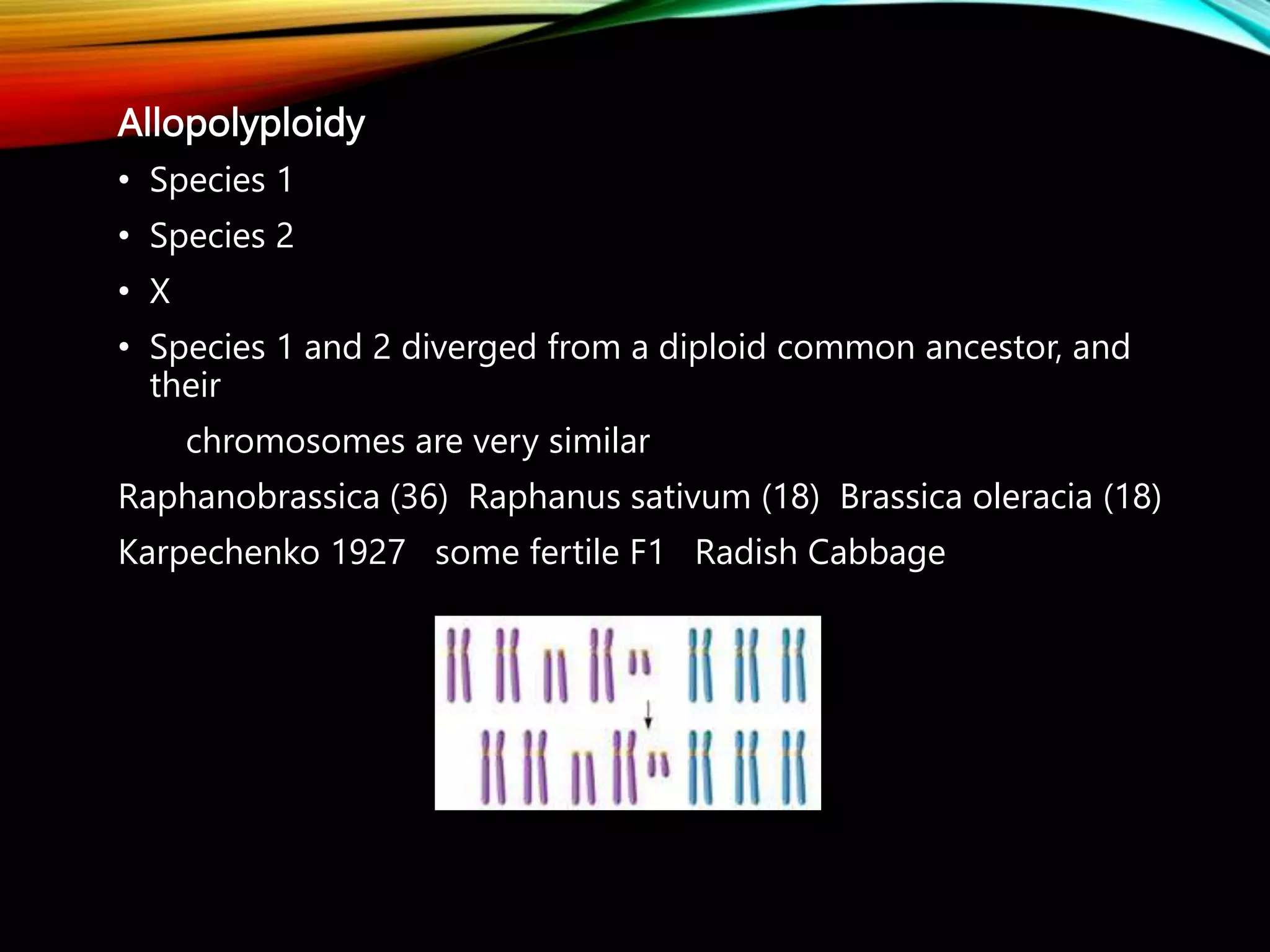
Allopolyploidy
• Species 1
• Species 2
• X
• Species 1 and 2 diverged from a diploid common ancestor, and
their
chromosomes are very similar
Raphanobrassica (36) Raphanus sativum (18) Brassica oleracia (18)
Karpechenko 1927 some fertile F1 Radish Cabbage
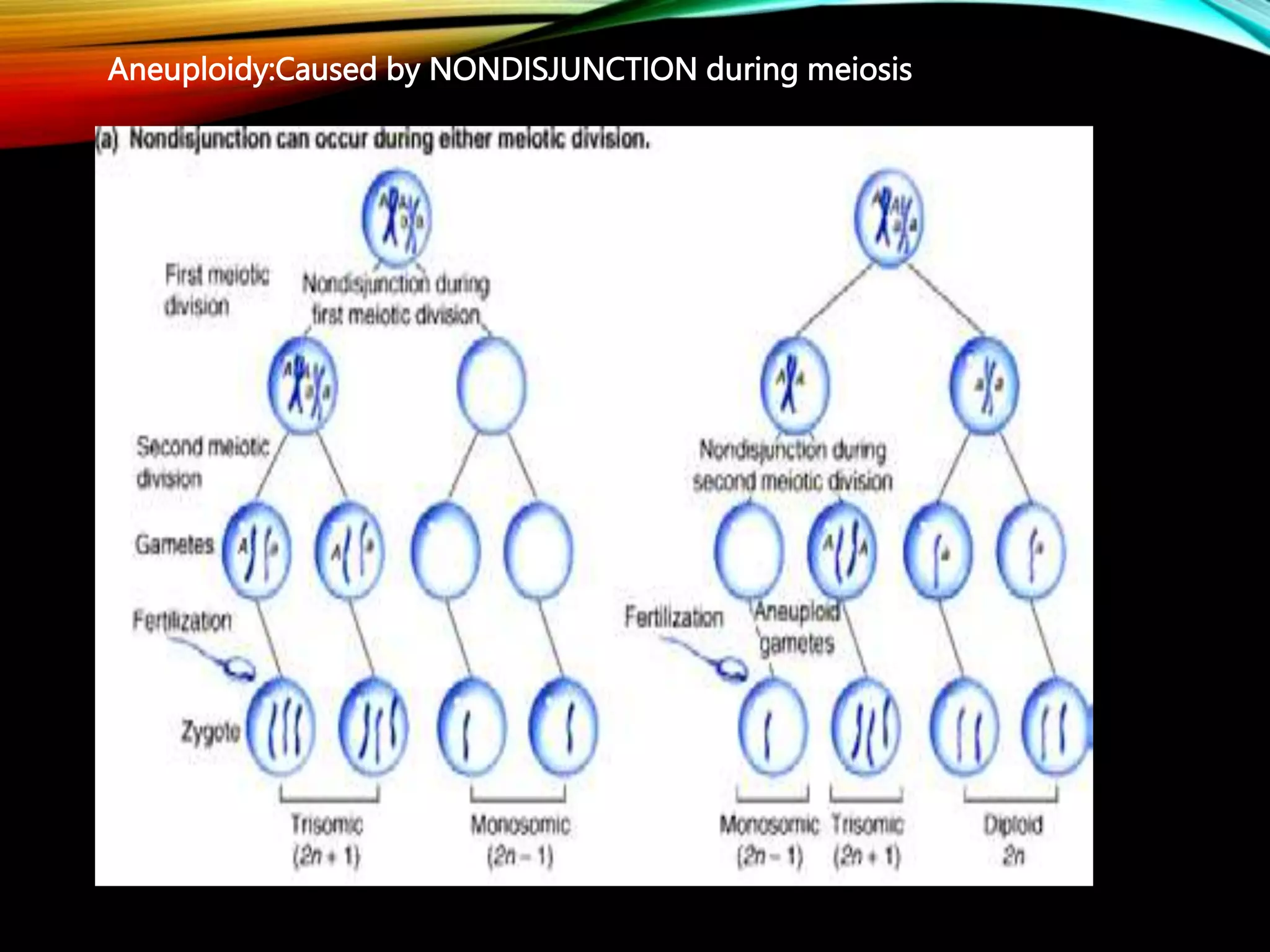
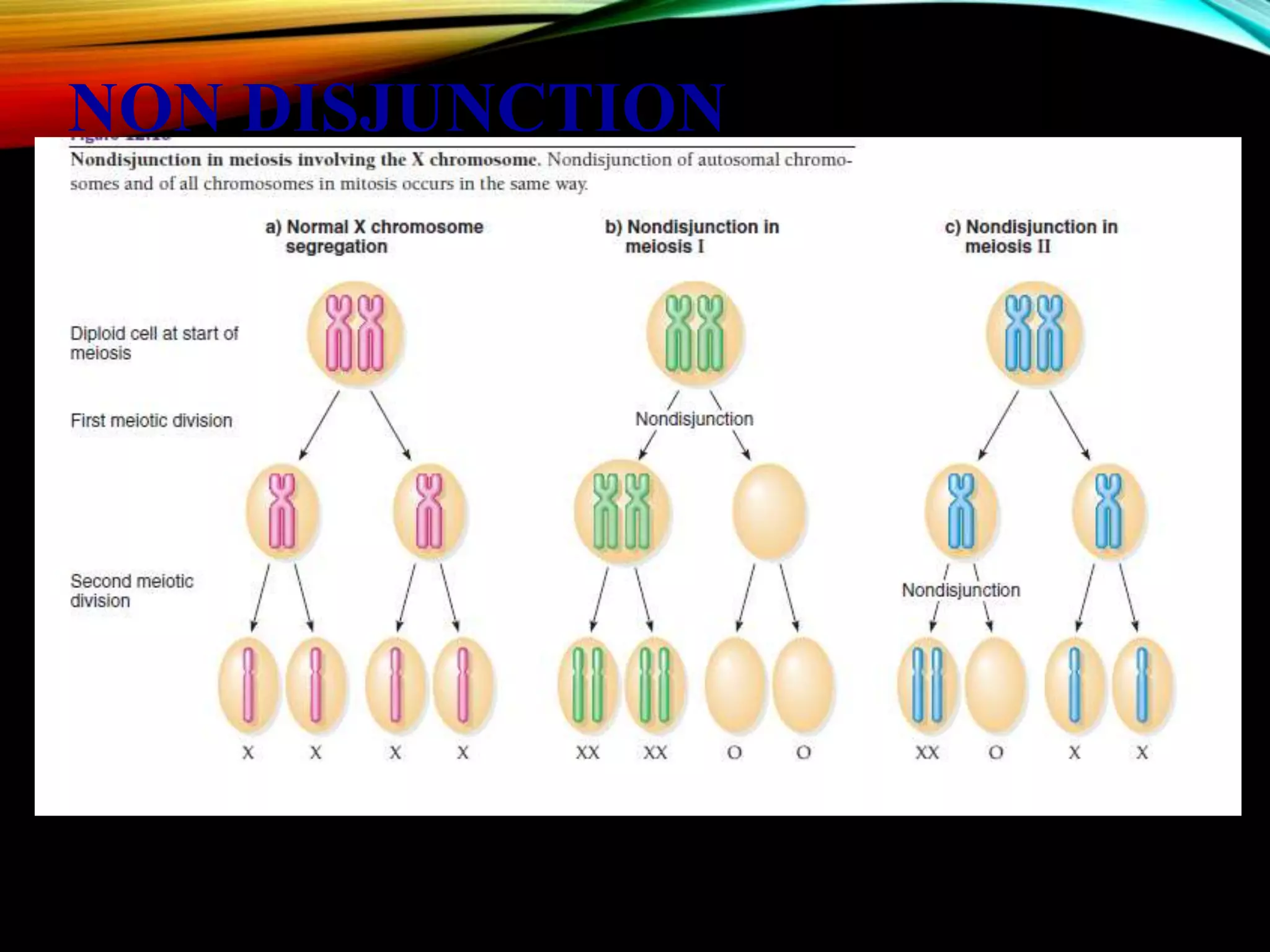
Aneuploidy:Caused by NONDISJUNCTION during meiosis
NUMERICAL
ABNORMALITIES
• Aneuploidy
The category of chromosome changes which do not involve
whole sets. It is usually the consequence of a failure of a single
chromosome (or bivalent) to complete division.
• Monosomy
All autosomal monosomies are lethal in very early
embryogenesis. They abort too early even to be recognised as a
conception.
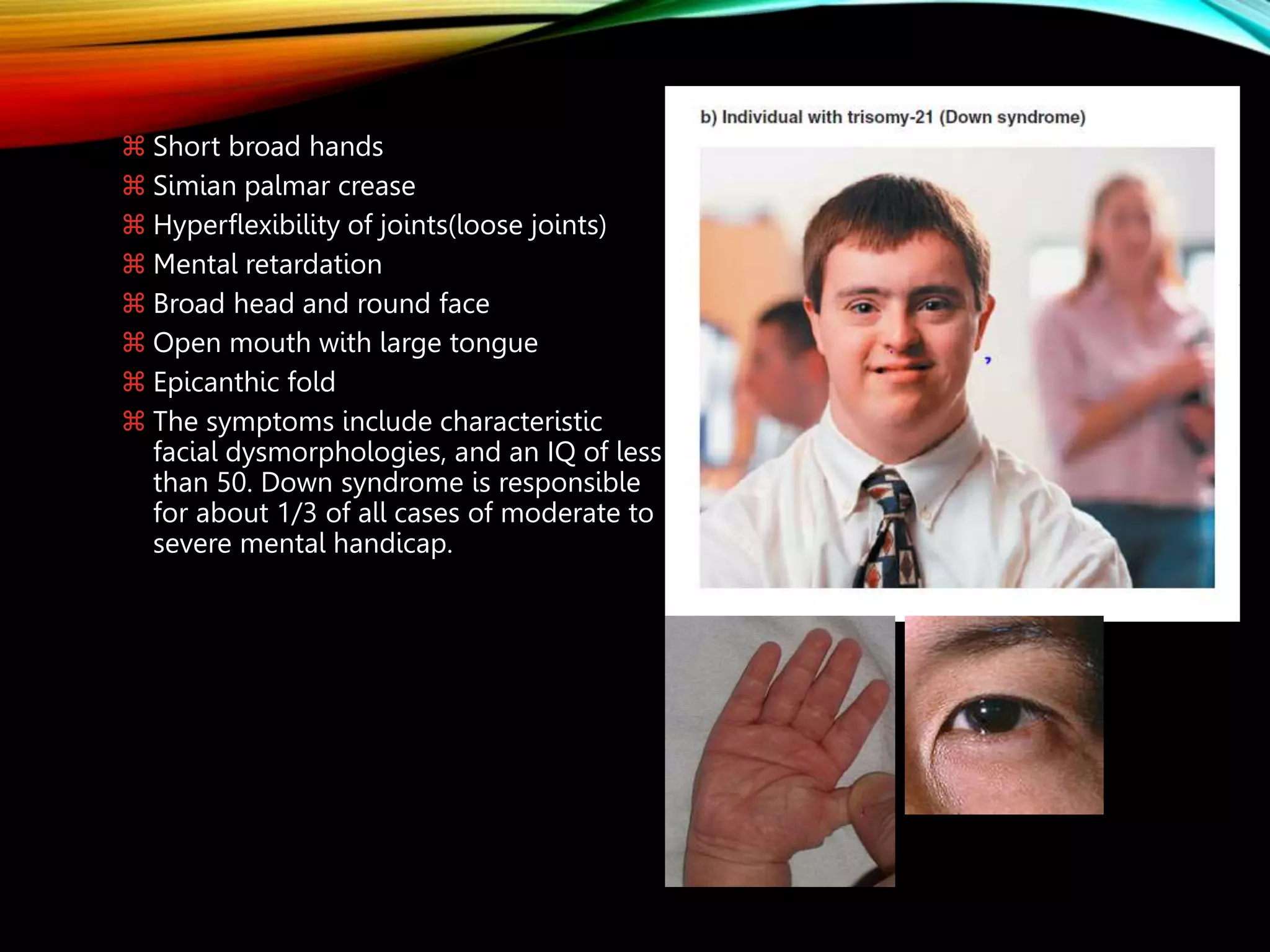
• Trisomies(21 Down syndrome)
The incidence of trisomy 21 rises sharply with increasing
maternal age.
NUMERICAL
ABNORMALITIES
• Aneuploidy (uneven) monosomy trisomy tetrasomy nullisomy
• Down syndrome, trisomy 21(46+1) three 21’s
Most cases arise from non disjunction in the first meiotic
division, the father contributing the extra chromosome in 15% of
cases.
About 4% of cases arise by inheritance of a translocation
chromosome from a parent who is a balanced carrier.
Freq: 16-26 age : 7.7/10000
 27-34 age : 8/10000
 35-39 age : 29/10000
 40-44 age : 100/10000
 45-47 age : 333/10000
 Short broad hands
 Simian palmar crease
 Hyperflexibility of joints(loose joints)
 Mental retardation
 Broad head and round face
 Open mouth with large tongue
 Epicanthic fold
 The symptoms include characteristic
facial dysmorphologies, and an IQ of less
than 50. Down syndrome is responsible
for about 1/3 of all cases of moderate to
severe mental handicap.
NUMERICAL ABNORMALITIES
• Aneuploidy
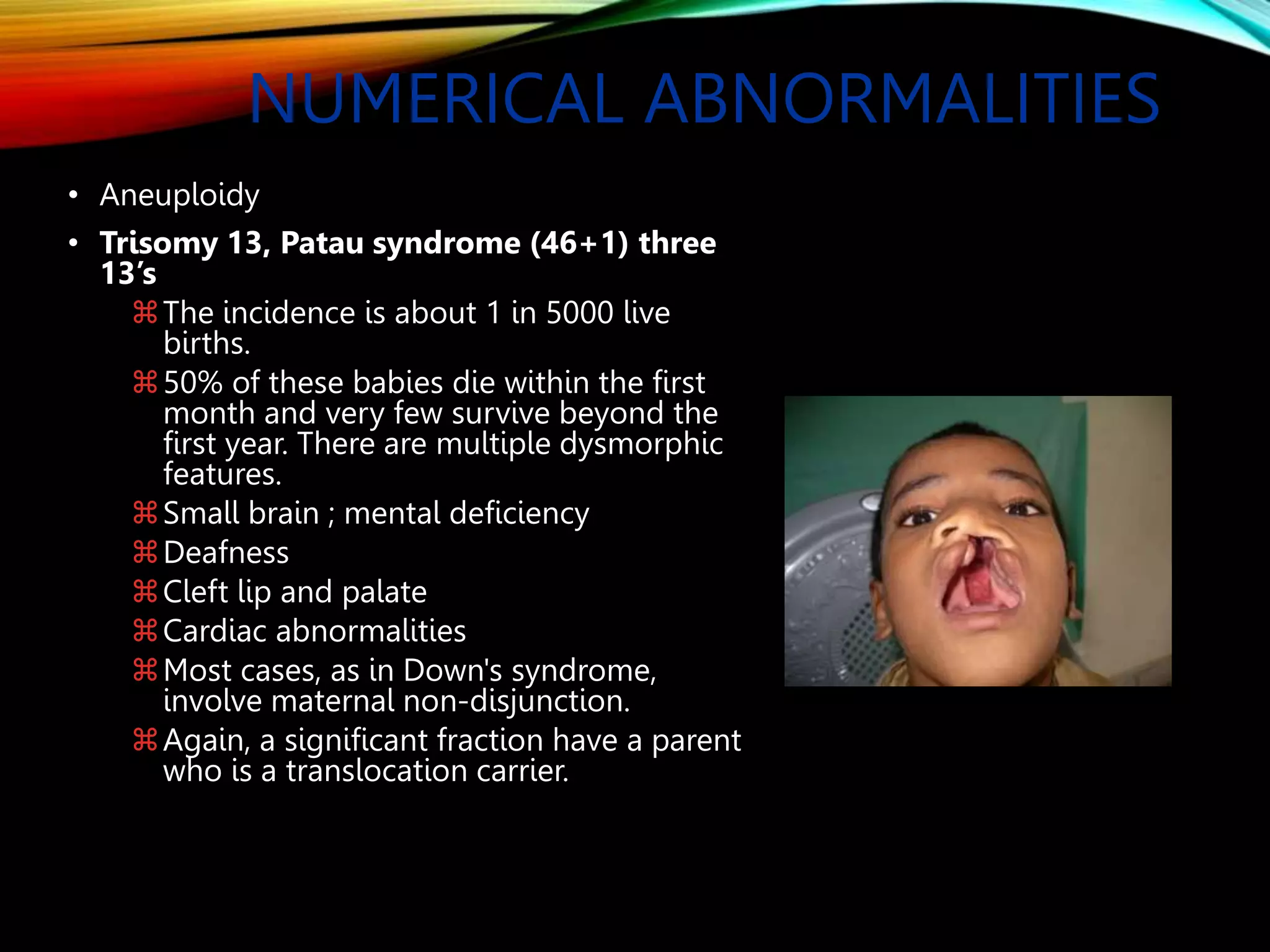
• Trisomy 13, Patau syndrome (46+1) three
13’s
The incidence is about 1 in 5000 live
births.
50% of these babies die within the first
month and very few survive beyond the
first year. There are multiple dysmorphic
features.
Small brain ; mental deficiency
Deafness
Cleft lip and palate
Cardiac abnormalities
Most cases, as in Down's syndrome,
involve maternal non-disjunction.
Again, a significant fraction have a parent
who is a translocation carrier.
• Trisomy 18, Edwards Syndrome (46+1) three 18’s
Incidence ~2.5 in 10000
Small size at birth
Conigental abnormalities
Clenched fist
Elongated skull
Low malformed ears
Mental abn.
Horse shoe or double kidney
Receding mandable, small mouth and nose
Short sternum
Again most babies die in the first year and many
within the first month.
NUMERICAL ABNORMALITY
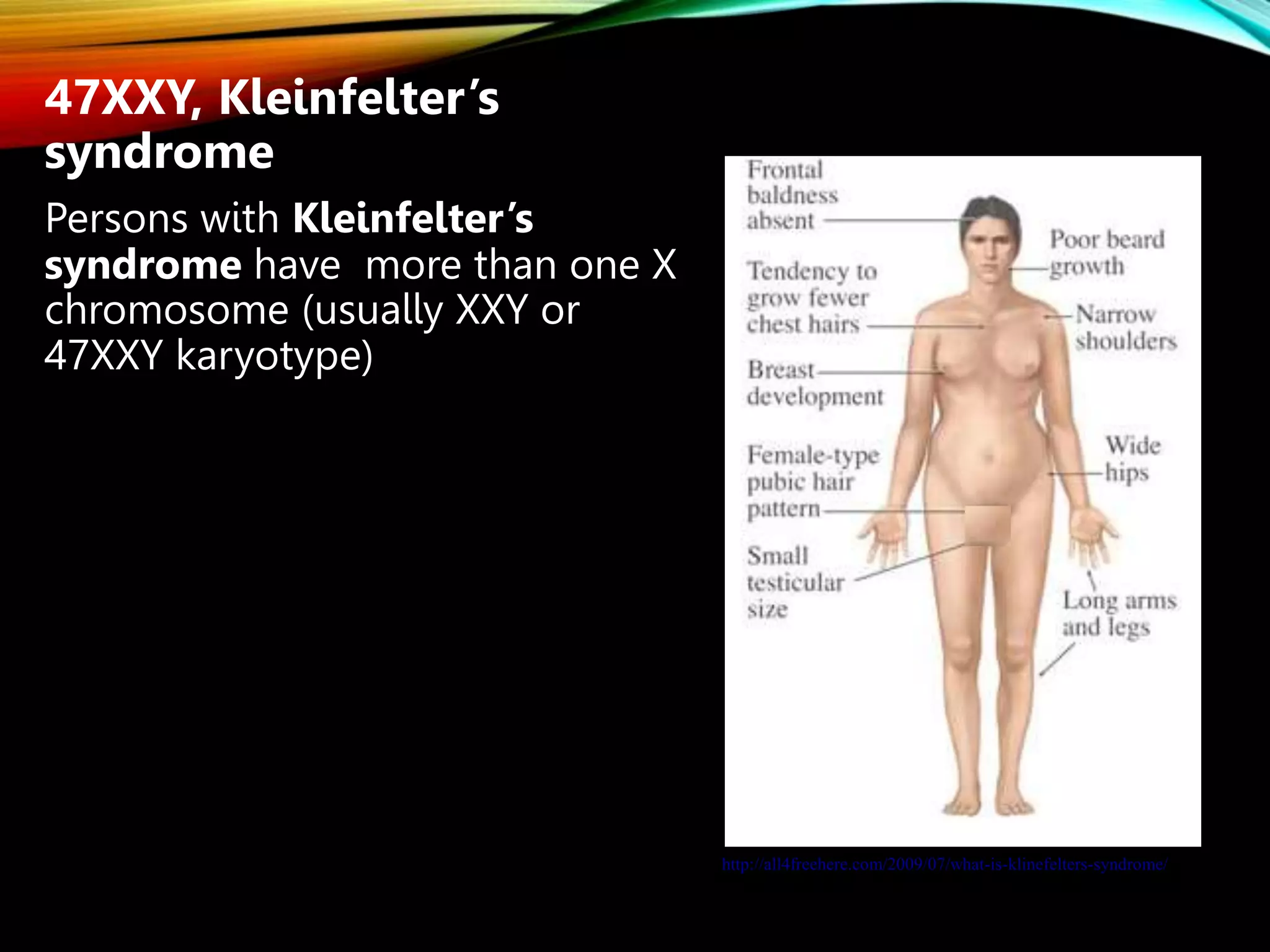
• Kleinfelter’s syndrome 47,XXY
The incidence at birth is about 1 in 1000 males.
Testes are small and fail to produce normal levels
of testosterone poorly developed secondary male
sexual characteristics.
Female characters appearance
Small prostrate glands
There is no spermatogenesis.
These males are taller and thinner than average
and may have a slight reduction in IQ. Many
Kleinfelter males lead a normal life.
Very rarely more extreme forms of Kleinfelter's
syndrome occur where the patient has 48, XXXY or
even 49, XXXXY karyotype. These individuals are
generally severely retarded.
Fertilization of XX egg with Y sperm; rare cases of
X egg and XY sperm
NUMERICAL
ABNORMALITIES
• XXX : superfemales
About one woman in 1000 has an extra X chromosome.
It seems to do little harm, individuals are fertile .
Slight mental retardation
They do have a reduction in IQ comparable to that of
Kleinfelter's males.
ABNORMAL SEX KARYOTYPES
OR
GENETIC SEX DISORDERS
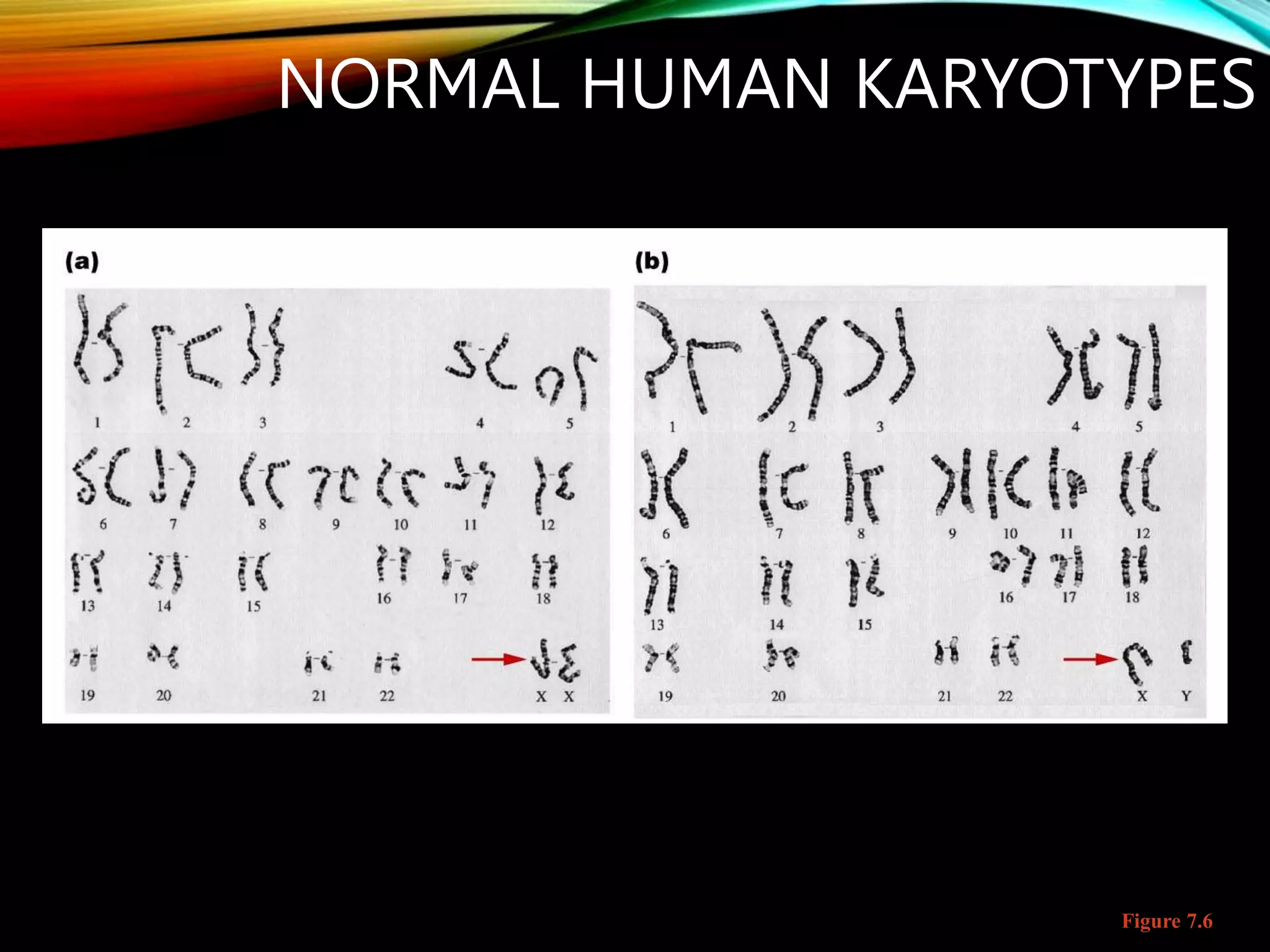
Figure 7.6
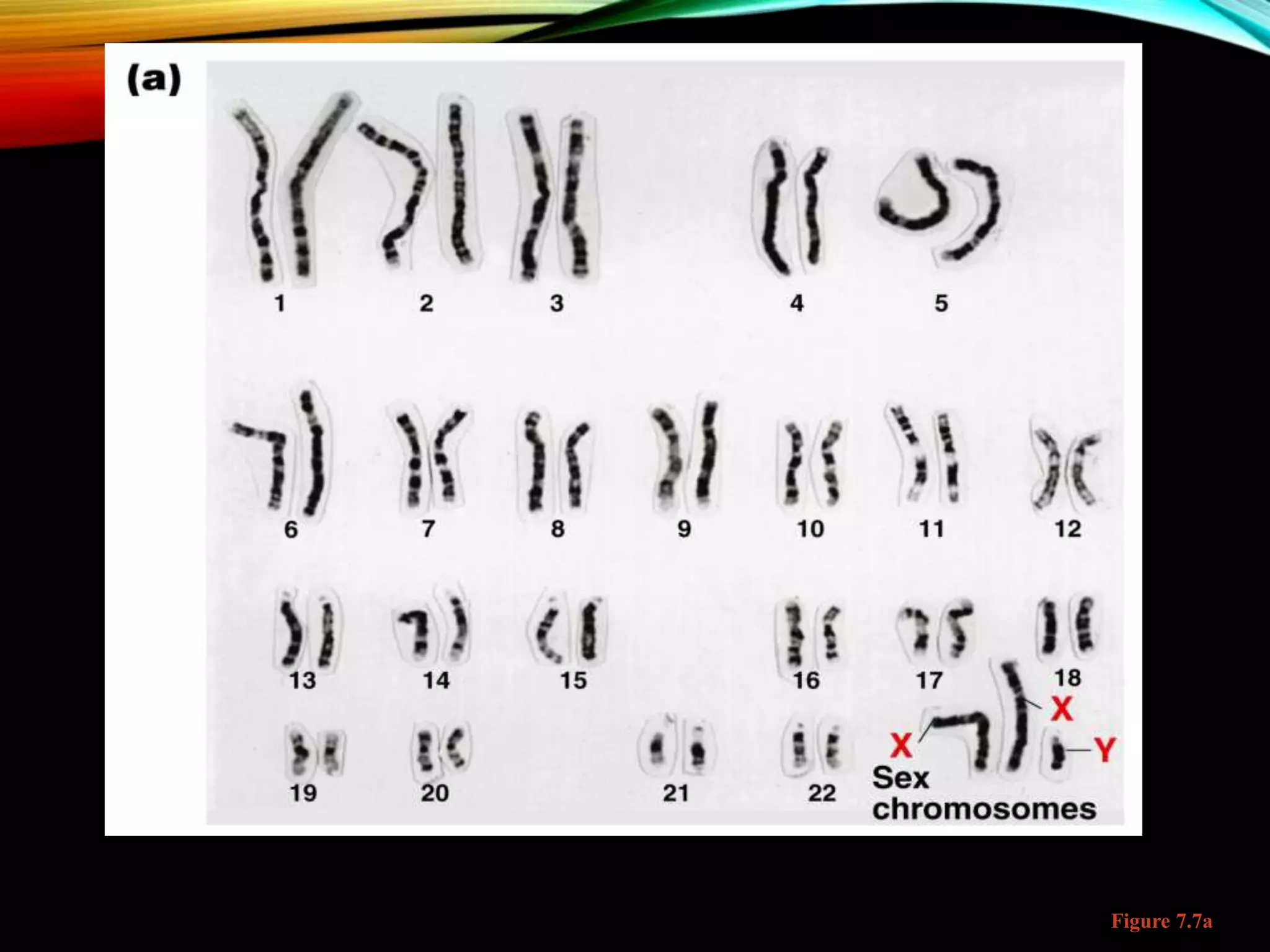
NORMAL HUMAN KARYOTYPES
NON DISJUNCTION
47XXY, Kleinfelter’s
syndrome
Persons with Kleinfelter’s
syndrome have more than one X
chromosome (usually XXY or
47XXY karyotype)
http://all4freehere.com/2009/07/what-is-klinefelters-syndrome/
Figure 7.7a
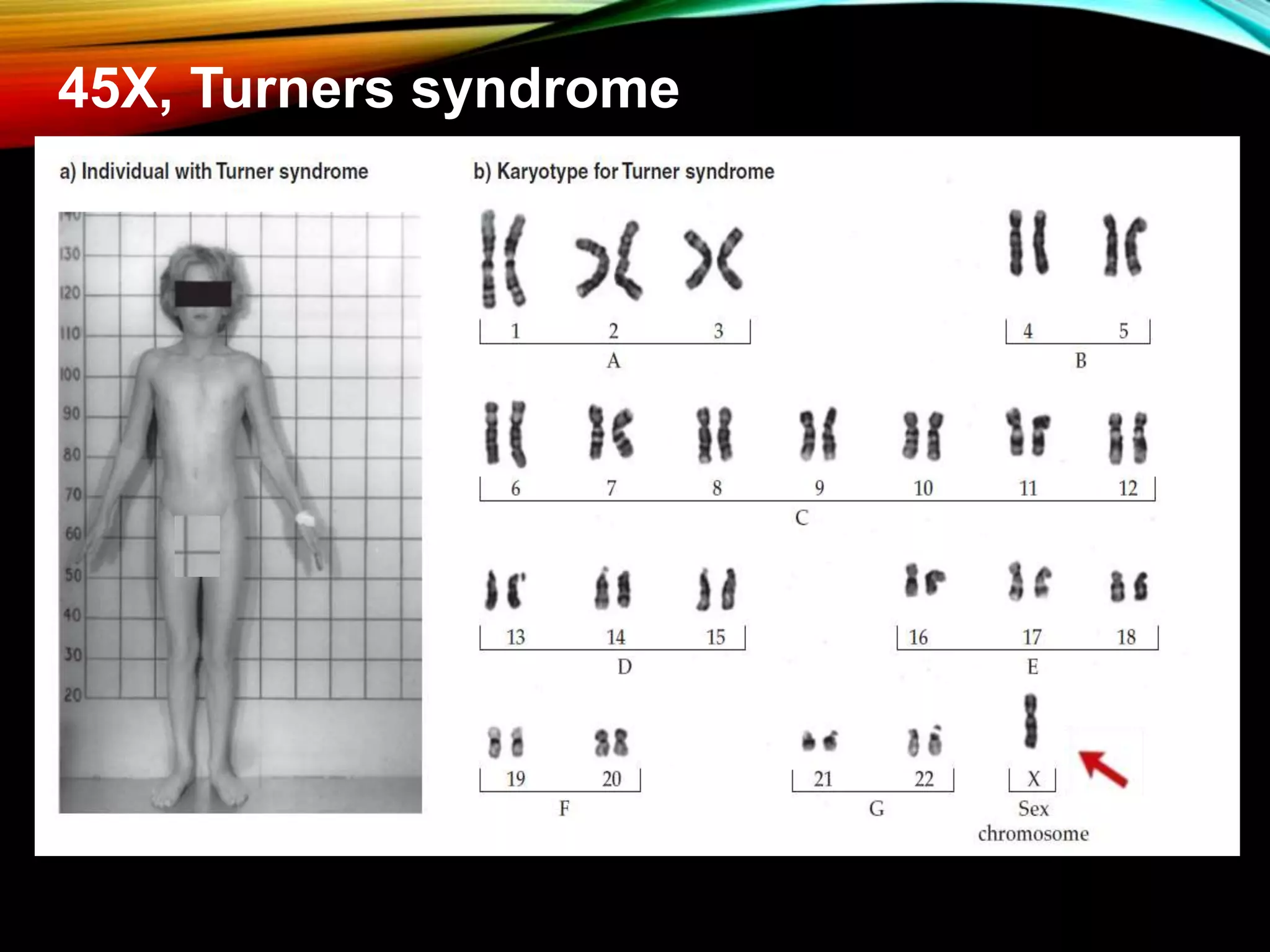
45X, Turners syndrome
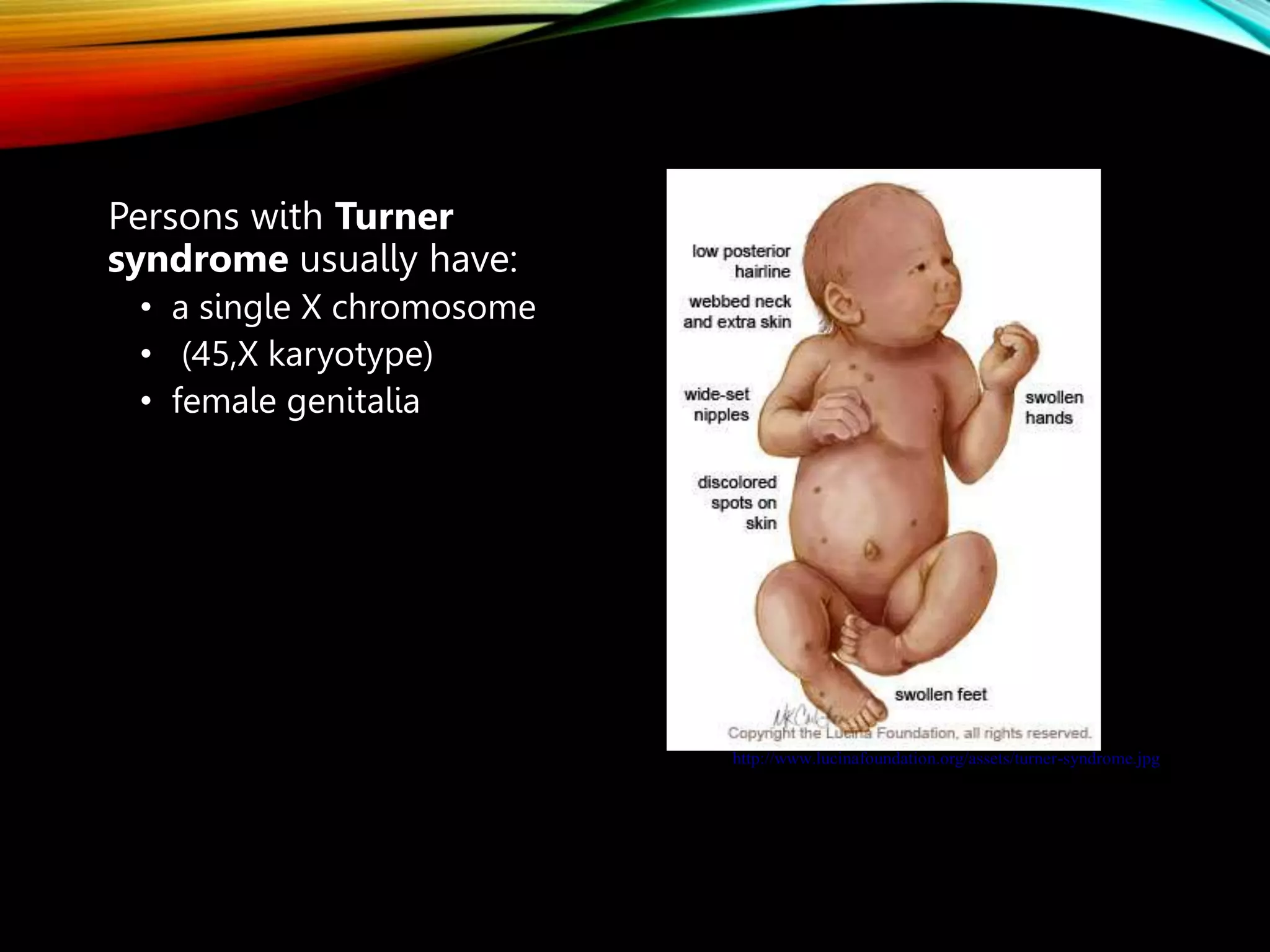
Persons with Turner
syndrome usually have:
• a single X chromosome
• (45,X karyotype)
• female genitalia
http://www.lucinafoundation.org/assets/turner-syndrome.jpg
47, XXX – Trisomy X
• 3 X chromosomes along with a normal set of autosomes
• Usually normal, physically indistinguishable
• In other cases, low self esteem, psychological problems,
underdeveloped secondary sex characteristics and infertility are
observed
• Auditory processing disorders , premature ovarian failure
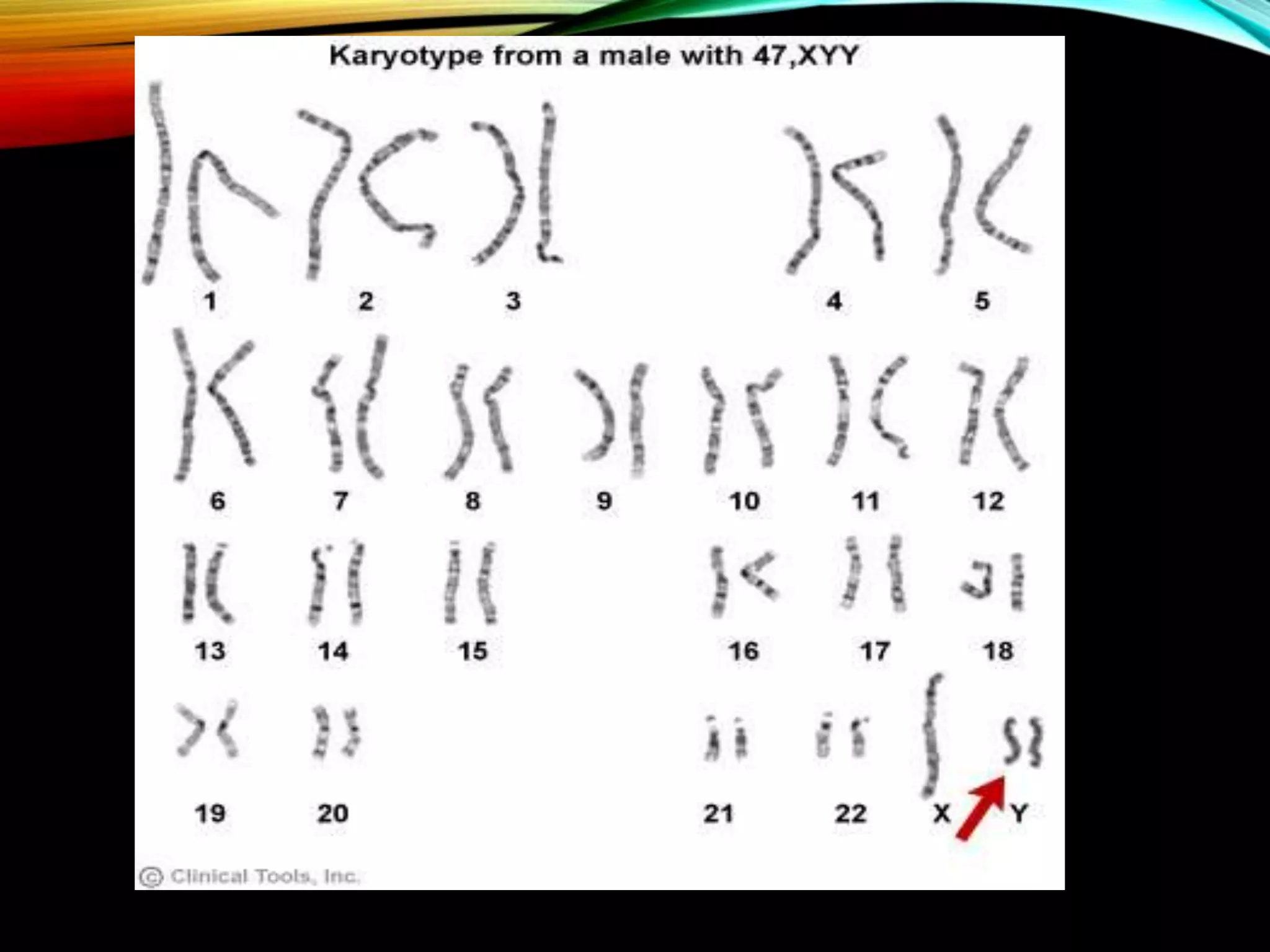
47XYY, Jacobs Syndrome
• Non disjunction during spermatogenesis
• Around 1 in 1,000 boys
• These males are usually over 6 feet tall
• fast increase in height
• Normal development & normal fertility
Reference : Gravholt, Claus Højbjerg (2013). "Sex chromosome abnormalities". In Pyeritz, Reed E.; Rimoin, David L.; Korf,
Bruce R. Emery and Rimoin's principles and practice of medical genetics (6th ed.). San Diego: Elsevier Academic
Press. pp. 1180–1211
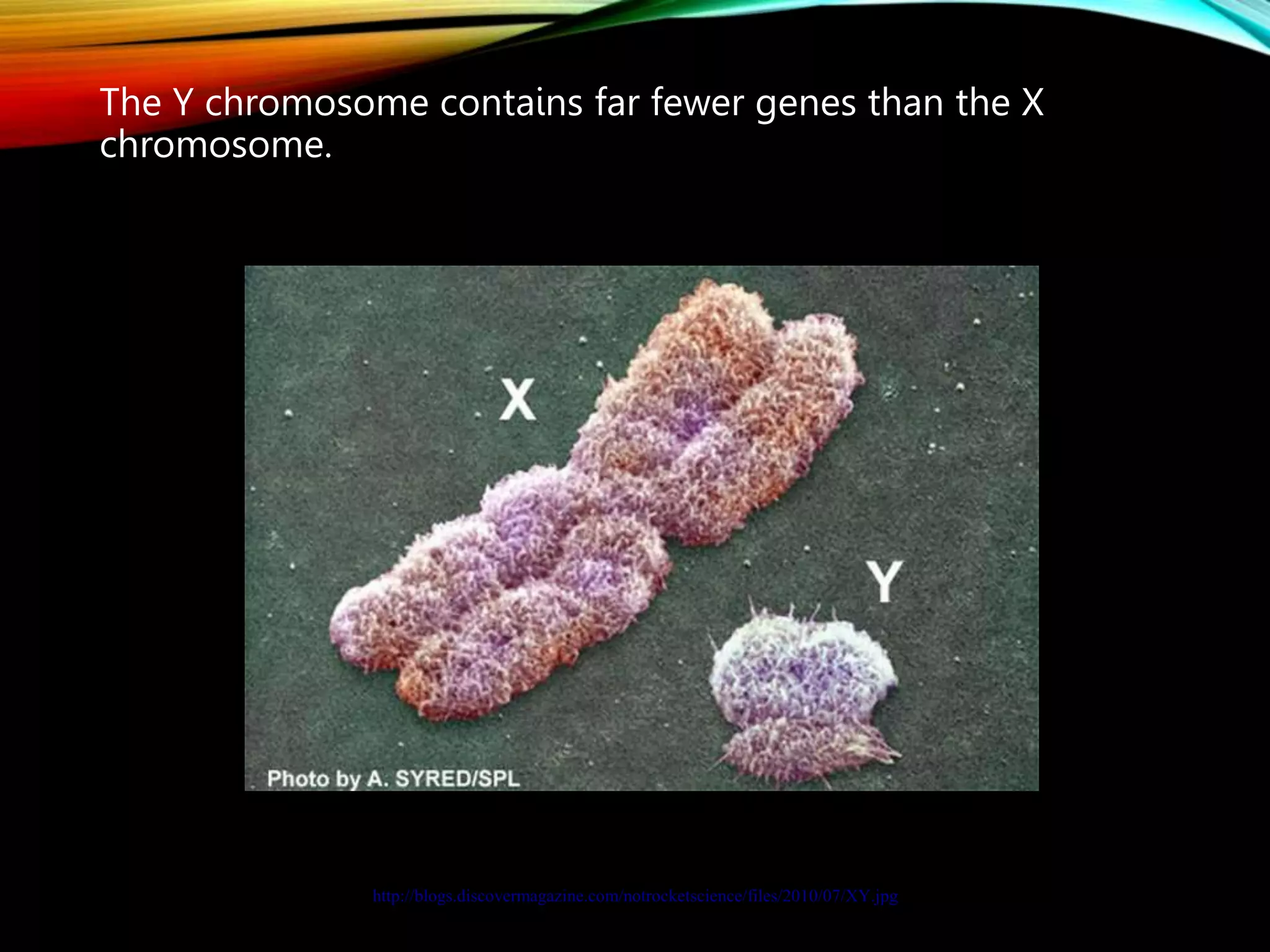
The Y chromosome contains far fewer genes than the X
chromosome.
http://blogs.discovermagazine.com/notrocketscience/files/2010/07/XY.jpg
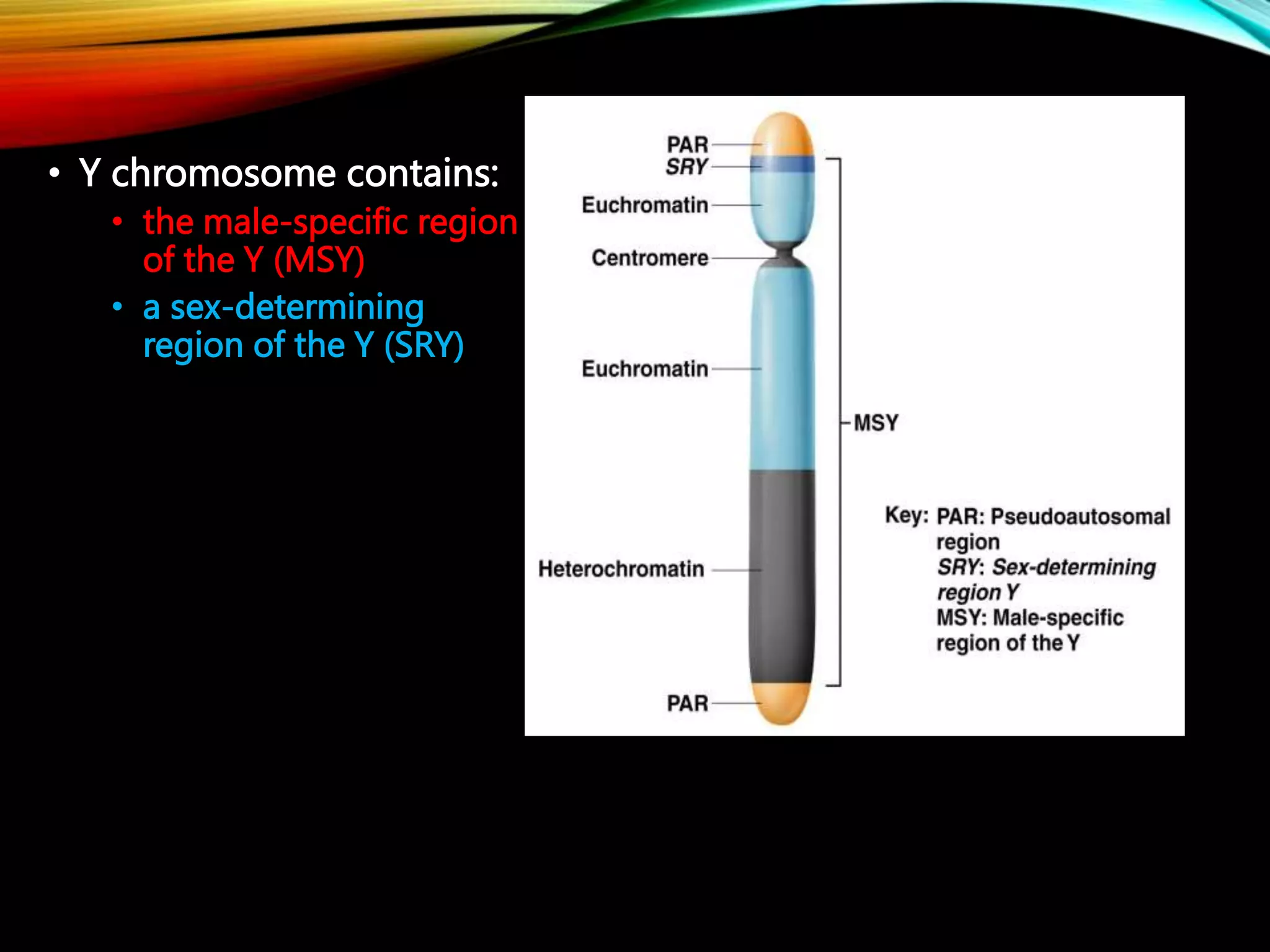
• Y chromosome contains:
• the male-specific region
of the Y (MSY)
• a sex-determining
region of the Y (SRY)
• Pseudoautosomal Regions (PARs)
• regions on Y chromosome that share homology with
regions on the X chromosome
• synapse and recombine with it during meiosis
• Presence of such a pairing region is critical to
segregation of the X and Y chromosomes during male
gametogenesis
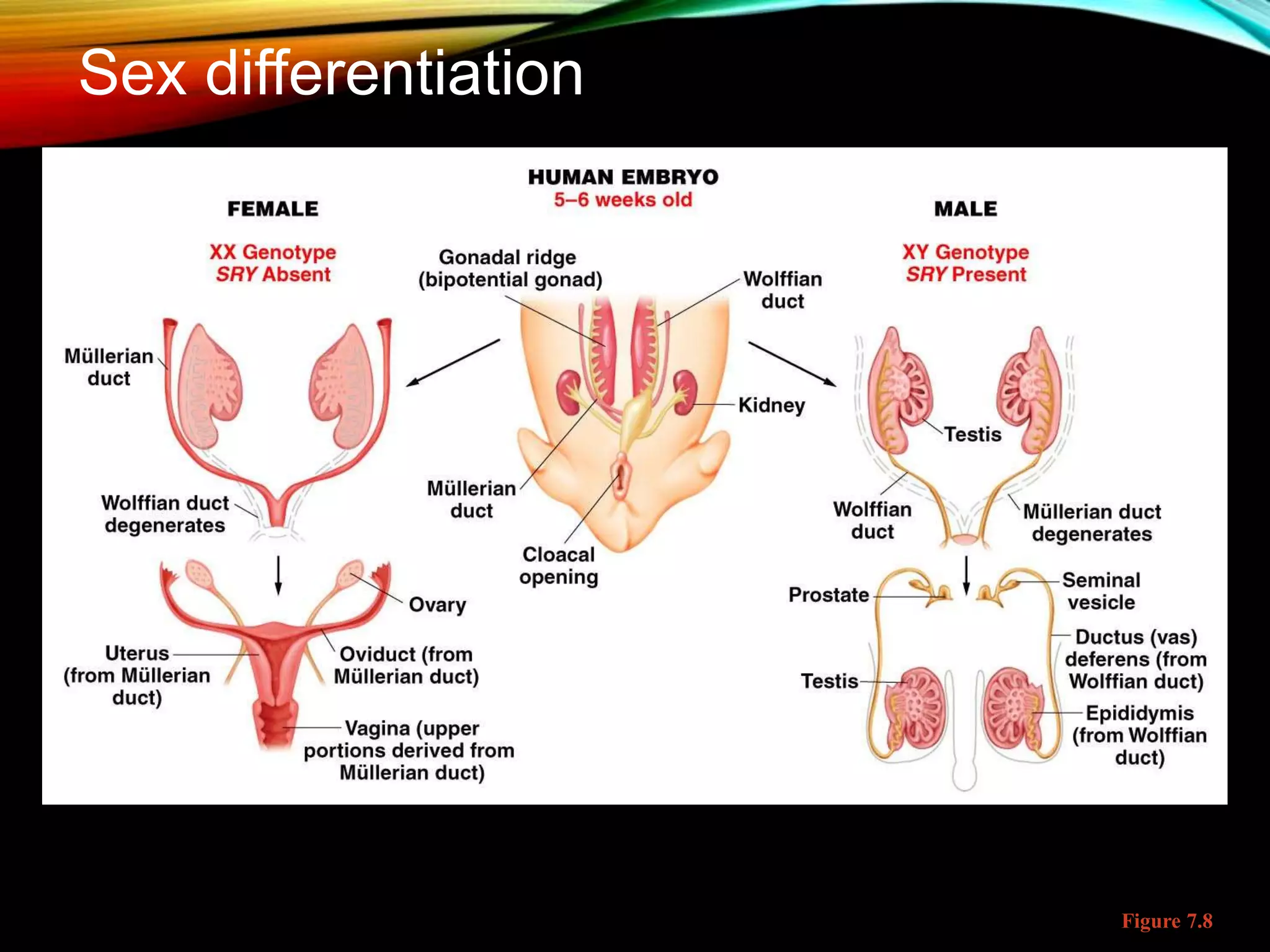
Figure 7.8
Sex differentiation
• Dosage Compensation Prevents Excessive Expression of X-
Linked Genes in Humans and Other Mammals
• Dosage compensation balances the dose of
X chromosome gene expression in females and males.
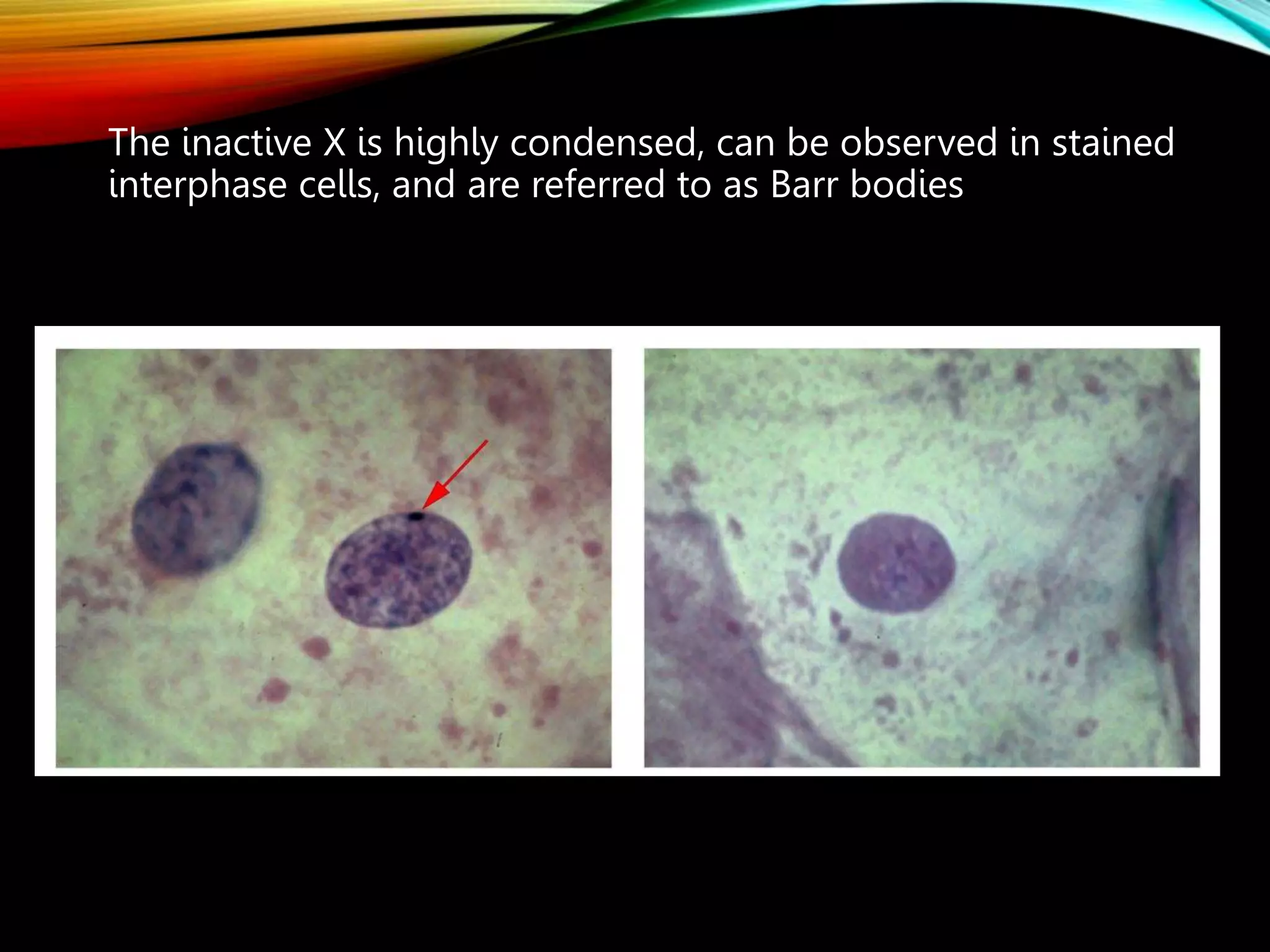
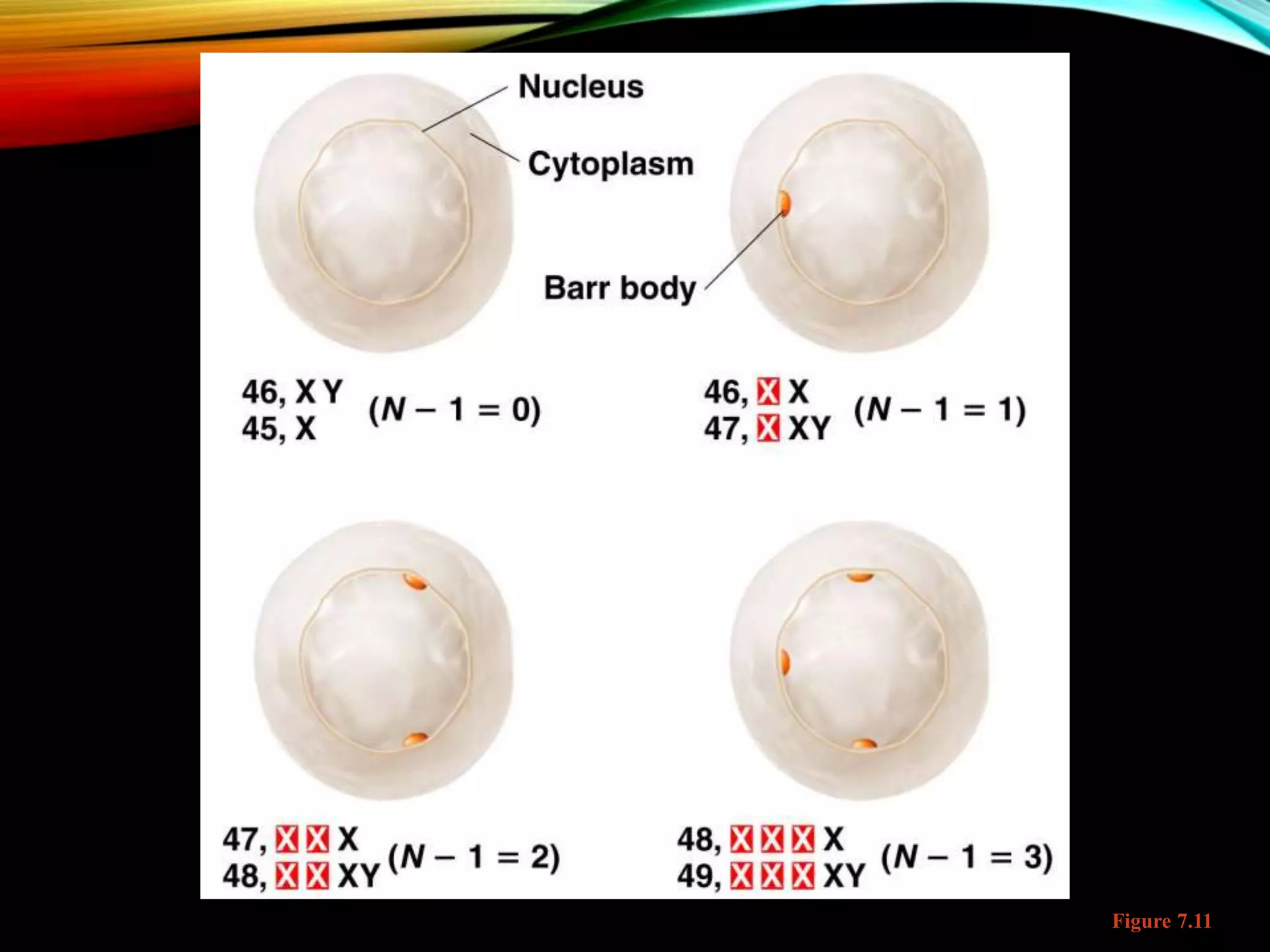
Lyonization
The inactive X is highly condensed, can be observed in stained
interphase cells, and are referred to as Barr bodies
Figure 7.11
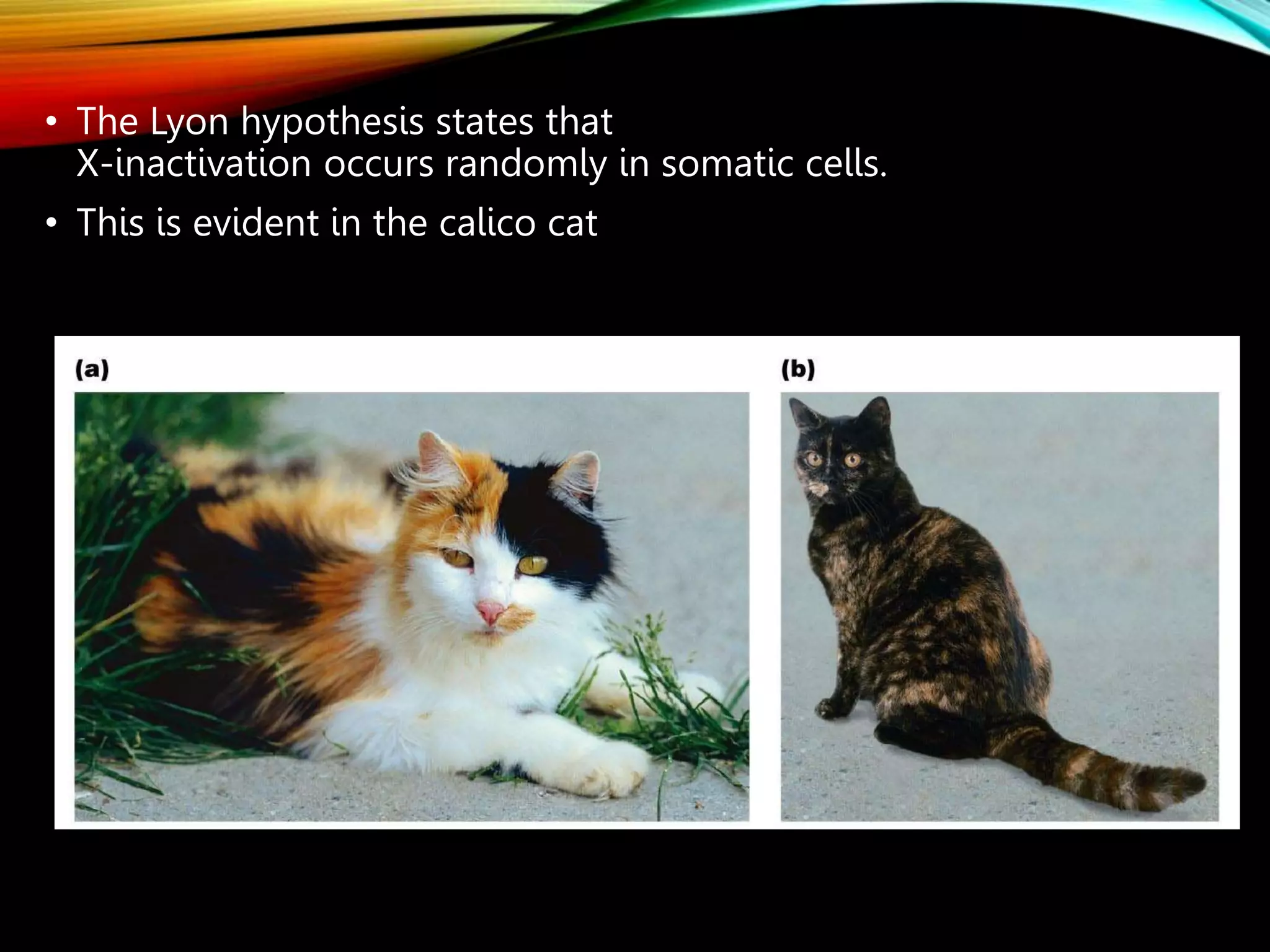
• The Lyon hypothesis states that
X-inactivation occurs randomly in somatic cells.
• This is evident in the calico cat

Numerical chnges.ppt

  • 1.
    NUMERICAL VARIATIONS Terminology: • Ploidy: no.of sets of chromosomes in a biological cell. • Monoploidy polyploidy aneuploidy • Euploidy : Euploidy is the state of a cell or organism having an integral multiple of the monoploid number. - a human cell has 46 chromosomes, which is an integral multiple of the monoploid number, 23. -Monoploidy common in plants barley (7), Corn (10) rare in animals Production of monoploids X-rays Delayed Pollination Cold treatment colchicine Distant hybridization Anther or pollen culture Smaller features/ small cells/ organelles sterile unequal meiotic chromosomal distribution
  • 2.
    NUMERICAL ABNORMALITIES • Monoploid- basic single set - Monoploid (N) • Euploidy - genome containing chromosomes that are multiple of basic single set - ex: Monoploid (N) or Diploid (2N) • Polyploidy - Triploidy (3N) –Three sets Tetraploidy (4N) – Four sets • Numerical abnormality or changes chromosomal changes which involve the addition or loss of complete sets of chromosomes.
  • 3.
    • Polyploidy :Presence of extra sets of chromosomes in cells • diploidy (2n) • triploidy (3n) • tetraploidy (4n) • pentaploidy (5n) • hexaploidy (6n) • heptaploidy (7n) • octaploidy (8n) • Aneuploidy : Presence of extra or missing chromosomes • e.g. monosomy (second most common) • e.g. trisomy (most common)
  • 4.
    Kinds of Polyploids 1)Autopolyploids- polyploidy as a result of duplications in the SAME species 2) Allopolyploids- polyploid formed by hybridization BETWEEN TWO Species A typical allopolyploid species is derived from hybridization from two or more diploid species with chromosome doubling following the hybridization Gigantism Bigger plant parts /more vigor less fertility
  • 5.
    Autopolyploidy • All chromosomescome from same ancestral diploid species • Homologous copies of each chromosome • Meiotic pairing, can form bivalents, trivalents, quadrivalents, • Univalents • Natural Induced (colchicine) mitotic spindle • Chrysanthimum • Autotriploids (artificial) seedless watermelons, tomato, grapes and banana • Autotetraploids(artificial) corn, rye, grapes , apples and marigolds
  • 6.
    Allopolyploidy • Species 1 •Species 2 • X • Species 1 and 2 diverged from a diploid common ancestor, and their chromosomes are very similar Raphanobrassica (36) Raphanus sativum (18) Brassica oleracia (18) Karpechenko 1927 some fertile F1 Radish Cabbage
  • 7.
  • 8.
    NUMERICAL ABNORMALITIES • Aneuploidy The categoryof chromosome changes which do not involve whole sets. It is usually the consequence of a failure of a single chromosome (or bivalent) to complete division. • Monosomy All autosomal monosomies are lethal in very early embryogenesis. They abort too early even to be recognised as a conception. • Trisomies(21 Down syndrome) The incidence of trisomy 21 rises sharply with increasing maternal age.
  • 9.
    NUMERICAL ABNORMALITIES • Aneuploidy (uneven)monosomy trisomy tetrasomy nullisomy • Down syndrome, trisomy 21(46+1) three 21’s Most cases arise from non disjunction in the first meiotic division, the father contributing the extra chromosome in 15% of cases. About 4% of cases arise by inheritance of a translocation chromosome from a parent who is a balanced carrier. Freq: 16-26 age : 7.7/10000  27-34 age : 8/10000  35-39 age : 29/10000  40-44 age : 100/10000  45-47 age : 333/10000
  • 10.
     Short broadhands  Simian palmar crease  Hyperflexibility of joints(loose joints)  Mental retardation  Broad head and round face  Open mouth with large tongue  Epicanthic fold  The symptoms include characteristic facial dysmorphologies, and an IQ of less than 50. Down syndrome is responsible for about 1/3 of all cases of moderate to severe mental handicap.
  • 11.
    NUMERICAL ABNORMALITIES • Aneuploidy •Trisomy 13, Patau syndrome (46+1) three 13’s The incidence is about 1 in 5000 live births. 50% of these babies die within the first month and very few survive beyond the first year. There are multiple dysmorphic features. Small brain ; mental deficiency Deafness Cleft lip and palate Cardiac abnormalities Most cases, as in Down's syndrome, involve maternal non-disjunction. Again, a significant fraction have a parent who is a translocation carrier.
  • 12.
    • Trisomy 18,Edwards Syndrome (46+1) three 18’s Incidence ~2.5 in 10000 Small size at birth Conigental abnormalities Clenched fist Elongated skull Low malformed ears Mental abn. Horse shoe or double kidney Receding mandable, small mouth and nose Short sternum Again most babies die in the first year and many within the first month.
  • 13.
    NUMERICAL ABNORMALITY • Kleinfelter’ssyndrome 47,XXY The incidence at birth is about 1 in 1000 males. Testes are small and fail to produce normal levels of testosterone poorly developed secondary male sexual characteristics. Female characters appearance Small prostrate glands There is no spermatogenesis. These males are taller and thinner than average and may have a slight reduction in IQ. Many Kleinfelter males lead a normal life. Very rarely more extreme forms of Kleinfelter's syndrome occur where the patient has 48, XXXY or even 49, XXXXY karyotype. These individuals are generally severely retarded. Fertilization of XX egg with Y sperm; rare cases of X egg and XY sperm
  • 14.
    NUMERICAL ABNORMALITIES • XXX :superfemales About one woman in 1000 has an extra X chromosome. It seems to do little harm, individuals are fertile . Slight mental retardation They do have a reduction in IQ comparable to that of Kleinfelter's males.
  • 15.
  • 16.
  • 17.
  • 18.
    47XXY, Kleinfelter’s syndrome Persons withKleinfelter’s syndrome have more than one X chromosome (usually XXY or 47XXY karyotype) http://all4freehere.com/2009/07/what-is-klinefelters-syndrome/
  • 19.
  • 20.
  • 21.
    Persons with Turner syndromeusually have: • a single X chromosome • (45,X karyotype) • female genitalia http://www.lucinafoundation.org/assets/turner-syndrome.jpg
  • 22.
    47, XXX –Trisomy X • 3 X chromosomes along with a normal set of autosomes • Usually normal, physically indistinguishable • In other cases, low self esteem, psychological problems, underdeveloped secondary sex characteristics and infertility are observed • Auditory processing disorders , premature ovarian failure
  • 23.
    47XYY, Jacobs Syndrome •Non disjunction during spermatogenesis • Around 1 in 1,000 boys • These males are usually over 6 feet tall • fast increase in height • Normal development & normal fertility Reference : Gravholt, Claus Højbjerg (2013). "Sex chromosome abnormalities". In Pyeritz, Reed E.; Rimoin, David L.; Korf, Bruce R. Emery and Rimoin's principles and practice of medical genetics (6th ed.). San Diego: Elsevier Academic Press. pp. 1180–1211
  • 25.
    The Y chromosomecontains far fewer genes than the X chromosome. http://blogs.discovermagazine.com/notrocketscience/files/2010/07/XY.jpg
  • 26.
    • Y chromosomecontains: • the male-specific region of the Y (MSY) • a sex-determining region of the Y (SRY)
  • 27.
    • Pseudoautosomal Regions(PARs) • regions on Y chromosome that share homology with regions on the X chromosome • synapse and recombine with it during meiosis • Presence of such a pairing region is critical to segregation of the X and Y chromosomes during male gametogenesis
  • 28.
  • 29.
    • Dosage CompensationPrevents Excessive Expression of X- Linked Genes in Humans and Other Mammals • Dosage compensation balances the dose of X chromosome gene expression in females and males. Lyonization
  • 30.
    The inactive Xis highly condensed, can be observed in stained interphase cells, and are referred to as Barr bodies
  • 31.
  • 32.
    • The Lyonhypothesis states that X-inactivation occurs randomly in somatic cells. • This is evident in the calico cat