
CHROMOSOMAL
ABERRATION
Prepared by :
INDU SARMA
5th semester , Botany
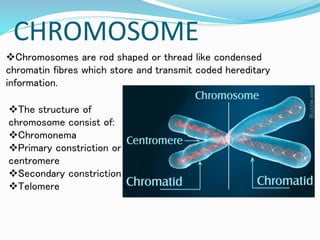
CHROMOSOME
Chromosomes are rod shaped or thread like condensed
chromatin fibres which store and transmit coded hereditary
information.
The structure of
chromosome consist of:
Chromonema
Primary constriction or
centromere
Secondary constriction
Telomere
CHROMOSOMAL ABERRATION
Mutations that cause change in the structure or number of
chromosomes are called chromosomal aberration.
These are of two types-
Structural chromosomal aberrations (change in the
structure of gene sequence).
Numerical chromosomal aberrations (change in the
number of chromosome).
Factors responsible for chromosomal aberration are-
Due to error in cell division.
Maternal age and
environment
STRUCTURAL CHROMOSOMAL
ABERRATIONS
Structural chromosomal aberration can be divided into four
types-
Deficiency or deletion
Duplication
Inversion
Translocation
Deletion and duplication involve alteration with certain
chromosomal segment being lost or doubled.
Inversion and translocation involve changes in position of
chromosome segment.
DELETION OR DEFICIENCY
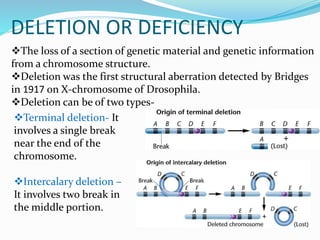
The loss of a section of genetic material and genetic information
from a chromosome structure.
Deletion was the first structural aberration detected by Bridges
in 1917 on X-chromosome of Drosophila.
Deletion can be of two types-
Terminal deletion- It
involves a single break
near the end of the
chromosome.
Intercalary deletion –
It involves two break in
the middle portion.
EFFECTS OF DEFICIENCY
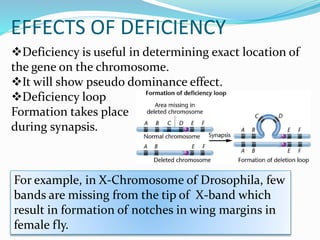
Deficiency is useful in determining exact location of
the gene on the chromosome.
It will show pseudo dominance effect.
Deficiency loop
Formation takes place
during synapsis.
For example, in X-Chromosome of Drosophila, few
bands are missing from the tip of X-band which
result in formation of notches in wing margins in
female fly.
DUPLICATION
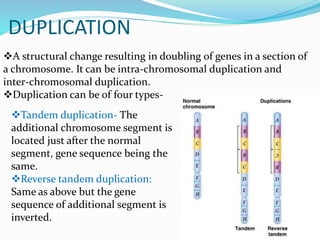
A structural change resulting in doubling of genes in a section of
a chromosome. It can be intra-chromosomal duplication and
inter-chromosomal duplication.
Duplication can be of four types-
Tandem duplication- The
additional chromosome segment is
located just after the normal
segment, gene sequence being the
same.
Reverse tandem duplication:
Same as above but the gene
sequence of additional segment is
inverted.
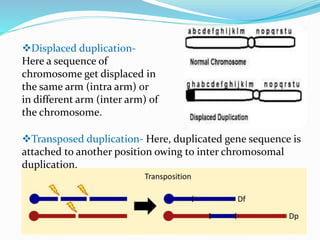
Displaced duplication-
Here a sequence of
chromosome get displaced in
the same arm (intra arm) or
in different arm (inter arm) of
the chromosome.
Transposed duplication- Here, duplicated gene sequence is
attached to another position owing to inter chromosomal
duplication.
EFFECT OF DUPLICATION
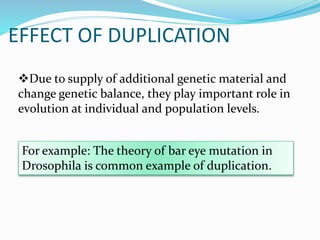
Due to supply of additional genetic material and
change genetic balance, they play important role in
evolution at individual and population levels.
For example: The theory of bar eye mutation in
Drosophila is common example of duplication.
INVERSION
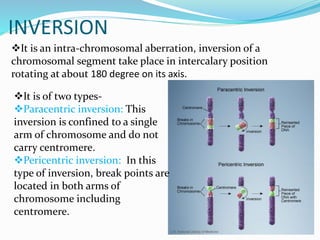
It is an intra-chromosomal aberration, inversion of a
chromosomal segment take place in intercalary position
rotating at about 180 degree on its axis.
It is of two types-
Paracentric inversion: This
inversion is confined to a single
arm of chromosome and do not
carry centromere.
Pericentric inversion: In this
type of inversion, break points are
located in both arms of
chromosome including
centromere.
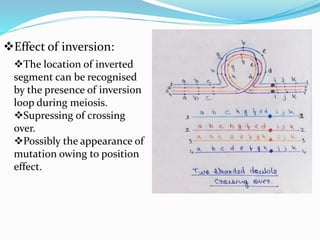
Effect of inversion:
The location of inverted
segment can be recognised
by the presence of inversion
loop during meiosis.
Supressing of crossing
over.
Possibly the appearance of
mutation owing to position
effect.
TRANSLOCATION
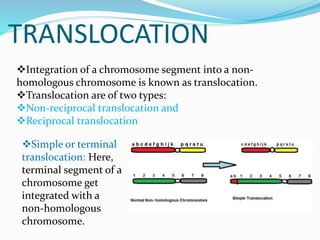
Integration of a chromosome segment into a non-
homologous chromosome is known as translocation.
Translocation are of two types:
Non-reciprocal translocation and
Reciprocal translocation
Simple or terminal
translocation: Here,
terminal segment of a
chromosome get
integrated with a
non-homologous
chromosome.
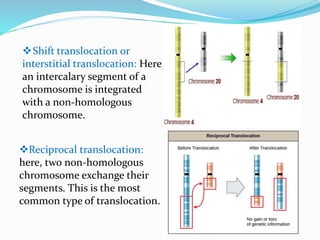
Shift translocation or
interstitial translocation: Here,
an intercalary segment of a
chromosome is integrated
with a non-homologous
chromosome.
Reciprocal translocation:
here, two non-homologous
chromosome exchange their
segments. This is the most
common type of translocation.
Effect of translocation:
It brings an qualitative change in the chromosome
structure.
It will bring about changes in the sequence of genes in
chromosomes which may eventually produce several
abnormalities in body characters. This is position effect.
The most harmful effect of translocation is semi-sterility it
causes.
Structural chromosomal aberration

Structural chromosomal aberration

  • 1.
    CHROMOSOMAL ABERRATION Prepared by : INDUSARMA 5th semester , Botany
  • 2.
    CHROMOSOME Chromosomes are rodshaped or thread like condensed chromatin fibres which store and transmit coded hereditary information. The structure of chromosome consist of: Chromonema Primary constriction or centromere Secondary constriction Telomere
  • 3.
    CHROMOSOMAL ABERRATION Mutations thatcause change in the structure or number of chromosomes are called chromosomal aberration. These are of two types- Structural chromosomal aberrations (change in the structure of gene sequence). Numerical chromosomal aberrations (change in the number of chromosome). Factors responsible for chromosomal aberration are- Due to error in cell division. Maternal age and environment
  • 4.
    STRUCTURAL CHROMOSOMAL ABERRATIONS Structural chromosomalaberration can be divided into four types- Deficiency or deletion Duplication Inversion Translocation Deletion and duplication involve alteration with certain chromosomal segment being lost or doubled. Inversion and translocation involve changes in position of chromosome segment.
  • 5.
    DELETION OR DEFICIENCY Theloss of a section of genetic material and genetic information from a chromosome structure. Deletion was the first structural aberration detected by Bridges in 1917 on X-chromosome of Drosophila. Deletion can be of two types- Terminal deletion- It involves a single break near the end of the chromosome. Intercalary deletion – It involves two break in the middle portion.
  • 6.
    EFFECTS OF DEFICIENCY Deficiencyis useful in determining exact location of the gene on the chromosome. It will show pseudo dominance effect. Deficiency loop Formation takes place during synapsis. For example, in X-Chromosome of Drosophila, few bands are missing from the tip of X-band which result in formation of notches in wing margins in female fly.
  • 7.
    DUPLICATION A structural changeresulting in doubling of genes in a section of a chromosome. It can be intra-chromosomal duplication and inter-chromosomal duplication. Duplication can be of four types- Tandem duplication- The additional chromosome segment is located just after the normal segment, gene sequence being the same. Reverse tandem duplication: Same as above but the gene sequence of additional segment is inverted.
  • 8.
    Displaced duplication- Here asequence of chromosome get displaced in the same arm (intra arm) or in different arm (inter arm) of the chromosome. Transposed duplication- Here, duplicated gene sequence is attached to another position owing to inter chromosomal duplication.
  • 9.
    EFFECT OF DUPLICATION Dueto supply of additional genetic material and change genetic balance, they play important role in evolution at individual and population levels. For example: The theory of bar eye mutation in Drosophila is common example of duplication.
  • 10.
    INVERSION It is anintra-chromosomal aberration, inversion of a chromosomal segment take place in intercalary position rotating at about 180 degree on its axis. It is of two types- Paracentric inversion: This inversion is confined to a single arm of chromosome and do not carry centromere. Pericentric inversion: In this type of inversion, break points are located in both arms of chromosome including centromere.
  • 11.
    Effect of inversion: Thelocation of inverted segment can be recognised by the presence of inversion loop during meiosis. Supressing of crossing over. Possibly the appearance of mutation owing to position effect.
  • 12.
    TRANSLOCATION Integration of achromosome segment into a non- homologous chromosome is known as translocation. Translocation are of two types: Non-reciprocal translocation and Reciprocal translocation Simple or terminal translocation: Here, terminal segment of a chromosome get integrated with a non-homologous chromosome.
  • 13.
    Shift translocation or interstitialtranslocation: Here, an intercalary segment of a chromosome is integrated with a non-homologous chromosome. Reciprocal translocation: here, two non-homologous chromosome exchange their segments. This is the most common type of translocation.
  • 14.
    Effect of translocation: Itbrings an qualitative change in the chromosome structure. It will bring about changes in the sequence of genes in chromosomes which may eventually produce several abnormalities in body characters. This is position effect. The most harmful effect of translocation is semi-sterility it causes.