NORMAL MENDELIAN RATIO
AND ITS MODIFICATION
(Includes Lethal Gene effects
& EPISTASIS
DR. ASHISH PATEL
Assistant professor
Dept. AGB, Veterinary College, AAU,
Anand
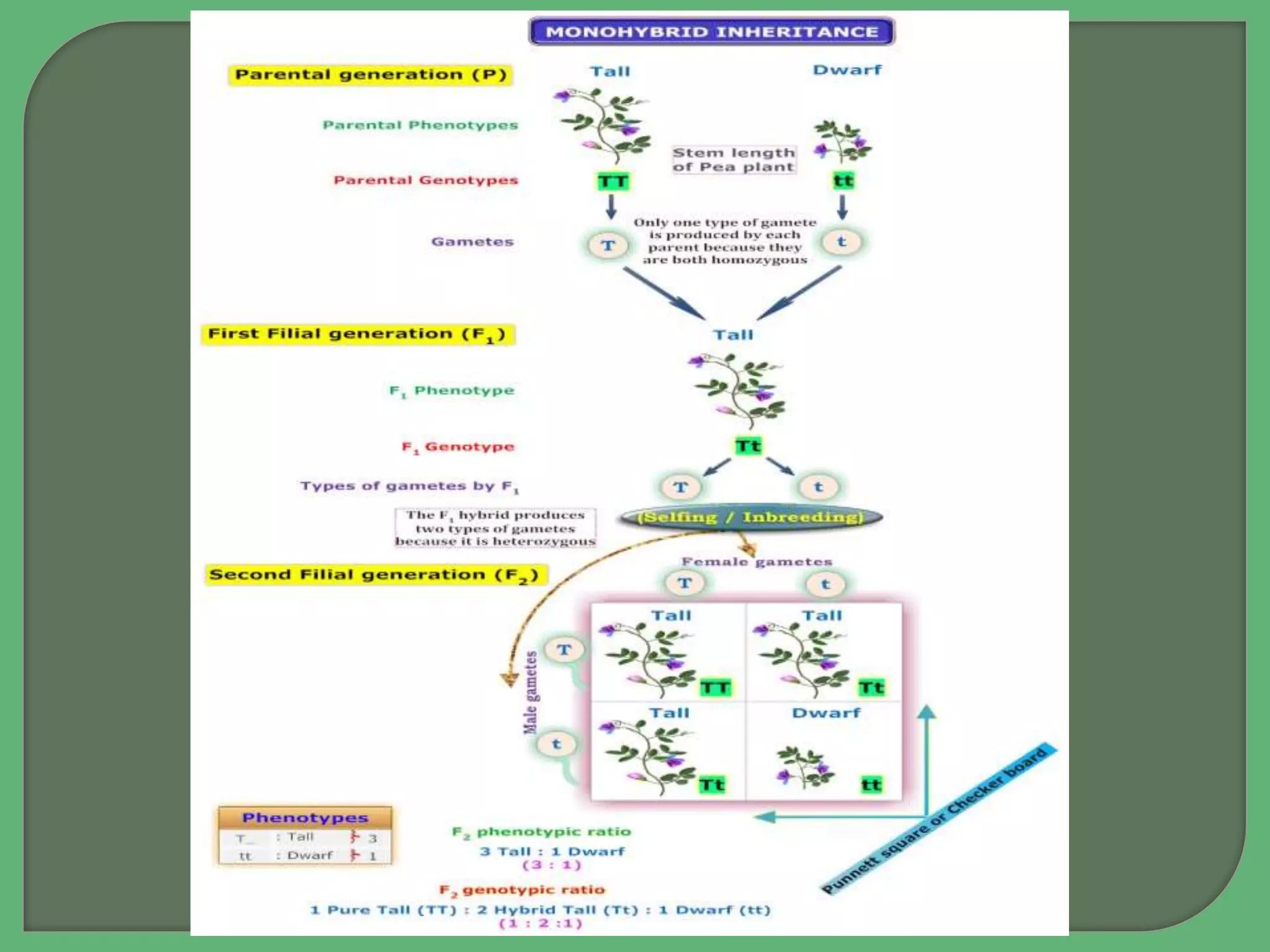
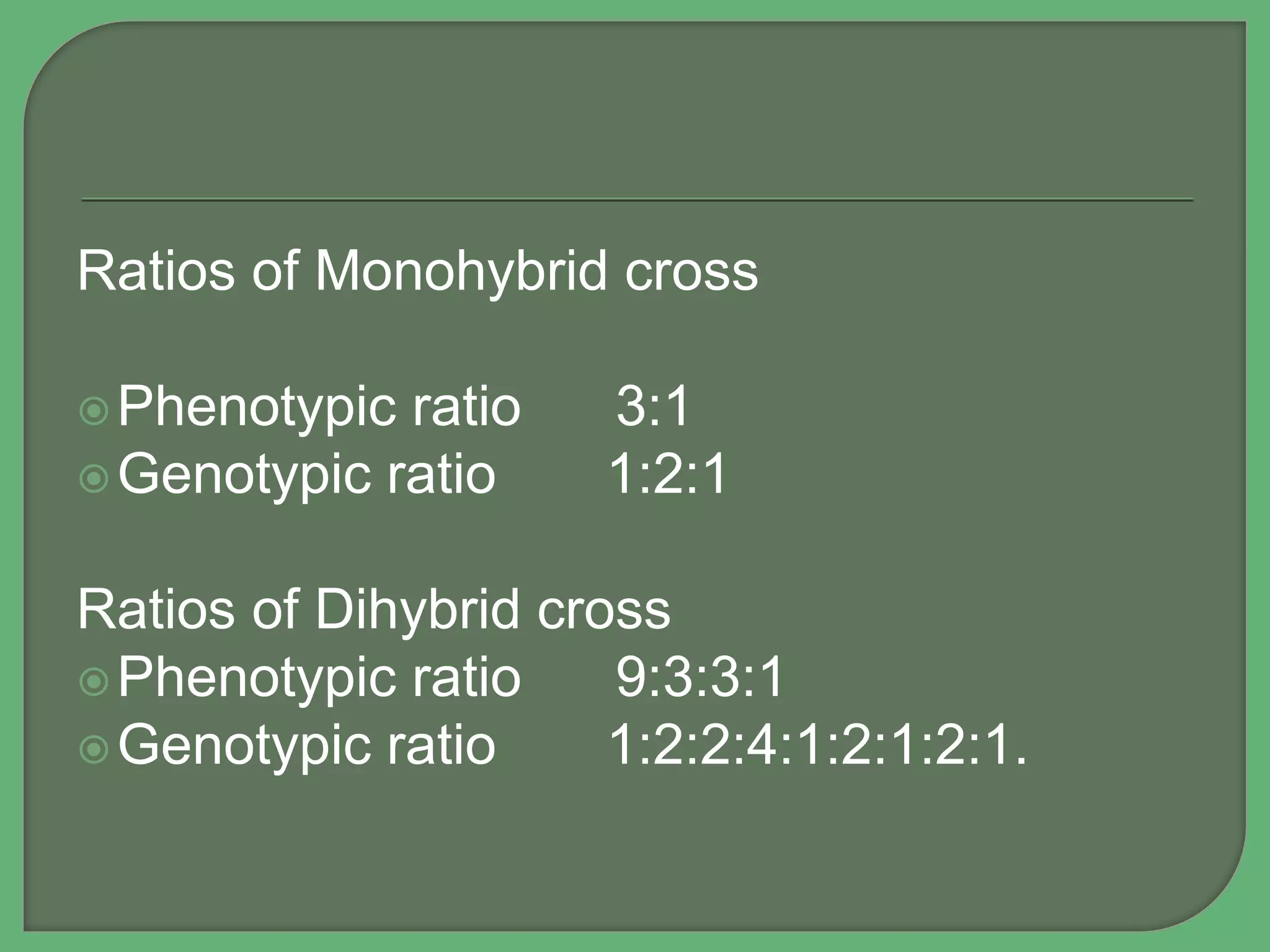
Ratios of Monohybrid cross
Phenotypic ratio 3:1
Genotypic ratio 1:2:1
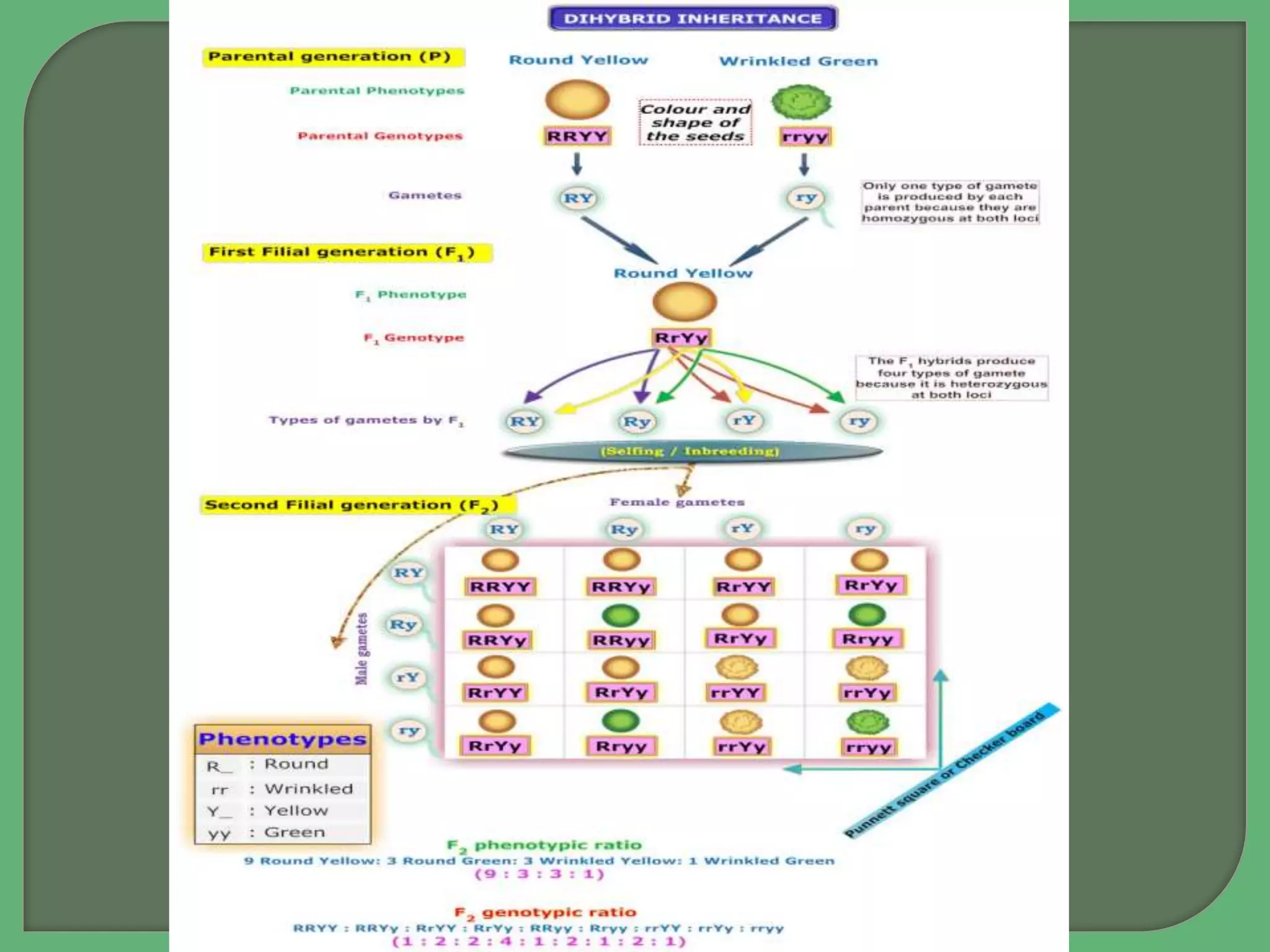
Ratios of Dihybrid cross
Phenotypic ratio 9:3:3:1
Genotypic ratio 1:2:2:4:1:2:1:2:1.
The law of purity of gametes
 When a pair of alleles is brought together in a
hybrid (F1) they remain together without
contaminating each other and they separate or
segregate from each other into a gamete during
the formation of gametes.
Or
 The two alleles of a gene remains separate and do
not contaminate each other in F1 generation or in
hybrid. At the time of gamete formation in F1, the
two alleles separate out and pass into different
gametes.
 The segregation of two or more characters in the
same hybrid is independent to each other. Thus
any allele of one gene is equally likely to combine
with any allele of the other gene and passed into
same gamete.

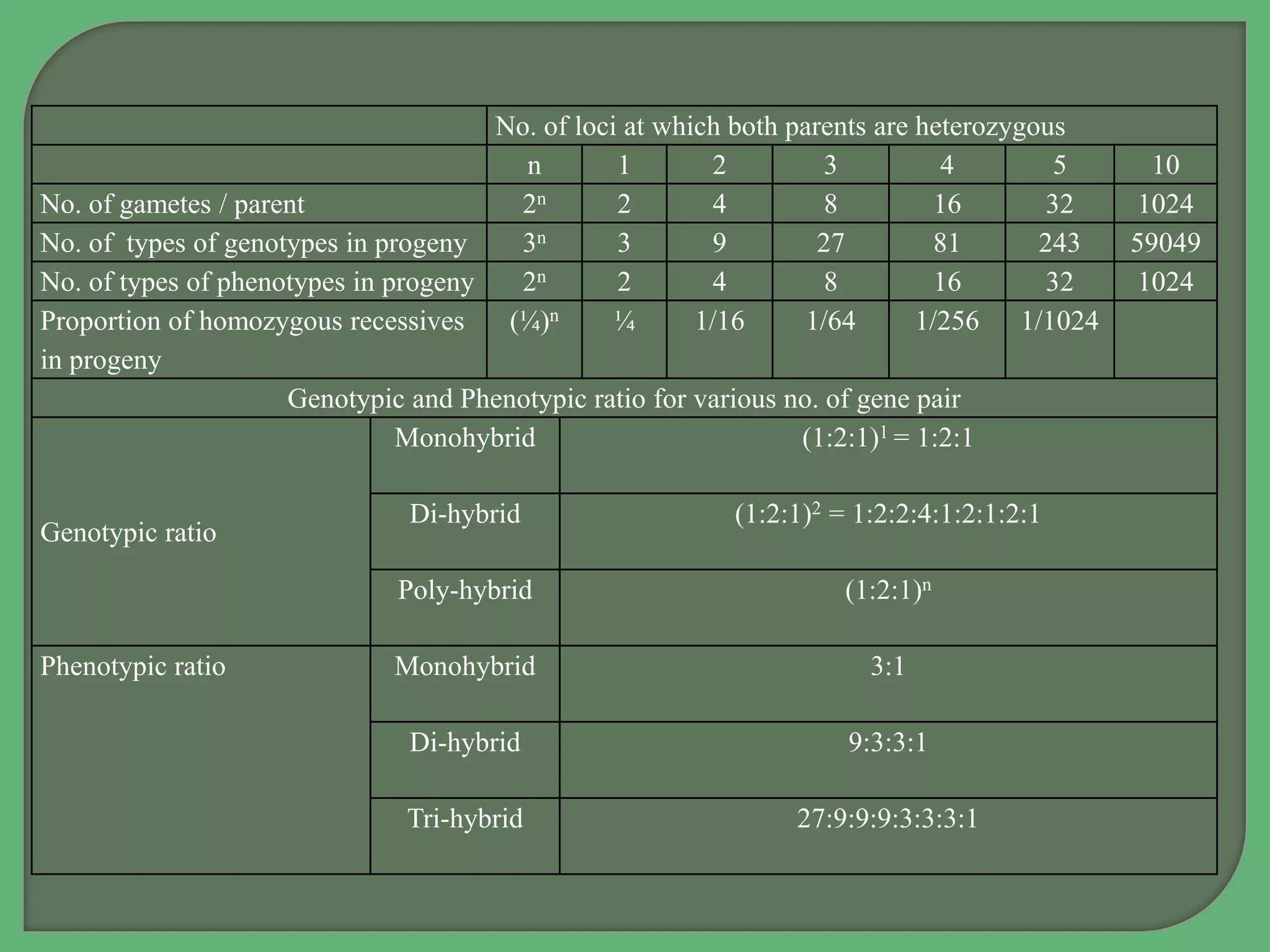
No. of loci at which both parents are heterozygous
n 1 2 3 4 5 10
No. of gametes / parent 2n 2 4 8 16 32 1024
No. of types of genotypes in progeny 3n 3 9 27 81 243 59049
No. of types of phenotypes in progeny 2n 2 4 8 16 32 1024
Proportion of homozygous recessives
in progeny
(¼)n ¼ 1/16 1/64 1/256 1/1024
Genotypic and Phenotypic ratio for various no. of gene pair
Genotypic ratio
Monohybrid (1:2:1)1 = 1:2:1
Di-hybrid (1:2:1)2 = 1:2:2:4:1:2:1:2:1
Poly-hybrid (1:2:1)n
Phenotypic ratio Monohybrid 3:1
Di-hybrid 9:3:3:1
Tri-hybrid 27:9:9:9:3:3:3:1
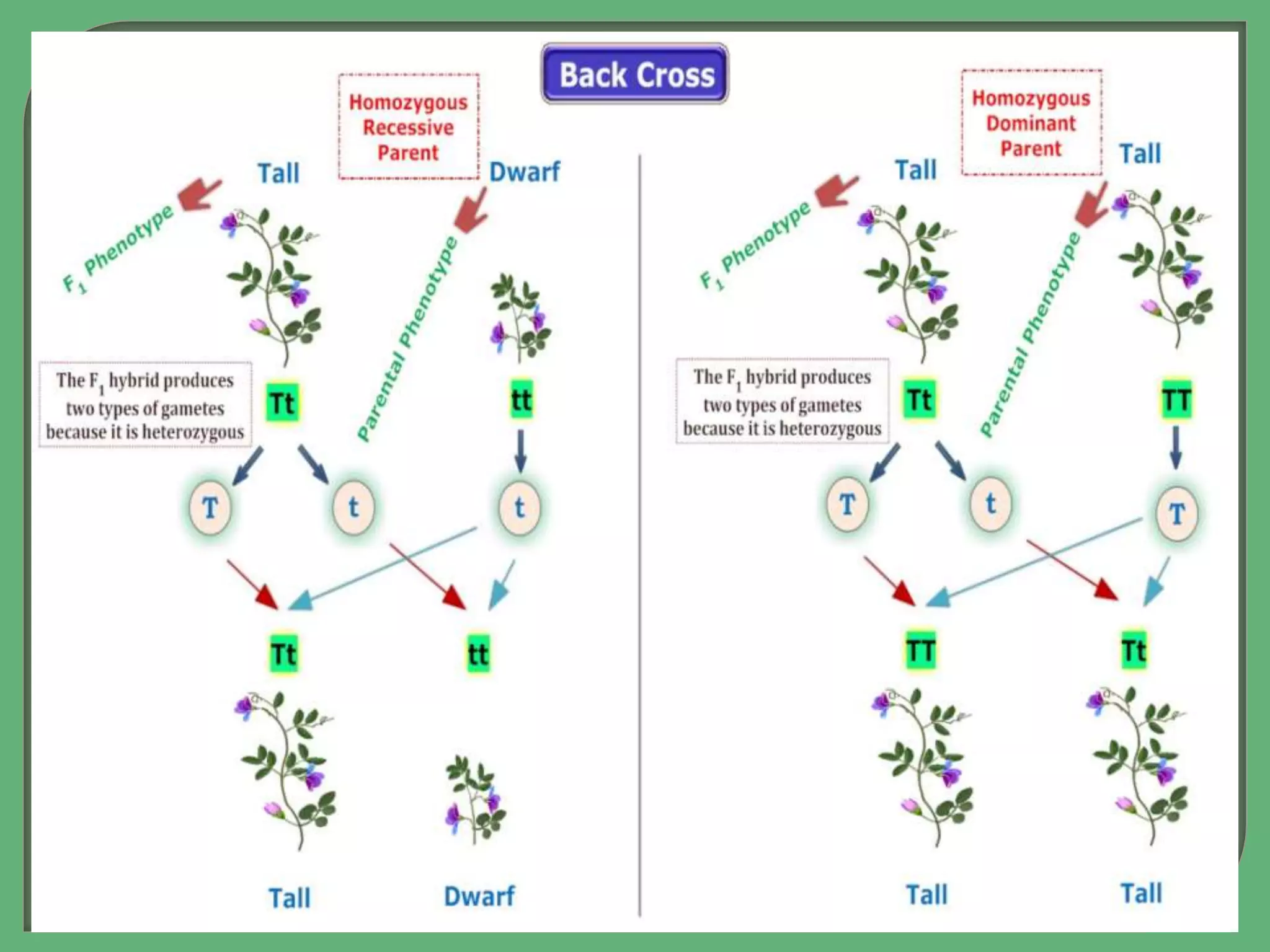
Mono hybrid test cross – 1 : 1
Di-hybrid test cross - 1 : 1 : 1 : 1
Tri-hybrid test cross - 1 : 1 : 1 : 1 : 1 : 1 : 1 : 1
 According to interaction between alleles or genes which
leads to change in the phenotypic ratio are categorized
as
1. Interaction between alleles at same locus
(Intra-locular interaction or intra-allelic interaction)
2. Interaction between alleles at different locus
(Inter-locular interaction or inter-allelic interaction)
1. Interaction between alleles at same locus / Intra-
locular interaction / intra-allelic interaction
The traits studied by mendel were determined by the
genes which acted as either dominant or as recessive.
In this type of allelic relationship, one allele completely
masked the effect of other alleles and other allele
masked by dominant allele. These two recessive and
dominance are two extreme form of gene expression.
So, in general the dominance is an interaction at
particular locus and hence this interaction is called as
Intra-locular interaction / intra-allelic interaction.
The Dominance is classified in to four categories.
1. Complete dominance
2. Incomplete dominance (partial dominance or semi dominance)
3. Co-dominance
4. Overdominance
5. Lethality of genes
 The phenotypic ratio of 3:1 in monohybrid crosses is obtained
when there is complete dominance.
 So, the extension of Mendelian ratio and principles due to
incomplete dominance, co-dominance and also due to lethal
genes.
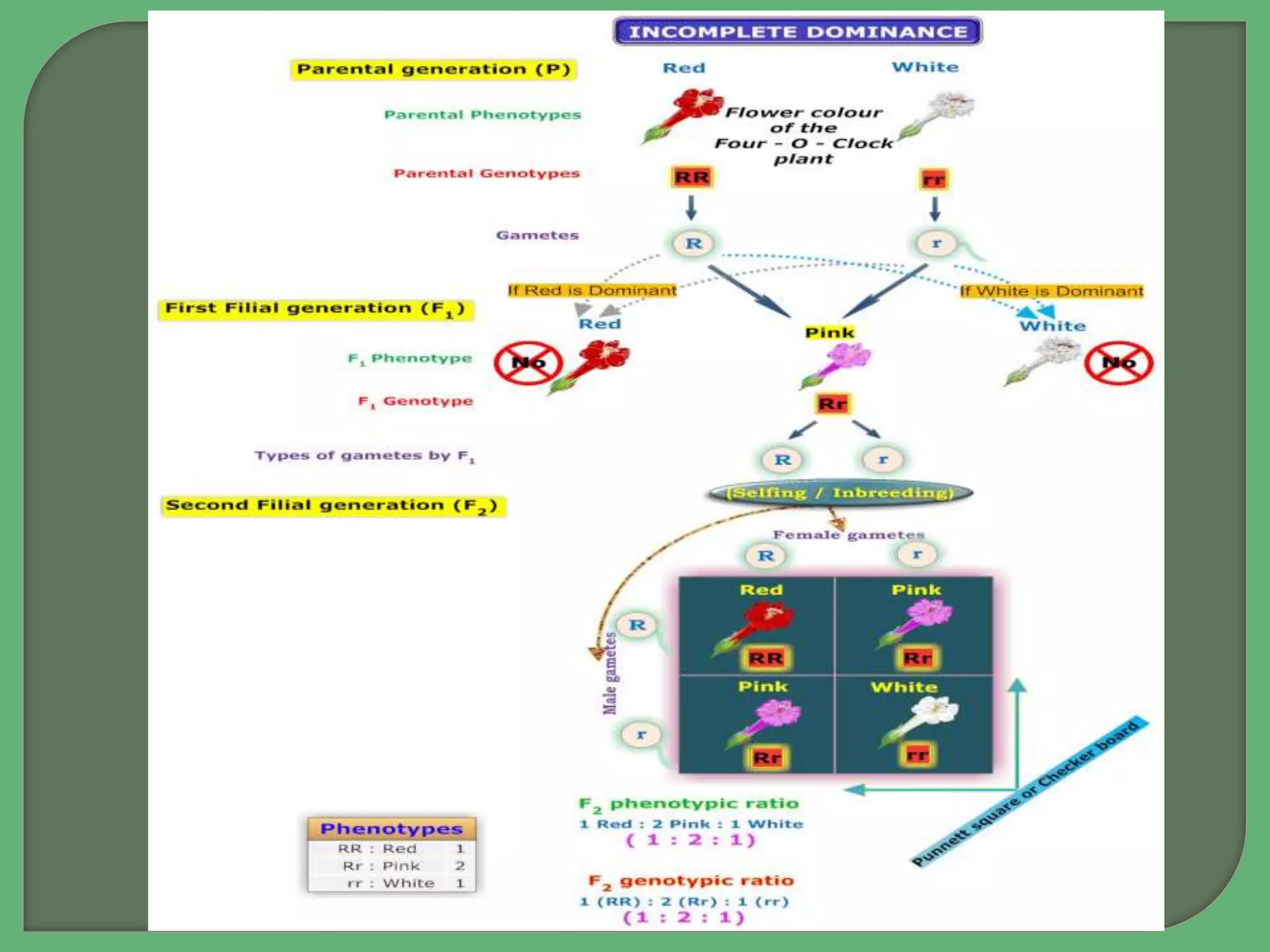
In this incomplete dominance the phenotype of heterozygote
is intermediate to the phenotypes of the two types of
homozygotes.
The genotypic and phenotypic ratios for monohybrids are
1:2:1 and 1:2:1.
E.g.
Flower color in four- O’- clock plants (Mirabilis Jalapa) and
Snapdragon (Antirrhinum majus), feather color in Blue
Andalusian fowl
The phenotypic ratio for the monohybrid cross becomes 1:2:1
instead of 3:1.
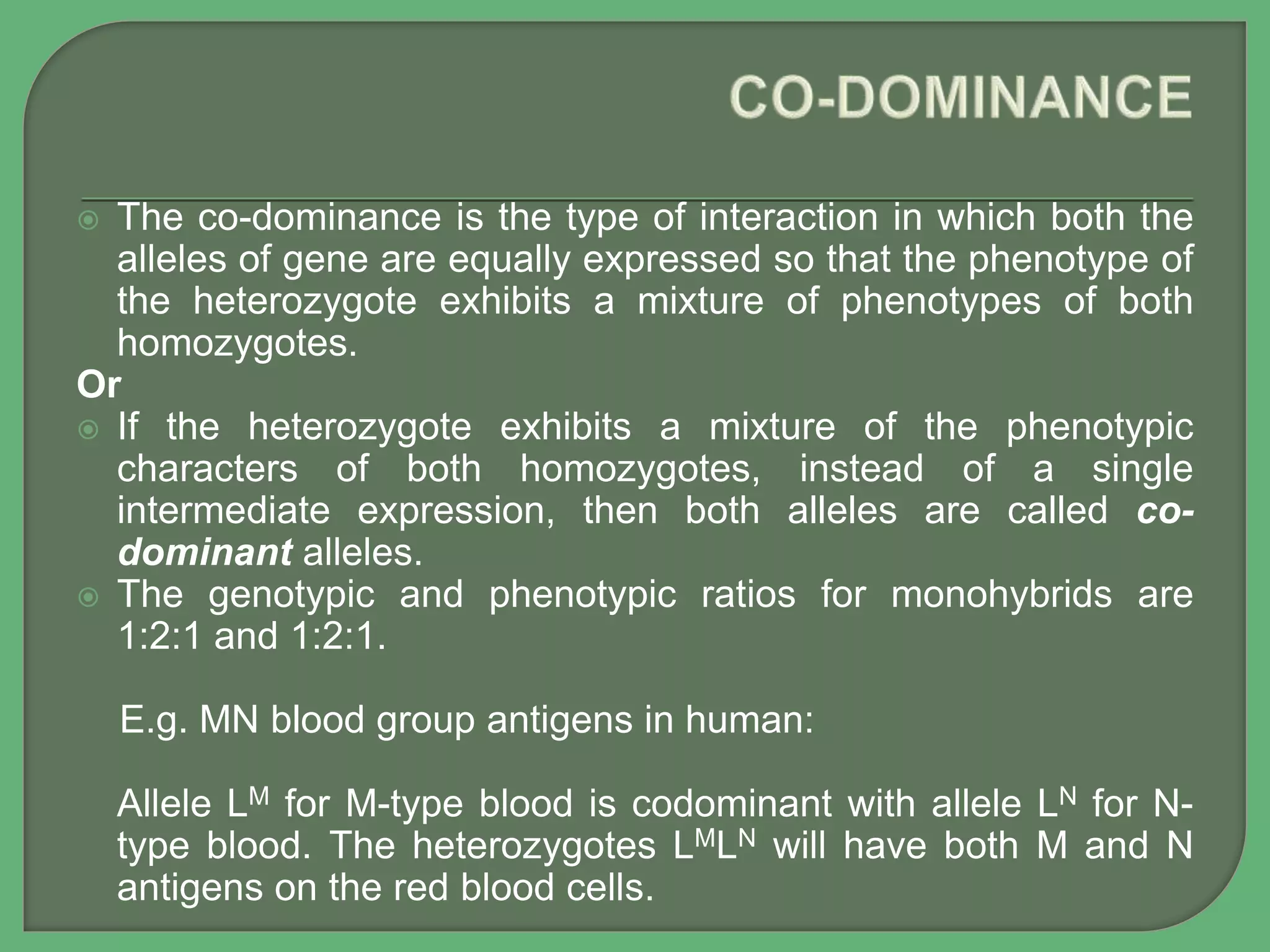
 The co-dominance is the type of interaction in which both the
alleles of gene are equally expressed so that the phenotype of
the heterozygote exhibits a mixture of phenotypes of both
homozygotes.
Or
 If the heterozygote exhibits a mixture of the phenotypic
characters of both homozygotes, instead of a single
intermediate expression, then both alleles are called co-
dominant alleles.
 The genotypic and phenotypic ratios for monohybrids are
1:2:1 and 1:2:1.
E.g. MN blood group antigens in human:
Allele LM for M-type blood is codominant with allele LN for N-
type blood. The heterozygotes LMLN will have both M and N
antigens on the red blood cells.
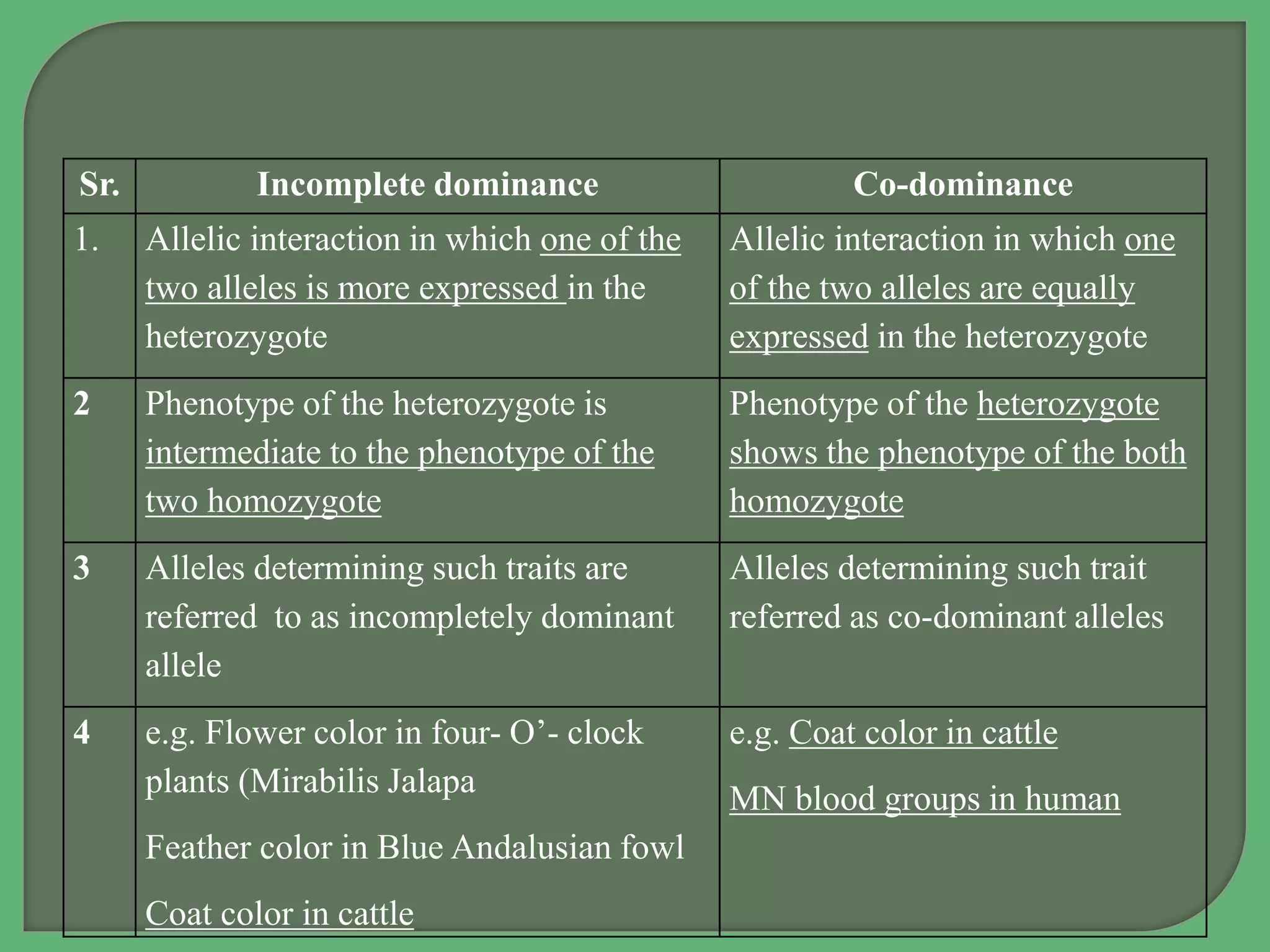
Sr. Incomplete dominance Co-dominance
1. Allelic interaction in which one of the
two alleles is more expressed in the
heterozygote
Allelic interaction in which one
of the two alleles are equally
expressed in the heterozygote
2 Phenotype of the heterozygote is
intermediate to the phenotype of the
two homozygote
Phenotype of the heterozygote
shows the phenotype of the both
homozygote
3 Alleles determining such traits are
referred to as incompletely dominant
allele
Alleles determining such trait
referred as co-dominant alleles
4 e.g. Flower color in four- O’- clock
plants (Mirabilis Jalapa
Feather color in Blue Andalusian fowl
Coat color in cattle
e.g. Coat color in cattle
MN blood groups in human
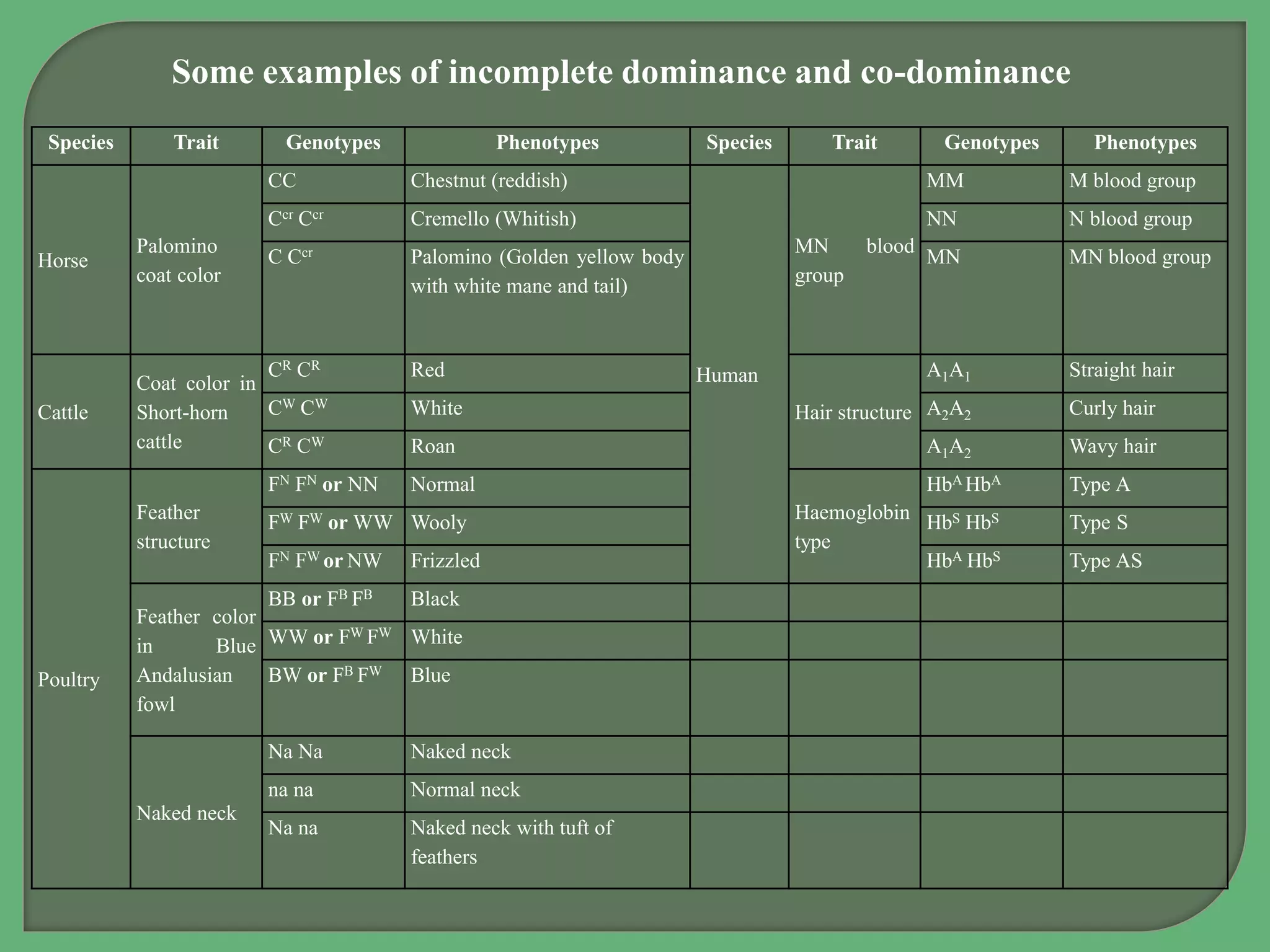
Species Trait Genotypes Phenotypes Species Trait Genotypes Phenotypes
Horse
Palomino
coat color
CC Chestnut (reddish)
Human
MN blood
group
MM M blood group
Ccr Ccr Cremello (Whitish) NN N blood group
C Ccr Palomino (Golden yellow body
with white mane and tail)
MN MN blood group
Cattle
Coat color in
Short-horn
cattle
CR CR Red
Hair structure
A1A1 Straight hair
CW CW White A2A2 Curly hair
CR CW Roan A1A2 Wavy hair
Poultry
Feather
structure
FN FN or NN Normal
Haemoglobin
type
HbA HbA Type A
FW FW or WW Wooly HbS HbS Type S
FN FW or NW Frizzled HbA HbS Type AS
Feather color
in Blue
Andalusian
fowl
BB or FB FB Black
WW or FW FW White
BW or FB FW Blue
Naked neck
Na Na Naked neck
na na Normal neck
Na na Naked neck with tuft of
feathers
Some examples of incomplete dominance and co-dominance
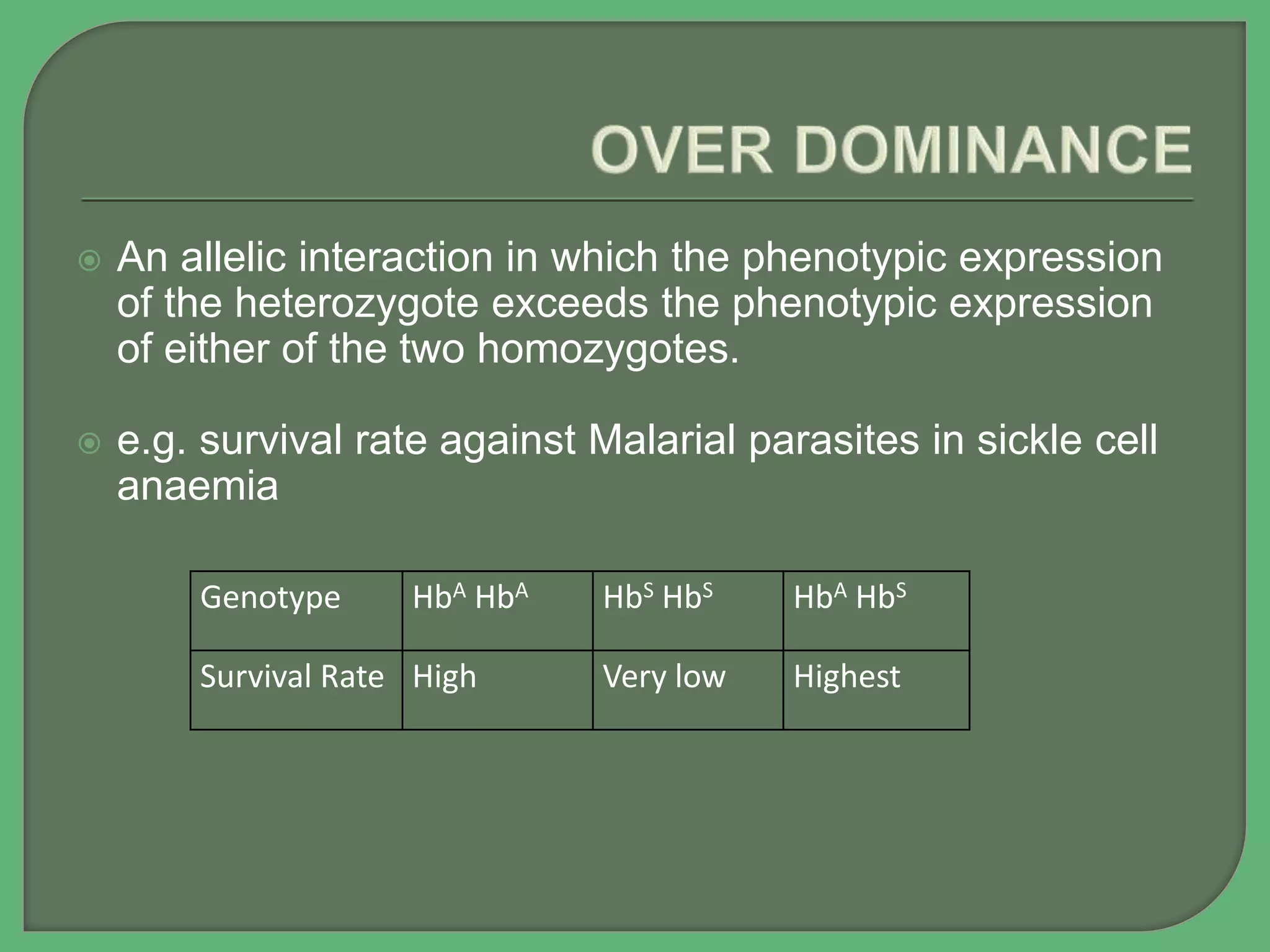
 An allelic interaction in which the phenotypic expression
of the heterozygote exceeds the phenotypic expression
of either of the two homozygotes.
 e.g. survival rate against Malarial parasites in sickle cell
anaemia
Genotype HbA HbA HbS HbS HbA HbS
Survival Rate High Very low Highest
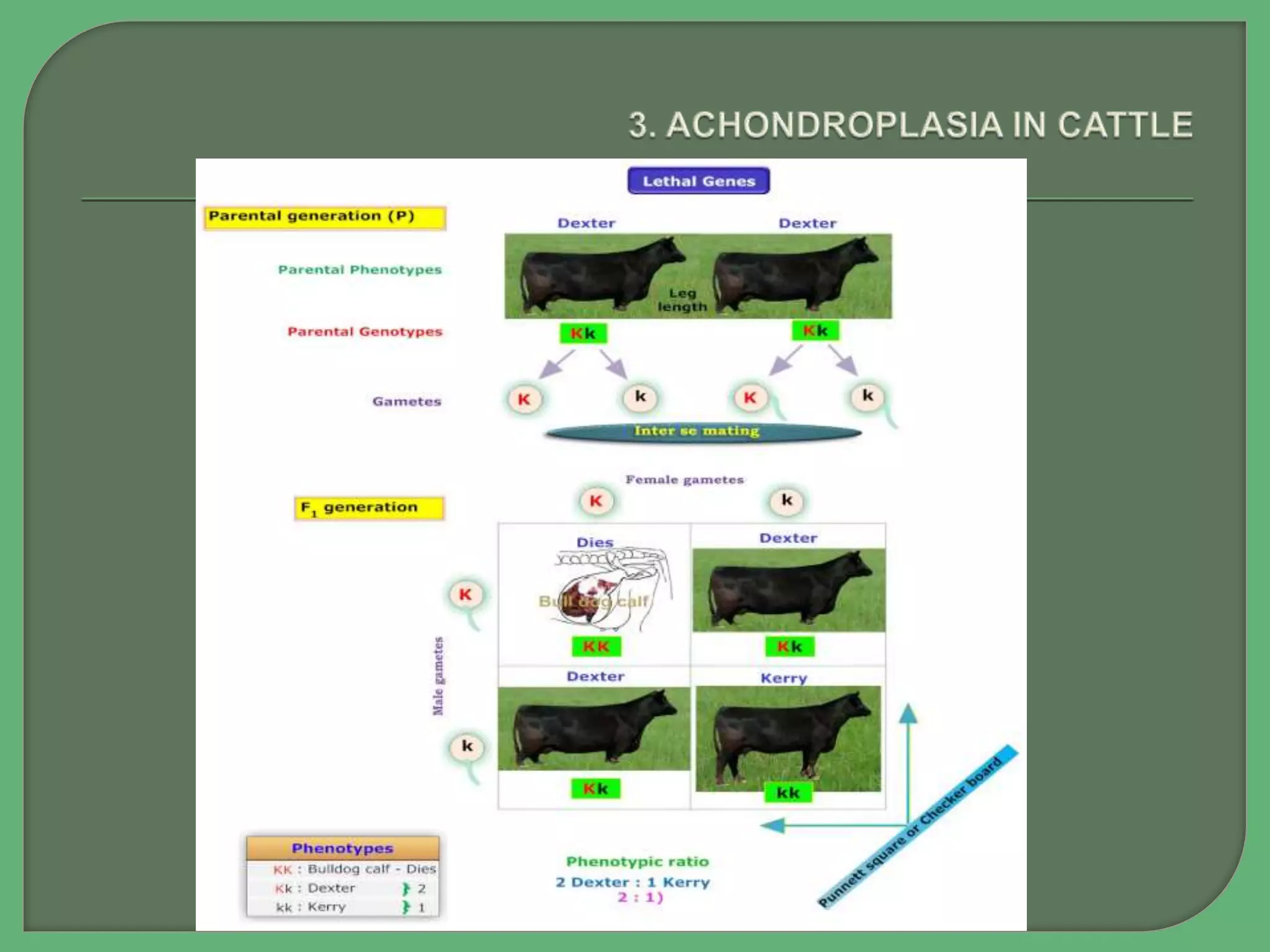
 Lethal genes are those that cause the death of the young
during pregnancy or at birth.
 Genes which affect the viability of an organism are
called lethal genes and the phenomenon is called lethality.
 Sub lethal and Semi lethal are those genes which cause the
death of the young after birth or some time later in life.
 Lethal genes can be recessive, dominant, conditional,
semilethal / sublethal, or synthetic, depending on the gene
or genes involved.
 If the lethal effect is dominant and immediate in
expression, all individuals carrying the gene will die and
the gene will be lost.
 Dominant lethal genes are expressed in both
homozygotes and heterozygotes. All individuals carrying
the genes will die and the genes will be lost in
populations.
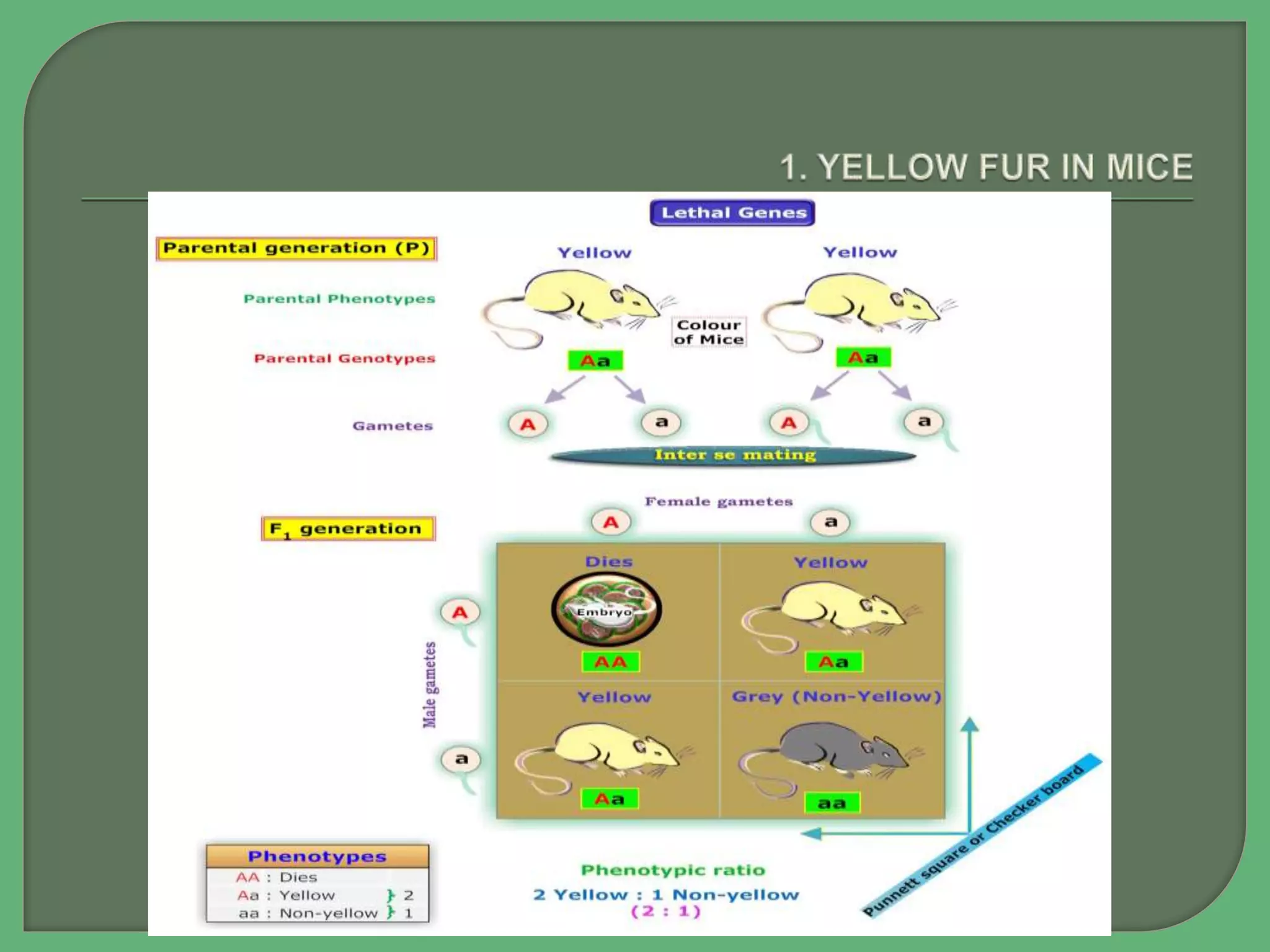
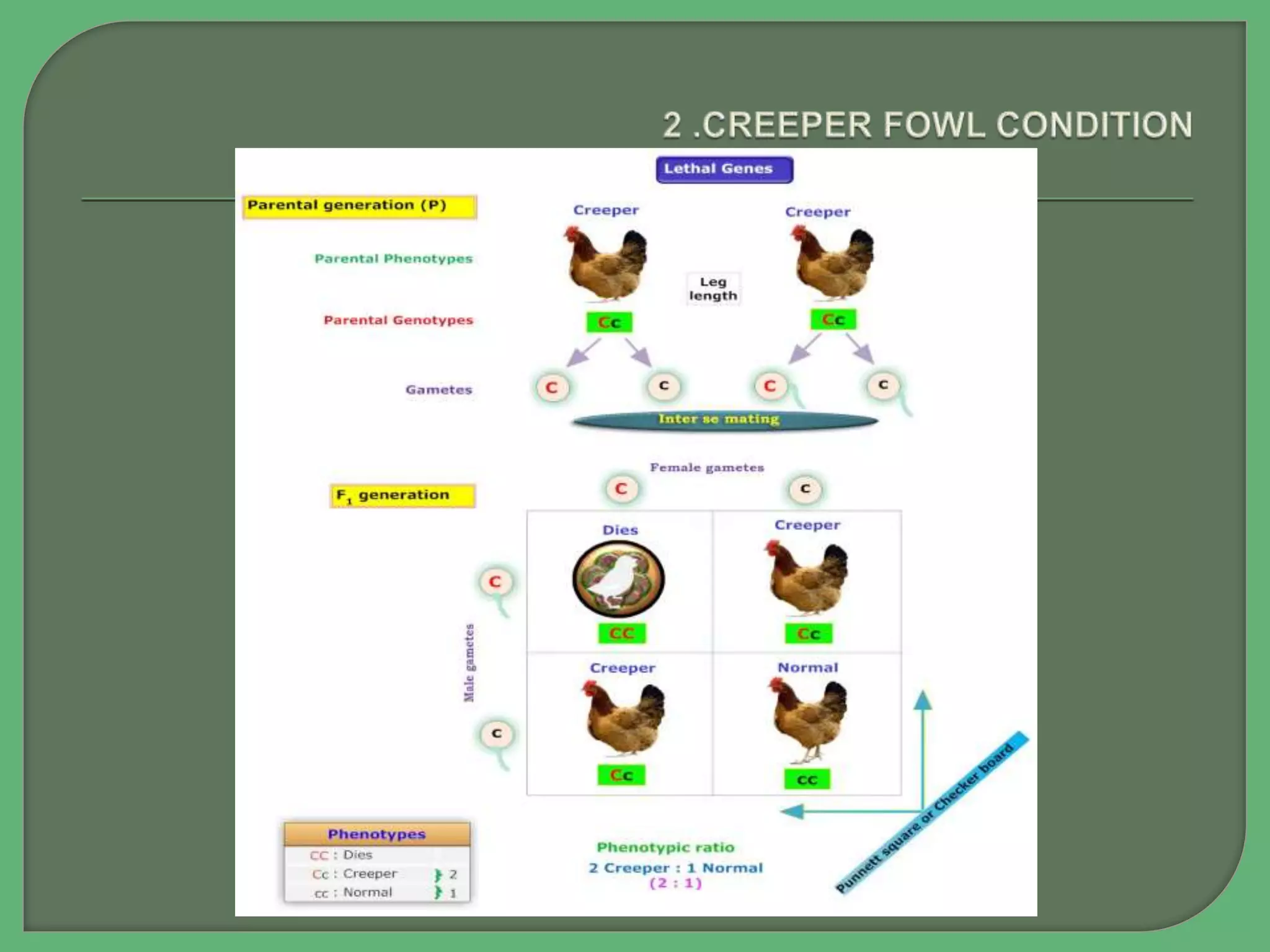
 Recessive lethal allele carried in the heterozygous
condition has no effect but they cause death when an
organism carries two copies of the lethal allele.
 Recessive lethal may come to expression when mating
between carriers occurs.
 The phonotypic ratio is modified in to 2:1.
 Elimination of lethal genes from the population could be
carried out by identifying the carriers (heterozygotes) and
preventing them from further breeding.
 Intermediate lethal genes are much easier to detect because
all the individuals will exhibit some phenotypic expression of
the gene.
 Dominant lethals kill the individual either in homozygous or
heterozygous conditions and therefore is eliminated from the
population in the same generation in which it arises.
 Recessive lethals kill only when in homzygous stage. They
are very difficult to eliminate from the population.
Heterozygous carrier parents that produce a lethal effect could
be used as testers to identify others in the population.
1. Interaction between alleles at same locus / Intra-
locular interaction / intra-allelic interaction
(Already discussed)
Now……..
2. Interaction between alleles at different locus
(Non allelic interaction/ Inter-locular interaction or
inter-allelic interaction)
 The phenotypic expression of alleles of one locus is
modified by the alleles of the other loci is called as
epistasis.
 The phenomenon of two or more genes which affects
single trait, in such a way that they affect the expressions
of each other in various ways is known as Gene
Interaction.
 The gene/locus that blocks the expression of an allelic
gene/locus is said to be epistatic and the gene/locus
whose expression is blocked is said to be hypostatic.
 When independent (non-homologous) genes located on
the same or on different chromosomes interact with one
another for the expression of single phenotypic trait then
it is known as Inter-Allelic Interactions.
 Gene interaction may involve two or more genes.
 Two interacting genes produce modified dihybrid ratios.
 Two genes influencing the same character
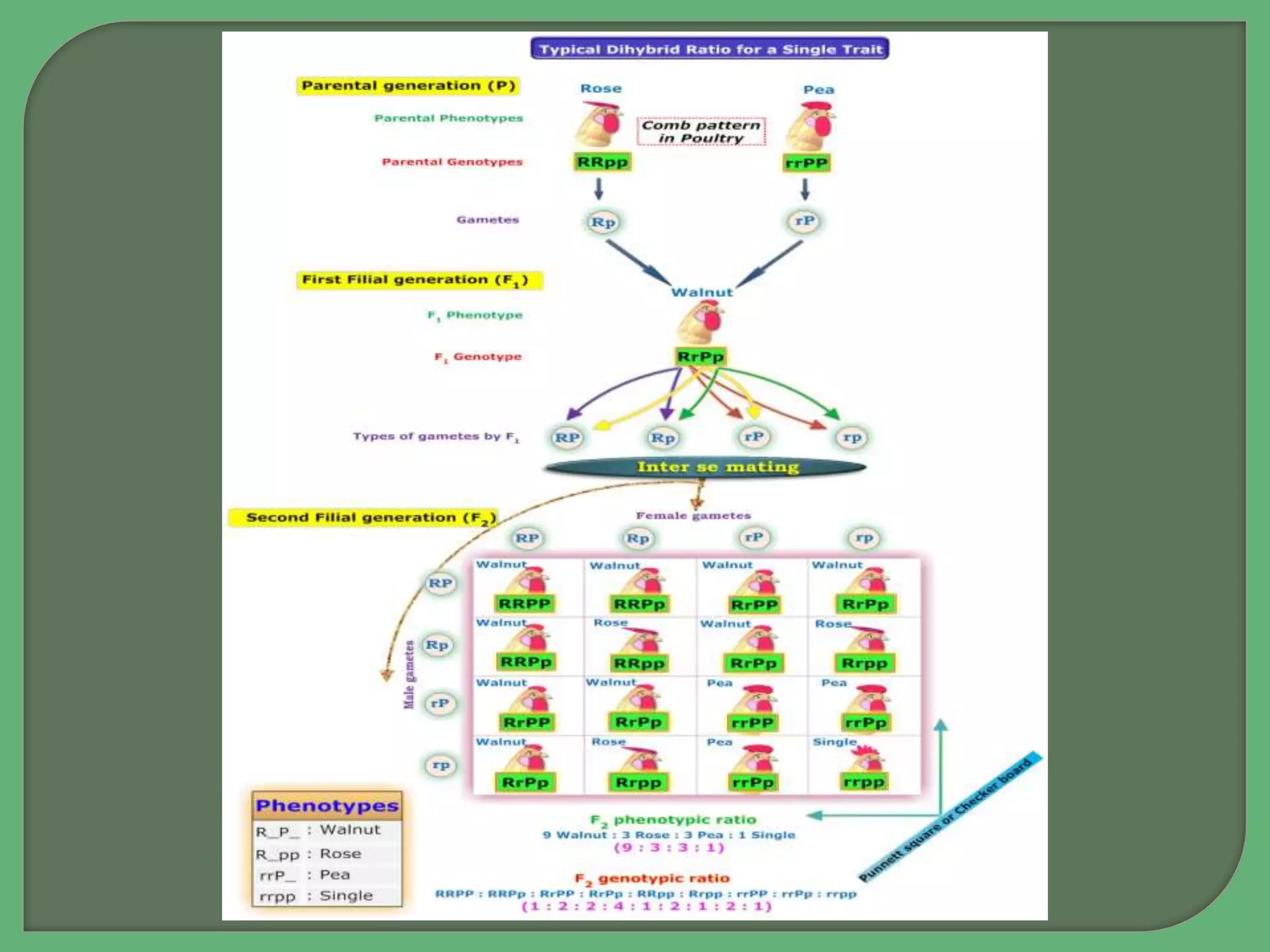
 Example: Comb pattern in poultry
 Normally, certain specific breeds have a specific comb pattern.
• Wyandotte – Rose comb
• Brahmas – Pea comb
• Leghorns – Single comb
 Crosses between Rose combed and single combed
variety showed that Rose was dominant over single and
a 3:1 ratio appeared in the F2.
 Crosses between Pea combed and single combed
variety showed that Pea was dominant over single and a
3:1 ratio appeared in the F2.
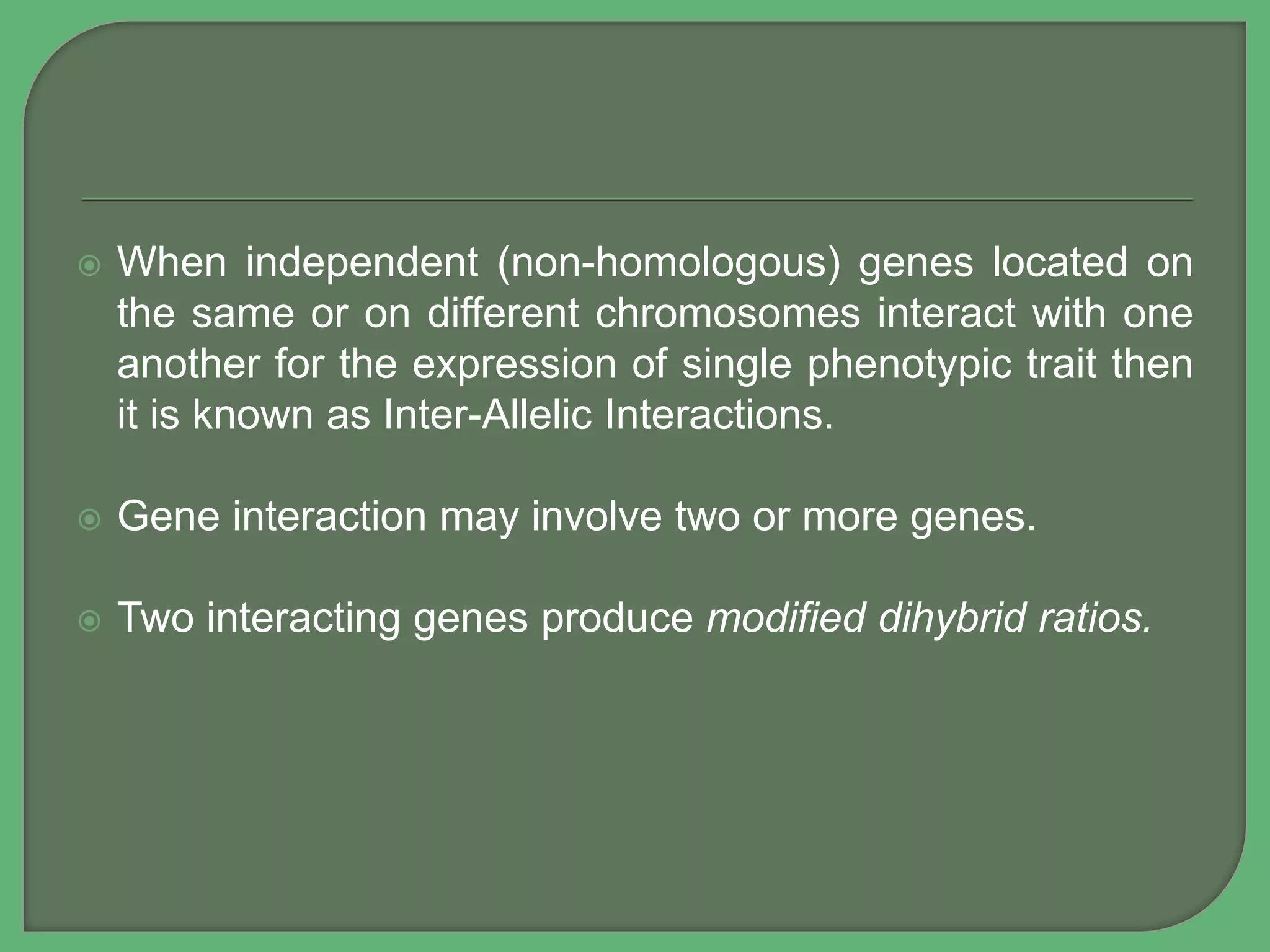
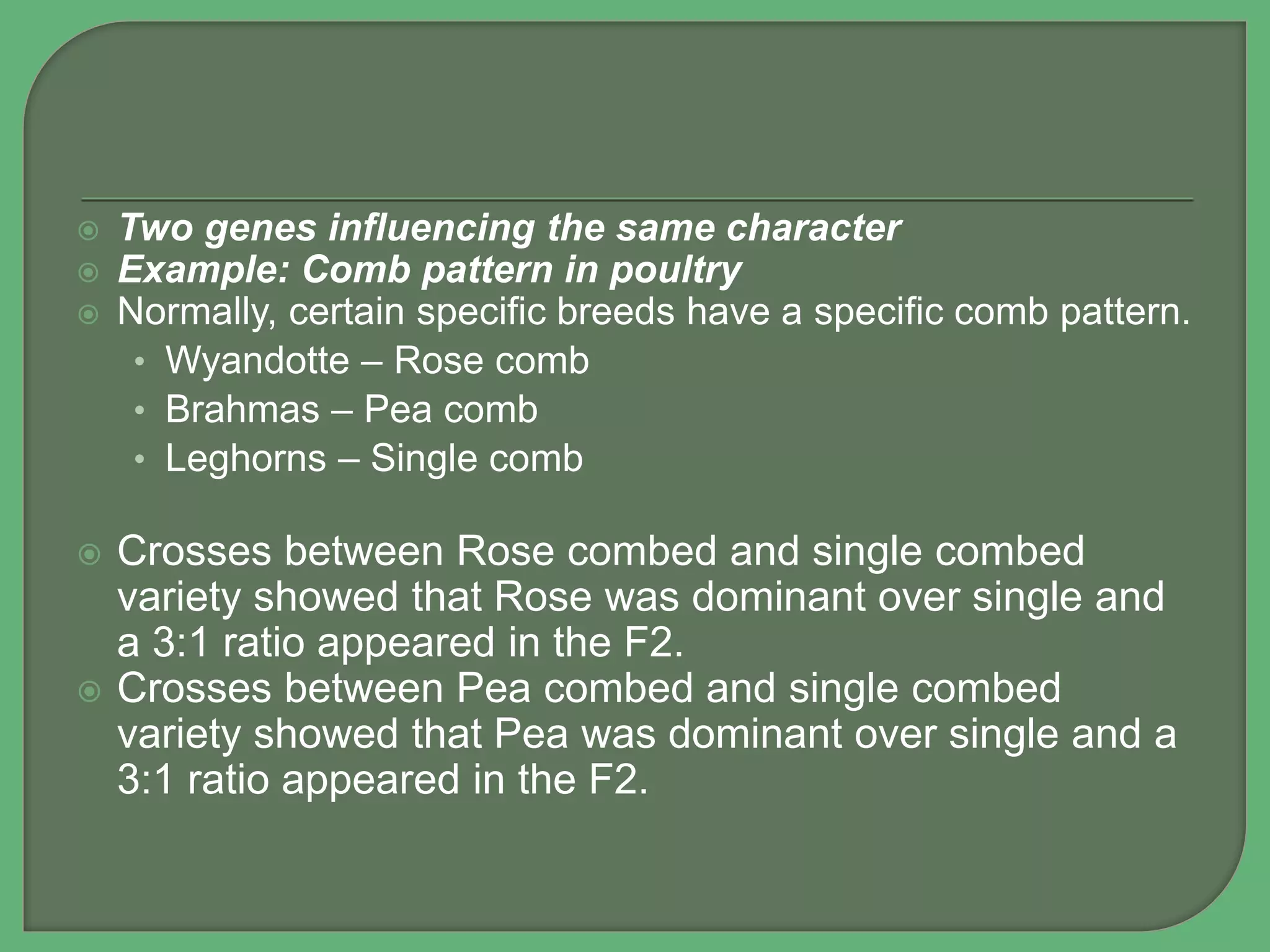
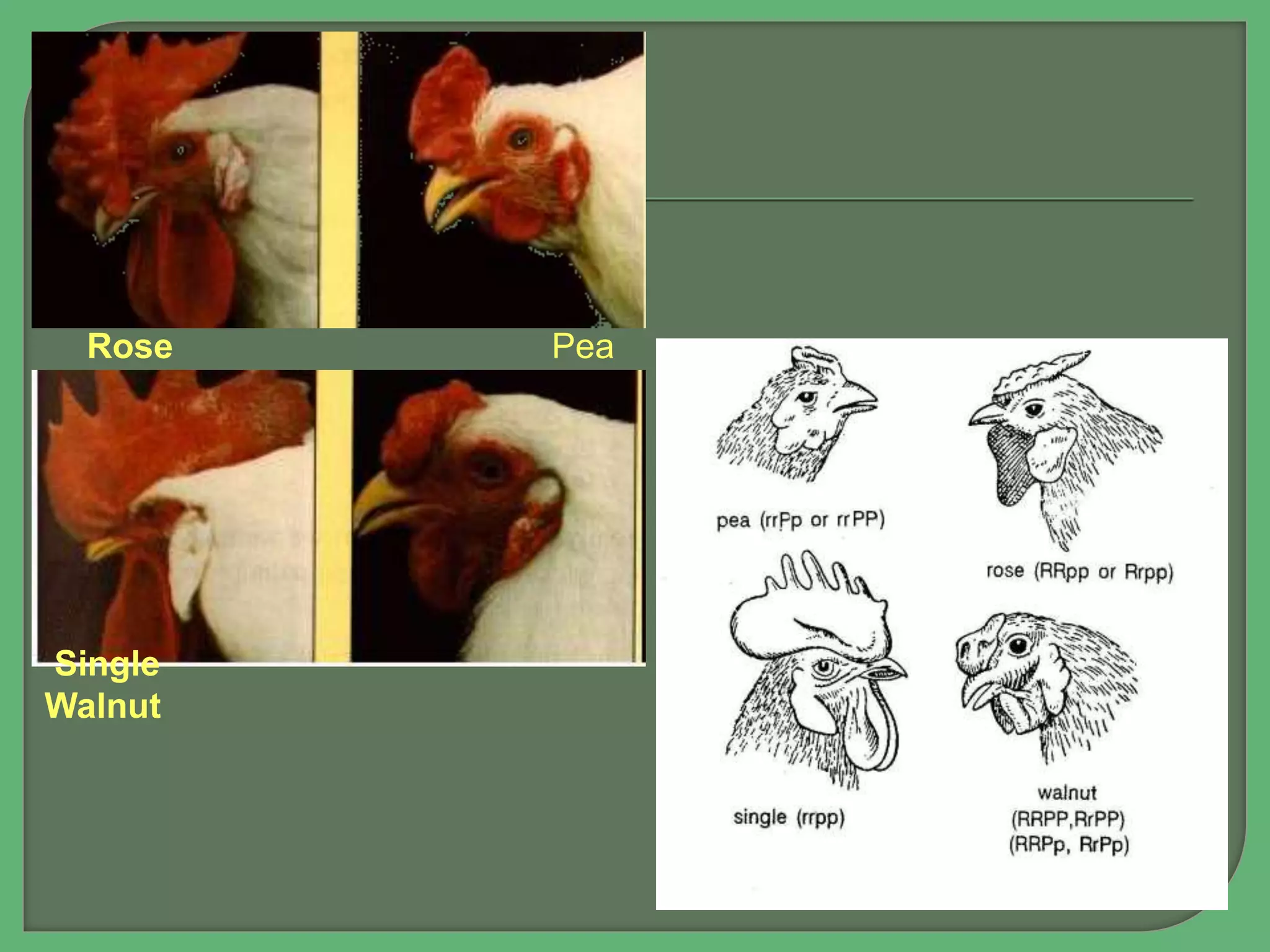
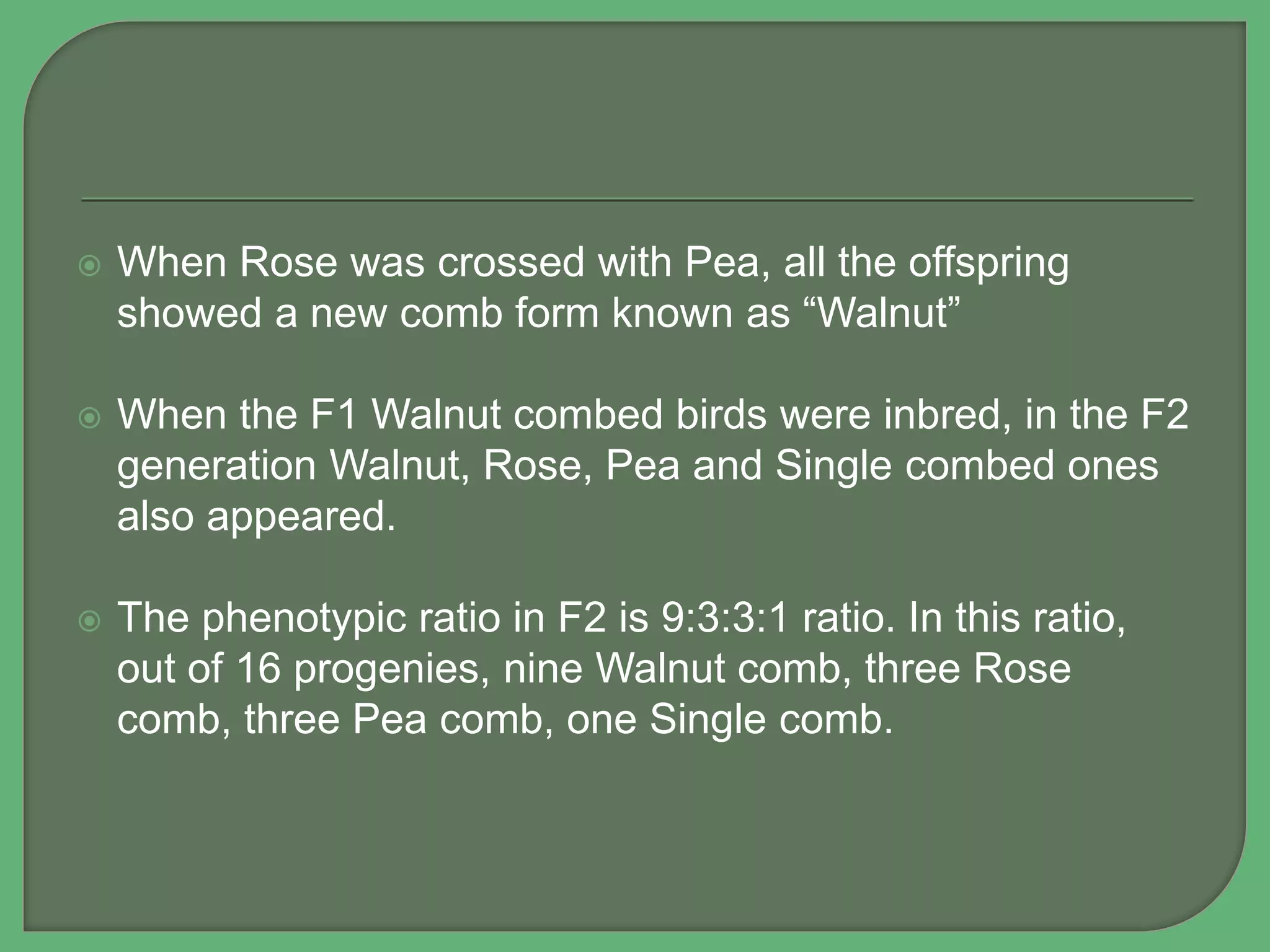
Rose Pea
Single
Walnut
 When Rose was crossed with Pea, all the offspring
showed a new comb form known as “Walnut”
 When the F1 Walnut combed birds were inbred, in the F2
generation Walnut, Rose, Pea and Single combed ones
also appeared.
 The phenotypic ratio in F2 is 9:3:3:1 ratio. In this ratio,
out of 16 progenies, nine Walnut comb, three Rose
comb, three Pea comb, one Single comb.
 Differences from normal dihybrid inheritance are
• The F1 resembles neither the parent (Walnut comb)
• Apparently novel characters appear in F2 (Single comb)
• Walnut character results from an interaction between
two independently inherited dominant Rose and Pea
genes.
 Single comb results from interaction of their two recessive
alleles.
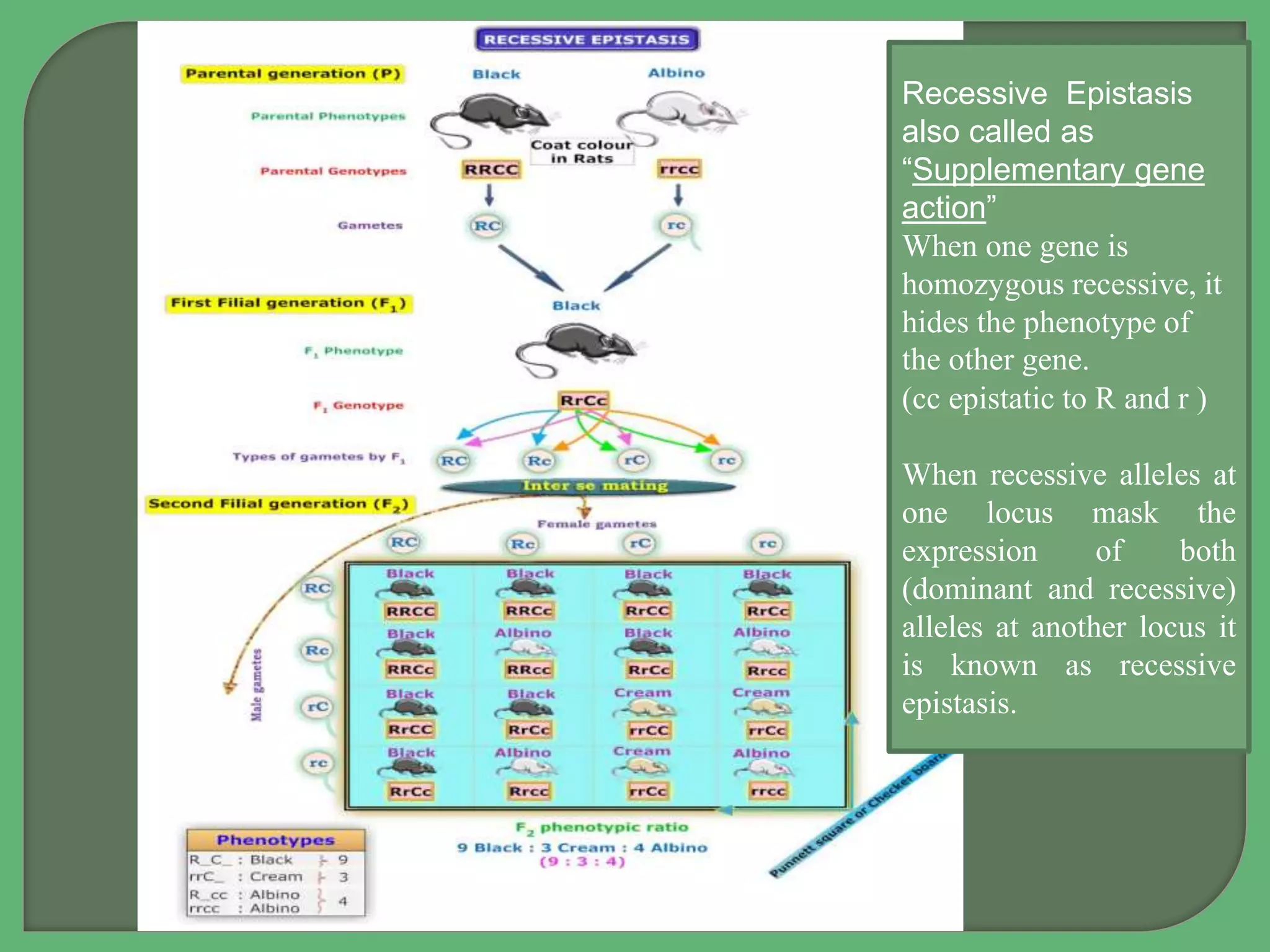
Recessive Epistasis
also called as
“Supplementary gene
action”
When one gene is
homozygous recessive, it
hides the phenotype of
the other gene.
(cc epistatic to R and r )
When recessive alleles at
one locus mask the
expression of both
(dominant and recessive)
alleles at another locus it
is known as recessive
epistasis.
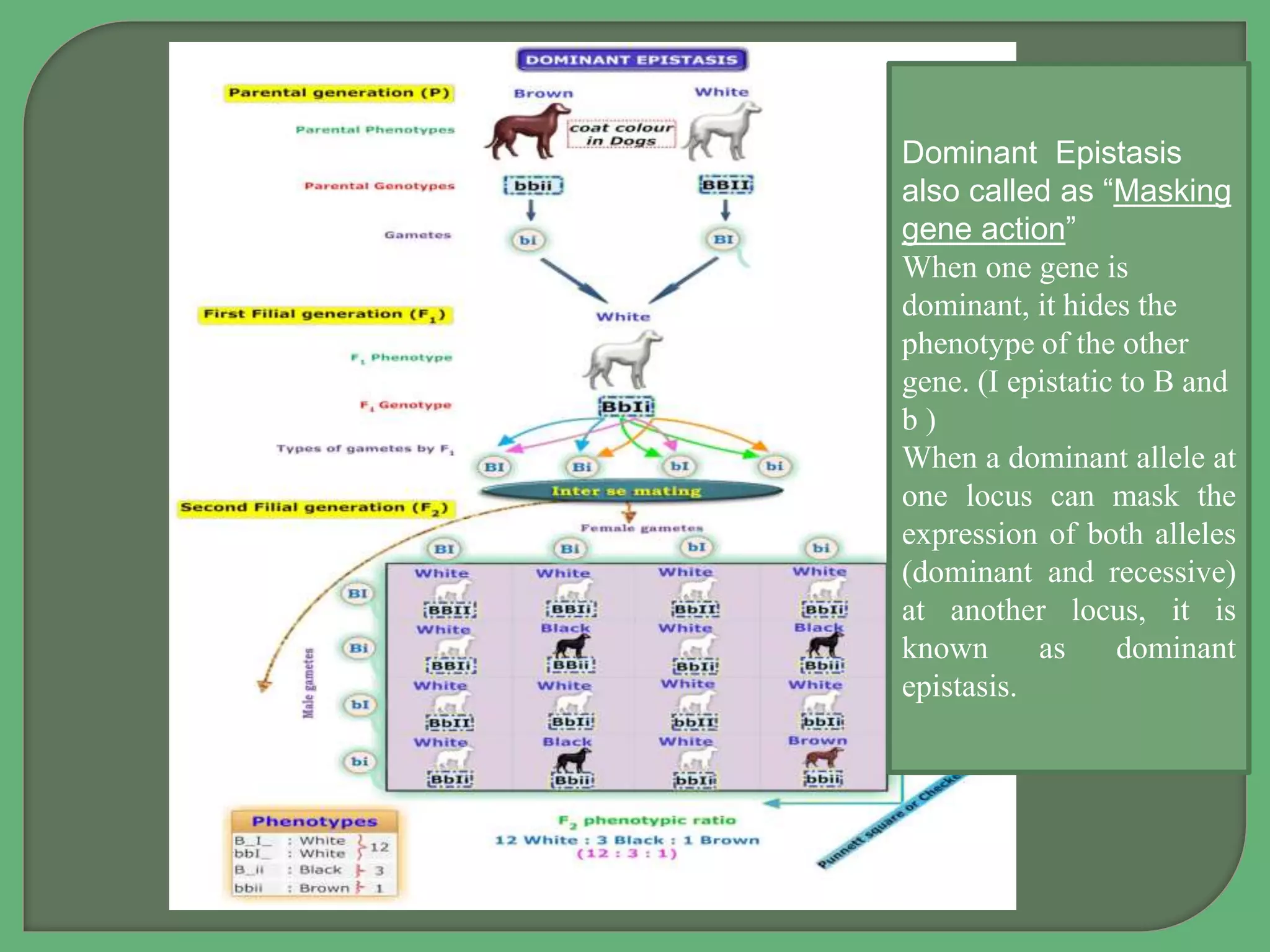
Dominant Epistasis
also called as “Masking
gene action”
When one gene is
dominant, it hides the
phenotype of the other
gene. (I epistatic to B and
b )
When a dominant allele at
one locus can mask the
expression of both alleles
(dominant and recessive)
at another locus, it is
known as dominant
epistasis.
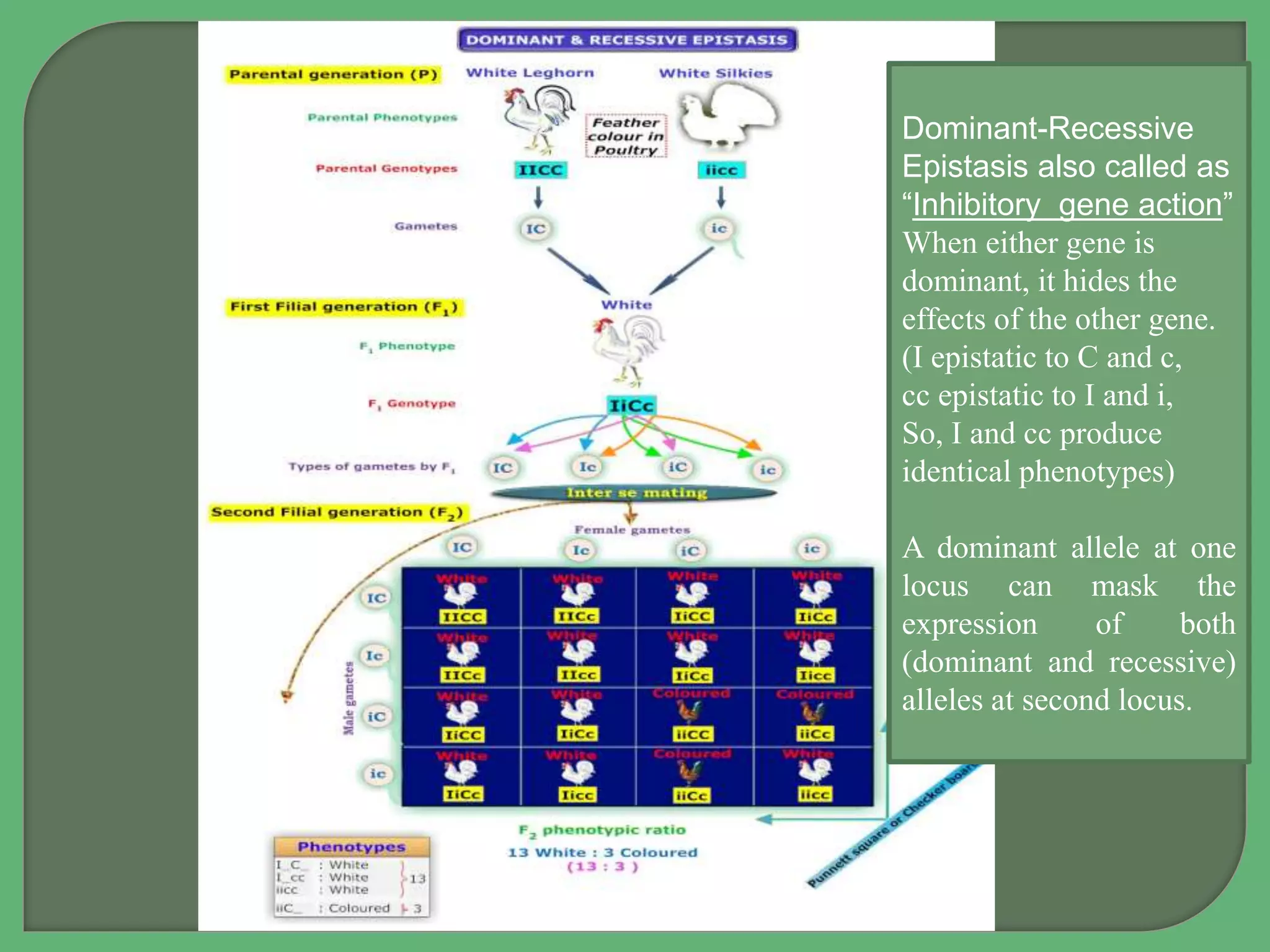
Dominant-Recessive
Epistasis also called as
“Inhibitory gene action”
When either gene is
dominant, it hides the
effects of the other gene.
(I epistatic to C and c,
cc epistatic to I and i,
So, I and cc produce
identical phenotypes)
A dominant allele at one
locus can mask the
expression of both
(dominant and recessive)
alleles at second locus.
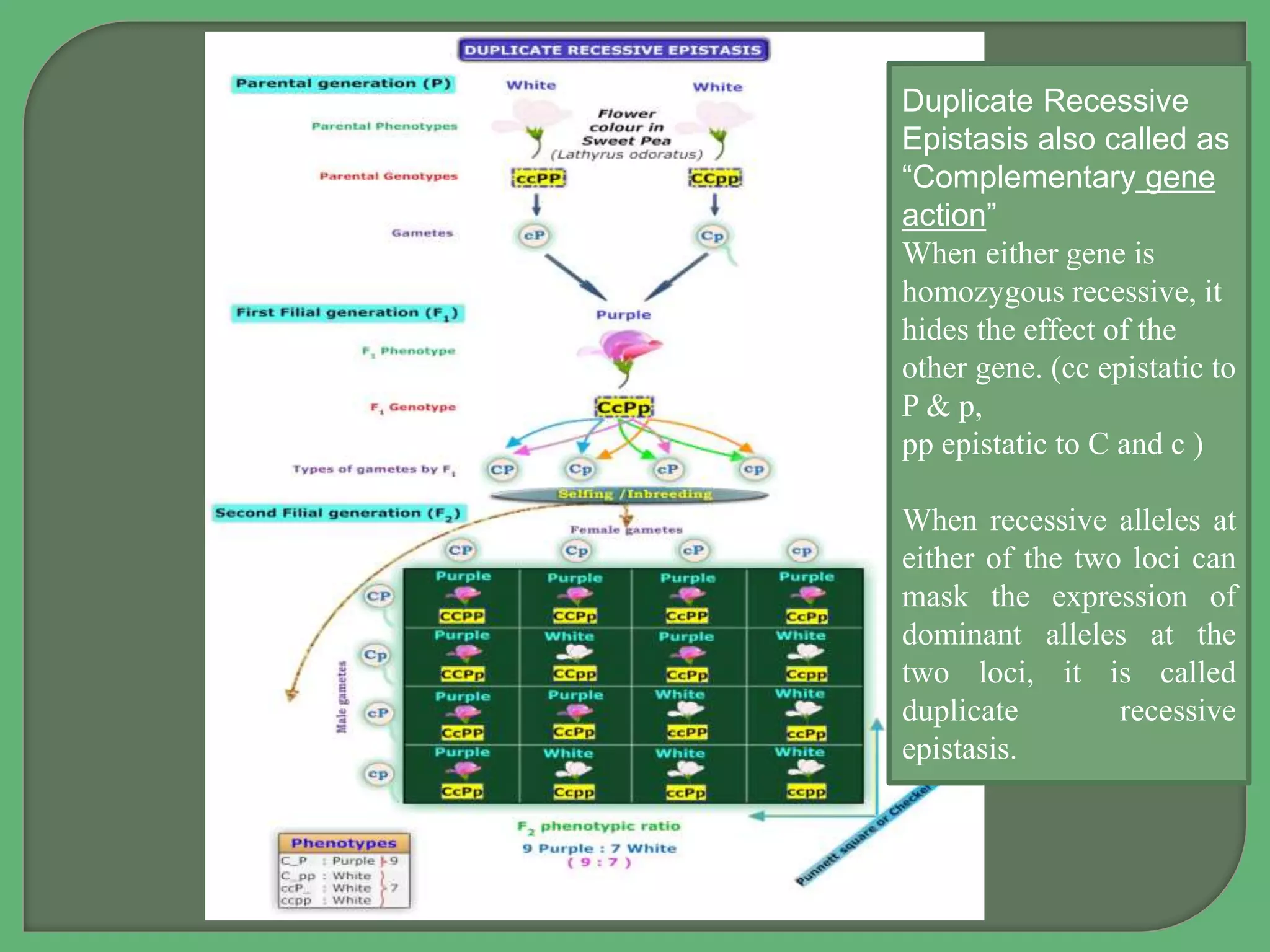
Duplicate Recessive
Epistasis also called as
“Complementary gene
action”
When either gene is
homozygous recessive, it
hides the effect of the
other gene. (cc epistatic to
P & p,
pp epistatic to C and c )
When recessive alleles at
either of the two loci can
mask the expression of
dominant alleles at the
two loci, it is called
duplicate recessive
epistasis.
Duplicate dominance
Epistasis also called as
“Duplicate gene action”
When either gene is
dominant, it hides the
effects of the other gene.
(F epistatic to ss,
S epistatic to ff)
When a dominant allele at
either of two loci can
mask the expression of
recessive alleles at the
two loci, it is known as
duplicate dominant
epistasis.
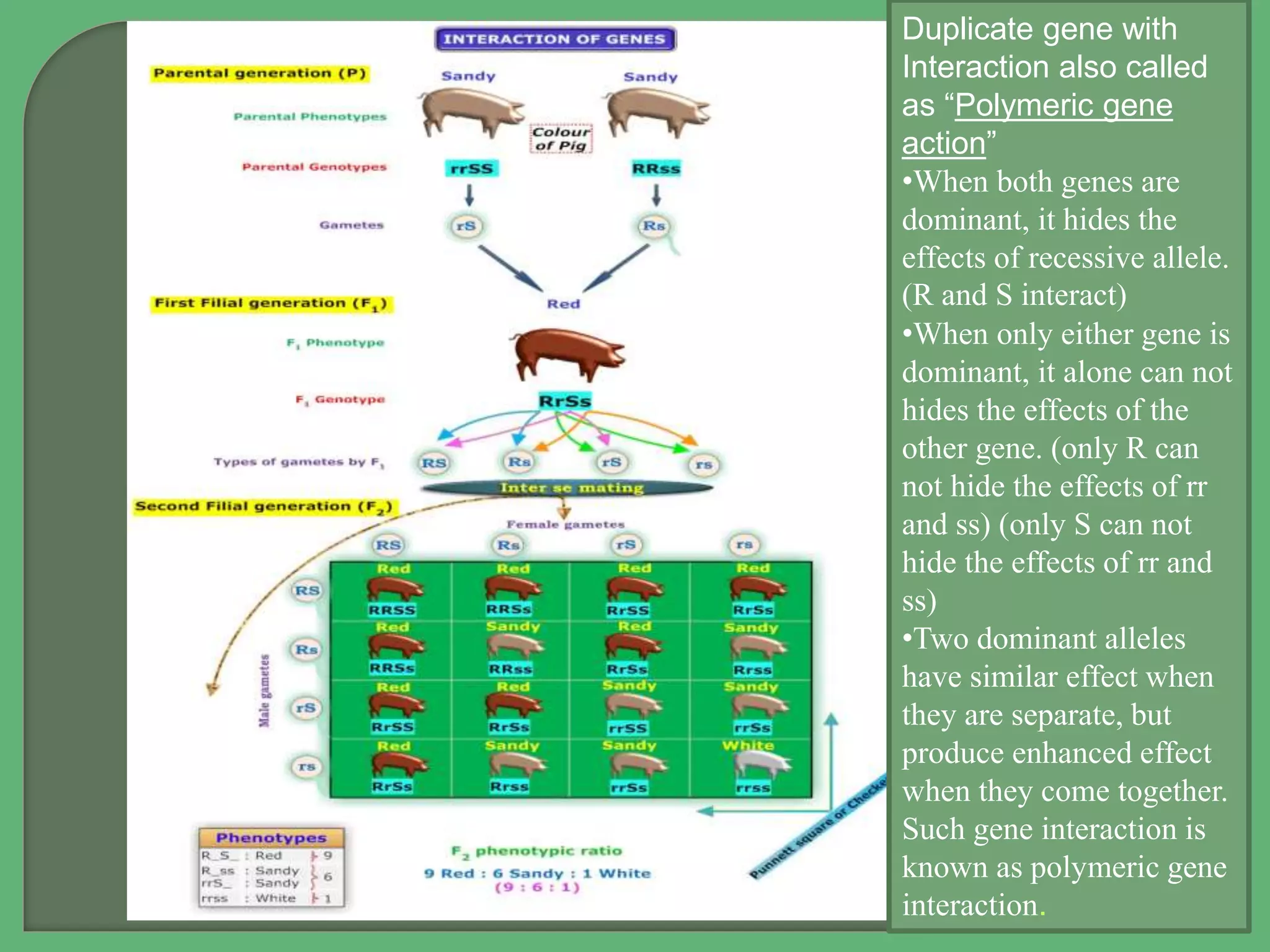
Duplicate gene with
Interaction also called
as “Polymeric gene
action”
•When both genes are
dominant, it hides the
effects of recessive allele.
(R and S interact)
•When only either gene is
dominant, it alone can not
hides the effects of the
other gene. (only R can
not hide the effects of rr
and ss) (only S can not
hide the effects of rr and
ss)
•Two dominant alleles
have similar effect when
they are separate, but
produce enhanced effect
when they come together.
Such gene interaction is
known as polymeric gene
interaction.
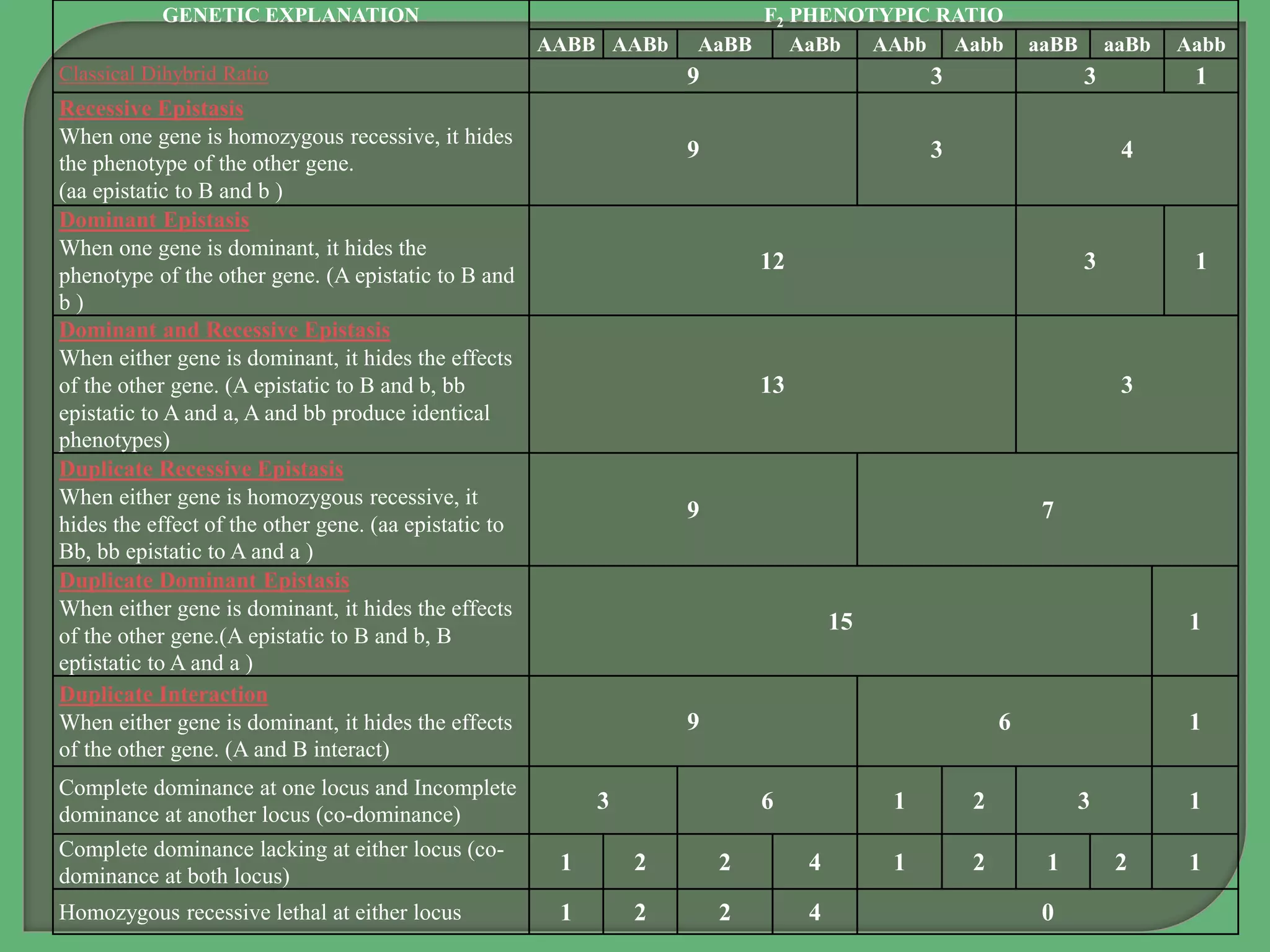
GENETIC EXPLANATION F2 PHENOTYPIC RATIO
AABB AABb AaBB AaBb AAbb Aabb aaBB aaBb Aabb
Classical Dihybrid Ratio 9 3 3 1
Recessive Epistasis
When one gene is homozygous recessive, it hides
the phenotype of the other gene.
(aa epistatic to B and b )
9 3 4
Dominant Epistasis
When one gene is dominant, it hides the
phenotype of the other gene. (A epistatic to B and
b )
12 3 1
Dominant and Recessive Epistasis
When either gene is dominant, it hides the effects
of the other gene. (A epistatic to B and b, bb
epistatic to A and a, A and bb produce identical
phenotypes)
13 3
Duplicate Recessive Epistasis
When either gene is homozygous recessive, it
hides the effect of the other gene. (aa epistatic to
Bb, bb epistatic to A and a )
9 7
Duplicate Dominant Epistasis
When either gene is dominant, it hides the effects
of the other gene.(A epistatic to B and b, B
eptistatic to A and a )
15 1
Duplicate Interaction
When either gene is dominant, it hides the effects
of the other gene. (A and B interact)
9 6 1
Complete dominance at one locus and Incomplete
dominance at another locus (co-dominance)
3 6 1 2 3 1
Complete dominance lacking at either locus (co-
dominance at both locus)
1 2 2 4 1 2 1 2 1
Homozygous recessive lethal at either locus 1 2 2 4 0

Modification of Normal Mendelian ratios with Lethal gene effcets and Epistasis

  • 1.
    NORMAL MENDELIAN RATIO ANDITS MODIFICATION (Includes Lethal Gene effects & EPISTASIS DR. ASHISH PATEL Assistant professor Dept. AGB, Veterinary College, AAU, Anand
  • 3.
    Ratios of Monohybridcross Phenotypic ratio 3:1 Genotypic ratio 1:2:1 Ratios of Dihybrid cross Phenotypic ratio 9:3:3:1 Genotypic ratio 1:2:2:4:1:2:1:2:1.
  • 5.
    The law ofpurity of gametes  When a pair of alleles is brought together in a hybrid (F1) they remain together without contaminating each other and they separate or segregate from each other into a gamete during the formation of gametes. Or  The two alleles of a gene remains separate and do not contaminate each other in F1 generation or in hybrid. At the time of gamete formation in F1, the two alleles separate out and pass into different gametes.
  • 6.
     The segregationof two or more characters in the same hybrid is independent to each other. Thus any allele of one gene is equally likely to combine with any allele of the other gene and passed into same gamete. 
  • 7.
    No. of lociat which both parents are heterozygous n 1 2 3 4 5 10 No. of gametes / parent 2n 2 4 8 16 32 1024 No. of types of genotypes in progeny 3n 3 9 27 81 243 59049 No. of types of phenotypes in progeny 2n 2 4 8 16 32 1024 Proportion of homozygous recessives in progeny (¼)n ¼ 1/16 1/64 1/256 1/1024 Genotypic and Phenotypic ratio for various no. of gene pair Genotypic ratio Monohybrid (1:2:1)1 = 1:2:1 Di-hybrid (1:2:1)2 = 1:2:2:4:1:2:1:2:1 Poly-hybrid (1:2:1)n Phenotypic ratio Monohybrid 3:1 Di-hybrid 9:3:3:1 Tri-hybrid 27:9:9:9:3:3:3:1
  • 9.
    Mono hybrid testcross – 1 : 1 Di-hybrid test cross - 1 : 1 : 1 : 1 Tri-hybrid test cross - 1 : 1 : 1 : 1 : 1 : 1 : 1 : 1
  • 10.
     According tointeraction between alleles or genes which leads to change in the phenotypic ratio are categorized as 1. Interaction between alleles at same locus (Intra-locular interaction or intra-allelic interaction) 2. Interaction between alleles at different locus (Inter-locular interaction or inter-allelic interaction)
  • 11.
    1. Interaction betweenalleles at same locus / Intra- locular interaction / intra-allelic interaction The traits studied by mendel were determined by the genes which acted as either dominant or as recessive. In this type of allelic relationship, one allele completely masked the effect of other alleles and other allele masked by dominant allele. These two recessive and dominance are two extreme form of gene expression. So, in general the dominance is an interaction at particular locus and hence this interaction is called as Intra-locular interaction / intra-allelic interaction.
  • 12.
    The Dominance isclassified in to four categories. 1. Complete dominance 2. Incomplete dominance (partial dominance or semi dominance) 3. Co-dominance 4. Overdominance 5. Lethality of genes  The phenotypic ratio of 3:1 in monohybrid crosses is obtained when there is complete dominance.  So, the extension of Mendelian ratio and principles due to incomplete dominance, co-dominance and also due to lethal genes.
  • 13.
    In this incompletedominance the phenotype of heterozygote is intermediate to the phenotypes of the two types of homozygotes. The genotypic and phenotypic ratios for monohybrids are 1:2:1 and 1:2:1. E.g. Flower color in four- O’- clock plants (Mirabilis Jalapa) and Snapdragon (Antirrhinum majus), feather color in Blue Andalusian fowl The phenotypic ratio for the monohybrid cross becomes 1:2:1 instead of 3:1.
  • 15.
     The co-dominanceis the type of interaction in which both the alleles of gene are equally expressed so that the phenotype of the heterozygote exhibits a mixture of phenotypes of both homozygotes. Or  If the heterozygote exhibits a mixture of the phenotypic characters of both homozygotes, instead of a single intermediate expression, then both alleles are called co- dominant alleles.  The genotypic and phenotypic ratios for monohybrids are 1:2:1 and 1:2:1. E.g. MN blood group antigens in human: Allele LM for M-type blood is codominant with allele LN for N- type blood. The heterozygotes LMLN will have both M and N antigens on the red blood cells.
  • 17.
    Sr. Incomplete dominanceCo-dominance 1. Allelic interaction in which one of the two alleles is more expressed in the heterozygote Allelic interaction in which one of the two alleles are equally expressed in the heterozygote 2 Phenotype of the heterozygote is intermediate to the phenotype of the two homozygote Phenotype of the heterozygote shows the phenotype of the both homozygote 3 Alleles determining such traits are referred to as incompletely dominant allele Alleles determining such trait referred as co-dominant alleles 4 e.g. Flower color in four- O’- clock plants (Mirabilis Jalapa Feather color in Blue Andalusian fowl Coat color in cattle e.g. Coat color in cattle MN blood groups in human
  • 18.
    Species Trait GenotypesPhenotypes Species Trait Genotypes Phenotypes Horse Palomino coat color CC Chestnut (reddish) Human MN blood group MM M blood group Ccr Ccr Cremello (Whitish) NN N blood group C Ccr Palomino (Golden yellow body with white mane and tail) MN MN blood group Cattle Coat color in Short-horn cattle CR CR Red Hair structure A1A1 Straight hair CW CW White A2A2 Curly hair CR CW Roan A1A2 Wavy hair Poultry Feather structure FN FN or NN Normal Haemoglobin type HbA HbA Type A FW FW or WW Wooly HbS HbS Type S FN FW or NW Frizzled HbA HbS Type AS Feather color in Blue Andalusian fowl BB or FB FB Black WW or FW FW White BW or FB FW Blue Naked neck Na Na Naked neck na na Normal neck Na na Naked neck with tuft of feathers Some examples of incomplete dominance and co-dominance
  • 19.
     An allelicinteraction in which the phenotypic expression of the heterozygote exceeds the phenotypic expression of either of the two homozygotes.  e.g. survival rate against Malarial parasites in sickle cell anaemia Genotype HbA HbA HbS HbS HbA HbS Survival Rate High Very low Highest
  • 20.
     Lethal genesare those that cause the death of the young during pregnancy or at birth.  Genes which affect the viability of an organism are called lethal genes and the phenomenon is called lethality.  Sub lethal and Semi lethal are those genes which cause the death of the young after birth or some time later in life.  Lethal genes can be recessive, dominant, conditional, semilethal / sublethal, or synthetic, depending on the gene or genes involved.
  • 21.
     If thelethal effect is dominant and immediate in expression, all individuals carrying the gene will die and the gene will be lost.  Dominant lethal genes are expressed in both homozygotes and heterozygotes. All individuals carrying the genes will die and the genes will be lost in populations.  Recessive lethal allele carried in the heterozygous condition has no effect but they cause death when an organism carries two copies of the lethal allele.  Recessive lethal may come to expression when mating between carriers occurs.  The phonotypic ratio is modified in to 2:1.
  • 25.
     Elimination oflethal genes from the population could be carried out by identifying the carriers (heterozygotes) and preventing them from further breeding.  Intermediate lethal genes are much easier to detect because all the individuals will exhibit some phenotypic expression of the gene.  Dominant lethals kill the individual either in homozygous or heterozygous conditions and therefore is eliminated from the population in the same generation in which it arises.  Recessive lethals kill only when in homzygous stage. They are very difficult to eliminate from the population. Heterozygous carrier parents that produce a lethal effect could be used as testers to identify others in the population.
  • 26.
    1. Interaction betweenalleles at same locus / Intra- locular interaction / intra-allelic interaction (Already discussed) Now…….. 2. Interaction between alleles at different locus (Non allelic interaction/ Inter-locular interaction or inter-allelic interaction)
  • 27.
     The phenotypicexpression of alleles of one locus is modified by the alleles of the other loci is called as epistasis.  The phenomenon of two or more genes which affects single trait, in such a way that they affect the expressions of each other in various ways is known as Gene Interaction.  The gene/locus that blocks the expression of an allelic gene/locus is said to be epistatic and the gene/locus whose expression is blocked is said to be hypostatic.
  • 28.
     When independent(non-homologous) genes located on the same or on different chromosomes interact with one another for the expression of single phenotypic trait then it is known as Inter-Allelic Interactions.  Gene interaction may involve two or more genes.  Two interacting genes produce modified dihybrid ratios.
  • 29.
     Two genesinfluencing the same character  Example: Comb pattern in poultry  Normally, certain specific breeds have a specific comb pattern. • Wyandotte – Rose comb • Brahmas – Pea comb • Leghorns – Single comb  Crosses between Rose combed and single combed variety showed that Rose was dominant over single and a 3:1 ratio appeared in the F2.  Crosses between Pea combed and single combed variety showed that Pea was dominant over single and a 3:1 ratio appeared in the F2.
  • 30.
  • 31.
     When Rosewas crossed with Pea, all the offspring showed a new comb form known as “Walnut”  When the F1 Walnut combed birds were inbred, in the F2 generation Walnut, Rose, Pea and Single combed ones also appeared.  The phenotypic ratio in F2 is 9:3:3:1 ratio. In this ratio, out of 16 progenies, nine Walnut comb, three Rose comb, three Pea comb, one Single comb.
  • 32.
     Differences fromnormal dihybrid inheritance are • The F1 resembles neither the parent (Walnut comb) • Apparently novel characters appear in F2 (Single comb) • Walnut character results from an interaction between two independently inherited dominant Rose and Pea genes.  Single comb results from interaction of their two recessive alleles.
  • 34.
    Recessive Epistasis also calledas “Supplementary gene action” When one gene is homozygous recessive, it hides the phenotype of the other gene. (cc epistatic to R and r ) When recessive alleles at one locus mask the expression of both (dominant and recessive) alleles at another locus it is known as recessive epistasis.
  • 35.
    Dominant Epistasis also calledas “Masking gene action” When one gene is dominant, it hides the phenotype of the other gene. (I epistatic to B and b ) When a dominant allele at one locus can mask the expression of both alleles (dominant and recessive) at another locus, it is known as dominant epistasis.
  • 36.
    Dominant-Recessive Epistasis also calledas “Inhibitory gene action” When either gene is dominant, it hides the effects of the other gene. (I epistatic to C and c, cc epistatic to I and i, So, I and cc produce identical phenotypes) A dominant allele at one locus can mask the expression of both (dominant and recessive) alleles at second locus.
  • 37.
    Duplicate Recessive Epistasis alsocalled as “Complementary gene action” When either gene is homozygous recessive, it hides the effect of the other gene. (cc epistatic to P & p, pp epistatic to C and c ) When recessive alleles at either of the two loci can mask the expression of dominant alleles at the two loci, it is called duplicate recessive epistasis.
  • 38.
    Duplicate dominance Epistasis alsocalled as “Duplicate gene action” When either gene is dominant, it hides the effects of the other gene. (F epistatic to ss, S epistatic to ff) When a dominant allele at either of two loci can mask the expression of recessive alleles at the two loci, it is known as duplicate dominant epistasis.
  • 39.
    Duplicate gene with Interactionalso called as “Polymeric gene action” •When both genes are dominant, it hides the effects of recessive allele. (R and S interact) •When only either gene is dominant, it alone can not hides the effects of the other gene. (only R can not hide the effects of rr and ss) (only S can not hide the effects of rr and ss) •Two dominant alleles have similar effect when they are separate, but produce enhanced effect when they come together. Such gene interaction is known as polymeric gene interaction.
  • 40.
    GENETIC EXPLANATION F2PHENOTYPIC RATIO AABB AABb AaBB AaBb AAbb Aabb aaBB aaBb Aabb Classical Dihybrid Ratio 9 3 3 1 Recessive Epistasis When one gene is homozygous recessive, it hides the phenotype of the other gene. (aa epistatic to B and b ) 9 3 4 Dominant Epistasis When one gene is dominant, it hides the phenotype of the other gene. (A epistatic to B and b ) 12 3 1 Dominant and Recessive Epistasis When either gene is dominant, it hides the effects of the other gene. (A epistatic to B and b, bb epistatic to A and a, A and bb produce identical phenotypes) 13 3 Duplicate Recessive Epistasis When either gene is homozygous recessive, it hides the effect of the other gene. (aa epistatic to Bb, bb epistatic to A and a ) 9 7 Duplicate Dominant Epistasis When either gene is dominant, it hides the effects of the other gene.(A epistatic to B and b, B eptistatic to A and a ) 15 1 Duplicate Interaction When either gene is dominant, it hides the effects of the other gene. (A and B interact) 9 6 1 Complete dominance at one locus and Incomplete dominance at another locus (co-dominance) 3 6 1 2 3 1 Complete dominance lacking at either locus (co- dominance at both locus) 1 2 2 4 1 2 1 2 1 Homozygous recessive lethal at either locus 1 2 2 4 0