
Sheep

Ovine
Terminology
•   Ewe- female of reproductive age
•   Ram- intact male of reproductive age
•   Lamb
-   noun: young sheep of either sex
-   Verb: to give birth
•   Wether- neutered adult male
•   Mutton- meat derived from adult, aged sheep
Star Program
• Management system of sheep that uses breeds of
  sheep that will breed out of season
• System attempts to create three lambings from
  each eye in two years
• Creates 5 miniflock lambing sessions to produce
  marketable lambs throughout the year, rather
  than spring alone
• Additionally: estrus synchronization sometimes
  combined with hormonal stimulation of estrus to
  breed out of season
Sheep Breeds
• Wool or ewe breeds
1. Merino
- White wool to eyes, horns on rams only
2. Rambouillet
- White wool to eyes, horns on rams only
3. Corriedale
- White wool to eyes, polled
4. Columbia
- White wool to eyes, polled
• Meat or ram breeds
1. Suffolk
- Black face with no wool on face, polled
2. Hampshire
- Black face with wool to eyes, polled
3. Shropshire
- Black wool to eyes, polled
4. Dorset
- White wool to eyes, polled, breeds out of season
• Multipurpose
1. Southdown
2. Romney
3. Polypay
4. Finnish landrace- white, many babies, more
    twins than usual
Tails- routinely docked, it is illegal in some states
not to dock tails of sheep, considered inhumane
Sheep Production
• Pasture throughout entire production cycle
• Environmental factors impact profitability
• Drought, fire, freezing, temperatures, snow, and
  predators
• Behavior:
- Wide angle vision, can see behind w/o turning
  head
- Respect solid fencing, not as easily spooked
- Move toward light and flock
Goat-Caprine terminology
•   Doe- female of reproductive age
•   Buck- intact male of reproductive age
•   Kid
-   noun- young goats of either sec
-   Verb- to give birth
•   Wether- neutered male of any age
•   Polyestrus fall/winter
Goat Breeds
• Saanen- white to cream colored
• Toggenburg- brown with white stripes on face,
  light colored legs
• Nubian- black or brown with or without white
  marks, floppy ears
• Alpine- white to black with spotting
• Lamanchis- no pinna
• Pigmy, fainting goats
Diseases of Goats
• Johne’s disease
- Not characterized by diarrhea like the disease
  in cattle
- Seen as chronic wasting disease
- More infective to young but can affect adults
• Enterotoxemia
• Cause: Clostridium perfringens type D with
  sudden feed changes
• Symptoms: frequently fatal, diarrhea and
  severe enterocolitis, very common in Dairy
  goats under stress
• tx: fluids, bicarbonate, type C and D antitoxin
  and antibiotics and given the vaccination
• Foot rot
• Cause: Fusobacterium necrophorum an
  Dichelobacter nodosus
• Symptoms: inflammation of interdigital skin
  followed by undermining of sole at heels
• tx: inspect all animals, trim all feet, run thru a
  foot bath of copper sulfate or zinc sulfate an
  separate into affected and unaffected,( Zn is less
  irritating)
• Cull non healers ( goats also get this)
Pregnancy Toxemia of goats and sheep
• Metabolic disease of carbohydrate metabolism
• Associated with multiple pregnancies
• During late gestation, caloric requirements
  exceeds calories consumed
• Dam mobilizes body’s energy reserves ( fats) and
  ketones are produced
• Symptoms: lethargic, recumbent, loss of appetite,
  fruity breath
• Tx: oral glucose, corticosteroids
White Muscle Disease
• Dietary deficiency of Vit E or Se
• Symptoms: stiff legged lambs, weakness, post
  mortem pale muscle, white streaks through
  heart muscle
• Prevention: supplement ewes with Vit E/Se,
  inject lambs at day 1 and 10 VitE/Se
Routine Management of Sheep
•   Tail docking
•   Castration
•   Vaccination
•   Deworming
•   Shearing/crutching out prior to lambing
•   Foot trim/foot bath
Routine Management of Goats
•   Vaccination
•   Deworming
•   Mastitis monitoring
•   Dehorning
•   Foot trimming/bath
• Tetanus
• Cause: Clostridium tetani invades wounds and
  produces potent neurotoxing ( also after tail
  docking, castration, and dehorning)
• Symptoms: progressive muscle tetany, stiff erect
  ears, rigid extension of limbs, prolapse of third
  eyelid, hyper responsive to noise, die of
  respiratory failure
• Tx: remove bacteria by clean/debride wound,
  high doses of penicillin and tetanus antitoxin,
  supportive care
• White Muscle Disease
• Cause- occurs in young born to dams on Se
  deficient diet
• Symptoms: muscular weakness, stiffness,
  sudden death if heart is involved, necropsy
  shows pale, white or streaked muscle
• Tx: early cases inject Vit E and Se, prevent by
  making sure diet is correct
• Caseous lymphadenitis
• Cause: Cornybacterium pseudotuberculosis
• Symptoms: highly contagious, lymph node
  abcesses, carcass condemnation, spread to
  other animals by pus, can be endemic in herd
• Tx: aggressive culling, surgical removal of
  abcess, flushing wound and long term
  antibiotics in valuable animals
• Pseudopregnancy
- Can occur in doe w/wo exposure to buck
- Accumulation of fluid in uterus, one or more
  corpus luteums on ovary
- Tx: injection of prostaglandins F2alpha to lyse
  corpus luteum
• Mastitis
- Blue bag mastitis ( gangrenous mastitis)
- Cause: Staphylococcus aureus #1, or
  Pasteurella Hemolytica
- May progress rapidly and cause death
- Tx: antimicrobial therapy, NSAIDS, fluid
  therapy, teat amputation but is usually not
  rewarding
• Urolithiasis
- Goats that are obstructed tend to vocalize due
  to pain
- Usually at the urethral process or the sigmoid
  flexure
- Usually occurs in males
- Tx: remove obstruction using cystotomy is the
  treatment of choice
• Caprine arthritis-encephalitis
• Cause: RNA virus
• Symptoms: polyarthritis, CNS disease, and
  pneumonia is possible
• Trans: through milk of infected dams
• Tx: eliminate it from herd through testing of
  dams
• Pregnancy toxemia – ketosis of goats late in
  gestation
• Symptoms: neurologic signs, anorexia, motor
  weakness leading to death, usually in does in
  their 2nd or 3rd pregnancy ( ketones in urine)
• Tx: propylene glycol ( 100 ml PO, BID) IV dextrose
  or glucose every 5-7 hours, insulin, B vitamins
• Prevention is the key to eradication, through
  body scoring and correct feeding in gestation
• Pinkeye
• Cause: Mycoplasma conjunctivae
• Symptoms: blepharospasm, conjunctivitis,
  photophobia, corneal edema
• Tx: self limiting but tetracycline topically is
  recommended to reduce spread of disease
  and speed healing
• Orf/soremouth, contagious ecthyma
• Cause: common viral disease
• Symptoms: crusty, proliferative lesions around
  mouth, nose of young and teat/udder of
  mother
• Tx: self limiting in 4-6 weeks
• ZOONOTIC- can affect humand so take care
  when handling animals
Goat Behavior
• Flock in extended family groups with strong
  hiercharchy
• Males and females establish dominance by head
  butting ( make sure to dehorn)
• Threatened goats sneeze at you
• Orally investigate environment, excellent climbers, gate
  openers
• Browse lines
• Seasonally polyestrus, primarily in fall, strong odor to
  bucks
• Wide angle vision, move to light, respect solid fence
Sheep and Goat diseases
                    Viral
• Caprine Arthritis Encephalitis ( big knee)
• Prepatent: up to several years
• Asymptomatic carrier state exists, virus is latent in bone
  marrow
• Stress precipitates viremia> leads to ability to infect others
• Adult symptoms- mild to severe lameness, joint
  enlargement
• Kids- neurologic disease, incoordination, hindlimb
  weakness
• Tx: none
• Prevention: serologic testing and culling of infected animals
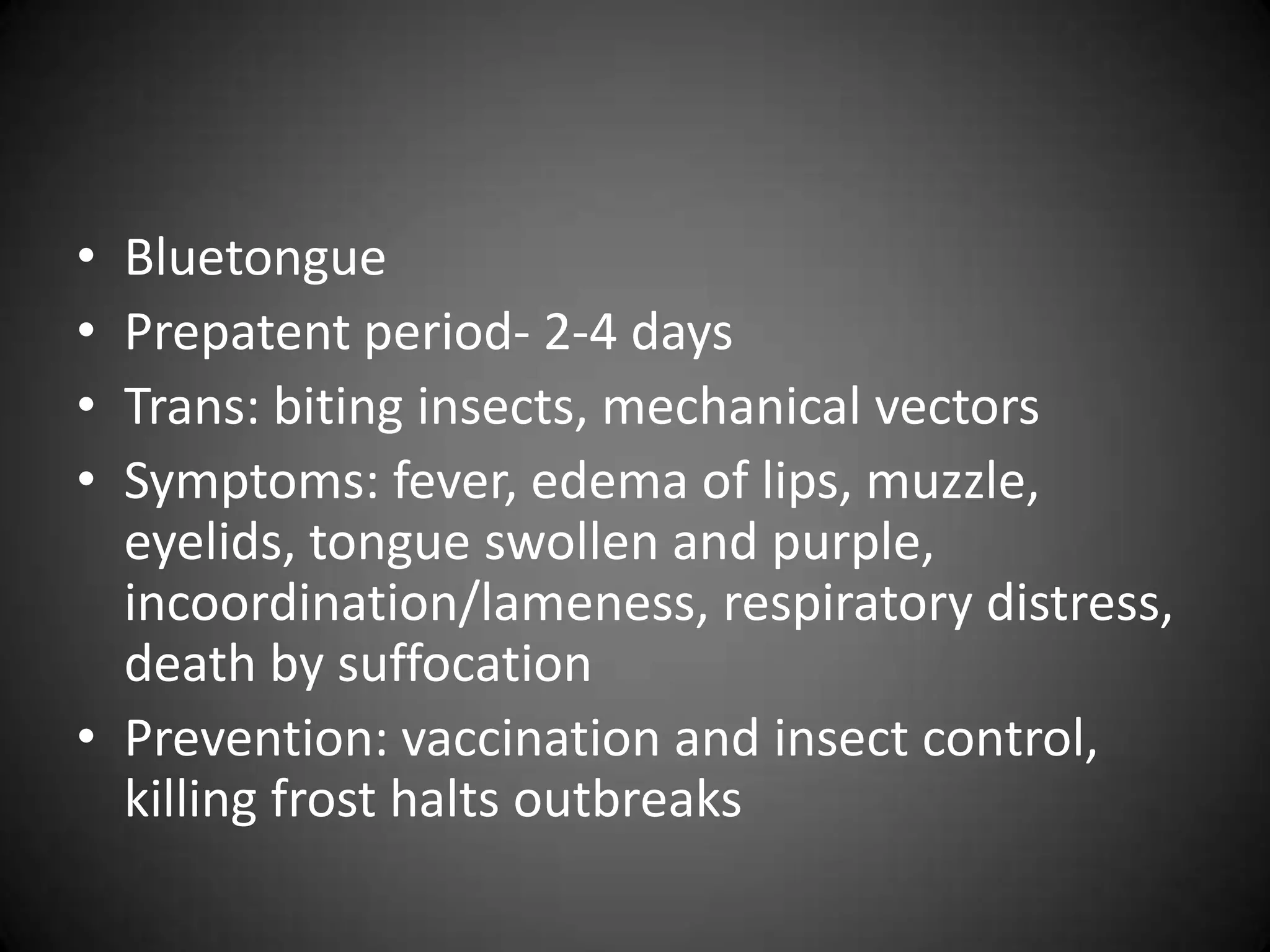
• Bluetongue
• Prepatent period- 2-4 days
• Trans: biting insects, mechanical vectors
• Symptoms: fever, edema of lips, muzzle,
  eyelids, tongue swollen and purple,
  incoordination/lameness, respiratory distress,
  death by suffocation
• Prevention: vaccination and insect control,
  killing frost halts outbreaks
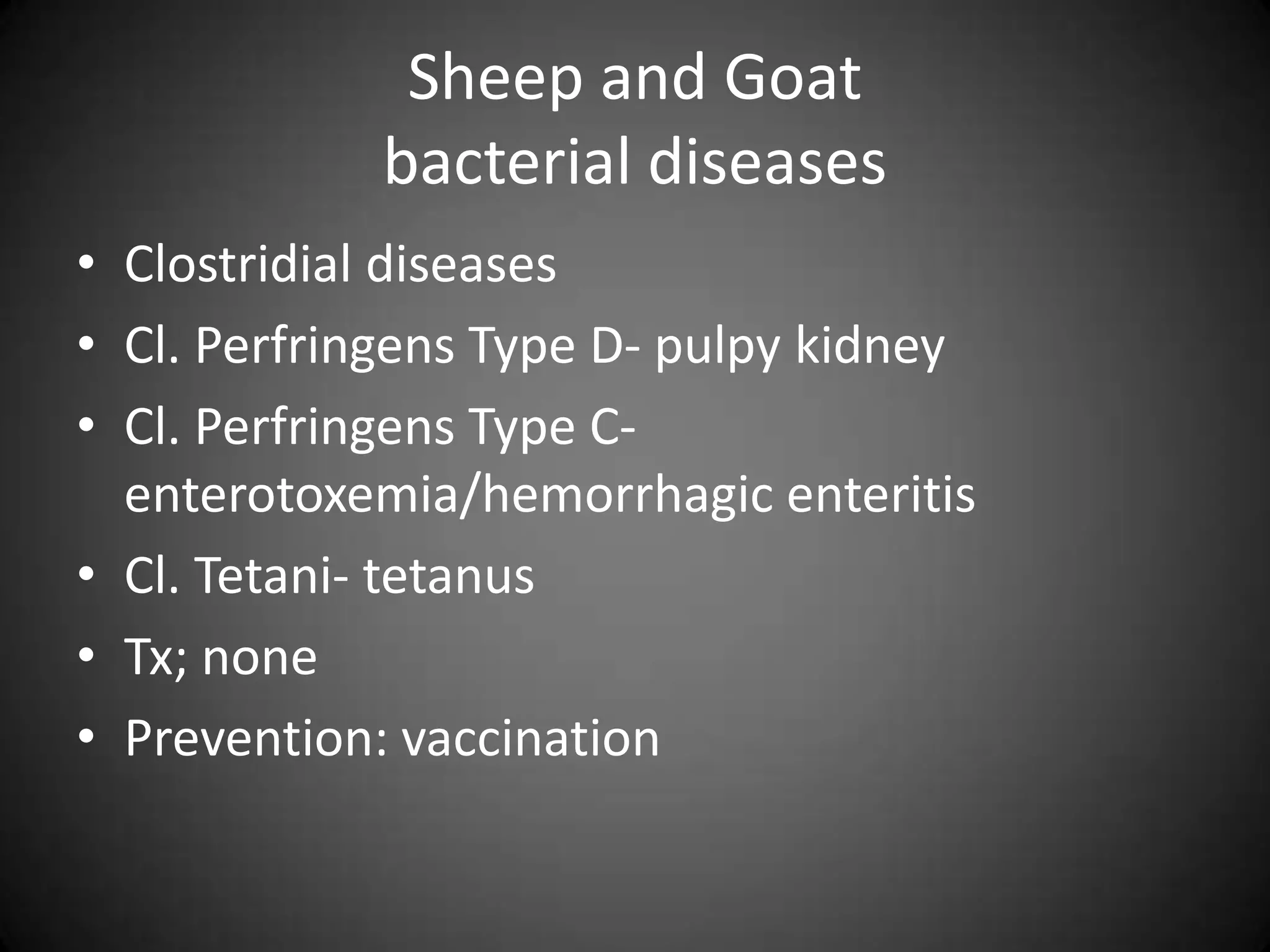
Sheep and Goat
            bacterial diseases
• Clostridial diseases
• Cl. Perfringens Type D- pulpy kidney
• Cl. Perfringens Type C-
  enterotoxemia/hemorrhagic enteritis
• Cl. Tetani- tetanus
• Tx; none
• Prevention: vaccination
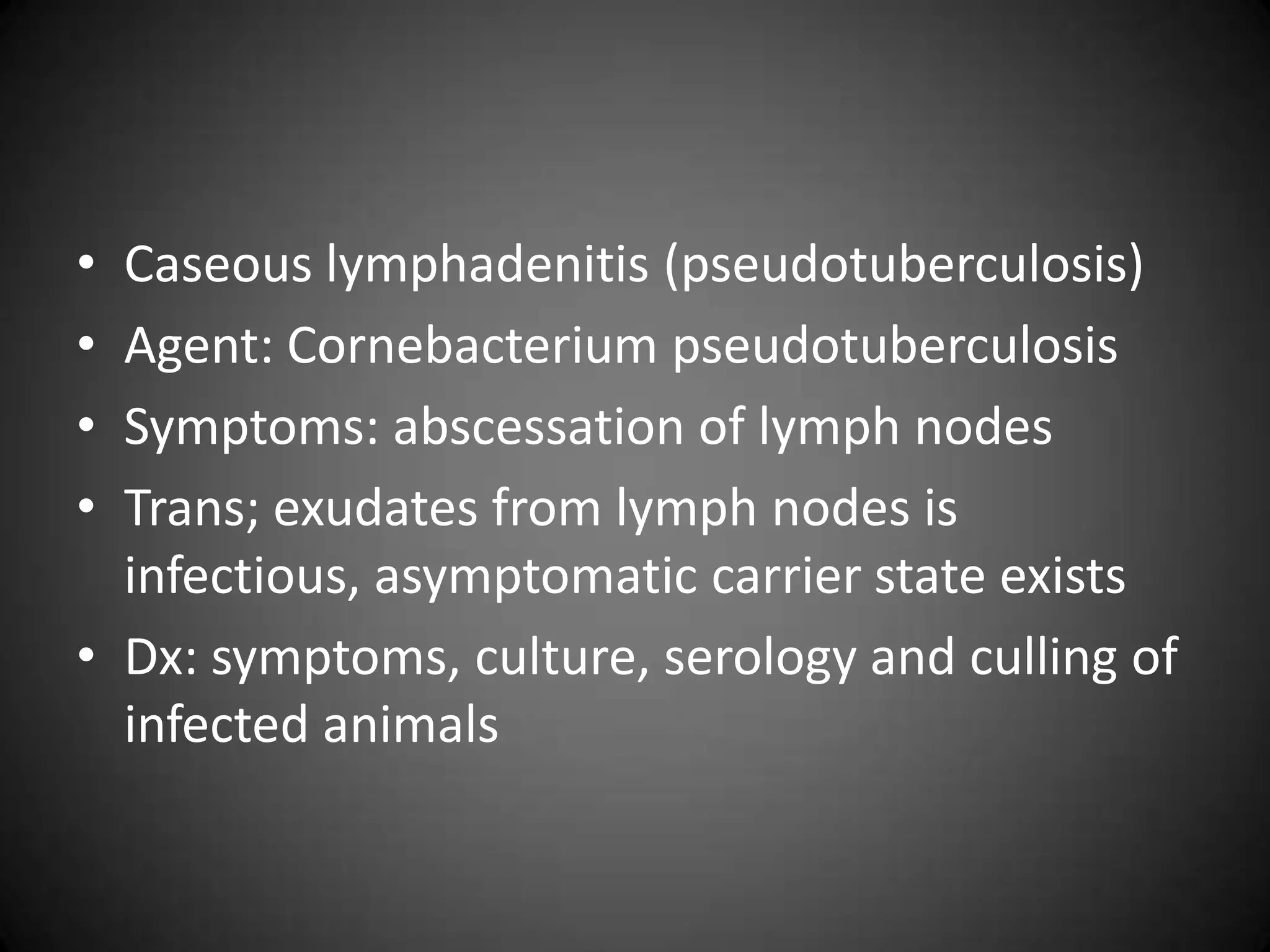
• Caseous lymphadenitis (pseudotuberculosis)
• Agent: Cornebacterium pseudotuberculosis
• Symptoms: abscessation of lymph nodes
• Trans; exudates from lymph nodes is
  infectious, asymptomatic carrier state exists
• Dx: symptoms, culture, serology and culling of
  infected animals
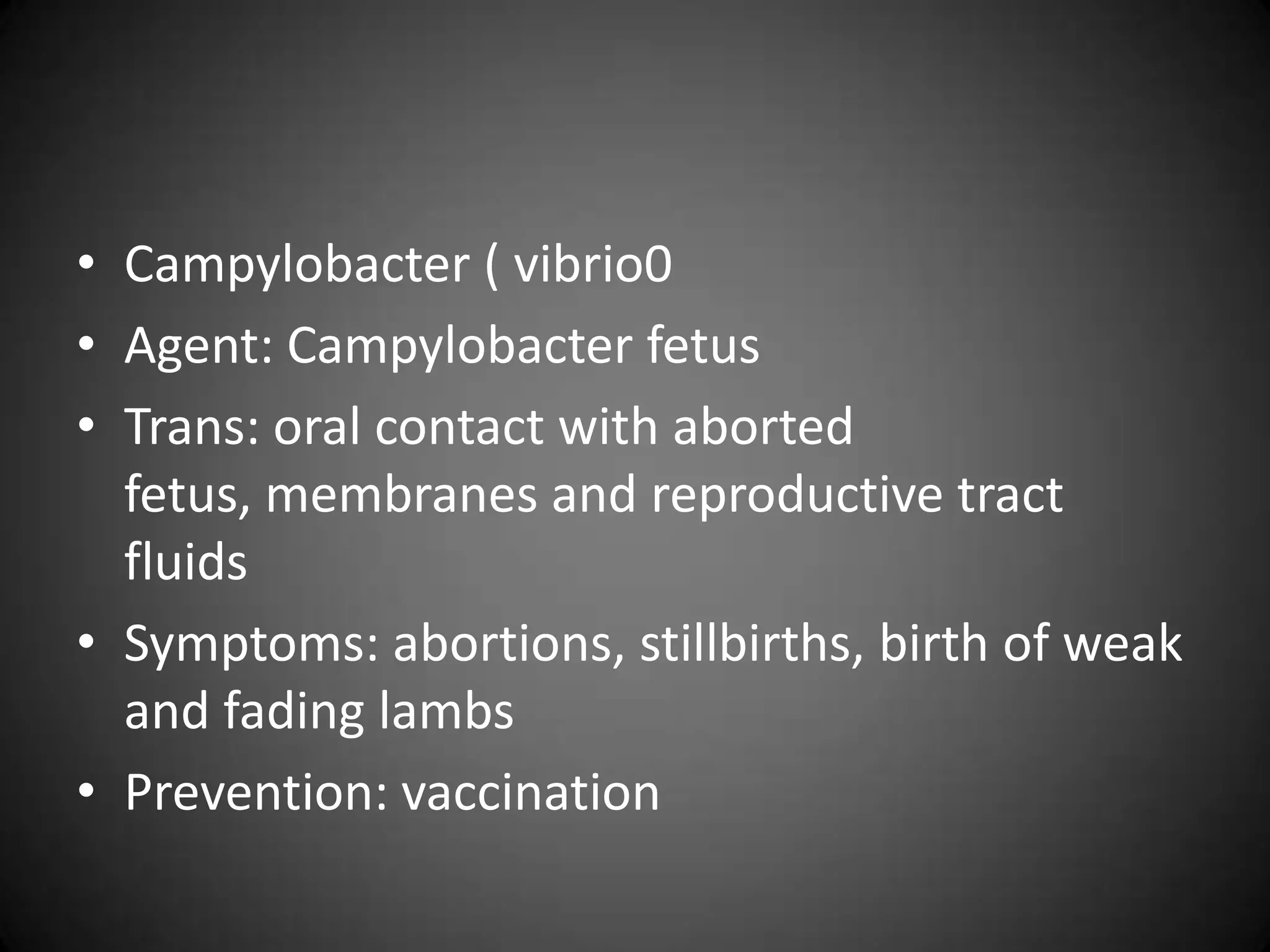
• Campylobacter ( vibrio0
• Agent: Campylobacter fetus
• Trans: oral contact with aborted
  fetus, membranes and reproductive tract
  fluids
• Symptoms: abortions, stillbirths, birth of weak
  and fading lambs
• Prevention: vaccination
• Enzootic abortion of ewes ( EAE)
• Agent: Chlamydia psittaci- rickettsia
• Symptoms: abortion, conjunctivitis, arthritis,
  epididymitis
• Trans: arthropod vector, all rickettsial diseases
  require arthropod vector for transmission
• Tx: none
• Prevention: vaccination
Sheep

Sheep

  • 1.
  • 2.
    Terminology • Ewe- female of reproductive age • Ram- intact male of reproductive age • Lamb - noun: young sheep of either sex - Verb: to give birth • Wether- neutered adult male • Mutton- meat derived from adult, aged sheep
  • 3.
    Star Program • Managementsystem of sheep that uses breeds of sheep that will breed out of season • System attempts to create three lambings from each eye in two years • Creates 5 miniflock lambing sessions to produce marketable lambs throughout the year, rather than spring alone • Additionally: estrus synchronization sometimes combined with hormonal stimulation of estrus to breed out of season
  • 4.
    Sheep Breeds • Woolor ewe breeds 1. Merino - White wool to eyes, horns on rams only 2. Rambouillet - White wool to eyes, horns on rams only 3. Corriedale - White wool to eyes, polled 4. Columbia - White wool to eyes, polled
  • 5.
    • Meat orram breeds 1. Suffolk - Black face with no wool on face, polled 2. Hampshire - Black face with wool to eyes, polled 3. Shropshire - Black wool to eyes, polled 4. Dorset - White wool to eyes, polled, breeds out of season
  • 6.
    • Multipurpose 1. Southdown 2.Romney 3. Polypay 4. Finnish landrace- white, many babies, more twins than usual Tails- routinely docked, it is illegal in some states not to dock tails of sheep, considered inhumane
  • 7.
    Sheep Production • Pasturethroughout entire production cycle • Environmental factors impact profitability • Drought, fire, freezing, temperatures, snow, and predators • Behavior: - Wide angle vision, can see behind w/o turning head - Respect solid fencing, not as easily spooked - Move toward light and flock
  • 8.
    Goat-Caprine terminology • Doe- female of reproductive age • Buck- intact male of reproductive age • Kid - noun- young goats of either sec - Verb- to give birth • Wether- neutered male of any age • Polyestrus fall/winter
  • 9.
    Goat Breeds • Saanen-white to cream colored • Toggenburg- brown with white stripes on face, light colored legs • Nubian- black or brown with or without white marks, floppy ears • Alpine- white to black with spotting • Lamanchis- no pinna • Pigmy, fainting goats
  • 10.
    Diseases of Goats •Johne’s disease - Not characterized by diarrhea like the disease in cattle - Seen as chronic wasting disease - More infective to young but can affect adults
  • 11.
    • Enterotoxemia • Cause:Clostridium perfringens type D with sudden feed changes • Symptoms: frequently fatal, diarrhea and severe enterocolitis, very common in Dairy goats under stress • tx: fluids, bicarbonate, type C and D antitoxin and antibiotics and given the vaccination
  • 12.
    • Foot rot •Cause: Fusobacterium necrophorum an Dichelobacter nodosus • Symptoms: inflammation of interdigital skin followed by undermining of sole at heels • tx: inspect all animals, trim all feet, run thru a foot bath of copper sulfate or zinc sulfate an separate into affected and unaffected,( Zn is less irritating) • Cull non healers ( goats also get this)
  • 13.
    Pregnancy Toxemia ofgoats and sheep • Metabolic disease of carbohydrate metabolism • Associated with multiple pregnancies • During late gestation, caloric requirements exceeds calories consumed • Dam mobilizes body’s energy reserves ( fats) and ketones are produced • Symptoms: lethargic, recumbent, loss of appetite, fruity breath • Tx: oral glucose, corticosteroids
  • 14.
    White Muscle Disease •Dietary deficiency of Vit E or Se • Symptoms: stiff legged lambs, weakness, post mortem pale muscle, white streaks through heart muscle • Prevention: supplement ewes with Vit E/Se, inject lambs at day 1 and 10 VitE/Se
  • 15.
    Routine Management ofSheep • Tail docking • Castration • Vaccination • Deworming • Shearing/crutching out prior to lambing • Foot trim/foot bath
  • 16.
    Routine Management ofGoats • Vaccination • Deworming • Mastitis monitoring • Dehorning • Foot trimming/bath
  • 17.
    • Tetanus • Cause:Clostridium tetani invades wounds and produces potent neurotoxing ( also after tail docking, castration, and dehorning) • Symptoms: progressive muscle tetany, stiff erect ears, rigid extension of limbs, prolapse of third eyelid, hyper responsive to noise, die of respiratory failure • Tx: remove bacteria by clean/debride wound, high doses of penicillin and tetanus antitoxin, supportive care
  • 18.
    • White MuscleDisease • Cause- occurs in young born to dams on Se deficient diet • Symptoms: muscular weakness, stiffness, sudden death if heart is involved, necropsy shows pale, white or streaked muscle • Tx: early cases inject Vit E and Se, prevent by making sure diet is correct
  • 19.
    • Caseous lymphadenitis •Cause: Cornybacterium pseudotuberculosis • Symptoms: highly contagious, lymph node abcesses, carcass condemnation, spread to other animals by pus, can be endemic in herd • Tx: aggressive culling, surgical removal of abcess, flushing wound and long term antibiotics in valuable animals
  • 20.
    • Pseudopregnancy - Canoccur in doe w/wo exposure to buck - Accumulation of fluid in uterus, one or more corpus luteums on ovary - Tx: injection of prostaglandins F2alpha to lyse corpus luteum
  • 21.
    • Mastitis - Bluebag mastitis ( gangrenous mastitis) - Cause: Staphylococcus aureus #1, or Pasteurella Hemolytica - May progress rapidly and cause death - Tx: antimicrobial therapy, NSAIDS, fluid therapy, teat amputation but is usually not rewarding
  • 22.
    • Urolithiasis - Goatsthat are obstructed tend to vocalize due to pain - Usually at the urethral process or the sigmoid flexure - Usually occurs in males - Tx: remove obstruction using cystotomy is the treatment of choice
  • 23.
    • Caprine arthritis-encephalitis •Cause: RNA virus • Symptoms: polyarthritis, CNS disease, and pneumonia is possible • Trans: through milk of infected dams • Tx: eliminate it from herd through testing of dams
  • 24.
    • Pregnancy toxemia– ketosis of goats late in gestation • Symptoms: neurologic signs, anorexia, motor weakness leading to death, usually in does in their 2nd or 3rd pregnancy ( ketones in urine) • Tx: propylene glycol ( 100 ml PO, BID) IV dextrose or glucose every 5-7 hours, insulin, B vitamins • Prevention is the key to eradication, through body scoring and correct feeding in gestation
  • 25.
    • Pinkeye • Cause:Mycoplasma conjunctivae • Symptoms: blepharospasm, conjunctivitis, photophobia, corneal edema • Tx: self limiting but tetracycline topically is recommended to reduce spread of disease and speed healing
  • 26.
    • Orf/soremouth, contagiousecthyma • Cause: common viral disease • Symptoms: crusty, proliferative lesions around mouth, nose of young and teat/udder of mother • Tx: self limiting in 4-6 weeks • ZOONOTIC- can affect humand so take care when handling animals
  • 27.
    Goat Behavior • Flockin extended family groups with strong hiercharchy • Males and females establish dominance by head butting ( make sure to dehorn) • Threatened goats sneeze at you • Orally investigate environment, excellent climbers, gate openers • Browse lines • Seasonally polyestrus, primarily in fall, strong odor to bucks • Wide angle vision, move to light, respect solid fence
  • 28.
    Sheep and Goatdiseases Viral • Caprine Arthritis Encephalitis ( big knee) • Prepatent: up to several years • Asymptomatic carrier state exists, virus is latent in bone marrow • Stress precipitates viremia> leads to ability to infect others • Adult symptoms- mild to severe lameness, joint enlargement • Kids- neurologic disease, incoordination, hindlimb weakness • Tx: none • Prevention: serologic testing and culling of infected animals
  • 29.
    • Bluetongue • Prepatentperiod- 2-4 days • Trans: biting insects, mechanical vectors • Symptoms: fever, edema of lips, muzzle, eyelids, tongue swollen and purple, incoordination/lameness, respiratory distress, death by suffocation • Prevention: vaccination and insect control, killing frost halts outbreaks
  • 30.
    Sheep and Goat bacterial diseases • Clostridial diseases • Cl. Perfringens Type D- pulpy kidney • Cl. Perfringens Type C- enterotoxemia/hemorrhagic enteritis • Cl. Tetani- tetanus • Tx; none • Prevention: vaccination
  • 31.
    • Caseous lymphadenitis(pseudotuberculosis) • Agent: Cornebacterium pseudotuberculosis • Symptoms: abscessation of lymph nodes • Trans; exudates from lymph nodes is infectious, asymptomatic carrier state exists • Dx: symptoms, culture, serology and culling of infected animals
  • 32.
    • Campylobacter (vibrio0 • Agent: Campylobacter fetus • Trans: oral contact with aborted fetus, membranes and reproductive tract fluids • Symptoms: abortions, stillbirths, birth of weak and fading lambs • Prevention: vaccination
  • 33.
    • Enzootic abortionof ewes ( EAE) • Agent: Chlamydia psittaci- rickettsia • Symptoms: abortion, conjunctivitis, arthritis, epididymitis • Trans: arthropod vector, all rickettsial diseases require arthropod vector for transmission • Tx: none • Prevention: vaccination