Chromatographic Methods of 
Analysis 
Gel Chromatography 
By: Prof / Dr. Tarek Fayed 
Represented by : Mahmoud Galal Zidan 
E-Mail : M7moud.zidan@yahoo.com 
E-Mail : m7moud.zidan@aol.com 
E-Mail : M7moud.zidan@Gmail.com 
Facebook : www.fb.com/m7moud.zidan 
Twitter : www.twitter.com/m7moudzidane
Gel Chromatography 
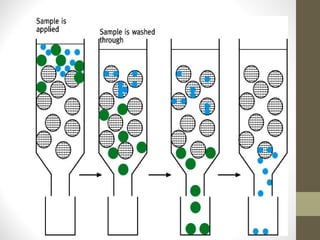
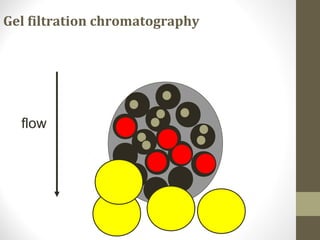
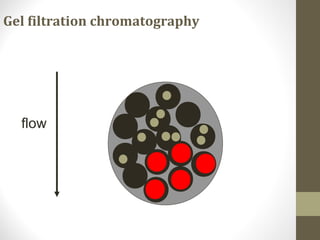
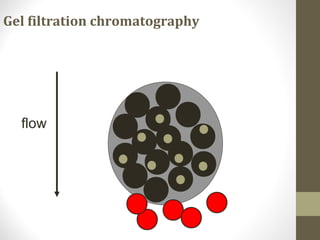
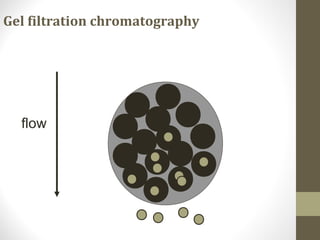
• Gel Chromatography (also known as gel permeation, 
molecular sieving or size exclusion chromatography) is a 
chromatographic technique in which the separation of 
components based on the difference of molecular weight or 
size, and is one of the effective methods used to isolate and 
analyze the bio-macromocular substances. 
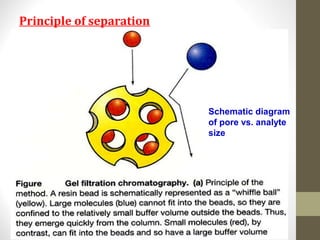
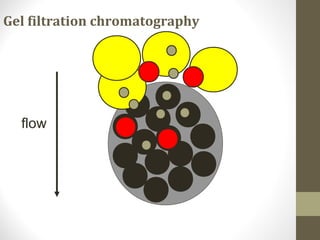
• The stationary phase consists of beads containing pores that 
span a relatively narrow size range. When the gel is packed 
into a column and percolated with a solvent, it permits the 
large molecular weight components to pass faster without 
penetration of the pores (totally excluded). 
• Smaller molecules spend more time inside the beads and 
therefore is eluted later (after a larger volume of mobile 
phase has passed through the column).
Principle of separation 
Schematic diagram 
of pore vs. analyte 
size
4
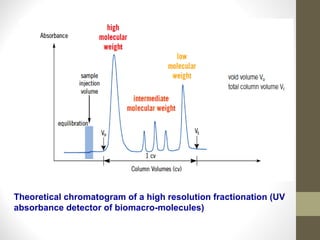
Theoretical chromatogram of a high resolution fractionation (UV 
absorbance detector of biomacro-molecules)
Properties and nature of the gel 
The gel should be: 
1- Chemically inert 
2- Mechanically stable 
3- Has ideal and homogeneous porous structure (wide pore 
size give low resolution). 
4- Uniform particle and pore size. 
5- The pore size of the gel must be carefully controlled. 
Types of gel: 
1- Dextran (Sephadex) gel 
a 1-6-polymer of glucose is prepared by fermentation of 
sucrose (glucose + fructose). It is natural gel. 
2- Agarose gel 
Obtained from agar and composed of alternating units of 
1,3 linked β-D-galactose and 1,4 linked 3,6-anhydro-α, L-galactose. 
It is a natural gel.
3- Acrylamide gels 
It is not dextran polymer. It is polymerized acrylamide or 
methylen-bis-acrylamide. It is a synthetic gel. 
According to the swelling process, the gels are two types: 
1- Soft gels (Xerogel, i. e gel only on swelling) 
e.g. Polyacrylamide gels, dextran or agarose (used for 
separation of proteins in aqueous mobile phase). 
2- Semirigid or rigid gels (aerogel i. e gel in air) 
1) Polystyrene gels (separation of non-polar polymers in 
non-polar solvents). 
2) Porous glass gels (separation of polar systems) 
Eluent 
The eluent (mobile phase) should be a good solvent for the 
polymer, should permit high detector response from the 
polymer and wet the packing surface. It may also buffer.
Advantages of Gel Filtration 
 Can handle biomolecules that are sensitive to changes in pH, 
concentration of metal ions or harsh environmental conditions. 
 Separations can be performed in the presence of essential ions, 
detergents, urea guanidine hydrochloride at high or low ionic 
strength. At 37 °C or in the cold room according to the 
requirements of the experiment. 
Common terms in size exclusion chromatography 
 The total volume (Vt): the sum of the volume of the gel matrix, 
the volume inside the gel matrix, and the volume outside the 
matrix. The total volume is also, in most cases, equal to the 
amount of the eluent required to elute a substance through the 
column, when the substance is small enough to completely 
penetrate the pores of the gel. 
 Inner volume (Vi): the volume of the eluent inside the gel matrix. 
The volume inside the beads.
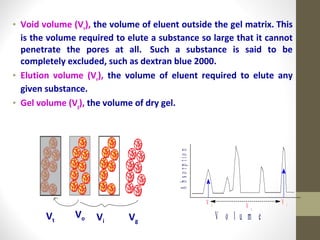
• Void volume (Vo), the volume of eluent outside the gel matrix. This 
is the volume required to elute a substance so large that it cannot 
penetrate the pores at all. Such a substance is said to be 
completely excluded, such as dextran blue 2000. 
• Elution volume (Ve), the volume of eluent required to elute any 
given substance. 
• Gel volume (Vg), the volume of dry gel. 
Vt Vo Vi Vg
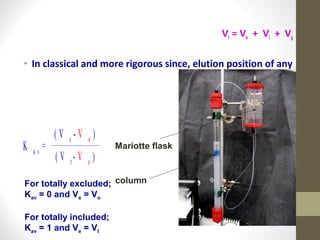
Vt = Vo + Vi + Vg 
• In classical and more rigorous since, elution position of any 
molecules should be 
reported as the partition 
coefficient (Kav) 
rather than volume. 
Mariotte flask 
For totally excluded; column 
Kav = 0 and Ve = Vo 
For totally included; 
Kav = 1 and Ve = Vt
Separation procedures 
1- Preparation of column for gel filtration 
 Swelling of the gel: some resin come in a powder form. these 
must be sonicated first in the eluent or the desired buffer to 
swell. 
 Packing the column: make a slurry of gel plus buffer and pour 
it into column which is one third filled with the buffer. 
 Washing the resin: after packing, pass several column volumes 
of the buffer through the column to remove any air bubbles and 
to test the column homogeneity. 
2- loading the sample onto the column: the sample must enter the 
resin in the form of solution using a syringe. 
3- eluting the sample and detection of components: 
Fractions are collected as the sample elutes from the column.
Applications of gel chromatography 
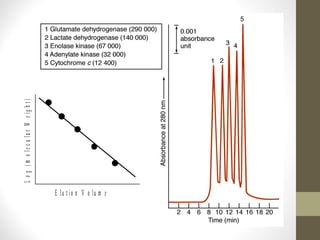
1.Molecular Weight Determination 
For spherical biomolecules like proteins, the elution volume 
(Ve) of the component is proportional to log of its molecular 
weight. So it component has it own Ve. 
Log MW = A - B(Ve/Vo) A and B are constants 
Procedure: 
1- Calibrate the column with a series of polymers with known molecular 
weights. 
2- Determine elution volumes of each polymer including the unknown. 
3- Construct a calibration curve relating (known) molecular weight to 
(measured) elution volume specifically for that column. 
4- Use this calibration curve to estimate the molecular weight of the 
unknown protein, based on its elution volume.
2. Fractionation of macromolecules 
• Biological macromolecules are synthesized or extracted as a 
mixture of several components, and when scientists study a 
macromolecule (protein, antibody, hormone, enzyme, or 
DNA) they need to separate it from the mixture. 
• These macromolecules are of different sizes and shapes, and 
thus, can be separated using gel filtration chromatography. 
3- Desalting 
• Biological samples may contain unwanted substances such 
as: salts, buffer components, small ligands, cofactors and 
precipitating reagents. All of these can be removed by gel 
chromatography. Example Is the removing of NaCl from 
hemoglobin.
Gel filtration chromatography 
flow
Gel filtration chromatography 
flow
Gel filtration chromatography 
flow
Gel filtration chromatography 
flow
Gel filtration chromatography 
flow

Chromatographic Methods of Analysis ( Gel Chromatography Method )

  • 1.
    Chromatographic Methods of Analysis Gel Chromatography By: Prof / Dr. Tarek Fayed Represented by : Mahmoud Galal Zidan E-Mail : M7moud.zidan@yahoo.com E-Mail : m7moud.zidan@aol.com E-Mail : M7moud.zidan@Gmail.com Facebook : www.fb.com/m7moud.zidan Twitter : www.twitter.com/m7moudzidane
  • 2.
    Gel Chromatography •Gel Chromatography (also known as gel permeation, molecular sieving or size exclusion chromatography) is a chromatographic technique in which the separation of components based on the difference of molecular weight or size, and is one of the effective methods used to isolate and analyze the bio-macromocular substances. • The stationary phase consists of beads containing pores that span a relatively narrow size range. When the gel is packed into a column and percolated with a solvent, it permits the large molecular weight components to pass faster without penetration of the pores (totally excluded). • Smaller molecules spend more time inside the beads and therefore is eluted later (after a larger volume of mobile phase has passed through the column).
  • 3.
    Principle of separation Schematic diagram of pore vs. analyte size
  • 4.
  • 5.
    Theoretical chromatogram ofa high resolution fractionation (UV absorbance detector of biomacro-molecules)
  • 6.
    Properties and natureof the gel The gel should be: 1- Chemically inert 2- Mechanically stable 3- Has ideal and homogeneous porous structure (wide pore size give low resolution). 4- Uniform particle and pore size. 5- The pore size of the gel must be carefully controlled. Types of gel: 1- Dextran (Sephadex) gel a 1-6-polymer of glucose is prepared by fermentation of sucrose (glucose + fructose). It is natural gel. 2- Agarose gel Obtained from agar and composed of alternating units of 1,3 linked β-D-galactose and 1,4 linked 3,6-anhydro-α, L-galactose. It is a natural gel.
  • 7.
    3- Acrylamide gels It is not dextran polymer. It is polymerized acrylamide or methylen-bis-acrylamide. It is a synthetic gel. According to the swelling process, the gels are two types: 1- Soft gels (Xerogel, i. e gel only on swelling) e.g. Polyacrylamide gels, dextran or agarose (used for separation of proteins in aqueous mobile phase). 2- Semirigid or rigid gels (aerogel i. e gel in air) 1) Polystyrene gels (separation of non-polar polymers in non-polar solvents). 2) Porous glass gels (separation of polar systems) Eluent The eluent (mobile phase) should be a good solvent for the polymer, should permit high detector response from the polymer and wet the packing surface. It may also buffer.
  • 8.
    Advantages of GelFiltration  Can handle biomolecules that are sensitive to changes in pH, concentration of metal ions or harsh environmental conditions.  Separations can be performed in the presence of essential ions, detergents, urea guanidine hydrochloride at high or low ionic strength. At 37 °C or in the cold room according to the requirements of the experiment. Common terms in size exclusion chromatography  The total volume (Vt): the sum of the volume of the gel matrix, the volume inside the gel matrix, and the volume outside the matrix. The total volume is also, in most cases, equal to the amount of the eluent required to elute a substance through the column, when the substance is small enough to completely penetrate the pores of the gel.  Inner volume (Vi): the volume of the eluent inside the gel matrix. The volume inside the beads.
  • 9.
    • Void volume(Vo), the volume of eluent outside the gel matrix. This is the volume required to elute a substance so large that it cannot penetrate the pores at all. Such a substance is said to be completely excluded, such as dextran blue 2000. • Elution volume (Ve), the volume of eluent required to elute any given substance. • Gel volume (Vg), the volume of dry gel. Vt Vo Vi Vg
  • 10.
    Vt = Vo+ Vi + Vg • In classical and more rigorous since, elution position of any molecules should be reported as the partition coefficient (Kav) rather than volume. Mariotte flask For totally excluded; column Kav = 0 and Ve = Vo For totally included; Kav = 1 and Ve = Vt
  • 11.
    Separation procedures 1-Preparation of column for gel filtration  Swelling of the gel: some resin come in a powder form. these must be sonicated first in the eluent or the desired buffer to swell.  Packing the column: make a slurry of gel plus buffer and pour it into column which is one third filled with the buffer.  Washing the resin: after packing, pass several column volumes of the buffer through the column to remove any air bubbles and to test the column homogeneity. 2- loading the sample onto the column: the sample must enter the resin in the form of solution using a syringe. 3- eluting the sample and detection of components: Fractions are collected as the sample elutes from the column.
  • 12.
    Applications of gelchromatography 1.Molecular Weight Determination For spherical biomolecules like proteins, the elution volume (Ve) of the component is proportional to log of its molecular weight. So it component has it own Ve. Log MW = A - B(Ve/Vo) A and B are constants Procedure: 1- Calibrate the column with a series of polymers with known molecular weights. 2- Determine elution volumes of each polymer including the unknown. 3- Construct a calibration curve relating (known) molecular weight to (measured) elution volume specifically for that column. 4- Use this calibration curve to estimate the molecular weight of the unknown protein, based on its elution volume.
  • 14.
    2. Fractionation ofmacromolecules • Biological macromolecules are synthesized or extracted as a mixture of several components, and when scientists study a macromolecule (protein, antibody, hormone, enzyme, or DNA) they need to separate it from the mixture. • These macromolecules are of different sizes and shapes, and thus, can be separated using gel filtration chromatography. 3- Desalting • Biological samples may contain unwanted substances such as: salts, buffer components, small ligands, cofactors and precipitating reagents. All of these can be removed by gel chromatography. Example Is the removing of NaCl from hemoglobin.
  • 15.
  • 16.
  • 17.
  • 18.
  • 19.

Editor's Notes

  • #16 Some proteins are small enough to also enter the molecular holes of the gel bead. Other proteins are too large to enter the holes and pass by the gel bead. The concept is of Reverse Sieve, since a normal sieve retains large and passes small particles. In gel filtration the larger proteins elute first, medim sized ones next and fijnally the smallest elute last.