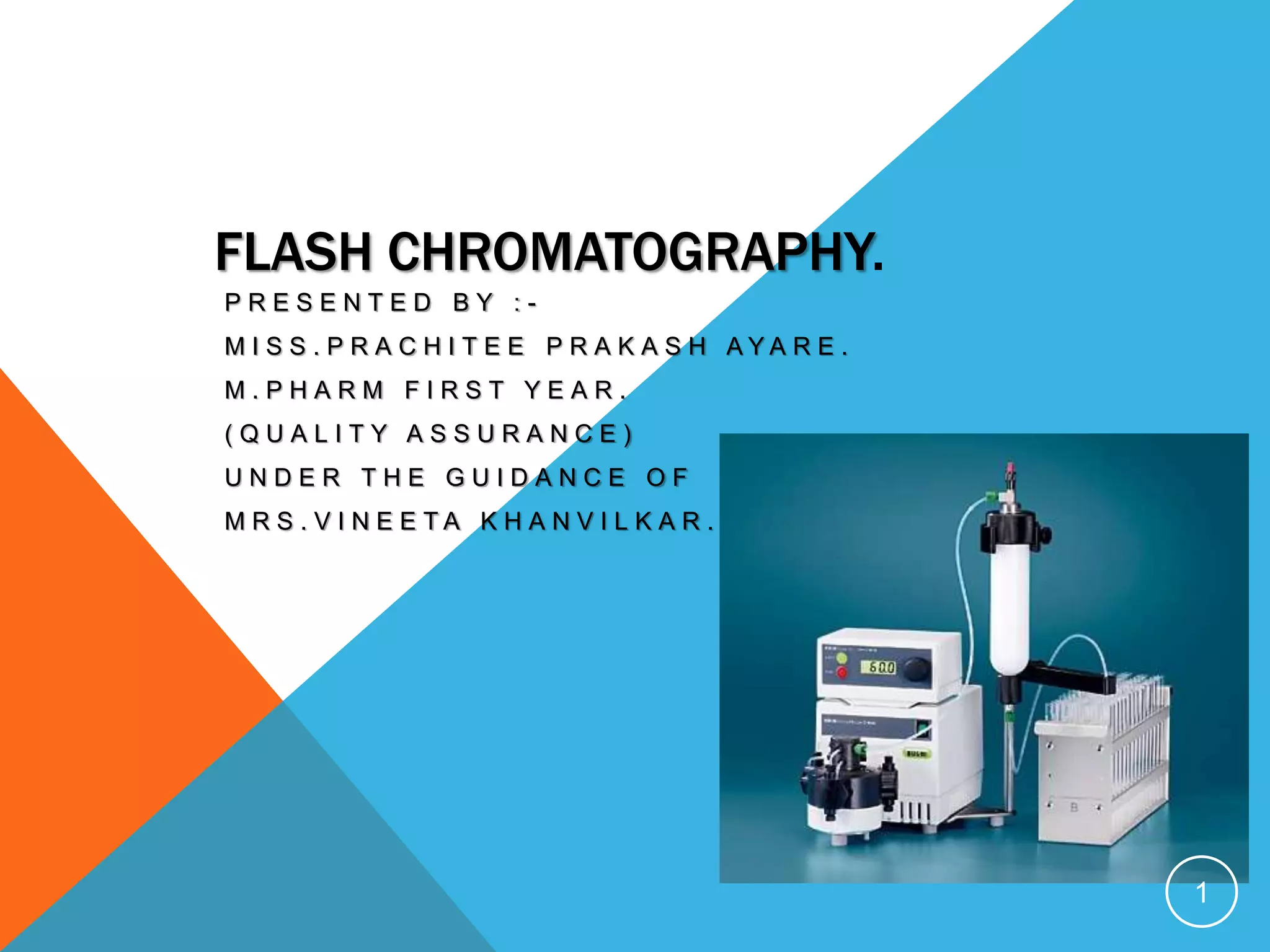
FLASH CHROMATOGRAPHY.
P R E S E N T E D B Y : -
M I S S . P R A C H I T E E P R A K A S H A Y A R E .
M . P H A R M F I R S T Y E A R .
( Q U A L I T Y A S S U R A N C E )
U N D E R T H E G U I D A N C E O F
M R S . V I N E E T A K H A N V I L K A R .
1
INTRODUCTION
 It is also called as “Medium Pressure chromatography”.
 An air pressure driven hybrid of medium and short column
chromatography.
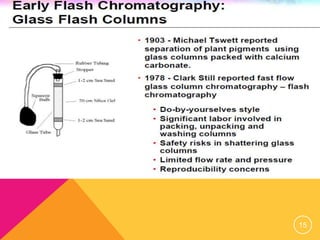
 Invented by Clark & Still of Columbia University in 1978.
 An alternative to slow and often inefficient gravity-fed
chromatography.
2
 Differs from the conventional technique in 2 ways:
 Slightly smaller silica gel particles (40 –
63 µm) are used.
 Due to restricted flow of solvent caused by the
small gel particles, pressurized gas (10-15 psi)
used to drive the solvent through the column of
stationary phase
The net result is a rapid “over in a flash”and high
resolution chromatography.
3
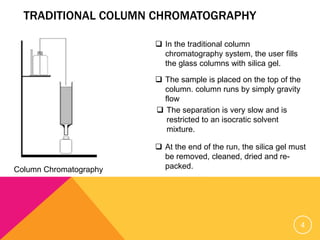
TRADITIONAL COLUMN CHROMATOGRAPHY
Column Chromatography
 In the traditional column
chromatography system, the user fills
the glass columns with silica gel.
 The sample is placed on the top of the
column. column runs by simply gravity
flow
 The separation is very slow and is
restricted to an isocratic solvent
mixture.
 At the end of the run, the silica gel must
be removed, cleaned, dried and re-
packed.
4
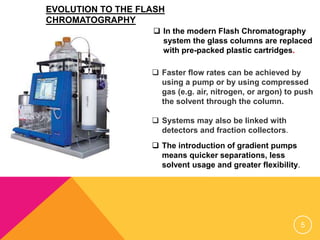
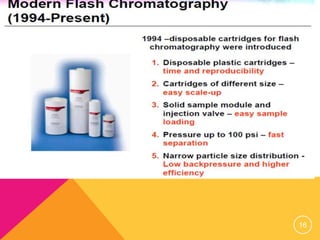
 In the modern Flash Chromatography
system the glass columns are replaced
with pre-packed plastic cartridges.
 Faster flow rates can be achieved by
using a pump or by using compressed
gas (e.g. air, nitrogen, or argon) to push
the solvent through the column.
 Systems may also be linked with
detectors and fraction collectors.
 The introduction of gradient pumps
means quicker separations, less
solvent usage and greater flexibility.
EVOLUTION TO THE FLASH
CHROMATOGRAPHY
5
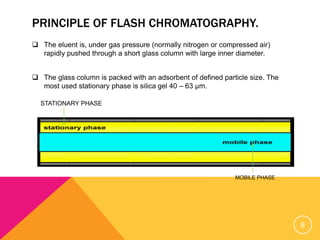
PRINCIPLE OF FLASH CHROMATOGRAPHY.
 The eluent is, under gas pressure (normally nitrogen or compressed air)
rapidly pushed through a short glass column with large inner diameter.
 The glass column is packed with an adsorbent of defined particle size. The
most used stationary phase is silica gel 40 – 63 μm.
STATIONARY PHASE
MOBILE PHASE
6
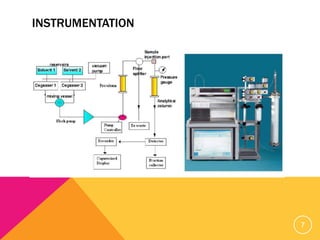
INSTRUMENTATION
7
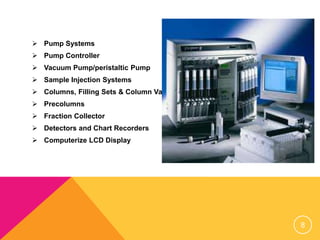
 Pump Systems
 Pump Controller
 Vacuum Pump/peristaltic Pump
 Sample Injection Systems
 Columns, Filling Sets & Column Valves
 Precolumns
 Fraction Collector
 Detectors and Chart Recorders
 Computerize LCD Display
8
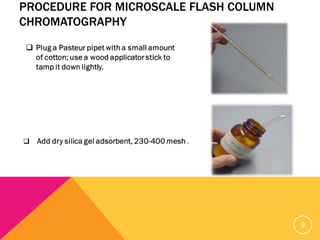
PROCEDURE FOR MICROSCALE FLASH COLUMN
CHROMATOGRAPHY
9
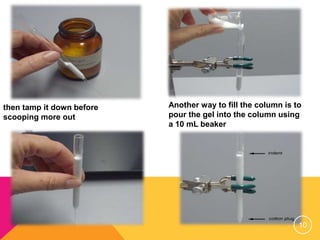
then tamp it down before
scooping more out
Another way to fill the column is to
pour the gel into the column using
a 10 mL beaker
10
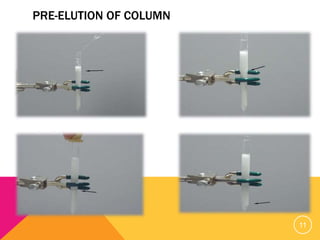
PRE-ELUTION OF COLUMN
11
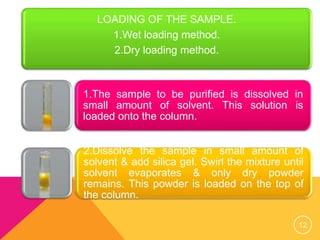
LOADING OF THE SAMPLE.
1.Wet loading method.
2.Dry loading method.
1.The sample to be purified is dissolved in
small amount of solvent. This solution is
loaded onto the column.
2.Dissolve the sample in small amount of
solvent & add silica gel. Swirl the mixture until
solvent evaporates & only dry powder
remains. This powder is loaded on the top of
the column.
12
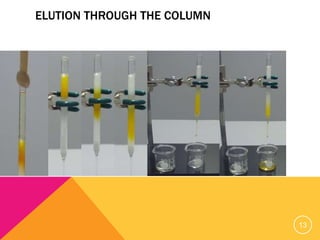
ELUTION THROUGH THE COLUMN
13
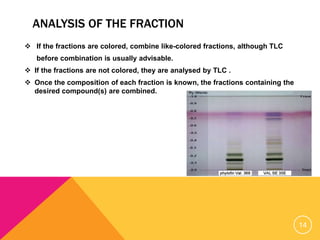
ANALYSIS OF THE FRACTION
 If the fractions are colored, combine like-colored fractions, although TLC
before combination is usually advisable.
 If the fractions are not colored, they are analysed by TLC .
 Once the composition of each fraction is known, the fractions containing the
desired compound(s) are combined.
14
15
16
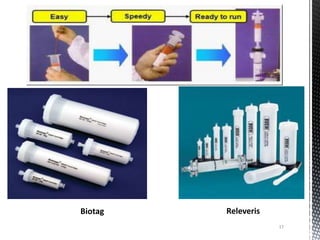
Biotag Releveris
17
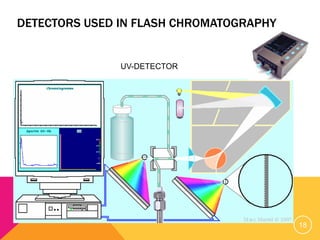
DETECTORS USED IN FLASH CHROMATOGRAPHY
UV-DETECTOR
18
19
ADVANCED DETECTION TECHNIQUES FOR
FLASH CHROMATOGRAPHY
 Compounds are often difficult to detect due to a lack of chromophores or, in
the case of natural products, the compound absorbance is unknown.
 Evaporative Light Scattering Detection (ELSD) has long been used for High
Performance Liquid Chromatography, but has only recently been employed
for Flash chromatography.
 All-Wavelength Collection allows the collection of compound with unknown
absorbance or collection in the presence of interfering solvent absorbance.
20
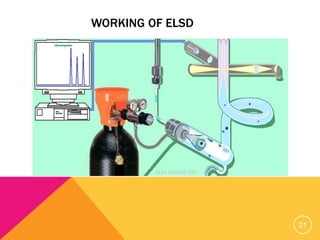
WORKING OF ELSD
21
CURRENT TRENDS IN FLASH CHROMATOGRAPHY…
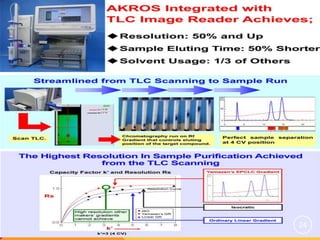
GREEN FLASH CHROMATOGRAPHY.
 The ultimate flash chromatographic technology that achieves
most efficient sample purification.
 The sample run is always carried out with minimum eluting
volume.
 Eco-friendly.
22
FEATURES OF GREEN FLASH CHROMATOGRAPHY
Optimal parameters for flow rate, run time, fraction volume, etc. will be
calculated and set automatically upon selecting a column on “Green
Flash” software. The default parameters will be shown in System
Setting window.
Software provides the maximum sample load information for the
selected column.
State-Of-The-Art Software Based On True Theory of Chromatography.
Sample Eluting Position and Resolution Can Be Fully Controlled for
Systems.
Automatic Method Setup for Reverse Phase Chromatography.
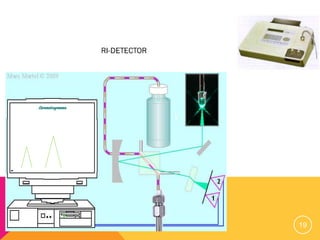
Parallel Detection of UV Detector and RI Detector or ELSD.
23
24
ADVANTAGES
 Large quantities of the sample can be separated (0.5-
2g)
 Fast ( 1o to 15 minutes)
 Cost efficient
 If high resolution is required, flash chromatography is
carried out before HPLC to avoid contamination of the
expensive columns.
25
APPLICATIONS
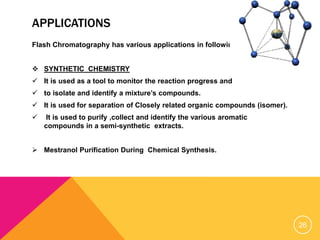
Flash Chromatography has various applications in following fields
 SYNTHETIC CHEMISTRY
 It is used as a tool to monitor the reaction progress and
 to isolate and identify a mixture’s compounds.
 It is used for separation of Closely related organic compounds (isomer).
 It is used to purify ,collect and identify the various aromatic
compounds in a semi-synthetic extracts.
 Mestranol Purification During Chemical Synthesis.
26
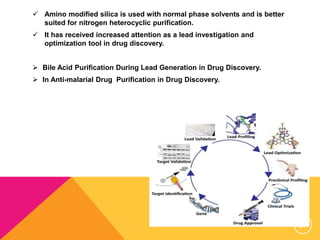
 Amino modified silica is used with normal phase solvents and is better
suited for nitrogen heterocyclic purification.
 It has received increased attention as a lead investigation and
optimization tool in drug discovery.
 Bile Acid Purification During Lead Generation in Drug Discovery.
 In Anti-malarial Drug Purification in Drug Discovery.
27
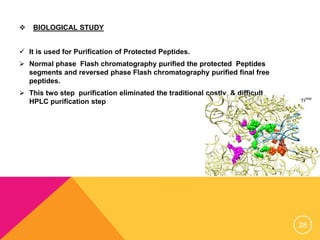
 BIOLOGICAL STUDY
 It is used for Purification of Protected Peptides.
 Normal phase Flash chromatography purified the protected Peptides
segments and reversed phase Flash chromatography purified final free
peptides.
 This two step purification eliminated the traditional costly & difficult
HPLC purification step
28
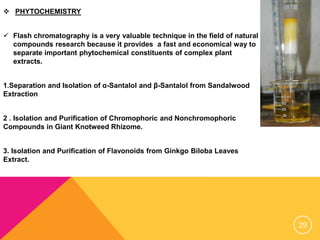
 PHYTOCHEMISTRY
 Flash chromatography is a very valuable technique in the field of natural
compounds research because it provides a fast and economical way to
separate important phytochemical constituents of complex plant
extracts.
1.Separation and Isolation of α-Santalol and β-Santalol from Sandalwood
Extraction
2 . Isolation and Purification of Chromophoric and Nonchromophoric
Compounds in Giant Knotweed Rhizome.
3. Isolation and Purification of Flavonoids from Ginkgo Biloba Leaves
Extract.
29
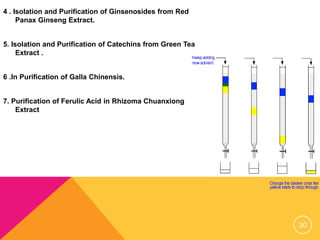
4 . Isolation and Purification of Ginsenosides from Red
Panax Ginseng Extract.
5. Isolation and Purification of Catechins from Green Tea
Extract .
6 .In Purification of Galla Chinensis.
7. Purification of Ferulic Acid in Rhizoma Chuanxiong
Extract
30
REFERENCES
1. Still WC. Kahn M., Mitra A, Flash chromatography, J.Org.Chem. 43(14)1978; 2923-2925.
2. A. B. Roge*, S. N. Firke, R. M. Kawade, S. K. Sarje, and S. M. Vadvalkar, BRIEF REVIEW
ON: FLASH CHROMATOGRAPHY, IJPSR (2011), Vol. 2, Issue 8,1930-1937.
3. William CSand Hill DC. General methods for flash chromatography using disposable
column. Mol. Divers, 13(2), 2009, 247-252.
4. Hetal Chaudhari*, Falguni Chaudhari, Madhavi Patel, P.K. Pradhan, U.M. Upadhyay, A
REVIEW ON A FLASH CHROMATOGRAPHY, International Journal of Pharmaceutical
Development & Technology, 2 (2), 2012, 80-84.
5. www.chem.rochester.edu/how to flash.html
6. www.saiadsorbants.com
7. www.sorbeadindia.com
8. www.orgchem.colorado.edu.
9. www. Buchi Preparative Chromatography.
10. Dane Ganesh D*, Raka KC, Honde BS, Bhawal GS, Tajane PJ, REVIEW ON FLASH
CHROMATOGRAPHY, Vol 3,Issue 1, 2013 ,45-49.
11. jsilver@teledyne.com
12. Dewick, P.; John Wiley & Sons, Inc., Hoboken, Medicinal natural products; a biosynthetic
approach, 3rd edition ,New Jersey, 2009.
13. www.discoverysciences.com
14. www.pretech.nu/products
15. http://www.sigmaaldrich.com
16. http://yamazenusa.com 31

Flash chromatography

  • 1.
    FLASH CHROMATOGRAPHY. P RE S E N T E D B Y : - M I S S . P R A C H I T E E P R A K A S H A Y A R E . M . P H A R M F I R S T Y E A R . ( Q U A L I T Y A S S U R A N C E ) U N D E R T H E G U I D A N C E O F M R S . V I N E E T A K H A N V I L K A R . 1
  • 2.
    INTRODUCTION  It isalso called as “Medium Pressure chromatography”.  An air pressure driven hybrid of medium and short column chromatography.  Invented by Clark & Still of Columbia University in 1978.  An alternative to slow and often inefficient gravity-fed chromatography. 2
  • 3.
     Differs fromthe conventional technique in 2 ways:  Slightly smaller silica gel particles (40 – 63 µm) are used.  Due to restricted flow of solvent caused by the small gel particles, pressurized gas (10-15 psi) used to drive the solvent through the column of stationary phase The net result is a rapid “over in a flash”and high resolution chromatography. 3
  • 4.
    TRADITIONAL COLUMN CHROMATOGRAPHY ColumnChromatography  In the traditional column chromatography system, the user fills the glass columns with silica gel.  The sample is placed on the top of the column. column runs by simply gravity flow  The separation is very slow and is restricted to an isocratic solvent mixture.  At the end of the run, the silica gel must be removed, cleaned, dried and re- packed. 4
  • 5.
     In themodern Flash Chromatography system the glass columns are replaced with pre-packed plastic cartridges.  Faster flow rates can be achieved by using a pump or by using compressed gas (e.g. air, nitrogen, or argon) to push the solvent through the column.  Systems may also be linked with detectors and fraction collectors.  The introduction of gradient pumps means quicker separations, less solvent usage and greater flexibility. EVOLUTION TO THE FLASH CHROMATOGRAPHY 5
  • 6.
    PRINCIPLE OF FLASHCHROMATOGRAPHY.  The eluent is, under gas pressure (normally nitrogen or compressed air) rapidly pushed through a short glass column with large inner diameter.  The glass column is packed with an adsorbent of defined particle size. The most used stationary phase is silica gel 40 – 63 μm. STATIONARY PHASE MOBILE PHASE 6
  • 7.
  • 8.
     Pump Systems Pump Controller  Vacuum Pump/peristaltic Pump  Sample Injection Systems  Columns, Filling Sets & Column Valves  Precolumns  Fraction Collector  Detectors and Chart Recorders  Computerize LCD Display 8
  • 9.
    PROCEDURE FOR MICROSCALEFLASH COLUMN CHROMATOGRAPHY 9
  • 10.
    then tamp itdown before scooping more out Another way to fill the column is to pour the gel into the column using a 10 mL beaker 10
  • 11.
  • 12.
    LOADING OF THESAMPLE. 1.Wet loading method. 2.Dry loading method. 1.The sample to be purified is dissolved in small amount of solvent. This solution is loaded onto the column. 2.Dissolve the sample in small amount of solvent & add silica gel. Swirl the mixture until solvent evaporates & only dry powder remains. This powder is loaded on the top of the column. 12
  • 13.
  • 14.
    ANALYSIS OF THEFRACTION  If the fractions are colored, combine like-colored fractions, although TLC before combination is usually advisable.  If the fractions are not colored, they are analysed by TLC .  Once the composition of each fraction is known, the fractions containing the desired compound(s) are combined. 14
  • 15.
  • 16.
  • 17.
  • 18.
    DETECTORS USED INFLASH CHROMATOGRAPHY UV-DETECTOR 18
  • 19.
  • 20.
    ADVANCED DETECTION TECHNIQUESFOR FLASH CHROMATOGRAPHY  Compounds are often difficult to detect due to a lack of chromophores or, in the case of natural products, the compound absorbance is unknown.  Evaporative Light Scattering Detection (ELSD) has long been used for High Performance Liquid Chromatography, but has only recently been employed for Flash chromatography.  All-Wavelength Collection allows the collection of compound with unknown absorbance or collection in the presence of interfering solvent absorbance. 20
  • 21.
  • 22.
    CURRENT TRENDS INFLASH CHROMATOGRAPHY… GREEN FLASH CHROMATOGRAPHY.  The ultimate flash chromatographic technology that achieves most efficient sample purification.  The sample run is always carried out with minimum eluting volume.  Eco-friendly. 22
  • 23.
    FEATURES OF GREENFLASH CHROMATOGRAPHY Optimal parameters for flow rate, run time, fraction volume, etc. will be calculated and set automatically upon selecting a column on “Green Flash” software. The default parameters will be shown in System Setting window. Software provides the maximum sample load information for the selected column. State-Of-The-Art Software Based On True Theory of Chromatography. Sample Eluting Position and Resolution Can Be Fully Controlled for Systems. Automatic Method Setup for Reverse Phase Chromatography. Parallel Detection of UV Detector and RI Detector or ELSD. 23
  • 24.
  • 25.
    ADVANTAGES  Large quantitiesof the sample can be separated (0.5- 2g)  Fast ( 1o to 15 minutes)  Cost efficient  If high resolution is required, flash chromatography is carried out before HPLC to avoid contamination of the expensive columns. 25
  • 26.
    APPLICATIONS Flash Chromatography hasvarious applications in following fields  SYNTHETIC CHEMISTRY  It is used as a tool to monitor the reaction progress and  to isolate and identify a mixture’s compounds.  It is used for separation of Closely related organic compounds (isomer).  It is used to purify ,collect and identify the various aromatic compounds in a semi-synthetic extracts.  Mestranol Purification During Chemical Synthesis. 26
  • 27.
     Amino modifiedsilica is used with normal phase solvents and is better suited for nitrogen heterocyclic purification.  It has received increased attention as a lead investigation and optimization tool in drug discovery.  Bile Acid Purification During Lead Generation in Drug Discovery.  In Anti-malarial Drug Purification in Drug Discovery. 27
  • 28.
     BIOLOGICAL STUDY It is used for Purification of Protected Peptides.  Normal phase Flash chromatography purified the protected Peptides segments and reversed phase Flash chromatography purified final free peptides.  This two step purification eliminated the traditional costly & difficult HPLC purification step 28
  • 29.
     PHYTOCHEMISTRY  Flashchromatography is a very valuable technique in the field of natural compounds research because it provides a fast and economical way to separate important phytochemical constituents of complex plant extracts. 1.Separation and Isolation of α-Santalol and β-Santalol from Sandalwood Extraction 2 . Isolation and Purification of Chromophoric and Nonchromophoric Compounds in Giant Knotweed Rhizome. 3. Isolation and Purification of Flavonoids from Ginkgo Biloba Leaves Extract. 29
  • 30.
    4 . Isolationand Purification of Ginsenosides from Red Panax Ginseng Extract. 5. Isolation and Purification of Catechins from Green Tea Extract . 6 .In Purification of Galla Chinensis. 7. Purification of Ferulic Acid in Rhizoma Chuanxiong Extract 30
  • 31.
    REFERENCES 1. Still WC.Kahn M., Mitra A, Flash chromatography, J.Org.Chem. 43(14)1978; 2923-2925. 2. A. B. Roge*, S. N. Firke, R. M. Kawade, S. K. Sarje, and S. M. Vadvalkar, BRIEF REVIEW ON: FLASH CHROMATOGRAPHY, IJPSR (2011), Vol. 2, Issue 8,1930-1937. 3. William CSand Hill DC. General methods for flash chromatography using disposable column. Mol. Divers, 13(2), 2009, 247-252. 4. Hetal Chaudhari*, Falguni Chaudhari, Madhavi Patel, P.K. Pradhan, U.M. Upadhyay, A REVIEW ON A FLASH CHROMATOGRAPHY, International Journal of Pharmaceutical Development & Technology, 2 (2), 2012, 80-84. 5. www.chem.rochester.edu/how to flash.html 6. www.saiadsorbants.com 7. www.sorbeadindia.com 8. www.orgchem.colorado.edu. 9. www. Buchi Preparative Chromatography. 10. Dane Ganesh D*, Raka KC, Honde BS, Bhawal GS, Tajane PJ, REVIEW ON FLASH CHROMATOGRAPHY, Vol 3,Issue 1, 2013 ,45-49. 11. jsilver@teledyne.com 12. Dewick, P.; John Wiley & Sons, Inc., Hoboken, Medicinal natural products; a biosynthetic approach, 3rd edition ,New Jersey, 2009. 13. www.discoverysciences.com 14. www.pretech.nu/products 15. http://www.sigmaaldrich.com 16. http://yamazenusa.com 31