Prof.Dr/ Hala Fawzy
By : Mahmoud Galal Zidan
Fibers
Are considered class evidence
Have probative value
Are common trace evidence at a
crime scene
Can be characterized based on
comparison of both physical
and chemical properties
2
By:MahmoudGalalZidan
Vegetable
Inorganic
Animal
Plants
Nature
created from
altered
natural
sources
synthesize
Artificial
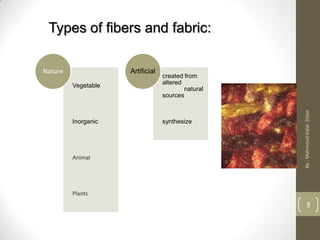
Types of fibers and fabric:
3
By:MahmoudGalalZidan
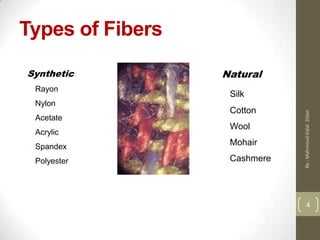
Types of Fibers
Natural
Silk
Cotton
Wool
Mohair
Cashmere
Synthetic
Rayon
Nylon
Acetate
Acrylic
Spandex
Polyester
4
By:MahmoudGalalZidan
Classification
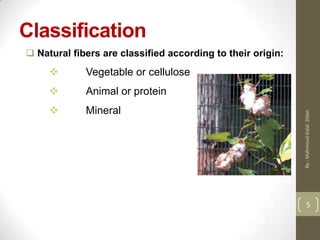
 Natural fibers are classified according to their origin:
 Vegetable or cellulose
 Animal or protein
 Mineral
5
By:MahmoudGalalZidan
Cellulose Fibers
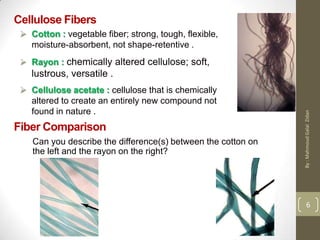
 Cotton : vegetable fiber; strong, tough, flexible,
moisture-absorbent, not shape-retentive .
 Rayon : chemically altered cellulose; soft,
lustrous, versatile .
 Cellulose acetate : cellulose that is chemically
altered to create an entirely new compound not
found in nature .
Fiber Comparison
Can you describe the difference(s) between the cotton on
the left and the rayon on the right?
6
By:MahmoudGalalZidan
Protein Fibers
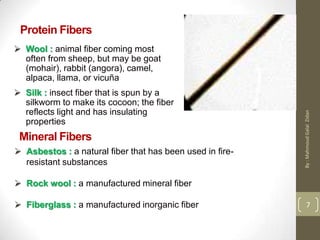
 Wool : animal fiber coming most
often from sheep, but may be goat
(mohair), rabbit (angora), camel,
alpaca, llama, or vicuña
 Silk : insect fiber that is spun by a
silkworm to make its cocoon; the fiber
reflects light and has insulating
properties
Mineral Fibers
 Asbestos : a natural fiber that has been used in fire-
resistant substances
 Rock wool : a manufactured mineral fiber
 Fiberglass : a manufactured inorganic fiber 7
By:MahmoudGalalZidan
Synthetic Fibers
Made from derivativesof petroleum,coal, and naturalgas
Nylon : most durable of man-made fibers; extremely lightweight
Polyester : most widely used man-made fiber
Acrylic : provides warmth from a lightweight, soft, and resilient
fiber
Spandex :extreme elastic properties
8
8
By:MahmoudGalalZidan
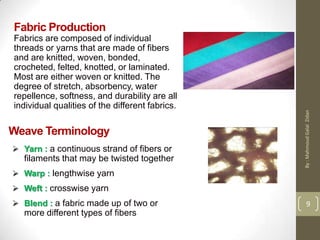
Fabric Production
Fabrics are composed of individual
threads or yarns that are made of fibers
and are knitted, woven, bonded,
crocheted, felted, knotted, or laminated.
Most are either woven or knitted. The
degree of stretch, absorbency, water
repellence, softness, and durability are all
individual qualities of the different fabrics.
9
Weave Terminology
 Yarn : a continuous strand of fibers or
filaments that may be twisted together
 Warp : lengthwise yarn
 Weft : crosswise yarn
 Blend : a fabric made up of two or
more different types of fibers
9
By:MahmoudGalalZidan
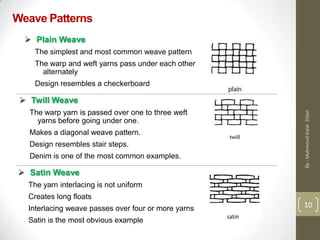
Weave Patterns
 Plain Weave
The simplest and most common weave pattern
The warp and weft yarns pass under each other
alternately
Design resembles a checkerboard
 Twill Weave
The warp yarn is passed over one to three weft
yarns before going under one.
Makes a diagonal weave pattern.
Design resembles stair steps.
Denim is one of the most common examples.
 Satin Weave
The yarn interlacing is not uniform
Creates long floats
Interlacing weave passes over four or more yarns
Satin is the most obvious example
10
By:MahmoudGalalZidan
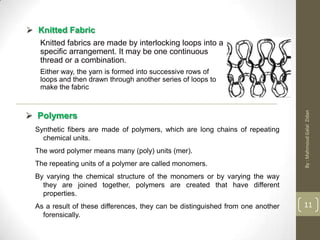
 Knitted Fabric
Knitted fabrics are made by interlocking loops into a
specific arrangement. It may be one continuous
thread or a combination.
Either way, the yarn is formed into successive rows of
loops and then drawn through another series of loops to
make the fabric
 Polymers
Synthetic fibers are made of polymers, which are long chains of repeating
chemical units.
The word polymer means many (poly) units (mer).
The repeating units of a polymer are called monomers.
By varying the chemical structure of the monomers or by varying the way
they are joined together, polymers are created that have different
properties.
As a result of these differences, they can be distinguished from one another
forensically.
11
By:MahmoudGalalZidan
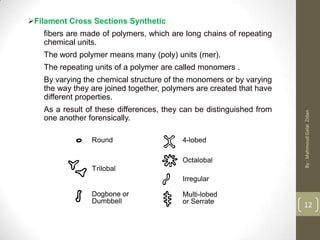
Round 4-lobed
Octalobal
Irregular
Multi-lobed
or Serrate
Trilobal
Dogbone or
Dumbbell
Filament Cross Sections Synthetic
fibers are made of polymers, which are long chains of repeating
chemical units.
The word polymer means many (poly) units (mer).
The repeating units of a polymer are called monomers .
By varying the chemical structure of the monomers or by varying
the way they are joined together, polymers are created that have
different properties.
As a result of these differences, they can be distinguished from
one another forensically.
12
By:MahmoudGalalZidan
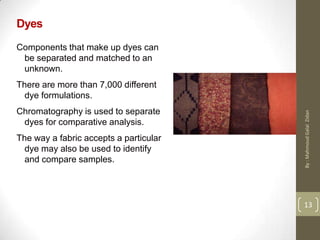
Dyes
Components that make up dyes can
be separated and matched to an
unknown.
There are more than 7,000 different
dye formulations.
Chromatography is used to separate
dyes for comparative analysis.
The way a fabric accepts a particular
dye may also be used to identify
and compare samples.
13
13
By:MahmoudGalalZidan

General Types of fabric

  • 1.
    Prof.Dr/ Hala Fawzy By: Mahmoud Galal Zidan
  • 2.
    Fibers Are considered classevidence Have probative value Are common trace evidence at a crime scene Can be characterized based on comparison of both physical and chemical properties 2 By:MahmoudGalalZidan
  • 3.
  • 4.
  • 5.
    Classification  Natural fibersare classified according to their origin:  Vegetable or cellulose  Animal or protein  Mineral 5 By:MahmoudGalalZidan
  • 6.
    Cellulose Fibers  Cotton: vegetable fiber; strong, tough, flexible, moisture-absorbent, not shape-retentive .  Rayon : chemically altered cellulose; soft, lustrous, versatile .  Cellulose acetate : cellulose that is chemically altered to create an entirely new compound not found in nature . Fiber Comparison Can you describe the difference(s) between the cotton on the left and the rayon on the right? 6 By:MahmoudGalalZidan
  • 7.
    Protein Fibers  Wool: animal fiber coming most often from sheep, but may be goat (mohair), rabbit (angora), camel, alpaca, llama, or vicuña  Silk : insect fiber that is spun by a silkworm to make its cocoon; the fiber reflects light and has insulating properties Mineral Fibers  Asbestos : a natural fiber that has been used in fire- resistant substances  Rock wool : a manufactured mineral fiber  Fiberglass : a manufactured inorganic fiber 7 By:MahmoudGalalZidan
  • 8.
    Synthetic Fibers Made fromderivativesof petroleum,coal, and naturalgas Nylon : most durable of man-made fibers; extremely lightweight Polyester : most widely used man-made fiber Acrylic : provides warmth from a lightweight, soft, and resilient fiber Spandex :extreme elastic properties 8 8 By:MahmoudGalalZidan
  • 9.
    Fabric Production Fabrics arecomposed of individual threads or yarns that are made of fibers and are knitted, woven, bonded, crocheted, felted, knotted, or laminated. Most are either woven or knitted. The degree of stretch, absorbency, water repellence, softness, and durability are all individual qualities of the different fabrics. 9 Weave Terminology  Yarn : a continuous strand of fibers or filaments that may be twisted together  Warp : lengthwise yarn  Weft : crosswise yarn  Blend : a fabric made up of two or more different types of fibers 9 By:MahmoudGalalZidan
  • 10.
    Weave Patterns  PlainWeave The simplest and most common weave pattern The warp and weft yarns pass under each other alternately Design resembles a checkerboard  Twill Weave The warp yarn is passed over one to three weft yarns before going under one. Makes a diagonal weave pattern. Design resembles stair steps. Denim is one of the most common examples.  Satin Weave The yarn interlacing is not uniform Creates long floats Interlacing weave passes over four or more yarns Satin is the most obvious example 10 By:MahmoudGalalZidan
  • 11.
     Knitted Fabric Knittedfabrics are made by interlocking loops into a specific arrangement. It may be one continuous thread or a combination. Either way, the yarn is formed into successive rows of loops and then drawn through another series of loops to make the fabric  Polymers Synthetic fibers are made of polymers, which are long chains of repeating chemical units. The word polymer means many (poly) units (mer). The repeating units of a polymer are called monomers. By varying the chemical structure of the monomers or by varying the way they are joined together, polymers are created that have different properties. As a result of these differences, they can be distinguished from one another forensically. 11 By:MahmoudGalalZidan
  • 12.
    Round 4-lobed Octalobal Irregular Multi-lobed or Serrate Trilobal Dogboneor Dumbbell Filament Cross Sections Synthetic fibers are made of polymers, which are long chains of repeating chemical units. The word polymer means many (poly) units (mer). The repeating units of a polymer are called monomers . By varying the chemical structure of the monomers or by varying the way they are joined together, polymers are created that have different properties. As a result of these differences, they can be distinguished from one another forensically. 12 By:MahmoudGalalZidan
  • 13.
    Dyes Components that makeup dyes can be separated and matched to an unknown. There are more than 7,000 different dye formulations. Chromatography is used to separate dyes for comparative analysis. The way a fabric accepts a particular dye may also be used to identify and compare samples. 13 13 By:MahmoudGalalZidan