ION EXCHANGE CHROMATOGRAPHY
PRESENTATION AND SUBMISSION
BY
ANANT NAG MPH/10016/21
SANJHI SHARMA MPH/10017/21
KIRTI RASHMI MPH/10018/21
MRINAL KANTI PRADHAN MPH/10020/21
DEEPIKA KUMARI MPH/10022/21
SUBJECT: MODERN PHARMACEUTICAL ANALYTICAL TECHNIQUES
UNDER THE GUIDANCE
OF
Dr. Kishanta Kumar Pradhan
Assistant Professor
DEPARTMENT OF PHARMACEUTICAL SCIENCES AND TECHNOLOGY
BIRLA INSTITUTE OF TECHNOLOGY , MESRA , RANCHI- 835215
2021
CONTENT
• INTRODUCTION
• PRINCIPLE OF ION EXCHANGE
• PRACTICAL REQUIREMENTS
• CLASSIFICATIONS OF RESINS
• FACTORS AFFECTING ION EXCHANGE SEPARATIONS
• APPLICATION
• REFERENCES
INTRODUCTION
• Ion chromatography (also known as ion exchange chromatography) separates ions and
polar molecules based on their affinity for the ion exchanger.
• It is effective on almost any charged molecule, including large proteins, small
nucleotides, and amino acids.
• Ion chromatography, on the other hand, must be performed in conditions one unit away
from a protein's iso-electric point.
• The two types of ion chromatography are :
✔anion-exchange and
✔cation-exchange.
• Cation-exchange chromatography is used when the molecule of interest is positively
charged. The molecule is positively charged because the pH for chromatography is less
than the pI (a/k/a pH(I)).
• In this type of chromatography, the stationary phase is negatively charged and
positively charged molecules are loaded to be attracted to it.
• Anion-exchange chromatography is when the stationary phase is positively
charged and negatively charged molecules (meaning that pH for chromatography
is greater than the pI) are loaded to be attracted to it.
• It is often used in protein purification, water analysis, and quality control.
• The water-soluble and charged molecules such as proteins, amino acids, and
peptides bind to moieties which are oppositely charged by forming ionic bonds to
the insoluble stationary phase.
Principle of Ion exchange
• Ion-exchange chromatography separates molecules based on their respective
charged groups.
• Ion-exchange chromatography retains analyte molecules on the column based
on coulombic (ionic) interactions. The ion exchange chromatography matrix
consists of positively and negatively charged ions.
• Ion chromatography is used in the separation of charged bio-molecules. The crude
sample containing charged molecules is used as the liquid phase. When it passes
through the chromatographic column, molecules bind to oppositely charged sites
in the stationary phase.
• The molecules separated on the basis of their charge are eluted using a solution of
varying ionic strength. By passing such a solution through the column, highly
selective separation of molecules according to their different charges takes place.
PRACTICAL REQUIREMENTS
1. COLUMN MATERIAL AND DIMENSIONS:
Glass is used to make laboratory columns. However, those used in industry are made of
high-quality stainless steel or polymers that can withstand strong acids and alkalis.. The
column dimensions are also important and a length: diameter ratio of 20:1 to 100:1 for
higher efficiency can be used.
2. PACKING OF THE COLUMN
Wet packing method : A slurry is prepared of the eluent with the stationary phase
powder and then carefully poured into the column. Care must be taken to avoid air
bubbles.
3. APPLICATION OF THE SAMPLE
• After packing , sample is added to the top of stationary phase, using syringe or pipette.
• This layer is usually topped with a small layer of sand or with cotton or with glass wool to
protect the shape of organic layer from the velocity of newly added eluent.
4. MOBILE PHASE:
Organic solvents are less effective and are rarely used. As eluting solvents, only
various strengths of acids, alkalis, and buffers are used. 0.1N HCL, 1N NaOH,
phosphate buffer, acetate buffer, borate buffer, phthalate buffer, etc are some
examples. Commonly used eluent additives which have been successfully used in
ion exchange chromatography are EDTA, Glycerol, glucose, and saccharose ,
Detergents ,Urea ,Lipids, Zwitter ions, Ligands etc.
5. STATIONARY PHASE
• Stationary phases comprised of two structural elements; the charged groups which
are involved in the exchange process and the matrix on which the charged groups
are fixed .
• Ion exchangers are characterized both by the nature of the ionic species
comprising the fixed ion and by the nature of the insoluble ion-exchange matrix
itself.
6. TYPES OF ION EXCHANGE RESINS AND PHYSICAL CHARACTERISTICS:
The following characteristics influence the choice of ion exchange resin:
i. Type of the ions to be separated - cations or anions
ii. Nature of the ions to be separated – Strong or weak
iii. Efficiency of the resin – It is measured by the ion exchange capacity.
Ion exchange capacity is the total ion exchange capacity in terms of the exchangeable
functional groups expressed as milli equivalents per grams of the ion exchange resin.
m.eq/g= 1000/eq. wt
iv. Particle size of the resin -50-100 mesh or 100-200 mesh is used.
v. Structural type of the resin – porous, pellicular. Etc
vi. Amount of cross linking agent present – which decides swelling of the resin
7. DEVELOPMENT OF THE CHROMATOGRAM AND ELUTION:
• Following the introduction of the sample, the chromatogram is developed using several
mobile phases.
• Organic solvents are less useful, as explained previously, and only acids, alkalis, and
buffers of various pH are utilised.
There are two elution techniques
ISOCRACTIC ELUTION TECHNIQUE
•Same solvent composition is used i.e. same
strength of acid or alkali or buffer.
GRADIENT ELUTION TECHNIQUE
Initially less acidic or basic character is used
followed by increasing the acidity of the
mobile phase and is usually used for complex
mixtures.
8. ANALYSIS OF THE ELUTE:
• The contents of various fractions collected with respect to volume or time are
evaluated. Depending on the nature and quantity of the sample, a variety of analysis
procedures can be applied.
• They include spectrophotometric, polarographic, conductometic, amperometric, flame
photometric, radiochemical (using Geiger Muller counter, ionisation chamber
method), and other approaches. Following the analysis, similar fractions are combined
to produce pure ions or compounds of each type.
Following the analysis, similar fractions are combined to produce pure ions or
compounds of each type.
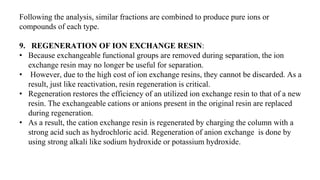
9. REGENERATION OF ION EXCHANGE RESIN:
• Because exchangeable functional groups are removed during separation, the ion
exchange resin may no longer be useful for separation.
• However, due to the high cost of ion exchange resins, they cannot be discarded. As a
result, just like reactivation, resin regeneration is critical.
• Regeneration restores the efficiency of an utilized ion exchange resin to that of a new
resin. The exchangeable cations or anions present in the original resin are replaced
during regeneration.
• As a result, the cation exchange resin is regenerated by charging the column with a
strong acid such as hydrochloric acid. Regeneration of anion exchange is done by
using strong alkali like sodium hydroxide or potassium hydroxide.
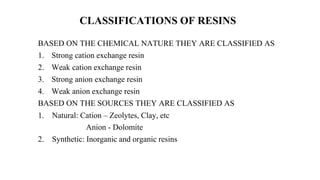
CLASSIFICATIONS OF RESINS
BASED ON THE CHEMICAL NATURE THEY ARE CLASSIFIED AS
1. Strong cation exchange resin
2. Weak cation exchange resin
3. Strong anion exchange resin
4. Weak anion exchange resin
BASED ON THE SOURCES THEY ARE CLASSIFIED AS
1. Natural: Cation – Zeolytes, Clay, etc
Anion - Dolomite
2. Synthetic: Inorganic and organic resins
Contd
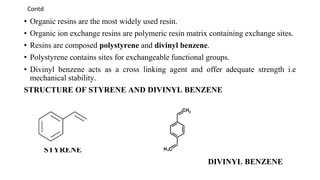
• Organic resins are the most widely used resin.
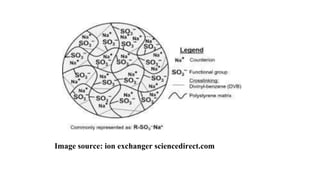
• Organic ion exchange resins are polymeric resin matrix containing exchange sites.
• Resins are composed polystyrene and divinyl benzene.
• Polystyrene contains sites for exchangeable functional groups.
• Divinyl benzene acts as a cross linking agent and offer adequate strength i.e
mechanical stability.
STRUCTURE OF STYRENE AND DIVINYL BENZENE
STYRENE
DIVINYL BENZENE
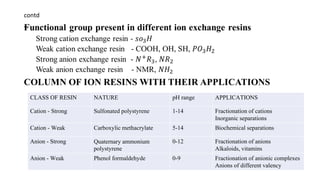
contd
•
CLASS OF RESIN NATURE pH range APPLICATIONS
Cation - Strong Sulfonated polystyrene 1-14 Fractionation of cations
Inorganic separations
Cation - Weak Carboxylic methacrylate 5-14 Biochemical separations
Anion - Strong Quaternary ammonium
polystyrene
0-12 Fractionation of anions
Alkaloids, vitamins
Anion - Weak Phenol formaldehyde 0-9 Fractionation of anionic complexes
Anions of different valency
contd
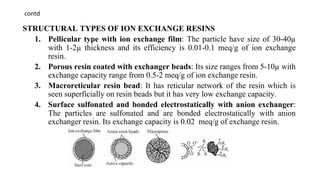
STRUCTURAL TYPES OF ION EXCHANGE RESINS
1. Pellicular type with ion exchange film: The particle have size of 30-40µ
with 1-2µ thickness and its efficiency is 0.01-0.1 meq/g of ion exchange
resin.
2. Porous resin coated with exchanger beads: Its size ranges from 5-10µ with
exchange capacity range from 0.5-2 meq/g of ion exchange resin.
3. Macroreticular resin bead: It has reticular network of the resin which is
seen superficially on resin beads but it has very low exchange capacity.
4. Surface sulfonated and bonded electrostatically with anion exchanger:
The particles are sulfonated and are bonded electrostatically with anion
exchanger resin. Its exchange capacity is 0.02 meq/g of exchange resin.
contd
Physical properties of resin:
1. Particle size: They are fine powder of uniform particle size from 50-200
mesh. They allow free and uniform flow of mobile phase and also contain
more exchangeable functional groups.
2. Cross linking and swelling: When more cross linking agent is present, they
are more rigid, but swells less. When swelling is less, separation of ions of
different ions of different sizes is difficult as they cannot pass through pores
present. When less cross linking agent is present, they are less rigid, but
swell more. Due to this, separation is not efficient and exchange of does not
take place. Hence optimum quantity of cross linking agent should be added.
Factors affecting ion exchange separations:
• 1. Nature and properties of ion exchange resins.
• 2. Nature of exchanging ions.
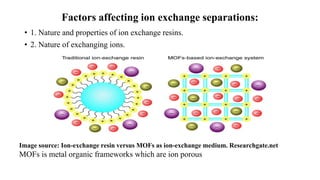
Image source: Ion-exchange resin versus MOFs as ion-exchange medium. Researchgate.net
MOFs is metal organic frameworks which are ion porous
Nature and properties of ion exchange resins.
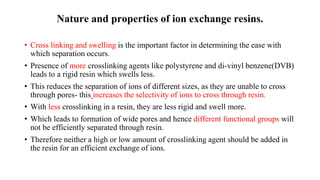
• Cross linking and swelling is the important factor in determining the ease with
which separation occurs.
• Presence of more crosslinking agents like polystyrene and di-vinyl benzene(DVB)
leads to a rigid resin which swells less.
• This reduces the separation of ions of different sizes, as they are unable to cross
through pores- this increases the selectivity of ions to cross through resin.
• With less crosslinking in a resin, they are less rigid and swell more.
• Which leads to formation of wide pores and hence different functional groups will
not be efficiently separated through resin.
• Therefore neither a high or low amount of crosslinking agent should be added in
the resin for an efficient exchange of ions.
Image source: ion exchanger sciencedirect.com
Nature of exchanging ions.
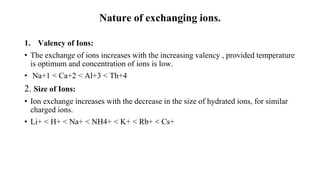
1. Valency of Ions:
• The exchange of ions increases with the increasing valency , provided temperature
is optimum and concentration of ions is low.
• Na+1 < Ca+2 < Al+3 < Th+4
2. Size of Ions:
• Ion exchange increases with the decrease in the size of hydrated ions, for similar
charged ions.
• Li+ < H+ < Na+ < NH4+ < K+ < Rb+ < Cs+
Cont.
3. Polarizability:
• Ion exchange is faster and preferred for ions which are highly polarised.
• I- < Br- < Cl- < F-
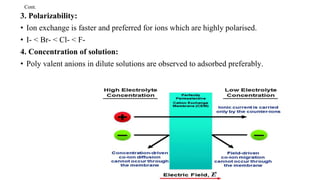
4. Concentration of solution:
• Poly valent anions in dilute solutions are observed to adsorbed preferably.
cont.
5. Concentration and charge of ions:
• Resin with high positive charge and solution with low positive
charge(comparatively electronegative) – exchange is favoured at a higher
concentration.
• If resin has low positive charge with solution at high positive charge
(comparatively electropositive) – exchange is favoured at low concentration.
APPLICATION
❑ Separation of inorganic ions: Cations and anions.
❑ Softening of water: Removal of monovalent and divalent ions like sodium
potassium, calcium, magnesium, etc.
❑ Biochemical separations like isolation of some drugs or metabolites from blood,
urine, etc.
❑ Concentration of ionic solutions: A cation or anion from a bulk of solution can be
adsorbed onto ion exchange resin. After adsorption ,it can be eluted by using small
volume of eluent.
❑ Ion exchange column in HPLC: For separation of compounds of mixed nature
like acidic and basic substances, ion exchange column is used in HPLC( High
performance liquid chromatography).
❑ Demineralisation or deionisation of water: Removal of different ions to get
demineralised water.
❑ Organic separations: Most of the pharmaceutical compounds are either strongly
or weakly acidic or basic in nature. Hence a mixture of those compounds can be
separated by using ion exchange resins. Some classes of compounds which can be
separated are amino acids, proteins, antibiotics, vitamins, fatty acids, etc
❑ Purification of some solutions to be free from ionic impurities.
REFERENCES:
1. Text Book of Pharmaceutical Analysis by Dr. Ravi Shankar, Fourth edition,
page no. 16-6 to 16-8.
2. Column Chromatography-Ion-Exchange Chromatography and Its
Applications, Martin, Dean (2013).
3. Specific Ion effects on membrane potential and the permseletivity of ion
exchange membranes, G.M Geise, Journal of Physical Chemistry Chemical
Physics, 2014,16, page no-21673-21681.
4. Ion exchange chromatography. https://ocw.mit.edu/

ION EXCHANGE CHROMATOGRAPHY

  • 1.
    ION EXCHANGE CHROMATOGRAPHY PRESENTATIONAND SUBMISSION BY ANANT NAG MPH/10016/21 SANJHI SHARMA MPH/10017/21 KIRTI RASHMI MPH/10018/21 MRINAL KANTI PRADHAN MPH/10020/21 DEEPIKA KUMARI MPH/10022/21 SUBJECT: MODERN PHARMACEUTICAL ANALYTICAL TECHNIQUES UNDER THE GUIDANCE OF Dr. Kishanta Kumar Pradhan Assistant Professor DEPARTMENT OF PHARMACEUTICAL SCIENCES AND TECHNOLOGY BIRLA INSTITUTE OF TECHNOLOGY , MESRA , RANCHI- 835215 2021
  • 2.
    CONTENT • INTRODUCTION • PRINCIPLEOF ION EXCHANGE • PRACTICAL REQUIREMENTS • CLASSIFICATIONS OF RESINS • FACTORS AFFECTING ION EXCHANGE SEPARATIONS • APPLICATION • REFERENCES
  • 3.
    INTRODUCTION • Ion chromatography(also known as ion exchange chromatography) separates ions and polar molecules based on their affinity for the ion exchanger. • It is effective on almost any charged molecule, including large proteins, small nucleotides, and amino acids. • Ion chromatography, on the other hand, must be performed in conditions one unit away from a protein's iso-electric point. • The two types of ion chromatography are : ✔anion-exchange and ✔cation-exchange. • Cation-exchange chromatography is used when the molecule of interest is positively charged. The molecule is positively charged because the pH for chromatography is less than the pI (a/k/a pH(I)).
  • 4.
    • In thistype of chromatography, the stationary phase is negatively charged and positively charged molecules are loaded to be attracted to it. • Anion-exchange chromatography is when the stationary phase is positively charged and negatively charged molecules (meaning that pH for chromatography is greater than the pI) are loaded to be attracted to it. • It is often used in protein purification, water analysis, and quality control. • The water-soluble and charged molecules such as proteins, amino acids, and peptides bind to moieties which are oppositely charged by forming ionic bonds to the insoluble stationary phase.
  • 5.
    Principle of Ionexchange • Ion-exchange chromatography separates molecules based on their respective charged groups. • Ion-exchange chromatography retains analyte molecules on the column based on coulombic (ionic) interactions. The ion exchange chromatography matrix consists of positively and negatively charged ions. • Ion chromatography is used in the separation of charged bio-molecules. The crude sample containing charged molecules is used as the liquid phase. When it passes through the chromatographic column, molecules bind to oppositely charged sites in the stationary phase. • The molecules separated on the basis of their charge are eluted using a solution of varying ionic strength. By passing such a solution through the column, highly selective separation of molecules according to their different charges takes place.
  • 6.
    PRACTICAL REQUIREMENTS 1. COLUMNMATERIAL AND DIMENSIONS: Glass is used to make laboratory columns. However, those used in industry are made of high-quality stainless steel or polymers that can withstand strong acids and alkalis.. The column dimensions are also important and a length: diameter ratio of 20:1 to 100:1 for higher efficiency can be used. 2. PACKING OF THE COLUMN Wet packing method : A slurry is prepared of the eluent with the stationary phase powder and then carefully poured into the column. Care must be taken to avoid air bubbles. 3. APPLICATION OF THE SAMPLE • After packing , sample is added to the top of stationary phase, using syringe or pipette. • This layer is usually topped with a small layer of sand or with cotton or with glass wool to protect the shape of organic layer from the velocity of newly added eluent.
  • 7.
    4. MOBILE PHASE: Organicsolvents are less effective and are rarely used. As eluting solvents, only various strengths of acids, alkalis, and buffers are used. 0.1N HCL, 1N NaOH, phosphate buffer, acetate buffer, borate buffer, phthalate buffer, etc are some examples. Commonly used eluent additives which have been successfully used in ion exchange chromatography are EDTA, Glycerol, glucose, and saccharose , Detergents ,Urea ,Lipids, Zwitter ions, Ligands etc. 5. STATIONARY PHASE • Stationary phases comprised of two structural elements; the charged groups which are involved in the exchange process and the matrix on which the charged groups are fixed . • Ion exchangers are characterized both by the nature of the ionic species comprising the fixed ion and by the nature of the insoluble ion-exchange matrix itself.
  • 8.
    6. TYPES OFION EXCHANGE RESINS AND PHYSICAL CHARACTERISTICS: The following characteristics influence the choice of ion exchange resin: i. Type of the ions to be separated - cations or anions ii. Nature of the ions to be separated – Strong or weak iii. Efficiency of the resin – It is measured by the ion exchange capacity. Ion exchange capacity is the total ion exchange capacity in terms of the exchangeable functional groups expressed as milli equivalents per grams of the ion exchange resin. m.eq/g= 1000/eq. wt iv. Particle size of the resin -50-100 mesh or 100-200 mesh is used. v. Structural type of the resin – porous, pellicular. Etc vi. Amount of cross linking agent present – which decides swelling of the resin 7. DEVELOPMENT OF THE CHROMATOGRAM AND ELUTION: • Following the introduction of the sample, the chromatogram is developed using several mobile phases. • Organic solvents are less useful, as explained previously, and only acids, alkalis, and buffers of various pH are utilised.
  • 9.
    There are twoelution techniques ISOCRACTIC ELUTION TECHNIQUE •Same solvent composition is used i.e. same strength of acid or alkali or buffer. GRADIENT ELUTION TECHNIQUE Initially less acidic or basic character is used followed by increasing the acidity of the mobile phase and is usually used for complex mixtures. 8. ANALYSIS OF THE ELUTE: • The contents of various fractions collected with respect to volume or time are evaluated. Depending on the nature and quantity of the sample, a variety of analysis procedures can be applied. • They include spectrophotometric, polarographic, conductometic, amperometric, flame photometric, radiochemical (using Geiger Muller counter, ionisation chamber method), and other approaches. Following the analysis, similar fractions are combined to produce pure ions or compounds of each type.
  • 10.
    Following the analysis,similar fractions are combined to produce pure ions or compounds of each type. 9. REGENERATION OF ION EXCHANGE RESIN: • Because exchangeable functional groups are removed during separation, the ion exchange resin may no longer be useful for separation. • However, due to the high cost of ion exchange resins, they cannot be discarded. As a result, just like reactivation, resin regeneration is critical. • Regeneration restores the efficiency of an utilized ion exchange resin to that of a new resin. The exchangeable cations or anions present in the original resin are replaced during regeneration. • As a result, the cation exchange resin is regenerated by charging the column with a strong acid such as hydrochloric acid. Regeneration of anion exchange is done by using strong alkali like sodium hydroxide or potassium hydroxide.
  • 11.
    CLASSIFICATIONS OF RESINS BASEDON THE CHEMICAL NATURE THEY ARE CLASSIFIED AS 1. Strong cation exchange resin 2. Weak cation exchange resin 3. Strong anion exchange resin 4. Weak anion exchange resin BASED ON THE SOURCES THEY ARE CLASSIFIED AS 1. Natural: Cation – Zeolytes, Clay, etc Anion - Dolomite 2. Synthetic: Inorganic and organic resins
  • 12.
    Contd • Organic resinsare the most widely used resin. • Organic ion exchange resins are polymeric resin matrix containing exchange sites. • Resins are composed polystyrene and divinyl benzene. • Polystyrene contains sites for exchangeable functional groups. • Divinyl benzene acts as a cross linking agent and offer adequate strength i.e mechanical stability. STRUCTURE OF STYRENE AND DIVINYL BENZENE STYRENE DIVINYL BENZENE
  • 13.
    contd • CLASS OF RESINNATURE pH range APPLICATIONS Cation - Strong Sulfonated polystyrene 1-14 Fractionation of cations Inorganic separations Cation - Weak Carboxylic methacrylate 5-14 Biochemical separations Anion - Strong Quaternary ammonium polystyrene 0-12 Fractionation of anions Alkaloids, vitamins Anion - Weak Phenol formaldehyde 0-9 Fractionation of anionic complexes Anions of different valency
  • 14.
    contd STRUCTURAL TYPES OFION EXCHANGE RESINS 1. Pellicular type with ion exchange film: The particle have size of 30-40µ with 1-2µ thickness and its efficiency is 0.01-0.1 meq/g of ion exchange resin. 2. Porous resin coated with exchanger beads: Its size ranges from 5-10µ with exchange capacity range from 0.5-2 meq/g of ion exchange resin. 3. Macroreticular resin bead: It has reticular network of the resin which is seen superficially on resin beads but it has very low exchange capacity. 4. Surface sulfonated and bonded electrostatically with anion exchanger: The particles are sulfonated and are bonded electrostatically with anion exchanger resin. Its exchange capacity is 0.02 meq/g of exchange resin.
  • 15.
    contd Physical properties ofresin: 1. Particle size: They are fine powder of uniform particle size from 50-200 mesh. They allow free and uniform flow of mobile phase and also contain more exchangeable functional groups. 2. Cross linking and swelling: When more cross linking agent is present, they are more rigid, but swells less. When swelling is less, separation of ions of different ions of different sizes is difficult as they cannot pass through pores present. When less cross linking agent is present, they are less rigid, but swell more. Due to this, separation is not efficient and exchange of does not take place. Hence optimum quantity of cross linking agent should be added.
  • 16.
    Factors affecting ionexchange separations: • 1. Nature and properties of ion exchange resins. • 2. Nature of exchanging ions. Image source: Ion-exchange resin versus MOFs as ion-exchange medium. Researchgate.net MOFs is metal organic frameworks which are ion porous
  • 17.
    Nature and propertiesof ion exchange resins. • Cross linking and swelling is the important factor in determining the ease with which separation occurs. • Presence of more crosslinking agents like polystyrene and di-vinyl benzene(DVB) leads to a rigid resin which swells less. • This reduces the separation of ions of different sizes, as they are unable to cross through pores- this increases the selectivity of ions to cross through resin. • With less crosslinking in a resin, they are less rigid and swell more. • Which leads to formation of wide pores and hence different functional groups will not be efficiently separated through resin. • Therefore neither a high or low amount of crosslinking agent should be added in the resin for an efficient exchange of ions.
  • 18.
    Image source: ionexchanger sciencedirect.com
  • 19.
    Nature of exchangingions. 1. Valency of Ions: • The exchange of ions increases with the increasing valency , provided temperature is optimum and concentration of ions is low. • Na+1 < Ca+2 < Al+3 < Th+4 2. Size of Ions: • Ion exchange increases with the decrease in the size of hydrated ions, for similar charged ions. • Li+ < H+ < Na+ < NH4+ < K+ < Rb+ < Cs+
  • 20.
    Cont. 3. Polarizability: • Ionexchange is faster and preferred for ions which are highly polarised. • I- < Br- < Cl- < F- 4. Concentration of solution: • Poly valent anions in dilute solutions are observed to adsorbed preferably.
  • 21.
    cont. 5. Concentration andcharge of ions: • Resin with high positive charge and solution with low positive charge(comparatively electronegative) – exchange is favoured at a higher concentration. • If resin has low positive charge with solution at high positive charge (comparatively electropositive) – exchange is favoured at low concentration.
  • 22.
    APPLICATION ❑ Separation ofinorganic ions: Cations and anions. ❑ Softening of water: Removal of monovalent and divalent ions like sodium potassium, calcium, magnesium, etc. ❑ Biochemical separations like isolation of some drugs or metabolites from blood, urine, etc. ❑ Concentration of ionic solutions: A cation or anion from a bulk of solution can be adsorbed onto ion exchange resin. After adsorption ,it can be eluted by using small volume of eluent.
  • 23.
    ❑ Ion exchangecolumn in HPLC: For separation of compounds of mixed nature like acidic and basic substances, ion exchange column is used in HPLC( High performance liquid chromatography). ❑ Demineralisation or deionisation of water: Removal of different ions to get demineralised water. ❑ Organic separations: Most of the pharmaceutical compounds are either strongly or weakly acidic or basic in nature. Hence a mixture of those compounds can be separated by using ion exchange resins. Some classes of compounds which can be separated are amino acids, proteins, antibiotics, vitamins, fatty acids, etc ❑ Purification of some solutions to be free from ionic impurities.
  • 24.
    REFERENCES: 1. Text Bookof Pharmaceutical Analysis by Dr. Ravi Shankar, Fourth edition, page no. 16-6 to 16-8. 2. Column Chromatography-Ion-Exchange Chromatography and Its Applications, Martin, Dean (2013). 3. Specific Ion effects on membrane potential and the permseletivity of ion exchange membranes, G.M Geise, Journal of Physical Chemistry Chemical Physics, 2014,16, page no-21673-21681. 4. Ion exchange chromatography. https://ocw.mit.edu/