MPC101T : GEL CHROMATOGRAPHY
Under the guidance of :
DR. POOJA CHAWLA
Professor and H.O.D
Department of Pharmaceutical Chemistry
ISF College of Pharmacy, Moga, Punjab
pooja.chawla@isfcp.org
Presented By:
DEBRSHI MONDAL
M.Pharm, 1st Sem.
Department of Pharmaceutical chemistry
ISF College of Pharmacy, Moga, Punjab
debarshimondal9134@gmail.com
SERIAL NO. TOPIC NAME SLIDE NO.
01 INTRODUCTION OF GEL CHROMATOGRAPHY 01
02 PRINCIPLE 02-03
03 DISTRIBUTION THEORY 04
04 INSTRUMENTATION
 STATIONARY PHASE
 MOBILE PHASE
 COLUMNS
 DETECTORS
05-20
05 METHODOLOGY 21-22
06 ADVANTAGES OF GEL CHROMATOGRAPHY 23
07 DISADVANTAGES OF GEL CHROMATOGRAPHY 24
08 APPLICATIONS 25-27
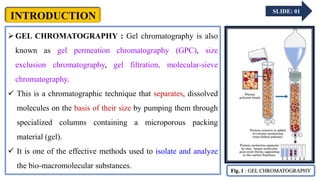
GEL CHROMATOGRAPHY : Gel chromatography is also
known as gel permeation chromatography (GPC), size
exclusion chromatography, gel filtration, molecular-sieve
chromatography.
 This is a chromatographic technique that separates, dissolved
molecules on the basis of their size by pumping them through
specialized columns containing a microporous packing
material (gel).
 It is one of the effective methods used to isolate and analyze
the bio-macromolecular substances.
SLIDE: 01
Fig. 1 : GEL CHROMATOGRAPHY
SLIDE: 02
 Stationary phase is a porous polymer matrix whose pores are completely filled with the
solvent to be used as the mobile phase.
 The flow of mobile phase will cause larger molecules to pass through the column
unhindered, without penetrating the gel matrix whereas smaller molecules will be retarded
according to their penetration of the gel.
 The one with largest molecular mass or size is eluted first, followed by elution of
intermediate sized molecules. The smaller size molecules are eluted in the last order of
elution.
Large size > Intermediate size > Smallest size
SLIDE: 03
Fig. 2 : Principle of gel chromatography: A) mixture
applied to the top of the column; B) partial separation; C)
complete separation; D) excluded substance emerges from
the column.
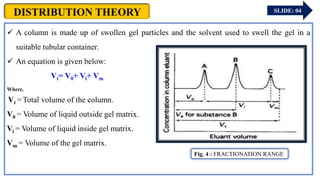
 A column is made up of swollen gel particles and the solvent used to swell the gel in a
suitable tubular container.
 An equation is given below:
Vt= V0+ Vi+ Vm
Where,
Vt = Total volume of the column.
V0 = Volume of liquid outside gel matrix.
Vi = Volume of liquid inside gel matrix.
Vm = Volume of the gel matrix.
Fig. 4 : FRACTIONATION RANGE
SLIDE: 04
 TYPES OF GELS USED
 The gels used as molecular sieves are cross linked polymers.
 They are uncharged and inert i.e., don't bind or react with the materials being analyzed.
 Three types of gels are used:
1. Dextran (Sephadex)
2. Agarose gel
3. Acrylamide gels (synthetic gel)
SLIDE: 05
SLIDE: 06
Nature
of Gel
Uniform
particle size
Chemically
inert
Wide pore
size give low
resolution
Ideal porous
structure
Mechanically
stable
SLIDE: 07
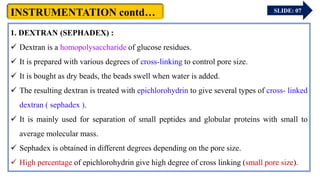
1. DEXTRAN (SEPHADEX) :
 Dextran is a homopolysaccharide of glucose residues.
 It is prepared with various degrees of cross-linking to control pore size.
 It is bought as dry beads, the beads swell when water is added.
 The resulting dextran is treated with epichlorohydrin to give several types of cross- linked
dextran ( sephadex ).
 It is mainly used for separation of small peptides and globular proteins with small to
average molecular mass.
 Sephadex is obtained in different degrees depending on the pore size.
 High percentage of epichlorohydrin give high degree of cross linking (small pore size).
SLIDE: 09
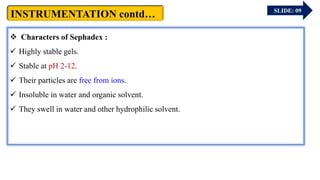
 Characters of Sephadex :
 Highly stable gels.
 Stable at pH 2-12.
 Their particles are free from ions.
 Insoluble in water and organic solvent.
 They swell in water and other hydrophilic solvent.
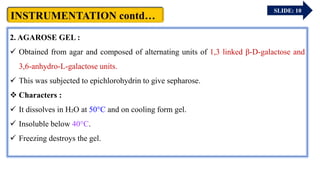
2. AGAROSE GEL :
 Obtained from agar and composed of alternating units of 1,3 linked β-D-galactose and
3,6-anhydro-L-galactose units.
 This was subjected to epichlorohydrin to give sepharose.
 Characters :
 It dissolves in H₂O at 50°C and on cooling form gel.
 Insoluble below 40°C.
 Freezing destroys the gel.
SLIDE: 10
SLIDE: 11
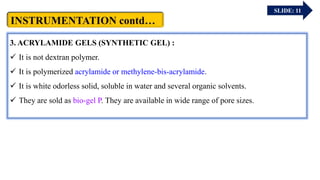
3. ACRYLAMIDE GELS (SYNTHETIC GEL) :
 It is not dextran polymer.
 It is polymerized acrylamide or methylene-bis-acrylamide.
 It is white odorless solid, soluble in water and several organic solvents.
 They are sold as bio-gel P. They are available in wide range of pore sizes.
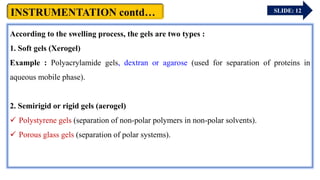
According to the swelling process, the gels are two types :
1. Soft gels (Xerogel)
Example : Polyacrylamide gels, dextran or agarose (used for separation of proteins in
aqueous mobile phase).
2. Semirigid or rigid gels (aerogel)
 Polystyrene gels (separation of non-polar polymers in non-polar solvents).
 Porous glass gels (separation of polar systems).
SLIDE: 12
SLIDE: 13
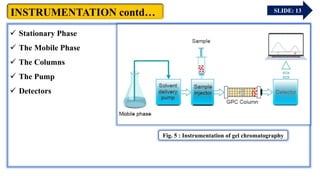
 Stationary Phase
 The Mobile Phase
 The Columns
 The Pump
 Detectors
Fig. 5 : Instrumentation of gel chromatography
SLIDE: 14
1. STATIONARY PHASE :
Composed of semi-permeable, porous polymer gel beads with well defined range of pore
sizes.
 Properties of gel beads :
 Chemically inert.
 Mechanically stable.
 Has ideal and homogeneous porous structure (wide pore size give low resolution).
 Uniform particle and pore size.
SLIDE: 15
2. THE MOBILE PHASE :
 Composed of a liquid used to dissolve the bio-molecules to make the mobile phase
permitting high detection response.
SLIDE: 16
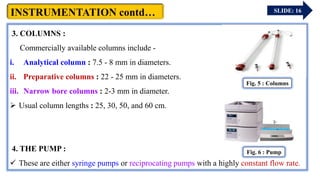
3. COLUMNS :
Commercially available columns include -
i. Analytical column : 7.5 - 8 mm in diameters.
ii. Preparative columns : 22 - 25 mm in diameters.
iii. Narrow bore columns : 2-3 mm in diameter.
 Usual column lengths : 25, 30, 50, and 60 cm.
4. THE PUMP :
 These are either syringe pumps or reciprocating pumps with a highly constant flow rate.
Fig. 5 : Columns
Fig. 6 : Pump
SLIDE: 17
5. DETECTORS :
 CONCENTRATION SENSITIVE DETECTORS -
 Bulk Property Detectors - Refractive Index (RI) Detector.
 Solute Property Detectors - Ultraviolet (UV) Absorption Detector.
 Evaporative Detectors - Evaporative Light Scattering Detector (ELSD).
 MOLAR MASS SENSITIVE DETECTORS :
 Light Scattering Detectors
 Low Angle Light Scattering (LALS) Detectors.
 Multi Angle Light Scattering (MALS) Detectors.
SLIDE: 18
 Viscosity Detectors - Differential Viscometers.
 Sample dissolved in mobile phase & carried to the column.
 Sample does not interact with component or stationary phase.
 THF, Dimethylformamide, Toluene, chloroform – solvent.
 Degasser - removes dissolved gases to eliminate bubble formation.
 Pump -maintains optimum flow rate.
 Separation on the basis of molecular size.
 Separated components pass through a detector and the signals.
Key Points :
SLIDE: 19
 SEPARATION PROCEDURE
1. PREPARATION OF COLUMN FOR GEL FILTRATION
 Swelling of the gel : Some resin come in a powder form. These must be sonicated first in
the eluent or the desired buffer to swell.
 Packing the column : Make a slurry of gel + buffer and pour it into column which is one
third filled with the buffer.
 Washing the resin : After packing, pass several column volumes of the buffer through
the column to remove any air bubbles and to test the column homogeneity.
SLIDE: 20
2. LOADING THE SAMPLE ON TO THE COLUMN
The sample must enter the resin in the form of solution using a syringe.
3. ELUTING THE SAMPLE AND DETECTION OF COMPONENTS
Fractions are collected as the sample elutes from the column.
SLIDE: 21
 Short analysis time.
 Well defined separation.
 Narrow bands and good sensitivity.
 There is no sample loss.
 Small amount of mobile phase required
 The flow rate can be set.
SLIDE: 22
 Limited number of peaks that can be resolved within the short time scale.
 Filtrations must be performed before using the instrument to prevent dust and other
particulates from ruining the columns and interfering with the detectors.
 The molecular masses of most of the chains will be too close for the separation to show
anything more than broad peaks.
SLIDE: 23
Gel chromatography is mainly used for the separation of sugars, polysaccharides, proteins,
lipids, polymers and other materials.
1. PURIFICATION :
 This technique is used for purification of biological molecules.
 Different proteins, enzymes, hormones, antibodies, polysaccharides have been separated
and purified by using appropriate gels.
 Low molecular weight dextran's can be separated from corn syrup oil.
SLIDE: 24
2. DESALTING :
 This method of desalting is faster and more efficient than dialysis.
 Examples of desalting process include separation of monosaccharides from
polysaccharides and separation of amino acids from proteins.
3. FRACTIONATION :
 In this method of separation, the similar substance are eluted closer to each other. Thus,
the separation of substances which has neatly equal molecular size can be separated.
4. PROTEIN-BINDING STUDIES
SLIDE: 25
5. DETERMINATION OF MOLECULAR WEIGHT:
 It is assumed that the size of molecule is proportional to the molecular weight. Their
relation is expressed by an equation.
VE = a + b logM
 Where, VE = elution time
 M = molecular weight
 a, b = constants that depend on stationary phase and mobile phase.
SLIDE: 26
• Gurdeep R. Chatwal, Sham K. Anand. "Instrumentation Method of Chemical Analysis".
• A. Braithwaite, F.J. Smith. "Textbook of Chromatographic Methods" 5th edition.
• Ravi Shankar. "Text book of pharmaceutical analysis" 5 th edition 2018 pg. no. 18.3-18.4
• Willard, Merritt and Settle. "Instrumental Methods of Analysis" 1986.
Gel Chromatography

Gel Chromatography

  • 1.
    MPC101T : GELCHROMATOGRAPHY Under the guidance of : DR. POOJA CHAWLA Professor and H.O.D Department of Pharmaceutical Chemistry ISF College of Pharmacy, Moga, Punjab pooja.chawla@isfcp.org Presented By: DEBRSHI MONDAL M.Pharm, 1st Sem. Department of Pharmaceutical chemistry ISF College of Pharmacy, Moga, Punjab debarshimondal9134@gmail.com
  • 2.
    SERIAL NO. TOPICNAME SLIDE NO. 01 INTRODUCTION OF GEL CHROMATOGRAPHY 01 02 PRINCIPLE 02-03 03 DISTRIBUTION THEORY 04 04 INSTRUMENTATION  STATIONARY PHASE  MOBILE PHASE  COLUMNS  DETECTORS 05-20 05 METHODOLOGY 21-22 06 ADVANTAGES OF GEL CHROMATOGRAPHY 23 07 DISADVANTAGES OF GEL CHROMATOGRAPHY 24 08 APPLICATIONS 25-27
  • 3.
    GEL CHROMATOGRAPHY :Gel chromatography is also known as gel permeation chromatography (GPC), size exclusion chromatography, gel filtration, molecular-sieve chromatography.  This is a chromatographic technique that separates, dissolved molecules on the basis of their size by pumping them through specialized columns containing a microporous packing material (gel).  It is one of the effective methods used to isolate and analyze the bio-macromolecular substances. SLIDE: 01 Fig. 1 : GEL CHROMATOGRAPHY
  • 4.
    SLIDE: 02  Stationaryphase is a porous polymer matrix whose pores are completely filled with the solvent to be used as the mobile phase.  The flow of mobile phase will cause larger molecules to pass through the column unhindered, without penetrating the gel matrix whereas smaller molecules will be retarded according to their penetration of the gel.  The one with largest molecular mass or size is eluted first, followed by elution of intermediate sized molecules. The smaller size molecules are eluted in the last order of elution. Large size > Intermediate size > Smallest size
  • 5.
    SLIDE: 03 Fig. 2: Principle of gel chromatography: A) mixture applied to the top of the column; B) partial separation; C) complete separation; D) excluded substance emerges from the column.
  • 6.
     A columnis made up of swollen gel particles and the solvent used to swell the gel in a suitable tubular container.  An equation is given below: Vt= V0+ Vi+ Vm Where, Vt = Total volume of the column. V0 = Volume of liquid outside gel matrix. Vi = Volume of liquid inside gel matrix. Vm = Volume of the gel matrix. Fig. 4 : FRACTIONATION RANGE SLIDE: 04
  • 7.
     TYPES OFGELS USED  The gels used as molecular sieves are cross linked polymers.  They are uncharged and inert i.e., don't bind or react with the materials being analyzed.  Three types of gels are used: 1. Dextran (Sephadex) 2. Agarose gel 3. Acrylamide gels (synthetic gel) SLIDE: 05
  • 8.
    SLIDE: 06 Nature of Gel Uniform particlesize Chemically inert Wide pore size give low resolution Ideal porous structure Mechanically stable
  • 9.
    SLIDE: 07 1. DEXTRAN(SEPHADEX) :  Dextran is a homopolysaccharide of glucose residues.  It is prepared with various degrees of cross-linking to control pore size.  It is bought as dry beads, the beads swell when water is added.  The resulting dextran is treated with epichlorohydrin to give several types of cross- linked dextran ( sephadex ).  It is mainly used for separation of small peptides and globular proteins with small to average molecular mass.  Sephadex is obtained in different degrees depending on the pore size.  High percentage of epichlorohydrin give high degree of cross linking (small pore size).
  • 10.
    SLIDE: 09  Charactersof Sephadex :  Highly stable gels.  Stable at pH 2-12.  Their particles are free from ions.  Insoluble in water and organic solvent.  They swell in water and other hydrophilic solvent.
  • 11.
    2. AGAROSE GEL:  Obtained from agar and composed of alternating units of 1,3 linked β-D-galactose and 3,6-anhydro-L-galactose units.  This was subjected to epichlorohydrin to give sepharose.  Characters :  It dissolves in H₂O at 50°C and on cooling form gel.  Insoluble below 40°C.  Freezing destroys the gel. SLIDE: 10
  • 12.
    SLIDE: 11 3. ACRYLAMIDEGELS (SYNTHETIC GEL) :  It is not dextran polymer.  It is polymerized acrylamide or methylene-bis-acrylamide.  It is white odorless solid, soluble in water and several organic solvents.  They are sold as bio-gel P. They are available in wide range of pore sizes.
  • 13.
    According to theswelling process, the gels are two types : 1. Soft gels (Xerogel) Example : Polyacrylamide gels, dextran or agarose (used for separation of proteins in aqueous mobile phase). 2. Semirigid or rigid gels (aerogel)  Polystyrene gels (separation of non-polar polymers in non-polar solvents).  Porous glass gels (separation of polar systems). SLIDE: 12
  • 14.
    SLIDE: 13  StationaryPhase  The Mobile Phase  The Columns  The Pump  Detectors Fig. 5 : Instrumentation of gel chromatography
  • 15.
    SLIDE: 14 1. STATIONARYPHASE : Composed of semi-permeable, porous polymer gel beads with well defined range of pore sizes.  Properties of gel beads :  Chemically inert.  Mechanically stable.  Has ideal and homogeneous porous structure (wide pore size give low resolution).  Uniform particle and pore size.
  • 16.
    SLIDE: 15 2. THEMOBILE PHASE :  Composed of a liquid used to dissolve the bio-molecules to make the mobile phase permitting high detection response.
  • 17.
    SLIDE: 16 3. COLUMNS: Commercially available columns include - i. Analytical column : 7.5 - 8 mm in diameters. ii. Preparative columns : 22 - 25 mm in diameters. iii. Narrow bore columns : 2-3 mm in diameter.  Usual column lengths : 25, 30, 50, and 60 cm. 4. THE PUMP :  These are either syringe pumps or reciprocating pumps with a highly constant flow rate. Fig. 5 : Columns Fig. 6 : Pump
  • 18.
    SLIDE: 17 5. DETECTORS:  CONCENTRATION SENSITIVE DETECTORS -  Bulk Property Detectors - Refractive Index (RI) Detector.  Solute Property Detectors - Ultraviolet (UV) Absorption Detector.  Evaporative Detectors - Evaporative Light Scattering Detector (ELSD).  MOLAR MASS SENSITIVE DETECTORS :  Light Scattering Detectors  Low Angle Light Scattering (LALS) Detectors.  Multi Angle Light Scattering (MALS) Detectors.
  • 19.
    SLIDE: 18  ViscosityDetectors - Differential Viscometers.  Sample dissolved in mobile phase & carried to the column.  Sample does not interact with component or stationary phase.  THF, Dimethylformamide, Toluene, chloroform – solvent.  Degasser - removes dissolved gases to eliminate bubble formation.  Pump -maintains optimum flow rate.  Separation on the basis of molecular size.  Separated components pass through a detector and the signals. Key Points :
  • 20.
    SLIDE: 19  SEPARATIONPROCEDURE 1. PREPARATION OF COLUMN FOR GEL FILTRATION  Swelling of the gel : Some resin come in a powder form. These must be sonicated first in the eluent or the desired buffer to swell.  Packing the column : Make a slurry of gel + buffer and pour it into column which is one third filled with the buffer.  Washing the resin : After packing, pass several column volumes of the buffer through the column to remove any air bubbles and to test the column homogeneity.
  • 21.
    SLIDE: 20 2. LOADINGTHE SAMPLE ON TO THE COLUMN The sample must enter the resin in the form of solution using a syringe. 3. ELUTING THE SAMPLE AND DETECTION OF COMPONENTS Fractions are collected as the sample elutes from the column.
  • 22.
    SLIDE: 21  Shortanalysis time.  Well defined separation.  Narrow bands and good sensitivity.  There is no sample loss.  Small amount of mobile phase required  The flow rate can be set.
  • 23.
    SLIDE: 22  Limitednumber of peaks that can be resolved within the short time scale.  Filtrations must be performed before using the instrument to prevent dust and other particulates from ruining the columns and interfering with the detectors.  The molecular masses of most of the chains will be too close for the separation to show anything more than broad peaks.
  • 24.
    SLIDE: 23 Gel chromatographyis mainly used for the separation of sugars, polysaccharides, proteins, lipids, polymers and other materials. 1. PURIFICATION :  This technique is used for purification of biological molecules.  Different proteins, enzymes, hormones, antibodies, polysaccharides have been separated and purified by using appropriate gels.  Low molecular weight dextran's can be separated from corn syrup oil.
  • 25.
    SLIDE: 24 2. DESALTING:  This method of desalting is faster and more efficient than dialysis.  Examples of desalting process include separation of monosaccharides from polysaccharides and separation of amino acids from proteins. 3. FRACTIONATION :  In this method of separation, the similar substance are eluted closer to each other. Thus, the separation of substances which has neatly equal molecular size can be separated. 4. PROTEIN-BINDING STUDIES
  • 26.
    SLIDE: 25 5. DETERMINATIONOF MOLECULAR WEIGHT:  It is assumed that the size of molecule is proportional to the molecular weight. Their relation is expressed by an equation. VE = a + b logM  Where, VE = elution time  M = molecular weight  a, b = constants that depend on stationary phase and mobile phase.
  • 27.
    SLIDE: 26 • GurdeepR. Chatwal, Sham K. Anand. "Instrumentation Method of Chemical Analysis". • A. Braithwaite, F.J. Smith. "Textbook of Chromatographic Methods" 5th edition. • Ravi Shankar. "Text book of pharmaceutical analysis" 5 th edition 2018 pg. no. 18.3-18.4 • Willard, Merritt and Settle. "Instrumental Methods of Analysis" 1986.