AFFINITY CHROMATOGRAPHY
Presented By:
Miss. Mohini Tawade
First Year M. Pharmacy,
Department of Quality Assurance,
Dr. D.Y. Patil College of Pharmacy, Akurdi, Pune.
INTRODUCTION
 The high-selectivity separation of biomolecules can be achieved by using affinity chromatography
 This separation technique is special and unique because the separation is achieved based on the
biological function or the unique chemical structure of a biomolecule
 This feature makes affinity chromatography suitable for the selective separation of the active
biomolecules and their isolation from the inactive or denatured forms
 This biomolecule binds selectively to the affinity ligand, which are fixed on stationary phase and the
binding of biomolecules with affinity ligand is reversible.
 The material is eluted from column by changing the composition of mobile phase
 The different biomolecules that can be separated by using this technique are enzymes, proteins.
hormones etc.
 Affinity Chromatography involves the covalent attachment of an immobilized
biochemical called as affinity ligand to a solid support.
 When a sample is passed through the column, only solute that selectively binds to the
complementary ligand is retained; other sample components elute without retention.
 The separation exploit the “lock and key” binding that is prevalent in biological
systems.
 The retention solutes can be eluted from the column by changing the mobile phase
composition.
PRINCIPLE
INSTRUMENTATION
.
1.Stationary Phase
2.Affinity Ligand
3.Sample Preparation
4.Binding of Molecule
5.Elution of Molecules
6.Regeneration
 Same as that of high performance liquid chromatography
 Only change in the stationary phase
 Here to stationary phase, affinity ligand binds and by lock and key mechanism biomolecules (Target
molecules) get attached to ligand and separation takes place
Stationary Phase
Ideal properties of stationary phase
 Should be sufficiently hydrophilic to avoid nonspecific binding of solutes
 Stable to most water soluble organic solvents
 Porous in nature to permit a high degree of ligand attachment
 Agarose is very popular matrix, porous in nature
other examples Cellulose, dextran, polyacrylamide, combination polymers, microporous
glass beads
Affinity Ligand
 A short alkyl chain of hexamethylenediamine is inserted between the ligand and stationary
phase to reduce or eliminate steric influence of stationary phase.
 2 types
Specific ligands:
Binds to one particular solute
 Advantage
High selectivity
Short column is used for separation
Separation in less than 1 min
Group specific ligands:
Binds to certain groups of solutes Separation
can be done by using isocratic or gradient
elution techniques
For better separation longer columns are used
Sample Preparation
 Sample must be clear solution free from solid particles
 0.45-μm pore size filters can be used for filtration
 To maintain the solubility and stability of sample, influence of pH, salt concentration and
presence of any organic solvent need to be considered
 Factors affecting interaction of between desired target protein and matrix bound affinity
ligands are pH, salt concentration, temperature
 Sample components interfering with affinity ligand should be removed before loading onto
the column
Binding of The Molecule of Interest And Wash-out of The
Unbound Material
 Sample loadings depends on the strength of interaction
 For high-affinity samples high flow rate may be applied
 In case of weak interaction or slow equilibrium process, reduced the rate of sample
loading.
 After sample application, column is further washed with binding buffer(it ensures
interaction of target molecules with ligands and other molecules are washed through
column) until all unbound components are removed
Elution Of The Molecules Of Interest By Changing
The Composition Of The Mobile Phase
 Elution via pH or ionic strength changes:
Elution achieved by decreasing the interaction
strength between the ligand and target
protein
Change in pH will change the ionization states
of charged groups of ligand and target protein ,
thereby changing the strength of interaction
Increasing ionic strength, reduces the
interaction strength ( done by raising NaCl
concentration)
 Competitive Elution:
Here materials are used that react with the
target molecule or Ligand , competing for
pre-existing interaction.
Regeneration
 After successful completion of the elution, the column can be washed with
several column volumes of binding buffer, and it can then be reused.
 For long-term storage, one must ensure that the column is not exposed to
bacterial or fungal infection.
 The toxic compound sodium azide can be used to prevent such infections.
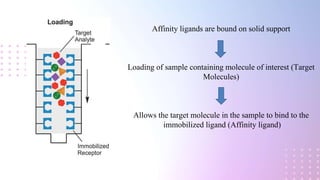
Affinity ligands are bound on solid support
Loading of sample containing molecule of interest (Target
Molecules)
Allows the target molecule in the sample to bind to the
immobilized ligand (Affinity ligand)
Highly selective target molecules binds to
affinity ligand
Washing away non-bound molecules from the
solid support.
Elution (dissociation and recovery) of the target
molecule from the immobilized ligand by
changing the composition of mobile phase
Advantages:
 The technique provides high selectivity, high resolution and generally high capacity
for the desired protein.
 Thus the degree of purification of protein is thousands times greater than the other
techniques.
 Also the isolation of biomolecule can be carried out from the inactive or denatured
forms.
 Another significant advantage of the method is that, in many cases, it allows single-
step isolation of the desired biomolecule.
 Time consuming method
 More amounts of solvents are required which may be expensive.
 Non-specific adsorption cannot be totally eliminated, it can only be minimized.
 Limited availability and high cost of affinity ligands.
 Proteins get denatured if required pH is not adjusted.
Disadvantages:
Application:
 Used to purify and concentrate a substance from a mixture, this reduces the amount of
unwanted substances in mixture
 Used for separation of antibodies, where antigen are bound chemically to the stationary
phase
 Analysis of enzymes can also be carried out using affinity chromatography
 Used for isolation and purification of biological macromolecules along with nucleic acid,
proteins, enzymes etc
 Investigation of binding sites for enzyme
Reference:
https://www.slideshare.net/sagarsavale1/affinity-chromatography-56328075
https://www.slideshare.net/rajpalchoudharyjat/affinity-chromatography-71915487
https://www.slideshare.net/ArvindHeer/affinity-chromatography-64645157
Urh M, Simpson D, Zhao K. Affinity chromatography: general methods. Methods
Enzymol. 2009;463:417-38. doi: 10.1016/S0076-6879(09)63026-3. PMID:
19892186.
MCQ
In affinity chromatography separation is based on:
a. Molecular size
b.Molecular structure
c. Specificity
d.Stereochemistry
The molecule of interest can be immobilized through:
a. Hydrogen bond
b.Sulphur bond
c. Covalent bond
d.Nitrogen bond
Specific ligands bind only to:
a. One particular solute
b. Certain groups of solutes
c. One or certain groups of ligand
d. None of this
When the medium is bound to protein of interest it becomes.
a. Solubilized
b. Partialized
c. Equilibrated
d. Immobilized
Affinity chromatography mostly uses:
a. Antibody coated beads
b. Column with empty beads
c. Only mobile phase
d. Only column
THANK YOU!

Affinity Chromatography.pdf

  • 1.
    AFFINITY CHROMATOGRAPHY Presented By: Miss.Mohini Tawade First Year M. Pharmacy, Department of Quality Assurance, Dr. D.Y. Patil College of Pharmacy, Akurdi, Pune.
  • 2.
    INTRODUCTION  The high-selectivityseparation of biomolecules can be achieved by using affinity chromatography  This separation technique is special and unique because the separation is achieved based on the biological function or the unique chemical structure of a biomolecule  This feature makes affinity chromatography suitable for the selective separation of the active biomolecules and their isolation from the inactive or denatured forms  This biomolecule binds selectively to the affinity ligand, which are fixed on stationary phase and the binding of biomolecules with affinity ligand is reversible.  The material is eluted from column by changing the composition of mobile phase  The different biomolecules that can be separated by using this technique are enzymes, proteins. hormones etc.
  • 3.
     Affinity Chromatographyinvolves the covalent attachment of an immobilized biochemical called as affinity ligand to a solid support.  When a sample is passed through the column, only solute that selectively binds to the complementary ligand is retained; other sample components elute without retention.  The separation exploit the “lock and key” binding that is prevalent in biological systems.  The retention solutes can be eluted from the column by changing the mobile phase composition. PRINCIPLE
  • 4.
    INSTRUMENTATION . 1.Stationary Phase 2.Affinity Ligand 3.SamplePreparation 4.Binding of Molecule 5.Elution of Molecules 6.Regeneration
  • 5.
     Same asthat of high performance liquid chromatography  Only change in the stationary phase  Here to stationary phase, affinity ligand binds and by lock and key mechanism biomolecules (Target molecules) get attached to ligand and separation takes place
  • 6.
    Stationary Phase Ideal propertiesof stationary phase  Should be sufficiently hydrophilic to avoid nonspecific binding of solutes  Stable to most water soluble organic solvents  Porous in nature to permit a high degree of ligand attachment  Agarose is very popular matrix, porous in nature other examples Cellulose, dextran, polyacrylamide, combination polymers, microporous glass beads
  • 7.
    Affinity Ligand  Ashort alkyl chain of hexamethylenediamine is inserted between the ligand and stationary phase to reduce or eliminate steric influence of stationary phase.  2 types Specific ligands: Binds to one particular solute  Advantage High selectivity Short column is used for separation Separation in less than 1 min Group specific ligands: Binds to certain groups of solutes Separation can be done by using isocratic or gradient elution techniques For better separation longer columns are used
  • 8.
    Sample Preparation  Samplemust be clear solution free from solid particles  0.45-μm pore size filters can be used for filtration  To maintain the solubility and stability of sample, influence of pH, salt concentration and presence of any organic solvent need to be considered  Factors affecting interaction of between desired target protein and matrix bound affinity ligands are pH, salt concentration, temperature  Sample components interfering with affinity ligand should be removed before loading onto the column
  • 9.
    Binding of TheMolecule of Interest And Wash-out of The Unbound Material  Sample loadings depends on the strength of interaction  For high-affinity samples high flow rate may be applied  In case of weak interaction or slow equilibrium process, reduced the rate of sample loading.  After sample application, column is further washed with binding buffer(it ensures interaction of target molecules with ligands and other molecules are washed through column) until all unbound components are removed
  • 10.
    Elution Of TheMolecules Of Interest By Changing The Composition Of The Mobile Phase  Elution via pH or ionic strength changes: Elution achieved by decreasing the interaction strength between the ligand and target protein Change in pH will change the ionization states of charged groups of ligand and target protein , thereby changing the strength of interaction Increasing ionic strength, reduces the interaction strength ( done by raising NaCl concentration)  Competitive Elution: Here materials are used that react with the target molecule or Ligand , competing for pre-existing interaction.
  • 11.
    Regeneration  After successfulcompletion of the elution, the column can be washed with several column volumes of binding buffer, and it can then be reused.  For long-term storage, one must ensure that the column is not exposed to bacterial or fungal infection.  The toxic compound sodium azide can be used to prevent such infections.
  • 12.
    Affinity ligands arebound on solid support Loading of sample containing molecule of interest (Target Molecules) Allows the target molecule in the sample to bind to the immobilized ligand (Affinity ligand)
  • 13.
    Highly selective targetmolecules binds to affinity ligand Washing away non-bound molecules from the solid support.
  • 14.
    Elution (dissociation andrecovery) of the target molecule from the immobilized ligand by changing the composition of mobile phase
  • 15.
    Advantages:  The techniqueprovides high selectivity, high resolution and generally high capacity for the desired protein.  Thus the degree of purification of protein is thousands times greater than the other techniques.  Also the isolation of biomolecule can be carried out from the inactive or denatured forms.  Another significant advantage of the method is that, in many cases, it allows single- step isolation of the desired biomolecule.
  • 16.
     Time consumingmethod  More amounts of solvents are required which may be expensive.  Non-specific adsorption cannot be totally eliminated, it can only be minimized.  Limited availability and high cost of affinity ligands.  Proteins get denatured if required pH is not adjusted. Disadvantages:
  • 17.
    Application:  Used topurify and concentrate a substance from a mixture, this reduces the amount of unwanted substances in mixture  Used for separation of antibodies, where antigen are bound chemically to the stationary phase  Analysis of enzymes can also be carried out using affinity chromatography  Used for isolation and purification of biological macromolecules along with nucleic acid, proteins, enzymes etc  Investigation of binding sites for enzyme
  • 18.
  • 19.
    MCQ In affinity chromatographyseparation is based on: a. Molecular size b.Molecular structure c. Specificity d.Stereochemistry The molecule of interest can be immobilized through: a. Hydrogen bond b.Sulphur bond c. Covalent bond d.Nitrogen bond
  • 20.
    Specific ligands bindonly to: a. One particular solute b. Certain groups of solutes c. One or certain groups of ligand d. None of this When the medium is bound to protein of interest it becomes. a. Solubilized b. Partialized c. Equilibrated d. Immobilized Affinity chromatography mostly uses: a. Antibody coated beads b. Column with empty beads c. Only mobile phase d. Only column
  • 21.