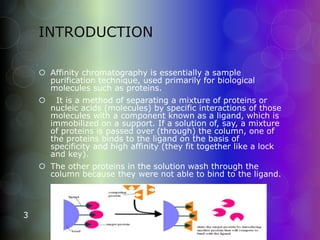
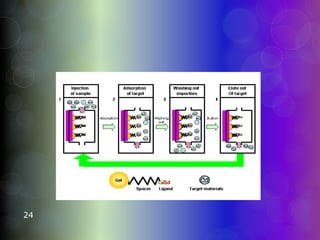
Affinity chromatography is a method to separate molecules based on specific biological interactions between a ligand attached to a support and the target molecule. It relies on reversible interactions such as those between enzymes and substrates, antibodies and antigens, or receptors and ligands. The target molecule binds to the ligand when a sample mixture is passed through the column, while other molecules pass through. The bound target molecule can then be eluted by changing conditions like pH or ionic strength to disrupt the specific interaction. Common applications of affinity chromatography include purifying antibodies, recombinant tagged proteins, and lectins.