

RIPER
AUTONOMOUS
NAAC &
NBA (UG)
SIRO- DSIR
Raghavendra Institute of Pharmaceutical Education and Research - Autonomous
K.R.Palli Cross, Chiyyedu, Anantapuramu, A. P- 515721 1
A seminar as a part of curricular requirement
for I year M. Pharm. I semester
Presented by
A. Harsha Vardan Naidu (20L81S0107)
M. Pharmacy
Department of Pharmacology
Under the guidance of
Dr. P. Ramalingam, M.Pharm, Ph. D
Director- R & D Division
Professor of Pharmaceutical Analysis and Medicinal Chemistry
RIPER
AUTONOMOUS
NAAC &
NBA (UG)
SIRO- DSIR
Raghavendra Institute of Pharmaceutical Education and Research - Autonomous
K.R.Palli Cross, Chiyyedu, Anantapuramu, A. P- 515721 2
1. Electrophoresis
2. Factors affecting electrophoresis
3. Types of electrophoresis
4. Capillary electrophoresis
5. Electro-osmotic flow
6. Instrumentation
7. Modes of capillary electrophoresis
8. Advantages
9. Disadvantages
10. Applications
11. Reference
Contents
RIPER
AUTONOMOUS
NAAC &
NBA (UG)
SIRO- DSIR
Raghavendra Institute of Pharmaceutical Education and Research - Autonomous
K.R.Palli Cross, Chiyyedu, Anantapuramu, A. P- 515721 3
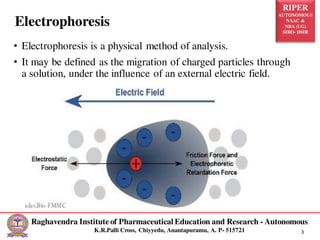
• Electrophoresis is a physical method of analysis.
• It may be defined as the migration of charged particles through
a solution, under the influence of an external electric field.
Electrophoresis
RIPER
AUTONOMOUS
NAAC &
NBA (UG)
SIRO- DSIR
Raghavendra Institute of Pharmaceutical Education and Research - Autonomous
K.R.Palli Cross, Chiyyedu, Anantapuramu, A. P- 515721 4
RIPER
AUTONOMOUS
NAAC &
NBA (UG)
SIRO- DSIR
Raghavendra Institute of Pharmaceutical Education and Research - Autonomous
K.R.Palli Cross, Chiyyedu, Anantapuramu, A. P- 515721 5
I. Zone electrophoresis
• Paper electrophoresis
• Cellulose acetate electrophoresis
• Gel electrophoresis
• Thin layer electrophoresis
II. Free/Moving boundary electrophoresis
• Capillary electrophoresis
• Isotachophoresis
• Isoelectric focusing
• Immuno electrophoresis
Types of electrophoresis
RIPER
AUTONOMOUS
NAAC &
NBA (UG)
SIRO- DSIR
Raghavendra Institute of Pharmaceutical Education and Research - Autonomous
K.R.Palli Cross, Chiyyedu, Anantapuramu, A. P- 515721 6
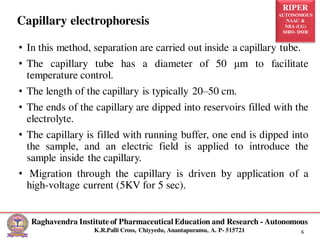
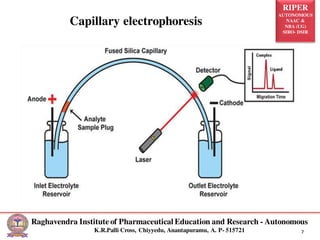
• In this method, separation are carried out inside a capillary tube.
• The capillary tube has a diameter of 50 μm to facilitate
temperature control.
• The length of the capillary is typically 20–50 cm.
• The ends of the capillary are dipped into reservoirs filled with the
electrolyte.
• The capillary is filled with running buffer, one end is dipped into
the sample, and an electric field is applied to introduce the
sample inside the capillary.
• Migration through the capillary is driven by application of a
high-voltage current (5KV for 5 sec).
Capillary electrophoresis
RIPER
AUTONOMOUS
NAAC &
NBA (UG)
SIRO- DSIR
Raghavendra Institute of Pharmaceutical Education and Research - Autonomous
K.R.Palli Cross, Chiyyedu, Anantapuramu, A. P- 515721 7
Capillary electrophoresis
RIPER
AUTONOMOUS
NAAC &
NBA (UG)
SIRO- DSIR
Raghavendra Institute of Pharmaceutical Education and Research - Autonomous
K.R.Palli Cross, Chiyyedu, Anantapuramu, A. P- 515721
8
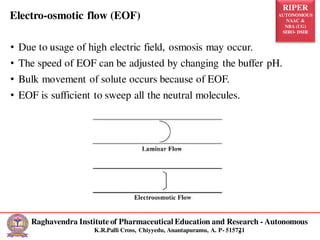
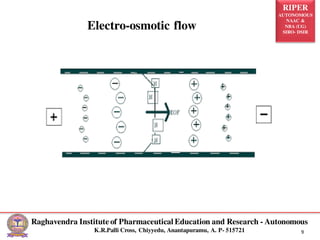
• Due to usage of high electric field, osmosis may occur.
• The speed of EOF can be adjusted by changing the buffer pH.
• Bulk movement of solute occurs because of EOF.
• EOF is sufficient to sweep all the neutral molecules.
Electro-osmotic flow (EOF)
RIPER
AUTONOMOUS
NAAC &
NBA (UG)
SIRO- DSIR
Raghavendra Institute of Pharmaceutical Education and Research - Autonomous
K.R.Palli Cross, Chiyyedu, Anantapuramu, A. P- 515721 9
Electro-osmotic flow
RIPER
AUTONOMOUS
NAAC &
NBA (UG)
SIRO- DSIR
Raghavendra Institute of Pharmaceutical Education and Research - Autonomous
K.R.Palli Cross, Chiyyedu, Anantapuramu, A. P- 515721 10
Instrumentation
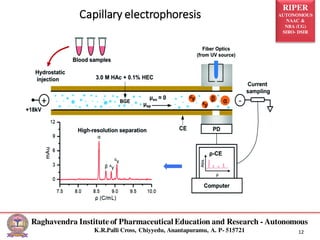
A typical capillary electrophoresis system consists of:
• A buffer solution (Sodium dihydrogen phosphate, Sodium
tetraborate).
• A high voltage supply (5 – 30 KV).
• A sample introduction system or sample injection (by
pressure/vaccum).
• A capillary tube with internal diameter of 10-100mm and a length of
20-100cms.
• A detector and an output device.
• Some instruments include temperature control device, to ensure
reproducible results.
RIPER
AUTONOMOUS
NAAC &
NBA (UG)
SIRO- DSIR
Raghavendra Institute of Pharmaceutical Education and Research - Autonomous
K.R.Palli Cross, Chiyyedu, Anantapuramu, A. P- 515721 11
Sample Injection:
• Hydrodynamic injection: by applying pressure/ by applying vacuum/
by gravitation.
• Electro kinetic injection: by using electric supply.
Detectors:
• Majorly UV detectors are used.
• Others include IR detector, fluorescence detector, conductivity
detector.
• The mass spectrometers are used to give structural information of
the resolved peak.
RIPER
AUTONOMOUS
NAAC &
NBA (UG)
SIRO- DSIR
Raghavendra Institute of Pharmaceutical Education and Research - Autonomous
K.R.Palli Cross, Chiyyedu, Anantapuramu, A. P- 515721 12
Capillary electrophoresis
RIPER
AUTONOMOUS
NAAC &
NBA (UG)
SIRO- DSIR
Raghavendra Institute of Pharmaceutical Education and Research - Autonomous
K.R.Palli Cross, Chiyyedu, Anantapuramu, A. P- 515721 13
Modes of capillary electrophoresis
• Capillary zone electrophoresis
• Capillary gel electrophoresis
• Capillary isoelectric focusing
• Capillary isotachophoresis
• Micellar electro kinetic chromatography(MECC/MEKC)
• Non-aqueous capillary electrophoresis
RIPER
AUTONOMOUS
NAAC &
NBA (UG)
SIRO- DSIR
Raghavendra Institute of Pharmaceutical Education and Research - Autonomous
K.R.Palli Cross, Chiyyedu, Anantapuramu, A. P- 515721 14
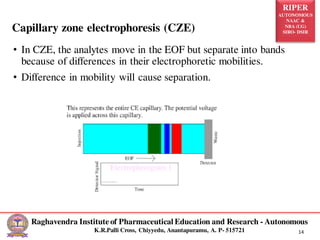
• In CZE, the analytes move in the EOF but separate into bands
because of differences in their electrophoretic mobilities.
• Difference in mobility will cause separation.
Capillary zone electrophoresis (CZE)
RIPER
AUTONOMOUS
NAAC &
NBA (UG)
SIRO- DSIR
Raghavendra Institute of Pharmaceutical Education and Research - Autonomous
K.R.Palli Cross, Chiyyedu, Anantapuramu, A. P- 515721 15
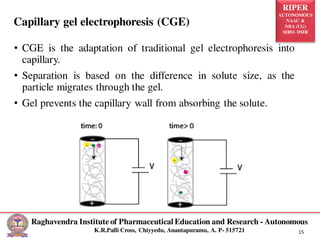
• CGE is the adaptation of traditional gel electrophoresis into
capillary.
• Separation is based on the difference in solute size, as the
particle migrates through the gel.
• Gel prevents the capillary wall from absorbing the solute.
Capillary gel electrophoresis (CGE)
RIPER
AUTONOMOUS
NAAC &
NBA (UG)
SIRO- DSIR
Raghavendra Institute of Pharmaceutical Education and Research - Autonomous
K.R.Palli Cross, Chiyyedu, Anantapuramu, A. P- 515721
16
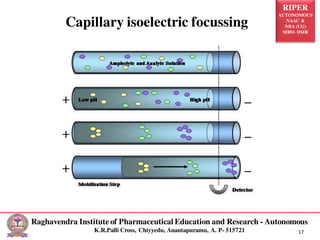
• When a pH gradient is applied across the capillary, and a voltage is
applied from positive voltage at low pH to negative voltage at high
pH.
• Components will migrate to the pH value that equals their pI value.
• At lower pH value, the components are positively charged, at
higher pH values the components are negatively charged.
• In this way, each component migrates to a different position in the
capillary.
• When pressure is applied, the complete pH gradient moves through
the capillary, and subsequently the components will pass the
detection window.
Capillary isoelectric focussing:
RIPER
AUTONOMOUS
NAAC &
NBA (UG)
SIRO- DSIR
Raghavendra Institute of Pharmaceutical Education and Research - Autonomous
K.R.Palli Cross, Chiyyedu, Anantapuramu, A. P- 515721 17
Capillary isoelectric focussing
RIPER
AUTONOMOUS
NAAC &
NBA (UG)
SIRO- DSIR
Raghavendra Institute of Pharmaceutical Education and Research - Autonomous
K.R.Palli Cross, Chiyyedu, Anantapuramu, A. P- 515721 18
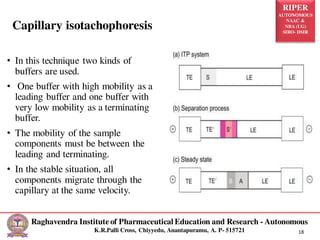
• In this technique two kinds of
buffers are used.
• One buffer with high mobility as a
leading buffer and one buffer with
very low mobility as a terminating
buffer.
• The mobility of the sample
components must be between the
leading and terminating.
• In the stable situation, all
components migrate through the
capillary at the same velocity.
Capillary isotachophoresis
RIPER
AUTONOMOUS
NAAC &
NBA (UG)
SIRO- DSIR
Raghavendra Institute of Pharmaceutical Education and Research - Autonomous
K.R.Palli Cross, Chiyyedu, Anantapuramu, A. P- 515721 19
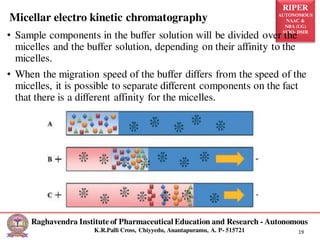
• Sample components in the buffer solution will be divided over the
micelles and the buffer solution, depending on their affinity to the
micelles.
• When the migration speed of the buffer differs from the speed of the
micelles, it is possible to separate different components on the fact
that there is a different affinity for the micelles.
Micellar electro kinetic chromatography
RIPER
AUTONOMOUS
NAAC &
NBA (UG)
SIRO- DSIR
Raghavendra Institute of Pharmaceutical Education and Research - Autonomous
K.R.Palli Cross, Chiyyedu, Anantapuramu, A. P- 515721 20
• In this technique, components that are insoluble in water are
separated, using organic solvents.
• The viscosity and dielectric constants of organic solvents affect both
sample ion mobility and the level of electro-osmotic flow.
Non-aqueous capillary electrophoresis
RIPER
AUTONOMOUS
NAAC &
NBA (UG)
SIRO- DSIR
Raghavendra Institute of Pharmaceutical Education and Research - Autonomous
K.R.Palli Cross, Chiyyedu, Anantapuramu, A. P- 515721 21
Advantages:
• Offers a new selectivity, an alternative to HPLC.
• Easy and predictable selectivity.
• High separation efficiency (more theoretical plates are formed).
• Small amount of sample is required.
• Time required for separation is less (1-45mins).
• Easily coupled to MS.
Disadvantages:
• Cannot be used for preparative scale separations.
• Sample may stick to capillary walls.
• Inconsistent retention time.
RIPER
AUTONOMOUS
NAAC &
NBA (UG)
SIRO- DSIR
Raghavendra Institute of Pharmaceutical Education and Research - Autonomous
K.R.Palli Cross, Chiyyedu, Anantapuramu, A. P- 515721 22
• DNA fingerprinting.
• Diagnosis of hereditary disorders and prenatal testing.
• Diagnosis of infectious diseases.
• Analysis of pharmaceuticals.
• Protein characterization.
• Counter-ion analysis in drug discovery.
Applications
RIPER
AUTONOMOUS
NAAC &
NBA (UG)
SIRO- DSIR
Raghavendra Institute of Pharmaceutical Education and Research - Autonomous
K.R.Palli Cross, Chiyyedu, Anantapuramu, A. P- 515721 23
1. Robert L. C. Voeten. Capillary Electrophoresis: Trends and recent
advances. NCBI. 2018; 90(3): 1464-1481.
2. Matthew Geiger, Amy L. Hogerton. Capillary electrophoresis. ACS
publications. 2012; 84(2): 577-596.
3. F. Robert. Capillary electrophoresis: Principle and applications.
PubMed. 1991; 49(3): 137-148.
4. Juliet Precissi. Capillary electrophoresis. LibreTexts. Aug 16, 2020.
References
RIPER
AUTONOMOUS
NAAC &
NBA (UG)
SIRO- DSIR
Raghavendra Institute of Pharmaceutical Education and Research - Autonomous
K.R.Palli Cross, Chiyyedu, Anantapuramu, A. P- 515721 24
THANK YOU

Capillary Electrophoresis

  • 1.
    RIPER AUTONOMOUS NAAC & NBA (UG) SIRO-DSIR Raghavendra Institute of Pharmaceutical Education and Research - Autonomous K.R.Palli Cross, Chiyyedu, Anantapuramu, A. P- 515721 1 A seminar as a part of curricular requirement for I year M. Pharm. I semester Presented by A. Harsha Vardan Naidu (20L81S0107) M. Pharmacy Department of Pharmacology Under the guidance of Dr. P. Ramalingam, M.Pharm, Ph. D Director- R & D Division Professor of Pharmaceutical Analysis and Medicinal Chemistry
  • 2.
    RIPER AUTONOMOUS NAAC & NBA (UG) SIRO-DSIR Raghavendra Institute of Pharmaceutical Education and Research - Autonomous K.R.Palli Cross, Chiyyedu, Anantapuramu, A. P- 515721 2 1. Electrophoresis 2. Factors affecting electrophoresis 3. Types of electrophoresis 4. Capillary electrophoresis 5. Electro-osmotic flow 6. Instrumentation 7. Modes of capillary electrophoresis 8. Advantages 9. Disadvantages 10. Applications 11. Reference Contents
  • 3.
    RIPER AUTONOMOUS NAAC & NBA (UG) SIRO-DSIR Raghavendra Institute of Pharmaceutical Education and Research - Autonomous K.R.Palli Cross, Chiyyedu, Anantapuramu, A. P- 515721 3 • Electrophoresis is a physical method of analysis. • It may be defined as the migration of charged particles through a solution, under the influence of an external electric field. Electrophoresis
  • 4.
    RIPER AUTONOMOUS NAAC & NBA (UG) SIRO-DSIR Raghavendra Institute of Pharmaceutical Education and Research - Autonomous K.R.Palli Cross, Chiyyedu, Anantapuramu, A. P- 515721 4
  • 5.
    RIPER AUTONOMOUS NAAC & NBA (UG) SIRO-DSIR Raghavendra Institute of Pharmaceutical Education and Research - Autonomous K.R.Palli Cross, Chiyyedu, Anantapuramu, A. P- 515721 5 I. Zone electrophoresis • Paper electrophoresis • Cellulose acetate electrophoresis • Gel electrophoresis • Thin layer electrophoresis II. Free/Moving boundary electrophoresis • Capillary electrophoresis • Isotachophoresis • Isoelectric focusing • Immuno electrophoresis Types of electrophoresis
  • 6.
    RIPER AUTONOMOUS NAAC & NBA (UG) SIRO-DSIR Raghavendra Institute of Pharmaceutical Education and Research - Autonomous K.R.Palli Cross, Chiyyedu, Anantapuramu, A. P- 515721 6 • In this method, separation are carried out inside a capillary tube. • The capillary tube has a diameter of 50 μm to facilitate temperature control. • The length of the capillary is typically 20–50 cm. • The ends of the capillary are dipped into reservoirs filled with the electrolyte. • The capillary is filled with running buffer, one end is dipped into the sample, and an electric field is applied to introduce the sample inside the capillary. • Migration through the capillary is driven by application of a high-voltage current (5KV for 5 sec). Capillary electrophoresis
  • 7.
    RIPER AUTONOMOUS NAAC & NBA (UG) SIRO-DSIR Raghavendra Institute of Pharmaceutical Education and Research - Autonomous K.R.Palli Cross, Chiyyedu, Anantapuramu, A. P- 515721 7 Capillary electrophoresis
  • 8.
    RIPER AUTONOMOUS NAAC & NBA (UG) SIRO-DSIR Raghavendra Institute of Pharmaceutical Education and Research - Autonomous K.R.Palli Cross, Chiyyedu, Anantapuramu, A. P- 515721 8 • Due to usage of high electric field, osmosis may occur. • The speed of EOF can be adjusted by changing the buffer pH. • Bulk movement of solute occurs because of EOF. • EOF is sufficient to sweep all the neutral molecules. Electro-osmotic flow (EOF)
  • 9.
    RIPER AUTONOMOUS NAAC & NBA (UG) SIRO-DSIR Raghavendra Institute of Pharmaceutical Education and Research - Autonomous K.R.Palli Cross, Chiyyedu, Anantapuramu, A. P- 515721 9 Electro-osmotic flow
  • 10.
    RIPER AUTONOMOUS NAAC & NBA (UG) SIRO-DSIR Raghavendra Institute of Pharmaceutical Education and Research - Autonomous K.R.Palli Cross, Chiyyedu, Anantapuramu, A. P- 515721 10 Instrumentation A typical capillary electrophoresis system consists of: • A buffer solution (Sodium dihydrogen phosphate, Sodium tetraborate). • A high voltage supply (5 – 30 KV). • A sample introduction system or sample injection (by pressure/vaccum). • A capillary tube with internal diameter of 10-100mm and a length of 20-100cms. • A detector and an output device. • Some instruments include temperature control device, to ensure reproducible results.
  • 11.
    RIPER AUTONOMOUS NAAC & NBA (UG) SIRO-DSIR Raghavendra Institute of Pharmaceutical Education and Research - Autonomous K.R.Palli Cross, Chiyyedu, Anantapuramu, A. P- 515721 11 Sample Injection: • Hydrodynamic injection: by applying pressure/ by applying vacuum/ by gravitation. • Electro kinetic injection: by using electric supply. Detectors: • Majorly UV detectors are used. • Others include IR detector, fluorescence detector, conductivity detector. • The mass spectrometers are used to give structural information of the resolved peak.
  • 12.
    RIPER AUTONOMOUS NAAC & NBA (UG) SIRO-DSIR Raghavendra Institute of Pharmaceutical Education and Research - Autonomous K.R.Palli Cross, Chiyyedu, Anantapuramu, A. P- 515721 12 Capillary electrophoresis
  • 13.
    RIPER AUTONOMOUS NAAC & NBA (UG) SIRO-DSIR Raghavendra Institute of Pharmaceutical Education and Research - Autonomous K.R.Palli Cross, Chiyyedu, Anantapuramu, A. P- 515721 13 Modes of capillary electrophoresis • Capillary zone electrophoresis • Capillary gel electrophoresis • Capillary isoelectric focusing • Capillary isotachophoresis • Micellar electro kinetic chromatography(MECC/MEKC) • Non-aqueous capillary electrophoresis
  • 14.
    RIPER AUTONOMOUS NAAC & NBA (UG) SIRO-DSIR Raghavendra Institute of Pharmaceutical Education and Research - Autonomous K.R.Palli Cross, Chiyyedu, Anantapuramu, A. P- 515721 14 • In CZE, the analytes move in the EOF but separate into bands because of differences in their electrophoretic mobilities. • Difference in mobility will cause separation. Capillary zone electrophoresis (CZE)
  • 15.
    RIPER AUTONOMOUS NAAC & NBA (UG) SIRO-DSIR Raghavendra Institute of Pharmaceutical Education and Research - Autonomous K.R.Palli Cross, Chiyyedu, Anantapuramu, A. P- 515721 15 • CGE is the adaptation of traditional gel electrophoresis into capillary. • Separation is based on the difference in solute size, as the particle migrates through the gel. • Gel prevents the capillary wall from absorbing the solute. Capillary gel electrophoresis (CGE)
  • 16.
    RIPER AUTONOMOUS NAAC & NBA (UG) SIRO-DSIR Raghavendra Institute of Pharmaceutical Education and Research - Autonomous K.R.Palli Cross, Chiyyedu, Anantapuramu, A. P- 515721 16 • When a pH gradient is applied across the capillary, and a voltage is applied from positive voltage at low pH to negative voltage at high pH. • Components will migrate to the pH value that equals their pI value. • At lower pH value, the components are positively charged, at higher pH values the components are negatively charged. • In this way, each component migrates to a different position in the capillary. • When pressure is applied, the complete pH gradient moves through the capillary, and subsequently the components will pass the detection window. Capillary isoelectric focussing:
  • 17.
    RIPER AUTONOMOUS NAAC & NBA (UG) SIRO-DSIR Raghavendra Institute of Pharmaceutical Education and Research - Autonomous K.R.Palli Cross, Chiyyedu, Anantapuramu, A. P- 515721 17 Capillary isoelectric focussing
  • 18.
    RIPER AUTONOMOUS NAAC & NBA (UG) SIRO-DSIR Raghavendra Institute of Pharmaceutical Education and Research - Autonomous K.R.Palli Cross, Chiyyedu, Anantapuramu, A. P- 515721 18 • In this technique two kinds of buffers are used. • One buffer with high mobility as a leading buffer and one buffer with very low mobility as a terminating buffer. • The mobility of the sample components must be between the leading and terminating. • In the stable situation, all components migrate through the capillary at the same velocity. Capillary isotachophoresis
  • 19.
    RIPER AUTONOMOUS NAAC & NBA (UG) SIRO-DSIR Raghavendra Institute of Pharmaceutical Education and Research - Autonomous K.R.Palli Cross, Chiyyedu, Anantapuramu, A. P- 515721 19 • Sample components in the buffer solution will be divided over the micelles and the buffer solution, depending on their affinity to the micelles. • When the migration speed of the buffer differs from the speed of the micelles, it is possible to separate different components on the fact that there is a different affinity for the micelles. Micellar electro kinetic chromatography
  • 20.
    RIPER AUTONOMOUS NAAC & NBA (UG) SIRO-DSIR Raghavendra Institute of Pharmaceutical Education and Research - Autonomous K.R.Palli Cross, Chiyyedu, Anantapuramu, A. P- 515721 20 • In this technique, components that are insoluble in water are separated, using organic solvents. • The viscosity and dielectric constants of organic solvents affect both sample ion mobility and the level of electro-osmotic flow. Non-aqueous capillary electrophoresis
  • 21.
    RIPER AUTONOMOUS NAAC & NBA (UG) SIRO-DSIR Raghavendra Institute of Pharmaceutical Education and Research - Autonomous K.R.Palli Cross, Chiyyedu, Anantapuramu, A. P- 515721 21 Advantages: • Offers a new selectivity, an alternative to HPLC. • Easy and predictable selectivity. • High separation efficiency (more theoretical plates are formed). • Small amount of sample is required. • Time required for separation is less (1-45mins). • Easily coupled to MS. Disadvantages: • Cannot be used for preparative scale separations. • Sample may stick to capillary walls. • Inconsistent retention time.
  • 22.
    RIPER AUTONOMOUS NAAC & NBA (UG) SIRO-DSIR Raghavendra Institute of Pharmaceutical Education and Research - Autonomous K.R.Palli Cross, Chiyyedu, Anantapuramu, A. P- 515721 22 • DNA fingerprinting. • Diagnosis of hereditary disorders and prenatal testing. • Diagnosis of infectious diseases. • Analysis of pharmaceuticals. • Protein characterization. • Counter-ion analysis in drug discovery. Applications
  • 23.
    RIPER AUTONOMOUS NAAC & NBA (UG) SIRO-DSIR Raghavendra Institute of Pharmaceutical Education and Research - Autonomous K.R.Palli Cross, Chiyyedu, Anantapuramu, A. P- 515721 23 1. Robert L. C. Voeten. Capillary Electrophoresis: Trends and recent advances. NCBI. 2018; 90(3): 1464-1481. 2. Matthew Geiger, Amy L. Hogerton. Capillary electrophoresis. ACS publications. 2012; 84(2): 577-596. 3. F. Robert. Capillary electrophoresis: Principle and applications. PubMed. 1991; 49(3): 137-148. 4. Juliet Precissi. Capillary electrophoresis. LibreTexts. Aug 16, 2020. References
  • 24.
    RIPER AUTONOMOUS NAAC & NBA (UG) SIRO-DSIR Raghavendra Institute of Pharmaceutical Education and Research - Autonomous K.R.Palli Cross, Chiyyedu, Anantapuramu, A. P- 515721 24 THANK YOU