By:Mahmoud Galal Zidan
D & F BLOCK ELEMENTS
SCANDIUM GROUP
Scandium ( Sc ) [ Ar ] d1 s2
Yttrium ( Y ) [ Kr ] d1 s2
Lutetium ( Lu ) [ Xe ] d1 s2
Lawrencium (Lr) [ Rn ] d1 s2
electron Configuration [ -- ] d1 s2
SCANDIUM GROUP
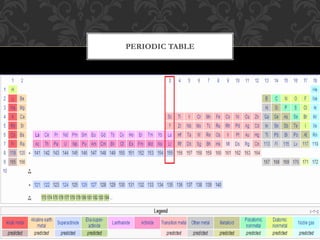
Names of Sc Group :
 IIIB ( USA )
 IIIA ( Euro)
 Gp. 3 ( IUPAC )
PERIODIC TABLE
• The metals are quit reactive and the reactivity increase with increase size
• Complex are formed with strong complexing agent like EDTA .
• They burn in O2 and gives M2O3 and tarnish in air except Yttrium is un
reactive .
• They react slowly with cold water and more rabidly with heating
La + H2O  La(OH)3 + LaO.OH
• Hydroxides increase on descending the group where Y(OH)3 and La(OH)3
are basic since scandium is amphoteric it dissolves in NaOH
Sc + NaOH  [ Sc(OH)6 ]-3 + H2
• The oxides and Hydroxides form salts with acids
Y(OH)3 and La(OH)3 react with CO2
GENERAL PROPERTIES
OF SCANDIUM GROUP
• Like other groups, the members of this family show patterns in their electron
configurations, especially the outermost shells, resulting in trends in chemical behavior.
However, lutetium is an exception, since its last electron is transferred to the
7p1/2 subshell due to relativistic effect .
• Most of the chemistry has been observed only for the first three members of the
group :
1. Elements of the group (scandium, yttrium, lutetium) are reactive metals with high
melting points (1541 °C, 1526 °C, 1652 °C respectively).
2. They are usually oxidized to the +3 oxidation state, even through scandium, yttrium
and lanthanum can form lower oxidation states. The reactivity of the elements,
especially yttrium, is not always obvious due to the formation of a stable oxide layer,
which prevents further reactions. Scandium(III) oxide , yttrium(III) oxide
,lanthanum(III) oxide and lutetium(III) oxide are white high-temperature-melting
solids. Yttrium(III) oxide and lutetium(III) oxide exhibit weak basic character, but
scandium(III) oxide is amphoteric . lutetium (III) oxide is strongly basic
CHEMICAL PROPERTIES
Elements that show tripositive ions with electronic configuration of a noble gas
(scandium, yttrium, lutetium, Lawrencium show a clear trend in their physical
properties, such as hardness. At the same time, if group 3 is continued with
lutetium and lawrencium, several trends are broken. For example:
• scandium and yttrium are both soft metals. lutetium is soft as well
• all these elements have their outermost electrons quite far from the nucleus
compared to the nuclei charges. Due to the lanthanide contraction, lutetium,
the last in the lanthanide series, has a significantly smaller atomic radius and a
higher nucleus charge, thus making the extraction of the electrons from the
atom to form metallic bonding more difficult, and thus making the metal
harder. However, lutetium suits the previous elements better in several other
properties, such as melting and boiling points .
• Very little is known about lawrencium ( Ac series ) , and none of its physical
properties have been confirmed.
PHYSICAL PROPERTIES
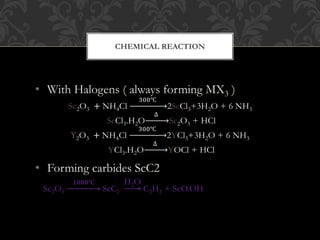
• With Halogens ( always forming MX3 )
Sc2O3 + NH4Cl
300℃
2ScCl3+3H2O + 6 NH3
ScCl3.H2O
∆
Sc2O3 + HCl
Y2O3 + NH4Cl
300℃
2YCl3+3H2O + 6 NH3
YCl3.H2O
∆
YOCl + HCl
• Forming carbides ScC2
Sc2O3
1000℃
ScC2
H2O
C2H2 + ScO.OH
CHEMICAL REACTION
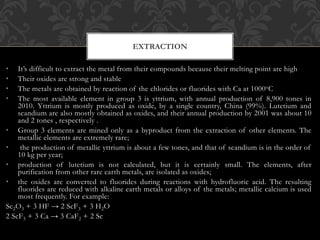
• It’s difficult to extract the metal from their compounds because their melting point are high
• Their oxides are strong and stable
• The metals are obtained by reaction of the chlorides or fluorides with Ca at 1000oC
• The most available element in group 3 is yttrium, with annual production of 8,900 tones in
2010. Yttrium is mostly produced as oxide, by a single country, China (99%). Lutetium and
scandium are also mostly obtained as oxides, and their annual production by 2001 was about 10
and 2 tones , respectively .
• Group 3 elements are mined only as a byproduct from the extraction of other elements. The
metallic elements are extremely rare;
• the production of metallic yttrium is about a few tones, and that of scandium is in the order of
10 kg per year;
• production of lutetium is not calculated, but it is certainly small. The elements, after
purification from other rare earth metals, are isolated as oxides;
• the oxides are converted to fluorides during reactions with hydrofluoric acid. The resulting
fluorides are reduced with alkaline earth metals or alloys of the metals; metallic calcium is used
most frequently. For example:
Sc2O3 + 3 HF → 2 ScF3 + 3 H2O
2 ScF3 + 3 Ca → 3 CaF2 + 2 Sc
EXTRACTION

Scandium group

  • 1.
    By:Mahmoud Galal Zidan D& F BLOCK ELEMENTS SCANDIUM GROUP
  • 2.
    Scandium ( Sc) [ Ar ] d1 s2 Yttrium ( Y ) [ Kr ] d1 s2 Lutetium ( Lu ) [ Xe ] d1 s2 Lawrencium (Lr) [ Rn ] d1 s2 electron Configuration [ -- ] d1 s2 SCANDIUM GROUP Names of Sc Group :  IIIB ( USA )  IIIA ( Euro)  Gp. 3 ( IUPAC )
  • 3.
  • 4.
    • The metalsare quit reactive and the reactivity increase with increase size • Complex are formed with strong complexing agent like EDTA . • They burn in O2 and gives M2O3 and tarnish in air except Yttrium is un reactive . • They react slowly with cold water and more rabidly with heating La + H2O  La(OH)3 + LaO.OH • Hydroxides increase on descending the group where Y(OH)3 and La(OH)3 are basic since scandium is amphoteric it dissolves in NaOH Sc + NaOH  [ Sc(OH)6 ]-3 + H2 • The oxides and Hydroxides form salts with acids Y(OH)3 and La(OH)3 react with CO2 GENERAL PROPERTIES OF SCANDIUM GROUP
  • 5.
    • Like othergroups, the members of this family show patterns in their electron configurations, especially the outermost shells, resulting in trends in chemical behavior. However, lutetium is an exception, since its last electron is transferred to the 7p1/2 subshell due to relativistic effect . • Most of the chemistry has been observed only for the first three members of the group : 1. Elements of the group (scandium, yttrium, lutetium) are reactive metals with high melting points (1541 °C, 1526 °C, 1652 °C respectively). 2. They are usually oxidized to the +3 oxidation state, even through scandium, yttrium and lanthanum can form lower oxidation states. The reactivity of the elements, especially yttrium, is not always obvious due to the formation of a stable oxide layer, which prevents further reactions. Scandium(III) oxide , yttrium(III) oxide ,lanthanum(III) oxide and lutetium(III) oxide are white high-temperature-melting solids. Yttrium(III) oxide and lutetium(III) oxide exhibit weak basic character, but scandium(III) oxide is amphoteric . lutetium (III) oxide is strongly basic CHEMICAL PROPERTIES
  • 6.
    Elements that showtripositive ions with electronic configuration of a noble gas (scandium, yttrium, lutetium, Lawrencium show a clear trend in their physical properties, such as hardness. At the same time, if group 3 is continued with lutetium and lawrencium, several trends are broken. For example: • scandium and yttrium are both soft metals. lutetium is soft as well • all these elements have their outermost electrons quite far from the nucleus compared to the nuclei charges. Due to the lanthanide contraction, lutetium, the last in the lanthanide series, has a significantly smaller atomic radius and a higher nucleus charge, thus making the extraction of the electrons from the atom to form metallic bonding more difficult, and thus making the metal harder. However, lutetium suits the previous elements better in several other properties, such as melting and boiling points . • Very little is known about lawrencium ( Ac series ) , and none of its physical properties have been confirmed. PHYSICAL PROPERTIES
  • 7.
    • With Halogens( always forming MX3 ) Sc2O3 + NH4Cl 300℃ 2ScCl3+3H2O + 6 NH3 ScCl3.H2O ∆ Sc2O3 + HCl Y2O3 + NH4Cl 300℃ 2YCl3+3H2O + 6 NH3 YCl3.H2O ∆ YOCl + HCl • Forming carbides ScC2 Sc2O3 1000℃ ScC2 H2O C2H2 + ScO.OH CHEMICAL REACTION
  • 8.
    • It’s difficultto extract the metal from their compounds because their melting point are high • Their oxides are strong and stable • The metals are obtained by reaction of the chlorides or fluorides with Ca at 1000oC • The most available element in group 3 is yttrium, with annual production of 8,900 tones in 2010. Yttrium is mostly produced as oxide, by a single country, China (99%). Lutetium and scandium are also mostly obtained as oxides, and their annual production by 2001 was about 10 and 2 tones , respectively . • Group 3 elements are mined only as a byproduct from the extraction of other elements. The metallic elements are extremely rare; • the production of metallic yttrium is about a few tones, and that of scandium is in the order of 10 kg per year; • production of lutetium is not calculated, but it is certainly small. The elements, after purification from other rare earth metals, are isolated as oxides; • the oxides are converted to fluorides during reactions with hydrofluoric acid. The resulting fluorides are reduced with alkaline earth metals or alloys of the metals; metallic calcium is used most frequently. For example: Sc2O3 + 3 HF → 2 ScF3 + 3 H2O 2 ScF3 + 3 Ca → 3 CaF2 + 2 Sc EXTRACTION