Presented by:
Shobhini Chandel
M.Pharm
1stsemester
Submitted to:
Dr. Chandana Majee
Associate Professor
NIET(Pharmacy Institute)
 Introduction
 Principle
 Advantages and disadvantages
 Component of gel chromatography
 Gel types
 Separation procedure
 Applications
 References
 Gel chromatography is also known as gel permeation, gel
filtration, molecular sieving or size exclusion chromatography.
 It is a technique in which the separation of component based on
the difference of molecular weight or size and is one of the
effective method used to isolate and analyze the macromolecular
substance.
 When an organic solvent is used as a mobile phase then the
chromatography technique is tends to called as gel permeation
chromatography.
 When an aqueous solution is used to transport the sample
through the column in the technique is known as gel filtration
chromatography.
 It is a technique in which of separation of component is based on
the difference in their molecular weight or the size.
 The stationary phase used is a porous polar matrix whose pores
are completely filled with the solvent to be used as a mobile
phase.
 The molecules in the sample are formed through specialized
column containing gel.
 The basis of the separation is that molecules above a certain size
are totally excluded from the pores while smaller molecule
access interior of the pores partly or wholly.
 The flow of the mobile phase hence will cause larger molecules
to pass through the column unhindered, without penetrating the
gel matrix, where as smaller molecules will be retarded
according to their penetration of the gel.
› Short analysis time
› Well-defined separation
› Narrowband and good sensitivity
› There is no sample loss
› Small amount of mobile phase required
› The flow rate can be set
DISADVANTAGES
Limited number of peaks that can be resolved within a short
time scale.
Filtration must be performed before using the instrument to
prevent dust and other particulates from ruining the columns
in interfering with the detector.
The molecular masses of most of the change will be too
close for the separation to show anything more than broad
peak.
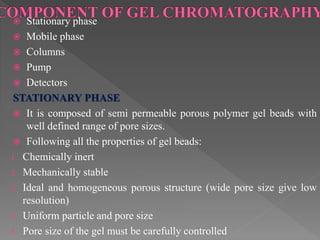
 Stationary phase
 Mobile phase
 Columns
 Pump
 Detectors
STATIONARY PHASE
 It is composed of semi permeable porous polymer gel beads with
well defined range of pore sizes.
 Following all the properties of gel beads:
1. Chemically inert
2. Mechanically stable
3. Ideal and homogeneous porous structure (wide pore size give low
resolution)
4. Uniform particle and pore size
5. Pore size of the gel must be carefully controlled
MOBILE PHASE
It is composed of liquid used to dissolve the biomolecules to make the
mobile phase permitting high detection and response and wet the
packing surface.
COLUMNS
Commercially available columns include
 Analytical column
 Preparative column
 Narrow bore column
PUMP
They are either syringe pump or reciprocating pump with high constant
flow rate.
DETECTOR
The various type of detectors are:
 Concentration sensitive detector
 Bulk property detector
 Refractive index detector and many more
There are different type of gels used in gel chromatography
 Dextran (sephadex) gel- α1-6-polymer of glucose is prepared by
fermentation of sucrose (glucose + fructose). It is a natural gel.
 Agarose gel- Obtained from agar and composed of alternating units of
1,3 linked β-D-galactose and 1,4-linked 3,6-anhydro-α, L- galactose. It
is a natural gel.
 Acryl amide gel- It is not dextran polymer. It is polymerized acryl
amide or methylen-bis-acrylamide.It is a synthetic gel.
According to the swelling process, the gels are two types:
• 1-Softgels ( Xerogel, is gel only on swelling)
e.g. Poly acryl amide gels, dextran or agarose(used for separation of
proteins in aqueous mobile phase).
• 2-Semi rigid or rigid gels ( aerogel, is gel in air)
 Polystyrene gels(separation of non-polar polymers in non-polar
solvents).
 Porous glass gels(separation of polar systems)
GEL TYPES IN GEL CHROMATOGRAPHY
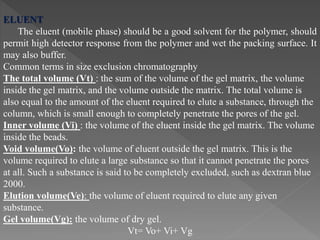
ELUENT
The eluent (mobile phase) should be a good solvent for the polymer, should
permit high detector response from the polymer and wet the packing surface. It
may also buffer.
Common terms in size exclusion chromatography
The total volume (Vt) : the sum of the volume of the gel matrix, the volume
inside the gel matrix, and the volume outside the matrix. The total volume is
also equal to the amount of the eluent required to elute a substance, through the
column, which is small enough to completely penetrate the pores of the gel.
Inner volume (Vi) : the volume of the eluent inside the gel matrix. The volume
inside the beads.
Void volume(Vo): the volume of eluent outside the gel matrix. This is the
volume required to elute a large substance so that it cannot penetrate the pores
at all. Such a substance is said to be completely excluded, such as dextran blue
2000.
Elution volume(Ve): the volume of eluent required to elute any given
substance.
Gel volume(Vg): the volume of dry gel.
Vt= Vo+ Vi+ Vg
In classical and more rigorous scince, elution position of any molecules should
be reported as the partition coefficient (Kav) rather than volume.
 For totally excluded;
Kav= 0 and Ve= Vo
 For totally permeated;
Kav= 1 and Ve= Vt
SEPARATION PROCEDURE
1-Preparation of column for gel filtration
Swelling of the gel: some resin come in a powder form, these must be sonicated
first in the eluent or the desired buffer to swell.
Packing the column: make a slurry of gel plus buffer and pour it into column
which is one third filled with the buffer.
Washing the resin: after packing, pass several column volumes of the buffer
through the column to remove any air bubbles and to test the column
homogeneity.
2-loading the sample onto the column: the sample must enter the resin in the
form of solution using a syringe.
3-eluting the sample and detection of components:
Fractions are collected as the sample elutes from the column.
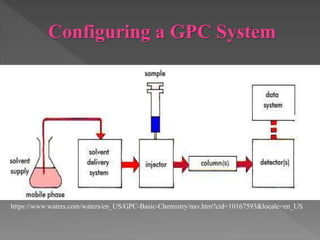
https://www.waters.com/waters/en_US/GPC-Basic-Chemistry/nav.htm?cid=10167593&locale=en_US
Configuring a GPC System
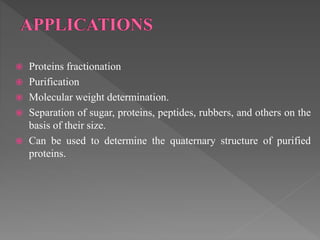
 Proteins fractionation
 Purification
 Molecular weight determination.
 Separation of sugar, proteins, peptides, rubbers, and others on the
basis of their size.
 Can be used to determine the quaternary structure of purified
proteins.
 ncbi.nlm.nih.gov/pmc/articles/PMC7121854/
 microbenotes.com/gel-permeation-
chromatography/#principle-of-gel-permeation-
chromatography
 conductscience.com/gel-filtration-chromatography-protocol/
 britannica.com/science/gel-chromatography
 slideshare.net/MehulJain143/gel-chromatography-249396454
 waters.com/waters/en_US/GPC-Basic-
Chemistry/nav.htm?cid=10167593&locale=en_US
GEL CHROMATOGRAPHY.pptx

GEL CHROMATOGRAPHY.pptx

  • 1.
    Presented by: Shobhini Chandel M.Pharm 1stsemester Submittedto: Dr. Chandana Majee Associate Professor NIET(Pharmacy Institute)
  • 2.
     Introduction  Principle Advantages and disadvantages  Component of gel chromatography  Gel types  Separation procedure  Applications  References
  • 3.
     Gel chromatographyis also known as gel permeation, gel filtration, molecular sieving or size exclusion chromatography.  It is a technique in which the separation of component based on the difference of molecular weight or size and is one of the effective method used to isolate and analyze the macromolecular substance.  When an organic solvent is used as a mobile phase then the chromatography technique is tends to called as gel permeation chromatography.  When an aqueous solution is used to transport the sample through the column in the technique is known as gel filtration chromatography.
  • 4.
     It isa technique in which of separation of component is based on the difference in their molecular weight or the size.  The stationary phase used is a porous polar matrix whose pores are completely filled with the solvent to be used as a mobile phase.  The molecules in the sample are formed through specialized column containing gel.  The basis of the separation is that molecules above a certain size are totally excluded from the pores while smaller molecule access interior of the pores partly or wholly.  The flow of the mobile phase hence will cause larger molecules to pass through the column unhindered, without penetrating the gel matrix, where as smaller molecules will be retarded according to their penetration of the gel.
  • 5.
    › Short analysistime › Well-defined separation › Narrowband and good sensitivity › There is no sample loss › Small amount of mobile phase required › The flow rate can be set DISADVANTAGES Limited number of peaks that can be resolved within a short time scale. Filtration must be performed before using the instrument to prevent dust and other particulates from ruining the columns in interfering with the detector. The molecular masses of most of the change will be too close for the separation to show anything more than broad peak.
  • 6.
     Stationary phase Mobile phase  Columns  Pump  Detectors STATIONARY PHASE  It is composed of semi permeable porous polymer gel beads with well defined range of pore sizes.  Following all the properties of gel beads: 1. Chemically inert 2. Mechanically stable 3. Ideal and homogeneous porous structure (wide pore size give low resolution) 4. Uniform particle and pore size 5. Pore size of the gel must be carefully controlled
  • 7.
    MOBILE PHASE It iscomposed of liquid used to dissolve the biomolecules to make the mobile phase permitting high detection and response and wet the packing surface. COLUMNS Commercially available columns include  Analytical column  Preparative column  Narrow bore column PUMP They are either syringe pump or reciprocating pump with high constant flow rate. DETECTOR The various type of detectors are:  Concentration sensitive detector  Bulk property detector  Refractive index detector and many more
  • 8.
    There are differenttype of gels used in gel chromatography  Dextran (sephadex) gel- α1-6-polymer of glucose is prepared by fermentation of sucrose (glucose + fructose). It is a natural gel.  Agarose gel- Obtained from agar and composed of alternating units of 1,3 linked β-D-galactose and 1,4-linked 3,6-anhydro-α, L- galactose. It is a natural gel.  Acryl amide gel- It is not dextran polymer. It is polymerized acryl amide or methylen-bis-acrylamide.It is a synthetic gel. According to the swelling process, the gels are two types: • 1-Softgels ( Xerogel, is gel only on swelling) e.g. Poly acryl amide gels, dextran or agarose(used for separation of proteins in aqueous mobile phase). • 2-Semi rigid or rigid gels ( aerogel, is gel in air)  Polystyrene gels(separation of non-polar polymers in non-polar solvents).  Porous glass gels(separation of polar systems) GEL TYPES IN GEL CHROMATOGRAPHY
  • 9.
    ELUENT The eluent (mobilephase) should be a good solvent for the polymer, should permit high detector response from the polymer and wet the packing surface. It may also buffer. Common terms in size exclusion chromatography The total volume (Vt) : the sum of the volume of the gel matrix, the volume inside the gel matrix, and the volume outside the matrix. The total volume is also equal to the amount of the eluent required to elute a substance, through the column, which is small enough to completely penetrate the pores of the gel. Inner volume (Vi) : the volume of the eluent inside the gel matrix. The volume inside the beads. Void volume(Vo): the volume of eluent outside the gel matrix. This is the volume required to elute a large substance so that it cannot penetrate the pores at all. Such a substance is said to be completely excluded, such as dextran blue 2000. Elution volume(Ve): the volume of eluent required to elute any given substance. Gel volume(Vg): the volume of dry gel. Vt= Vo+ Vi+ Vg
  • 10.
    In classical andmore rigorous scince, elution position of any molecules should be reported as the partition coefficient (Kav) rather than volume.  For totally excluded; Kav= 0 and Ve= Vo  For totally permeated; Kav= 1 and Ve= Vt SEPARATION PROCEDURE 1-Preparation of column for gel filtration Swelling of the gel: some resin come in a powder form, these must be sonicated first in the eluent or the desired buffer to swell. Packing the column: make a slurry of gel plus buffer and pour it into column which is one third filled with the buffer. Washing the resin: after packing, pass several column volumes of the buffer through the column to remove any air bubbles and to test the column homogeneity. 2-loading the sample onto the column: the sample must enter the resin in the form of solution using a syringe. 3-eluting the sample and detection of components: Fractions are collected as the sample elutes from the column.
  • 11.
  • 12.
     Proteins fractionation Purification  Molecular weight determination.  Separation of sugar, proteins, peptides, rubbers, and others on the basis of their size.  Can be used to determine the quaternary structure of purified proteins.
  • 13.
     ncbi.nlm.nih.gov/pmc/articles/PMC7121854/  microbenotes.com/gel-permeation- chromatography/#principle-of-gel-permeation- chromatography conductscience.com/gel-filtration-chromatography-protocol/  britannica.com/science/gel-chromatography  slideshare.net/MehulJain143/gel-chromatography-249396454  waters.com/waters/en_US/GPC-Basic- Chemistry/nav.htm?cid=10167593&locale=en_US