






•may be defined as a relatively
permanent change in behavior that
results from experience.
• is also said to be the result of
experience.
Not all behaviors, however, are the
result of experience. Behaviors that are
“built into” or inherited by an organism
are called unlearned or inherited
behaviors.
There are different ways of learning.
Most of the behaviors that we consider
“human” are acquired through learning
and experience.
The better we understand how people
learn, the better able we will be to help
them learn appropriate behaviors and
eliminate inappropriate ones. However,
this belief rests on three assumptions:
1. Behavior is lawful – how we behave is
entirely determined by our
environment and our genetic
inheritance is known as determinism.
2. If the laws of behavior are known,
behavior can be controlled.
3. The capacity to control behavior is
desirable.
There is considerable agreement that
behavior is at least partially lawful – that
the environment in which we find
ourselves can substantially alter how we
behave. If we discover the laws relating
behavior to the environment, there
seems little doubt that our capacity to
control behavior would increase.
Thus, learning is a relatively permanent
change in knowledge or behavior that
comes as a result of experience.
Processes when we learn the
relationship between events:
• learning in which the organism
comes to associate one stimulus
with another (also called
Pavlovian Conditioning)
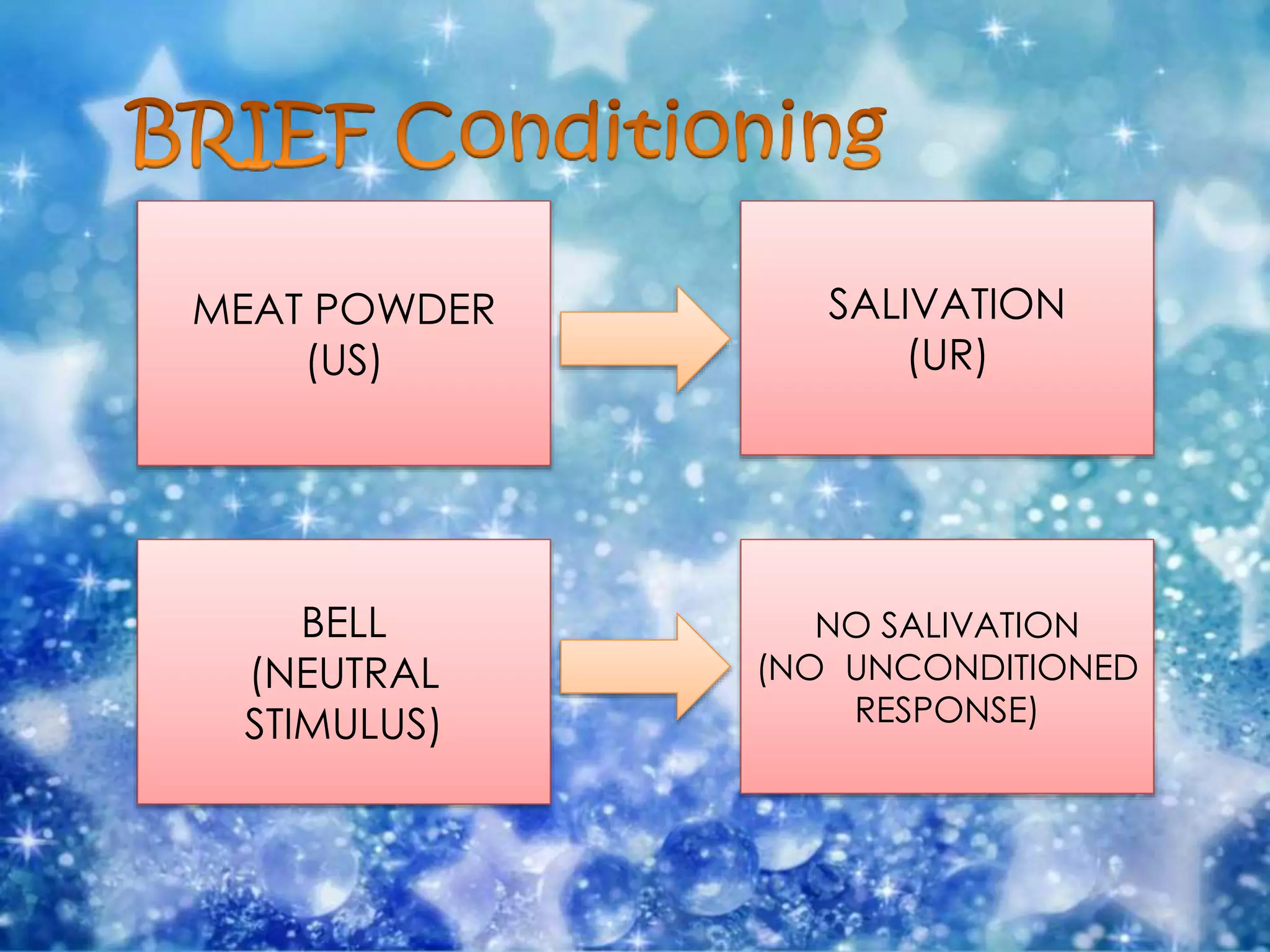
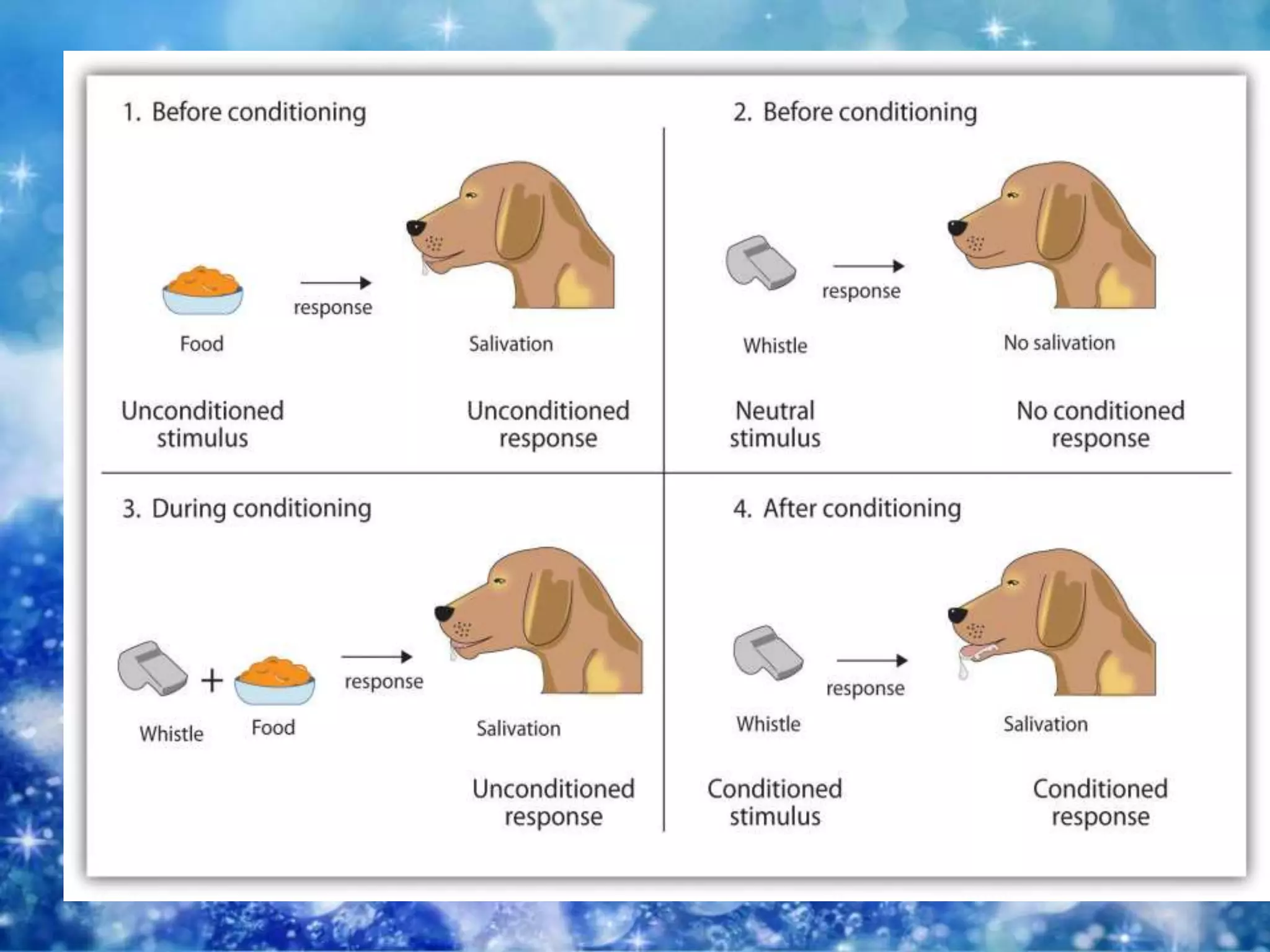
a. Unconditioned Responses (UR) – an
unlearned response to an
unconditioned stimulus.
b. Unconditioned Stimulus (US) – stimulus
that triggers an unconditioned
response.
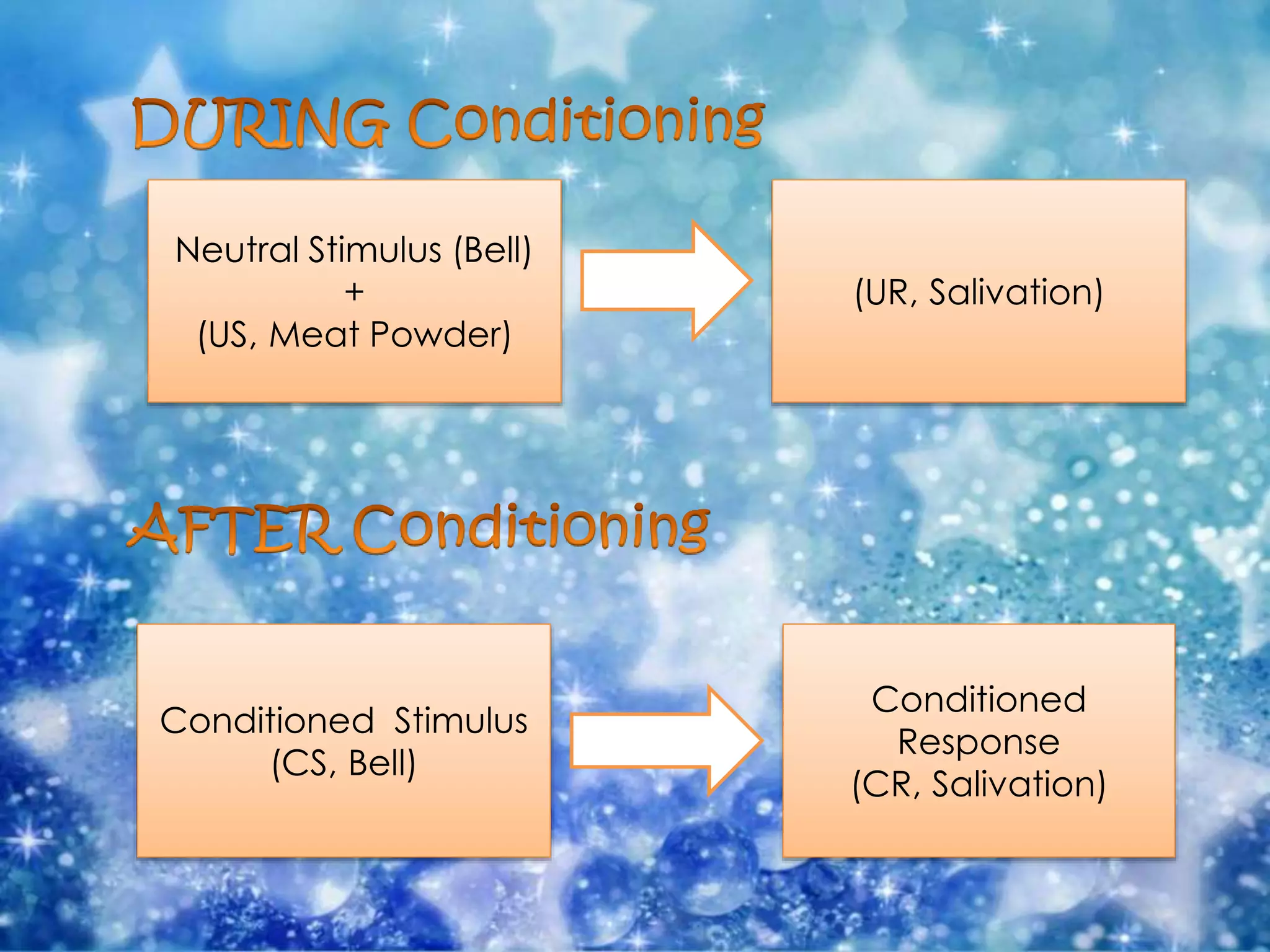
c. Conditioned Stimulus (CS) – a neutral
stimulus that comes to evoke a
classically conditioned response.
d. Conditioned Response – a learned
response to a classically conditioned
stimulus
MEAT POWDER
(US)
BELL
(NEUTRAL
STIMULUS)
SALIVATION
(UR)
NO SALIVATION
(NO UNCONDITIONED
RESPONSE)
Neutral Stimulus (Bell)
+
(US, Meat Powder)
(UR, Salivation)
Conditioned Stimulus
(CS, Bell)
Conditioned
Response
(CR, Salivation)
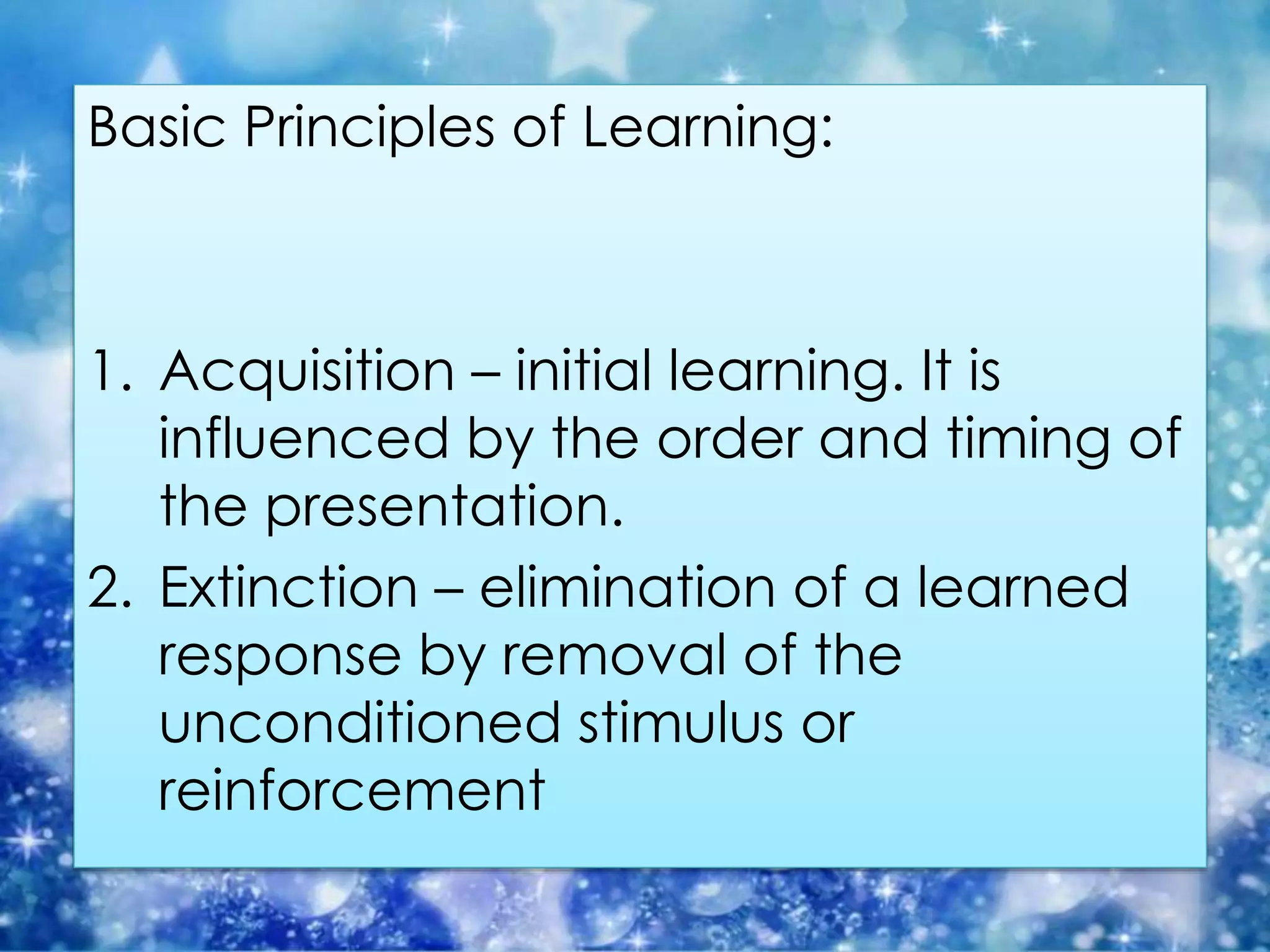
Basic Principles of Learning:
1. Acquisition – initial learning. It is
influenced by the order and timing of
the presentation.
2. Extinction – elimination of a learned
response by removal of the
unconditioned stimulus or
reinforcement
3. Generalization – tendency to
respond to stimulus that is similar to
conditioned stimulus
4. Discrimination – ability to distinguish
between different stimuli.
It is a process by which organisms
learn to behave in ways to produce
reinforcement or desirable outcomes
are not.
Law of Effects – responses followed by
positive outcomes are repeated, while
those followed by negative outcomes are
not.
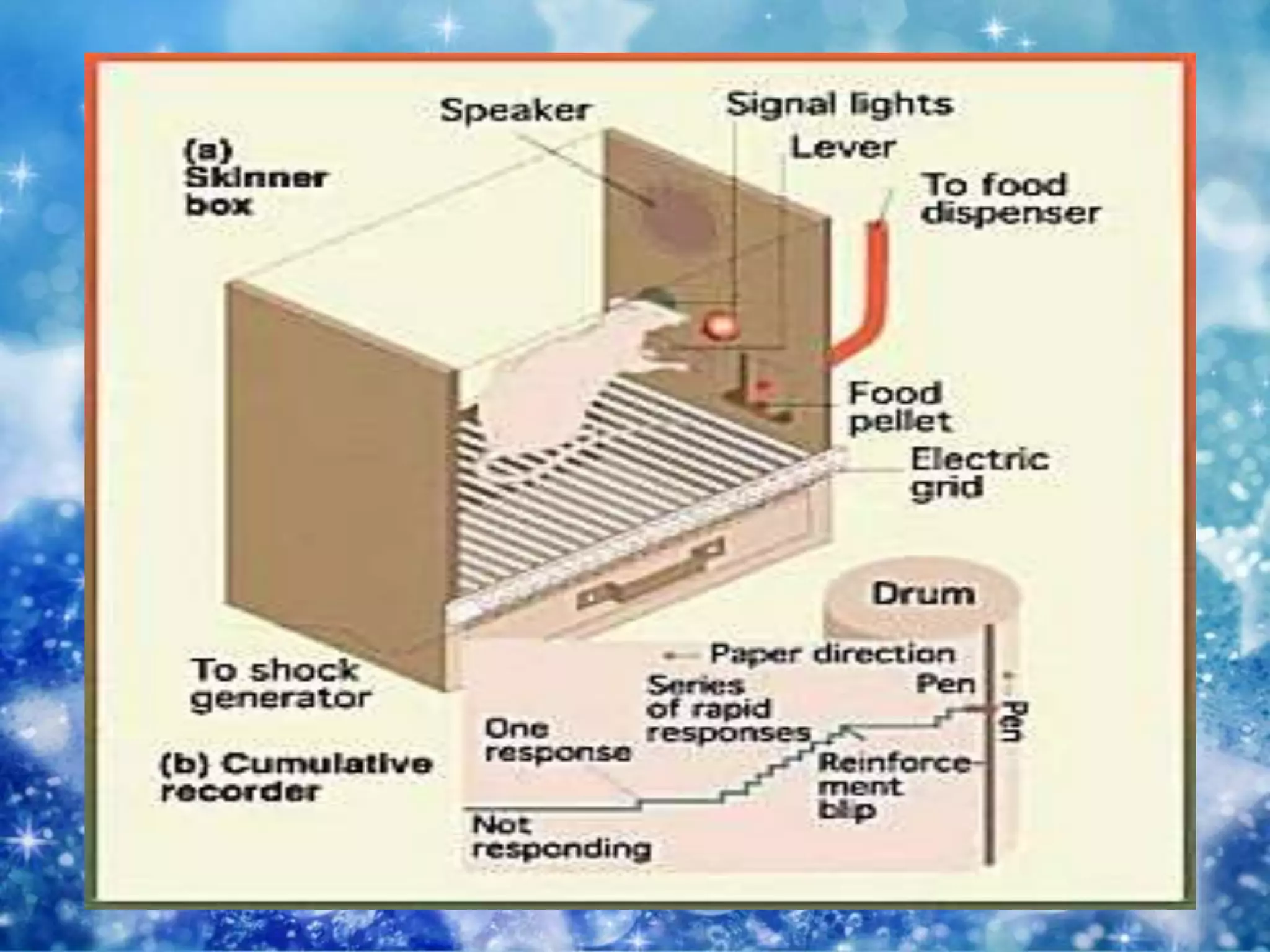
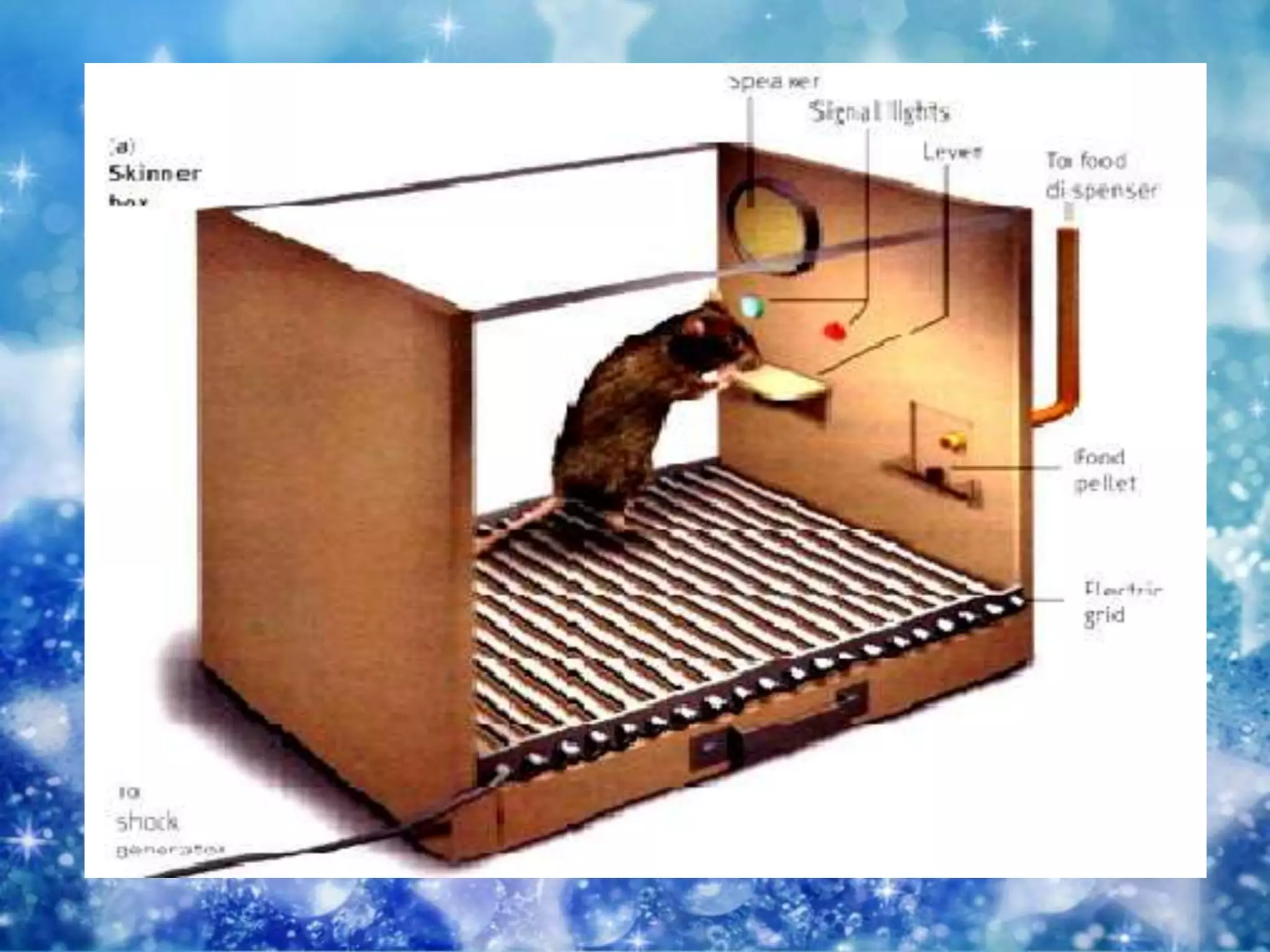
1. Operant Conditioning – involves the
learning of an association between a
spontaneously emitted action and its
consequences.
 Positive reinforcer – strengthens a prior
response through presentation of
positive stimulus
Negative Reinforcer – strengthens a
response through removal of aversive
stimulus.
2. Reinforcement – any stimulus that
increases the likelihood of a prior response.
3. Punishment – any stimulus that decreases
the likelihood of a prior response.
Positive punisher – weakens a response
through presentation of aversive stimulus
Negative punisher – weakens behavior
through removal of a stimulus
characterized as positive.
Practical Applications of Operant
Conditioning
1. Clinical purposes – foundation for
behavior mode using reinforcement to
change maladaptive thoughts, feelings
and behaviors. It also forms the basis for
“biofeedback” – a procedure where
people learn to control their own
automatic processes by receiving
continuous information or feedback in
the form of visual or auditory displays.
2. Work place settings – recognizing
employees’ performance.
3. Student classroom – animated
displays of correct answers in computer
games, earning stars, tokens for desired
behaviors and others.
Biological Constraints/Roots
Behavior is guided by an organism’s
evolutionary past, not just by personal
experience. Operant learning is limited by
an organism’s own adaptive ways.
 Latent learning (Tolman) – learning is not
exhibited in overt performance until there
is an incentive to do so. Animals learn from
experience with or without reinforcement.
Behavior is influenced more by
subjective interpretations of
reinforcement. Reinforcement can
influence behavior only if we perceive
the two as causally connected. People
differ in their generalized expectancies
for personal control and their responsive
to reinforcement.
People do not mindlessly repeat
behaviors that are followed by
reinforcement but, instead, are
influenced by their perception, beliefs
and expectations.
Steps in Observational Learning
a. Attention – command our attention to model’s
behavior
b. Retention – behavior must be memorable, must
be recalled
c. Motivation – expectations for reinforcement –
based not only on personal experience but on
the experiences of others.
Vicarious reinforcement – people are more likely to
imitate models who were rewarded for their
behavior and less likely to imitate those who are
punished. Learning can occur without direct,
firsthand experience.
1. Acquisition of a CR is influenced by
the order and timing of the CS-US
pairing.
2. Extinction – repeated presentation of
the CS without the US causes the CR
to lose its power, although there is an
occasional rebound effect called
spontaneous recovery.
3. After an organism is conditioned to a
CS, similar stimuli will often evoke the CR
through stimulus generalization.
4. Discrimination is the opposite process,
one of learning to distinguish between
stimuli.
Therefore, psychology is grounded in S-
R behaviorism. However, biological
disposition the cognitive process and
other factors residing within the
organism are important.
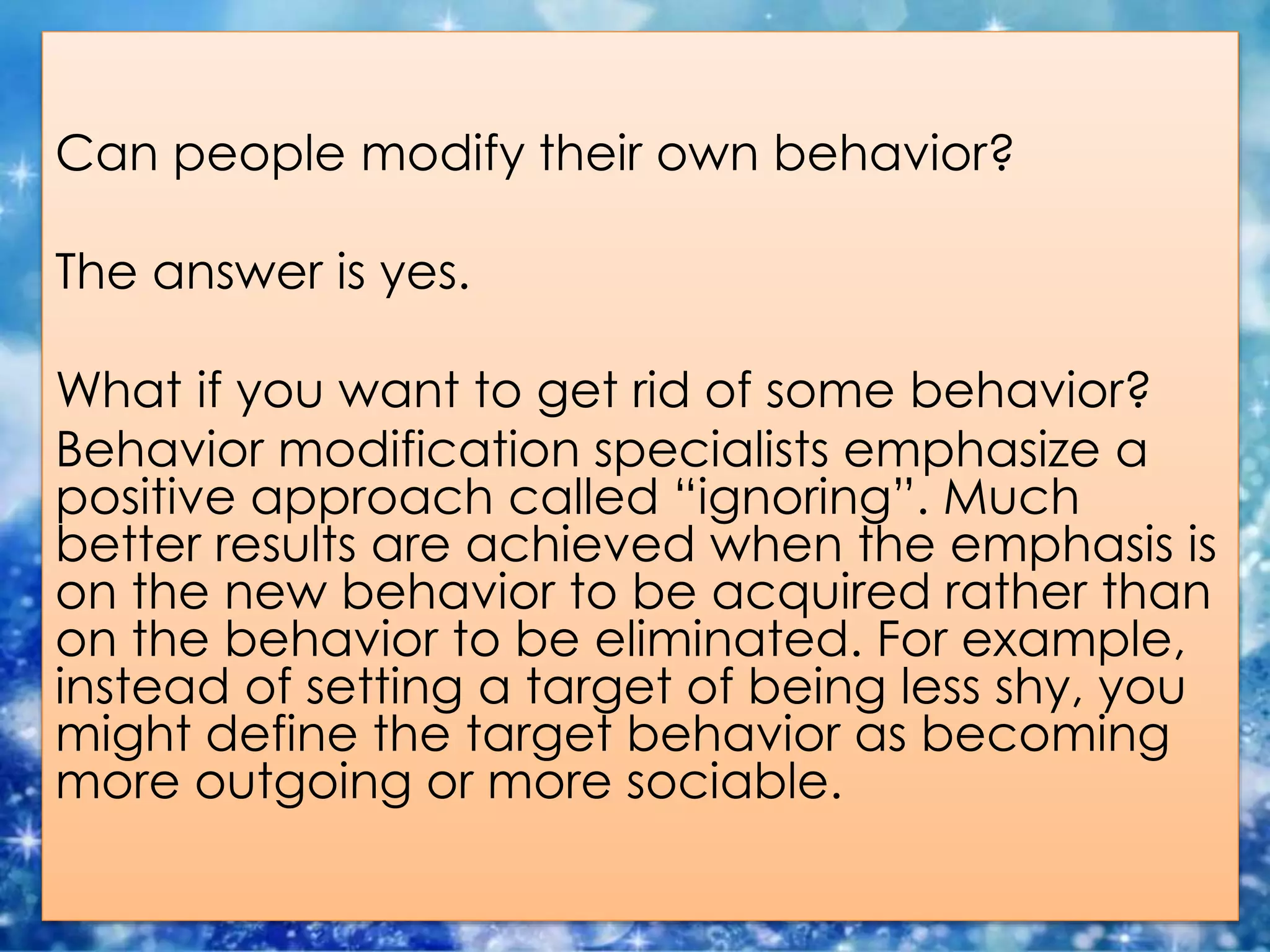
Can people modify their own behavior?
The answer is yes.
What if you want to get rid of some behavior?
Behavior modification specialists emphasize a
positive approach called “ignoring”. Much
better results are achieved when the emphasis is
on the new behavior to be acquired rather than
on the behavior to be eliminated. For example,
instead of setting a target of being less shy, you
might define the target behavior as becoming
more outgoing or more sociable.
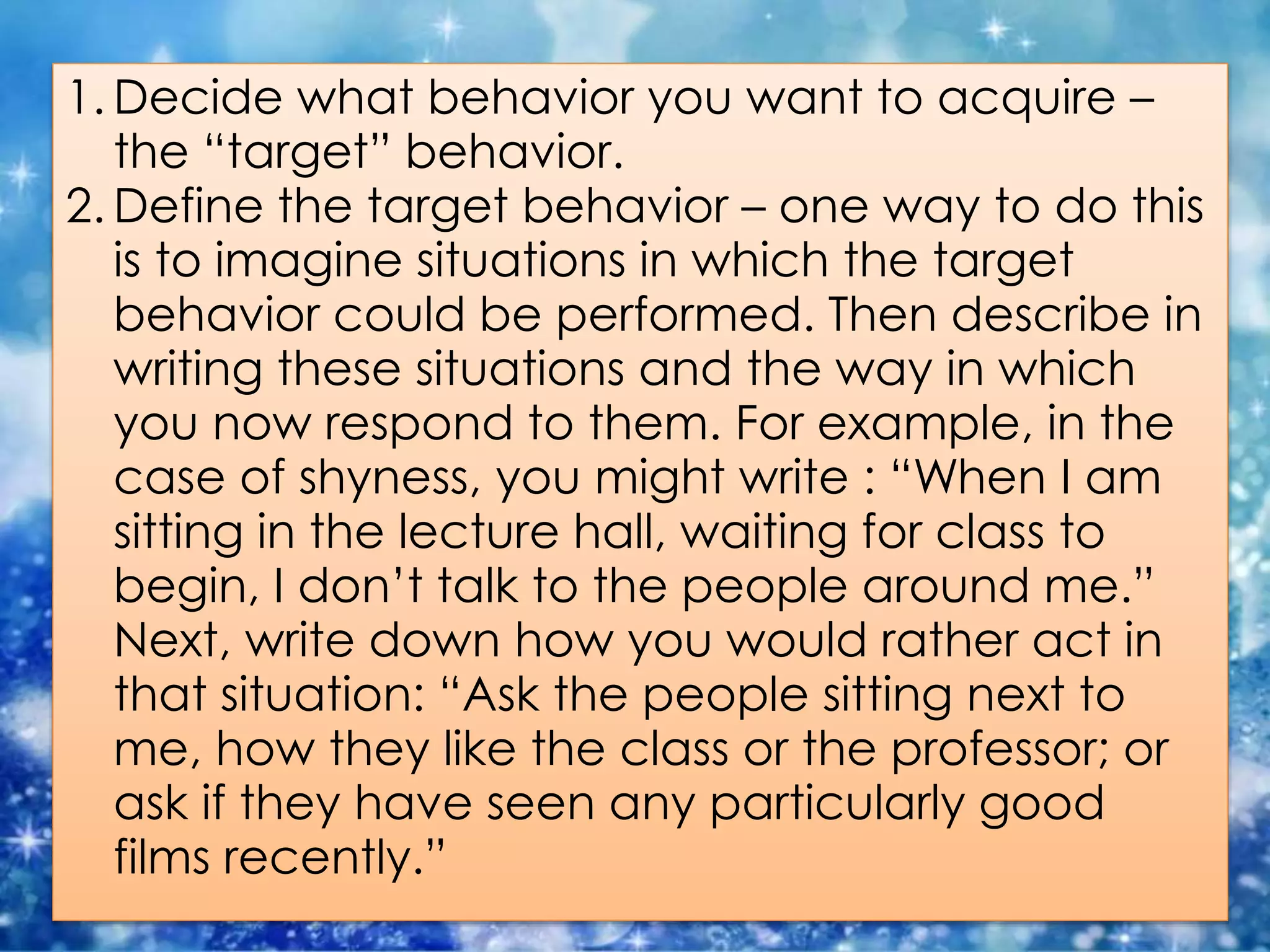
1. Decide what behavior you want to acquire –
the “target” behavior.
2. Define the target behavior – one way to do this
is to imagine situations in which the target
behavior could be performed. Then describe in
writing these situations and the way in which
you now respond to them. For example, in the
case of shyness, you might write : “When I am
sitting in the lecture hall, waiting for class to
begin, I don’t talk to the people around me.”
Next, write down how you would rather act in
that situation: “Ask the people sitting next to
me, how they like the class or the professor; or
ask if they have seen any particularly good
films recently.”
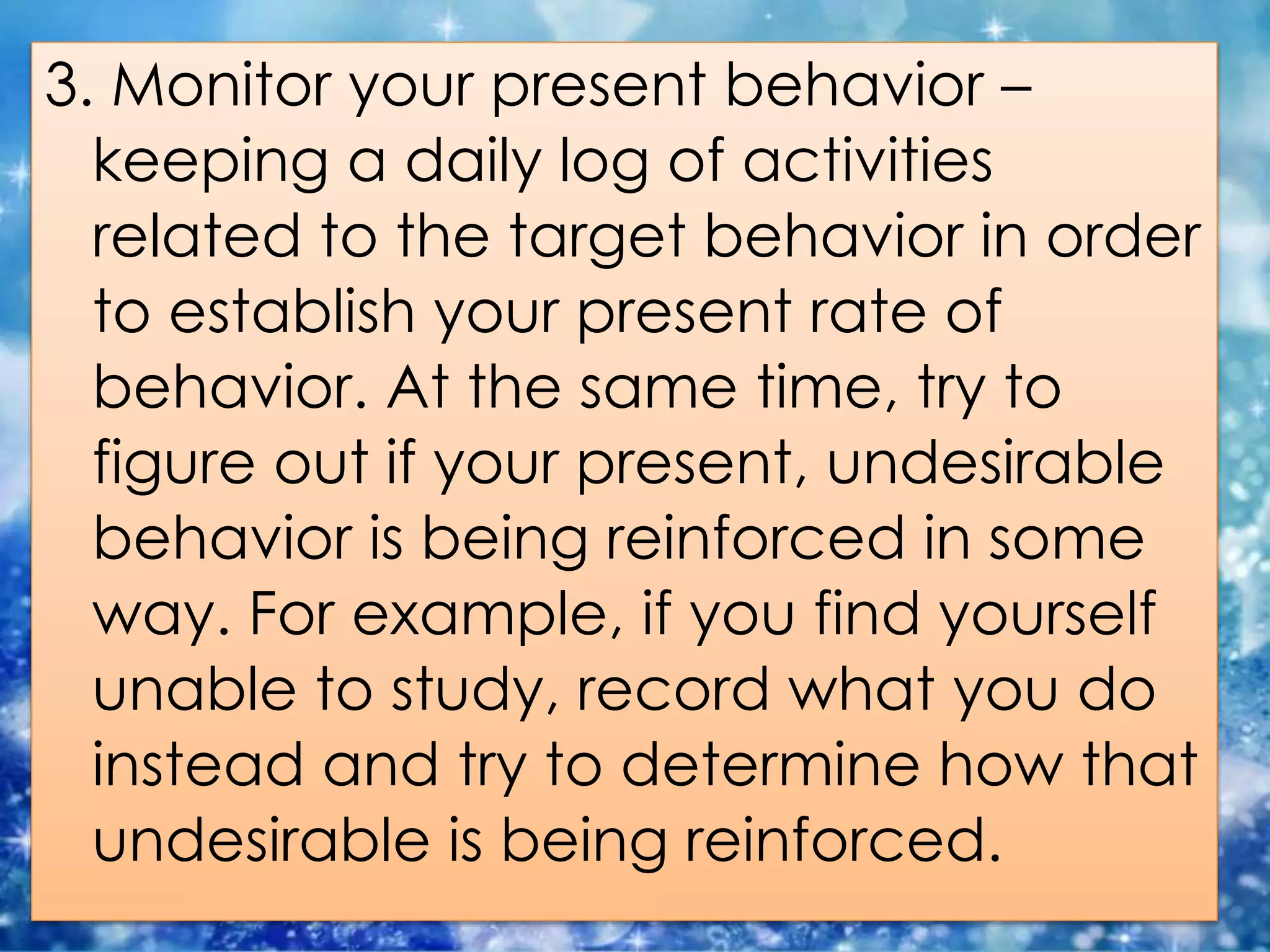
3. Monitor your present behavior –
keeping a daily log of activities
related to the target behavior in order
to establish your present rate of
behavior. At the same time, try to
figure out if your present, undesirable
behavior is being reinforced in some
way. For example, if you find yourself
unable to study, record what you do
instead and try to determine how that
undesirable is being reinforced.
4. Provide yourself with a positive reinforce that is
contingent on specific improvements in the target
behavior. – You may be able to use the same
reinforce. Watson and Tharp (1981) use the
example of a student who wanted to improve his
relationship with his parents. He first counted the
times he said a pleasant remark to them and then
rewarded himself for improvement by making his
favorite pastime, playing pool, contingent on the
predetermined increases in the number of
pleasant remarks he made.
Remember that behavior needs not to be
learned all in one piece. You can use shaping or
successive approximations to change your behavior
bit by bit over a period of time.
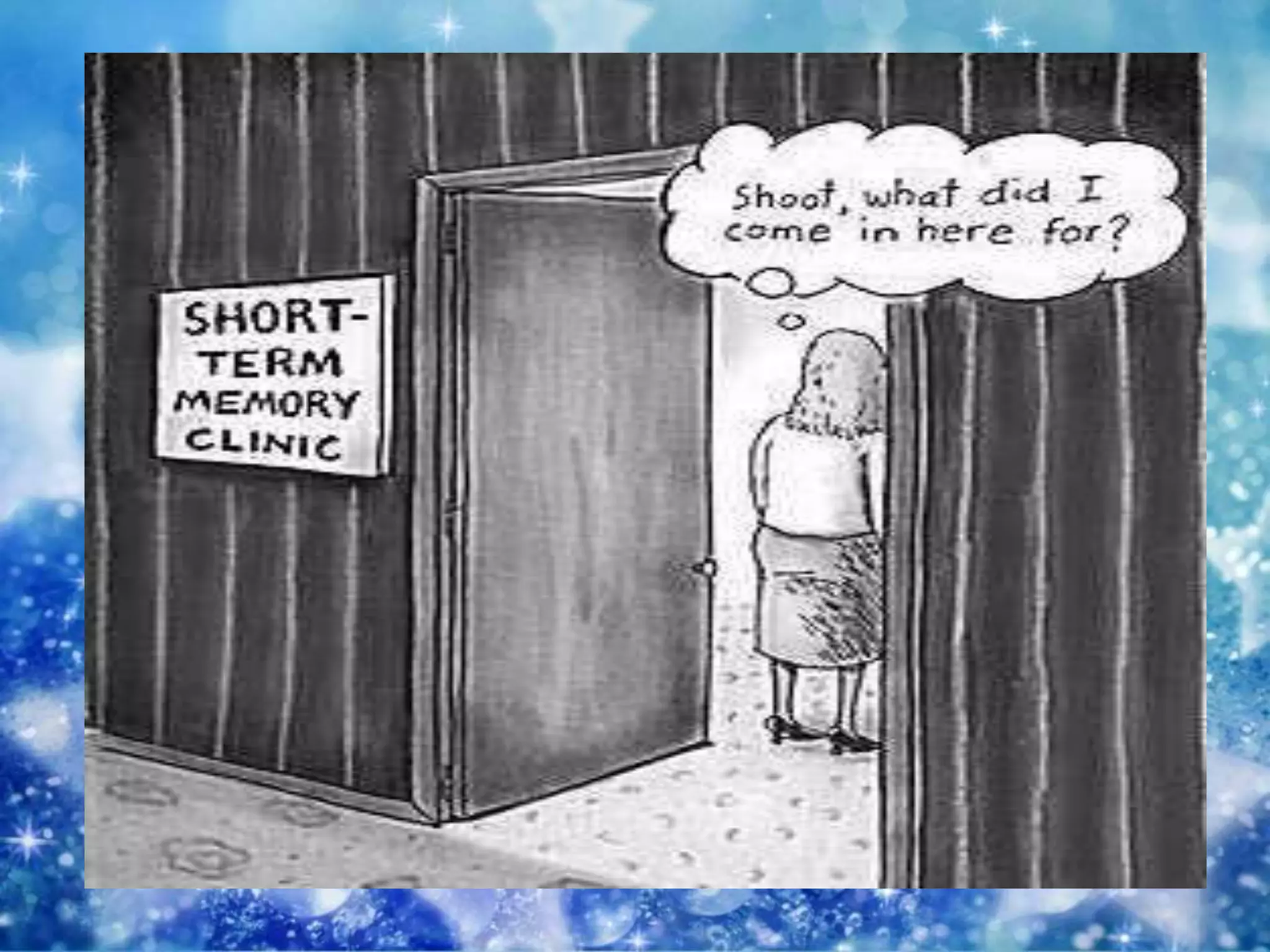
MEMORY
•You rely on your memory every moment
of the day. Without it you would have no
sense of continuity, no realization of the
past, and you could not benefit from any
learning or experience. Without memory it
would be impossible for you to function.
•From birth to death, the average person
stores 500 times more information than the
Encyclopedia Britannica.
Memory is an expression – processing system
(cognitive psychologists)
•Sensory memory – stores sensation for a brief
moment.
•Short Term memory – those that draw
attention are transferred
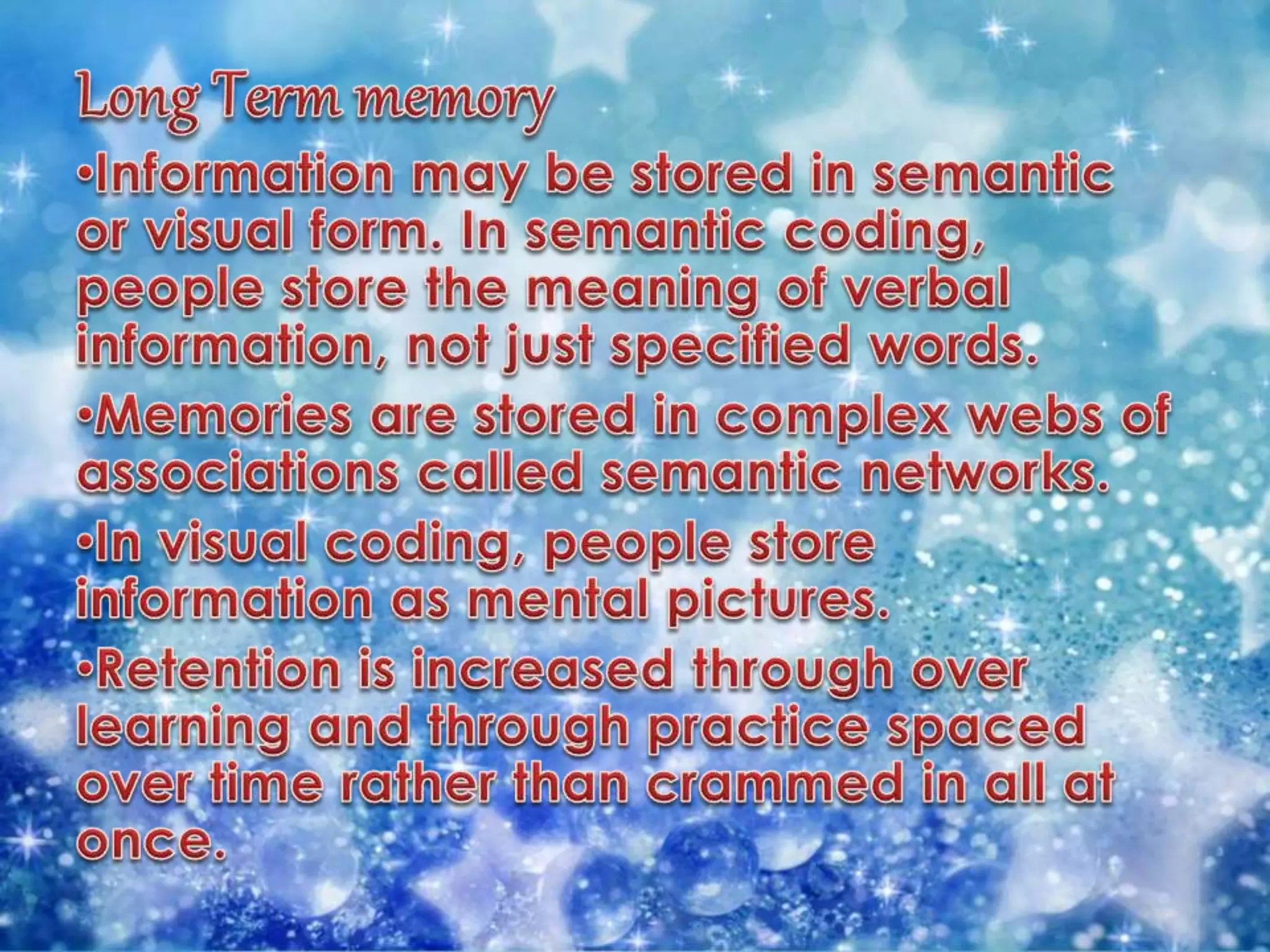
•Long term memory – those that are further
encoded are stored.
•Iconic memory – images in the visual system
lasting for only a fraction of a second before
fading.
•Echoic memory – sounds stored in the
auditory system composed of few items only
lasting for 2 to 3 seconds, sometimes longer.
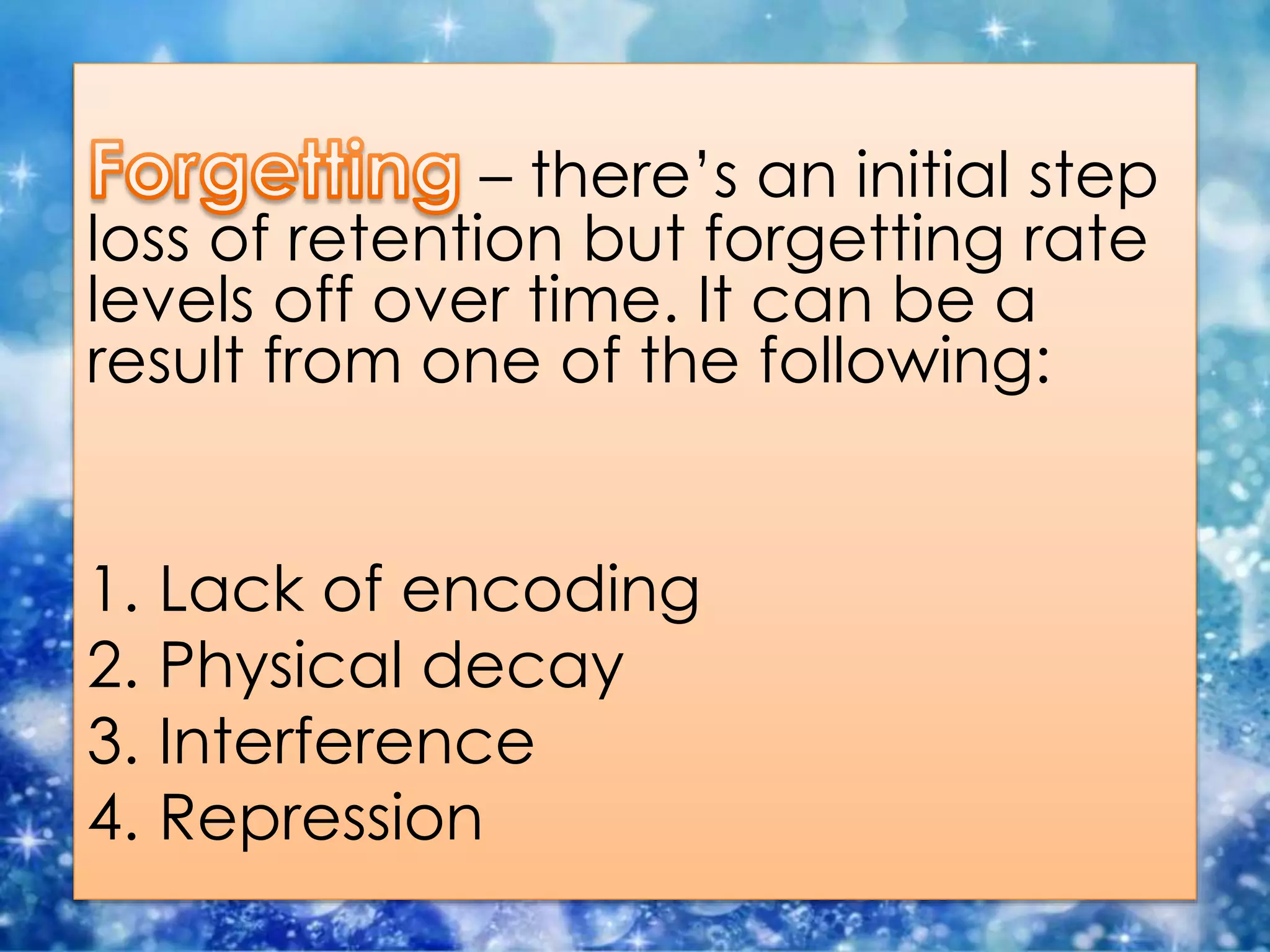
– there’s an initial step
loss of retention but forgetting rate
levels off over time. It can be a
result from one of the following:
1. Lack of encoding
2. Physical decay
3. Interference
4. Repression
2 types of interference
1. Practice interference – prior
information exhibits one’s ability to
recall something new.
2. Retroactive interference – new
material disrupts memory for
previously learned information.
remembering is an active process in
which people construct memories based
on schemes, or preconceptions and
information from outside sources.
consists of recollections people have
their own personal experiments. People
can best recall events from events from
recent than distant past although other
adults report personal memories from age
range of 11 to 30 yrs. and tend to recall
events which are particularly vivid,
dramatic and unique.
The Zeigarnik effect states that people
remember uncompleted or interrupted tasks
better than completed tasks. (Wikipedia, 2013)
Soviet psychologist Bluma Zeigarnik first studied
the phenomenon after her professor, Gestalt
psychologist Kurt Lewin, noticed that a waiter had
better recollections of still unpaid orders.
However, several replication studies of Zeigarniks
experiment, done later in other countries, failed to
find significant differences in recall between
finished and unfinished (interrupted) tasks (e.g.
Van Bergen, 1968).
In Gestalt psychology, the Zeigarnik
effect has been used to demonstrate the
general presence of Gestalt phenomena:
not just appearing as perceptual effects,
but also present in cognition.
The Zeigarnik effect suggests that
students who suspend their study, during
which they do unrelated activities (such as
studying unrelated subjects or playing
games), will remember material better than
students who complete study sessions
without a break (Zeigarnik, 1927; McKinney
1935).
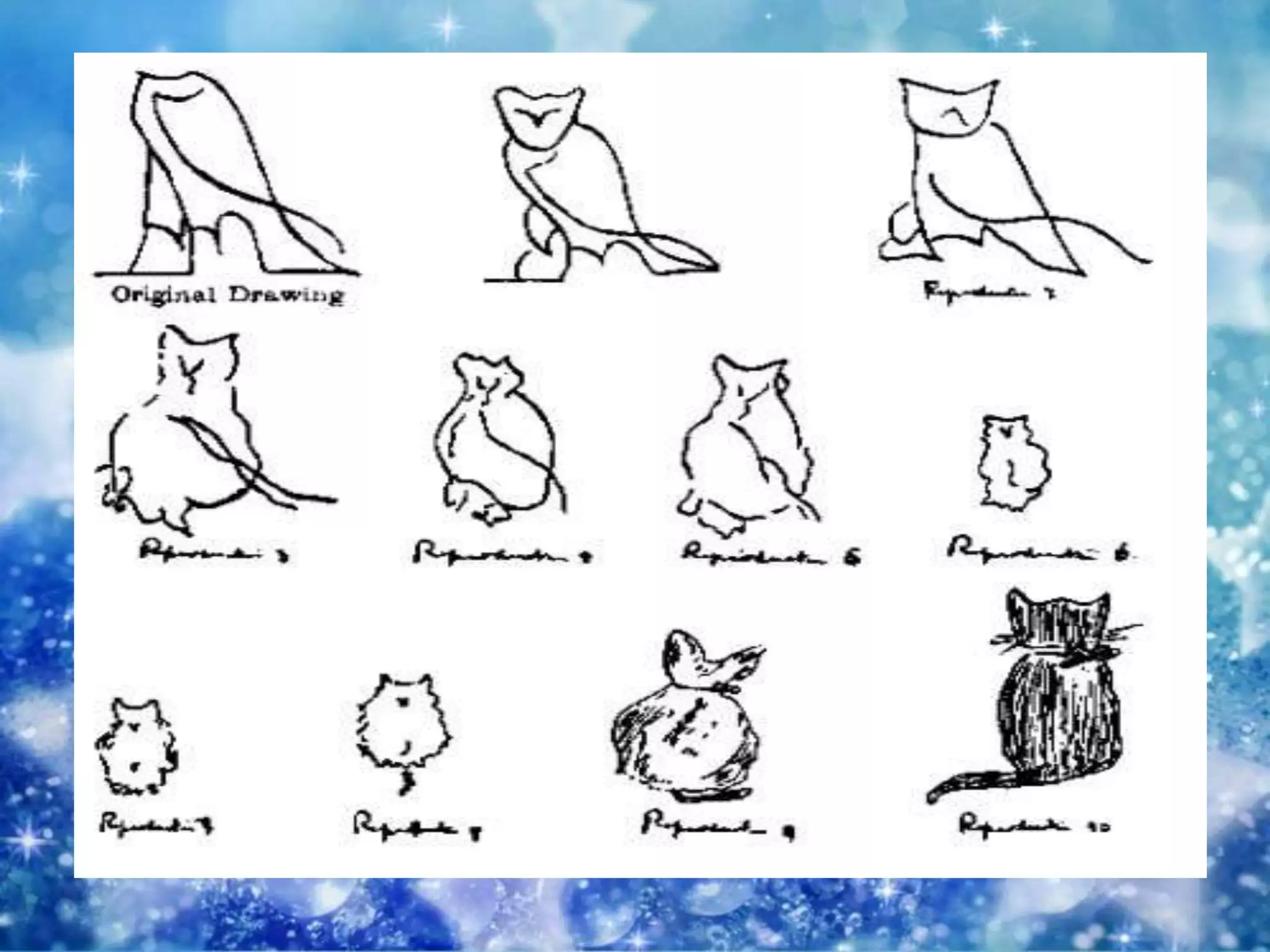
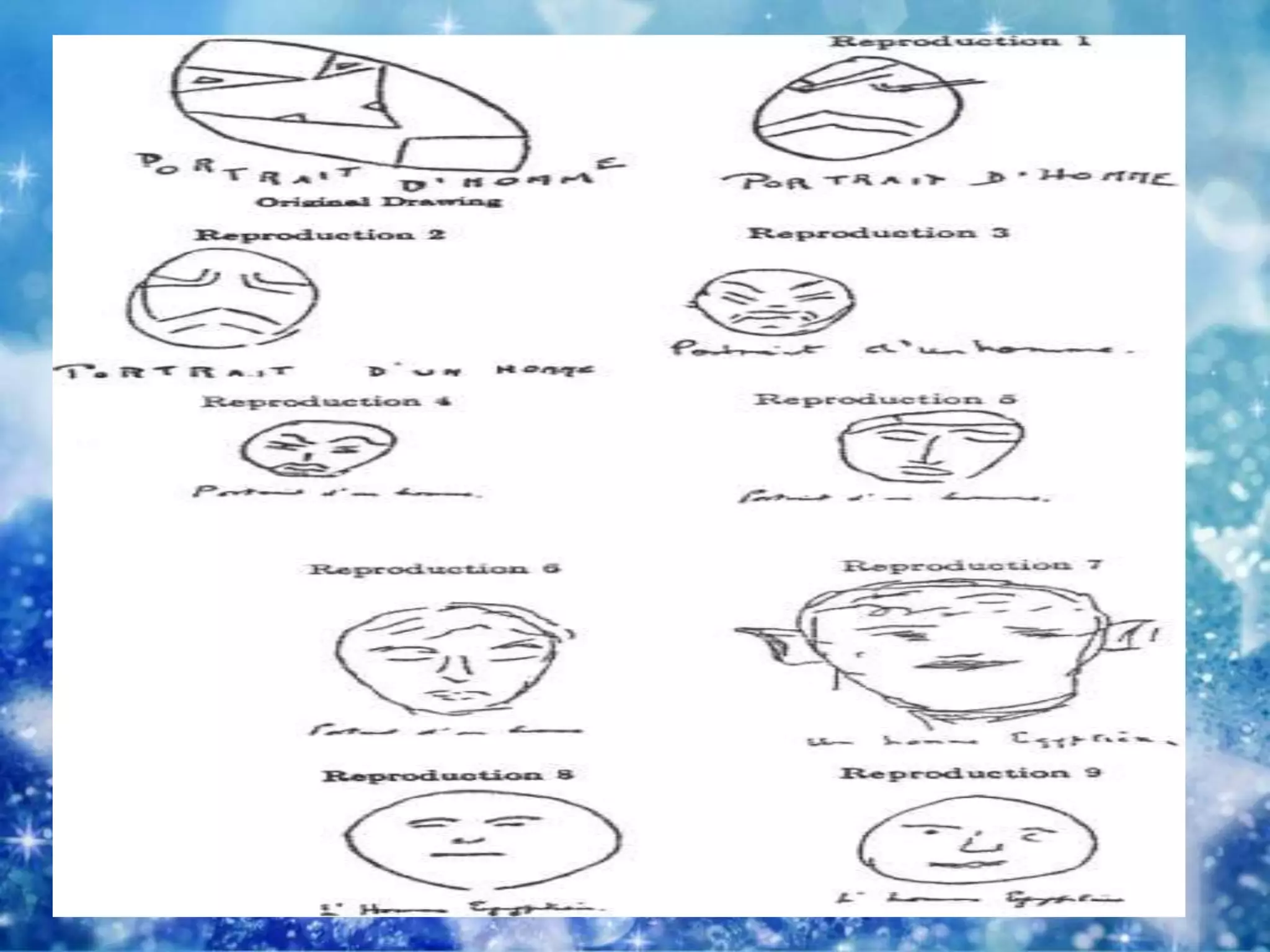
Serial reproduction deals with the
process of images reproduction and the
transformation/dilution of meaning. Each
piece is casted using as a model the result of
the previous iteration. By continuously
reproducing an already reproduced object,
the imperfection of the process is thus
amplified, allowing them to slowly mutate
and redefine in an autonomous way. The
outcome is a series of unique objects that
can only be understood when seen as a
part of a whole and not as independent
pieces.
(http://www.meirlobaton.com/selected-
work/serial-reproduction/)
The tip-of-the-tongue phenomenon
(TOT), sometimes called presque vu, is
the failure to retrieve a word from
memory, combined with
partial recall and the feeling that
retrieval is imminent. The phenomenon's
name comes from the saying, "It's on
the tip of my tongue."
People in a tip-of-the-tongue state can
often recall one or more features of the
target word, such as the first letter,
its syllabic stress, and words similar in sound
and/or meaning. Individuals report a
feeling of being seized by the state,
feeling something like mild anguish while
searching for the word, and a sense of
relief when the word is found. While many
aspects of the tip-of-the-tongue state
remain unclear, there are two major
competing explanations for its
occurrence, the direct-access view and
the inferential view.
The direct-access view posits that the
state occurs when memory strength is not
enough to recall an item, but is strong
enough to trigger the state. The inferential
view posits that the state occurs when the
subject infers knowledge of the target
word, and tries to piece together different
clues about the word that are accessible
in memory. Emotional-induced retrieval
often causes more TOT experiences than
emotionally-neutral retrieval, such as
asking where a famous icon was
assassinated rather than simply asking the
capitol city of a state.
1.Distribution of Practice – for most kinds
of material, spaced learning is more
efficient than mass learning.
2.Intervening Activities – what we do
during the time between learning and
recall is a factor of retention. We are
most apt to retain material if we go to
sleep immediately after learning it,
because there are no intervening
activities to interfere with retention.
3. Knowledge of Results – if we are informed of our
progress, either by being told how poorly we are
doing or by seeing the results directly, we can
correct our errors. This is the principle behind
programmed instruction – the learner receives
immediate feedback, telling him how well he is
doing. Feedback seems also to provide
reinforcement. A delay in feedback does not in itself
appear to influence retention, but it does allow
intervening activities to interfere.
4. Whole vs. Part learning – whole learning is usually
more efficient than learning by parts and then trying
to put them all together, but much depends on the
way the material is organized. Consider the following
list of words:
a.North, Man, Red, Spring, Woman, East,
Autumn, Yellow, Summer, Boy, Blue, West,
Winter, Girl, Green, South.
b.North, East, South, West, Spring, Summer,
Autumn, Winter, Yellow, Green, Blue,
Man, Woman, Boy, Girl.
The second list is easier to learn because
of the way it is organized. Material can
be efficiently learned by parts, however,
if the parts are logical subunits of the
whole.
5. Meaning – it is easier to learn and
remember something if you understand its
overall meaning and can relate it material
you already know. The organization of
learned material is crucial to both storage
and retrieval.
6. Motivation – continuous routine repetition
will less effective than fewer repetitions
accompanied by intent to learn. We are
more receptive to learning if we know that
the material will be useful to us later, through
we may only remember it for a short time –
long enough to take test, for example.
Memory can be impaired by various
injuries and diseases. Damage to the medial
temporal lobe and hippocampus can
devastate the ability to acquire new
declarative memory; damage to the
storage areas in cortex can disrupt retrieval
of old memories and interfere with
acquisition of new memories -- simply
because there is nowhere to put them.
Another critical factor is attention. Items
are more likely to be remembered if they are
attended to in the first place; this is why
novel or exciting items are more likely to be
remembered than dull or ordinary ones.
Damage to the frontal lobes, which disrupts
attention, may affect memory.
Various psychiatric disorders such as paranoia and
schizophrenia may affect memory adversely,
either by disrupting attention or by disrupting the
biological bases of memory, or both.
Alzheimer's disease causes memory impairments
from the early stages, probably because of cell
death in the basal forebrain, an area that
produces the chemical acetylcholine which
facilitates plasticity (learning). Recent memories
tend to be poorly remembered, while there may
be good memory for long-ago events.
Other conditions such as viral infections, depression
and use of drugs (including medication) can
affect memory by disrupting brain chemicals as
well.
(http://www.memorylossonline.com/glossary/mem
ory.html)
The causes of memory pathology
are invariably traced to brain damaged.
But what causes brain damage?
Nutritional imbalances may be an
important factor in some cases.
Accidents, including those caused
inadvertently during surgical operations,
are another. Other researches show that
supposedly beneficial drugs like
antibiotics can cause varying degrees of
forgetfulness, apparently by inhibiting
essential protein synthesis (Rosenzweig &
Leiman, 1982)
A flashbulb memory is a highly detailed,
exceptionally vivid 'snapshot' of the moment
and circumstances in which a piece of
surprising and consequential (or emotionally
arousing) news was heard. Flashbulb
memory is an appropriate name for the
phenomenon in that it suggests surprise, an
indiscriminate illumination, and brevity. The
name is inappropriate as an actual
photograph is indiscriminate and preserves
everything within its scope. Flashbulb
memories, in actuality, are only somewhat
indiscriminate and are far from complete.
Evidence has shown that although people
are highly confident in their memories, the
details of the memories can be forgotten.
Flashbulb memories are one type
of autobiographical memory. Some
researchers believe that there is reason
to distinguish flashbulb memories from
other types of autobiographical
memory because they rely on elements
of personal importance,
consequentiality, emotion, and surprise.
Others believe that ordinary memories
can also be accurate and long lasting if
they are highly distinctive, personally
significant, or repeatedly rehearsed.
(Wikipedia, 2013)
•The Freudian slip is named
after Sigmund Freud, who, in his 1901
book The Psychopathology of Everyday
Life, described and analyzed a large
number of seemingly trivial, bizarre, or
nonsensical errors and slips.
•It is unknown who first coined the term
"Freudian slip", but it has since come to
be used around the world and has
been found in various pop-culture
references and even found its way into
everyday speech.
•In contrast to psychoanalytic theorists,
cognitive psychologists claim that linguistic
slips can represent a sequencing conflict in
grammar production. From this perspective,
slips may be due to cognitive under
specification that can take a variety of forms
– inattention, incomplete sense data or
insufficient knowledge. Secondly, they may
be due to the existence of some locally
appropriate response pattern that is strongly
primed by its prior usage, recent activation or
emotional change or by the situation calling
conditions.
•The replacement of archaic or unusual
expressions with forms that are in more
common use. In other words, the errors were
due to strong habit substitution.
In general use, the term 'Freudian slip'
has been debased to refer to any
accidental tongue. Thus many
examples are found in explanations
and dictionaries which do not strictly fit
the psychoanalytic definition.
For example: She: 'What would you
like—bread and butter, or cake?' He:
'Bed and butter.
In the above, the man may be
presumed to have a sexual feeling or
intention that he wished to leave
unexpressed, not a sexual feeling or
intention that was dynamically
repressed. His sexual intention was
therefore secret, rather
than unconscious, and any 'parapraxis'
would inhere in the idea that
he unconsciously wished to express that
intention, rather than in the sexual
connotation of the substitution.
Cognitive and Affective Processes

Cognitive and Affective Processes

  • 2.
    •may be definedas a relatively permanent change in behavior that results from experience. • is also said to be the result of experience. Not all behaviors, however, are the result of experience. Behaviors that are “built into” or inherited by an organism are called unlearned or inherited behaviors.
  • 3.
    There are differentways of learning. Most of the behaviors that we consider “human” are acquired through learning and experience. The better we understand how people learn, the better able we will be to help them learn appropriate behaviors and eliminate inappropriate ones. However, this belief rests on three assumptions:
  • 4.
    1. Behavior islawful – how we behave is entirely determined by our environment and our genetic inheritance is known as determinism. 2. If the laws of behavior are known, behavior can be controlled. 3. The capacity to control behavior is desirable.
  • 5.
    There is considerableagreement that behavior is at least partially lawful – that the environment in which we find ourselves can substantially alter how we behave. If we discover the laws relating behavior to the environment, there seems little doubt that our capacity to control behavior would increase. Thus, learning is a relatively permanent change in knowledge or behavior that comes as a result of experience.
  • 7.
    Processes when welearn the relationship between events: • learning in which the organism comes to associate one stimulus with another (also called Pavlovian Conditioning)
  • 8.
    a. Unconditioned Responses(UR) – an unlearned response to an unconditioned stimulus. b. Unconditioned Stimulus (US) – stimulus that triggers an unconditioned response. c. Conditioned Stimulus (CS) – a neutral stimulus that comes to evoke a classically conditioned response. d. Conditioned Response – a learned response to a classically conditioned stimulus
  • 9.
  • 10.
    Neutral Stimulus (Bell) + (US,Meat Powder) (UR, Salivation) Conditioned Stimulus (CS, Bell) Conditioned Response (CR, Salivation)
  • 12.
    Basic Principles ofLearning: 1. Acquisition – initial learning. It is influenced by the order and timing of the presentation. 2. Extinction – elimination of a learned response by removal of the unconditioned stimulus or reinforcement
  • 13.
    3. Generalization –tendency to respond to stimulus that is similar to conditioned stimulus 4. Discrimination – ability to distinguish between different stimuli.
  • 14.
    It is aprocess by which organisms learn to behave in ways to produce reinforcement or desirable outcomes are not.
  • 15.
    Law of Effects– responses followed by positive outcomes are repeated, while those followed by negative outcomes are not. 1. Operant Conditioning – involves the learning of an association between a spontaneously emitted action and its consequences.  Positive reinforcer – strengthens a prior response through presentation of positive stimulus
  • 16.
    Negative Reinforcer –strengthens a response through removal of aversive stimulus. 2. Reinforcement – any stimulus that increases the likelihood of a prior response. 3. Punishment – any stimulus that decreases the likelihood of a prior response. Positive punisher – weakens a response through presentation of aversive stimulus Negative punisher – weakens behavior through removal of a stimulus characterized as positive.
  • 20.
    Practical Applications ofOperant Conditioning 1. Clinical purposes – foundation for behavior mode using reinforcement to change maladaptive thoughts, feelings and behaviors. It also forms the basis for “biofeedback” – a procedure where people learn to control their own automatic processes by receiving continuous information or feedback in the form of visual or auditory displays.
  • 21.
    2. Work placesettings – recognizing employees’ performance. 3. Student classroom – animated displays of correct answers in computer games, earning stars, tokens for desired behaviors and others.
  • 22.
    Biological Constraints/Roots Behavior isguided by an organism’s evolutionary past, not just by personal experience. Operant learning is limited by an organism’s own adaptive ways.  Latent learning (Tolman) – learning is not exhibited in overt performance until there is an incentive to do so. Animals learn from experience with or without reinforcement.
  • 24.
    Behavior is influencedmore by subjective interpretations of reinforcement. Reinforcement can influence behavior only if we perceive the two as causally connected. People differ in their generalized expectancies for personal control and their responsive to reinforcement. People do not mindlessly repeat behaviors that are followed by reinforcement but, instead, are influenced by their perception, beliefs and expectations.
  • 26.
    Steps in ObservationalLearning a. Attention – command our attention to model’s behavior b. Retention – behavior must be memorable, must be recalled c. Motivation – expectations for reinforcement – based not only on personal experience but on the experiences of others. Vicarious reinforcement – people are more likely to imitate models who were rewarded for their behavior and less likely to imitate those who are punished. Learning can occur without direct, firsthand experience.
  • 27.
    1. Acquisition ofa CR is influenced by the order and timing of the CS-US pairing. 2. Extinction – repeated presentation of the CS without the US causes the CR to lose its power, although there is an occasional rebound effect called spontaneous recovery.
  • 28.
    3. After anorganism is conditioned to a CS, similar stimuli will often evoke the CR through stimulus generalization. 4. Discrimination is the opposite process, one of learning to distinguish between stimuli. Therefore, psychology is grounded in S- R behaviorism. However, biological disposition the cognitive process and other factors residing within the organism are important.
  • 30.
    Can people modifytheir own behavior? The answer is yes. What if you want to get rid of some behavior? Behavior modification specialists emphasize a positive approach called “ignoring”. Much better results are achieved when the emphasis is on the new behavior to be acquired rather than on the behavior to be eliminated. For example, instead of setting a target of being less shy, you might define the target behavior as becoming more outgoing or more sociable.
  • 31.
    1. Decide whatbehavior you want to acquire – the “target” behavior. 2. Define the target behavior – one way to do this is to imagine situations in which the target behavior could be performed. Then describe in writing these situations and the way in which you now respond to them. For example, in the case of shyness, you might write : “When I am sitting in the lecture hall, waiting for class to begin, I don’t talk to the people around me.” Next, write down how you would rather act in that situation: “Ask the people sitting next to me, how they like the class or the professor; or ask if they have seen any particularly good films recently.”
  • 32.
    3. Monitor yourpresent behavior – keeping a daily log of activities related to the target behavior in order to establish your present rate of behavior. At the same time, try to figure out if your present, undesirable behavior is being reinforced in some way. For example, if you find yourself unable to study, record what you do instead and try to determine how that undesirable is being reinforced.
  • 33.
    4. Provide yourselfwith a positive reinforce that is contingent on specific improvements in the target behavior. – You may be able to use the same reinforce. Watson and Tharp (1981) use the example of a student who wanted to improve his relationship with his parents. He first counted the times he said a pleasant remark to them and then rewarded himself for improvement by making his favorite pastime, playing pool, contingent on the predetermined increases in the number of pleasant remarks he made. Remember that behavior needs not to be learned all in one piece. You can use shaping or successive approximations to change your behavior bit by bit over a period of time.
  • 34.
    MEMORY •You rely onyour memory every moment of the day. Without it you would have no sense of continuity, no realization of the past, and you could not benefit from any learning or experience. Without memory it would be impossible for you to function. •From birth to death, the average person stores 500 times more information than the Encyclopedia Britannica.
  • 35.
    Memory is anexpression – processing system (cognitive psychologists) •Sensory memory – stores sensation for a brief moment. •Short Term memory – those that draw attention are transferred •Long term memory – those that are further encoded are stored. •Iconic memory – images in the visual system lasting for only a fraction of a second before fading. •Echoic memory – sounds stored in the auditory system composed of few items only lasting for 2 to 3 seconds, sometimes longer.
  • 40.
    – there’s aninitial step loss of retention but forgetting rate levels off over time. It can be a result from one of the following: 1. Lack of encoding 2. Physical decay 3. Interference 4. Repression
  • 42.
    2 types ofinterference 1. Practice interference – prior information exhibits one’s ability to recall something new. 2. Retroactive interference – new material disrupts memory for previously learned information.
  • 43.
    remembering is anactive process in which people construct memories based on schemes, or preconceptions and information from outside sources. consists of recollections people have their own personal experiments. People can best recall events from events from recent than distant past although other adults report personal memories from age range of 11 to 30 yrs. and tend to recall events which are particularly vivid, dramatic and unique.
  • 44.
    The Zeigarnik effectstates that people remember uncompleted or interrupted tasks better than completed tasks. (Wikipedia, 2013) Soviet psychologist Bluma Zeigarnik first studied the phenomenon after her professor, Gestalt psychologist Kurt Lewin, noticed that a waiter had better recollections of still unpaid orders. However, several replication studies of Zeigarniks experiment, done later in other countries, failed to find significant differences in recall between finished and unfinished (interrupted) tasks (e.g. Van Bergen, 1968).
  • 45.
    In Gestalt psychology,the Zeigarnik effect has been used to demonstrate the general presence of Gestalt phenomena: not just appearing as perceptual effects, but also present in cognition. The Zeigarnik effect suggests that students who suspend their study, during which they do unrelated activities (such as studying unrelated subjects or playing games), will remember material better than students who complete study sessions without a break (Zeigarnik, 1927; McKinney 1935).
  • 47.
    Serial reproduction dealswith the process of images reproduction and the transformation/dilution of meaning. Each piece is casted using as a model the result of the previous iteration. By continuously reproducing an already reproduced object, the imperfection of the process is thus amplified, allowing them to slowly mutate and redefine in an autonomous way. The outcome is a series of unique objects that can only be understood when seen as a part of a whole and not as independent pieces. (http://www.meirlobaton.com/selected- work/serial-reproduction/)
  • 51.
    The tip-of-the-tongue phenomenon (TOT),sometimes called presque vu, is the failure to retrieve a word from memory, combined with partial recall and the feeling that retrieval is imminent. The phenomenon's name comes from the saying, "It's on the tip of my tongue."
  • 52.
    People in atip-of-the-tongue state can often recall one or more features of the target word, such as the first letter, its syllabic stress, and words similar in sound and/or meaning. Individuals report a feeling of being seized by the state, feeling something like mild anguish while searching for the word, and a sense of relief when the word is found. While many aspects of the tip-of-the-tongue state remain unclear, there are two major competing explanations for its occurrence, the direct-access view and the inferential view.
  • 53.
    The direct-access viewposits that the state occurs when memory strength is not enough to recall an item, but is strong enough to trigger the state. The inferential view posits that the state occurs when the subject infers knowledge of the target word, and tries to piece together different clues about the word that are accessible in memory. Emotional-induced retrieval often causes more TOT experiences than emotionally-neutral retrieval, such as asking where a famous icon was assassinated rather than simply asking the capitol city of a state.
  • 55.
    1.Distribution of Practice– for most kinds of material, spaced learning is more efficient than mass learning. 2.Intervening Activities – what we do during the time between learning and recall is a factor of retention. We are most apt to retain material if we go to sleep immediately after learning it, because there are no intervening activities to interfere with retention.
  • 56.
    3. Knowledge ofResults – if we are informed of our progress, either by being told how poorly we are doing or by seeing the results directly, we can correct our errors. This is the principle behind programmed instruction – the learner receives immediate feedback, telling him how well he is doing. Feedback seems also to provide reinforcement. A delay in feedback does not in itself appear to influence retention, but it does allow intervening activities to interfere. 4. Whole vs. Part learning – whole learning is usually more efficient than learning by parts and then trying to put them all together, but much depends on the way the material is organized. Consider the following list of words:
  • 57.
    a.North, Man, Red,Spring, Woman, East, Autumn, Yellow, Summer, Boy, Blue, West, Winter, Girl, Green, South. b.North, East, South, West, Spring, Summer, Autumn, Winter, Yellow, Green, Blue, Man, Woman, Boy, Girl. The second list is easier to learn because of the way it is organized. Material can be efficiently learned by parts, however, if the parts are logical subunits of the whole.
  • 58.
    5. Meaning –it is easier to learn and remember something if you understand its overall meaning and can relate it material you already know. The organization of learned material is crucial to both storage and retrieval. 6. Motivation – continuous routine repetition will less effective than fewer repetitions accompanied by intent to learn. We are more receptive to learning if we know that the material will be useful to us later, through we may only remember it for a short time – long enough to take test, for example.
  • 60.
    Memory can beimpaired by various injuries and diseases. Damage to the medial temporal lobe and hippocampus can devastate the ability to acquire new declarative memory; damage to the storage areas in cortex can disrupt retrieval of old memories and interfere with acquisition of new memories -- simply because there is nowhere to put them. Another critical factor is attention. Items are more likely to be remembered if they are attended to in the first place; this is why novel or exciting items are more likely to be remembered than dull or ordinary ones. Damage to the frontal lobes, which disrupts attention, may affect memory.
  • 61.
    Various psychiatric disorderssuch as paranoia and schizophrenia may affect memory adversely, either by disrupting attention or by disrupting the biological bases of memory, or both. Alzheimer's disease causes memory impairments from the early stages, probably because of cell death in the basal forebrain, an area that produces the chemical acetylcholine which facilitates plasticity (learning). Recent memories tend to be poorly remembered, while there may be good memory for long-ago events. Other conditions such as viral infections, depression and use of drugs (including medication) can affect memory by disrupting brain chemicals as well. (http://www.memorylossonline.com/glossary/mem ory.html)
  • 62.
    The causes ofmemory pathology are invariably traced to brain damaged. But what causes brain damage? Nutritional imbalances may be an important factor in some cases. Accidents, including those caused inadvertently during surgical operations, are another. Other researches show that supposedly beneficial drugs like antibiotics can cause varying degrees of forgetfulness, apparently by inhibiting essential protein synthesis (Rosenzweig & Leiman, 1982)
  • 64.
    A flashbulb memoryis a highly detailed, exceptionally vivid 'snapshot' of the moment and circumstances in which a piece of surprising and consequential (or emotionally arousing) news was heard. Flashbulb memory is an appropriate name for the phenomenon in that it suggests surprise, an indiscriminate illumination, and brevity. The name is inappropriate as an actual photograph is indiscriminate and preserves everything within its scope. Flashbulb memories, in actuality, are only somewhat indiscriminate and are far from complete. Evidence has shown that although people are highly confident in their memories, the details of the memories can be forgotten.
  • 65.
    Flashbulb memories areone type of autobiographical memory. Some researchers believe that there is reason to distinguish flashbulb memories from other types of autobiographical memory because they rely on elements of personal importance, consequentiality, emotion, and surprise. Others believe that ordinary memories can also be accurate and long lasting if they are highly distinctive, personally significant, or repeatedly rehearsed. (Wikipedia, 2013)
  • 68.
    •The Freudian slipis named after Sigmund Freud, who, in his 1901 book The Psychopathology of Everyday Life, described and analyzed a large number of seemingly trivial, bizarre, or nonsensical errors and slips. •It is unknown who first coined the term "Freudian slip", but it has since come to be used around the world and has been found in various pop-culture references and even found its way into everyday speech.
  • 69.
    •In contrast topsychoanalytic theorists, cognitive psychologists claim that linguistic slips can represent a sequencing conflict in grammar production. From this perspective, slips may be due to cognitive under specification that can take a variety of forms – inattention, incomplete sense data or insufficient knowledge. Secondly, they may be due to the existence of some locally appropriate response pattern that is strongly primed by its prior usage, recent activation or emotional change or by the situation calling conditions. •The replacement of archaic or unusual expressions with forms that are in more common use. In other words, the errors were due to strong habit substitution.
  • 70.
    In general use,the term 'Freudian slip' has been debased to refer to any accidental tongue. Thus many examples are found in explanations and dictionaries which do not strictly fit the psychoanalytic definition. For example: She: 'What would you like—bread and butter, or cake?' He: 'Bed and butter.
  • 71.
    In the above,the man may be presumed to have a sexual feeling or intention that he wished to leave unexpressed, not a sexual feeling or intention that was dynamically repressed. His sexual intention was therefore secret, rather than unconscious, and any 'parapraxis' would inhere in the idea that he unconsciously wished to express that intention, rather than in the sexual connotation of the substitution.