LEARNING
ROBIN CHEAH
INTRO TO PSYCHOLOGY
TUTORIAL 5
LEARNING OUTCOMES
Define
Define learning
Compare
Compare classical
and operant
conditioning
Explain
Explain how we
learn using
cognitive learning
theory
Describe
Describe
observational
learning theory
Apply
Apply theories in
everyday life
INTRODUCTION
From the day we born until the day we die, we never stop learning
Born: learning how to crawl
Child: Learning how to read
Adulthood: Navigating life challenges
Old Age: Coping with retirement
3
LEARNING
4
Concepts
Theories
Ideas
Mental abstraction
LEARNING
WHAT IS LEARNING?
5
We learn many things
by observing and
imitating people
We also learn through
association
Learning as an
association between a
stimulus (e.g. toys) and
a response (e.g.
happiness) :
Conditioning
WHAT IS
LEARNING
There are many ways we have
been conditioned without even
realising
6
EXAMPLES OF
CONDITIONING
7
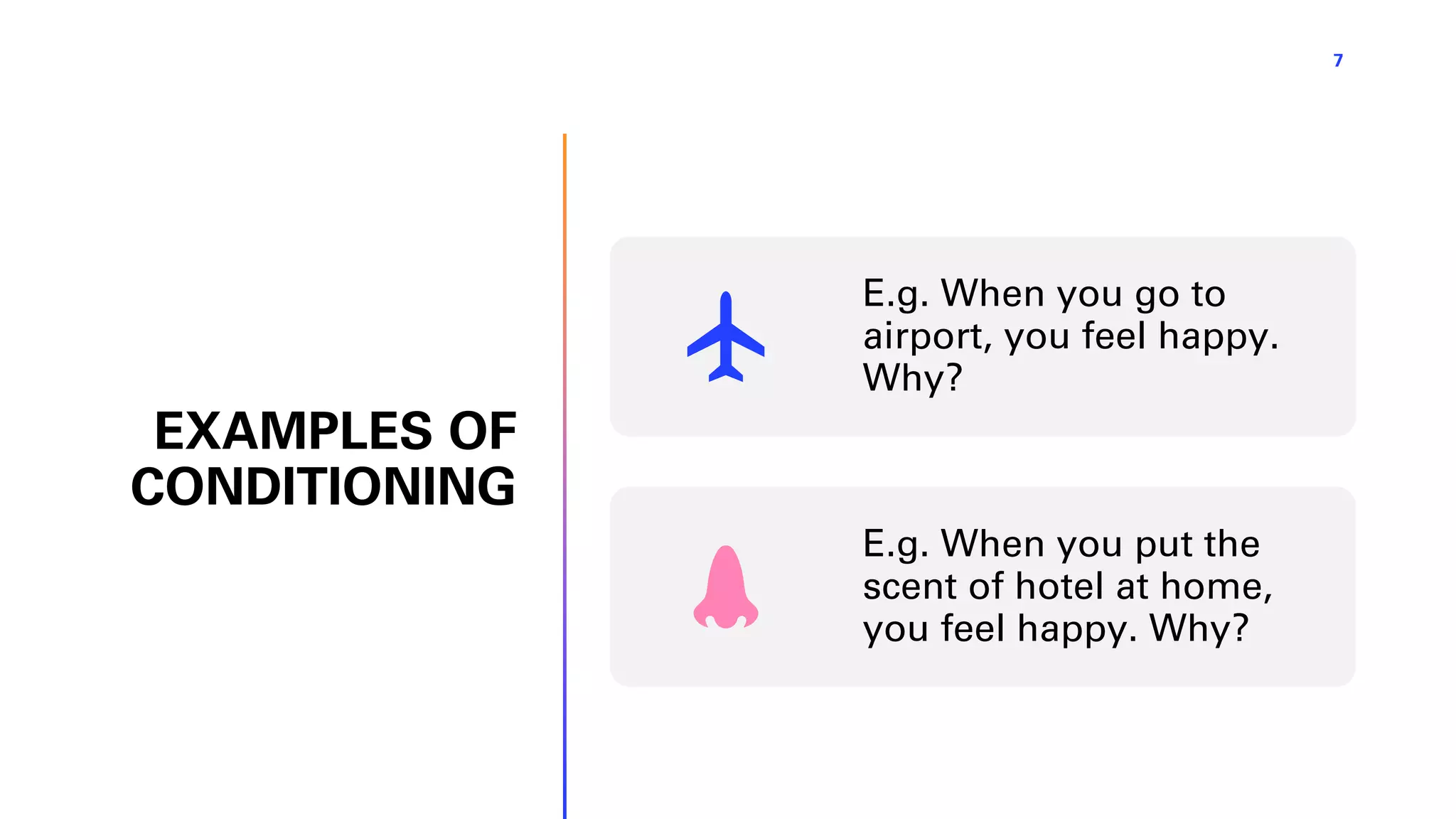
E.g. When you go to
airport, you feel happy.
Why?
E.g. When you put the
scent of hotel at home,
you feel happy. Why?
SOURCE
OF
LEARNING
8
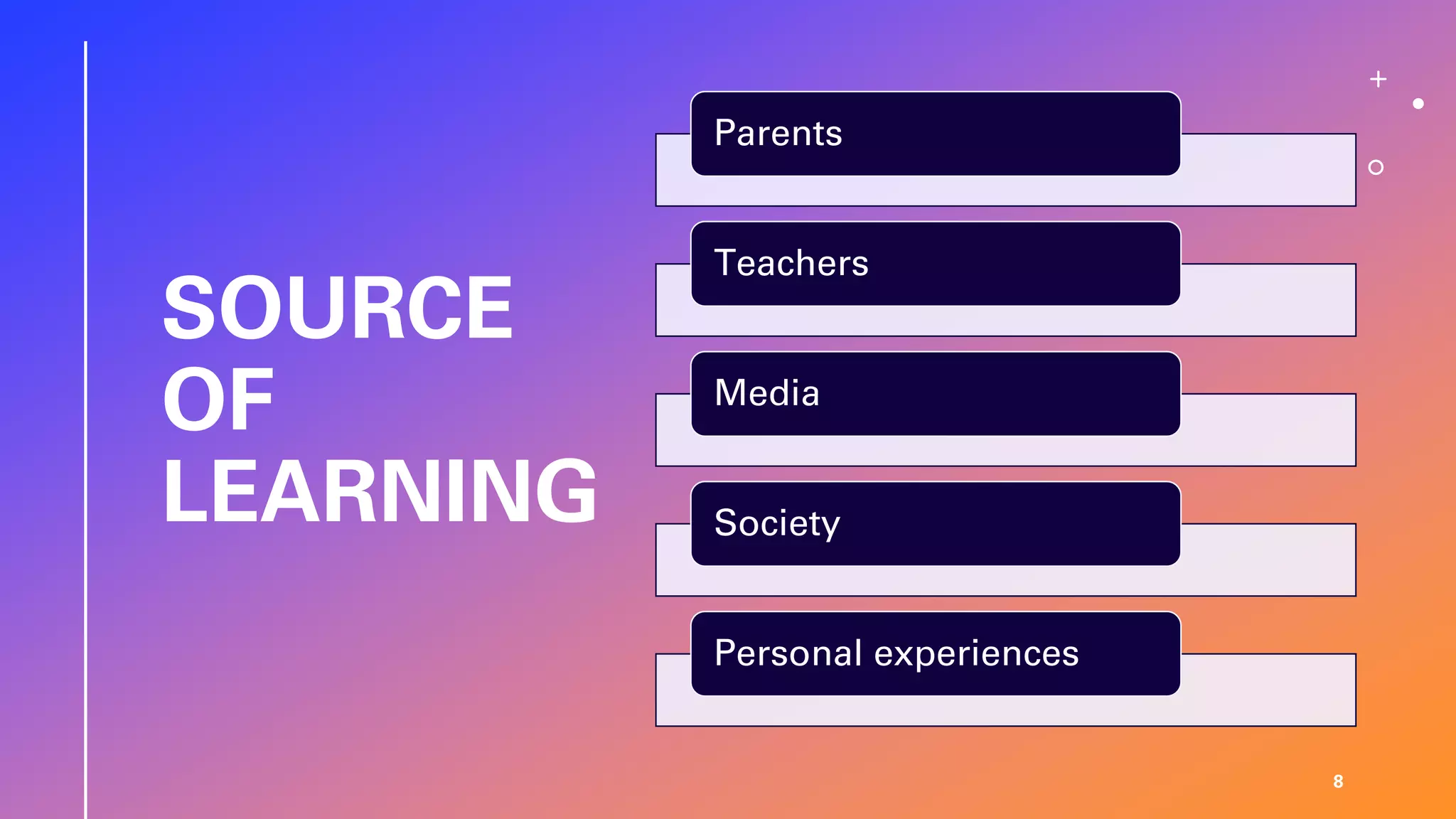
Parents
Teachers
Media
Society
Personal experiences
DEFINING
LEARNING
•Learning takes
places whenever
experience or
practice results in a
relatively
permanent change
in behaviour
9
WHAT IS LEARNING
10
Changes that can initiate in potential changes, but real changes wouldn’t take
place because opportunity never arises
You watch a YouTube video on how to make Starbucks-like coffee. But
you can’t do it at home because you do not have the needed machine
Changes in behaviour
Change the way you play musical instrument after your teacher suggests
a new way of playing
WHAT IS
LEARNING
11
Although learning is relatively
permanent, learnt behaviour not
necessarily permanent
Learning can be unlearnt
Learning is the results of practice or
experience
We can learn by repeating the
behaviour or simply experiencing it
CLASSICAL
CONDITIONING
12
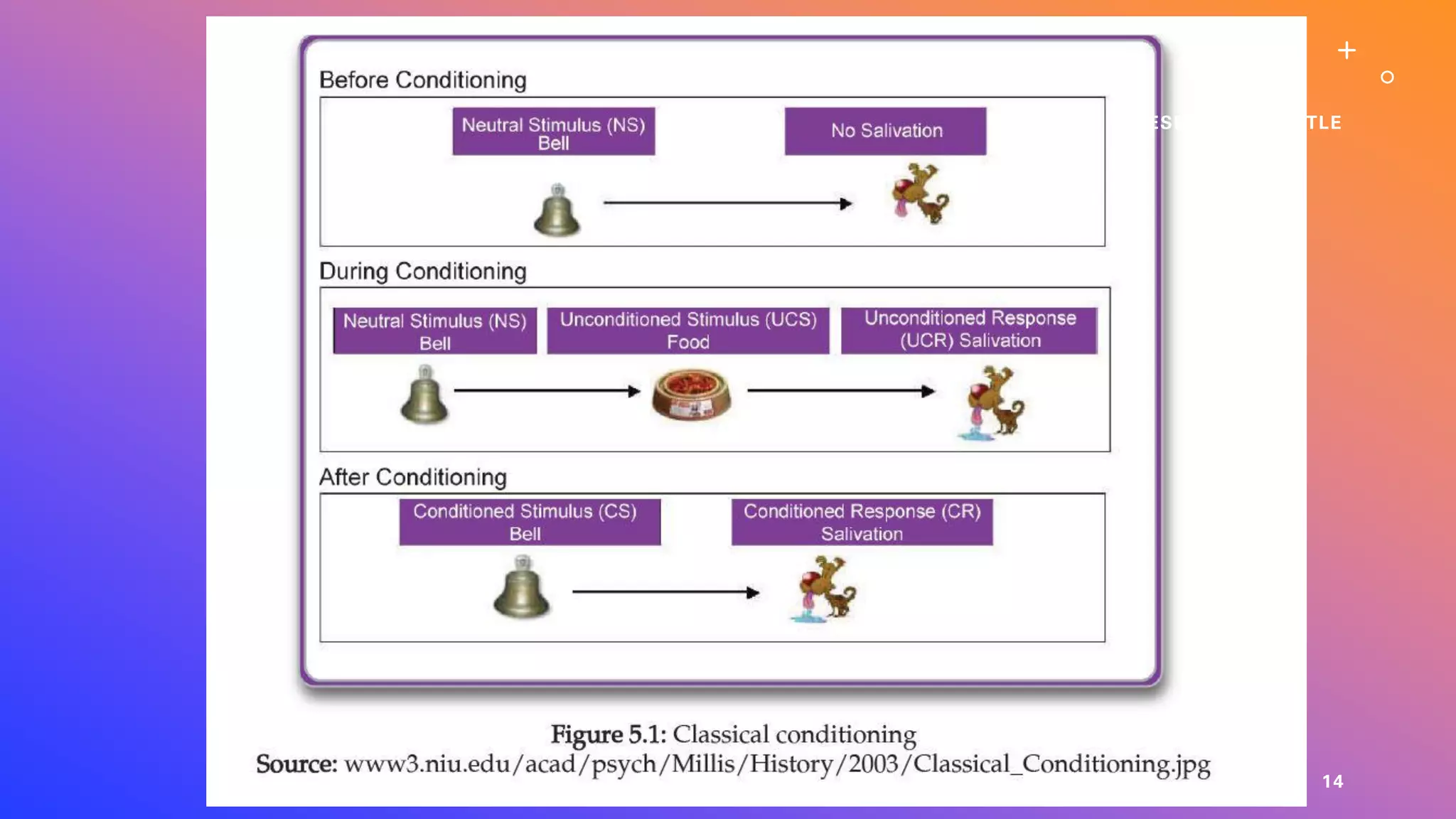
Classical conditioning, also called
Pavlovian conditioning and
respondent conditioning, is learning
through the association of a neutral
stimulus with a biologically potent
stimulus.
The biologically potent stimulus is
an involuntary response also known
as reflex or reflexive response.
CLASSICAL CONDITIONING
13
Russian physiologist Ivan
Pavlov as he studied the
digestive system of dogs in
the early 1900s
Pavlov observed that his
dogs would salivate every
time he entered the room,
whether or not he brought
food, because the dogs had
associated his entrance into
the room with being fed.
https://www.youtube.com/watch?v=jd7Jdug5SRc
PRESENTATION TITLE
14
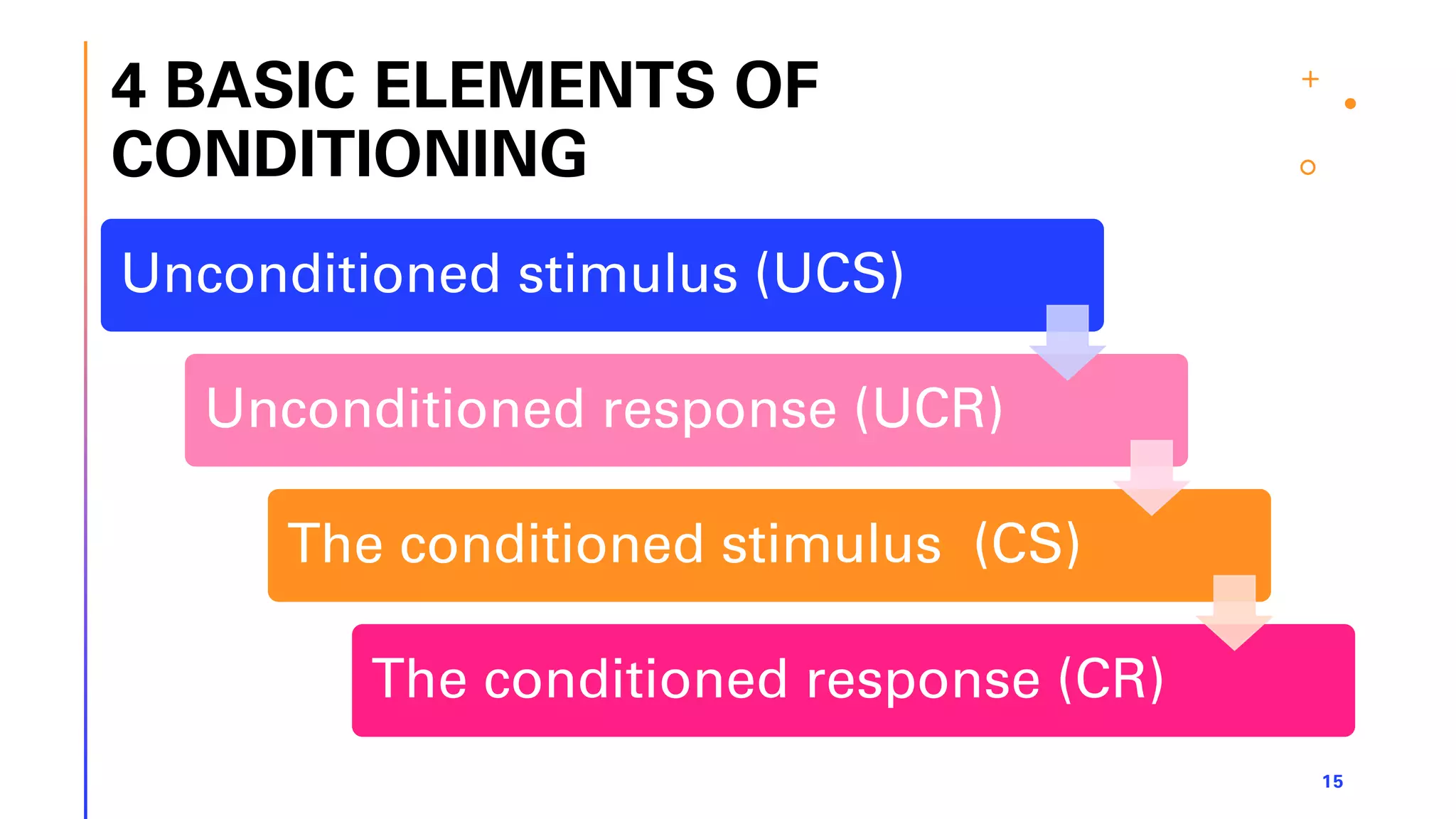
4 BASIC ELEMENTS OF
CONDITIONING
15
Unconditioned stimulus (UCS)
Unconditioned response (UCR)
The conditioned stimulus (CS)
The conditioned response (CR)
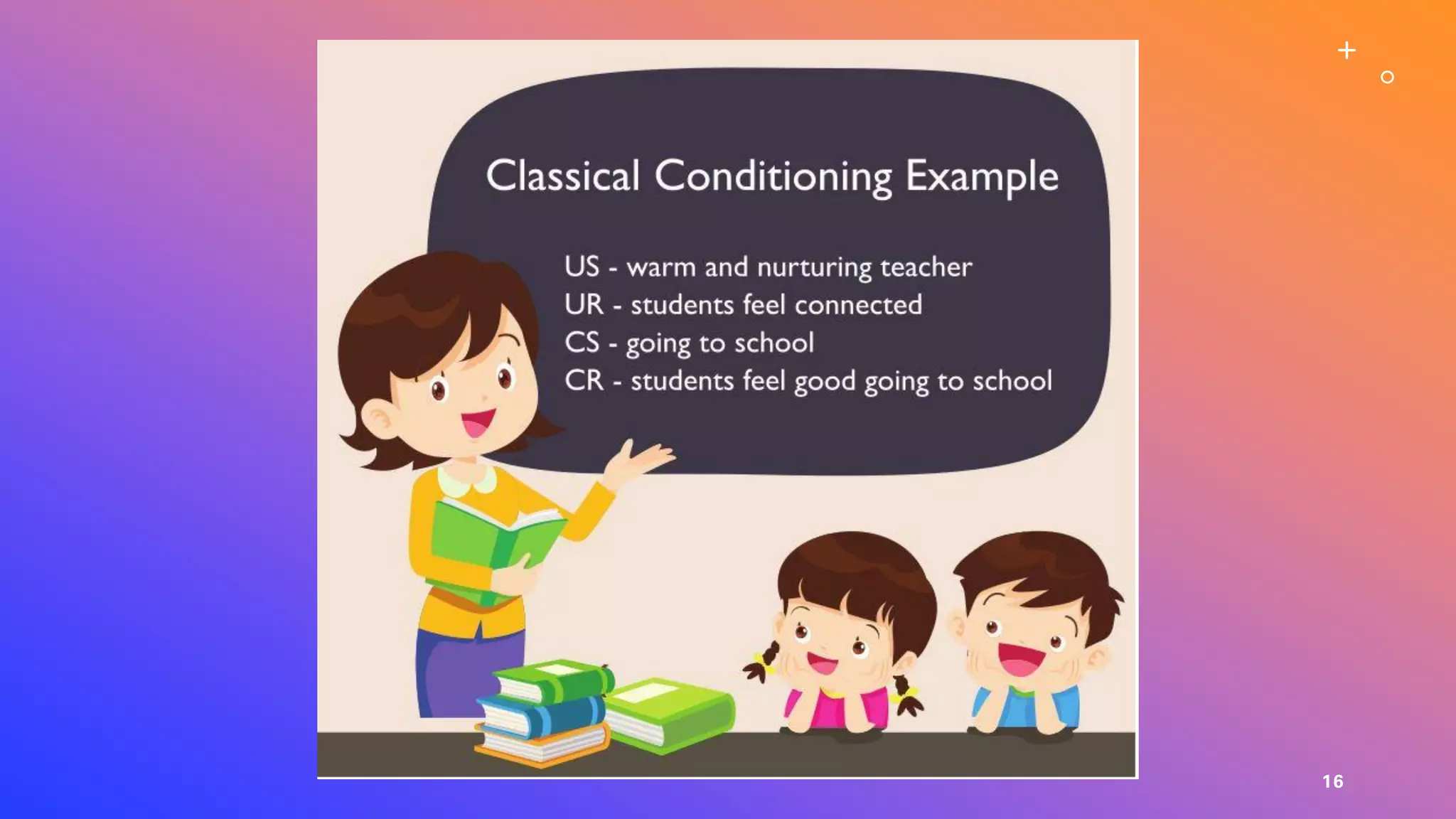
16
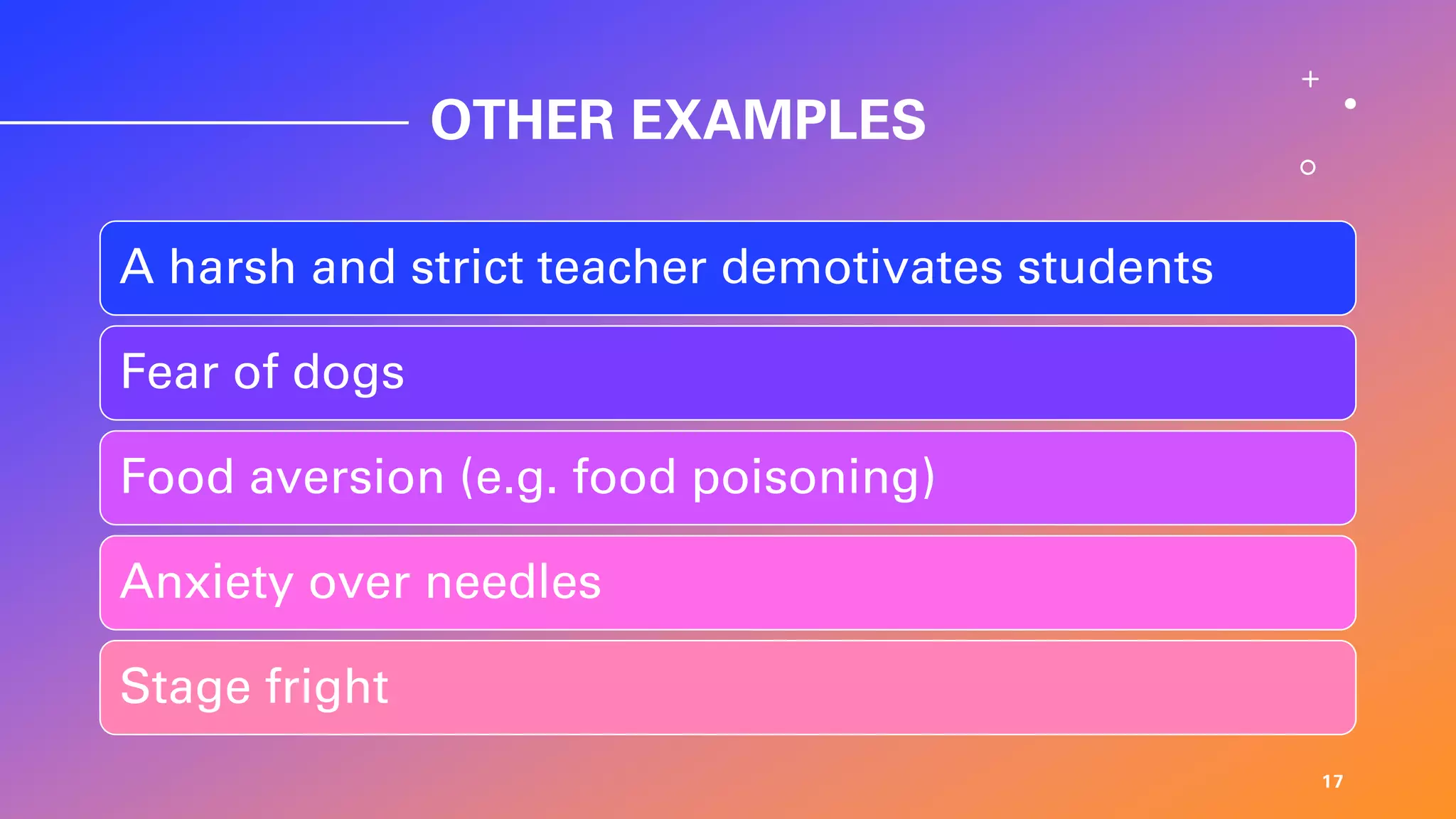
OTHER EXAMPLES
17
A harsh and strict teacher demotivates students
Fear of dogs
Food aversion (e.g. food poisoning)
Anxiety over needles
Stage fright
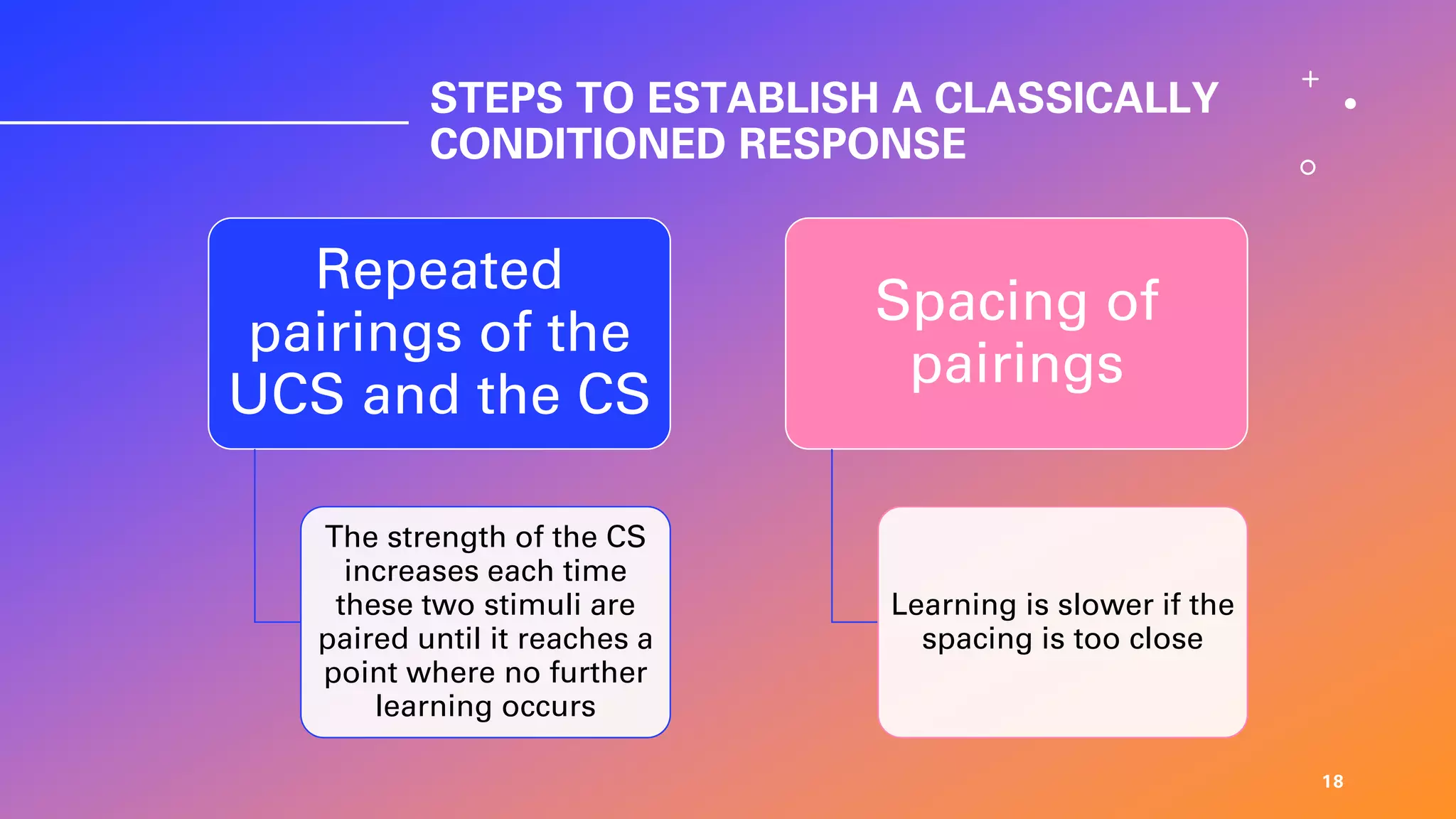
STEPS TO ESTABLISH A CLASSICALLY
CONDITIONED RESPONSE
18
Repeated
pairings of the
UCS and the CS
The strength of the CS
increases each time
these two stimuli are
paired until it reaches a
point where no further
learning occurs
Spacing of
pairings
Learning is slower if the
spacing is too close
OPERANT CONDITIONING
Instrumental conditioning
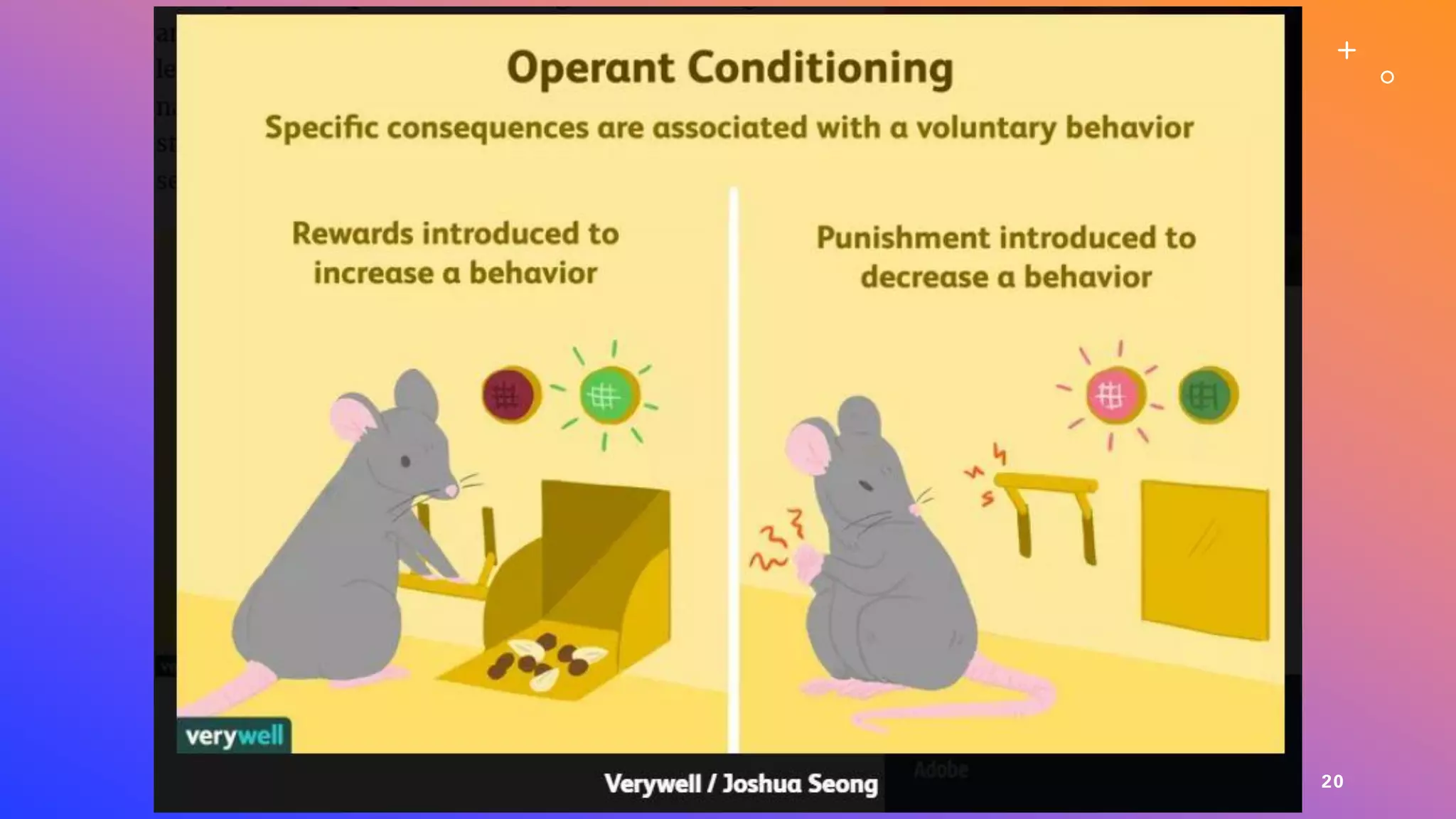
employs rewards and punishments for behavior.
19
20
21
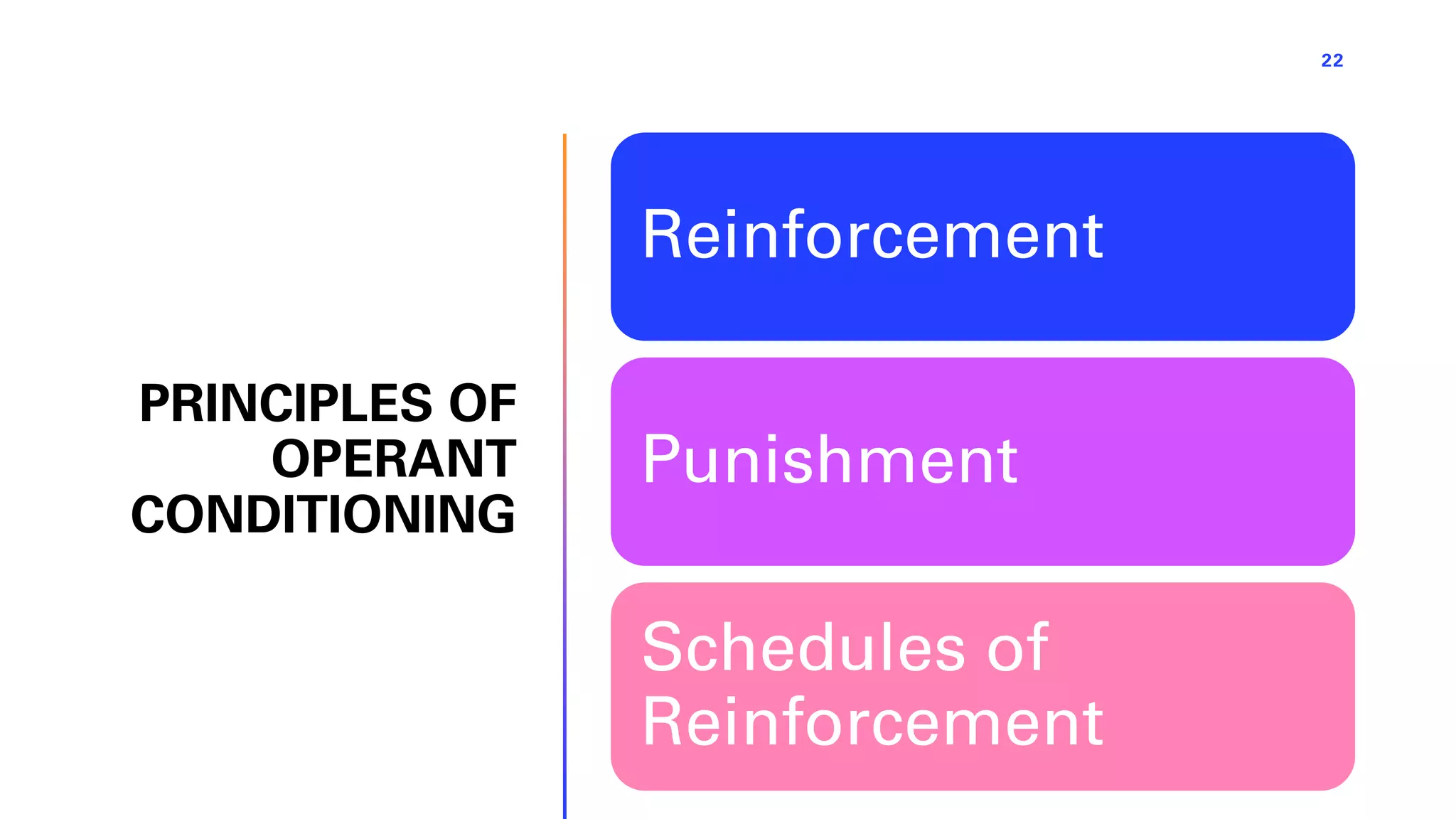
PRINCIPLES OF
OPERANT
CONDITIONING
22
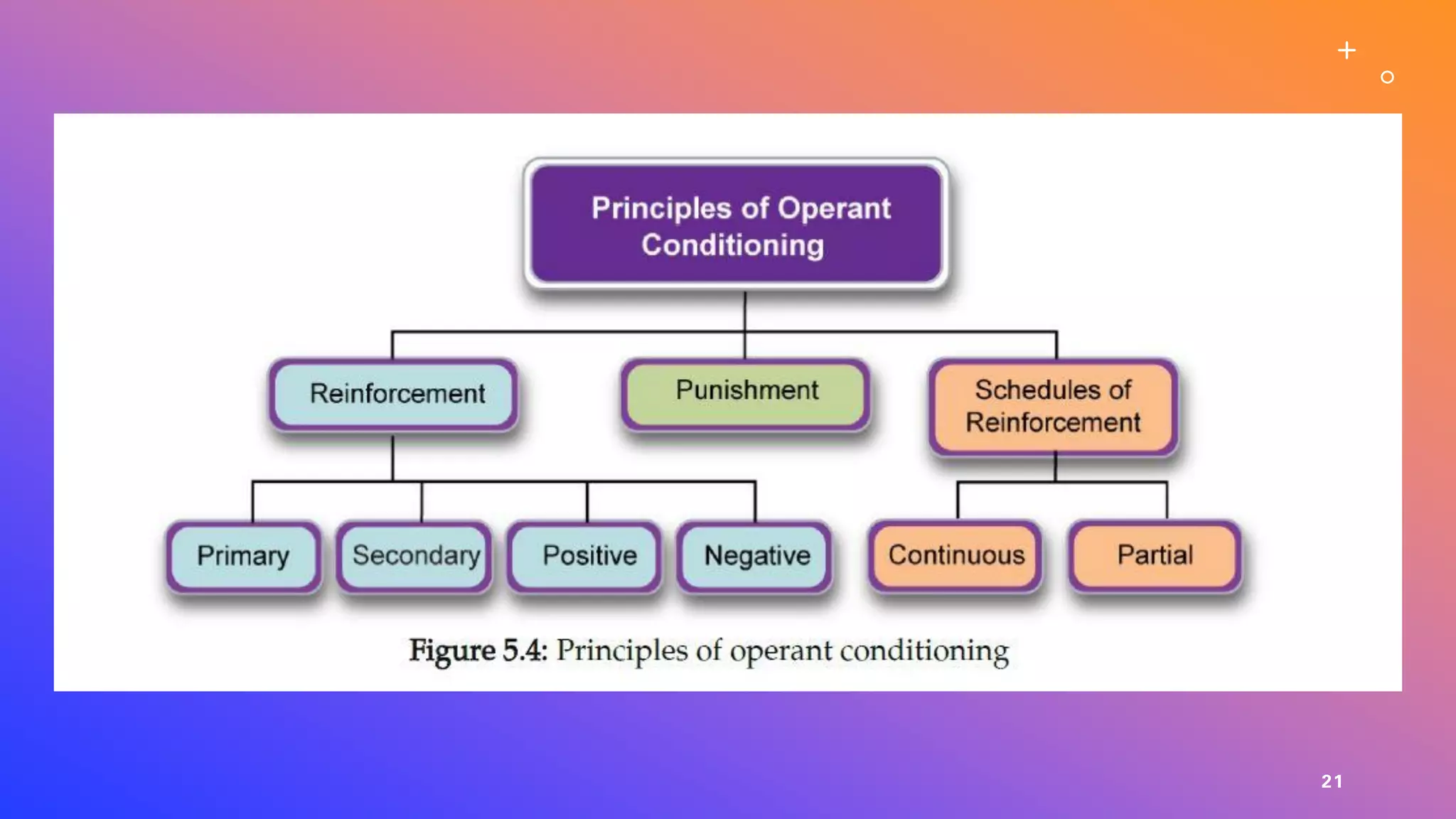
Reinforcement
Punishment
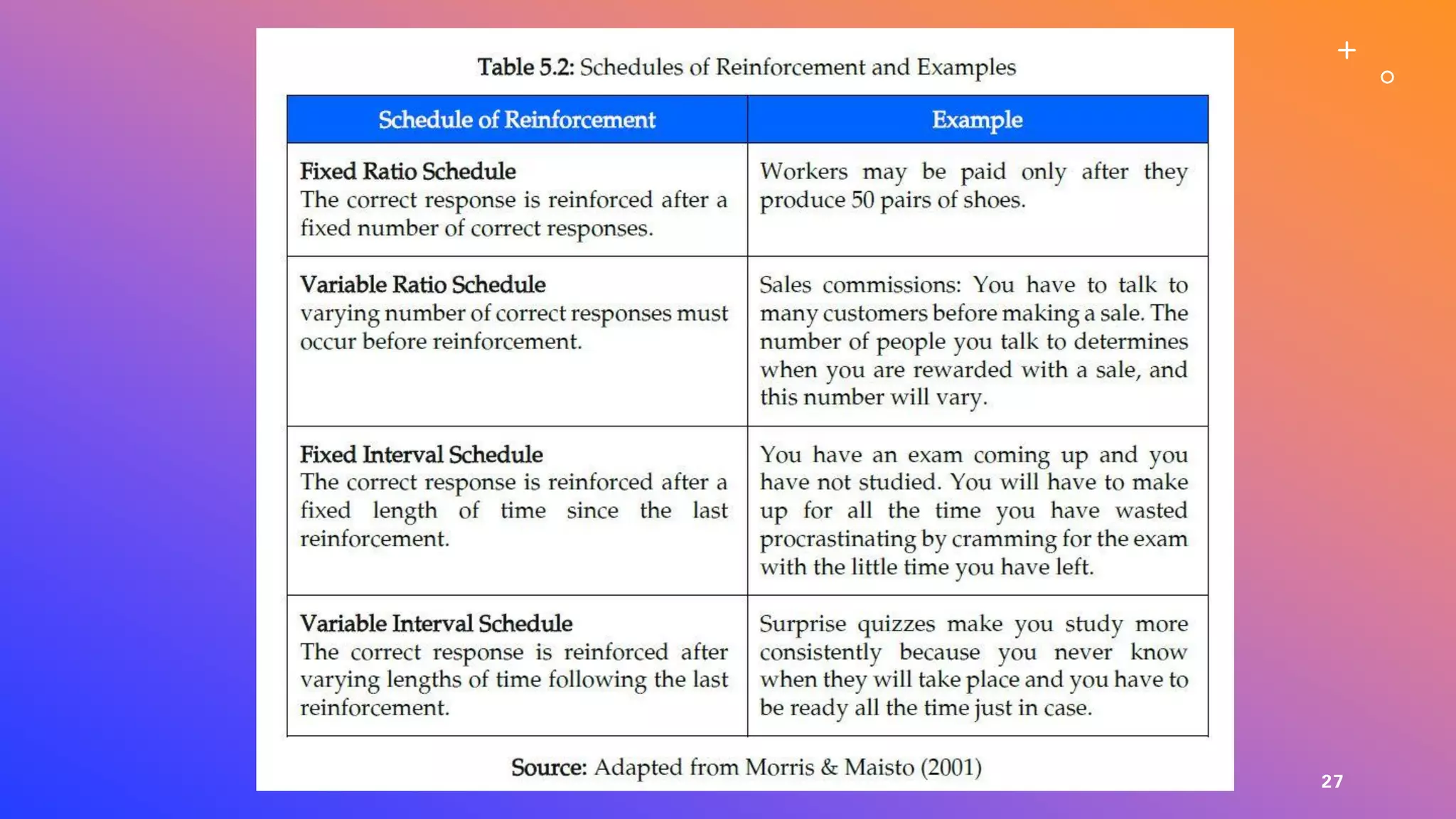
Schedules of
Reinforcement
WHAT ARE THE
DIFFERENCES?
https://www.youtube.com/watch?v=H6LEcM0E0io
23
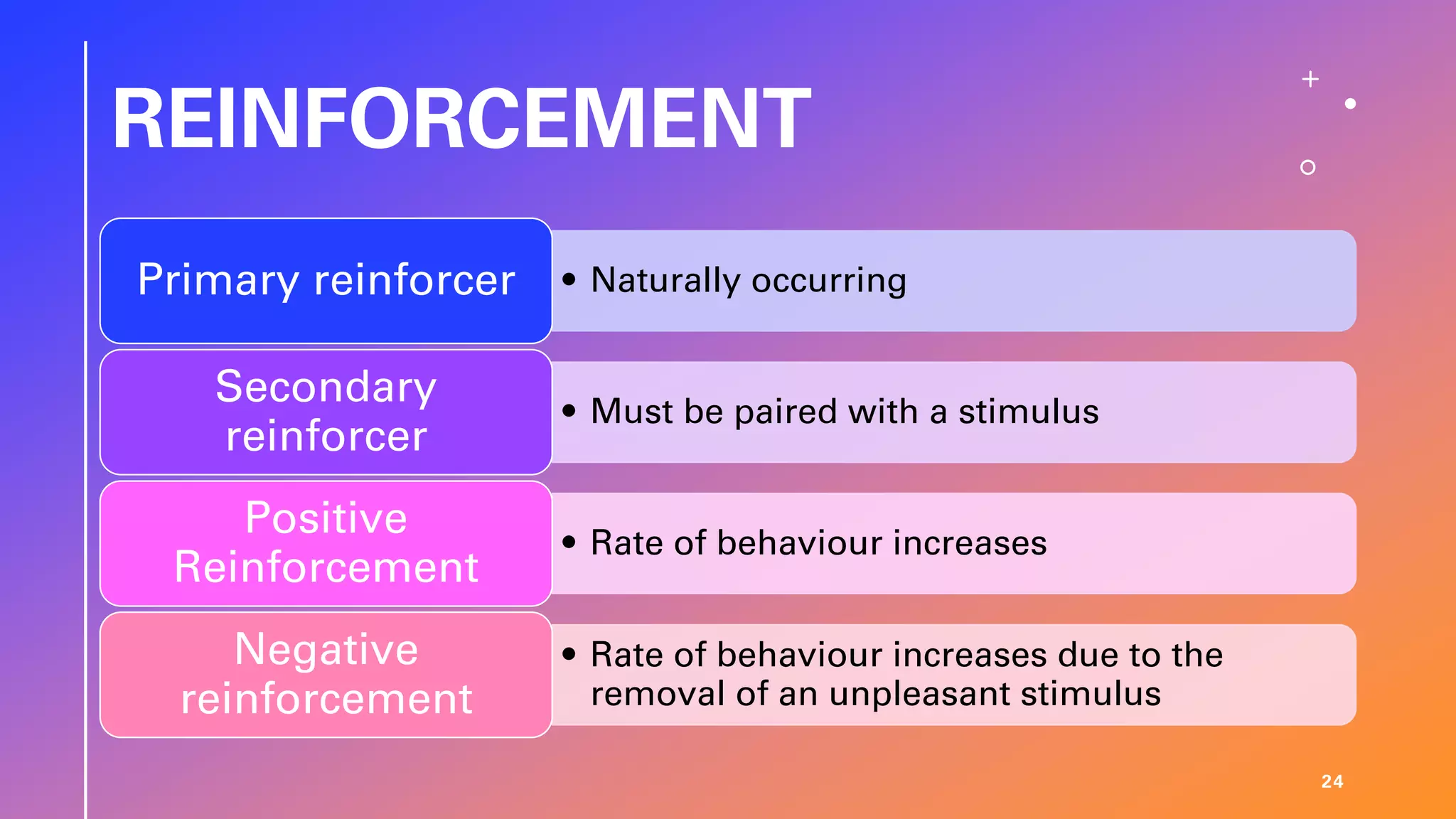
REINFORCEMENT
24
• Naturally occurring
Primary reinforcer
• Must be paired with a stimulus
Secondary
reinforcer
• Rate of behaviour increases
Positive
Reinforcement
• Rate of behaviour increases due to the
removal of an unpleasant stimulus
Negative
reinforcement
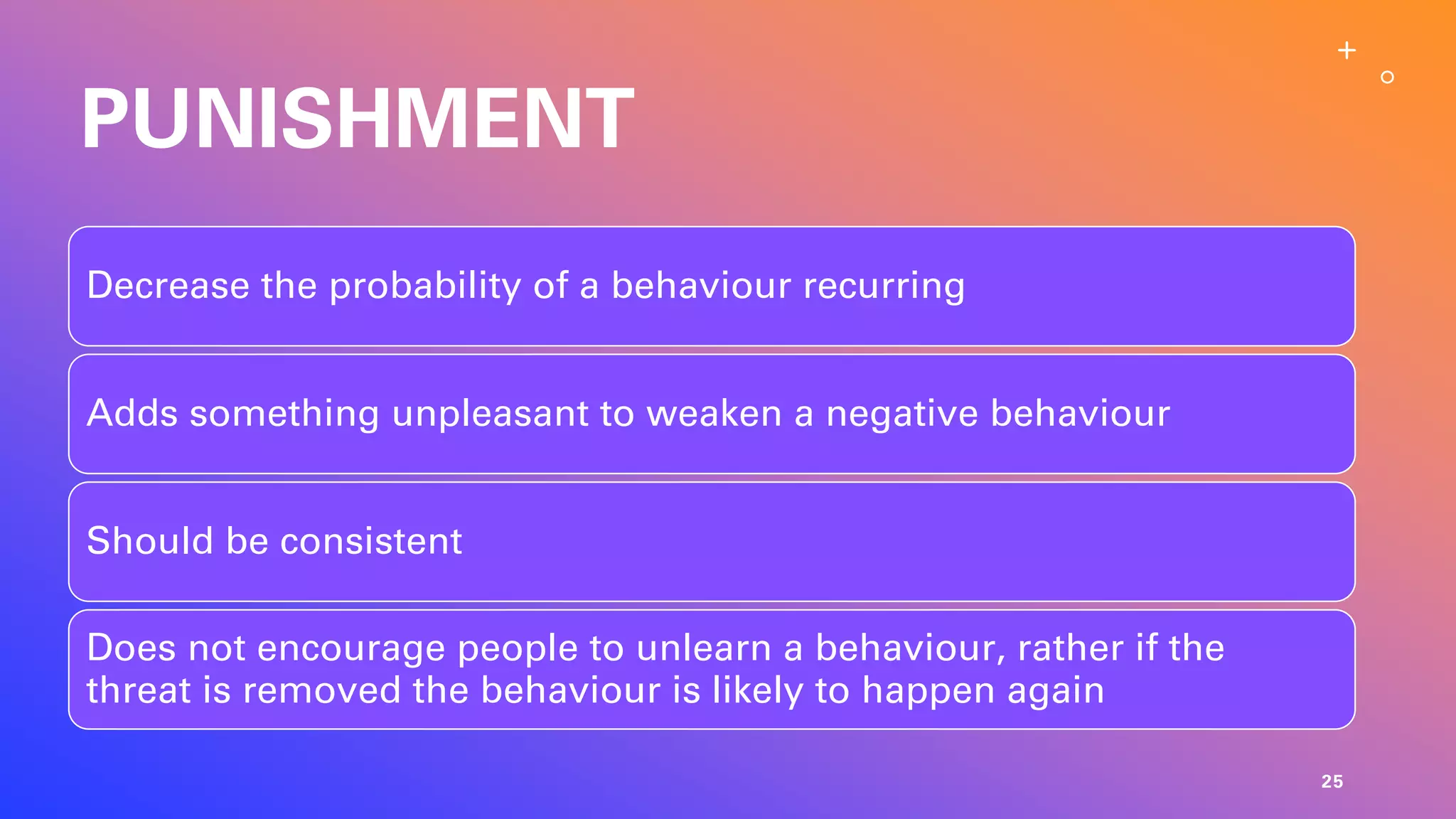
PUNISHMENT
Decrease the probability of a behaviour recurring
Adds something unpleasant to weaken a negative behaviour
Should be consistent
Does not encourage people to unlearn a behaviour, rather if the
threat is removed the behaviour is likely to happen again
25
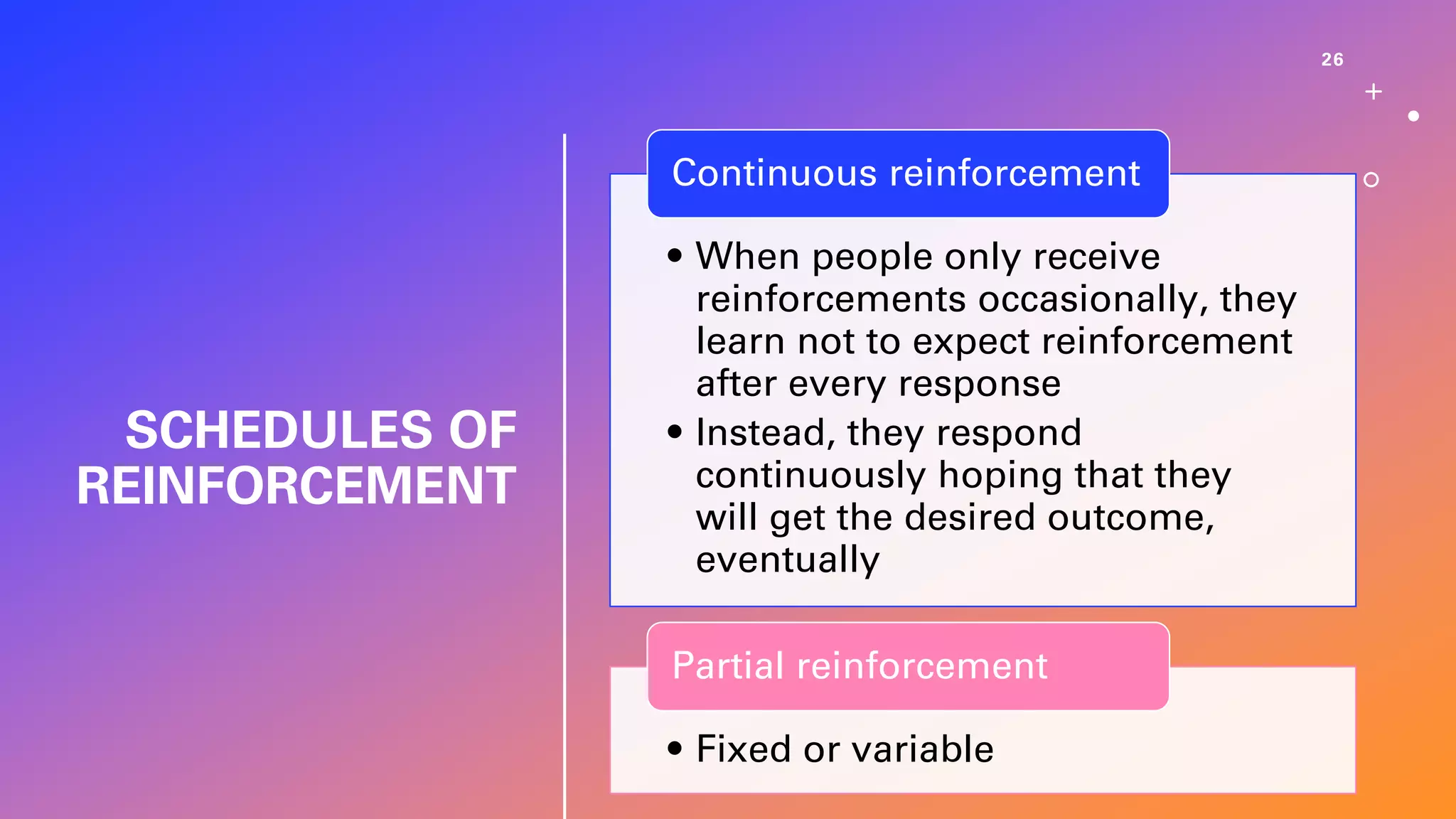
SCHEDULES OF
REINFORCEMENT
26
• When people only receive
reinforcements occasionally, they
learn not to expect reinforcement
after every response
• Instead, they respond
continuously hoping that they
will get the desired outcome,
eventually
Continuous reinforcement
• Fixed or variable
Partial reinforcement
27
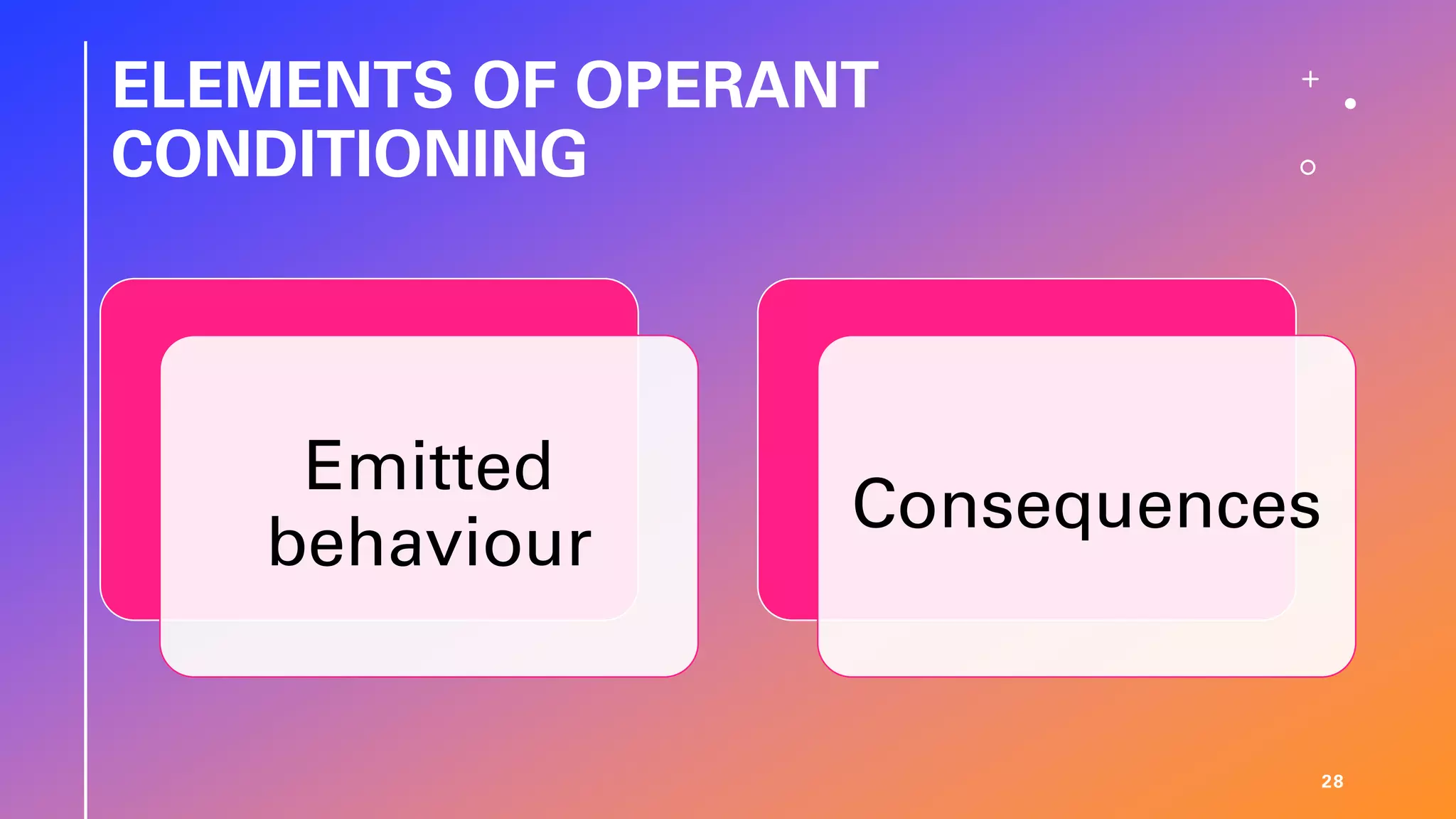
ELEMENTS OF OPERANT
CONDITIONING
28
Emitted
behaviour
Consequences
COGNITIVE
LEARNING
29
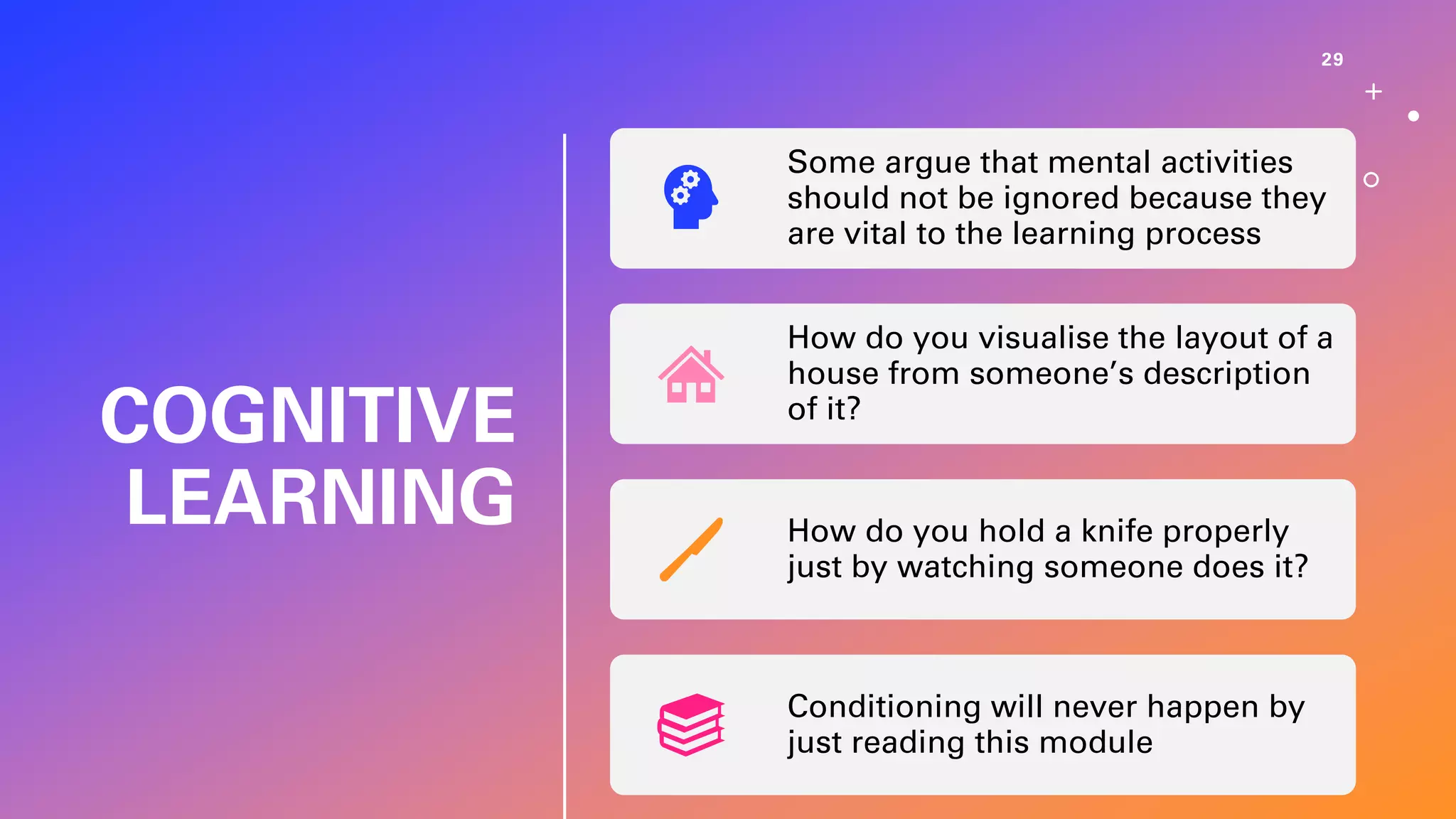
Some argue that mental activities
should not be ignored because they
are vital to the learning process
How do you visualise the layout of a
house from someone’s description
of it?
How do you hold a knife properly
just by watching someone does it?
Conditioning will never happen by
just reading this module
COGNITIVE LEARNING
30
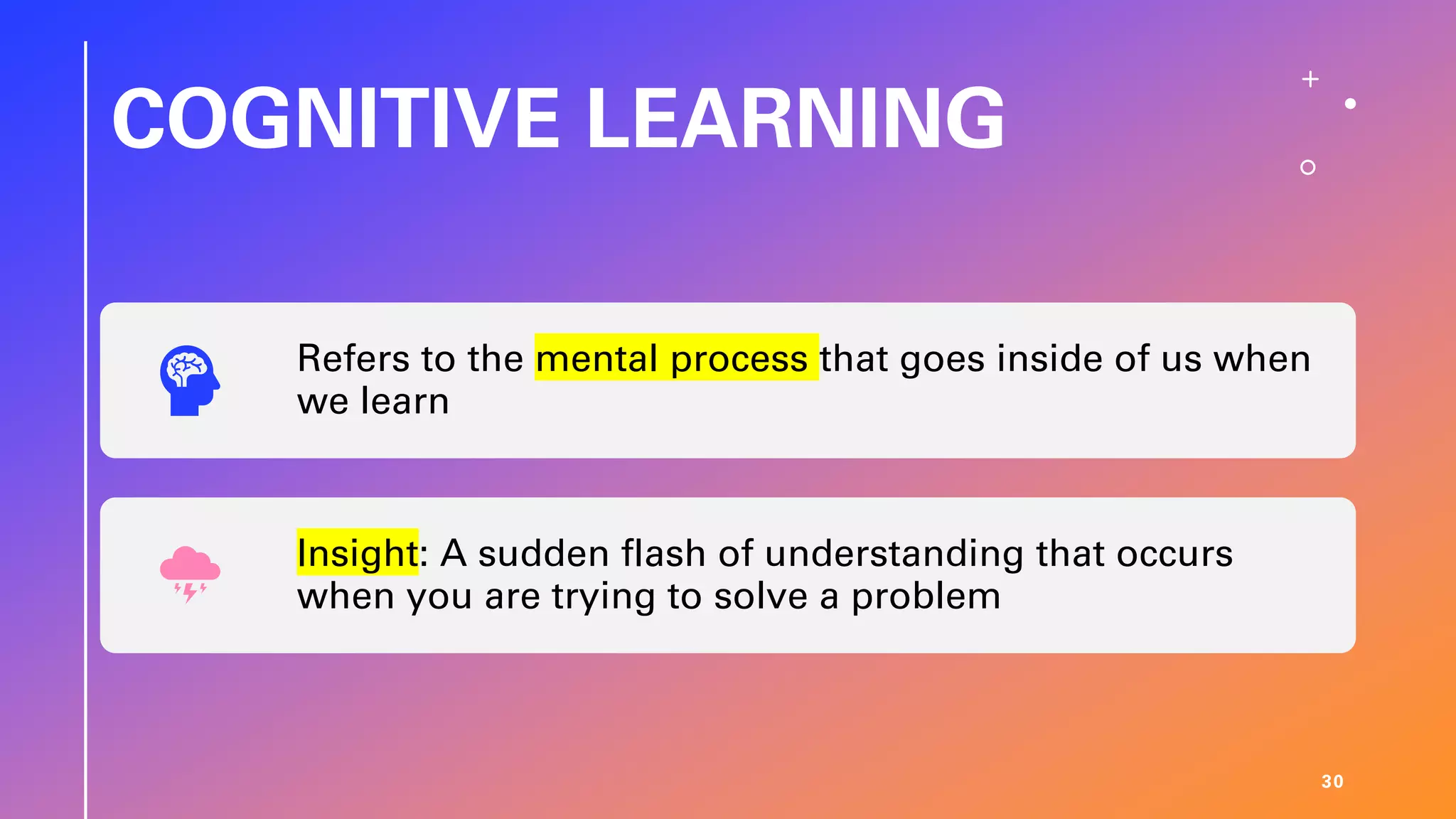
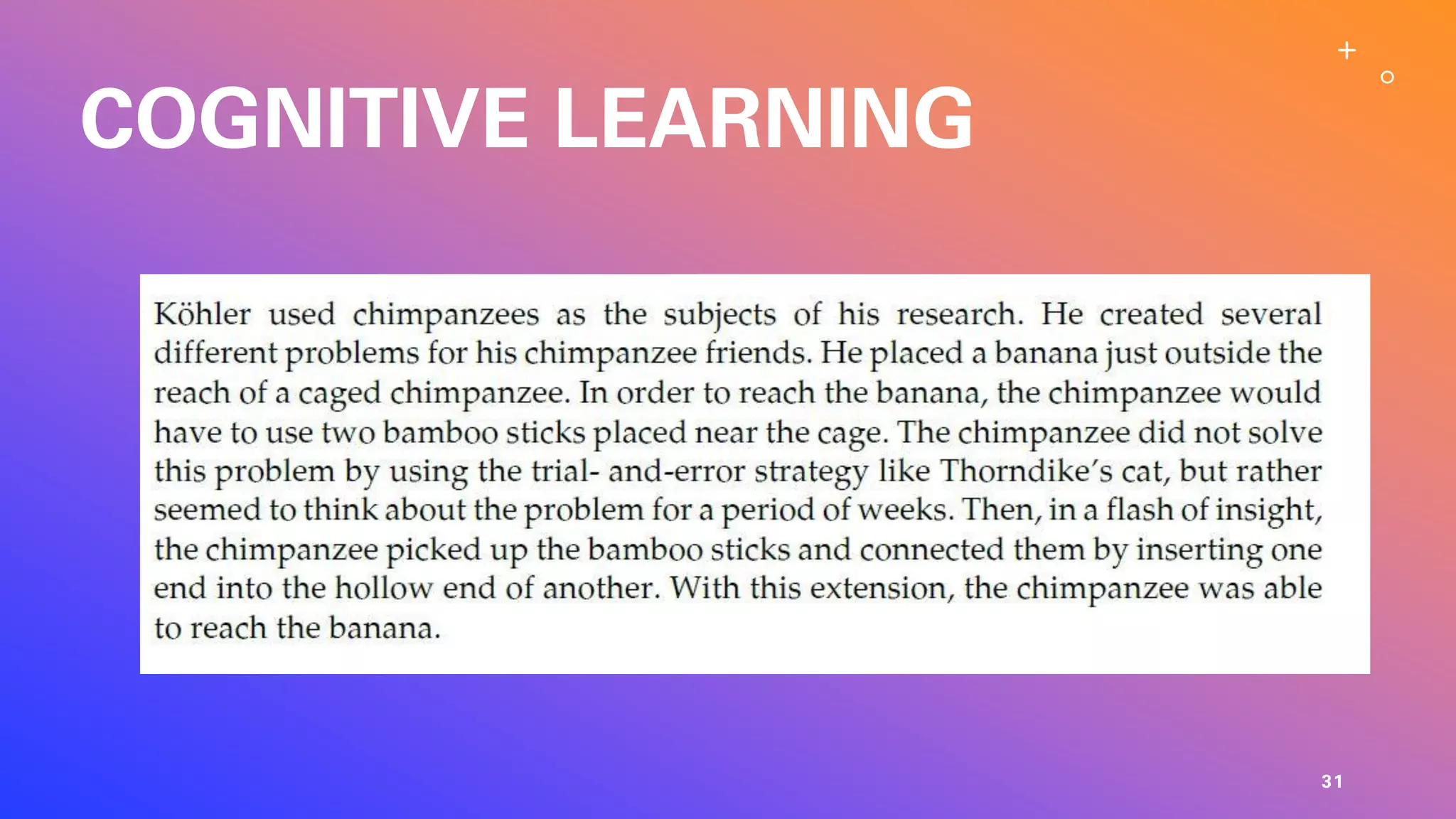
Refers to the mental process that goes inside of us when
we learn
Insight: A sudden flash of understanding that occurs
when you are trying to solve a problem
COGNITIVE LEARNING
31
OBSERVATIONAL
LEARNING
32
A form of social learning
Watching others
We learn how to respect others
We learn how to do things
OBSERVATIONAL LEARNING
We do not pay attention to everything that goes around us
We usually imitate behaviours that are modelled by someone we look
up to
If the behaviour expressed by the modelled is not memorable, it will
not be learnt
If we are motivated to perform the observed behaviour, we probably
will not show what we have learnt
33
THANK YOU
ROBIN CHEAH WEN KIT
wkcheah@oum.edu.my

Introduction to Psychology - Topic 5 - Learning