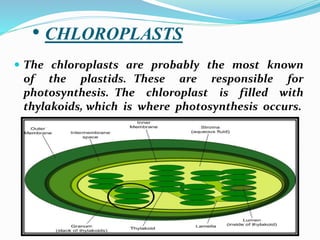
Chloroplasts are organelles found in plant cells and algae that conduct photosynthesis. They have a complex structure with double and triple membrane systems that divide the chloroplast into compartments. Chloroplasts contain pigments like chlorophyll that capture light energy during photosynthesis to convert carbon dioxide and water into oxygen and energy-rich organic compounds like sugars. This process occurs through light-dependent and light-independent reactions. In addition to their primary role in photosynthesis, chloroplasts also synthesize other biomolecules like proteins, lipids, and fatty acids.